
Somewhere on the internet right now, a person who has never been pregnant, never sat through an antenatal scan, and last cracked open a biology textbook before Twitter became X, is squinting at a photograph of Anne Hathaway's stomach and arriving at a confident conclusion. Fake. Silicone. A movie prop, or, per one especially well-credentialed critic quoted by The New Daily, "the one you can get off Amazon. I'm just saying." The evidence entered into the record was her navel, which struck the assembled experts as a bit off.
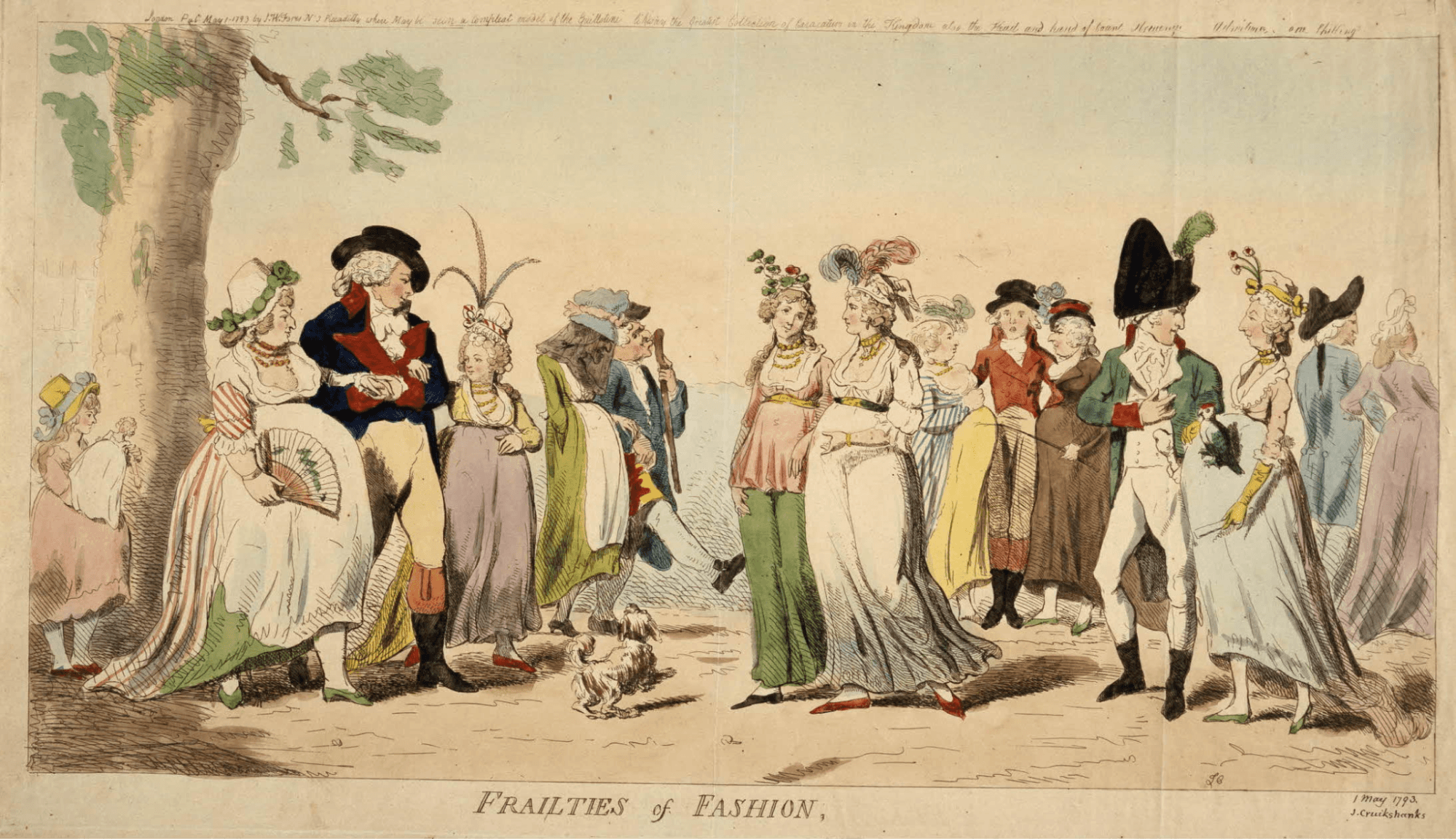
Isaac Cruikshank, Frailties of Fashion, 1793. Hand-colored etching, 299 x 518 mm. British Museum, London. © Trustees of the British Museum.
In the eighteenth century, fashionable Englishwomen briefly did the opposite of what the internet now polices. For one strange year, 1793, the pregnant look was in, and anyone could buy it. The item was called The Pad, a padded false belly worn under a flouncy white muslin dress, and for a season the streets around St James's filled with women who were not expecting doing an impression of women who were. London's Morning Herald dutifully reported that the pads continued to be worn. Caricaturists had a field day, a farce titled The Pad ran all summer at Covent Garden to full houses, and the whole business was mocked into extinction within about eighteen months. CNN Style reached back for this while trying to explain the present, and the contrast does the explaining on its own. Three hundred years ago the scandal was faking a bump you did not have. Now the scandal is being accused of faking a bump you are visibly, publicly, exhaustingly carrying around in front of everyone. Progress of a sort.
Anne Hathaway walked into this earlier this month. The actress, 43 and expecting her third child, turned up to the premiere of The End of Oak Street in a crop top and low-rise jeans, and within hours a jury she never empanelled had returned a verdict on the bump underneath. Hathaway declined to produce a doctor's note. She posted a video from the premiere captioned "fake hair, real bump," then reappeared on Jimmy Kimmel Live the next night in another belly-baring outfit, a black waterfall of ruffles, which is one way of strolling back to the scene of the crime to wave at the witnesses.
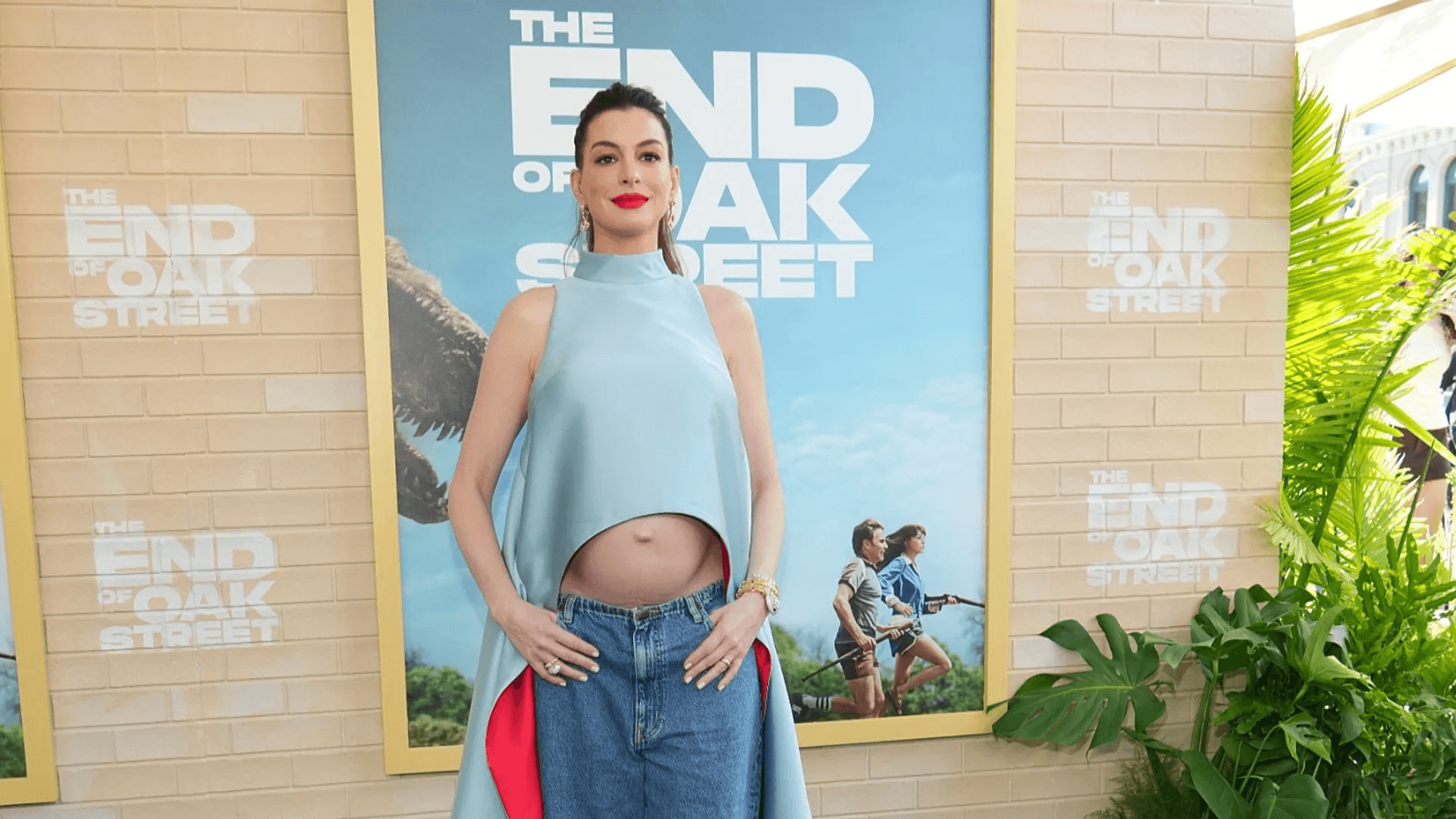
Anne Hathaway at the world premiere of "The End of Oak Street," Burbank, California, 9 August 2026. Image from Euronews Culture
Exhibit A: the receipts
The thing about the bumpvestigation is that its members show their work, which spares everyone the trouble of paraphrasing.
Under an Entertainment Tonight TikTok of the premiere, per HuffPost, one of the top comments was simply "That belly looks fake." Over on X, Euronews reported that a viral thread from an account named "21" drew a crowd of hobbyist anatomists. "Looks like a fake stomach. The belly button looks unreal," one wrote. Another, cited by The New Daily, went with "Oh come on. That is not real." A third produced credentials: "As someone who has kids, her belly looks like those fake ones they use in movies." Hello! magazine caught a fourth workshopping the theory in real time: "Idk if it's the shape or her belly button but it looks fake."
Then, the pivot. Once faking became hard to sustain, Euronews noted that the discourse simply changed lanes and started blaming the stylist. "Unflattering styling for a beautiful pregnant woman," one wrote. "Pregnancy is beautiful, but this is a stylist fail," offered another, apparently satisfied that the problem had been located.
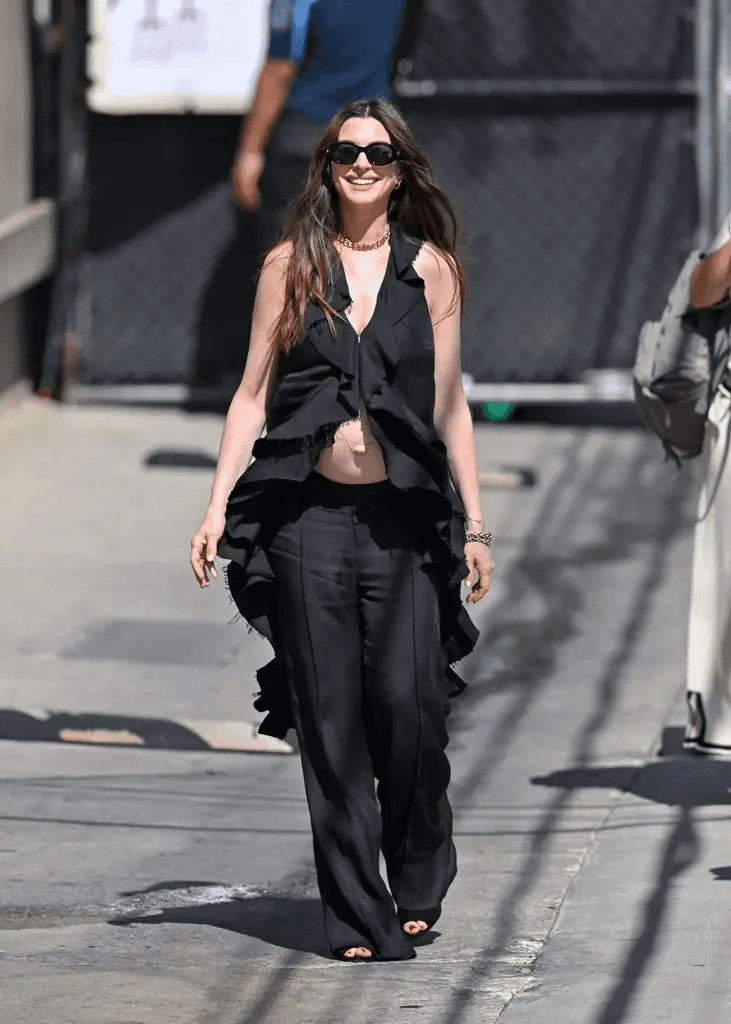
Anne Hathaway in bump-baring black ruffles the following night, August 2026. Source: Hello!
Notice the shape of the trap, because it recurs. If the bump is real, it is fake. If it cannot be fake, it is badly dressed. Cover up and you are hiding something; bare it and you are flaunting something. There is no crop top that wins, which is a strong hint the game was never about the crop top. Somewhere, an 18th-century pamphleteer is nodding, because as CNN Style pointed out, padded false bellies were an actual fashion in Georgian England. The technology has improved. The suspicion has not.
The moon-bump hall of fame
Hathaway is a recent inductee into a club with an unusually starry membership. The internet has a standing tradition here, and it even has branding: the #moonbump, the term conspiracy theorists coined for the prosthetic belly they are certain their favourite celebrities are smuggling around under couture.
Beyoncé is the founding member. When she sat down during a 2011 Australian TV interview and her stomach appeared to fold, YouTube concluded she was a surrogacy operation in a rubber suit. Her mother, Tina Knowles, dispatched the theory with the precise contempt it had earned, telling People, as reported by NBC News, "It was a fabric that folded. Does fabric not fold? Oh my gosh, so stupid." Beyoncé called the episode "crazy" and closed the case by appearing in a bikini in Croatia, an argument no zoom tool could rebut.
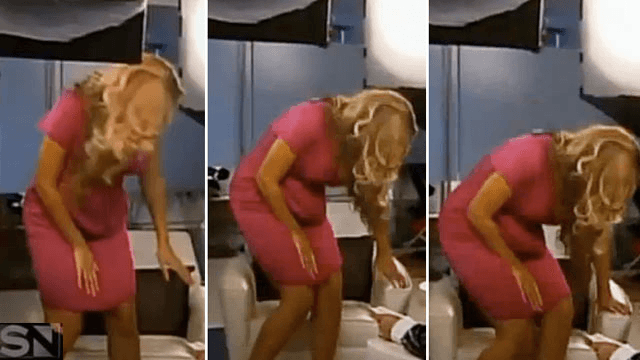
Video grabs taken from the footage of Beyonce sitting down Credit: Photo: YouTube
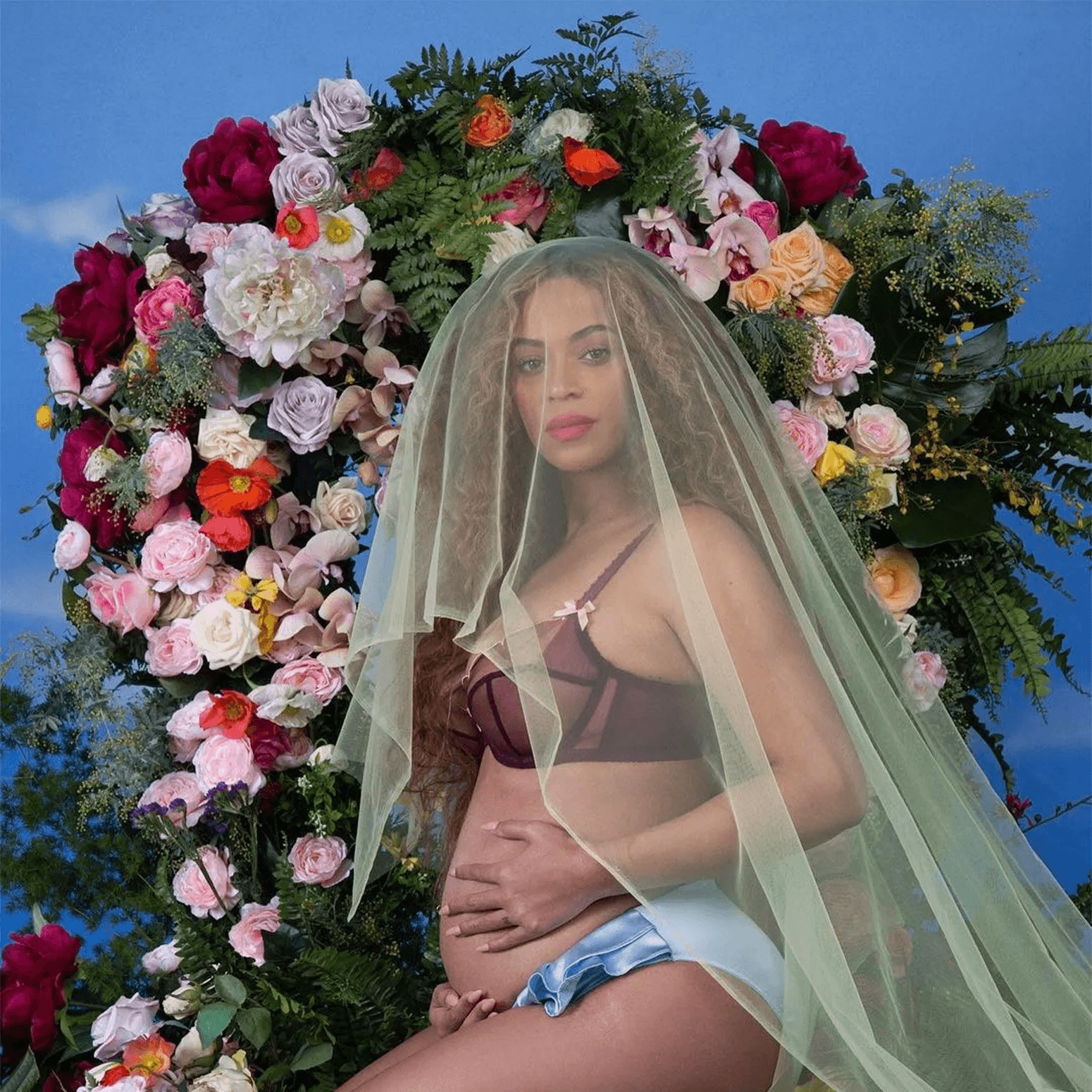
Beyoncé during her 2011 pregnancy with Blue Ivy, announced via Instagram
Meghan Markle inherited the crown. Fox News documented the accounts insisting the Duchess was wearing a "Moon Bump," their proof being slowed-down footage of her belly "wobbling" and, in one instance flagged by AOL, the genuinely astonishing observation that she was able to squat. Kim Kardashian faced the same jury and answered it, as People and others reported, by posting a nude pregnancy photo, which is one way to rest your case. Benedict Cumberbatch's wife Sophie Hunter, Jennifer Lopez, Nicole Kidman and Amal Clooney have all, at one point or another, been accused of gestating soft furnishings.
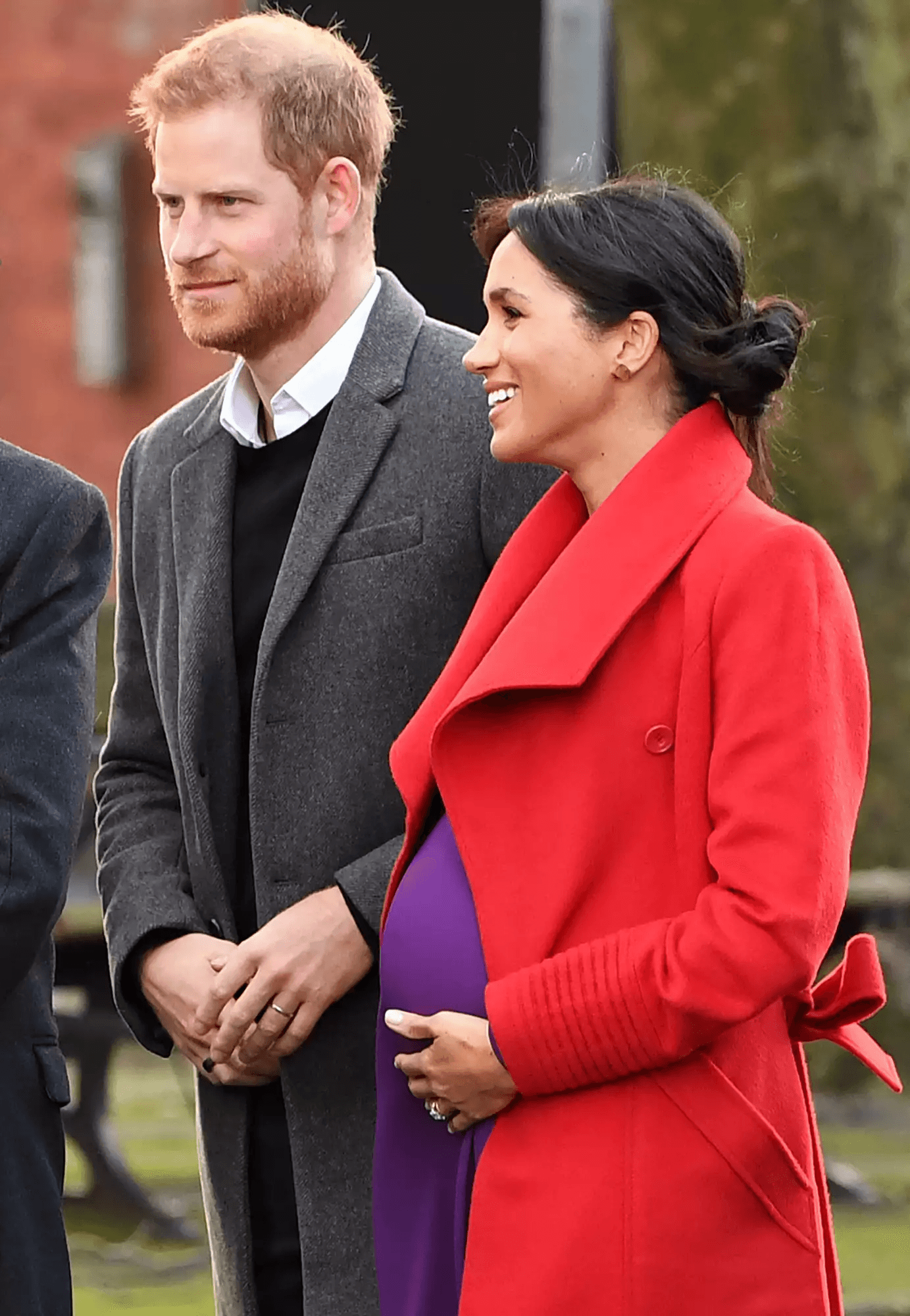
Meghan Markle on the 2018 royal tour, the bump-cradling that launched a thousand conspiracy threads. Source: People.
As the culture writer Kayleigh Donaldson put it in Pajiba, what these theories share is "a fundamental misunderstanding of pregnancy," which she credited, drily, to "all those decades of schools offering sex education of questionable quality finally paying off." Beyoncé's bump moved wrong. Hunter's changed size. Meghan could squat. The offence, in every case, was living while pregnant.
What Foucault would make of your comment section
Here the tone earns the right to get slightly serious, because there is a very good explanation for all this, and it has been sitting in a philosophy seminar since 1975.
Michel Foucault, in Discipline and Punish, borrowed Jeremy Bentham's blueprint for the panopticon: a prison built so a single guard tower can see into every cell, while the inmates can never see the tower. Not knowing when they are watched, they behave as if they always are, and in time they do the guard's job for him. Discipline stops being imposed and becomes a reflex.
The feminist philosopher Sandra Lee Bartky aimed that idea straight at femininity. In her 1990 book Femininity and Domination, she suggested women live inside a version of this prison where the watcher has been swallowed whole, so that each woman totes around what she called an internal "panoptical male connoisseur," an inspector who grades her body against an impossible standard whether or not a single other person is in the room. Susan Bordo, in Unbearable Weight, pushed it on, treating the female body as a cultural billboard onto which the rules about discipline and control get printed.
A red carpet is this theory rendered in 4K. A pregnant celebrity stands lit and photographed for an audience of millions, every one of whom was raised to inspect, and the comment section is merely the guard tower with wifi. The communication scholar Sara Symonds LeBlanc, in a 2020 study for The Qualitative Report titled "Surveilling the Maternal Body," describes how the pregnant body becomes "a site of surveillance often used to judge the goodness of the mother." The bump does not read as a body. It reads as a claim to be verified and a mother to be marked, ideally by people who have never met her and would struggle to locate a fallopian tube on a diagram.
Why the belly, of all things, sends everyone feral
There is a tighter psychological account of why a stomach in a crop top, and not a face or a frock, trips the alarm, and it comes from objectification theory, set out by the psychologists Barbara Fredrickson and Tomi-Ann Roberts in the Psychology of Women Quarterly in 1997. Their finding, now among the most cited in the field, is that a society fixated on women's appearance trains women to watch themselves from the outside, to treat their own bodies as objects on permanent display. They called it seeing yourself through a "veil of sexism," and the data underneath it is bleak: this endless self-monitoring tracks with body shame, anxiety, and higher rates of depression and disordered eating.
Which is where the venom starts to make a dark kind of sense. A woman who bares her pregnant belly on purpose, cheerfully, is doing the exact opposite of what that training demands. She is not shrinking, and she is certainly not apologising. To the viewers who have most thoroughly swallowed the inspector, that lands as a provocation, and calling the bump fake is a tidy way to let the air out of it. Perinatal research published via NCBI in 2023 found that heightened body surveillance during pregnancy tracked with poorer maternal mental health and harder mother-infant bonding, which means the thing Hathaway can wave off is, for women without a publicist, a measurable factor in how they experience new motherhood.
The researchers who say the quiet part out loud
Amy Diehl, a gender-equity researcher and co-author of Glass Walls, told HuffPost what the fake-bump charge is really for. Questioning a pregnancy as fake, she said, is "a way to try to upend and delegitimize their status and power and to keep the gender hierarchy of men above women firmly in place." She added that it doubles as a memo to everyone watching: step into a public role and "their lives, their bodies and their families will be publicly scrutinized in the same way." The trial of one woman is a warning to the whole gallery.
Jay Daniel Thompson, who researches conspiracy theories at the Royal Melbourne Institute of Technology, told the same outlet that the fake-pregnancy claim is a way to shame a woman who does not fit the mould of how a pregnant woman is meant to look, and reflects a discomfort at seeing a pregnant body worn with ease instead of tucked away in penance.
Jezebel, an American feminist news and culture website, founded in 2007 under Gawker Media, known for its commentary on gender, celebrity, politics and women's issues, on an earlier round of this, spotted the cruellest cog in the machine: the postpartum double-bind. A celebrity who lets her body change gets "gawked at and mocked, but might ultimately be forgiven and patronizingly celebrated for being real." A celebrity who snaps back into shape gets accused of never having been pregnant at all, "a perverse acknowledgement of her success at keeping her figure." Heads you faked it, tails you failed. The house always wins, and the house is a stranger with a burner account.
Deepika Padukone and the Bollywood edition of the bump trial
Anyone tempted to file this as a purely Western affliction should spend a week on the Indian internet, where the identical trial runs with its own cast, its own dialect of concern-trolling, and a truly obsessive interest in what pregnant women choose to put on their feet.
When Deepika Padukone stepped out in May 2024 to vote in the Lok Sabha elections, visibly pregnant, footage of her and Ranveer Singh in matching white shirts went viral, and the audit began. During the Kalki 2898 AD promotions, the charges swelled into something close to an appraisal. The Print collected the airport comments: "How come she is able to walk comfortably?" and "Maybe surrogacy, and it's just drama," and the connoisseur's verdict, "She is a good actress but is not able to do the role of a pregnant woman properly," as though she had been miscast in her own gestation. Her charge sheet, per Harper's Bazaar India, included wearing heels and owning a stomach that folded the wrong way in one photograph, which by now you will recognise as the Beyoncé fabric problem in an updated wardrobe.

Deepika Padukone cradled baby bump as she arrived to vote. (Photo: Yogen Shah)

Deepika Padukone during the Kalki 2898 AD promotional run, 2024, in a black bodycon dress and black heels - a look for which she later faced scrutiny. Images via India Today
The journalist Faye D'Souza posted a line, quoted widely including by India.com, that should never have needed typing: Deepika stepped out to do her democratic duty, she did not ask for feedback on her body or her pregnancy, and no one has the right to comment on any aspect of her life. Alia Bhatt and half her family liked it. Writing in The Print, the columnist summed the accusations up as "a nasty cocktail of misogyny and an ignorance of basic human biology," and reminded the jury, gently, that low weight gain in pregnancy is common and medically dull.
Sonam Kapoor drew a subtler charge in 2022, not deception but delight. Her Vogue India maternity cover produced comments, catalogued by Hindustan Times, along the lines of "Why it is mandatory to be semi naked for maternity photoshoot?" Kapoor's reply, given to Vogue and reported by NDTV, had a shrug built into it. She said she had grown out of reacting to things she does not need to react to, that she lives "a very charmed life," and that if she puts out something to celebrate her body, "it shouldn't come as a surprise," given she has always spoken openly about PCOS, weight gain and stretch marks.

Sonam Kapoor's Vogue India maternity cover, September 2022, shot by Ben Weller. Image via vogue.in
The bit nobody screenshots
The easy exit here is that these women are rich and famous and will be fine, and they will. Hathaway can caption her way through it. Deepika told Vogue about the rib pain and the person who warned her that having a child would kill her brand, then went ahead and kept the brand. Kapoor has the vocabulary of privilege and uses it well.
The celebrities are not the injury, though. They are the X-ray, the version with the contrast turned all the way up, and what it exposes is a pattern that lands on women without security details every day and in silence. A widely cited survey found that roughly one in five mothers has faced pregnancy discrimination at work. Plenty of women hide their bumps at the office for as long as biology allows, not out of shyness but out of strategy, because a visible pregnancy has a habit of prompting quiet reassessments of whether you are still serious about the job. Diehl's memo to the gallery is not a figure of speech. Every moon-bump thread is a rehearsal, teaching a mass audience that a woman's body is a document strangers may check for authenticity and a performance they may score out of ten.
There is a plot twist the bumpvestigators would have caught if they had spent as long reading as they did zooming. Hathaway is not a woman who has ever treated pregnancy as a costume. She has spoken, in a 2019 Instagram post and to the BBC, about a miscarriage in 2015 and about the fertility struggles that came before both her earlier children, writing that a purely happy announcement "would've felt disingenuous" when the truth "was not a straight line." Of every woman in Hollywood, the crowd picked, to accuse of faking a pregnancy, one who had already stood up in public and walked everyone through how uncertain and hard-won hers had been.
So the magnifying glass comes down, and what it has been held over turns out to be a person doing the single most ordinary thing our species has ever done, watched by an audience that owes its entire existence to other people having done it first. Beyoncé's mother said it cleanest, back when this was her daughter's turn in the dock. Does fabric not fold, she asked People, and the answer, then and now, is that it does, and the court has never once let that settle anything. Hathaway gave the reply the whole affair deserved, and it ran to four words. Not a defence, because a defence would have granted the charge a seriousness it never earned. Just a caption, a peace sign, and the last word. Fake hair, real bump.
TO BE CONTINUED, FOR SUBSCRIBERS ONLY.
This is where the surface ends and the reporting begins.
The complete piece, the full archive, and access to The French Press Circle. Reporting answerable only to its readers.
Already a subscriber ?
Login
Read these on the house, with our compliments.
A selection from the current issue, open to all readers. Read them in full. The rest is one decision away.









Somewhere on the internet right now, a person who has never been pregnant, never sat through an antenatal scan, and last cracked open a biology textbook before Twitter became X, is squinting at a photograph of Anne Hathaway's stomach and arriving at a confident conclusion. Fake. Silicone. A movie prop, or, per one especially well-credentialed critic quoted by The New Daily, "the one you can get off Amazon. I'm just saying." The evidence entered into the record was her navel, which struck the assembled experts as a bit off.
Isaac Cruikshank, Frailties of Fashion, 1793. Hand-colored etching, 299 x 518 mm. British Museum, London. © Trustees of the British Museum.
In the eighteenth century, fashionable Englishwomen briefly did the opposite of what the internet now polices. For one strange year, 1793, the pregnant look was in, and anyone could buy it. The item was called The Pad, a padded false belly worn under a flouncy white muslin dress, and for a season the streets around St James's filled with women who were not expecting doing an impression of women who were. London's Morning Herald dutifully reported that the pads continued to be worn. Caricaturists had a field day, a farce titled The Pad ran all summer at Covent Garden to full houses, and the whole business was mocked into extinction within about eighteen months. CNN Style reached back for this while trying to explain the present, and the contrast does the explaining on its own. Three hundred years ago the scandal was faking a bump you did not have. Now the scandal is being accused of faking a bump you are visibly, publicly, exhaustingly carrying around in front of everyone. Progress of a sort.
Anne Hathaway walked into this earlier this month. The actress, 43 and expecting her third child, turned up to the premiere of The End of Oak Street in a crop top and low-rise jeans, and within hours a jury she never empanelled had returned a verdict on the bump underneath. Hathaway declined to produce a doctor's note. She posted a video from the premiere captioned "fake hair, real bump," then reappeared on Jimmy Kimmel Live the next night in another belly-baring outfit, a black waterfall of ruffles, which is one way of strolling back to the scene of the crime to wave at the witnesses.
Anne Hathaway at the world premiere of "The End of Oak Street," Burbank, California, 9 August 2026. Image from Euronews Culture
Exhibit A: the receipts
The thing about the bumpvestigation is that its members show their work, which spares everyone the trouble of paraphrasing.
Under an Entertainment Tonight TikTok of the premiere, per HuffPost, one of the top comments was simply "That belly looks fake." Over on X, Euronews reported that a viral thread from an account named "21" drew a crowd of hobbyist anatomists. "Looks like a fake stomach. The belly button looks unreal," one wrote. Another, cited by The New Daily, went with "Oh come on. That is not real." A third produced credentials: "As someone who has kids, her belly looks like those fake ones they use in movies." Hello! magazine caught a fourth workshopping the theory in real time: "Idk if it's the shape or her belly button but it looks fake."
Then, the pivot. Once faking became hard to sustain, Euronews noted that the discourse simply changed lanes and started blaming the stylist. "Unflattering styling for a beautiful pregnant woman," one wrote. "Pregnancy is beautiful, but this is a stylist fail," offered another, apparently satisfied that the problem had been located.
Anne Hathaway in bump-baring black ruffles the following night, August 2026. Source: Hello!
Notice the shape of the trap, because it recurs. If the bump is real, it is fake. If it cannot be fake, it is badly dressed. Cover up and you are hiding something; bare it and you are flaunting something. There is no crop top that wins, which is a strong hint the game was never about the crop top. Somewhere, an 18th-century pamphleteer is nodding, because as CNN Style pointed out, padded false bellies were an actual fashion in Georgian England. The technology has improved. The suspicion has not.
The moon-bump hall of fame
Hathaway is a recent inductee into a club with an unusually starry membership. The internet has a standing tradition here, and it even has branding: the #moonbump, the term conspiracy theorists coined for the prosthetic belly they are certain their favourite celebrities are smuggling around under couture.
Beyoncé is the founding member. When she sat down during a 2011 Australian TV interview and her stomach appeared to fold, YouTube concluded she was a surrogacy operation in a rubber suit. Her mother, Tina Knowles, dispatched the theory with the precise contempt it had earned, telling People, as reported by NBC News, "It was a fabric that folded. Does fabric not fold? Oh my gosh, so stupid." Beyoncé called the episode "crazy" and closed the case by appearing in a bikini in Croatia, an argument no zoom tool could rebut.
Video grabs taken from the footage of Beyonce sitting down Credit: Photo: YouTube
Beyoncé during her 2011 pregnancy with Blue Ivy, announced via Instagram
Meghan Markle inherited the crown. Fox News documented the accounts insisting the Duchess was wearing a "Moon Bump," their proof being slowed-down footage of her belly "wobbling" and, in one instance flagged by AOL, the genuinely astonishing observation that she was able to squat. Kim Kardashian faced the same jury and answered it, as People and others reported, by posting a nude pregnancy photo, which is one way to rest your case. Benedict Cumberbatch's wife Sophie Hunter, Jennifer Lopez, Nicole Kidman and Amal Clooney have all, at one point or another, been accused of gestating soft furnishings.
Meghan Markle on the 2018 royal tour, the bump-cradling that launched a thousand conspiracy threads. Source: People.
As the culture writer Kayleigh Donaldson put it in Pajiba, what these theories share is "a fundamental misunderstanding of pregnancy," which she credited, drily, to "all those decades of schools offering sex education of questionable quality finally paying off." Beyoncé's bump moved wrong. Hunter's changed size. Meghan could squat. The offence, in every case, was living while pregnant.
What Foucault would make of your comment section
Here the tone earns the right to get slightly serious, because there is a very good explanation for all this, and it has been sitting in a philosophy seminar since 1975.
Michel Foucault, in Discipline and Punish, borrowed Jeremy Bentham's blueprint for the panopticon: a prison built so a single guard tower can see into every cell, while the inmates can never see the tower. Not knowing when they are watched, they behave as if they always are, and in time they do the guard's job for him. Discipline stops being imposed and becomes a reflex.
The feminist philosopher Sandra Lee Bartky aimed that idea straight at femininity. In her 1990 book Femininity and Domination, she suggested women live inside a version of this prison where the watcher has been swallowed whole, so that each woman totes around what she called an internal "panoptical male connoisseur," an inspector who grades her body against an impossible standard whether or not a single other person is in the room. Susan Bordo, in Unbearable Weight, pushed it on, treating the female body as a cultural billboard onto which the rules about discipline and control get printed.
A red carpet is this theory rendered in 4K. A pregnant celebrity stands lit and photographed for an audience of millions, every one of whom was raised to inspect, and the comment section is merely the guard tower with wifi. The communication scholar Sara Symonds LeBlanc, in a 2020 study for The Qualitative Report titled "Surveilling the Maternal Body," describes how the pregnant body becomes "a site of surveillance often used to judge the goodness of the mother." The bump does not read as a body. It reads as a claim to be verified and a mother to be marked, ideally by people who have never met her and would struggle to locate a fallopian tube on a diagram.
Why the belly, of all things, sends everyone feral
There is a tighter psychological account of why a stomach in a crop top, and not a face or a frock, trips the alarm, and it comes from objectification theory, set out by the psychologists Barbara Fredrickson and Tomi-Ann Roberts in the Psychology of Women Quarterly in 1997. Their finding, now among the most cited in the field, is that a society fixated on women's appearance trains women to watch themselves from the outside, to treat their own bodies as objects on permanent display. They called it seeing yourself through a "veil of sexism," and the data underneath it is bleak: this endless self-monitoring tracks with body shame, anxiety, and higher rates of depression and disordered eating.
Which is where the venom starts to make a dark kind of sense. A woman who bares her pregnant belly on purpose, cheerfully, is doing the exact opposite of what that training demands. She is not shrinking, and she is certainly not apologising. To the viewers who have most thoroughly swallowed the inspector, that lands as a provocation, and calling the bump fake is a tidy way to let the air out of it. Perinatal research published via NCBI in 2023 found that heightened body surveillance during pregnancy tracked with poorer maternal mental health and harder mother-infant bonding, which means the thing Hathaway can wave off is, for women without a publicist, a measurable factor in how they experience new motherhood.
The researchers who say the quiet part out loud
Amy Diehl, a gender-equity researcher and co-author of Glass Walls, told HuffPost what the fake-bump charge is really for. Questioning a pregnancy as fake, she said, is "a way to try to upend and delegitimize their status and power and to keep the gender hierarchy of men above women firmly in place." She added that it doubles as a memo to everyone watching: step into a public role and "their lives, their bodies and their families will be publicly scrutinized in the same way." The trial of one woman is a warning to the whole gallery.
Jay Daniel Thompson, who researches conspiracy theories at the Royal Melbourne Institute of Technology, told the same outlet that the fake-pregnancy claim is a way to shame a woman who does not fit the mould of how a pregnant woman is meant to look, and reflects a discomfort at seeing a pregnant body worn with ease instead of tucked away in penance.
Jezebel, an American feminist news and culture website, founded in 2007 under Gawker Media, known for its commentary on gender, celebrity, politics and women's issues, on an earlier round of this, spotted the cruellest cog in the machine: the postpartum double-bind. A celebrity who lets her body change gets "gawked at and mocked, but might ultimately be forgiven and patronizingly celebrated for being real." A celebrity who snaps back into shape gets accused of never having been pregnant at all, "a perverse acknowledgement of her success at keeping her figure." Heads you faked it, tails you failed. The house always wins, and the house is a stranger with a burner account.
Deepika Padukone and the Bollywood edition of the bump trial
Anyone tempted to file this as a purely Western affliction should spend a week on the Indian internet, where the identical trial runs with its own cast, its own dialect of concern-trolling, and a truly obsessive interest in what pregnant women choose to put on their feet.
When Deepika Padukone stepped out in May 2024 to vote in the Lok Sabha elections, visibly pregnant, footage of her and Ranveer Singh in matching white shirts went viral, and the audit began. During the Kalki 2898 AD promotions, the charges swelled into something close to an appraisal. The Print collected the airport comments: "How come she is able to walk comfortably?" and "Maybe surrogacy, and it's just drama," and the connoisseur's verdict, "She is a good actress but is not able to do the role of a pregnant woman properly," as though she had been miscast in her own gestation. Her charge sheet, per Harper's Bazaar India, included wearing heels and owning a stomach that folded the wrong way in one photograph, which by now you will recognise as the Beyoncé fabric problem in an updated wardrobe.
Deepika Padukone cradled baby bump as she arrived to vote. (Photo: Yogen Shah)
Deepika Padukone during the Kalki 2898 AD promotional run, 2024, in a black bodycon dress and black heels - a look for which she later faced scrutiny. Images via India Today
The journalist Faye D'Souza posted a line, quoted widely including by India.com, that should never have needed typing: Deepika stepped out to do her democratic duty, she did not ask for feedback on her body or her pregnancy, and no one has the right to comment on any aspect of her life. Alia Bhatt and half her family liked it. Writing in The Print, the columnist summed the accusations up as "a nasty cocktail of misogyny and an ignorance of basic human biology," and reminded the jury, gently, that low weight gain in pregnancy is common and medically dull.
Sonam Kapoor drew a subtler charge in 2022, not deception but delight. Her Vogue India maternity cover produced comments, catalogued by Hindustan Times, along the lines of "Why it is mandatory to be semi naked for maternity photoshoot?" Kapoor's reply, given to Vogue and reported by NDTV, had a shrug built into it. She said she had grown out of reacting to things she does not need to react to, that she lives "a very charmed life," and that if she puts out something to celebrate her body, "it shouldn't come as a surprise," given she has always spoken openly about PCOS, weight gain and stretch marks.
Sonam Kapoor's Vogue India maternity cover, September 2022, shot by Ben Weller. Image via vogue.in
The bit nobody screenshots
The easy exit here is that these women are rich and famous and will be fine, and they will. Hathaway can caption her way through it. Deepika told Vogue about the rib pain and the person who warned her that having a child would kill her brand, then went ahead and kept the brand. Kapoor has the vocabulary of privilege and uses it well.
The celebrities are not the injury, though. They are the X-ray, the version with the contrast turned all the way up, and what it exposes is a pattern that lands on women without security details every day and in silence. A widely cited survey found that roughly one in five mothers has faced pregnancy discrimination at work. Plenty of women hide their bumps at the office for as long as biology allows, not out of shyness but out of strategy, because a visible pregnancy has a habit of prompting quiet reassessments of whether you are still serious about the job. Diehl's memo to the gallery is not a figure of speech. Every moon-bump thread is a rehearsal, teaching a mass audience that a woman's body is a document strangers may check for authenticity and a performance they may score out of ten.
There is a plot twist the bumpvestigators would have caught if they had spent as long reading as they did zooming. Hathaway is not a woman who has ever treated pregnancy as a costume. She has spoken, in a 2019 Instagram post and to the BBC, about a miscarriage in 2015 and about the fertility struggles that came before both her earlier children, writing that a purely happy announcement "would've felt disingenuous" when the truth "was not a straight line." Of every woman in Hollywood, the crowd picked, to accuse of faking a pregnancy, one who had already stood up in public and walked everyone through how uncertain and hard-won hers had been.
So the magnifying glass comes down, and what it has been held over turns out to be a person doing the single most ordinary thing our species has ever done, watched by an audience that owes its entire existence to other people having done it first. Beyoncé's mother said it cleanest, back when this was her daughter's turn in the dock. Does fabric not fold, she asked People, and the answer, then and now, is that it does, and the court has never once let that settle anything. Hathaway gave the reply the whole affair deserved, and it ran to four words. Not a defence, because a defence would have granted the charge a seriousness it never earned. Just a caption, a peace sign, and the last word. Fake hair, real bump.
TO BE CONTINUED, FOR SUBSCRIBERS ONLY.
This is where the surface ends and the reporting begins.
The complete piece, the full archive, and access to The French Press Circle. Reporting answerable only to its readers.
Already a subscriber ?
Login
Read these on the house, with our compliments.
A selection from the current issue, open to all readers. Read them in full. The rest is one decision away.