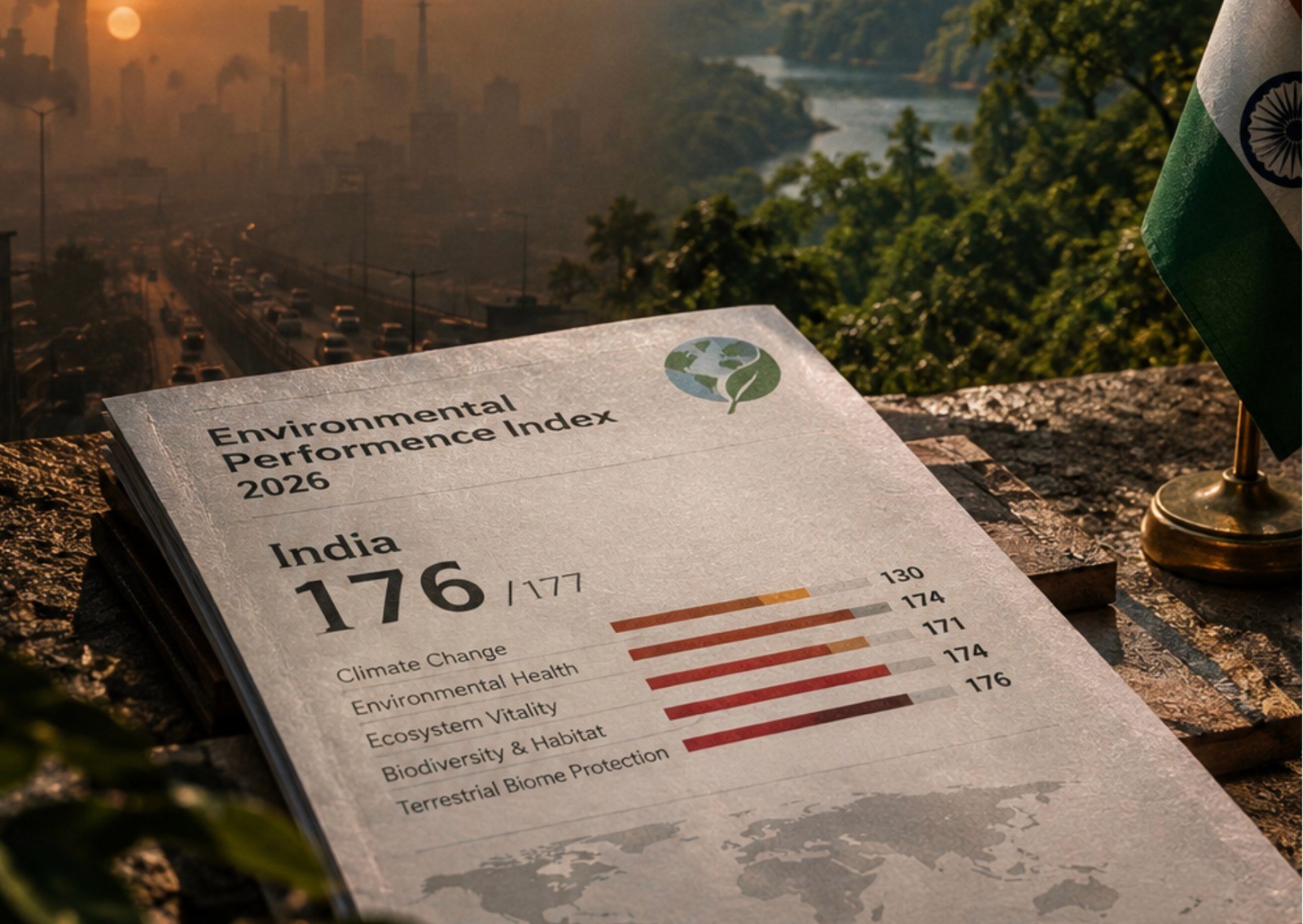
At COP31 in Antalya this November, India's delegation will make an argument it has made at every climate summit for years: judge us by per-capita emissions, not national totals, and factor in who industrialized first. It is a fair argument. It is also, almost word for word, the same argument India's Environment Ministry used three months earlier to dismiss its own ranking on Yale and Columbia's 2026 Environmental Performance Index, where India placed 176th of 177 countries, ahead only of Laos and 7th among the 8 South Asian countries. Meanwhile, Estonia was placed at the top of the index with a score of 74.79.

The dispute, and why it's partly fair
The EPI's overall score for India was 22.46 out of 100. Break it into its parts, though, and the picture splits sharply: India's climate-change sub-rank was 130, poor, but nowhere near the bottom. Environmental health came in at 174. Ecosystem vitality, 171. Biodiversity and habitat, 174. Terrestrial biome protection and protected-area representativeness, both 176.
The ministry's objection focuses almost entirely on the climate methodology, the same territory where India's equity argument genuinely applies.
"Some of the government's questions are fair," says Aakash Ranison, 31, founder of the Greener Earth Foundation. "India is doing positive work in several areas, so if they feel the methodology is not reflecting that, they can ask those questions." Other indices back a version of India's complaint, the Climate Change Performance Index, which weights per-capita emissions more heavily, ranks India 23rd.
But Ranison is careful not to let that stand in for the whole picture. "There are undeniably some very concerning points. Air quality being the clearest. It's not just EPI, IQAir ranked India 5th most polluted in 2024, 6th in 2025." Multiple independent measures, not just Yale's, land in the same place.
Priti Prasad Deo, 66, a retired Executive Director at ONGC, rejects the per-capita framing outright. "The factors affecting climate are global. It is measured in totality and cannot be brought down by making it per capita. A country with smaller population is equally responsible for its climate damage than a country with larger population." It's a useful contrast: even among people broadly sympathetic to India's development story, there's no consensus that the equity argument should extend as far as the ministry wants it to.
What the equity argument doesn't touch
Delhi's air makes the abstraction physical. The city's November average AQI has run "Very Poor" for three straight years, 373 in 2023, 374 in 2024, 354 in 2025, with September 2026 already provisionally trending toward the same seasonal climb. "Wearing an N95 during Delhi winters doesn't feel like a COVID thing anymore," Ranison says. "It has almost become a normal seasonal thing for me." When asked whether this November might break the pattern, he's blunt: "We don't have a reliable forecast yet... I don't see enough evidence yet to assume that this November will suddenly be very different."

Deo, from inside the policy establishment, doesn't dispute the trend either. "The GRAP used to control the air quality is not sufficient enough to control the AQI. More stringent measures need to be implemented." Metro expansion, CNG and electric buses "have definitely worked in the right direction... But these are not sufficient for seeing perceptible changes."
Biodiversity tells a similar story of real progress sitting next to a real gap. India's protected-area network grew from 745 sites in 2014 to 1,134 in 2025, now covering 5.7 percent of the country. But the EPI's low score isn't about the count. "It's not just how many protected areas there are, but whether those areas actually cover all the different ecosystems," Ranison says. A 2022 study involving IISc and IISER Tirupati found that only some of India's richest biodiversity areas actually sit inside protected zones, pockets like the lateritic plateaus of the northern Western Ghats fall outside or are fragmented across the formal network.
Deo offers a case from the inside: Odisha's Mahendragiri Hills, declared a Biodiversity Heritage Site in 2022. Legal protection exists but so does the problem it can't fully solve. The site is also a Saivite pilgrimage destination, and visitors "do visit this place with food items brought with them and litter it all around. This does impact the very delicate eco balance of this area." Protection on paper; erosion on the ground.
The pattern, and the silence
India isn't unusual in disputing an index, Ranison notes Australia and New Zealand have pushed back on climate assessments, Pakistan and Bangladesh on governance rankings. What's harder to find is the opposite case. "I actually tried finding a case where an independent international report gave India a really bad result and the government simply said, yes, we accept this," Ranison says. "It was difficult to find one." Domestic data, CPCB's own pollution numbers, for instance, rarely gets the same fight. "When the data is coming from India itself or through an agreed system like UNFCCC ... we don't really see the same kind of fight. But when an international organisation independently studies India... the reaction becomes much stronger."
That's the actual shape of the problem, and both men, from very different vantage points, arrive at nearly the same place. "Every Government will try to justify their action," Deo says. He emphasizes that not only the environmental factors but other factors also play a significant role. “In the garb of development like hydro electric project in silent valley of Kerala or commercial port development in extremely eco sensitive Nicobar island or Mineral exploitation in Gandhamardhan area of Odisha, we do damage the biodiversity.”
The most important factor to focus on here should be to hold ourselves accountable for our actions towards the environment.
Ranison puts it in almost the same term, "You can think a methodology is flawed and still acknowledge that we have a massive environmental problem on our hands. It doesn't have to be one or the other; both are real."
Which is the question India carries into Antalya, whether or not anyone there asks it aloud: not whether 176 is the right number, but whether the country's institutions can hold an unfair metric and an uncomfortable fact in the same hand.
Citations
https://www.drishtiias.com/daily-updates/daily-news-analysis/environmental-performance-index-2026-1
https://yuvacompetitiveacademy.com/articles/summary-pib-year-end-review-2025-moefcc/
TO BE CONTINUED, FOR SUBSCRIBERS ONLY.
This is where the surface ends and the reporting begins.
The complete piece, the full archive, and access to The French Press Circle. Reporting answerable only to its readers.
Already a subscriber ?
Login
Read these on the house, with our compliments.
A selection from the current issue, open to all readers. Read them in full. The rest is one decision away.







At COP31 in Antalya this November, India's delegation will make an argument it has made at every climate summit for years: judge us by per-capita emissions, not national totals, and factor in who industrialized first. It is a fair argument. It is also, almost word for word, the same argument India's Environment Ministry used three months earlier to dismiss its own ranking on Yale and Columbia's 2026 Environmental Performance Index, where India placed 176th of 177 countries, ahead only of Laos and 7th among the 8 South Asian countries. Meanwhile, Estonia was placed at the top of the index with a score of 74.79.
The dispute, and why it's partly fair
The EPI's overall score for India was 22.46 out of 100. Break it into its parts, though, and the picture splits sharply: India's climate-change sub-rank was 130, poor, but nowhere near the bottom. Environmental health came in at 174. Ecosystem vitality, 171. Biodiversity and habitat, 174. Terrestrial biome protection and protected-area representativeness, both 176.
The ministry's objection focuses almost entirely on the climate methodology, the same territory where India's equity argument genuinely applies.
"Some of the government's questions are fair," says Aakash Ranison, 31, founder of the Greener Earth Foundation. "India is doing positive work in several areas, so if they feel the methodology is not reflecting that, they can ask those questions." Other indices back a version of India's complaint, the Climate Change Performance Index, which weights per-capita emissions more heavily, ranks India 23rd.
But Ranison is careful not to let that stand in for the whole picture. "There are undeniably some very concerning points. Air quality being the clearest. It's not just EPI, IQAir ranked India 5th most polluted in 2024, 6th in 2025." Multiple independent measures, not just Yale's, land in the same place.
Priti Prasad Deo, 66, a retired Executive Director at ONGC, rejects the per-capita framing outright. "The factors affecting climate are global. It is measured in totality and cannot be brought down by making it per capita. A country with smaller population is equally responsible for its climate damage than a country with larger population." It's a useful contrast: even among people broadly sympathetic to India's development story, there's no consensus that the equity argument should extend as far as the ministry wants it to.
What the equity argument doesn't touch
Delhi's air makes the abstraction physical. The city's November average AQI has run "Very Poor" for three straight years, 373 in 2023, 374 in 2024, 354 in 2025, with September 2026 already provisionally trending toward the same seasonal climb. "Wearing an N95 during Delhi winters doesn't feel like a COVID thing anymore," Ranison says. "It has almost become a normal seasonal thing for me." When asked whether this November might break the pattern, he's blunt: "We don't have a reliable forecast yet... I don't see enough evidence yet to assume that this November will suddenly be very different."
Deo, from inside the policy establishment, doesn't dispute the trend either. "The GRAP used to control the air quality is not sufficient enough to control the AQI. More stringent measures need to be implemented." Metro expansion, CNG and electric buses "have definitely worked in the right direction... But these are not sufficient for seeing perceptible changes."
Biodiversity tells a similar story of real progress sitting next to a real gap. India's protected-area network grew from 745 sites in 2014 to 1,134 in 2025, now covering 5.7 percent of the country. But the EPI's low score isn't about the count. "It's not just how many protected areas there are, but whether those areas actually cover all the different ecosystems," Ranison says. A 2022 study involving IISc and IISER Tirupati found that only some of India's richest biodiversity areas actually sit inside protected zones, pockets like the lateritic plateaus of the northern Western Ghats fall outside or are fragmented across the formal network.
Deo offers a case from the inside: Odisha's Mahendragiri Hills, declared a Biodiversity Heritage Site in 2022. Legal protection exists but so does the problem it can't fully solve. The site is also a Saivite pilgrimage destination, and visitors "do visit this place with food items brought with them and litter it all around. This does impact the very delicate eco balance of this area." Protection on paper; erosion on the ground.
The pattern, and the silence
India isn't unusual in disputing an index, Ranison notes Australia and New Zealand have pushed back on climate assessments, Pakistan and Bangladesh on governance rankings. What's harder to find is the opposite case. "I actually tried finding a case where an independent international report gave India a really bad result and the government simply said, yes, we accept this," Ranison says. "It was difficult to find one." Domestic data, CPCB's own pollution numbers, for instance, rarely gets the same fight. "When the data is coming from India itself or through an agreed system like UNFCCC ... we don't really see the same kind of fight. But when an international organisation independently studies India... the reaction becomes much stronger."
That's the actual shape of the problem, and both men, from very different vantage points, arrive at nearly the same place. "Every Government will try to justify their action," Deo says. He emphasizes that not only the environmental factors but other factors also play a significant role. “In the garb of development like hydro electric project in silent valley of Kerala or commercial port development in extremely eco sensitive Nicobar island or Mineral exploitation in Gandhamardhan area of Odisha, we do damage the biodiversity.”
The most important factor to focus on here should be to hold ourselves accountable for our actions towards the environment.
Ranison puts it in almost the same term, "You can think a methodology is flawed and still acknowledge that we have a massive environmental problem on our hands. It doesn't have to be one or the other; both are real."
Which is the question India carries into Antalya, whether or not anyone there asks it aloud: not whether 176 is the right number, but whether the country's institutions can hold an unfair metric and an uncomfortable fact in the same hand.
Citations
https://www.drishtiias.com/daily-updates/daily-news-analysis/environmental-performance-index-2026-1
https://yuvacompetitiveacademy.com/articles/summary-pib-year-end-review-2025-moefcc/
TO BE CONTINUED, FOR SUBSCRIBERS ONLY.
This is where the surface ends and the reporting begins.
The complete piece, the full archive, and access to The French Press Circle. Reporting answerable only to its readers.
Already a subscriber ?
Login
Read these on the house, with our compliments.
A selection from the current issue, open to all readers. Read them in full. The rest is one decision away.