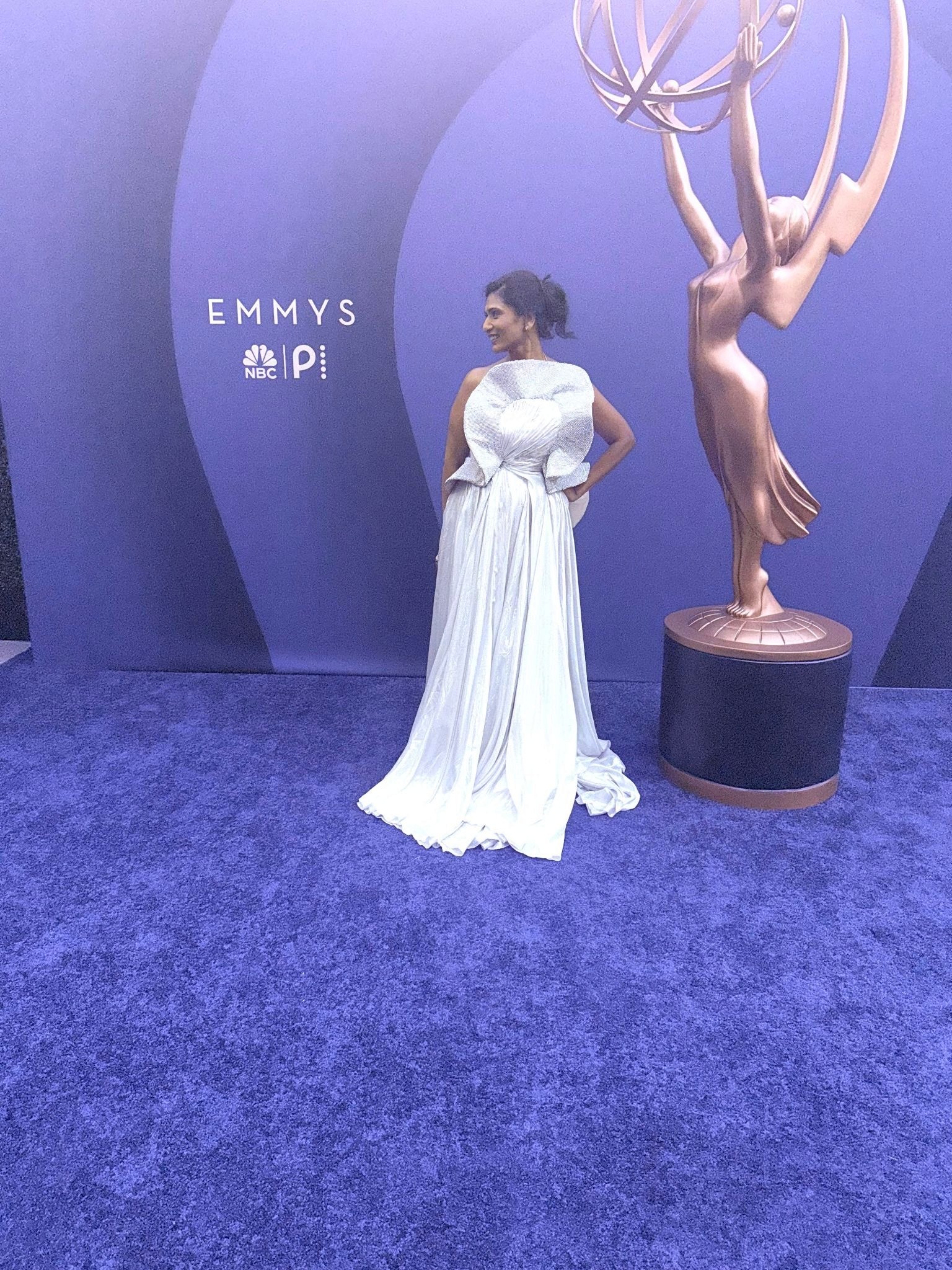
Emmy week gathers the whole of television into a single city. By the time the 78th Primetime Emmy Awards opened at the Peacock Theater in downtown Los Angeles on Monday 14 September, broadcast on NBC and Peacock, the industry's most powerful people were within a few miles of one another. Kavita Gupta chose to move through that week in Indian couture, and I found myself thinking about what that choice asks of the people watching.

Kavita Gupta in Emmys week in Los Angeles wearing Not So Serious by Pallavi Mohan at Gold House’s One House Toast
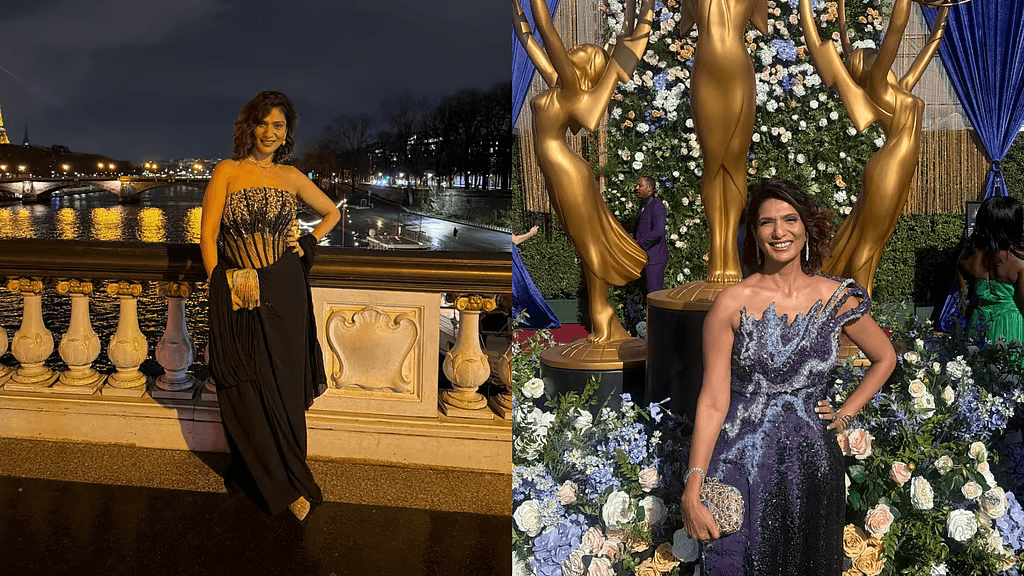
Her week began on Sunday 13 September at the Motion Picture & Television Fund's 20th annual Evening Before, the pre-Emmy benefit that supports working and retired members of the entertainment community. She arrived in Not So Serious by Pallavi Mohan, and I liked the wit of it: a label with that name, worn to one of the most earnest nights of the Emmys calendar, by a woman who takes Indian design very seriously indeed. On the eve of the ceremony, she wore Jade by Monica and Karishma. At the BAFTA tea party, where British talent turned out in force to toast one another in Los Angeles, she chose Bloni Atelier, and she returned to the house for the main event: the 78th Primetime Emmy Awards and the Governors Ball that followed. 4 rooms, 3 Indian labels, and an Indian name in every one of them.

Kavita Gupta wore a black quilted taffeta dress by Bloni Atelier

Kavita Gupta at MPTF’s wearing JADE by Monica & Karishma.

Kavita Gupta with Huma Qureshi
At the ceremony, she hosted Huma Qureshi as her guest, bringing 2 Indian voices into one of the most influential rooms in global television. Seeing the two of them together in Los Angeles, during the busiest week on the television calendar, was a picture I was very glad to see.
Gupta understood exactly what those nights were for. "These two nights are the industry at its most serious and its most generous, and it mattered to walk into both of them with an Indian name on the record," she says. "Having Huma beside me at the ceremony made that point better than anything I could have said."
Gupta found her way to fashion through finance, which may explain why she speaks about it with such clarity. She is the founder and general partner of Delta Blockchain Fund, an early-stage fund focused on blockchain infrastructure and related technologies. Her career spans more than 18 years in investment, with roles connected to the World Bank, the IFC and the Eric Schmidt Family Office, and she helped start ConsenSys Ventures and the Tachyon accelerator. She was an early investor in Polygon, StarkWare, Quantstamp and Sorare, among more than 100 companies. She teaches "Beyond Bitcoin" as a visiting scholar at Stanford University, and in 2015 she received a UN Innovation Award for her role in creating green and social-impact bonds.
I have heard many people say Indian craft deserves more appreciation. Gupta says something more exact. She sees fashion as a system in which labour, intellectual property, identity and national influence all meet. Indian hands, she points out, are present throughout global luxury production, while the credit rarely travels with the garment. Her ambition is to move Indian craftsmanship from visibility to authority, and it is the most useful sentence I have heard on the subject in some time.
Anyone who has sat with a karigar in an embroidery workshop knows how much knowledge lives in that work. What the karigar seldom receives is a name on the label or a fair share of the price. Gupta wants artisans recognised as collaborators, and Indian designers treated as authorities in their own right.
Kavita Gupta was appointed to the leadership board of the Fashion Institute of Technology (New York).
Her work in New York gives the idea somewhere to go. She is the first Indian appointed to the Foundation Board of the Fashion Institute of Technology (FIT), and her plans there could include a collaboration between FIT and the Chanakya School of Design, a stronger Indian presence at New York Fashion Week, and coursework that links heritage craft with sustainability and emerging technology. It is patient work, the kind that happens in classrooms and on show schedules, and it is where lasting reputations are made.
In television, she holds a place within the International Emmy Awards. This week she brought Indian couture into that world with her.
Gupta holds 3 things at once: capital, a seat in New York fashion education and access to international television. She is using all 3 to make the case that Indian couture should be credited, taught, commissioned and financed as a serious force in global fashion and on
screen.
Indian fashion has needed someone to make that case in rooms like these. Gupta is making it, and making it well.
TO BE CONTINUED, FOR SUBSCRIBERS ONLY.
This is where the surface ends and the reporting begins.
The complete piece, the full archive, and access to The French Press Circle. Reporting answerable only to its readers.
Already a subscriber ?
Login
Read these on the house, with our compliments.
A selection from the current issue, open to all readers. Read them in full. The rest is one decision away.




Emmy week gathers the whole of television into a single city. By the time the 78th Primetime Emmy Awards opened at the Peacock Theater in downtown Los Angeles on Monday 14 September, broadcast on NBC and Peacock, the industry's most powerful people were within a few miles of one another. Kavita Gupta chose to move through that week in Indian couture, and I found myself thinking about what that choice asks of the people watching.
Kavita Gupta in Emmys week in Los Angeles wearing Not So Serious by Pallavi Mohan at Gold House’s One House Toast
Her week began on Sunday 13 September at the Motion Picture & Television Fund's 20th annual Evening Before, the pre-Emmy benefit that supports working and retired members of the entertainment community. She arrived in Not So Serious by Pallavi Mohan, and I liked the wit of it: a label with that name, worn to one of the most earnest nights of the Emmys calendar, by a woman who takes Indian design very seriously indeed. On the eve of the ceremony, she wore Jade by Monica and Karishma. At the BAFTA tea party, where British talent turned out in force to toast one another in Los Angeles, she chose Bloni Atelier, and she returned to the house for the main event: the 78th Primetime Emmy Awards and the Governors Ball that followed. 4 rooms, 3 Indian labels, and an Indian name in every one of them.
Kavita Gupta wore a black quilted taffeta dress by Bloni Atelier
Kavita Gupta at MPTF’s wearing JADE by Monica & Karishma.
Kavita Gupta with Huma Qureshi
At the ceremony, she hosted Huma Qureshi as her guest, bringing 2 Indian voices into one of the most influential rooms in global television. Seeing the two of them together in Los Angeles, during the busiest week on the television calendar, was a picture I was very glad to see.
Gupta understood exactly what those nights were for. "These two nights are the industry at its most serious and its most generous, and it mattered to walk into both of them with an Indian name on the record," she says. "Having Huma beside me at the ceremony made that point better than anything I could have said."
Gupta found her way to fashion through finance, which may explain why she speaks about it with such clarity. She is the founder and general partner of Delta Blockchain Fund, an early-stage fund focused on blockchain infrastructure and related technologies. Her career spans more than 18 years in investment, with roles connected to the World Bank, the IFC and the Eric Schmidt Family Office, and she helped start ConsenSys Ventures and the Tachyon accelerator. She was an early investor in Polygon, StarkWare, Quantstamp and Sorare, among more than 100 companies. She teaches "Beyond Bitcoin" as a visiting scholar at Stanford University, and in 2015 she received a UN Innovation Award for her role in creating green and social-impact bonds.
I have heard many people say Indian craft deserves more appreciation. Gupta says something more exact. She sees fashion as a system in which labour, intellectual property, identity and national influence all meet. Indian hands, she points out, are present throughout global luxury production, while the credit rarely travels with the garment. Her ambition is to move Indian craftsmanship from visibility to authority, and it is the most useful sentence I have heard on the subject in some time.
Anyone who has sat with a karigar in an embroidery workshop knows how much knowledge lives in that work. What the karigar seldom receives is a name on the label or a fair share of the price. Gupta wants artisans recognised as collaborators, and Indian designers treated as authorities in their own right.
Kavita Gupta was appointed to the leadership board of the Fashion Institute of Technology (New York).
Her work in New York gives the idea somewhere to go. She is the first Indian appointed to the Foundation Board of the Fashion Institute of Technology (FIT), and her plans there could include a collaboration between FIT and the Chanakya School of Design, a stronger Indian presence at New York Fashion Week, and coursework that links heritage craft with sustainability and emerging technology. It is patient work, the kind that happens in classrooms and on show schedules, and it is where lasting reputations are made.
In television, she holds a place within the International Emmy Awards. This week she brought Indian couture into that world with her.
Gupta holds 3 things at once: capital, a seat in New York fashion education and access to international television. She is using all 3 to make the case that Indian couture should be credited, taught, commissioned and financed as a serious force in global fashion and on
screen.
Indian fashion has needed someone to make that case in rooms like these. Gupta is making it, and making it well.
TO BE CONTINUED, FOR SUBSCRIBERS ONLY.
This is where the surface ends and the reporting begins.
The complete piece, the full archive, and access to The French Press Circle. Reporting answerable only to its readers.
Already a subscriber ?
Login
Read these on the house, with our compliments.
A selection from the current issue, open to all readers. Read them in full. The rest is one decision away.