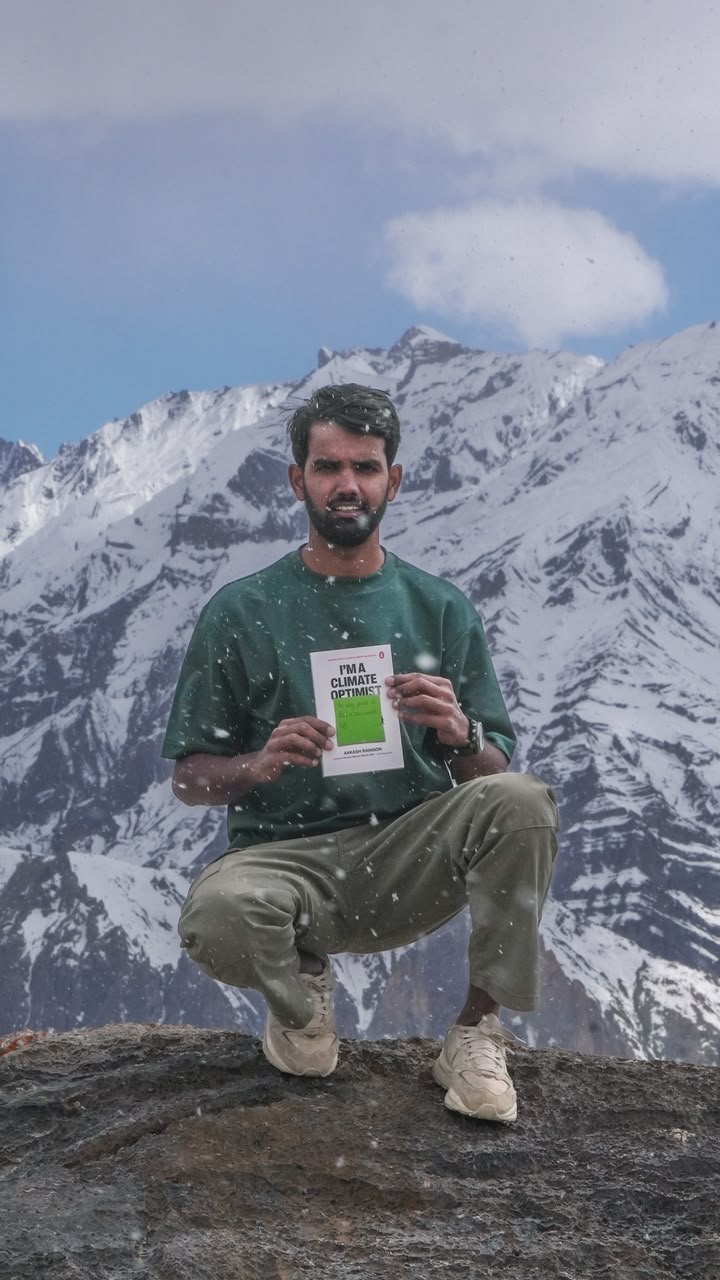
In 2017, I went to Ladakh for the first time.
I was there with WWF for a snow leopard conservation programme. I wasn't working in the climate space back then. I was a traveller, curious about the world and quite happy moving from one place to another without necessarily knowing where any of it was taking me.
One morning, I was walking from Leh towards Shanti Stupa when I noticed plastic wrappers lying along the way. I had seen litter all my life. I had lived in Indore, Delhi and Mumbai. There was nothing new about a chips packet thrown on the ground.
Still, seeing it there bothered me.
Maybe it was because Ladakh was new to me. I knew very little about the place before arriving and I was still trying to take in the scale of the landscape. Seeing something so familiar from our cities lying there felt out of place.
I remember thinking, this place doesn't deserve this.

Then,
I continued with my regular life.
There was no great awakening. I didn't return home and become an environmentalist. I kept travelling. I went to Spiti, where I eventually spent close to a year. Somewhere along the way I started reading about plastic, then about the environment, then climate change, ecosystems, animals and the science of the planet itself.
It brought back a curiosity I had carried since childhood but never really knew what to do with. I had always wanted to understand science and the universe, but school, for me, was mostly about studying what was in the curriculum and remembering enough of it to score marks. My curiosity rarely moved in such straight lines.
Now there was no curriculum.
One question could lead me to another and then somewhere completely unexpected. By 2019, almost two years after that first trip to Ladakh, the environment had quietly moved from something I was interested in to the centre of my work.
The more I learned, though, the harder some of it became to carry.
During COVID, I was living in a small village in Himachal Pradesh. Travel had stopped, and because I had already decided to focus my work on climate change, I spent a lot of time reading. Reports, research, stories from communities, new findings about what was happening to the planet.
Some of it would stay with me for days.

I would think about the snow leopards I had first gone to Ladakh to learn about. A snow leopard comes down looking for food because of the shifting climate and kills a sheep. The sheep belongs to a shepherd for whom losing one animal can mean losing an important part of his income. He has every reason to protect it. The snow leopard, of course, doesn't know that the sheep belongs to anyone. It is hungry.
Who do you get angry with?
I kept encountering versions of this question. Animals losing habitat, communities living with consequences they had done very little to create, forests being fragmented, people and wildlife being pushed into each other's spaces.
There were days when I would read and cry. At first, I didn't even know that climate anxiety was a term. I just knew that learning about something I cared about was making me deeply unhappy.
Strangely, I never wanted to leave the work.
I have wanted projects to work differently. I have questioned my methods hundreds of times. I have received enough rejections to know that climate work, especially when you run a nonprofit, is not an easy place to find money. But I don't remember ever thinking that I should give up and do something else.
Perhaps some of that resilience had been building long before climate became my work.
Years ago, during a difficult period in my life, I applied for a 10-day Vipassana course in Ladakh. I was living in Himachal and didn't have much money at the time. I also felt that I needed to do something difficult enough to wake myself up, so I decided to walk from Manali towards Ladakh.
When you walk in those mountains, your problems acquire a different scale. The climb doesn't care how you are feeling that morning. You walk because that is how you get to the other side.
Hitchhiking had taught me its own version of this. You put your hand out. A vehicle passes. Then another. And another. Most people don't stop. So you keep walking. You look at the mountains, sing a song, talk to whoever is walking with you, put your hand out again. Eventually somebody stops.
Years later, when proposals began getting rejected or somebody said no to an idea I had spent months developing, the feeling wasn't entirely unfamiliar.
A no is a no. You keep walking.
Vipassana worked on me more quietly. I didn't come out after 10 days as some dramatically transformed person. Life continued, and for a long time I didn't know whether anything fundamental had changed.
Almost two years later, a friend noticed something before I did.
We were sitting together talking when I opened my laptop to work. The screen started flickering. It was about a year old, already out of warranty, and I knew immediately that getting it repaired would be expensive. I closed it and continued our conversation.
Later my friend opened it.
“Hey, what happened to your laptop?”
I told her the screen had stopped working.
She looked at me, surprised. “How are you so casual about this?”
Until she asked, I hadn't thought there was anything unusual about my reaction. The laptop was broken. I couldn't change that by being upset about it.
That small moment helped me recognise something Vipassana had been teaching me: do what you can, observe what happens, and then work with what is in front of you.
It has become useful in climate work too.
Whenever something fails, I try to ask myself what I could have done better. Maybe the idea wasn't communicated well. Maybe I approached the wrong person. Maybe I don't understand something yet. Looking there gives me somewhere to go. If I decide that every failure belongs entirely to somebody else, I also give away much of my ability to improve it.
Years later, when I came across Václav Havel's writing about hope, I recognised something familiar in his idea that hope does not depend on knowing that things will turn out well. It comes from finding meaning in what we are doing regardless of how things eventually turn out.
I think climate optimism has gradually become something similar for me. It is a discipline I carry into the work rather than something I expect the work to give back to me.
And there is another, much simpler reason I have managed to stay.
I still love being outside.
I still go to the mountains. I still get excited when I see an animal in the wild. I still want to understand glaciers, forests, rivers and landscapes. Living a nomadic life has allowed me to remain close to many of the things I spend my working life talking about.
That proximity matters to me.
There is only so much optimism I can extract from reports about everything that is disappearing. Sometimes I need to close the laptop and see what is still here.
Somewhere through all these years, I have come to understand a very basic human behaviour: we protect what we love.
And love is difficult to build from a distance.

When I spend time in nature, I don't come back thinking that all the problems have disappeared. I come back remembering why they matter. I have seen something beautiful, watched another living being going about its life, walked through a landscape that existed long before me, and found again something worth fighting for.
That refills something in me.
Balance, for me, is partly this movement between giving and refilling. If all I do is read, worry, campaign and work, eventually there will be very little left in me to give. A jug pours what it contains.
The work itself also has to give me something.
I love being behind a camera. I can spend a ridiculous amount of time looking through a viewfinder trying to get a frame right. A documentary can take me to a remote village where I sit across from someone whose life I knew nothing about a few days earlier. For those few hours, my job is simply to listen well enough to tell their story.
Writing gives me a different kind of pleasure. Sometimes I disappear somewhere quiet for weeks, away from social media, meetings, parties and people, and just write. Making an art installation lets me work with materials I may never have touched before. One project makes me learn about wax, another about wood, another about thousands of discarded bottle caps. I have to understand the science, find a way to communicate it, build a team and somehow make the thing exist.
Every project gives the curious child in me another subject to study.
So, on most mornings, I am not waking up thinking about saving the planet.
I might be thinking about an interview I want to shoot. A frame I want to capture. A paragraph that isn't working. A material I have never used. A glacier I want to understand. An idea I want somebody to fund.
That keeps the days exciting, even when the larger problem can feel unbearably heavy.
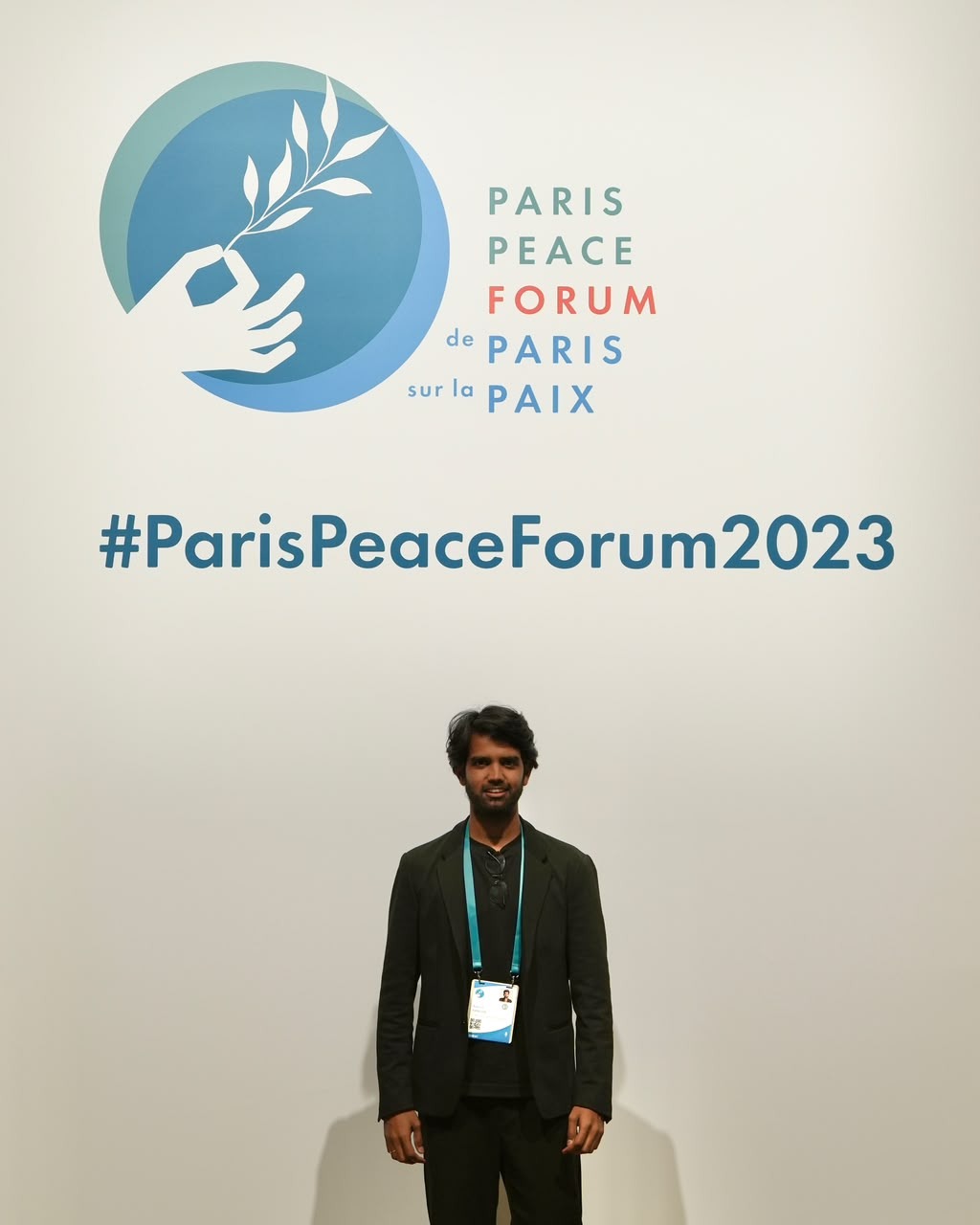
More than fourteen years into my professional journey, I do not know whether everything will turn out well, nor do I feel the need to have all the answers anymore.
There will be another report to read, another idea that doesn't work, another proposal that gets rejected. I know that part of the road by now.
But there are still mountains I haven't walked through, people whose stories I haven't heard, animals I haven't seen, questions I haven't learned enough to ask, and a living world that I still find astonishing.
There is still so much here worth fighting for.
And that is enough to get me out of bed tomorrow.
TO BE CONTINUED, FOR SUBSCRIBERS ONLY.
This is where the surface ends and the reporting begins.
The complete piece, the full archive, and access to The French Press Circle. Reporting answerable only to its readers.
Already a subscriber ?
Login
Read these on the house, with our compliments.
A selection from the current issue, open to all readers. Read them in full. The rest is one decision away.





In 2017, I went to Ladakh for the first time.
I was there with WWF for a snow leopard conservation programme. I wasn't working in the climate space back then. I was a traveller, curious about the world and quite happy moving from one place to another without necessarily knowing where any of it was taking me.
One morning, I was walking from Leh towards Shanti Stupa when I noticed plastic wrappers lying along the way. I had seen litter all my life. I had lived in Indore, Delhi and Mumbai. There was nothing new about a chips packet thrown on the ground.
Still, seeing it there bothered me.
Maybe it was because Ladakh was new to me. I knew very little about the place before arriving and I was still trying to take in the scale of the landscape. Seeing something so familiar from our cities lying there felt out of place.
I remember thinking, this place doesn't deserve this.
Then,
I continued with my regular life.
There was no great awakening. I didn't return home and become an environmentalist. I kept travelling. I went to Spiti, where I eventually spent close to a year. Somewhere along the way I started reading about plastic, then about the environment, then climate change, ecosystems, animals and the science of the planet itself.
It brought back a curiosity I had carried since childhood but never really knew what to do with. I had always wanted to understand science and the universe, but school, for me, was mostly about studying what was in the curriculum and remembering enough of it to score marks. My curiosity rarely moved in such straight lines.
Now there was no curriculum.
One question could lead me to another and then somewhere completely unexpected. By 2019, almost two years after that first trip to Ladakh, the environment had quietly moved from something I was interested in to the centre of my work.
The more I learned, though, the harder some of it became to carry.
During COVID, I was living in a small village in Himachal Pradesh. Travel had stopped, and because I had already decided to focus my work on climate change, I spent a lot of time reading. Reports, research, stories from communities, new findings about what was happening to the planet.
Some of it would stay with me for days.
I would think about the snow leopards I had first gone to Ladakh to learn about. A snow leopard comes down looking for food because of the shifting climate and kills a sheep. The sheep belongs to a shepherd for whom losing one animal can mean losing an important part of his income. He has every reason to protect it. The snow leopard, of course, doesn't know that the sheep belongs to anyone. It is hungry.
Who do you get angry with?
I kept encountering versions of this question. Animals losing habitat, communities living with consequences they had done very little to create, forests being fragmented, people and wildlife being pushed into each other's spaces.
There were days when I would read and cry. At first, I didn't even know that climate anxiety was a term. I just knew that learning about something I cared about was making me deeply unhappy.
Strangely, I never wanted to leave the work.
I have wanted projects to work differently. I have questioned my methods hundreds of times. I have received enough rejections to know that climate work, especially when you run a nonprofit, is not an easy place to find money. But I don't remember ever thinking that I should give up and do something else.
Perhaps some of that resilience had been building long before climate became my work.
Years ago, during a difficult period in my life, I applied for a 10-day Vipassana course in Ladakh. I was living in Himachal and didn't have much money at the time. I also felt that I needed to do something difficult enough to wake myself up, so I decided to walk from Manali towards Ladakh.
When you walk in those mountains, your problems acquire a different scale. The climb doesn't care how you are feeling that morning. You walk because that is how you get to the other side.
Hitchhiking had taught me its own version of this. You put your hand out. A vehicle passes. Then another. And another. Most people don't stop. So you keep walking. You look at the mountains, sing a song, talk to whoever is walking with you, put your hand out again. Eventually somebody stops.
Years later, when proposals began getting rejected or somebody said no to an idea I had spent months developing, the feeling wasn't entirely unfamiliar.
A no is a no. You keep walking.
Vipassana worked on me more quietly. I didn't come out after 10 days as some dramatically transformed person. Life continued, and for a long time I didn't know whether anything fundamental had changed.
Almost two years later, a friend noticed something before I did.
We were sitting together talking when I opened my laptop to work. The screen started flickering. It was about a year old, already out of warranty, and I knew immediately that getting it repaired would be expensive. I closed it and continued our conversation.
Later my friend opened it.
“Hey, what happened to your laptop?”
I told her the screen had stopped working.
She looked at me, surprised. “How are you so casual about this?”
Until she asked, I hadn't thought there was anything unusual about my reaction. The laptop was broken. I couldn't change that by being upset about it.
That small moment helped me recognise something Vipassana had been teaching me: do what you can, observe what happens, and then work with what is in front of you.
It has become useful in climate work too.
Whenever something fails, I try to ask myself what I could have done better. Maybe the idea wasn't communicated well. Maybe I approached the wrong person. Maybe I don't understand something yet. Looking there gives me somewhere to go. If I decide that every failure belongs entirely to somebody else, I also give away much of my ability to improve it.
Years later, when I came across Václav Havel's writing about hope, I recognised something familiar in his idea that hope does not depend on knowing that things will turn out well. It comes from finding meaning in what we are doing regardless of how things eventually turn out.
I think climate optimism has gradually become something similar for me. It is a discipline I carry into the work rather than something I expect the work to give back to me.
And there is another, much simpler reason I have managed to stay.
I still love being outside.
I still go to the mountains. I still get excited when I see an animal in the wild. I still want to understand glaciers, forests, rivers and landscapes. Living a nomadic life has allowed me to remain close to many of the things I spend my working life talking about.
That proximity matters to me.
There is only so much optimism I can extract from reports about everything that is disappearing. Sometimes I need to close the laptop and see what is still here.
Somewhere through all these years, I have come to understand a very basic human behaviour: we protect what we love.
And love is difficult to build from a distance.
When I spend time in nature, I don't come back thinking that all the problems have disappeared. I come back remembering why they matter. I have seen something beautiful, watched another living being going about its life, walked through a landscape that existed long before me, and found again something worth fighting for.
That refills something in me.
Balance, for me, is partly this movement between giving and refilling. If all I do is read, worry, campaign and work, eventually there will be very little left in me to give. A jug pours what it contains.
The work itself also has to give me something.
I love being behind a camera. I can spend a ridiculous amount of time looking through a viewfinder trying to get a frame right. A documentary can take me to a remote village where I sit across from someone whose life I knew nothing about a few days earlier. For those few hours, my job is simply to listen well enough to tell their story.
Writing gives me a different kind of pleasure. Sometimes I disappear somewhere quiet for weeks, away from social media, meetings, parties and people, and just write. Making an art installation lets me work with materials I may never have touched before. One project makes me learn about wax, another about wood, another about thousands of discarded bottle caps. I have to understand the science, find a way to communicate it, build a team and somehow make the thing exist.
Every project gives the curious child in me another subject to study.
So, on most mornings, I am not waking up thinking about saving the planet.
I might be thinking about an interview I want to shoot. A frame I want to capture. A paragraph that isn't working. A material I have never used. A glacier I want to understand. An idea I want somebody to fund.
That keeps the days exciting, even when the larger problem can feel unbearably heavy.
More than fourteen years into my professional journey, I do not know whether everything will turn out well, nor do I feel the need to have all the answers anymore.
There will be another report to read, another idea that doesn't work, another proposal that gets rejected. I know that part of the road by now.
But there are still mountains I haven't walked through, people whose stories I haven't heard, animals I haven't seen, questions I haven't learned enough to ask, and a living world that I still find astonishing.
There is still so much here worth fighting for.
And that is enough to get me out of bed tomorrow.
TO BE CONTINUED, FOR SUBSCRIBERS ONLY.
This is where the surface ends and the reporting begins.
The complete piece, the full archive, and access to The French Press Circle. Reporting answerable only to its readers.
Already a subscriber ?
Login
Read these on the house, with our compliments.
A selection from the current issue, open to all readers. Read them in full. The rest is one decision away.
