
There is a village in Purvi Champaran, deep in Bihar, with an address so long it reads like a small pilgrimage in itself: Murgiya Tala, moje Pulwariya, post Atkhapariya, thaana Ramgadhwa, district Motihari. It is the kind of address the fashion industry rarely has occasion to write down, and almost never prints. Ram Babu Prajapati left it at the age of twelve to learn stitching, and now, at forty-four, he runs a floor for the designer Pallavi Mohan. When you ask him how he became a masterji, he does not begin with a garment or a technique. He begins with his grandmother, who set him on the path, and his elder brother, who became his first and biggest teacher.
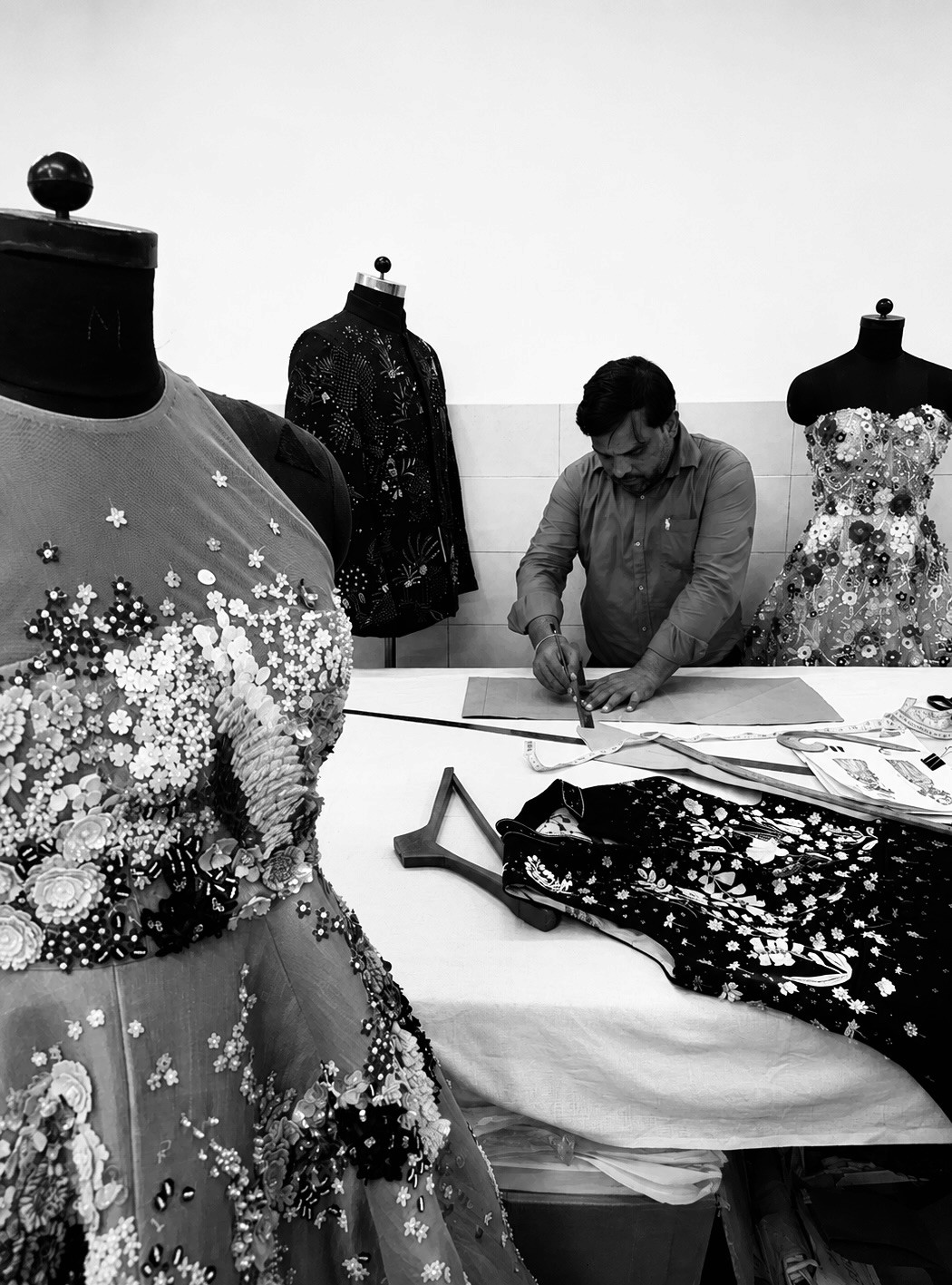
Rashid ji, a pattern masterji at the atelier of Sahil Kocchar
Ten days ago, the nineteenth edition of India Couture Week closed at the Taj Palace in Delhi, having opened for the first time in its history outside the capital, at the scorpion-shaped Falaknuma Palace in Hyderabad. There were lehengas that had taken weeks to build, organza cut by hand, anarkalis assembled stitch by stitch over months. The names that travelled out of that week and into the next morning's papers belonged, as they always do, to the designers, who conceive the collections and carry the risk of them. Alongside those names runs a simple arithmetic. For every one on a label there are dozens of hands that never appear anywhere, and some of them travelled further to be in that room than anyone in the front row: from Motihari, from Nagpur, from a friend's boutique in Civil Lines. On National Handloom Day, when the country turns to honour the weaver and the loom, it is worth following the thread past the loom, all the way to the people who decide what the fabric finally becomes.
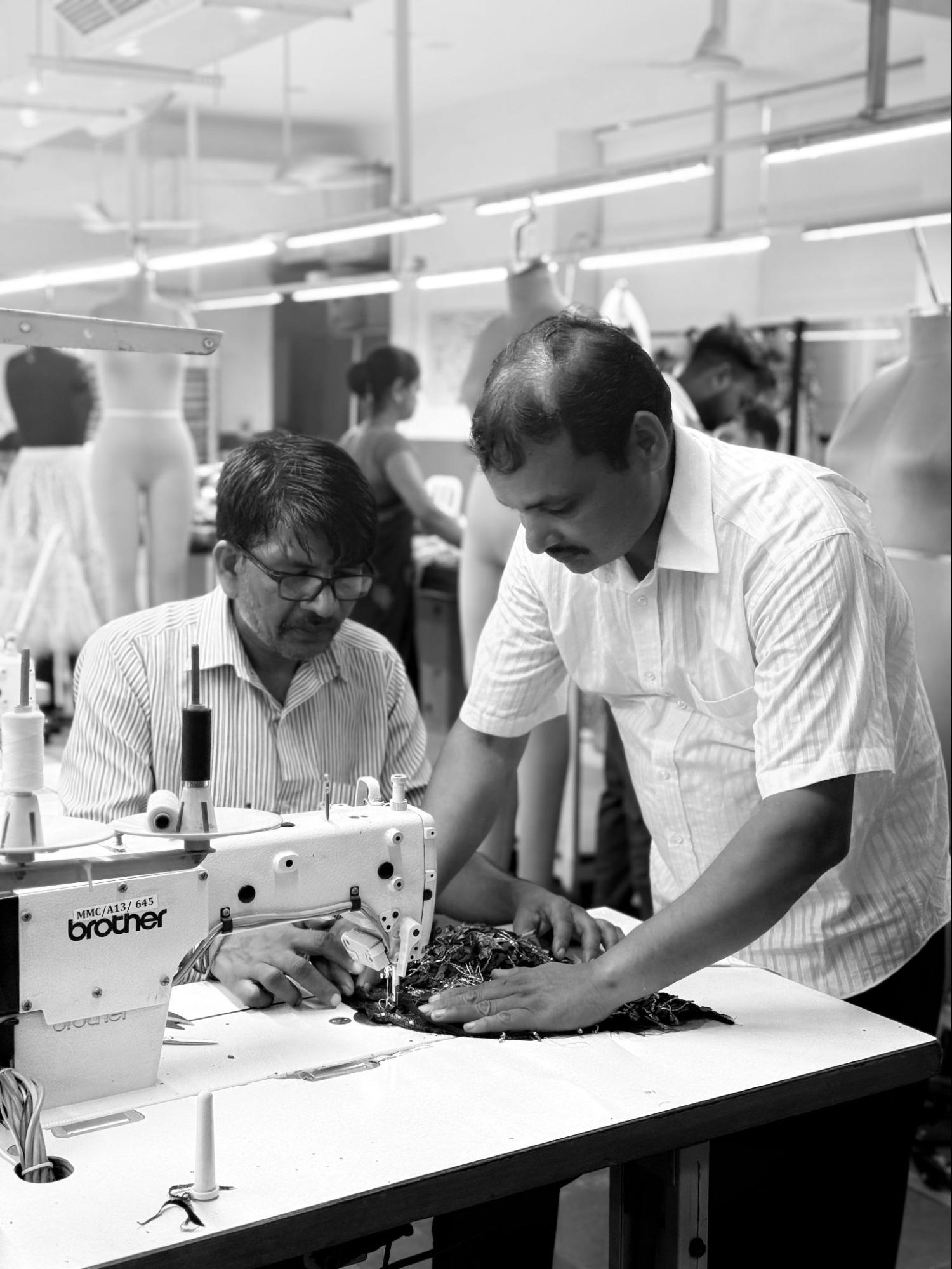
Ram Babu Prajapati working with another karigar at atelier of Not So Serious by Pallavi Mohan
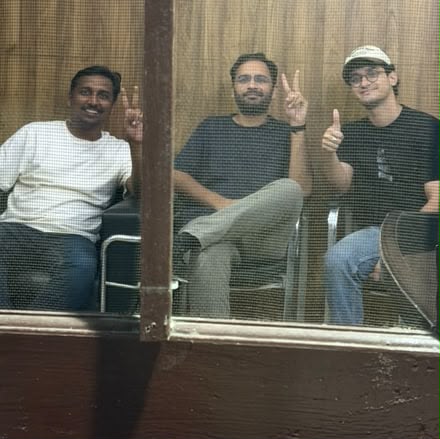
Somewhere in each of those garments is a decision no one photographed: a seam re-cut at midnight, a pattern taken apart and begun again, a lining finished as carefully as the face. Five men who make those decisions, at the ateliers of Pallavi Mohan, Sahil Kochhar, Mandira Wirk, Karan Torani and Shruti Sancheti, agreed to talk about the part of couture that never reaches the runway.
How Indian Masterjis Learn Their Craft: Teacher, Lineage, or Years of Practice
Ask six masterjis where their skill came from and you reopen the oldest argument in any craft. Is mastery transmitted from a teacher, hand to hand, or is it accumulated privately, through years of one's own trial and failure?
Ram Babu of Pallavi Mohan’s atelier, will not budge from the first position. "I strongly believe that no skill can be learned without a teacher," he says, "although experience helps you perfect it." His elder brother taught him stitching; his grandmother inspired the journey. For him the chain of transmission is close to sacred. The hand must be guided by another hand before it can be trusted to guide itself. There is something almost pre-modern in this, in the good sense: it belongs to the world of the guru-shishya parampara, of ustad and shagird, of knowledge as an inheritance passed between bodies rather than downloaded from a manual.
Mazher Shah, the head master cutter at Manoviraj Khosla's atelier in Bangalore, belongs to the same lineage-minded camp, and he traces his skill to a single door. He grew up in a family rooted in the tailoring business, with an uncle who was a master tailor. "As a child, I dreamed of becoming a cutting master just like him," he says. "Seeing my passion, he took me under his wing and taught me not just the craft, but also the discipline it demands." He began as a helping hand, sourcing fabrics, procuring raw materials, learning every step, until, in 1997, his uncle judged him ready and started teaching him pattern cutting and garment construction. "That's when my interest truly deepened. I poured my heart and soul into this profession." The teacher had a name too, and Mazher offers it readily: his late uncle Altaf Hussain, his Guru, followed by the mentors Mehboob, Saud and Babu, to whom he remains grateful.

Rohit Kain, masterji at the atelier of Karan Torani
Rohit Kain, forty-two, who works with Karan Torani in Delhi, sits at the opposite end of the same bench and states the contrary case just as flatly. "I didn't learn this skill from any one person," he says. "I developed it through years of hands-on experience, continuous practice, and a willingness to keep trying new things. I've always believed in experimenting, learning, and constantly pushing myself to grow and improve in my craft." His route into couture was oblique. "My journey began in Civil Lines, where I first started learning and understanding the craft. After that, I worked at a regular boutique, where the main focus was on achieving high-quality finishing. That experience taught me the importance of precision and attention to detail." No lineage, no workshop dynasty. He watched, and stayed, and the watching became a life.
Rashid, the pattern masterji at Sahil Kochhar, refuses the binary altogether, which may be the wisest place to stand. "My journey began with my family. We have been involved in karigari for generations," he says. "Growing up around this craft gave me an early understanding of how garments are made. I started by learning the fundamentals, then became a cutting master, and later specialised in pattern making." The fundamentals were inherited. Everything after was earned. "While I learned the basics early on, most of what I know today has come through years of hands-on experience. Every garment, every fitting, and every challenge has taught me something new. I believe this craft is one that you continue learning throughout your career."

Ziyauddin Ansari, masterji at the atelier of Shruti Sancheti
The contrast in answers perhaps is a testament to the complexity of Indian couture. It is a version of a debate the West staged for centuries, between the medieval guild that believed skill was a social possession, held and handed down by a community, and the Romantic cult of the self-taught genius who owes nothing to anyone. It is the tension between the ustad and the autodidact, between the recipe and the palate, between the coach and the prodigy. The masterjis have not resolved it because it is not, finally, resolvable. What is striking is that whichever side they take, they agree entirely on one thing: the unit of measurement. Nobody here counts in months. Ram Babu spent four to five years mastering a single centimetre-measurement technique. Rashid is still, by his own account, learning pattern-making after seventeen years. Ziyauddin Ansari, a master cutter of twenty-nine working at Mandira Wirk’s atelier, names perfect fitting as the skill that took the longest, and says it plainly: it "comes only through years of experience and continuous practice." In an economy that has taught the rest of us to expect competence in an afternoon and mastery in a weekend, these are people who still measure their education in decades.
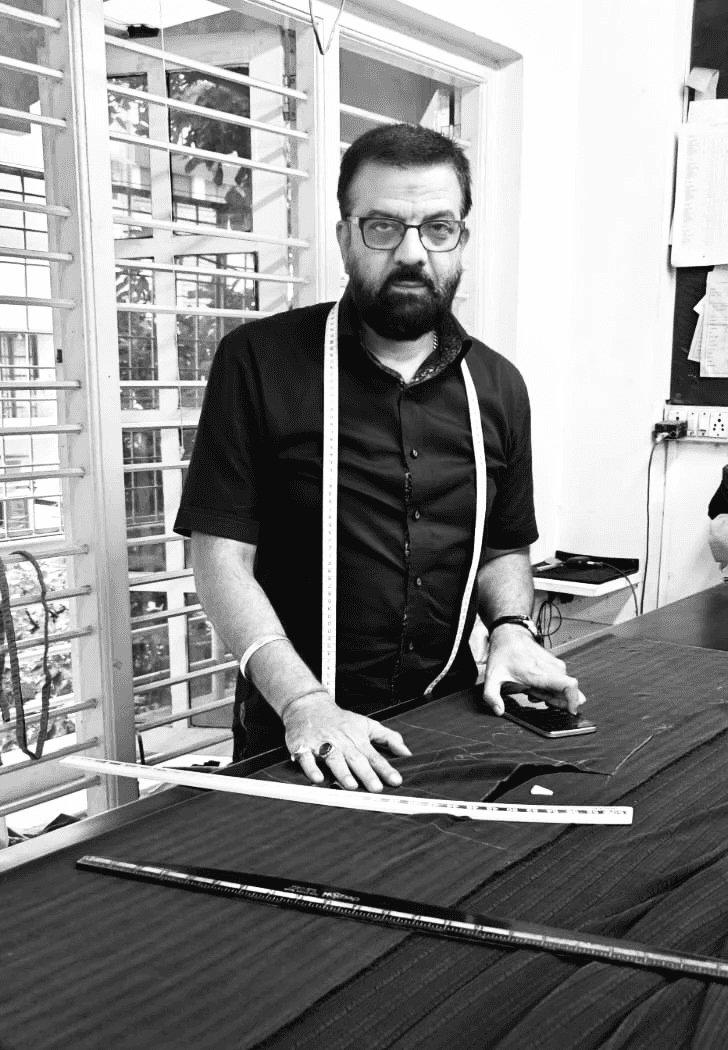
Mazher Shah, who hails from Bangalore, and is currently the head master cutter at the atelier of Manoviraj Khosla
Mazher Shah, twenty-nine years in at Manoviraj Khosla, measures his own tenure the same way, and credits his endurance to something that sits alongside technique. "What keeps me going is the respect from my clients and the happiness I see on their faces with a perfect fit," he says. Ram Babu's concern for the young is exactly this: "Many expect quick results without mastering the basics." The fabric, he is telling us, does not care how impatient you are.
The atelier as control tower
The public imagines the atelier as a hushed and beautiful room. The masterjis describe something closer to an air traffic control tower during a storm.
"During couture season, there is a lot of work and pressure," says Ram Babu, and every other voice confirms it in its own register. Ziyauddin, with a cutter's economy, puts it this way: "We start work in the morning, and before we know it, it is evening. Deadlines are tight, and there is always a lot to finish in a short time." Rohit's day is a running act of triage. "A typical day for me starts with reviewing all the tasks scheduled for the day," he says. "Once I have a clear plan, I brief my team and the tailors, explaining the work and giving them the necessary instructions. Throughout the day, while managing my own work, I also keep a close eye on client orders. I make sure every garment meets our quality and finishing standards, guide the tailors wherever needed, and ensure the work is progressing correctly. At the same time, I monitor timelines so that every order is completed and delivered on schedule." Mohmd Kaleem, who works with Mandira Wirk and whose day begins before work with prayer, describes the same relentless sequence. "मेरा दिन सुबह की नमाज़ से शुरू होता है, फिर मैं काम पर आकर सीधे अपनी ज़िम्मेदारियों में लग जाता हूँ," he says. ("My day starts with the morning prayer, then I come to work and get straight into my responsibilities.") Fabric, cutting, draping, fittings, construction, finishing: everything, he says, needs attention.
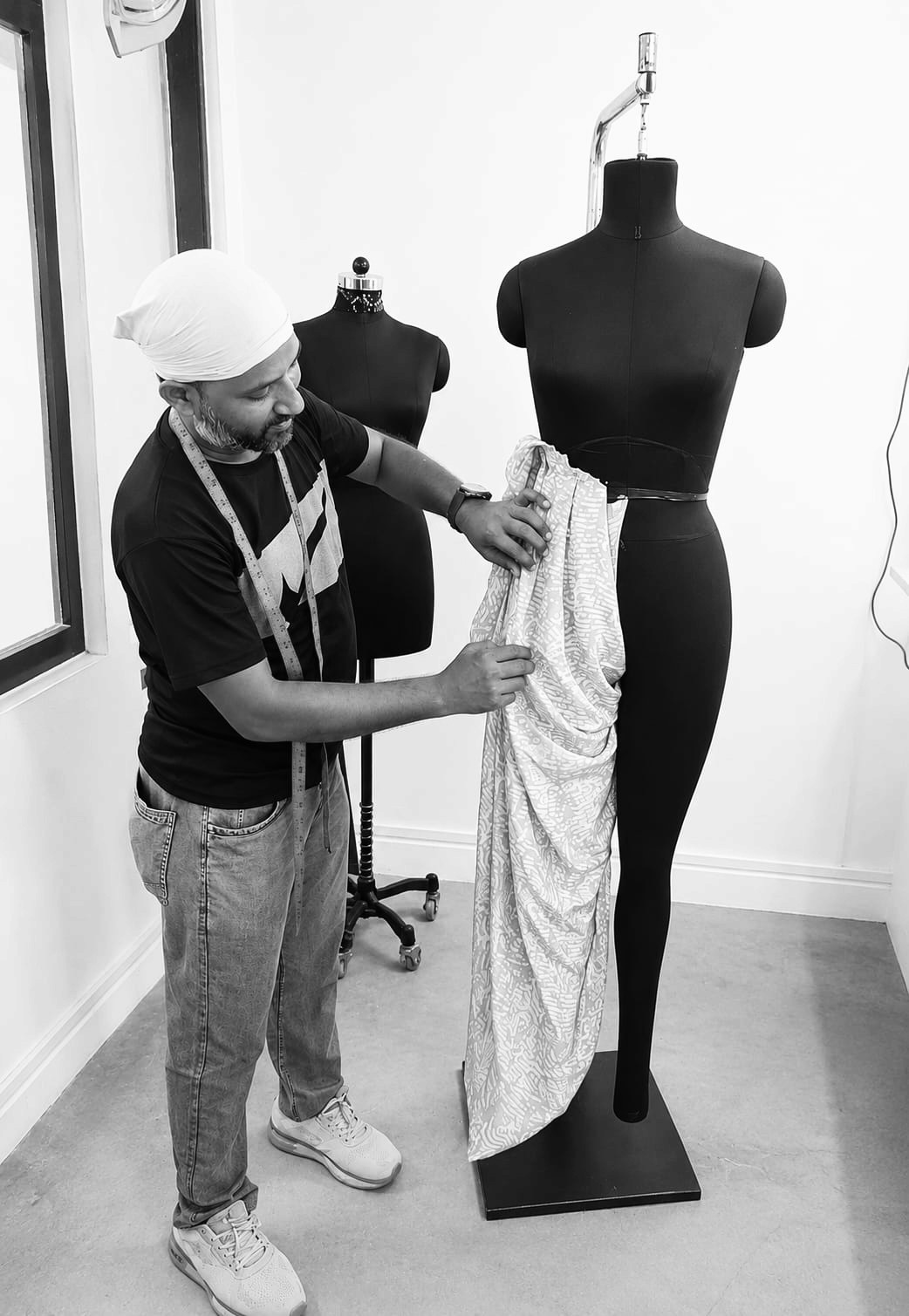
Mohmd Kaleem, masterji at the atelier of Mandira Wirk
Mazher describes couture season as the atelier's biggest test. "We work day and night to meet our goals, and it's also incredibly rewarding," he says. "Beyond the final garment that people see, there's weeks of trial and error, dedication, and energy that go into every piece." For him the pressure runs together with the learning: "It's a time of immense learning for the entire team, and a chance to experiment with designs that once seemed impossible."
There is a reason the vocabulary keeps sliding from art towards logistics. A couture house is a factory that produces exactly one of everything, under deadline, to a standard that does not forgive, and the masterji is the person holding the whole structure in tolerance.
And the hardest part is, almost by definition, the part the client is never meant to notice. Ask what the world outside the atelier never sees and the answers converge, again and again, on two words: fitting and pattern.
Kaleem locates the challenge in time itself. "The biggest challenge is the fitting process and the amount of time a couture garment actually takes. People usually see only the finished outfit and may feel that it comes together quickly, but the process is very long. A garment goes through repeated fittings, corrections, adjustments and finishing before it is ready." In his own words: "सही फिट पाने के लिए बहुत धैर्य, सटीकता और कई घंटों की बारीक मेहनत लगती है।" ("Getting the right fit takes a great deal of patience, precision and many hours of fine, careful work.") Rashid frames the same problem as a kind of geometry, a war against dimension: "Converting a two-dimensional pattern into a three-dimensional garment that fits beautifully requires both precision and experience." He goes on: "One of the biggest challenges is maintaining consistency throughout the entire garment while ensuring that fabric is used efficiently and waste is kept to a minimum. Throughout the process, we also have to balance the designer's vision with comfort, movement, and wearability so that the final garment looks as beautiful as it feels."
Rohit, at Karan Torani, is the most vivid on where the actual labour hides. "When people look at a garment, they usually notice the design and the finishing. But there is a lot of work behind the scenes that isn't visible. The most important part is the pattern. Creating the right pattern requires careful planning and strong technical knowledge. Even a small mistake in the pattern can mean taking the entire garment apart and remaking it. That's why we pay the greatest attention to this stage." Everyone in the world celebrates the sketch, the flat and photogenic idea. What the masterji is paid for is the far harder act of lifting that idea off the page and forcing it to obey a living, moving, breathing body.
Behind The Seams
There is a concept in Japanese craft, shokunin, that describes the artisan whose obligation runs past skill and into something closer to conscience, the maker who keeps refining a thing long after any customer could possibly tell the difference. The sushi master Jiro Ono, who gave the idea its most famous modern face, believed one could work for a lifetime and still fall short of the ideal. Something of that same disposition runs through every masterji here, though none of them would reach for a foreign word to describe it. They would simply point to the finishing, and to the inside of the garment, the surface no one will ever inspect.
"For me, it is the finishing," says Kaleem, asked what people overlook. "People first notice the design, embroidery or fabric, but the true quality of a couture garment is revealed through its finishing. Clean stitching, neat seams, the right lining and attention to every small detail make the garment refined and comfortable." Then the line that stays with you: "अच्छी फिनिशिंग दूर से हमेशा दिखाई नहीं देती, लेकिन पहनते ही उसका फर्क महसूस हो जाता है।" ("Good finishing is not always visible from a distance, but the moment you wear the garment, you feel the difference.")
Rohit takes the thought to its most radical conclusion, relocating the soul of the object to its interior. "The beauty of a garment isn't just in what you see on the outside. Some of the most important details are actually hidden inside. For me, the most important aspect is the inside finishing. That's what truly reflects the quality of the garment and sets it apart from others. When the inside is finished neatly and professionally, it not only looks better but also lasts longer and feels premium." Ziyauddin says the identical thing in the language of a cutter: what people overlook is "the finishing inside the garment. Details such as lining, hidden stitches, seam finishing, construction, and the way different panels are joined together are often invisible to the customer, but they determine the garment's quality, comfort, and durability. Even the inside of the garment receives as much attention as the outside."
Mazher puts the same conviction in plainer terms. "Inside an atelier, every inch matters," he says. "It's not mass production. It's dreams being cut, stitched, and finished by human hands."
A masterji is hired to produce a visible object and, unbidden, perfects the invisible one, because in his understanding the two cannot be separated. This is craftsmanship as a private ethic, a discipline practised where there is no audience to reward it. It is the seam finished flawlessly on the side that faces the skin, the lining as honest as the façade. In a culture that has industrialised the performance of authenticity, that has learned to optimise every surface for the photograph and let the substance behind it rot, the masterji's insistence on the integrity of the unseen is close to a moral rebuke. Ram Babu names the unnamed reward of it: the pride of "knowing my team has created it with honesty, skill, and dedication." Ziyauddin Ansari, the master cutter at Shruti Sancheti, condenses the whole philosophy into a single line that could serve as the profession's motto: "हो सकता है हमारी पहचान सामने न दिखे, लेकिन हमारी कारीगरी हर टांके और हर बारीकी में दिखाई देती है।" ("Our name may not be visible up front, but our craftsmanship shows in every stitch and every fine detail.")
What makes a master, and it is not only the hands
Patience comes first, always. "The first and most important quality is patience, because couture cannot be rushed," says Mohmd, the Mandira Wirk masterji. Ram Babu lists "patience, discipline, attention to detail, dedication, and the willingness to keep learning." Ziyauddin insists a great masterji "should always be willing to learn." But underneath the patience sits something more interesting: a genuinely humane philosophy of authority, arrived at not in a management seminar but on a workshop floor, through the daily fact of depending on other people's hands to realise your own judgement.
Rohit, on this, says eloquently, "In my opinion, a good masterji is someone who works with the team, not just manages it. If a tailor makes a small mistake, there's no point in scolding them. It's better to explain where the mistake happened and how to avoid it next time. That's how people learn and improve. Treating your craftsmen with respect is equally important. When you guide them patiently and value their work, they give their best in return."
Mazher Shah gathers the same qualities into a creed: to become a great masterji "requires dedication, discipline, and loyalty," along with being "kind to clients, calm under pressure, professional and polite in every situation." He, too, insists the karigars be guided with respect. And he adds a dimension the others only imply, a close attention to the individual body. "There's a real art to understanding a client's body type and helping them understand what fit will suit them. Not every masterji pays attention to that," he says. "Because no two bodies are the same, we need to focus on giving a better, tailored fit that settles for no standard, one-size approach."
Ziyauddin frames it as intelligent delegation: a masterji must "understand each artisan's strengths so the right person is assigned to the right task." Mohmd Kaleem points the whole apparatus outward, towards the person who will wear the thing: the most important quality is to "understand the client's needs and expectations and give them the right fitting. When the fit is correct and the client feels confident, the effort becomes worthwhile."
That last sentence subtly redefines what "finished" means. A garment is not complete when it is beautiful on a stand. It is complete when a human being puts it on and, in it, believes in themselves. The masterji, in this telling, is not merely a technician of the fabric. He is a technician of confidence, and the object is only the instrument.
The invisible workforce, in a year that made it visible
In April, the industrial belt around Noida saw thousands of garment workers walk out over wages, after neighbouring Haryana notified a thirty-five per cent rise in its minimum wage and workers across the border asked for parity. Work slowed across roughly three hundred factories; the demonstrations grew tense before the Uttar Pradesh government approved a revision of its own. In Karnataka, the Garment and Textile Workers' Union has spent the year contesting the exclusion of garment workers, most of them women, from a broader minimum-wage revision, framing it as a question of equity for a workforce the union argues has long been valued below its neighbours. These were, for the most part, mass-manufacturing floors rather than couture rooms. But they put a number to something the whole industry usually keeps abstract: what the labour of the hand is actually worth, and who gets to set the figure.
A careful distinction is owed here. The masterjis we interviewed are not, mostly, those workers. Couture ateliers sit at the skilled, well-regarded, better-paid end of a very long spectrum; the mass export floors sit at the other. To collapse the two would flatter one and misread the other. Yet they belong to the same spectrum, and one logic runs along its whole length: the people whose hands make the clothes are the people whose names are least likely to be spoken. What the year's headlines made briefly visible is the thing this profession lives inside every day, and which the industry's own vocabulary already has a name for. The brief for this story calls it, accurately, invisible labour.
The masterjis themselves see the economics clearly, and they decline to romanticise it. Rohit, thirty years in, reads the situation as a matter of supply rather than sentiment. His hope for the young is real, and he attaches a condition to it. "The wages of tailors and craftsmen are also improving," he says. "If they receive better pay, respect, and opportunities, more young people will be inspired to join the profession and help keep this craft alive for future generations." His concern is not that the young lack talent. It is that fewer of them are choosing to enter at all: "The younger generation is not choosing this profession the way they used to. Fewer people are entering the field today." A tradition that wants masters in twenty years has to make the apprenticeship worth beginning today, and that is a question designers, ateliers and the market answer together. It is also, a shared interest. The value of an Indian couture house and the livelihood of the hands inside it rise on the same tide, which is the reputation of the work itself.
Mazher's worry is pitched slightly differently. He is heartened to see the young eager to learn pattern cutting and quick to embrace new trends. What unsettles him is "when the work turns commercial and we lose the passion and the dream behind it." To become the best, he says, "you need sacrifice, discipline, and love for the craft, and that's something I wish we saw more of today."
Why the craft cannot be outsourced to a machine, or to nostalgia
There is a temptation, on a day like this, to treat handwork as heritage: something to be preserved behind glass, admired, mourned in advance. The masterjis have no patience for that framing, because for them the craft is not a relic. It is a live technology, still the best available tool for the job.
Ziyauddin on this, says, "Fashion changes constantly. New designers, trends, fabrics, and techniques continue to emerge. However, traditional craftsmanship remains just as valuable. Handmade work still carries a uniqueness that machines cannot replace." Rashid, who has watched couture grow more experimental across his seventeen years, says the methods have evolved while the essential thing has not: "While the methods have evolved, the importance of craftsmanship and precision has remained the same." This is worth taking seriously as a claim about value, not merely sentiment. The reason a couture garment cannot be printed or automated into existence is the same reason the pattern takes years to learn: it is a negotiation between a fixed idea and a body that is never the same twice. Mohmd Kaleem says the hardest thing to master is not a technique at all but a translation, "understanding a designer's vision and translating it into a garment exactly as intended." That act of translation, from one human imagination through a second human's hands into a third human's lived experience of wearing it, is precisely the thing no machine can perform, because it is not really about cloth. It is about judgement.
Mazher describes that translation as a discipline of exactness. "Bringing a designer's vision to life comes with risk, because the goal is to stand out and be truly unique," he says. "We can't afford to deviate even an inch from the designer's dream." At Manoviraj Khosla, he locates that signature in a particular daring, "experimenting with two different fabrics, prints, or textures and bringing them together to create a masterpiece," the kind of rare combination, he says, that keeps clients returning for something only their designer can make.
Indian couture, as an idea and as an export, does not exist without these hands. Rohit describes the transformation he has watched: once, Indian designer clothing "was worn mostly within India. Today, it's appreciated and worn around the world, and Indian craftsmanship has gained recognition on an international stage." Note the noun. Not Indian design alone, but Indian craftsmanship. Part of what the world has learned to want from India is, specifically, the work of its hands: the embroidery, the finishing and the fit that many ateliers elsewhere can no longer source or execute at this level. A couture house runs on two engines that need each other completely. The designer supplies the vision, the direction and the reputation that brings the client to the door. The masterji supplies the knowledge that turns a drawing into a thing a body can wear, knowledge that in this case learned its trade from a brother in Bihar. Take either one out of the equation and the object does not get cheaper. It stops existing. A vision with no hand to build it is a sketch; a hand with no vision to serve is a workshop waiting for a brief. The value everyone admires at couture week is the point where the two meet.
The Masterjis Behind Indian Couture, in Their Own Words
We put the same final question to all five. When someone admires a couture garment at a wedding or under the runway lights, they remember the designer's name and not the hands that made it. What would you want them to remember?
In a culture organised around self-promotion, where visibility has become the highest good and the unbranded self is treated as a failure, these are people who have looked at the question of recognition and, for the most part, declined it.
Mohmd Kaleem goes furthest, and without a flicker of resentment. "I believe the designer deserves the recognition, because every garment begins with the designer's creativity, guidance and direction. As masterjis, our responsibility is to understand that vision and bring it to life through our skill. The designer has trusted and hired us to do that work. At the same time, couture is a team effort, and every garment carries the dedication of many hands. I do not seek separate credit. I only hope people respect the craftsmanship behind the finished piece." Ram Babu draws the cleanest possible line between the two halves of the labour: "Designers create the vision, but it is the craftsmen who turn that vision into reality." Ziyauddin agrees, and completes the thought: "Designers imagine the garment, but Masterjis and karigars turn that imagination into reality. If people remember and appreciate the craftsmanship behind the garment, that is the greatest recognition we can receive."
There is a humility here that is easy to misread as smallness, and it is the opposite. It takes a different kind of strength to pour a lifetime of skill into an object, sign nothing, and locate your pride not in being named but in knowing, privately, that the seam no one will ever see was finished as carefully as the one they will. Rohit, for example, wants people to grasp "that a garment is much more than just a design. Behind every outfit is the hard work of a masterji and an entire team. Much of this effort goes unnoticed, but it is what truly defines a well-made garment."
Mazher Shah answers the same question by asking to be remembered for three things: patience, because couture cannot be rushed; memory, because he and his team hold on to "every client's posture, every fitting note"; and pride. "We don't just stitch clothes," he says. "We stitch confidence for life's biggest days."
The loom we honour today is a machine, but a machine worked by a hand, and behind that hand is another, and another, reaching back through grandmothers in Champaran and ustaads in borrowed boutiques and elder brothers who taught for nothing. These same hands, or hands exactly like them, hem the school uniform, take in the wedding blouse, turn the fallen hem of an ordinary Tuesday. The masterji is not an exotic figure who lives only at couture week. He is the most familiar craftsman in Indian life, the one nearly every family has depended on, elevated to the highest tier of his art and rendered, at that height, somehow more invisible rather than less.
On National Handloom Day, the truest we can be to ourselves is to refuse the easy reverence and see the whole chain instead of only its final, glittering link. Pay it, at both ends. And the next time you admire something exquisite on someone's back, remember that a person you will never meet decided, with no one watching and no one about to praise them for it, to finish the inside of it as beautifully as the outside.
That is the part that lasts. That is the part that was always meant for no one to see.
TO BE CONTINUED, FOR SUBSCRIBERS ONLY.
This is where the surface ends and the reporting begins.
The complete piece, the full archive, and access to The French Press Circle. Reporting answerable only to its readers.
Already a subscriber ?
Login
Read these on the house, with our compliments.
A selection from the current issue, open to all readers. Read them in full. The rest is one decision away.










There is a village in Purvi Champaran, deep in Bihar, with an address so long it reads like a small pilgrimage in itself: Murgiya Tala, moje Pulwariya, post Atkhapariya, thaana Ramgadhwa, district Motihari. It is the kind of address the fashion industry rarely has occasion to write down, and almost never prints. Ram Babu Prajapati left it at the age of twelve to learn stitching, and now, at forty-four, he runs a floor for the designer Pallavi Mohan. When you ask him how he became a masterji, he does not begin with a garment or a technique. He begins with his grandmother, who set him on the path, and his elder brother, who became his first and biggest teacher.
Rashid ji, a pattern masterji at the atelier of Sahil Kocchar
Ten days ago, the nineteenth edition of India Couture Week closed at the Taj Palace in Delhi, having opened for the first time in its history outside the capital, at the scorpion-shaped Falaknuma Palace in Hyderabad. There were lehengas that had taken weeks to build, organza cut by hand, anarkalis assembled stitch by stitch over months. The names that travelled out of that week and into the next morning's papers belonged, as they always do, to the designers, who conceive the collections and carry the risk of them. Alongside those names runs a simple arithmetic. For every one on a label there are dozens of hands that never appear anywhere, and some of them travelled further to be in that room than anyone in the front row: from Motihari, from Nagpur, from a friend's boutique in Civil Lines. On National Handloom Day, when the country turns to honour the weaver and the loom, it is worth following the thread past the loom, all the way to the people who decide what the fabric finally becomes.
Ram Babu Prajapati working with another karigar at atelier of Not So Serious by Pallavi Mohan
Somewhere in each of those garments is a decision no one photographed: a seam re-cut at midnight, a pattern taken apart and begun again, a lining finished as carefully as the face. Five men who make those decisions, at the ateliers of Pallavi Mohan, Sahil Kochhar, Mandira Wirk, Karan Torani and Shruti Sancheti, agreed to talk about the part of couture that never reaches the runway.
How Indian Masterjis Learn Their Craft: Teacher, Lineage, or Years of Practice
Ask six masterjis where their skill came from and you reopen the oldest argument in any craft. Is mastery transmitted from a teacher, hand to hand, or is it accumulated privately, through years of one's own trial and failure?
Ram Babu of Pallavi Mohan’s atelier, will not budge from the first position. "I strongly believe that no skill can be learned without a teacher," he says, "although experience helps you perfect it." His elder brother taught him stitching; his grandmother inspired the journey. For him the chain of transmission is close to sacred. The hand must be guided by another hand before it can be trusted to guide itself. There is something almost pre-modern in this, in the good sense: it belongs to the world of the guru-shishya parampara, of ustad and shagird, of knowledge as an inheritance passed between bodies rather than downloaded from a manual.
Mazher Shah, the head master cutter at Manoviraj Khosla's atelier in Bangalore, belongs to the same lineage-minded camp, and he traces his skill to a single door. He grew up in a family rooted in the tailoring business, with an uncle who was a master tailor. "As a child, I dreamed of becoming a cutting master just like him," he says. "Seeing my passion, he took me under his wing and taught me not just the craft, but also the discipline it demands." He began as a helping hand, sourcing fabrics, procuring raw materials, learning every step, until, in 1997, his uncle judged him ready and started teaching him pattern cutting and garment construction. "That's when my interest truly deepened. I poured my heart and soul into this profession." The teacher had a name too, and Mazher offers it readily: his late uncle Altaf Hussain, his Guru, followed by the mentors Mehboob, Saud and Babu, to whom he remains grateful.
Rohit Kain, masterji at the atelier of Karan Torani
Rohit Kain, forty-two, who works with Karan Torani in Delhi, sits at the opposite end of the same bench and states the contrary case just as flatly. "I didn't learn this skill from any one person," he says. "I developed it through years of hands-on experience, continuous practice, and a willingness to keep trying new things. I've always believed in experimenting, learning, and constantly pushing myself to grow and improve in my craft." His route into couture was oblique. "My journey began in Civil Lines, where I first started learning and understanding the craft. After that, I worked at a regular boutique, where the main focus was on achieving high-quality finishing. That experience taught me the importance of precision and attention to detail." No lineage, no workshop dynasty. He watched, and stayed, and the watching became a life.
Rashid, the pattern masterji at Sahil Kochhar, refuses the binary altogether, which may be the wisest place to stand. "My journey began with my family. We have been involved in karigari for generations," he says. "Growing up around this craft gave me an early understanding of how garments are made. I started by learning the fundamentals, then became a cutting master, and later specialised in pattern making." The fundamentals were inherited. Everything after was earned. "While I learned the basics early on, most of what I know today has come through years of hands-on experience. Every garment, every fitting, and every challenge has taught me something new. I believe this craft is one that you continue learning throughout your career."
Ziyauddin Ansari, masterji at the atelier of Shruti Sancheti
The contrast in answers perhaps is a testament to the complexity of Indian couture. It is a version of a debate the West staged for centuries, between the medieval guild that believed skill was a social possession, held and handed down by a community, and the Romantic cult of the self-taught genius who owes nothing to anyone. It is the tension between the ustad and the autodidact, between the recipe and the palate, between the coach and the prodigy. The masterjis have not resolved it because it is not, finally, resolvable. What is striking is that whichever side they take, they agree entirely on one thing: the unit of measurement. Nobody here counts in months. Ram Babu spent four to five years mastering a single centimetre-measurement technique. Rashid is still, by his own account, learning pattern-making after seventeen years. Ziyauddin Ansari, a master cutter of twenty-nine working at Mandira Wirk’s atelier, names perfect fitting as the skill that took the longest, and says it plainly: it "comes only through years of experience and continuous practice." In an economy that has taught the rest of us to expect competence in an afternoon and mastery in a weekend, these are people who still measure their education in decades.
Mazher Shah, who hails from Bangalore, and is currently the head master cutter at the atelier of Manoviraj Khosla
Mazher Shah, twenty-nine years in at Manoviraj Khosla, measures his own tenure the same way, and credits his endurance to something that sits alongside technique. "What keeps me going is the respect from my clients and the happiness I see on their faces with a perfect fit," he says. Ram Babu's concern for the young is exactly this: "Many expect quick results without mastering the basics." The fabric, he is telling us, does not care how impatient you are.
The atelier as control tower
The public imagines the atelier as a hushed and beautiful room. The masterjis describe something closer to an air traffic control tower during a storm.
"During couture season, there is a lot of work and pressure," says Ram Babu, and every other voice confirms it in its own register. Ziyauddin, with a cutter's economy, puts it this way: "We start work in the morning, and before we know it, it is evening. Deadlines are tight, and there is always a lot to finish in a short time." Rohit's day is a running act of triage. "A typical day for me starts with reviewing all the tasks scheduled for the day," he says. "Once I have a clear plan, I brief my team and the tailors, explaining the work and giving them the necessary instructions. Throughout the day, while managing my own work, I also keep a close eye on client orders. I make sure every garment meets our quality and finishing standards, guide the tailors wherever needed, and ensure the work is progressing correctly. At the same time, I monitor timelines so that every order is completed and delivered on schedule." Mohmd Kaleem, who works with Mandira Wirk and whose day begins before work with prayer, describes the same relentless sequence. "मेरा दिन सुबह की नमाज़ से शुरू होता है, फिर मैं काम पर आकर सीधे अपनी ज़िम्मेदारियों में लग जाता हूँ," he says. ("My day starts with the morning prayer, then I come to work and get straight into my responsibilities.") Fabric, cutting, draping, fittings, construction, finishing: everything, he says, needs attention.
Mohmd Kaleem, masterji at the atelier of Mandira Wirk
Mazher describes couture season as the atelier's biggest test. "We work day and night to meet our goals, and it's also incredibly rewarding," he says. "Beyond the final garment that people see, there's weeks of trial and error, dedication, and energy that go into every piece." For him the pressure runs together with the learning: "It's a time of immense learning for the entire team, and a chance to experiment with designs that once seemed impossible."
There is a reason the vocabulary keeps sliding from art towards logistics. A couture house is a factory that produces exactly one of everything, under deadline, to a standard that does not forgive, and the masterji is the person holding the whole structure in tolerance.
And the hardest part is, almost by definition, the part the client is never meant to notice. Ask what the world outside the atelier never sees and the answers converge, again and again, on two words: fitting and pattern.
Kaleem locates the challenge in time itself. "The biggest challenge is the fitting process and the amount of time a couture garment actually takes. People usually see only the finished outfit and may feel that it comes together quickly, but the process is very long. A garment goes through repeated fittings, corrections, adjustments and finishing before it is ready." In his own words: "सही फिट पाने के लिए बहुत धैर्य, सटीकता और कई घंटों की बारीक मेहनत लगती है।" ("Getting the right fit takes a great deal of patience, precision and many hours of fine, careful work.") Rashid frames the same problem as a kind of geometry, a war against dimension: "Converting a two-dimensional pattern into a three-dimensional garment that fits beautifully requires both precision and experience." He goes on: "One of the biggest challenges is maintaining consistency throughout the entire garment while ensuring that fabric is used efficiently and waste is kept to a minimum. Throughout the process, we also have to balance the designer's vision with comfort, movement, and wearability so that the final garment looks as beautiful as it feels."
Rohit, at Karan Torani, is the most vivid on where the actual labour hides. "When people look at a garment, they usually notice the design and the finishing. But there is a lot of work behind the scenes that isn't visible. The most important part is the pattern. Creating the right pattern requires careful planning and strong technical knowledge. Even a small mistake in the pattern can mean taking the entire garment apart and remaking it. That's why we pay the greatest attention to this stage." Everyone in the world celebrates the sketch, the flat and photogenic idea. What the masterji is paid for is the far harder act of lifting that idea off the page and forcing it to obey a living, moving, breathing body.
Behind The Seams
There is a concept in Japanese craft, shokunin, that describes the artisan whose obligation runs past skill and into something closer to conscience, the maker who keeps refining a thing long after any customer could possibly tell the difference. The sushi master Jiro Ono, who gave the idea its most famous modern face, believed one could work for a lifetime and still fall short of the ideal. Something of that same disposition runs through every masterji here, though none of them would reach for a foreign word to describe it. They would simply point to the finishing, and to the inside of the garment, the surface no one will ever inspect.
"For me, it is the finishing," says Kaleem, asked what people overlook. "People first notice the design, embroidery or fabric, but the true quality of a couture garment is revealed through its finishing. Clean stitching, neat seams, the right lining and attention to every small detail make the garment refined and comfortable." Then the line that stays with you: "अच्छी फिनिशिंग दूर से हमेशा दिखाई नहीं देती, लेकिन पहनते ही उसका फर्क महसूस हो जाता है।" ("Good finishing is not always visible from a distance, but the moment you wear the garment, you feel the difference.")
Rohit takes the thought to its most radical conclusion, relocating the soul of the object to its interior. "The beauty of a garment isn't just in what you see on the outside. Some of the most important details are actually hidden inside. For me, the most important aspect is the inside finishing. That's what truly reflects the quality of the garment and sets it apart from others. When the inside is finished neatly and professionally, it not only looks better but also lasts longer and feels premium." Ziyauddin says the identical thing in the language of a cutter: what people overlook is "the finishing inside the garment. Details such as lining, hidden stitches, seam finishing, construction, and the way different panels are joined together are often invisible to the customer, but they determine the garment's quality, comfort, and durability. Even the inside of the garment receives as much attention as the outside."
Mazher puts the same conviction in plainer terms. "Inside an atelier, every inch matters," he says. "It's not mass production. It's dreams being cut, stitched, and finished by human hands."
A masterji is hired to produce a visible object and, unbidden, perfects the invisible one, because in his understanding the two cannot be separated. This is craftsmanship as a private ethic, a discipline practised where there is no audience to reward it. It is the seam finished flawlessly on the side that faces the skin, the lining as honest as the façade. In a culture that has industrialised the performance of authenticity, that has learned to optimise every surface for the photograph and let the substance behind it rot, the masterji's insistence on the integrity of the unseen is close to a moral rebuke. Ram Babu names the unnamed reward of it: the pride of "knowing my team has created it with honesty, skill, and dedication." Ziyauddin Ansari, the master cutter at Shruti Sancheti, condenses the whole philosophy into a single line that could serve as the profession's motto: "हो सकता है हमारी पहचान सामने न दिखे, लेकिन हमारी कारीगरी हर टांके और हर बारीकी में दिखाई देती है।" ("Our name may not be visible up front, but our craftsmanship shows in every stitch and every fine detail.")
What makes a master, and it is not only the hands
Patience comes first, always. "The first and most important quality is patience, because couture cannot be rushed," says Mohmd, the Mandira Wirk masterji. Ram Babu lists "patience, discipline, attention to detail, dedication, and the willingness to keep learning." Ziyauddin insists a great masterji "should always be willing to learn." But underneath the patience sits something more interesting: a genuinely humane philosophy of authority, arrived at not in a management seminar but on a workshop floor, through the daily fact of depending on other people's hands to realise your own judgement.
Rohit, on this, says eloquently, "In my opinion, a good masterji is someone who works with the team, not just manages it. If a tailor makes a small mistake, there's no point in scolding them. It's better to explain where the mistake happened and how to avoid it next time. That's how people learn and improve. Treating your craftsmen with respect is equally important. When you guide them patiently and value their work, they give their best in return."
Mazher Shah gathers the same qualities into a creed: to become a great masterji "requires dedication, discipline, and loyalty," along with being "kind to clients, calm under pressure, professional and polite in every situation." He, too, insists the karigars be guided with respect. And he adds a dimension the others only imply, a close attention to the individual body. "There's a real art to understanding a client's body type and helping them understand what fit will suit them. Not every masterji pays attention to that," he says. "Because no two bodies are the same, we need to focus on giving a better, tailored fit that settles for no standard, one-size approach."
Ziyauddin frames it as intelligent delegation: a masterji must "understand each artisan's strengths so the right person is assigned to the right task." Mohmd Kaleem points the whole apparatus outward, towards the person who will wear the thing: the most important quality is to "understand the client's needs and expectations and give them the right fitting. When the fit is correct and the client feels confident, the effort becomes worthwhile."
That last sentence subtly redefines what "finished" means. A garment is not complete when it is beautiful on a stand. It is complete when a human being puts it on and, in it, believes in themselves. The masterji, in this telling, is not merely a technician of the fabric. He is a technician of confidence, and the object is only the instrument.
The invisible workforce, in a year that made it visible
In April, the industrial belt around Noida saw thousands of garment workers walk out over wages, after neighbouring Haryana notified a thirty-five per cent rise in its minimum wage and workers across the border asked for parity. Work slowed across roughly three hundred factories; the demonstrations grew tense before the Uttar Pradesh government approved a revision of its own. In Karnataka, the Garment and Textile Workers' Union has spent the year contesting the exclusion of garment workers, most of them women, from a broader minimum-wage revision, framing it as a question of equity for a workforce the union argues has long been valued below its neighbours. These were, for the most part, mass-manufacturing floors rather than couture rooms. But they put a number to something the whole industry usually keeps abstract: what the labour of the hand is actually worth, and who gets to set the figure.
A careful distinction is owed here. The masterjis we interviewed are not, mostly, those workers. Couture ateliers sit at the skilled, well-regarded, better-paid end of a very long spectrum; the mass export floors sit at the other. To collapse the two would flatter one and misread the other. Yet they belong to the same spectrum, and one logic runs along its whole length: the people whose hands make the clothes are the people whose names are least likely to be spoken. What the year's headlines made briefly visible is the thing this profession lives inside every day, and which the industry's own vocabulary already has a name for. The brief for this story calls it, accurately, invisible labour.
The masterjis themselves see the economics clearly, and they decline to romanticise it. Rohit, thirty years in, reads the situation as a matter of supply rather than sentiment. His hope for the young is real, and he attaches a condition to it. "The wages of tailors and craftsmen are also improving," he says. "If they receive better pay, respect, and opportunities, more young people will be inspired to join the profession and help keep this craft alive for future generations." His concern is not that the young lack talent. It is that fewer of them are choosing to enter at all: "The younger generation is not choosing this profession the way they used to. Fewer people are entering the field today." A tradition that wants masters in twenty years has to make the apprenticeship worth beginning today, and that is a question designers, ateliers and the market answer together. It is also, a shared interest. The value of an Indian couture house and the livelihood of the hands inside it rise on the same tide, which is the reputation of the work itself.
Mazher's worry is pitched slightly differently. He is heartened to see the young eager to learn pattern cutting and quick to embrace new trends. What unsettles him is "when the work turns commercial and we lose the passion and the dream behind it." To become the best, he says, "you need sacrifice, discipline, and love for the craft, and that's something I wish we saw more of today."
Why the craft cannot be outsourced to a machine, or to nostalgia
There is a temptation, on a day like this, to treat handwork as heritage: something to be preserved behind glass, admired, mourned in advance. The masterjis have no patience for that framing, because for them the craft is not a relic. It is a live technology, still the best available tool for the job.
Ziyauddin on this, says, "Fashion changes constantly. New designers, trends, fabrics, and techniques continue to emerge. However, traditional craftsmanship remains just as valuable. Handmade work still carries a uniqueness that machines cannot replace." Rashid, who has watched couture grow more experimental across his seventeen years, says the methods have evolved while the essential thing has not: "While the methods have evolved, the importance of craftsmanship and precision has remained the same." This is worth taking seriously as a claim about value, not merely sentiment. The reason a couture garment cannot be printed or automated into existence is the same reason the pattern takes years to learn: it is a negotiation between a fixed idea and a body that is never the same twice. Mohmd Kaleem says the hardest thing to master is not a technique at all but a translation, "understanding a designer's vision and translating it into a garment exactly as intended." That act of translation, from one human imagination through a second human's hands into a third human's lived experience of wearing it, is precisely the thing no machine can perform, because it is not really about cloth. It is about judgement.
Mazher describes that translation as a discipline of exactness. "Bringing a designer's vision to life comes with risk, because the goal is to stand out and be truly unique," he says. "We can't afford to deviate even an inch from the designer's dream." At Manoviraj Khosla, he locates that signature in a particular daring, "experimenting with two different fabrics, prints, or textures and bringing them together to create a masterpiece," the kind of rare combination, he says, that keeps clients returning for something only their designer can make.
Indian couture, as an idea and as an export, does not exist without these hands. Rohit describes the transformation he has watched: once, Indian designer clothing "was worn mostly within India. Today, it's appreciated and worn around the world, and Indian craftsmanship has gained recognition on an international stage." Note the noun. Not Indian design alone, but Indian craftsmanship. Part of what the world has learned to want from India is, specifically, the work of its hands: the embroidery, the finishing and the fit that many ateliers elsewhere can no longer source or execute at this level. A couture house runs on two engines that need each other completely. The designer supplies the vision, the direction and the reputation that brings the client to the door. The masterji supplies the knowledge that turns a drawing into a thing a body can wear, knowledge that in this case learned its trade from a brother in Bihar. Take either one out of the equation and the object does not get cheaper. It stops existing. A vision with no hand to build it is a sketch; a hand with no vision to serve is a workshop waiting for a brief. The value everyone admires at couture week is the point where the two meet.
The Masterjis Behind Indian Couture, in Their Own Words
We put the same final question to all five. When someone admires a couture garment at a wedding or under the runway lights, they remember the designer's name and not the hands that made it. What would you want them to remember?
In a culture organised around self-promotion, where visibility has become the highest good and the unbranded self is treated as a failure, these are people who have looked at the question of recognition and, for the most part, declined it.
Mohmd Kaleem goes furthest, and without a flicker of resentment. "I believe the designer deserves the recognition, because every garment begins with the designer's creativity, guidance and direction. As masterjis, our responsibility is to understand that vision and bring it to life through our skill. The designer has trusted and hired us to do that work. At the same time, couture is a team effort, and every garment carries the dedication of many hands. I do not seek separate credit. I only hope people respect the craftsmanship behind the finished piece." Ram Babu draws the cleanest possible line between the two halves of the labour: "Designers create the vision, but it is the craftsmen who turn that vision into reality." Ziyauddin agrees, and completes the thought: "Designers imagine the garment, but Masterjis and karigars turn that imagination into reality. If people remember and appreciate the craftsmanship behind the garment, that is the greatest recognition we can receive."
There is a humility here that is easy to misread as smallness, and it is the opposite. It takes a different kind of strength to pour a lifetime of skill into an object, sign nothing, and locate your pride not in being named but in knowing, privately, that the seam no one will ever see was finished as carefully as the one they will. Rohit, for example, wants people to grasp "that a garment is much more than just a design. Behind every outfit is the hard work of a masterji and an entire team. Much of this effort goes unnoticed, but it is what truly defines a well-made garment."
Mazher Shah answers the same question by asking to be remembered for three things: patience, because couture cannot be rushed; memory, because he and his team hold on to "every client's posture, every fitting note"; and pride. "We don't just stitch clothes," he says. "We stitch confidence for life's biggest days."
The loom we honour today is a machine, but a machine worked by a hand, and behind that hand is another, and another, reaching back through grandmothers in Champaran and ustaads in borrowed boutiques and elder brothers who taught for nothing. These same hands, or hands exactly like them, hem the school uniform, take in the wedding blouse, turn the fallen hem of an ordinary Tuesday. The masterji is not an exotic figure who lives only at couture week. He is the most familiar craftsman in Indian life, the one nearly every family has depended on, elevated to the highest tier of his art and rendered, at that height, somehow more invisible rather than less.
On National Handloom Day, the truest we can be to ourselves is to refuse the easy reverence and see the whole chain instead of only its final, glittering link. Pay it, at both ends. And the next time you admire something exquisite on someone's back, remember that a person you will never meet decided, with no one watching and no one about to praise them for it, to finish the inside of it as beautifully as the outside.
That is the part that lasts. That is the part that was always meant for no one to see.
TO BE CONTINUED, FOR SUBSCRIBERS ONLY.
This is where the surface ends and the reporting begins.
The complete piece, the full archive, and access to The French Press Circle. Reporting answerable only to its readers.
Already a subscriber ?
Login
Read these on the house, with our compliments.
A selection from the current issue, open to all readers. Read them in full. The rest is one decision away.