There was a time in our pursuit of wellness when 'more' was the goal. Adding a new routine or another product with a promise to benefit some part of the body or mind. But the conversation has become quieter and more exact. We are moving from acquisition to discernment. From collecting experiences and products to understanding them. Surprisingly, water has become part of this conversation on quiet luxury. A compelling expression of the shift towards choosing well is Bisleri Vedica Himalayan Spring Water.
The new luxury of knowing what is worth choosing is visible in the way we live. Homes and experiences are being curated. Wardrobes are becoming more considered, fewer pieces, each chosen for their fabric, construction, or the story of the maker. Travel is slowing down, making room for places to be experienced rather than simply visited. Even at the table, the conversation has moved beyond what is being served to where an ingredient comes from, who produced it, and why it tastes the way it does.
The front of a label no longer settles it. What does is provenance, and it is the same instinct that has redefined luxury. Authenticity cannot be manufactured overnight. It is built through time and stories. We want to know where something has come from, how it was made, and what is in it. For those who have always paid attention to the finer details — the connoisseurs of food, design, craft, travel and beauty — this is less a new habit than a more deliberate way of looking.
Chances are you discuss your coffee now by estate and altitude. Assess beauty products through formulation and sourcing. And ditch the itinerary to opt for slow travel that takes you deeper into the places you pass. The pleasure lies as much in knowing the beginning of something as in the experience itself.
India has known this instinct since time immemorial. Our culture has always rewarded authenticity. Handlooms are bought for the weaver's signature and not a mass label. Cuisines are built around a region's produce. Wellness, too, is traced to its roots before addressing our needs, be it in yoga or Ayurveda. There has always been an understanding that the source can never be an afterthought.
Yet one category integral to wellness has escaped this scrutiny almost entirely. Water. Consumed more often than anything else but examined the least, it is present at breakfast, on our work desks, at a meal and while travelling, but inevitably reduced to a single function.
Water, in fact, may be the most elemental expression of provenance there is. Before it reaches a glass, it has already travelled through a landscape. Its character is shaped by where it begins, the depths it moves through, rocks it encounters, and minerals it gathers along the way. Its origin story can be as particular as any wine or single-estate bean. To ask where it comes from is not affectation. It is the same question we have already learnt to ask of everything else on the table.

Carved at the neck, sealed with a gold crown: Vedica still water in 300ml and 750ml glass.
Once you begin to think about water this way, the category changes. It is no longer simply something we consume; it becomes another expression of place. If we care about the region behind our olive oil and the maker behind our textiles, why should water be the exception? It is within this shift that Bisleri Vedica Himalayan Spring Water earns its place.
Drawn from primordial aquifers deep within the Himalayas, it descends through layers of ancient rock long before it is bottled. Its unhurried passage leaves it naturally enriched with calcium and magnesium and holds its alkalinity between a pH of 7.3 and 7.9. It is bottled at the source. None of these is protocol or promise. It is simply what the mountain does, and what the water is. While a formulation can be engineered, a source certainly cannot.
The Himalayas are not a mood board or a range borrowed for a label. They are the reason Vedica tastes the way it does. Clean, faintly sweet, with the crispness of altitude and a finish that clears rather than lingers. There is an inherent luxury in such simplicity. There is no need to manufacture a story when its source already provides one.

At a well-set table, Vedica takes its place.
Water suits a quieter luxury precisely because its place in the day is so ordinary. Choosing well here does not turn a meal into a ceremony. At a well-composed dining table, every element has a role, the produce, glassware, pour, and pace, and water belongs among them without competing for attention. Vedica's glass bottle distils this. Carved at the neck, sealed with a gold crown, it holds a table without ever asking for the room.
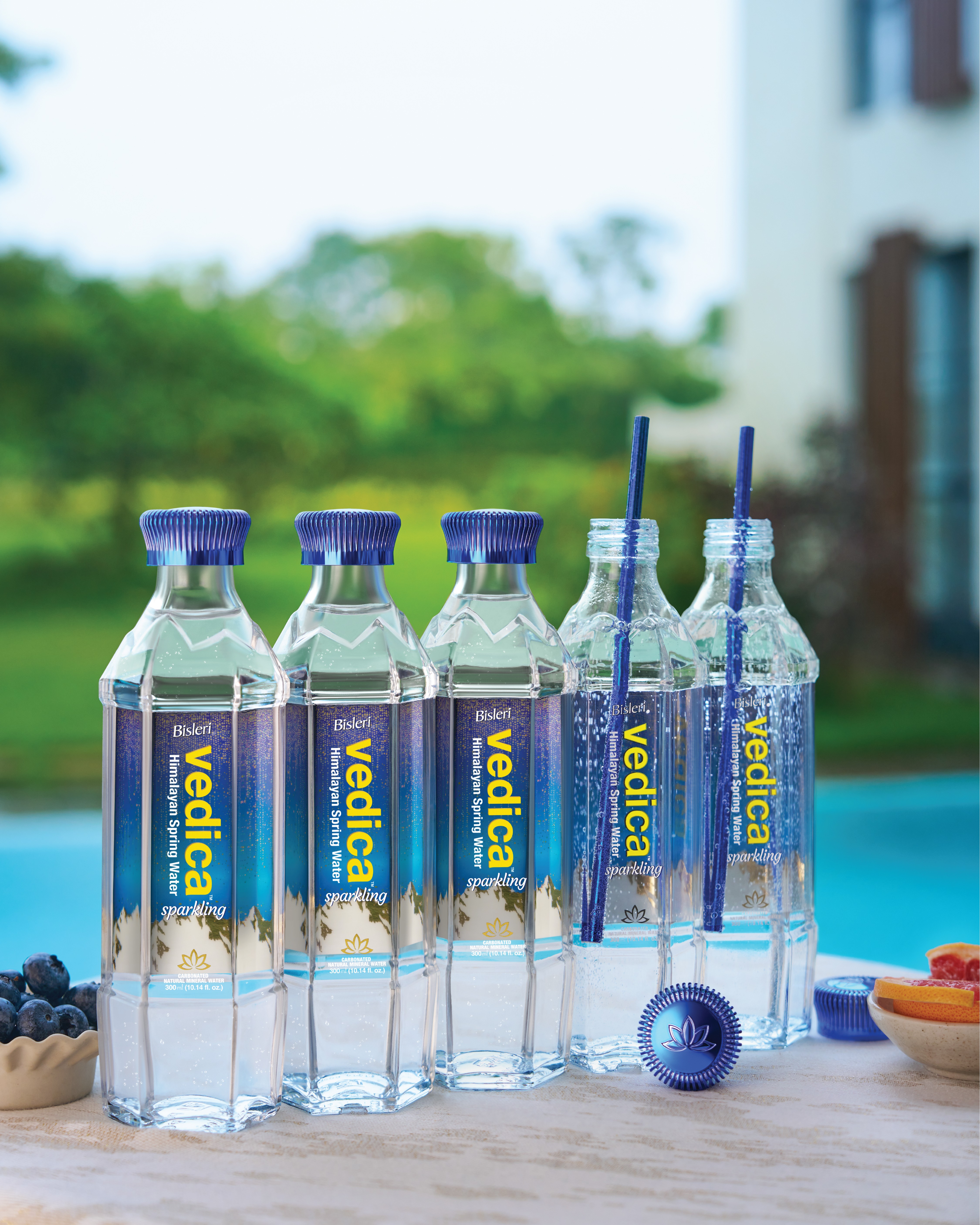
The same sensibility extends beyond the still bottle. Vedica's sparkling variant brings the idea into more convivial settings. Mixologists like the way it lifts citrus, herbs and berries without flattening them. Its carbonation is fine and deliberate, a soft effervescence that refreshes the palate rather than scours it, which is why it has found its way onto low-ABV menus, art dinners, design previews and long, unhurried brunches.

Vedica Sparkling: a fine, deliberate effervescence.
Water is the quietest face of mindful consumption. It does not demand that we consume less, or that every purchase carries moral weight. It asks only that we know more about what we have already chosen.
In a market offering an almost unmanageable abundance, discernment becomes the scarce resource. The Himalayas are where Vedica's story begins. In a wellness landscape thick with elaborate promises about who we might become, there is something restorative about a product content to be what it already is.
TO BE CONTINUED, FOR SUBSCRIBERS ONLY.
This is where the surface ends and the reporting begins.
The complete piece, the full archive, and access to The French Press Circle. Reporting answerable only to its readers.
Already a subscriber ?
Login
Read these on the house, with our compliments.
A selection from the current issue, open to all readers. Read them in full. The rest is one decision away.




There was a time in our pursuit of wellness when 'more' was the goal. Adding a new routine or another product with a promise to benefit some part of the body or mind. But the conversation has become quieter and more exact. We are moving from acquisition to discernment. From collecting experiences and products to understanding them. Surprisingly, water has become part of this conversation on quiet luxury. A compelling expression of the shift towards choosing well is Bisleri Vedica Himalayan Spring Water.
The new luxury of knowing what is worth choosing is visible in the way we live. Homes and experiences are being curated. Wardrobes are becoming more considered, fewer pieces, each chosen for their fabric, construction, or the story of the maker. Travel is slowing down, making room for places to be experienced rather than simply visited. Even at the table, the conversation has moved beyond what is being served to where an ingredient comes from, who produced it, and why it tastes the way it does.
The front of a label no longer settles it. What does is provenance, and it is the same instinct that has redefined luxury. Authenticity cannot be manufactured overnight. It is built through time and stories. We want to know where something has come from, how it was made, and what is in it. For those who have always paid attention to the finer details — the connoisseurs of food, design, craft, travel and beauty — this is less a new habit than a more deliberate way of looking.
Chances are you discuss your coffee now by estate and altitude. Assess beauty products through formulation and sourcing. And ditch the itinerary to opt for slow travel that takes you deeper into the places you pass. The pleasure lies as much in knowing the beginning of something as in the experience itself.
India has known this instinct since time immemorial. Our culture has always rewarded authenticity. Handlooms are bought for the weaver's signature and not a mass label. Cuisines are built around a region's produce. Wellness, too, is traced to its roots before addressing our needs, be it in yoga or Ayurveda. There has always been an understanding that the source can never be an afterthought.
Yet one category integral to wellness has escaped this scrutiny almost entirely. Water. Consumed more often than anything else but examined the least, it is present at breakfast, on our work desks, at a meal and while travelling, but inevitably reduced to a single function.
Water, in fact, may be the most elemental expression of provenance there is. Before it reaches a glass, it has already travelled through a landscape. Its character is shaped by where it begins, the depths it moves through, rocks it encounters, and minerals it gathers along the way. Its origin story can be as particular as any wine or single-estate bean. To ask where it comes from is not affectation. It is the same question we have already learnt to ask of everything else on the table.
Carved at the neck, sealed with a gold crown: Vedica still water in 300ml and 750ml glass.
Once you begin to think about water this way, the category changes. It is no longer simply something we consume; it becomes another expression of place. If we care about the region behind our olive oil and the maker behind our textiles, why should water be the exception? It is within this shift that Bisleri Vedica Himalayan Spring Water earns its place.
Drawn from primordial aquifers deep within the Himalayas, it descends through layers of ancient rock long before it is bottled. Its unhurried passage leaves it naturally enriched with calcium and magnesium and holds its alkalinity between a pH of 7.3 and 7.9. It is bottled at the source. None of these is protocol or promise. It is simply what the mountain does, and what the water is. While a formulation can be engineered, a source certainly cannot.
The Himalayas are not a mood board or a range borrowed for a label. They are the reason Vedica tastes the way it does. Clean, faintly sweet, with the crispness of altitude and a finish that clears rather than lingers. There is an inherent luxury in such simplicity. There is no need to manufacture a story when its source already provides one.
At a well-set table, Vedica takes its place.
Water suits a quieter luxury precisely because its place in the day is so ordinary. Choosing well here does not turn a meal into a ceremony. At a well-composed dining table, every element has a role, the produce, glassware, pour, and pace, and water belongs among them without competing for attention. Vedica's glass bottle distils this. Carved at the neck, sealed with a gold crown, it holds a table without ever asking for the room.
The same sensibility extends beyond the still bottle. Vedica's sparkling variant brings the idea into more convivial settings. Mixologists like the way it lifts citrus, herbs and berries without flattening them. Its carbonation is fine and deliberate, a soft effervescence that refreshes the palate rather than scours it, which is why it has found its way onto low-ABV menus, art dinners, design previews and long, unhurried brunches.
Vedica Sparkling: a fine, deliberate effervescence.
Water is the quietest face of mindful consumption. It does not demand that we consume less, or that every purchase carries moral weight. It asks only that we know more about what we have already chosen.
In a market offering an almost unmanageable abundance, discernment becomes the scarce resource. The Himalayas are where Vedica's story begins. In a wellness landscape thick with elaborate promises about who we might become, there is something restorative about a product content to be what it already is.
TO BE CONTINUED, FOR SUBSCRIBERS ONLY.
This is where the surface ends and the reporting begins.
The complete piece, the full archive, and access to The French Press Circle. Reporting answerable only to its readers.
Already a subscriber ?
Login
Read these on the house, with our compliments.
A selection from the current issue, open to all readers. Read them in full. The rest is one decision away.