There is a sound you hear a lot these days if you spend time on the correct corner of Instagram. It is the small, satisfying press of a plastic gem against a clear phone case, a lighter, or even a nacho, repeated a few thousand times a day across bedrooms in Delhi, Mumbai, Bangalore and every metro in between. On its own it means nothing. In aggregate it looks a great deal like a movement, or at least a very committed hobby that has started to say something about the people doing it.

A bedazzled nacho diy-ed by @stinky.crafts on Instagram
Bedazzling, the act of covering an object in rhinestones, charms, stickers and assorted sparkle, has returned. It never fully left, of course, having lived quietly in the drawers of anyone who owned a pencil box coated in glitter stickers, but it has now acquired the full apparatus of a trend: the hashtags, the hauls, the explainer reels, the faint sense that you are late to something. The more interesting story sits underneath the sparkle, in the reasons a generation with famously little to spare on non-essentials is spending time, money and thumb-callouses making its stuff louder.
The whimsy of it all
Ask anyone who bedazzles why they do it and a specific word arrives with suspicious speed.
"It makes me feel very whimsical," says Akshita Prakash, 24, a masters student who decorates her phone with charms and saves the larger rhinestone stickers for her laptop and iPad case. "It's very cute, and it's just more personalised. It looks pretty."
Whimsy. There it is. It is a word carrying these conversations on its back, a soft, harmless-sounding thing that people reach for the way an earlier generation reached for "it's just a phase." Kayna Gandhi, 23, a fashion communication student, produces it without any prompting at all. "I sometimes add charms to things like my bag, but only because it makes me feel like it adds whimsy to my life, and that's my little joy," she says. Then comes the line that gives the game away: "A lot of people have told me they think my charms are ugly, but I love ugly-cute things."
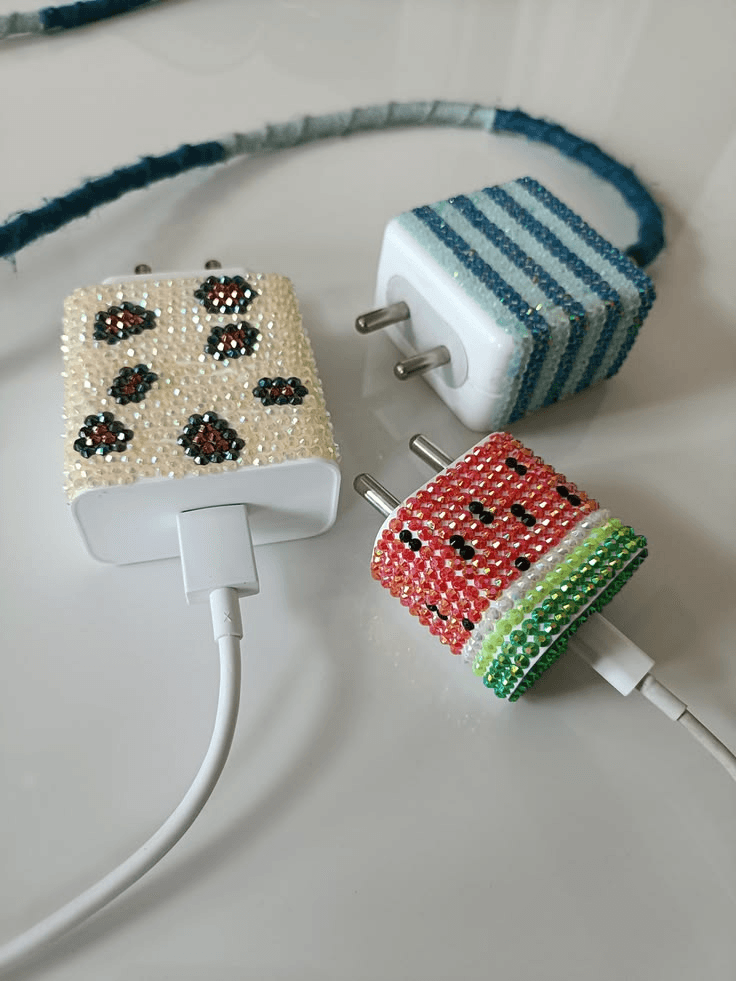
Embellished phone chargers / Image via Pinterest
Whimsy, it turns out, is rarely just that. Somewhere behind the cuteness is a small refusal, a decision to make an object legible only to yourself and slightly illegible to everyone else. Oorja Sood, 20, also a fashion communication student, describes the same logic with a purchaser's precision. "Someone could have that bag, but my bag will still look different, because I customised it in my own way," she says. The charm is not decoration so much as a claim of ownership, a tiny flag planted on mass-produced territory.
Ishita Goel, 21, another fashion communication student, is even blunter about the message and its intended recipient. "My target audience is always girls," she says. "I hope they think I'm not boring and I'm cool. Adding charms and embellishments to a simple silhouette gives a lot of personality to any garment." The bedazzling, in her account, is a form of speech aimed at a specific crowd. "I like to say I'm not a minimalist without opening my mouth."
Against the psych-ward aesthetic
Every trend is a rebuttal to the one before it, and this one knows exactly what it is arguing with. For most of the last decade, taste was governed by restraint. Beige, greige, oat, bone, the whole Farrow-and-Ball spectrum of nothing. Quiet luxury told us that sophistication meant subtraction, that the height of style was owning very expensive things that looked like nothing at all. It was elegant for about a year and then it started to feel like living inside a very well-lit waiting room.
Kayna Gandhi puts the indictment plainly. "Nowadays everything is so bland, colourless, minimal," she says, and that is the whole case for the prosecution. There is a reason "clean girl aesthetic" and its whitewashed interiors began to draw comparisons online to the inside of a psychiatric ward, all soft edges and beige compliance and nothing on the walls. Minimalism promised calm. What it often delivered was the visual equivalent of an unseasoned meal.
Naisha Arora, 23, creative director and founder of the label Maison Rora, reads the revival as a hunger finally breaking its diet. The trend "pushes back against sterile quiet luxury while tapping into the child within that adult life often buries," she says. "People using minimal maximalism, with pops of colour, gemstones and bag charms, show a real hunger for playful creativity after years of restraint."
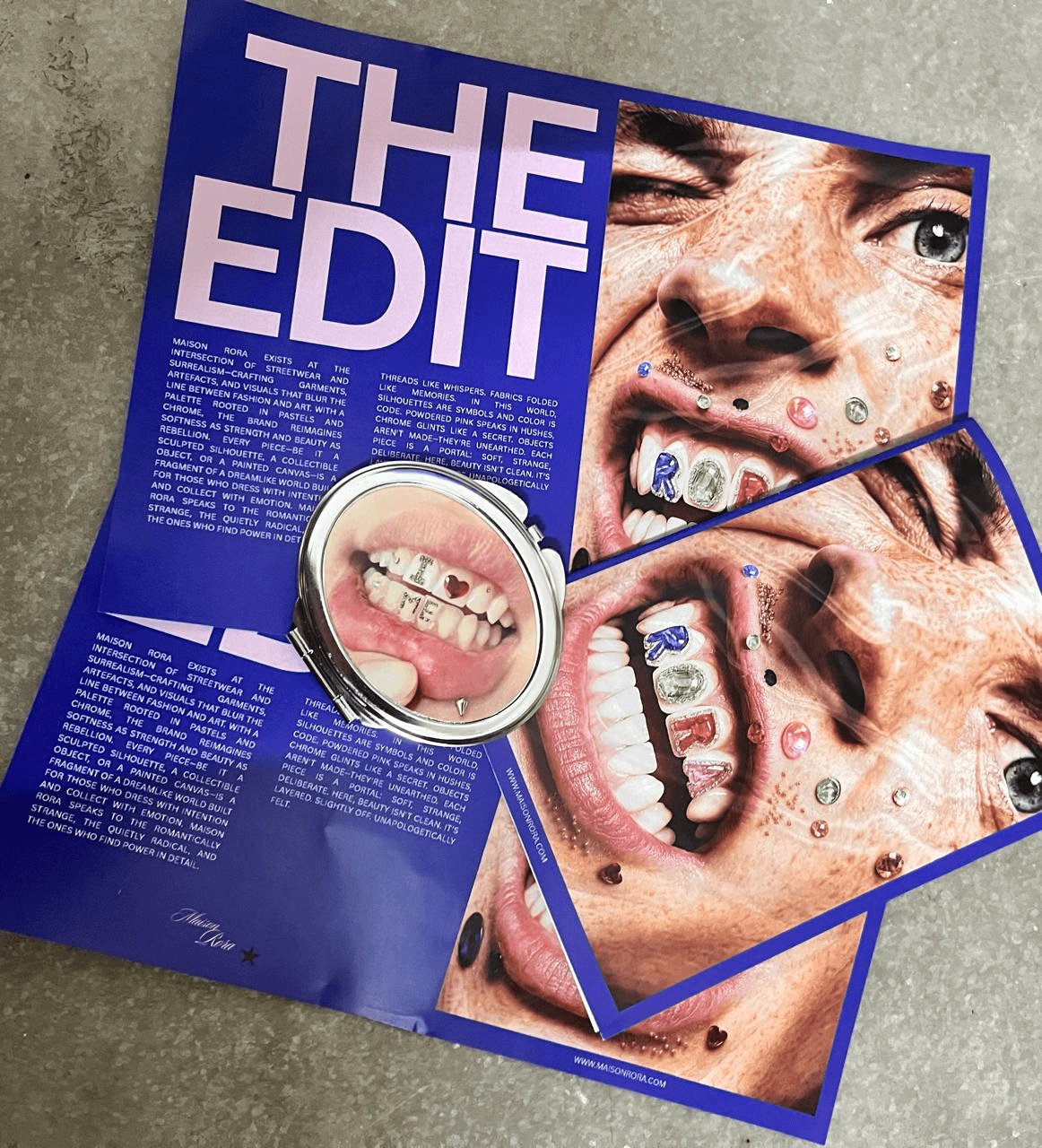
The ‘I LUV ME’ mirror by Maison Rora, with bedazzled packaging. Images from the personal archive of Naisha Arora, founder of Maison Rora
Oorja Sood, notably, refuses to give minimalism even the dignity of an opponent. "I rebel against minimalism in too many things in general," she says. "I feel like that's a personality trait of mine alone." She has also clocked the twist that makes the whole thing more complicated. Even the minimalists, she notices, are not immune. "Even the people who like minimalism, they still look for something unique that other people don't have."
The sticker book was foreshadowing
There is a temporal strangeness to how this generation experiences the past, and bedazzling sits right on top of it. Akshita Prakash points to a trend she watched circulate earlier this year, the notion that 2026 is somehow the new 2016, and to the sudden nostalgia for 2020, of all years. "It was only six years ago, but it feels like a long time ago," she says, describing the peculiar vertigo of people whose entire adolescence is archived online and therefore feels both recent and ancient at once.
Her reading of where the impulse comes from is sharper than she gives herself credit for. People "want to escape back to 2016, 2017, or even 2012, 2013, when the time was simpler," she says. "We were not growing up in a heavy internet era. Now everything is about going wild on Instagram. Your phone is always in your hands."
The escape from the phone is being staged, primarily, by decorating the phone. The route back to a pre-internet childhood runs directly through the most concentrated piece of internet a person owns. Nobody involved seems remotely troubled by this, which is probably the correct attitude.
For many, the nostalgia is deeply emotional, and tangible. Yuvika Sachdeva, 23, an independent journalist, traces it to being a child covering accessories and gadgets in sparkle "to express our creativity and find a hobby that gives us joy." Oorja Sood says it plainly: "I honestly had a sticker book collection when I was a kid, so, definitely." Ishita Goel keeps the thread running all the way back to the classroom. "Since I was little, I used to get those plastic charm sheets to decorate my projects in school," she says. "I really think I reconnect with my childhood by continuing this." Anyone who grew up in India in the 2000s recognises the impulse, the Archies-store haul, the Pokemon trump cards, the scented gel pens, the sacred labour of covering a Classmate notebook until it stopped looking like anyone else's. The current wave is that same child, older now, with disposable income and a Blinkit account. Adult money, as they call it.
Sachdeva resists the tidy rebellion framing, which is the more interesting position. Bedazzling, for her, is less about rejecting minimalism than about reclaiming "a form of joy without it needing to always serve a practical or aesthetic purpose." Joy that justifies itself, decoration that answers to no one, is a stranger and more radical thing than it sounds in a culture that appraises every act of self-expression for its content value before the glue has dried.
The labour theory of the phone case
Looking beyond the glamour, literally, there is real cognitive science lurking under the glitter. Decorate an object with your own hands and your relationship to it changes, and everyone interviewed reported the same shift with something close to unanimity.
"If I am decorating something, it instantly becomes more personalised," Akshita Prakash says. "I go and buy a laptop and it's the same blue-black laptop. But if I add stickers and embellishments to it, it just becomes mine."
Behavioural economists call this the endowment effect, the well-documented tendency to value a thing more highly the moment it is yours and you have poured effort into it. Yuvika Sachdeva gets there on instinct: "No two people can decorate an object in the same way. Bedazzling transforms something ordinary into something that is uniquely ours." Naisha Arora frames it as near-alchemy. "Placing gems or charms embeds your time and energy into the material. It transforms a mass-produced item into an irreplaceable artefact with emotional weight." Kayna Gandhi lands on the sentiment: "One spends time, money, effort into it. It becomes more personalised and sentimental. Personalisation has always brought emotional value to items." Ishita Goel puts it in terms nobody could misread. Whether it is a diary, a lighter or a phone case, she says, "it has a lot more sentimental value than a store-bought product. It's like my baby."
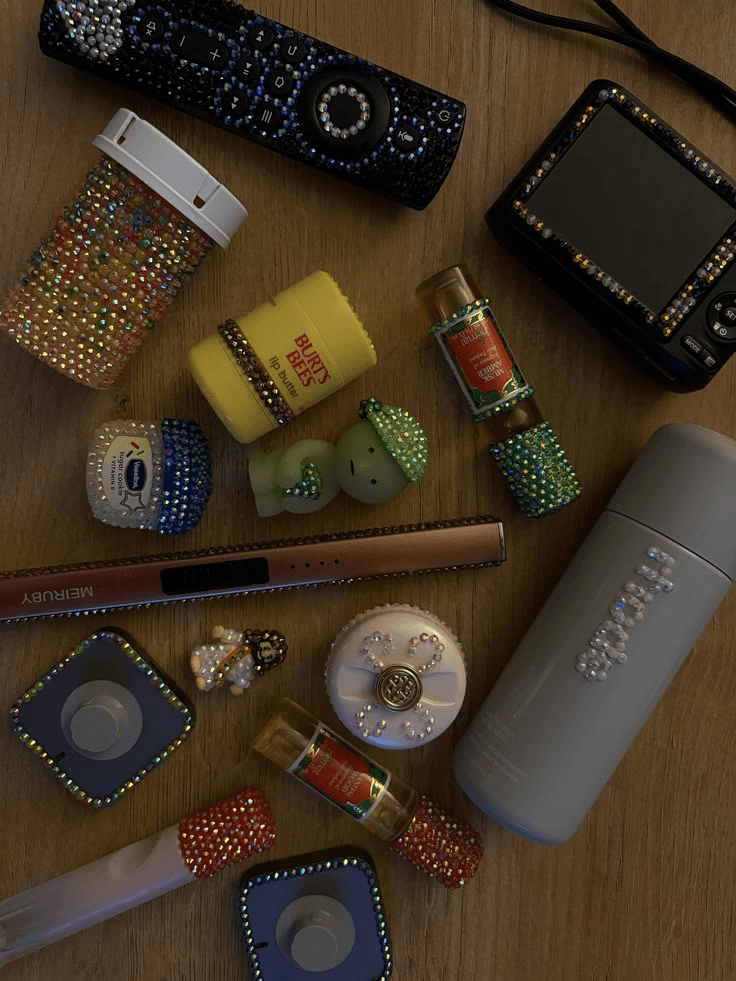
Bedazzled makeup products / Image via Pinterest
Oorja Sood takes it furthest, to the point of overriding price entirely. "I would any day pick a bedazzled pair of low-waist jeans that you cannot easily find online over some normal jeans from Zara or Bershka," she says. "Even if the store-bought product costs more money, for me it (the customised piece) would have more value, because I don't think anyone else could have that easily." A one-of-one thrifted find beats a full-price Zara piece, and the maths only works if the thing being purchased is not the object but the uniqueness. Consider what that means in an economy where you own almost nothing outright, where your music is rented from Spotify and your films leased from an OTT platform that removes them without warning. The hand-bedazzled jeans may be one of the few things in a young person's life that is unambiguously, irreversibly theirs. If you bling it, it’s yours.
The handmade as a small mutiny
This is where the sparkle starts to look less trivial. We have arrived, rather suddenly, in an age where an enormous volume of what we see was not made by a person at all. AI slop fills the feeds: the uncanny render, the six-fingered hand, the caption in a font no human chose, the Ghibli-fied selfie that everyone had for about a week. Everything is generated, templated, optimised, A/B tested into a smooth grey average. The Instagram grid has a house style now, and it is nobody's.
Against this, gluing a plastic gem to a case by hand is a small analogue mutiny. It is slow, it is imperfect, it is unmistakably touched by a specific person. Naisha Arora points to exactly this in the ritual itself. "Social media sparks the trend, but the physical act of placing charms is deeply personal and meditative," she says. "The ultimate satisfaction comes from the hands-on process, not the view count." The handmade object carries the one thing the algorithm cannot fake, which is evidence of a human hand having been there.
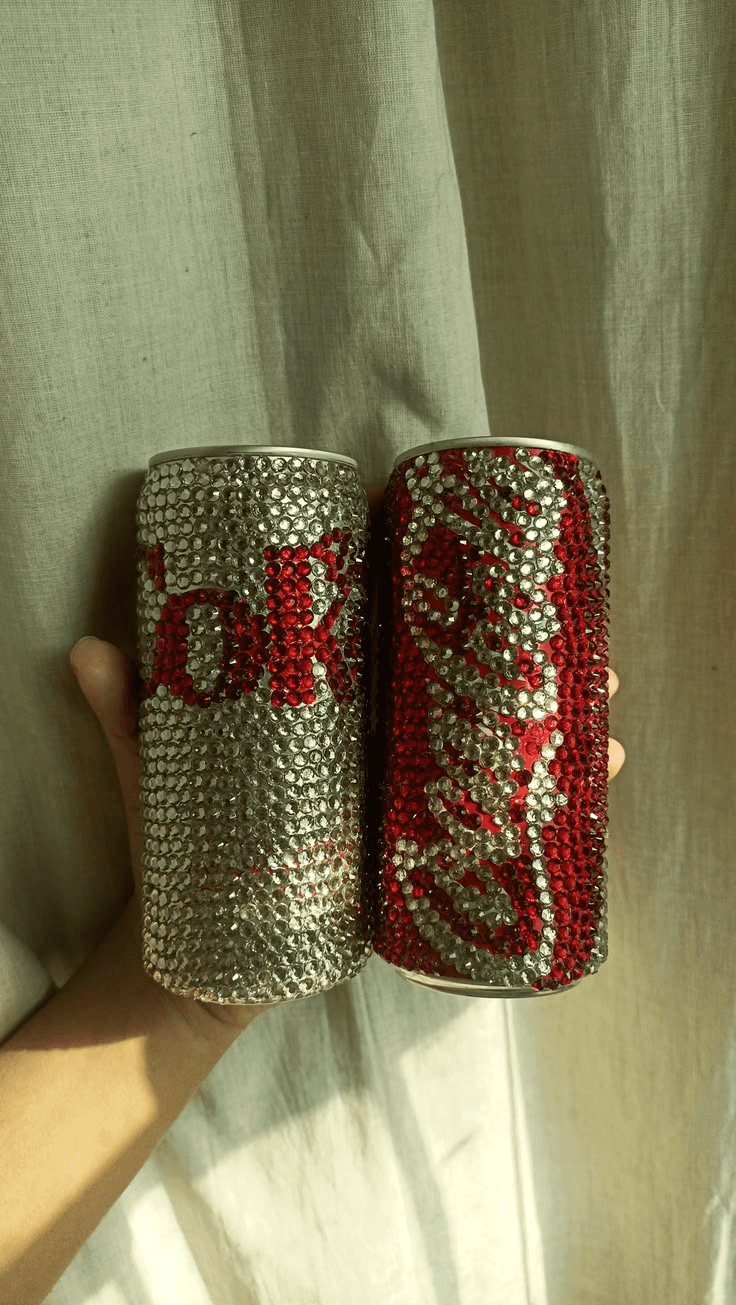
Internet’s latest obsession: Diet coke, now comes in an all new iced-out avatar / Image via Pinterest
There is a sociological word that hovers over all of this: the collective consciousness, the shared set of tastes and images a networked culture converges on. The trouble with a collective consciousness running on recommendation algorithms is that it flattens everyone towards the same handful of aesthetics, the same viral audio, the same three approved personalities. Individuality becomes a rounding error. Ishita Goel describes the exact moment the flattening becomes unbearable. "I literally saw ten people wearing the same bonkers crop top in college on the same day," she says. "It's obviously not a good feeling when you think something you buy is so you, but then, bam, you are just another white sheep." Bedazzling reads, in that light, as a manual override, a way of dragging one object out of the average and insisting it stay strange.
Personal, but Definitely Not Private
No account of a Gen Z aesthetic can dodge the social media question, and to their credit the people doing the bedazzling are clear-eyed about their own compromised position. Akshita Prakash starts by estimating the split between social media influence and private joy at fifty-fifty, then revises herself upwards mid-sentence. "Maybe it's seventy-thirty at this point. Seventy per cent of it is driven by social media." Without the algorithm surfacing nostalgia content, she suspects, "it would have stayed niche."
This produces the central knot of the whole phenomenon, the collapse of the wall between doing a thing because you love it and doing a thing because you watched three hundred people do it first. Prakash traces the family tree with real specificity. The rhinestones-under-the-eye look, she notes, "started because of Euphoria, back in 2022," the HBO show that turned face gems into a semester-long dialect for teenagers who had never been to a rave.
Her test for what counts as real is refreshingly practical: a trend fades, and personal style is whatever survives the fade. "I picked up the rhinestone habit from Euphoria and I still do it, and I don't see a lot of people still doing it as much as they did in 2022," she says. "It has become part of my personal style now, but it was definitely influenced by a trend." Style, in this reading, is just trend with staying power. There is no purity to defend, only persistence to prove.
Ishita Goel proposes a cleaner test, one based on restraint. "People who like to bedazzle genuinely do it out of love, so they will never overdo it," she says. "People who are doing it just for the sake of the trend overdo things and leave that phase behind." The devoted, in her theory, know when to stop. The trend-chasers cannot help but pile on until the phase collapses under its own weight.
Oorja Sood claims the opposite starting point, insisting she was never in it for the trend. "I'm never going to customise something because it's a trend I want to follow. It's always going to fall under personal style for me," she says, before adding the small honesty that complicates it: "This is very personal to me, but it's definitely not private. I'm pretty active on social media, I do like to make content about my style." Personal but not private is possibly the truest four-word description of an entire generation's relationship to everything it enjoys.
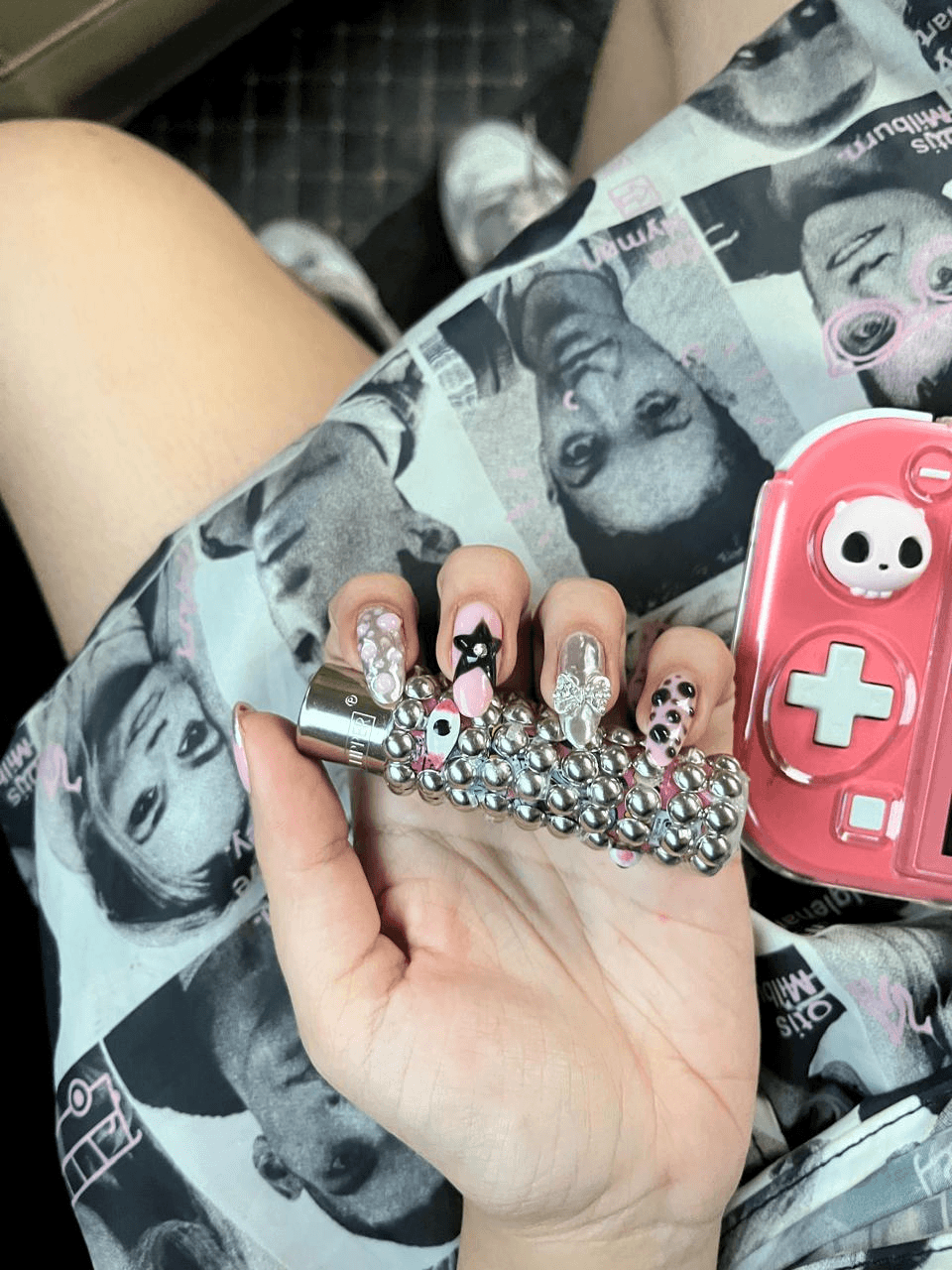
A bedazzled lighter made by Naisha Arora
Naisha Arora locates the dividing line in intention. "Trend-chasing copies viral templates. Genuine style happens when customisation feels unique, mixing unexpected textures and motifs on everyday objects." Kayna Gandhi, in contrast, declines to police the border at all, which is its own kind of answer. "I'm sure there is a line, but it's so subjective, I don't think it's my place to say where to draw it. Each to their own. If you want to bedazzle your whole house, go for it." In a culture that expends colossal energy sorting the authentic from the performative, shrugging and telling someone to bedazzle their whole house is a small mercy.
The uncertainty under the Glitter
Scrape off the crystals and you find something a little melancholy, as tends to be the case with anything that is truly fun. Akshita Prakash offers the widest-angle lens on what the decorating is actually for, and arrives at a paradox she has clearly turned over more than once.
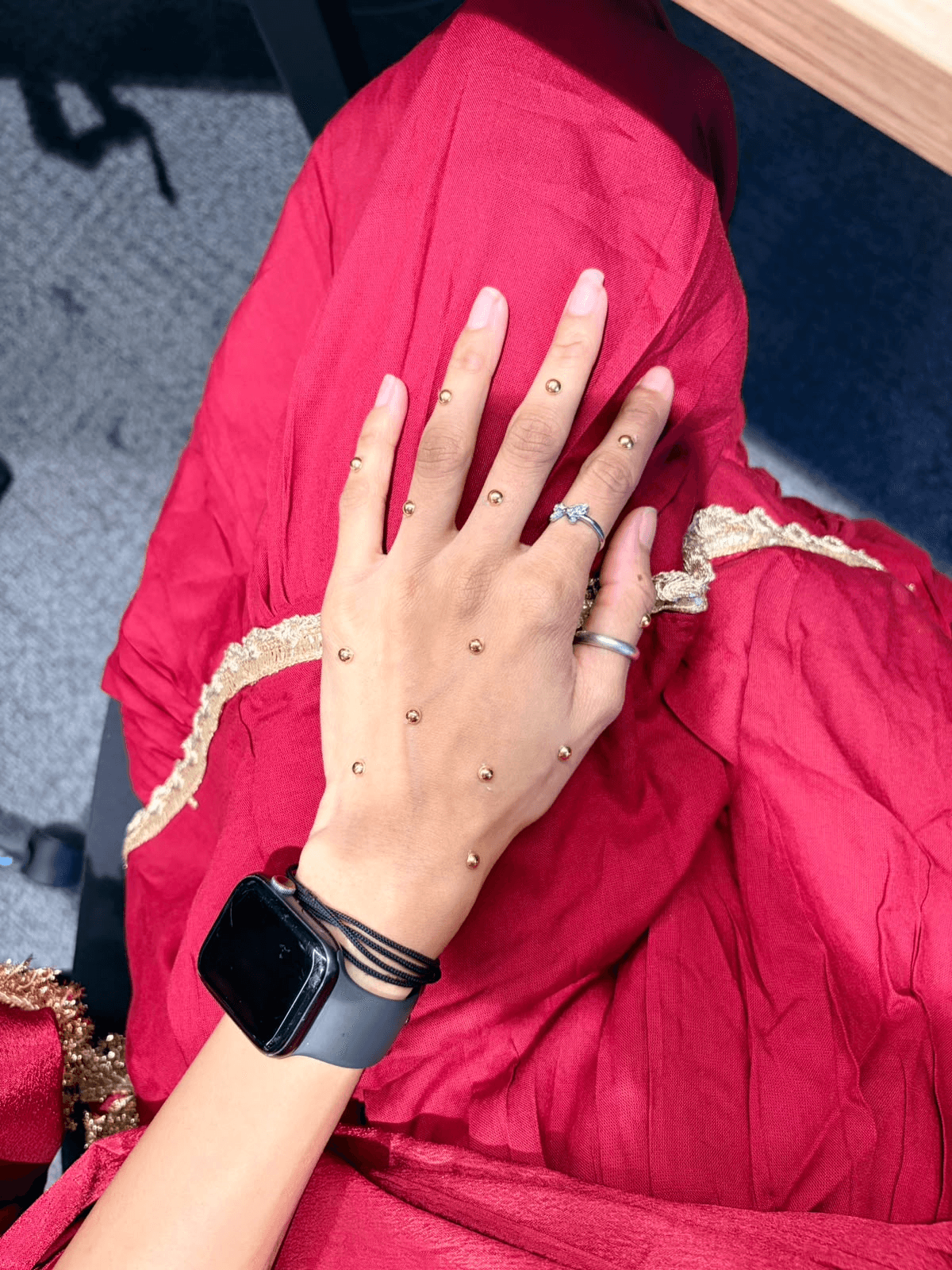
A bedazzled take on the classic Mehendi (henna) by Akshita Prakash
"At some level we do want to feel unique," she says. "But when it comes to other emotions, we want to feel the same way other people do, so we know we're not alone." The bedazzling serves both masters at the same time. It makes your object unlike anyone else's while confirming that you belong to a tribe of people doing exactly the same thing. Performing individuality as a group activity may be the most accurate description of online identity anyone has managed.
She also has a sharp theory about why trends move the way they now do. Decades used to have signatures, she points out, the disco-ball eighties, the comparative restraint of the seventies. "Now we don't really define one decade like that." Cultural identity has splintered into micro-trends with the shelf life of a reel, and maximalism is simply the current coping mechanism. "People feel uncertain and they've picked up maximalism as one form of escape," she says. "Two years later, uncertainty will not go away, but they'll pick up a different method of dealing with it." She names the likely successor herself, the liminal-space and dreamcore videos already gathering pace online. The specific decoration will change. The thing it treats will not.
Kayna Gandhi frames the same instinct as a straightforward reach for control. It "reflects a desire to make something feel personal in a world where everything is mass-produced and looks the same," she says. "It gives people a sense of ownership by taking something as ordinary as a clear phone case and making it distinctly yours." Sit with the object she chose for that sentence. The clear phone case, the single most mass-produced accessory of the decade, sold in identical multipacks to millions, becomes the raw material for uniqueness. The rebellion against sameness is built, entirely, from sameness.
Ishita Goel arrives at the bleakest and most honest version of the same idea. "No one wants to be basic, and no one wants to look exactly like any other person," she says. "Whether it's a small charm on your Crocs or a thousand embellishments on your jacket, it all makes a difference." The stakes she assigns to a single charm are enormous, and she is not wrong to assign them. The charm is the last line of defence against becoming, in her phrase, another white sheep.
None of which makes the joy fake. It makes it complicated, which is a great deal more interesting. A generation that inherited climate dread, a punishing job market and a property ladder that has been pulled up out of reach has responded by asserting total control over the one square inch it can actually own. GenZ cannot buy a flat in Gurgaon anymore. But we can absolutely cover our phone in gems until it refuses to be mistaken for anyone else's. Yuvika Sachdeva calls it "setting yourself free in a world where appearances are heavily curated," and the smallness of the freedom takes nothing away from it.
So the clicking continues, plastic gem meeting plastic case, one more surface pulled out of the average. This will fade, as Akshita Prakash promises it will, and the liminal videos or whatever comes next will take its place. But the thing driving it does not fade. When a generation cannot own the big things, a flat, a stable job, a future it can picture clearly, it takes fierce ownership of the small ones. The rhinestone is not really about the rhinestone. It is a person insisting, against an internet built to make everyone identical, that at least one object in their life will refuse to be anyone else's.
Two years from now the crystals will be in a drawer and the feeds will have moved to something else. What stays is the reflex underneath: the need to leave a fingerprint on a mass-produced world, to make one object carry proof that a specific person, with specific taste and an afternoon to spare, was here. In an age where the algorithm can generate everything except evidence of a human hand, that proof is the whole point. The sparkle is just how it catches the light.
TO BE CONTINUED, FOR SUBSCRIBERS ONLY.
This is where the surface ends and the reporting begins.
The complete piece, the full archive, and access to The French Press Circle. Reporting answerable only to its readers.
Already a subscriber ?
Login
Read these on the house, with our compliments.
A selection from the current issue, open to all readers. Read them in full. The rest is one decision away.









There is a sound you hear a lot these days if you spend time on the correct corner of Instagram. It is the small, satisfying press of a plastic gem against a clear phone case, a lighter, or even a nacho, repeated a few thousand times a day across bedrooms in Delhi, Mumbai, Bangalore and every metro in between. On its own it means nothing. In aggregate it looks a great deal like a movement, or at least a very committed hobby that has started to say something about the people doing it.
A bedazzled nacho diy-ed by @stinky.crafts on Instagram
Bedazzling, the act of covering an object in rhinestones, charms, stickers and assorted sparkle, has returned. It never fully left, of course, having lived quietly in the drawers of anyone who owned a pencil box coated in glitter stickers, but it has now acquired the full apparatus of a trend: the hashtags, the hauls, the explainer reels, the faint sense that you are late to something. The more interesting story sits underneath the sparkle, in the reasons a generation with famously little to spare on non-essentials is spending time, money and thumb-callouses making its stuff louder.
The whimsy of it all
Ask anyone who bedazzles why they do it and a specific word arrives with suspicious speed.
"It makes me feel very whimsical," says Akshita Prakash, 24, a masters student who decorates her phone with charms and saves the larger rhinestone stickers for her laptop and iPad case. "It's very cute, and it's just more personalised. It looks pretty."
Whimsy. There it is. It is a word carrying these conversations on its back, a soft, harmless-sounding thing that people reach for the way an earlier generation reached for "it's just a phase." Kayna Gandhi, 23, a fashion communication student, produces it without any prompting at all. "I sometimes add charms to things like my bag, but only because it makes me feel like it adds whimsy to my life, and that's my little joy," she says. Then comes the line that gives the game away: "A lot of people have told me they think my charms are ugly, but I love ugly-cute things."
Embellished phone chargers / Image via Pinterest
Whimsy, it turns out, is rarely just that. Somewhere behind the cuteness is a small refusal, a decision to make an object legible only to yourself and slightly illegible to everyone else. Oorja Sood, 20, also a fashion communication student, describes the same logic with a purchaser's precision. "Someone could have that bag, but my bag will still look different, because I customised it in my own way," she says. The charm is not decoration so much as a claim of ownership, a tiny flag planted on mass-produced territory.
Ishita Goel, 21, another fashion communication student, is even blunter about the message and its intended recipient. "My target audience is always girls," she says. "I hope they think I'm not boring and I'm cool. Adding charms and embellishments to a simple silhouette gives a lot of personality to any garment." The bedazzling, in her account, is a form of speech aimed at a specific crowd. "I like to say I'm not a minimalist without opening my mouth."
Against the psych-ward aesthetic
Every trend is a rebuttal to the one before it, and this one knows exactly what it is arguing with. For most of the last decade, taste was governed by restraint. Beige, greige, oat, bone, the whole Farrow-and-Ball spectrum of nothing. Quiet luxury told us that sophistication meant subtraction, that the height of style was owning very expensive things that looked like nothing at all. It was elegant for about a year and then it started to feel like living inside a very well-lit waiting room.
Kayna Gandhi puts the indictment plainly. "Nowadays everything is so bland, colourless, minimal," she says, and that is the whole case for the prosecution. There is a reason "clean girl aesthetic" and its whitewashed interiors began to draw comparisons online to the inside of a psychiatric ward, all soft edges and beige compliance and nothing on the walls. Minimalism promised calm. What it often delivered was the visual equivalent of an unseasoned meal.
Naisha Arora, 23, creative director and founder of the label Maison Rora, reads the revival as a hunger finally breaking its diet. The trend "pushes back against sterile quiet luxury while tapping into the child within that adult life often buries," she says. "People using minimal maximalism, with pops of colour, gemstones and bag charms, show a real hunger for playful creativity after years of restraint."
The ‘I LUV ME’ mirror by Maison Rora, with bedazzled packaging. Images from the personal archive of Naisha Arora, founder of Maison Rora
Oorja Sood, notably, refuses to give minimalism even the dignity of an opponent. "I rebel against minimalism in too many things in general," she says. "I feel like that's a personality trait of mine alone." She has also clocked the twist that makes the whole thing more complicated. Even the minimalists, she notices, are not immune. "Even the people who like minimalism, they still look for something unique that other people don't have."
The sticker book was foreshadowing
There is a temporal strangeness to how this generation experiences the past, and bedazzling sits right on top of it. Akshita Prakash points to a trend she watched circulate earlier this year, the notion that 2026 is somehow the new 2016, and to the sudden nostalgia for 2020, of all years. "It was only six years ago, but it feels like a long time ago," she says, describing the peculiar vertigo of people whose entire adolescence is archived online and therefore feels both recent and ancient at once.
Her reading of where the impulse comes from is sharper than she gives herself credit for. People "want to escape back to 2016, 2017, or even 2012, 2013, when the time was simpler," she says. "We were not growing up in a heavy internet era. Now everything is about going wild on Instagram. Your phone is always in your hands."
The escape from the phone is being staged, primarily, by decorating the phone. The route back to a pre-internet childhood runs directly through the most concentrated piece of internet a person owns. Nobody involved seems remotely troubled by this, which is probably the correct attitude.
For many, the nostalgia is deeply emotional, and tangible. Yuvika Sachdeva, 23, an independent journalist, traces it to being a child covering accessories and gadgets in sparkle "to express our creativity and find a hobby that gives us joy." Oorja Sood says it plainly: "I honestly had a sticker book collection when I was a kid, so, definitely." Ishita Goel keeps the thread running all the way back to the classroom. "Since I was little, I used to get those plastic charm sheets to decorate my projects in school," she says. "I really think I reconnect with my childhood by continuing this." Anyone who grew up in India in the 2000s recognises the impulse, the Archies-store haul, the Pokemon trump cards, the scented gel pens, the sacred labour of covering a Classmate notebook until it stopped looking like anyone else's. The current wave is that same child, older now, with disposable income and a Blinkit account. Adult money, as they call it.
Sachdeva resists the tidy rebellion framing, which is the more interesting position. Bedazzling, for her, is less about rejecting minimalism than about reclaiming "a form of joy without it needing to always serve a practical or aesthetic purpose." Joy that justifies itself, decoration that answers to no one, is a stranger and more radical thing than it sounds in a culture that appraises every act of self-expression for its content value before the glue has dried.
The labour theory of the phone case
Looking beyond the glamour, literally, there is real cognitive science lurking under the glitter. Decorate an object with your own hands and your relationship to it changes, and everyone interviewed reported the same shift with something close to unanimity.
"If I am decorating something, it instantly becomes more personalised," Akshita Prakash says. "I go and buy a laptop and it's the same blue-black laptop. But if I add stickers and embellishments to it, it just becomes mine."
Behavioural economists call this the endowment effect, the well-documented tendency to value a thing more highly the moment it is yours and you have poured effort into it. Yuvika Sachdeva gets there on instinct: "No two people can decorate an object in the same way. Bedazzling transforms something ordinary into something that is uniquely ours." Naisha Arora frames it as near-alchemy. "Placing gems or charms embeds your time and energy into the material. It transforms a mass-produced item into an irreplaceable artefact with emotional weight." Kayna Gandhi lands on the sentiment: "One spends time, money, effort into it. It becomes more personalised and sentimental. Personalisation has always brought emotional value to items." Ishita Goel puts it in terms nobody could misread. Whether it is a diary, a lighter or a phone case, she says, "it has a lot more sentimental value than a store-bought product. It's like my baby."
Bedazzled makeup products / Image via Pinterest
Oorja Sood takes it furthest, to the point of overriding price entirely. "I would any day pick a bedazzled pair of low-waist jeans that you cannot easily find online over some normal jeans from Zara or Bershka," she says. "Even if the store-bought product costs more money, for me it (the customised piece) would have more value, because I don't think anyone else could have that easily." A one-of-one thrifted find beats a full-price Zara piece, and the maths only works if the thing being purchased is not the object but the uniqueness. Consider what that means in an economy where you own almost nothing outright, where your music is rented from Spotify and your films leased from an OTT platform that removes them without warning. The hand-bedazzled jeans may be one of the few things in a young person's life that is unambiguously, irreversibly theirs. If you bling it, it’s yours.
The handmade as a small mutiny
This is where the sparkle starts to look less trivial. We have arrived, rather suddenly, in an age where an enormous volume of what we see was not made by a person at all. AI slop fills the feeds: the uncanny render, the six-fingered hand, the caption in a font no human chose, the Ghibli-fied selfie that everyone had for about a week. Everything is generated, templated, optimised, A/B tested into a smooth grey average. The Instagram grid has a house style now, and it is nobody's.
Against this, gluing a plastic gem to a case by hand is a small analogue mutiny. It is slow, it is imperfect, it is unmistakably touched by a specific person. Naisha Arora points to exactly this in the ritual itself. "Social media sparks the trend, but the physical act of placing charms is deeply personal and meditative," she says. "The ultimate satisfaction comes from the hands-on process, not the view count." The handmade object carries the one thing the algorithm cannot fake, which is evidence of a human hand having been there.
Internet’s latest obsession: Diet coke, now comes in an all new iced-out avatar / Image via Pinterest
There is a sociological word that hovers over all of this: the collective consciousness, the shared set of tastes and images a networked culture converges on. The trouble with a collective consciousness running on recommendation algorithms is that it flattens everyone towards the same handful of aesthetics, the same viral audio, the same three approved personalities. Individuality becomes a rounding error. Ishita Goel describes the exact moment the flattening becomes unbearable. "I literally saw ten people wearing the same bonkers crop top in college on the same day," she says. "It's obviously not a good feeling when you think something you buy is so you, but then, bam, you are just another white sheep." Bedazzling reads, in that light, as a manual override, a way of dragging one object out of the average and insisting it stay strange.
Personal, but Definitely Not Private
No account of a Gen Z aesthetic can dodge the social media question, and to their credit the people doing the bedazzling are clear-eyed about their own compromised position. Akshita Prakash starts by estimating the split between social media influence and private joy at fifty-fifty, then revises herself upwards mid-sentence. "Maybe it's seventy-thirty at this point. Seventy per cent of it is driven by social media." Without the algorithm surfacing nostalgia content, she suspects, "it would have stayed niche."
This produces the central knot of the whole phenomenon, the collapse of the wall between doing a thing because you love it and doing a thing because you watched three hundred people do it first. Prakash traces the family tree with real specificity. The rhinestones-under-the-eye look, she notes, "started because of Euphoria, back in 2022," the HBO show that turned face gems into a semester-long dialect for teenagers who had never been to a rave.
Her test for what counts as real is refreshingly practical: a trend fades, and personal style is whatever survives the fade. "I picked up the rhinestone habit from Euphoria and I still do it, and I don't see a lot of people still doing it as much as they did in 2022," she says. "It has become part of my personal style now, but it was definitely influenced by a trend." Style, in this reading, is just trend with staying power. There is no purity to defend, only persistence to prove.
Ishita Goel proposes a cleaner test, one based on restraint. "People who like to bedazzle genuinely do it out of love, so they will never overdo it," she says. "People who are doing it just for the sake of the trend overdo things and leave that phase behind." The devoted, in her theory, know when to stop. The trend-chasers cannot help but pile on until the phase collapses under its own weight.
Oorja Sood claims the opposite starting point, insisting she was never in it for the trend. "I'm never going to customise something because it's a trend I want to follow. It's always going to fall under personal style for me," she says, before adding the small honesty that complicates it: "This is very personal to me, but it's definitely not private. I'm pretty active on social media, I do like to make content about my style." Personal but not private is possibly the truest four-word description of an entire generation's relationship to everything it enjoys.
A bedazzled lighter made by Naisha Arora
Naisha Arora locates the dividing line in intention. "Trend-chasing copies viral templates. Genuine style happens when customisation feels unique, mixing unexpected textures and motifs on everyday objects." Kayna Gandhi, in contrast, declines to police the border at all, which is its own kind of answer. "I'm sure there is a line, but it's so subjective, I don't think it's my place to say where to draw it. Each to their own. If you want to bedazzle your whole house, go for it." In a culture that expends colossal energy sorting the authentic from the performative, shrugging and telling someone to bedazzle their whole house is a small mercy.
The uncertainty under the Glitter
Scrape off the crystals and you find something a little melancholy, as tends to be the case with anything that is truly fun. Akshita Prakash offers the widest-angle lens on what the decorating is actually for, and arrives at a paradox she has clearly turned over more than once.
A bedazzled take on the classic Mehendi (henna) by Akshita Prakash
"At some level we do want to feel unique," she says. "But when it comes to other emotions, we want to feel the same way other people do, so we know we're not alone." The bedazzling serves both masters at the same time. It makes your object unlike anyone else's while confirming that you belong to a tribe of people doing exactly the same thing. Performing individuality as a group activity may be the most accurate description of online identity anyone has managed.
She also has a sharp theory about why trends move the way they now do. Decades used to have signatures, she points out, the disco-ball eighties, the comparative restraint of the seventies. "Now we don't really define one decade like that." Cultural identity has splintered into micro-trends with the shelf life of a reel, and maximalism is simply the current coping mechanism. "People feel uncertain and they've picked up maximalism as one form of escape," she says. "Two years later, uncertainty will not go away, but they'll pick up a different method of dealing with it." She names the likely successor herself, the liminal-space and dreamcore videos already gathering pace online. The specific decoration will change. The thing it treats will not.
Kayna Gandhi frames the same instinct as a straightforward reach for control. It "reflects a desire to make something feel personal in a world where everything is mass-produced and looks the same," she says. "It gives people a sense of ownership by taking something as ordinary as a clear phone case and making it distinctly yours." Sit with the object she chose for that sentence. The clear phone case, the single most mass-produced accessory of the decade, sold in identical multipacks to millions, becomes the raw material for uniqueness. The rebellion against sameness is built, entirely, from sameness.
Ishita Goel arrives at the bleakest and most honest version of the same idea. "No one wants to be basic, and no one wants to look exactly like any other person," she says. "Whether it's a small charm on your Crocs or a thousand embellishments on your jacket, it all makes a difference." The stakes she assigns to a single charm are enormous, and she is not wrong to assign them. The charm is the last line of defence against becoming, in her phrase, another white sheep.
None of which makes the joy fake. It makes it complicated, which is a great deal more interesting. A generation that inherited climate dread, a punishing job market and a property ladder that has been pulled up out of reach has responded by asserting total control over the one square inch it can actually own. GenZ cannot buy a flat in Gurgaon anymore. But we can absolutely cover our phone in gems until it refuses to be mistaken for anyone else's. Yuvika Sachdeva calls it "setting yourself free in a world where appearances are heavily curated," and the smallness of the freedom takes nothing away from it.
So the clicking continues, plastic gem meeting plastic case, one more surface pulled out of the average. This will fade, as Akshita Prakash promises it will, and the liminal videos or whatever comes next will take its place. But the thing driving it does not fade. When a generation cannot own the big things, a flat, a stable job, a future it can picture clearly, it takes fierce ownership of the small ones. The rhinestone is not really about the rhinestone. It is a person insisting, against an internet built to make everyone identical, that at least one object in their life will refuse to be anyone else's.
Two years from now the crystals will be in a drawer and the feeds will have moved to something else. What stays is the reflex underneath: the need to leave a fingerprint on a mass-produced world, to make one object carry proof that a specific person, with specific taste and an afternoon to spare, was here. In an age where the algorithm can generate everything except evidence of a human hand, that proof is the whole point. The sparkle is just how it catches the light.
TO BE CONTINUED, FOR SUBSCRIBERS ONLY.
This is where the surface ends and the reporting begins.
The complete piece, the full archive, and access to The French Press Circle. Reporting answerable only to its readers.
Already a subscriber ?
Login
Read these on the house, with our compliments.
A selection from the current issue, open to all readers. Read them in full. The rest is one decision away.