
On August 5, 2026, a release went out from Mumbai and Los Angeles in the same hour. Reliance Brands Limited and Skims, the shapewear label co-founded by Kim Kardashian and Jens Grede, were partnering to bring the brand to India, opening first in Delhi and Mumbai before a phased expansion across cities and channels. Isha Ambani, director of Reliance Retail, supplied the quotable line: Skims "has changed how the world thinks about shape, comfort and inclusivity," and it "speaks directly to a new generation of Indian consumers who want fashion that is both aspirational and made for them."
Made for them. Hold the phrase;there’s much more on this as you read.
The numbers are verified and mostly unglamorous. Skims was valued at $5 billion in November 2025 after a $225 million round led by Goldman Sachs Alternatives, with BDT & MSD Partners' affiliated funds joining, up from roughly $4 billion at its 2023 Series C. It expected to clear $1 billion in net sales that year. India's entire shapewear market was worth about $101.5 million in 2025 by Grand View Research's Horizon estimate, on track for around $202.6 million by 2033 at a compound rate near nine percent. India was a little over three percent of the global shapewear market last year. The category Skims is entering is small. The luxury market around it is not: consultancy forecasts range from $85 billion to $180 billion by 2030, depending on the model.
The ₹400 Shaper India Already Owns
Indian women did not wait for Skims to discover shapewear. They have worn it for generations and bought the modern version in bulk for the last decade, cheaply, from homegrown labels.
Zivame's saree-shapewear catalogue runs largely between ₹400 and ₹800, the "mermaid" silhouette sold on an unsentimental promise: two inches slimmer under an organza drape. On Flipkart, Lyra and Zivame shapers move at ₹300 to ₹600. These are not aspirational objects. They are the invisible foundation under a wedding-season wardrobe, the thing a mother tells a daughter to buy before the reception, the reason the petticoat has been slowly compressed out of existence.
The saree shaper is an Indian solution, not an import: a 5,000-year-old draping problem answered in polyamide spandex. It is worn across income brackets, in towns where a Skims store will never open, by women who would not describe themselves as shapewear consumers. Into that room walks a brand selling "technically engineered shapewear that enhances curves," where the product already exists, already works, and already costs a tenth as much.
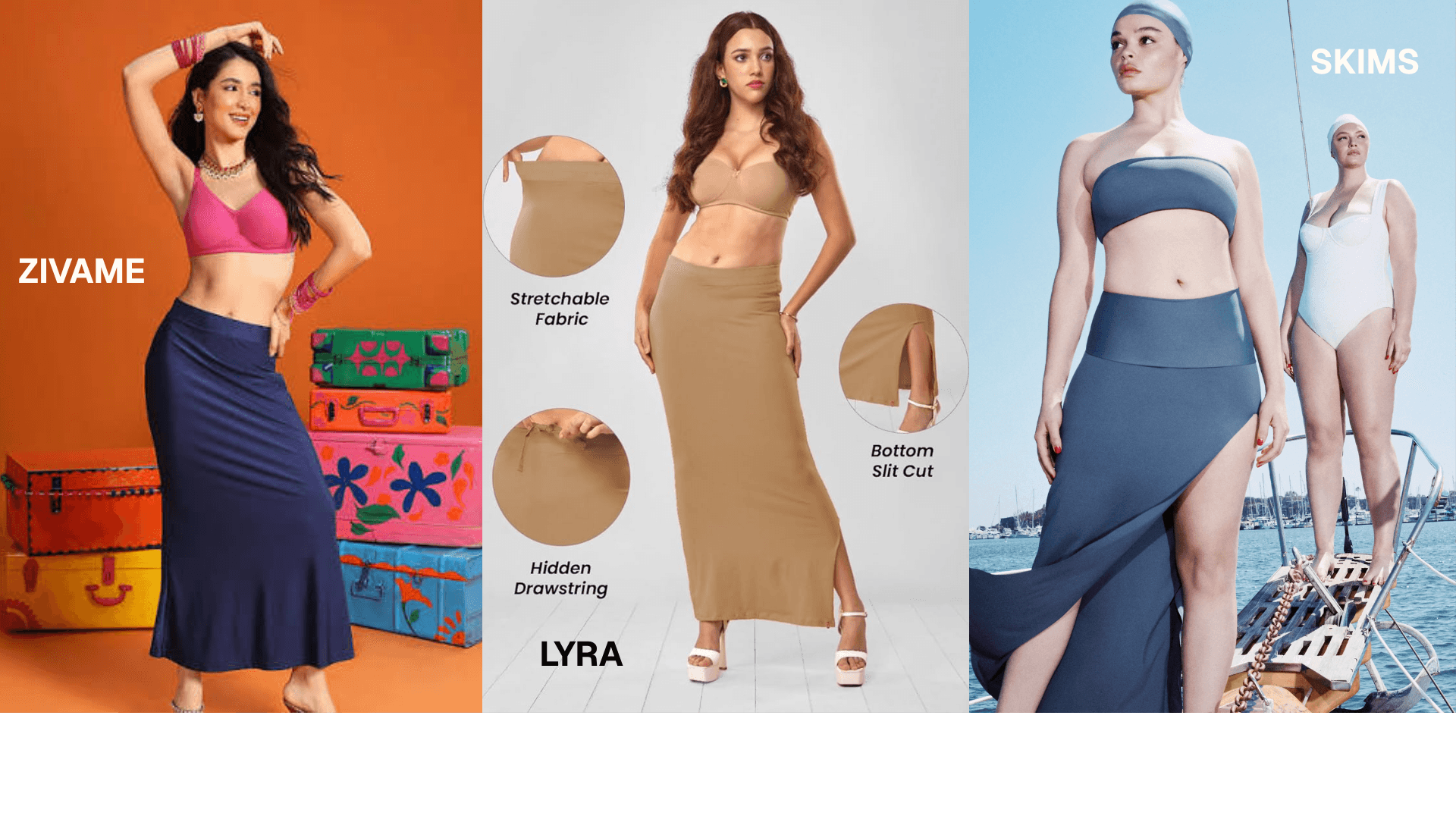
A side-by-side comparison of Zivame (left), Lyra (middle) and new global entrant Skims (right)
Function, therefore, is not the sale. Meaning is. A ₹400 Zivame shaper and a Skims Sculpting Bodysuit at several thousand rupees do close to the same physical work; the premium buys the brand as a sentence about the wearer. India is about to watch that alchemy performed on a garment its grandmothers wore under cotton sarees without once believing it made them interesting.
Skims' 'Nude' Problem Meets India's Colourism
Skims was built on a shade card. Kardashian's origin story, recited in nearly every profile, is frustration with shapewear that came in one or two "nudes" and matched no real skin, and a brand launched instead with a graded range of neutrals meant to vanish against many complexions. The 2019 relaunch imagery widened from six thin torsos to a dozen women of different sizes and colours. Skin-tone inclusivity was not a footnote. It was the whole pitch.
That pitch has to survive contact with a country that has fought over this exact word for a century. "Nude" has never been neutral in India. The subcontinent's colourism is documented, structural and old, braided into caste and hardened under colonial rule, enforced for decades by a beauty economy that sold lightness as ambition. Unilever's fairness cream held a dominant share of that category for roughly forty years; when the 2020 reckoning came, the company dropped "Fair" from the name and called it "Glow & Lovely." Nandita Das, years into the "Dark is Beautiful" and "India's Got Colour" campaigns, made the obvious point that renaming a cream does not unmake the belief it monetised.
A shade card built for a Western read of "diverse" can still cluster around tones that leave the deepest and the most olive-yellow Indian skins matching nothing on the shelf. Whether Skims re-tooled its palette for South Asian undertones or shipped the global range and called it inclusion is the question the launch copy does not touch. Ship it unchanged, and the brand whose founding claim is a nude for everyone reproduces, in the one market most sensitised to it, the grievance it was built to end. Adapt it, and there is a real story of adaptation Skims has every reason to tell and has not. So far it offers the excitement of its Indian "community," which is not an answer. The display will answer it, to anyone who holds a forearm to the swatches and looks.
The Dupes Got There First
The Skims look has been available in India without Skims for years. The dupe economy the brand spawned, Amazon bodysuits at a third of the price, seamless bike shorts, the sculpting thong bodysuit that lives on TikTok, reaches Indian buyers through the same cross-border marketplaces and Instagram resellers that carry everything else. The silhouette, the muted colour names, the second-skin hand-feel were fluent here long before the franchise deal was signed.
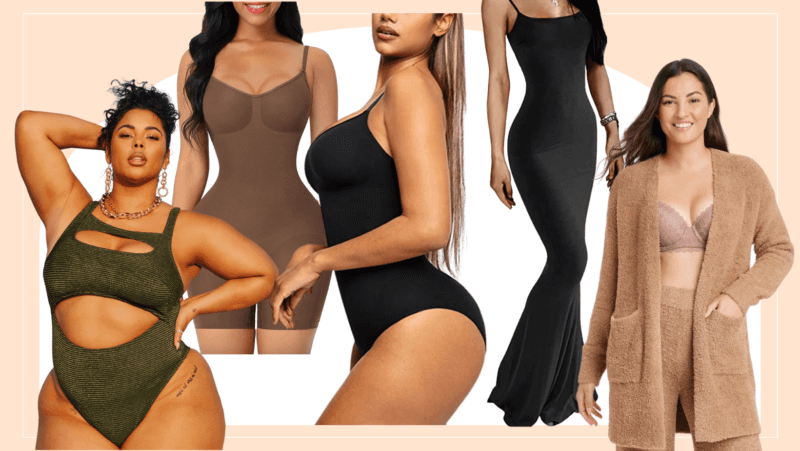
A collage of various Skims dupes available on Amazon
Skims opens in Delhi not to introduce its aesthetic but as the authenticated edition of one the market already knows through imitation. The dupes did years of unpaid brand-building; the original arrives to collect. Whether the Indian buyer pays the premium for authorship, or shrugs because the ₹600 version snatches the waist identically under a lehenga, is the commercial hinge of the launch, and the one Kardashian's wattage controls least.
Why Skims Needed Reliance to Enter India
No global brand crosses into India alone anymore, and the door Skims used explains the timing better than any consumer trend.
Reliance Brands is the premium arm of Reliance Retail, inside Mukesh Ambani's conglomerate, and it has spent nearly two decades assembling the largest stable of foreign luxury and premium labels operating in the country: Tiffany, Versace, Balenciaga, Valentino, Jimmy Choo, Ferragamo, Bottega Veneta, and Fenty, the Rihanna line it also imported. It runs well over 1,800 doors. Isha Ambani has called India "the next big growth story in luxury," and the family's billion-dollar Jio World Plaza in Mumbai exists to be the portal each foreign brand passes through. India's retail market is fragmented, tariff-walled and operationally punishing; Reliance is the toll road, and partnering with it is less a preference than an acknowledgment of how the country works.
Skims enters on the logic that carried Fenty and Valentino, a shelf assembled for the roughly 110 million middle-income households analysts expect India to add by 2030 and the 1.2 million-plus millionaires it may cross by 2027. The play is the aisle, not the shapewear. A new consumer class is learning to spend, and Reliance is stocking the shelf it will reach for. Kardashian is the most legible name money can put on it.
From 'Kimono' to Cultural Sensitivity: The Kardashian Contradiction
Skims's inclusivity is real and selectively remembered. The brand that now trades on skin-tone sensitivity launched in 2019 as "Kimono," a pun on Kardashian's own name pressed onto a sacred Japanese garment. The backlash was immediate and global; #KimOhNo trended, the mayor of Kyoto wrote to explain what the kimono means, Japanese officials pressed the trademark. She abandoned the name and the filings, relaunched as Skims, and has said her intentions were innocent and the cultural significance simply lost on her.
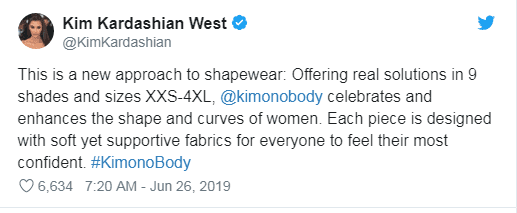
Kim Kardashian via a Twitter post, announcing KIMONO, dated June 26, 2019
The Kardashians have long been a standing social paradox, some may even say that very paradox is their claim to fame; that they’ve made controversy a marketing strategy; and in momager Kris’ words, "There is no such thing as bad publicity.”
The shade range and the size range, XXS to 5XL, are genuine; yet the founder also tried to trademark a culture's word for its own design ethos because it contained her nickname. India knows the sensation of having its garments and symbols borrowed, flattened and sold back, yoga to bindis to "boho" print. Received as an emissary of cultural sensitivity, a brand whose founding scandal was cultural appropriation in all but the courtroom, it asks the Indian consumer to practise the amnesia she is being trained into. Kardashian is not disqualified by it. But "made for them" is being said by someone who had to be told, at volume, that a garment was not hers to name.
Skims India: The Tests That Will Decide the Launch
A few tests outlast the launch copy. Whether the India shade range is built for South Asian skin or imported and relabelled. Whether Skims prices as accessible premium, competing at the top of the Zivame-and-imports bracket, or as untouchable luxury priced to signal rather than move, and which the buyer rewards. Whether its skin-forward global aesthetic runs on a single feed here or splits into an Indian one, and how much that split admits about adaptation versus arrival.
The last test is the widest. The saree shaper is worn in towns Skims will not open in. For years the brand is a Delhi-and-Mumbai object for a consumer who already follows Kardashian, already owns the dupes, and can already pay for the authenticated version of a thing available for less. A real market, and a thin slice of a country. Between that slice and the woman buying a ₹400 mermaid shaper for her cousin's wedding sits the whole distance between the India in the press release and the India that gets dressed in the morning.
A second skin. Whose, at what price, and made in the end for whom, is answered in carts, not quotes.
TO BE CONTINUED, FOR SUBSCRIBERS ONLY.
This is where the surface ends and the reporting begins.
The complete piece, the full archive, and access to The French Press Circle. Reporting answerable only to its readers.
Already a subscriber ?
Login
Read these on the house, with our compliments.
A selection from the current issue, open to all readers. Read them in full. The rest is one decision away.







On August 5, 2026, a release went out from Mumbai and Los Angeles in the same hour. Reliance Brands Limited and Skims, the shapewear label co-founded by Kim Kardashian and Jens Grede, were partnering to bring the brand to India, opening first in Delhi and Mumbai before a phased expansion across cities and channels. Isha Ambani, director of Reliance Retail, supplied the quotable line: Skims "has changed how the world thinks about shape, comfort and inclusivity," and it "speaks directly to a new generation of Indian consumers who want fashion that is both aspirational and made for them."
Made for them. Hold the phrase;there’s much more on this as you read.
The numbers are verified and mostly unglamorous. Skims was valued at $5 billion in November 2025 after a $225 million round led by Goldman Sachs Alternatives, with BDT & MSD Partners' affiliated funds joining, up from roughly $4 billion at its 2023 Series C. It expected to clear $1 billion in net sales that year. India's entire shapewear market was worth about $101.5 million in 2025 by Grand View Research's Horizon estimate, on track for around $202.6 million by 2033 at a compound rate near nine percent. India was a little over three percent of the global shapewear market last year. The category Skims is entering is small. The luxury market around it is not: consultancy forecasts range from $85 billion to $180 billion by 2030, depending on the model.
The ₹400 Shaper India Already Owns
Indian women did not wait for Skims to discover shapewear. They have worn it for generations and bought the modern version in bulk for the last decade, cheaply, from homegrown labels.
Zivame's saree-shapewear catalogue runs largely between ₹400 and ₹800, the "mermaid" silhouette sold on an unsentimental promise: two inches slimmer under an organza drape. On Flipkart, Lyra and Zivame shapers move at ₹300 to ₹600. These are not aspirational objects. They are the invisible foundation under a wedding-season wardrobe, the thing a mother tells a daughter to buy before the reception, the reason the petticoat has been slowly compressed out of existence.
The saree shaper is an Indian solution, not an import: a 5,000-year-old draping problem answered in polyamide spandex. It is worn across income brackets, in towns where a Skims store will never open, by women who would not describe themselves as shapewear consumers. Into that room walks a brand selling "technically engineered shapewear that enhances curves," where the product already exists, already works, and already costs a tenth as much.
A side-by-side comparison of Zivame (left), Lyra (middle) and new global entrant Skims (right)
Function, therefore, is not the sale. Meaning is. A ₹400 Zivame shaper and a Skims Sculpting Bodysuit at several thousand rupees do close to the same physical work; the premium buys the brand as a sentence about the wearer. India is about to watch that alchemy performed on a garment its grandmothers wore under cotton sarees without once believing it made them interesting.
Skims' 'Nude' Problem Meets India's Colourism
Skims was built on a shade card. Kardashian's origin story, recited in nearly every profile, is frustration with shapewear that came in one or two "nudes" and matched no real skin, and a brand launched instead with a graded range of neutrals meant to vanish against many complexions. The 2019 relaunch imagery widened from six thin torsos to a dozen women of different sizes and colours. Skin-tone inclusivity was not a footnote. It was the whole pitch.
That pitch has to survive contact with a country that has fought over this exact word for a century. "Nude" has never been neutral in India. The subcontinent's colourism is documented, structural and old, braided into caste and hardened under colonial rule, enforced for decades by a beauty economy that sold lightness as ambition. Unilever's fairness cream held a dominant share of that category for roughly forty years; when the 2020 reckoning came, the company dropped "Fair" from the name and called it "Glow & Lovely." Nandita Das, years into the "Dark is Beautiful" and "India's Got Colour" campaigns, made the obvious point that renaming a cream does not unmake the belief it monetised.
A shade card built for a Western read of "diverse" can still cluster around tones that leave the deepest and the most olive-yellow Indian skins matching nothing on the shelf. Whether Skims re-tooled its palette for South Asian undertones or shipped the global range and called it inclusion is the question the launch copy does not touch. Ship it unchanged, and the brand whose founding claim is a nude for everyone reproduces, in the one market most sensitised to it, the grievance it was built to end. Adapt it, and there is a real story of adaptation Skims has every reason to tell and has not. So far it offers the excitement of its Indian "community," which is not an answer. The display will answer it, to anyone who holds a forearm to the swatches and looks.
The Dupes Got There First
The Skims look has been available in India without Skims for years. The dupe economy the brand spawned, Amazon bodysuits at a third of the price, seamless bike shorts, the sculpting thong bodysuit that lives on TikTok, reaches Indian buyers through the same cross-border marketplaces and Instagram resellers that carry everything else. The silhouette, the muted colour names, the second-skin hand-feel were fluent here long before the franchise deal was signed.
A collage of various Skims dupes available on Amazon
Skims opens in Delhi not to introduce its aesthetic but as the authenticated edition of one the market already knows through imitation. The dupes did years of unpaid brand-building; the original arrives to collect. Whether the Indian buyer pays the premium for authorship, or shrugs because the ₹600 version snatches the waist identically under a lehenga, is the commercial hinge of the launch, and the one Kardashian's wattage controls least.
Why Skims Needed Reliance to Enter India
No global brand crosses into India alone anymore, and the door Skims used explains the timing better than any consumer trend.
Reliance Brands is the premium arm of Reliance Retail, inside Mukesh Ambani's conglomerate, and it has spent nearly two decades assembling the largest stable of foreign luxury and premium labels operating in the country: Tiffany, Versace, Balenciaga, Valentino, Jimmy Choo, Ferragamo, Bottega Veneta, and Fenty, the Rihanna line it also imported. It runs well over 1,800 doors. Isha Ambani has called India "the next big growth story in luxury," and the family's billion-dollar Jio World Plaza in Mumbai exists to be the portal each foreign brand passes through. India's retail market is fragmented, tariff-walled and operationally punishing; Reliance is the toll road, and partnering with it is less a preference than an acknowledgment of how the country works.
Skims enters on the logic that carried Fenty and Valentino, a shelf assembled for the roughly 110 million middle-income households analysts expect India to add by 2030 and the 1.2 million-plus millionaires it may cross by 2027. The play is the aisle, not the shapewear. A new consumer class is learning to spend, and Reliance is stocking the shelf it will reach for. Kardashian is the most legible name money can put on it.
From 'Kimono' to Cultural Sensitivity: The Kardashian Contradiction
Skims's inclusivity is real and selectively remembered. The brand that now trades on skin-tone sensitivity launched in 2019 as "Kimono," a pun on Kardashian's own name pressed onto a sacred Japanese garment. The backlash was immediate and global; #KimOhNo trended, the mayor of Kyoto wrote to explain what the kimono means, Japanese officials pressed the trademark. She abandoned the name and the filings, relaunched as Skims, and has said her intentions were innocent and the cultural significance simply lost on her.
Kim Kardashian via a Twitter post, announcing KIMONO, dated June 26, 2019
The Kardashians have long been a standing social paradox, some may even say that very paradox is their claim to fame; that they’ve made controversy a marketing strategy; and in momager Kris’ words, "There is no such thing as bad publicity.”
The shade range and the size range, XXS to 5XL, are genuine; yet the founder also tried to trademark a culture's word for its own design ethos because it contained her nickname. India knows the sensation of having its garments and symbols borrowed, flattened and sold back, yoga to bindis to "boho" print. Received as an emissary of cultural sensitivity, a brand whose founding scandal was cultural appropriation in all but the courtroom, it asks the Indian consumer to practise the amnesia she is being trained into. Kardashian is not disqualified by it. But "made for them" is being said by someone who had to be told, at volume, that a garment was not hers to name.
Skims India: The Tests That Will Decide the Launch
A few tests outlast the launch copy. Whether the India shade range is built for South Asian skin or imported and relabelled. Whether Skims prices as accessible premium, competing at the top of the Zivame-and-imports bracket, or as untouchable luxury priced to signal rather than move, and which the buyer rewards. Whether its skin-forward global aesthetic runs on a single feed here or splits into an Indian one, and how much that split admits about adaptation versus arrival.
The last test is the widest. The saree shaper is worn in towns Skims will not open in. For years the brand is a Delhi-and-Mumbai object for a consumer who already follows Kardashian, already owns the dupes, and can already pay for the authenticated version of a thing available for less. A real market, and a thin slice of a country. Between that slice and the woman buying a ₹400 mermaid shaper for her cousin's wedding sits the whole distance between the India in the press release and the India that gets dressed in the morning.
A second skin. Whose, at what price, and made in the end for whom, is answered in carts, not quotes.
TO BE CONTINUED, FOR SUBSCRIBERS ONLY.
This is where the surface ends and the reporting begins.
The complete piece, the full archive, and access to The French Press Circle. Reporting answerable only to its readers.
Already a subscriber ?
Login
Read these on the house, with our compliments.
A selection from the current issue, open to all readers. Read them in full. The rest is one decision away.