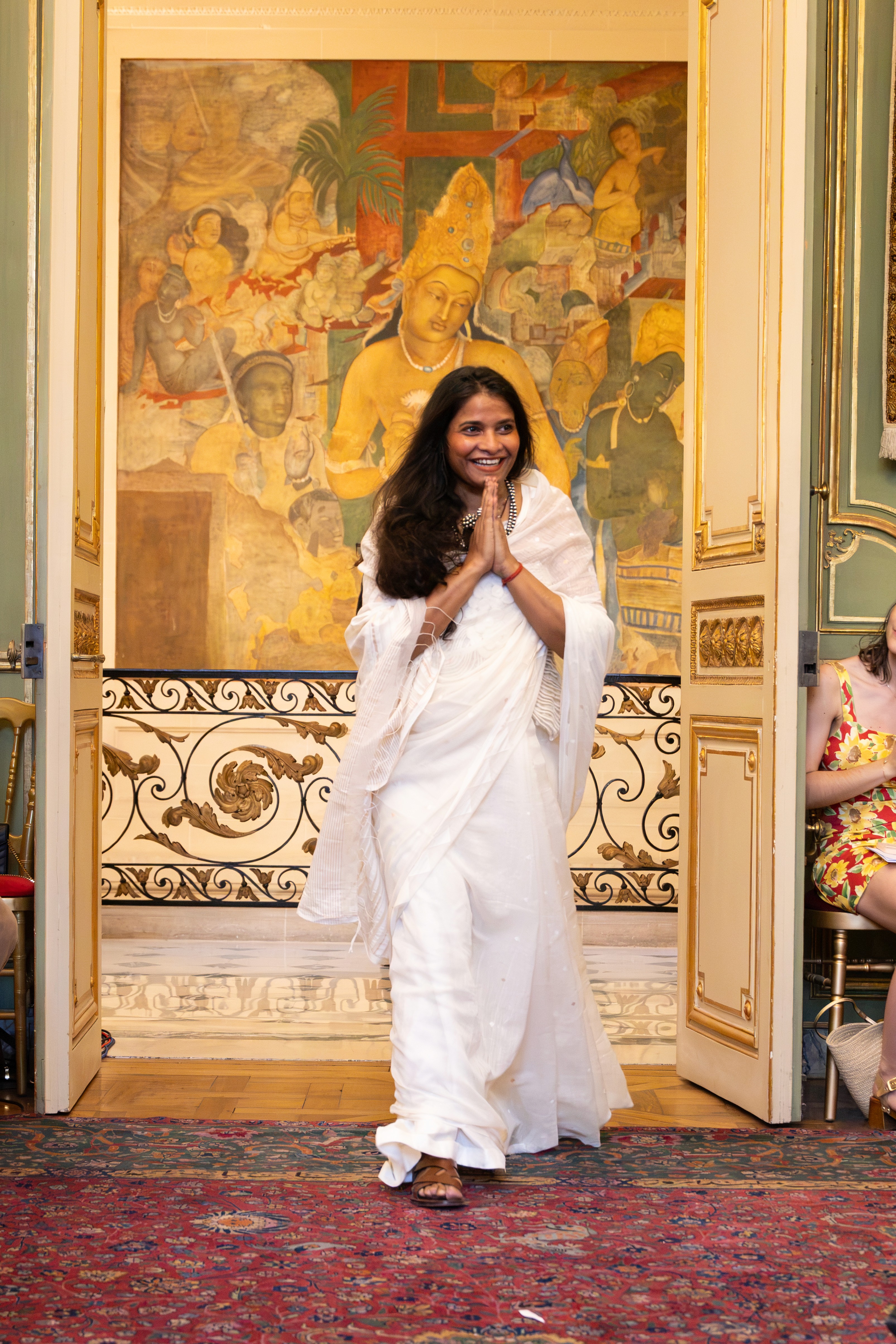
On National Handloom Day, the name that travels furthest from the loom is Vaishali Shadangule's. She is, by the reckoning of those who follow the global couture calendar, the only designer who works exclusively in handloom, and in 2021 she became the only woman of Indian origin ever selected to present at Paris Haute Couture Week. The distance between those two facts, from a village loom in Madhya Pradesh to the official schedule of the Fédération de la Haute Couture et de la Mode, is the whole story.
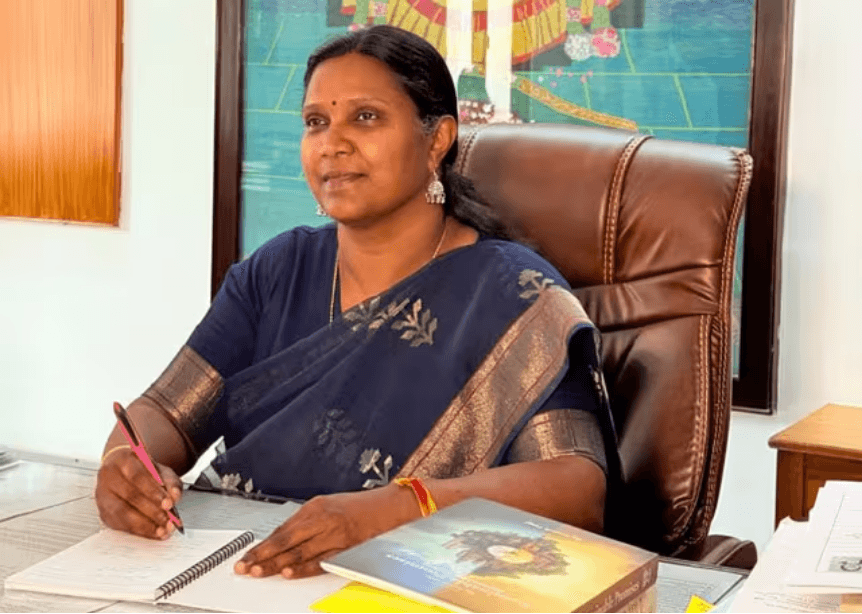
Dr. M. Beena, IAS, Development Commissioner (Handlooms) under the Ministry of Textiles
The context makes the achievement legible. As Dr. M. Beena, IAS, Development Commissioner (Handlooms) under the Ministry of Textiles, puts it: "Indian handlooms embody India's rich textile traditions and are a major source of employment in the rural landscape. The sector employs 35 lakh-plus weavers and workers, 72% of whom are women. The sector is increasingly focusing on reimagining itself through contemporary designs and sustainability branding. Designers like Vaishali Shadangule have succeeded in positioning Indian handlooms in international couture." Shadangule's work sits at exactly that intersection, where a rural livelihood and a global runway turn out to be the same thread.
Shadangule was born in Vidisha, Madhya Pradesh, near Chanderi, where early memories of watching looms being set up stayed with her, shaping a design philosophy that would later challenge how luxury is defined. She left home at seventeen without family support, trained as an engineer, and took a series of jobs, carrying a sketchbook throughout. A loan of fifty thousand rupees from the wife of a bank manager who recognised her talent gave her the beginning she needed. She founded her eponymous label in 2001.
What makes the label unusual is not that it uses handloom but that it is built entirely from it. Vaishali S Couture exists to inspire a new approach to fashion that entirely relies on artisanal crafts, and every fabric in every collection is hand-woven to her own designs. This means each garment begins not at the sketch or the cutting table but at the warp and weft. On her first visit to Chanderi, she watched the painstaking process of weavers setting up nearly 5,000 threads over two weeks to prepare the warp.
The weaves, and the masterjis behind them
Shadangule's method is grounded in long stretches of time spent with weavers. She travelled extensively across Madhya Pradesh, the Northeast, West Bengal and Maharashtra, spending days with weavers, understanding techniques that had survived generations, and she often lives alongside artisans while a fabric is being developed. That immersion has taken her through Chanderi and Maheshwari in Madhya Pradesh, Paithani in Maharashtra, the weaves of West Bengal and Rajasthan, and Chettinad in the south. In one instance, she had to walk for four hours to reach the village where Kesapat was made.

Vaishali Shadangule alongside a weaver whom she works with
The clearest example of her revival work is Khun, a lightweight cloth known for its small geometric patterns and vivid contrasting borders. She found Guledagudda in 2012, which was not on the map, in Karnataka, where the Khun weave comes from, and she is widely credited with helping bring the weave back into circulation. For Shadangule, Khun is a remarkable textile with a strong cultural identity, traditionally rooted in local dress, and what struck her was its structural strength and graphic quality, qualities that lent themselves to reinterpretation.
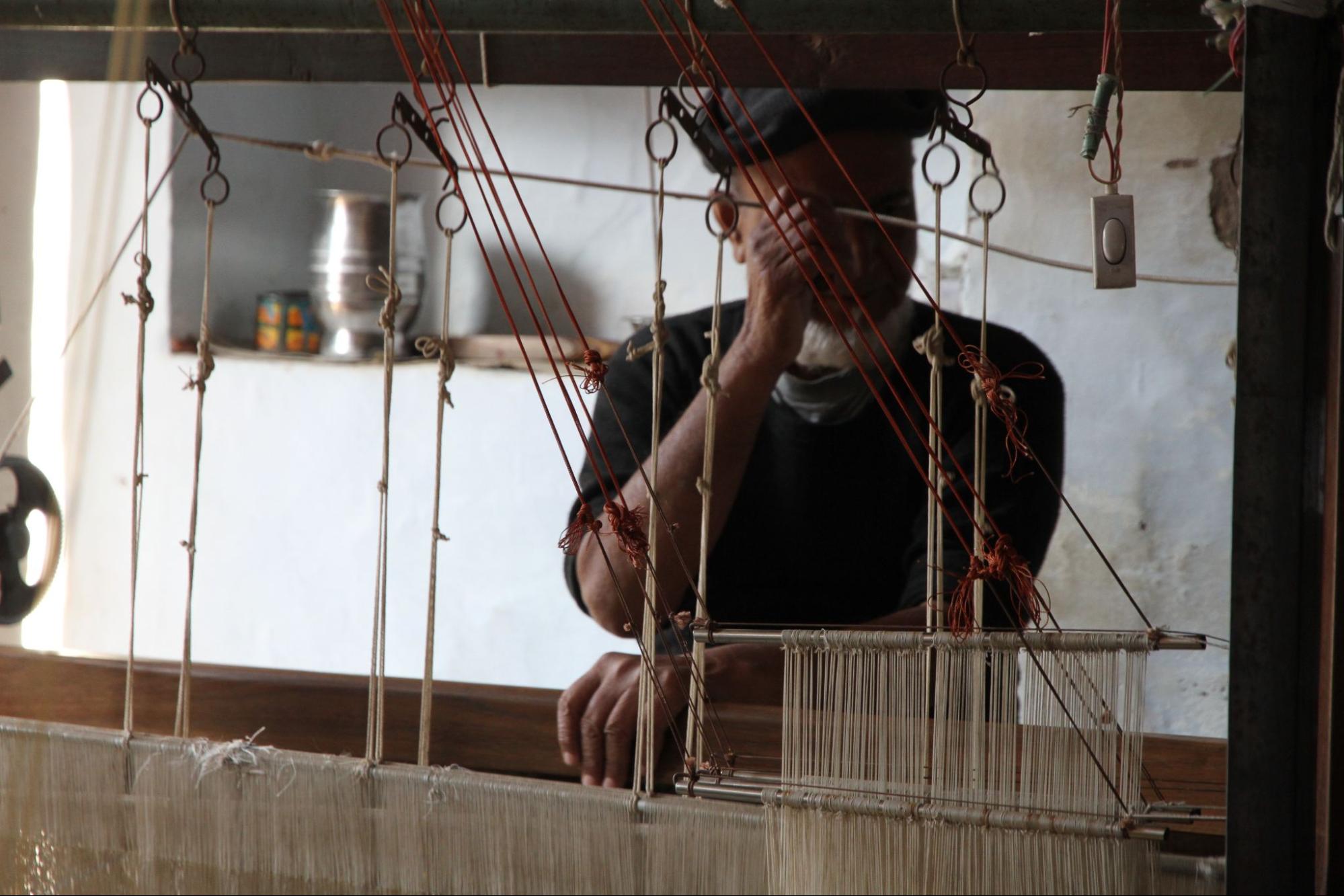
Behind-the-scenes with the weavers Vaishali Shadangule has worked with for over 25 years
Her signature technique is a proprietary cording method that gives fragile handwoven cloth structural integrity. A core purpose of the technique is to repurpose scraps by turning them into hand-rolled or braided cords, which are then manipulated into three-dimensional forms resembling organic textures such as tree bark, coral formations, spiralling leaves, and seashells. It is also what allows her Chanderi, Maheshwari and Khun to be shaped into the sculptural silhouettes seen at Paris Haute Couture Week. The garments are almost free of stitching, and many are draped rather than cut.
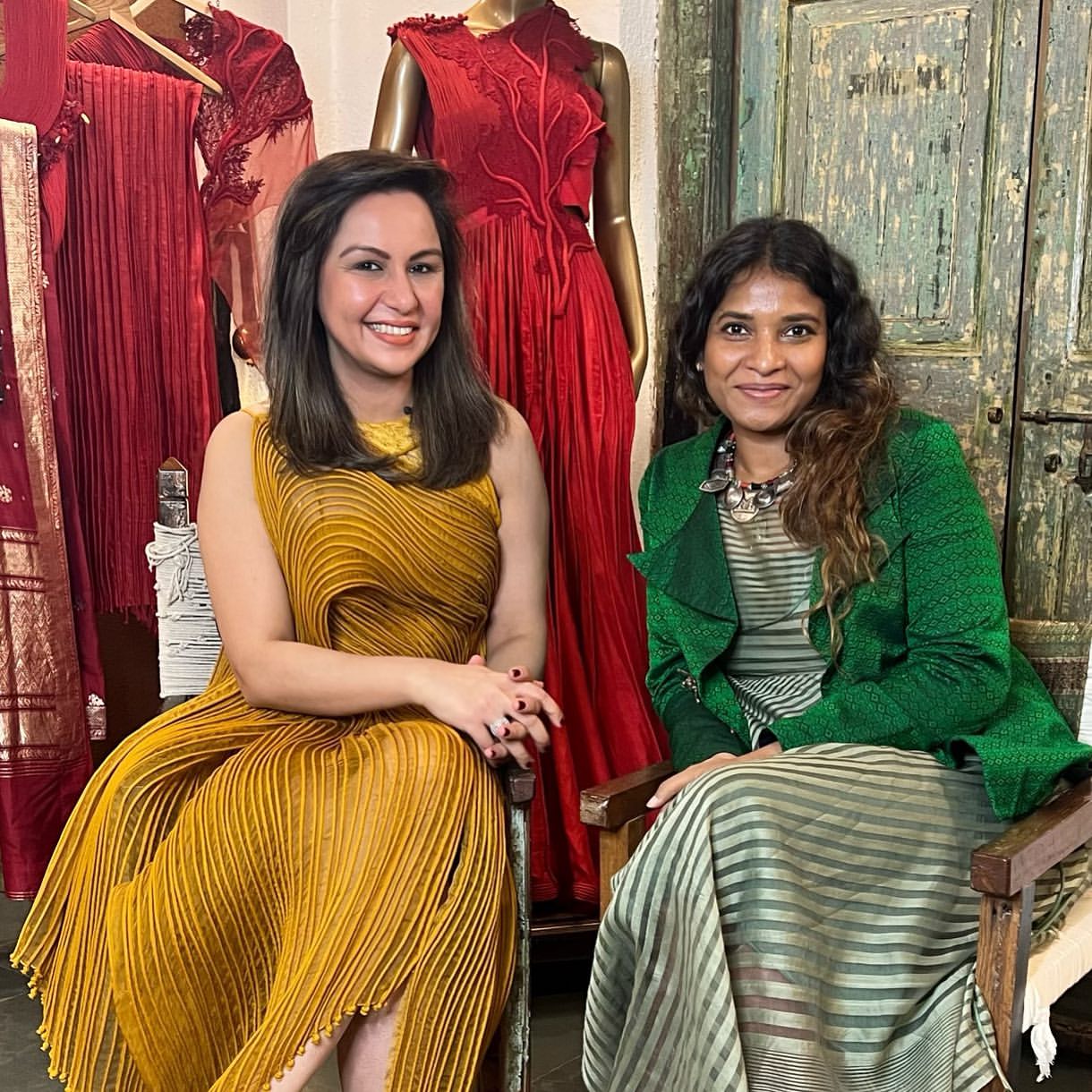
Chaiti Narula and Vaishali Shadangule behind-the-scenes at an interview tracing Vaishali’s journey
Chaiti Narula, Editor-in-Chief at French Press Global and founder and CEO of Maison French Press, reads the technique as the intellectual centre of the work. "The handloom keeps its own time, and that insistence is the entire argument," she says. "Vaishali builds at the speed of the thread, which is the speed of a human hand deciding, one pass at a time, what beauty is worth. Where the industry worships velocity, she has made patience look like the radical position it always was." The cording, in Narula's reading, is where that argument turns physical. "She takes a flat, humble weave and gives it spine, volume, architecture, until the fabric stops behaving like cloth and starts behaving like sculpture. That is the intellectual move at the heart of her work. She holds that Indian craft is structural, not merely decorative."
The atelier is deliberately kept close to the hand. Everything is manufactured in-house in South Mumbai, even the buttons, which are made with leftovers. The fabrics themselves come from a network that has grown from a single weaver into a country-wide cluster. Bridging the gap between craft and global platforms required increasing the cluster of weavers slowly from one to 4,500 around the country, and much of that network is made up of women. As Shadangule has described it, the fabrics are made by weavers of different villages across seven states of India, mostly women, and the brand set a goal of bringing more artisan clusters into a family that already supported 900+ families.
Traceability and the maker
Each Vaishali S piece carries a QR code on its tag that lets the owner trace the garment back to its origins and to the artisans who wove and worked it. In an industry that has spent decades erasing the maker from the made thing, that insistence on lineage is its own quiet politics: the weaver, not the designer, is treated as the point where the garment begins.
The label consciously chooses to work with female artisans across the country, empowering and enabling them to make informed choices that progressively enrich their lives, and it treats the identity of the maker as inseparable from the object. Narula frames this as the sector's central, avoided truth. "In Vaishali's hands the loom is contemporary technology and the weaver is an author," she says. "She works with thousands of weaving families across several Indian states because she grasps the one truth the sector keeps avoiding: you preserve a craft by paying for it, not by admiring it from a distance. National Handloom Day earns its place only when it converts sentiment into livelihoods."

Sustainability, in Vaishali’s practice, is built into the ethos instead of being used as a marketing buzzword. The label was built around handwoven fabrics, village-based artisans and zero-waste draping, and it holds to zero-waste and plastic-free methods. Garments are crafted to order, each one a unique piece, and all are consciously made to last a lifetime, with many bridal sets designed to be worn afterwards as separates.
From Vidisha to Paris Haute Couture Week
Shadangule made her runway debut at Lakme Fashion Week in 2011, showing dresses in Chanderi and Paithani. It was perhaps the first time these fabrics had been cut into dresses, since until then they had only been woven into 5.5-metre saris, and to make it possible she reached out directly to the weavers of Chanderi and Paithani to adapt their designs into cloth suitable for cutting.

Vaishali S and models at Paris Haute Couture Week Fall 2021.
The recognition that followed came from the work itself. In 2019, Alessandro Giuliani, president of the Italian Chamber of Commerce in India and later a director of her label, saw her work and named it couture. She applied to Paris Haute Couture Week, and the selection came in 2020 while she was quarantined in the Maldives after a severe case of Covid-19, the call arriving on her birthday. In 2021, she became the first Indian female designer invited by the Fédération de la Haute Couture et de la Mode to present at Paris Haute Couture Week, showing her collection Shwas on the left bank. In her own words at the time, the idea was to put the Indian weave on the highest platform, in its purest form.

Vaishali S took over the majestic steps of the Asiatic Society Mumbai Library in Fort, Mumbai, celebrating 25 years of her eponymous label
The firsts accumulated from there. In 2022, she became the first Indian woman on the official presentations calendar at Milan Fashion Week. In 2023, she spoke at TEDx Mumbai and received the Vogue Forces of Fashion award. In 2024, she became the first Indian designer to open a store on Boulevard Saint-Germain in Paris. In 2026, marking twenty-five years, she staged Beneath the Surface on the steps of Mumbai's Asiatic Society, a venue she chose because it was founded to spread the heritage and culture of India, aligned with her mission of preserving and reviving the Indian handloom.

Marco Ferra / Image via Instagram
The Italian stylist and creative director Marco Ferra places her beyond the designer category altogether. "To me, Vaishali is far more than a couturier; she is an artist and a true ambassador of India's culture," he says. "Her Haute Couture collections are a celebration of creativity, where innovation meets centuries of craftsmanship. Deeply committed to researching, preserving, and elevating India's extraordinary weaving traditions and textile heritage, she transforms exceptional artisanal techniques into contemporary works of art. Every creation reflects not only remarkable talent, but also heart, passion, and profound respect for the artisans and communities who keep these traditions alive."
For Narula, the accolades matter less than the nerve behind them. "What moves me about Vaishali is that she never asked for permission," she says. "A self-taught woman from a small town in Madhya Pradesh, she looked at a craft the market had written off as provincial and decided it belonged in the same conversation as Paris. She was right. Twenty-five years on, the weave she championed reads as a global luxury language, and she authored much of that vocabulary herself."
The point she keeps proving
Asked about the misconception she has spent her career dismantling, Shadangule's answer is immediate. People think handloom is fragile, that it isn't fashionable. Her work, she says, proves it is the strongest fabric and the most fashionable. The claim widens from there to something national in scale: India is the most fashionable country in the world, because every village has its own fabric, its own colour language and its own identity, and the real task is to appreciate what we already have.
Narula puts the conclusion without hedging. "Vaishali proved a simple and uncomfortable point," she says. "The handloom could be couture all along, never the poor relation the industry made it out to be. It only needed someone with the conviction to say it plainly."
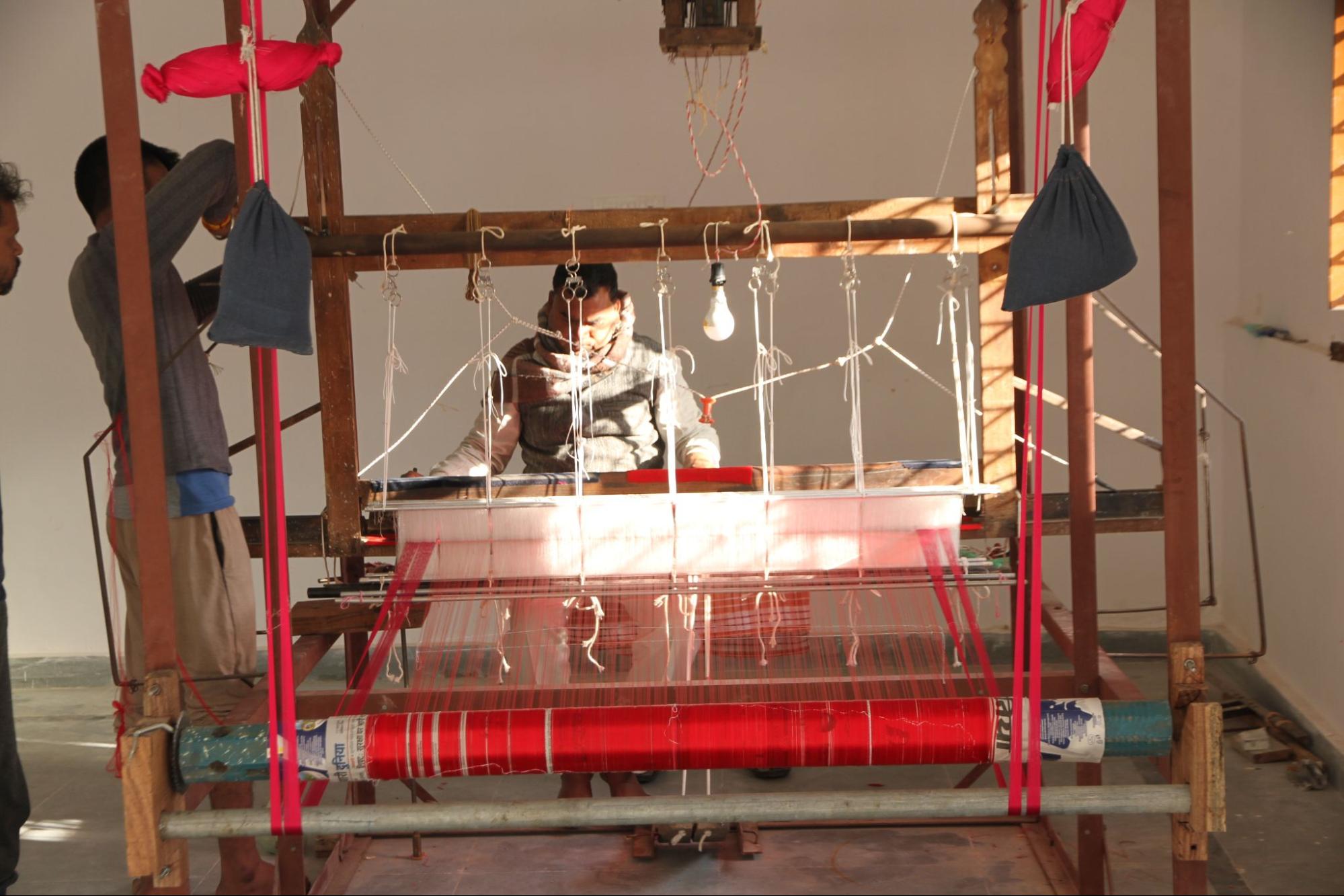
For all the talk of firsts, the more telling detail is how little has changed in her method since the fifty-thousand-rupee loan. The looms are the same looms. The four-hour walks still happen. What moved was everyone else's idea of where handloom belonged. National Handloom Day tends to speak in the language of preservation, of keeping something alive; Shadangule's twenty-five years suggest a different reading, that the cloth was never in need of rescue, only of someone willing to stake a couture house on it and wait for the world to catch up.
Disclosure: Vaishali S. is a client of Maison French Press, the brand architecture house of French Press Global.
TO BE CONTINUED, FOR SUBSCRIBERS ONLY.
This is where the surface ends and the reporting begins.
The complete piece, the full archive, and access to The French Press Circle. Reporting answerable only to its readers.
Already a subscriber ?
Login
Read these on the house, with our compliments.
A selection from the current issue, open to all readers. Read them in full. The rest is one decision away.






On National Handloom Day, the name that travels furthest from the loom is Vaishali Shadangule's. She is, by the reckoning of those who follow the global couture calendar, the only designer who works exclusively in handloom, and in 2021 she became the only woman of Indian origin ever selected to present at Paris Haute Couture Week. The distance between those two facts, from a village loom in Madhya Pradesh to the official schedule of the Fédération de la Haute Couture et de la Mode, is the whole story.
Dr. M. Beena, IAS, Development Commissioner (Handlooms) under the Ministry of Textiles
The context makes the achievement legible. As Dr. M. Beena, IAS, Development Commissioner (Handlooms) under the Ministry of Textiles, puts it: "Indian handlooms embody India's rich textile traditions and are a major source of employment in the rural landscape. The sector employs 35 lakh-plus weavers and workers, 72% of whom are women. The sector is increasingly focusing on reimagining itself through contemporary designs and sustainability branding. Designers like Vaishali Shadangule have succeeded in positioning Indian handlooms in international couture." Shadangule's work sits at exactly that intersection, where a rural livelihood and a global runway turn out to be the same thread.
Shadangule was born in Vidisha, Madhya Pradesh, near Chanderi, where early memories of watching looms being set up stayed with her, shaping a design philosophy that would later challenge how luxury is defined. She left home at seventeen without family support, trained as an engineer, and took a series of jobs, carrying a sketchbook throughout. A loan of fifty thousand rupees from the wife of a bank manager who recognised her talent gave her the beginning she needed. She founded her eponymous label in 2001.
What makes the label unusual is not that it uses handloom but that it is built entirely from it. Vaishali S Couture exists to inspire a new approach to fashion that entirely relies on artisanal crafts, and every fabric in every collection is hand-woven to her own designs. This means each garment begins not at the sketch or the cutting table but at the warp and weft. On her first visit to Chanderi, she watched the painstaking process of weavers setting up nearly 5,000 threads over two weeks to prepare the warp.
The weaves, and the masterjis behind them
Shadangule's method is grounded in long stretches of time spent with weavers. She travelled extensively across Madhya Pradesh, the Northeast, West Bengal and Maharashtra, spending days with weavers, understanding techniques that had survived generations, and she often lives alongside artisans while a fabric is being developed. That immersion has taken her through Chanderi and Maheshwari in Madhya Pradesh, Paithani in Maharashtra, the weaves of West Bengal and Rajasthan, and Chettinad in the south. In one instance, she had to walk for four hours to reach the village where Kesapat was made.
Vaishali Shadangule alongside a weaver whom she works with
The clearest example of her revival work is Khun, a lightweight cloth known for its small geometric patterns and vivid contrasting borders. She found Guledagudda in 2012, which was not on the map, in Karnataka, where the Khun weave comes from, and she is widely credited with helping bring the weave back into circulation. For Shadangule, Khun is a remarkable textile with a strong cultural identity, traditionally rooted in local dress, and what struck her was its structural strength and graphic quality, qualities that lent themselves to reinterpretation.
Behind-the-scenes with the weavers Vaishali Shadangule has worked with for over 25 years
Her signature technique is a proprietary cording method that gives fragile handwoven cloth structural integrity. A core purpose of the technique is to repurpose scraps by turning them into hand-rolled or braided cords, which are then manipulated into three-dimensional forms resembling organic textures such as tree bark, coral formations, spiralling leaves, and seashells. It is also what allows her Chanderi, Maheshwari and Khun to be shaped into the sculptural silhouettes seen at Paris Haute Couture Week. The garments are almost free of stitching, and many are draped rather than cut.
Chaiti Narula and Vaishali Shadangule behind-the-scenes at an interview tracing Vaishali’s journey
Chaiti Narula, Editor-in-Chief at French Press Global and founder and CEO of Maison French Press, reads the technique as the intellectual centre of the work. "The handloom keeps its own time, and that insistence is the entire argument," she says. "Vaishali builds at the speed of the thread, which is the speed of a human hand deciding, one pass at a time, what beauty is worth. Where the industry worships velocity, she has made patience look like the radical position it always was." The cording, in Narula's reading, is where that argument turns physical. "She takes a flat, humble weave and gives it spine, volume, architecture, until the fabric stops behaving like cloth and starts behaving like sculpture. That is the intellectual move at the heart of her work. She holds that Indian craft is structural, not merely decorative."
The atelier is deliberately kept close to the hand. Everything is manufactured in-house in South Mumbai, even the buttons, which are made with leftovers. The fabrics themselves come from a network that has grown from a single weaver into a country-wide cluster. Bridging the gap between craft and global platforms required increasing the cluster of weavers slowly from one to 4,500 around the country, and much of that network is made up of women. As Shadangule has described it, the fabrics are made by weavers of different villages across seven states of India, mostly women, and the brand set a goal of bringing more artisan clusters into a family that already supported 900+ families.
Traceability and the maker
Each Vaishali S piece carries a QR code on its tag that lets the owner trace the garment back to its origins and to the artisans who wove and worked it. In an industry that has spent decades erasing the maker from the made thing, that insistence on lineage is its own quiet politics: the weaver, not the designer, is treated as the point where the garment begins.
The label consciously chooses to work with female artisans across the country, empowering and enabling them to make informed choices that progressively enrich their lives, and it treats the identity of the maker as inseparable from the object. Narula frames this as the sector's central, avoided truth. "In Vaishali's hands the loom is contemporary technology and the weaver is an author," she says. "She works with thousands of weaving families across several Indian states because she grasps the one truth the sector keeps avoiding: you preserve a craft by paying for it, not by admiring it from a distance. National Handloom Day earns its place only when it converts sentiment into livelihoods."
Sustainability, in Vaishali’s practice, is built into the ethos instead of being used as a marketing buzzword. The label was built around handwoven fabrics, village-based artisans and zero-waste draping, and it holds to zero-waste and plastic-free methods. Garments are crafted to order, each one a unique piece, and all are consciously made to last a lifetime, with many bridal sets designed to be worn afterwards as separates.
From Vidisha to Paris Haute Couture Week
Shadangule made her runway debut at Lakme Fashion Week in 2011, showing dresses in Chanderi and Paithani. It was perhaps the first time these fabrics had been cut into dresses, since until then they had only been woven into 5.5-metre saris, and to make it possible she reached out directly to the weavers of Chanderi and Paithani to adapt their designs into cloth suitable for cutting.
Vaishali S and models at Paris Haute Couture Week Fall 2021.
The recognition that followed came from the work itself. In 2019, Alessandro Giuliani, president of the Italian Chamber of Commerce in India and later a director of her label, saw her work and named it couture. She applied to Paris Haute Couture Week, and the selection came in 2020 while she was quarantined in the Maldives after a severe case of Covid-19, the call arriving on her birthday. In 2021, she became the first Indian female designer invited by the Fédération de la Haute Couture et de la Mode to present at Paris Haute Couture Week, showing her collection Shwas on the left bank. In her own words at the time, the idea was to put the Indian weave on the highest platform, in its purest form.
Vaishali S took over the majestic steps of the Asiatic Society Mumbai Library in Fort, Mumbai, celebrating 25 years of her eponymous label
The firsts accumulated from there. In 2022, she became the first Indian woman on the official presentations calendar at Milan Fashion Week. In 2023, she spoke at TEDx Mumbai and received the Vogue Forces of Fashion award. In 2024, she became the first Indian designer to open a store on Boulevard Saint-Germain in Paris. In 2026, marking twenty-five years, she staged Beneath the Surface on the steps of Mumbai's Asiatic Society, a venue she chose because it was founded to spread the heritage and culture of India, aligned with her mission of preserving and reviving the Indian handloom.
Marco Ferra / Image via Instagram
The Italian stylist and creative director Marco Ferra places her beyond the designer category altogether. "To me, Vaishali is far more than a couturier; she is an artist and a true ambassador of India's culture," he says. "Her Haute Couture collections are a celebration of creativity, where innovation meets centuries of craftsmanship. Deeply committed to researching, preserving, and elevating India's extraordinary weaving traditions and textile heritage, she transforms exceptional artisanal techniques into contemporary works of art. Every creation reflects not only remarkable talent, but also heart, passion, and profound respect for the artisans and communities who keep these traditions alive."
For Narula, the accolades matter less than the nerve behind them. "What moves me about Vaishali is that she never asked for permission," she says. "A self-taught woman from a small town in Madhya Pradesh, she looked at a craft the market had written off as provincial and decided it belonged in the same conversation as Paris. She was right. Twenty-five years on, the weave she championed reads as a global luxury language, and she authored much of that vocabulary herself."
The point she keeps proving
Asked about the misconception she has spent her career dismantling, Shadangule's answer is immediate. People think handloom is fragile, that it isn't fashionable. Her work, she says, proves it is the strongest fabric and the most fashionable. The claim widens from there to something national in scale: India is the most fashionable country in the world, because every village has its own fabric, its own colour language and its own identity, and the real task is to appreciate what we already have.
Narula puts the conclusion without hedging. "Vaishali proved a simple and uncomfortable point," she says. "The handloom could be couture all along, never the poor relation the industry made it out to be. It only needed someone with the conviction to say it plainly."
For all the talk of firsts, the more telling detail is how little has changed in her method since the fifty-thousand-rupee loan. The looms are the same looms. The four-hour walks still happen. What moved was everyone else's idea of where handloom belonged. National Handloom Day tends to speak in the language of preservation, of keeping something alive; Shadangule's twenty-five years suggest a different reading, that the cloth was never in need of rescue, only of someone willing to stake a couture house on it and wait for the world to catch up.
Disclosure: Vaishali S. is a client of Maison French Press, the brand architecture house of French Press Global.
TO BE CONTINUED, FOR SUBSCRIBERS ONLY.
This is where the surface ends and the reporting begins.
The complete piece, the full archive, and access to The French Press Circle. Reporting answerable only to its readers.
Already a subscriber ?
Login
Read these on the house, with our compliments.
A selection from the current issue, open to all readers. Read them in full. The rest is one decision away.