
There is a particular kind of silence that follows a bad sentence in India, the two or three seconds before the country decides what to do with it. In May 2026, Chief Justice of India Surya Kant filled that silence during a Supreme Court hearing by comparing certain individuals to cockroaches and parasites, a line he insisted afterwards was aimed narrowly at people practising law with fake degrees. The remark became the origin point of the Cockroach Janta Party, a parody social media account and eventual protest movement founded by political communications strategist Abhijeet Dipke. The account exploded into relevance almost immediately. Within 78 hours of the page going up, it had drawn 3 million followers, and within a week that number had grown past 20 million, overtaking the official handle of the ruling party along the way. By July, the movement had carried its protest off Instagram entirely, taking to the streets of Delhi, Pune, Bengaluru, and Lucknow, channelling a season of anger over examination leaks, graduate unemployment, and a state that many young Indians felt had stopped listening.
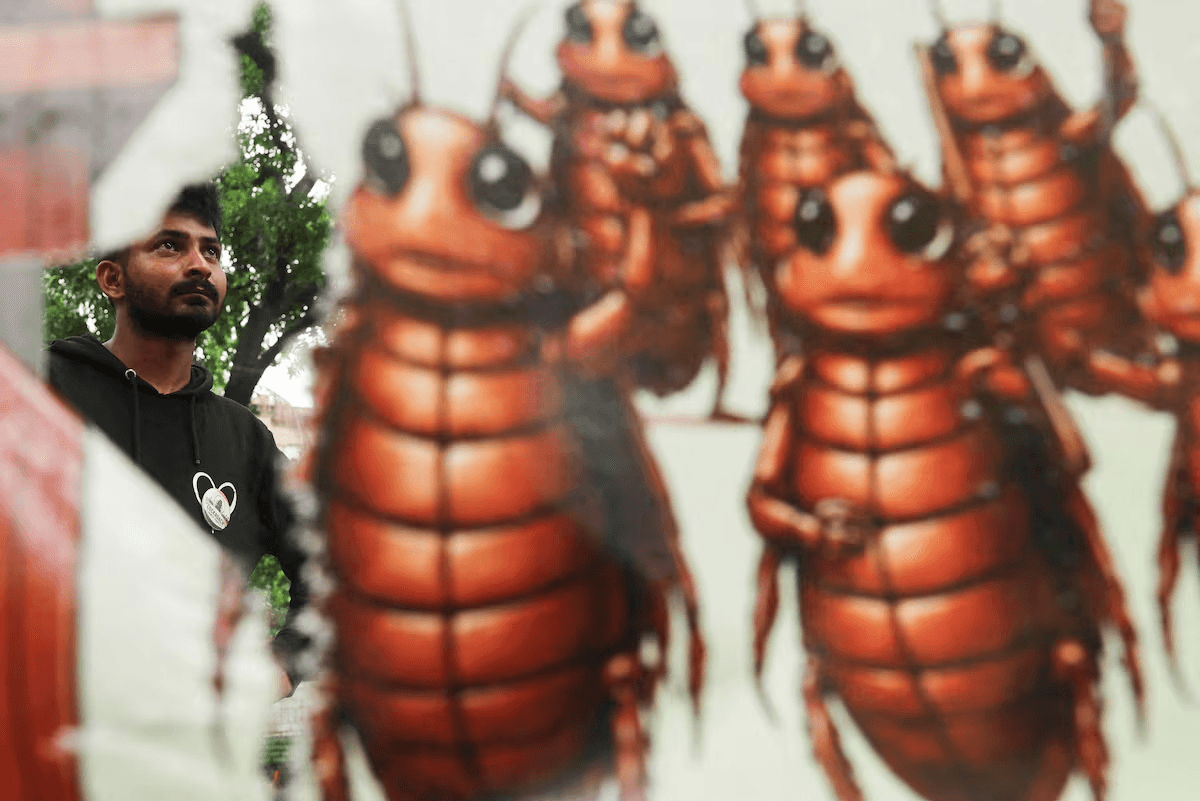
A supporter of the satirical Cockroach Janta Party (CJP) behind a torn banner bearing the movement's symbol | Image: Hindustan Times
The Chief Justice of India meant to insult a small, specific category of people and clarify himself out of the mess by morning. He ended up demonstrating a law of Indian public life that no constitution has ever written down: the republic keeps its receipts, and every generation eventually finds the one sentence that lets it read all the old receipts aloud at once.
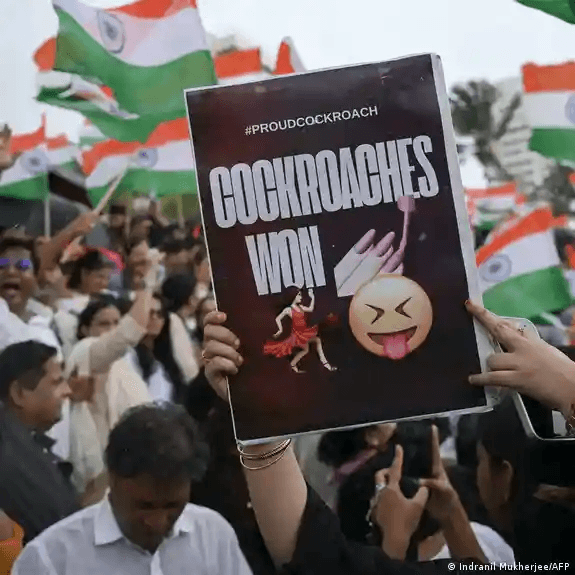
The Cockroach movement originated as a social media satire after the chief justice of India referred to young unemployed Indians as 'cockroaches'. | Image: Indranil Mukherjee/AFP
The anatomy of a spark
Cruelty builds movements only in combination with other forces. Indian public life produces cruel statements at an almost agricultural rate, and most rot quietly in the news cycle within a week. A forgettable insult turns into a founding document when three things happen at once, and naming that combination is the closest anyone has come to a science of Indian outrage.
The first is a listening public that was already primed, already carrying grievance it had nowhere to put. The Cockroach Janta Party gave existing youth anger over unemployment and examination fraud a mascot and a punchline, rather than inventing that anger from scratch. The second is a speaker with institutional weight, someone whose words are assumed to carry the authority of the office rather than the opinion of the individual, so the insult reads as the state's true feeling finally slipping out from behind its manners. The third, and the one that modern India has weaponised more completely than any generation before it, is translatability into a form that spreads on its own, a slogan, a meme, a hashtag, an image absurd enough to outcompete the news cycle that produced it.
Put those three together, and a sentence stops behaving like language and starts behaving as a match dropped into a room that has been filling with gas for years.
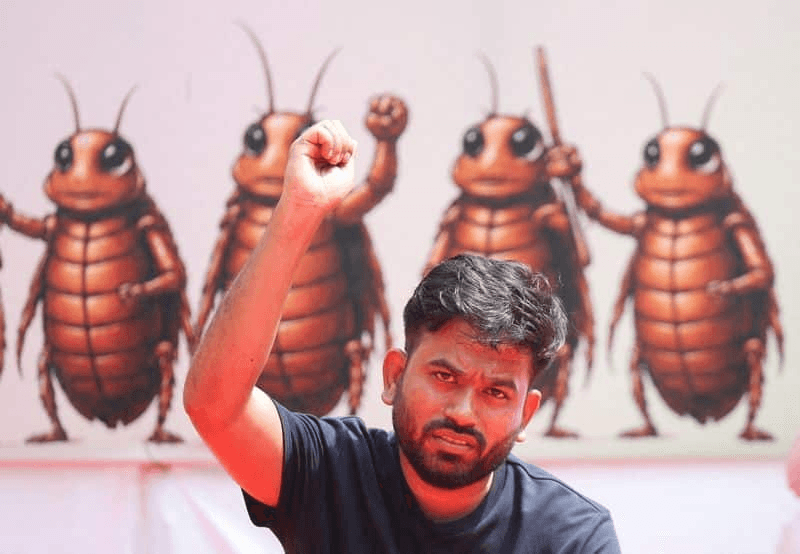
Abhijeet Dipke, head of the Cockroach Janta Party (CJP),gestures to the supporters of the CJP during a sit-in protest demanding the resignation of Indian Education Minister Dharmendra Pradhan, in New Delhi. | Image Source : Google
A century of sentences
Long before hashtags existed to carry outrage on their backs, India was already a country that organised itself around the memorable line. Mahatma Gandhi closed the Quit India movement of 1942 with two words, do or die, and a nation under colonial rule took him at his word within days. Jayaprakash Narayan stood in Patna in 1974 and called for Sampoorna Kranti, total revolution, turning a student agitation over corruption and price rise into a movement that helped topple a government and usher in the Emergency's messy, necessary reckoning. Bhagat Singh threw pamphlets rather than shrapnel into the Central Legislative Assembly in 1929, trusting correctly that a phrase can travel further than a bomb and last considerably longer in the national memory.
The pattern holds with less romance and more raw grievance as the country modernises. In 1990, the announcement of the Mandal Commission's job reservation quotas reshaped policy and produced a wave of upper caste student protests so intense that self-immolation attempts entered the national vocabulary, opening a debate over merit and representation that continues today. Every generation gets handed its own defining sentence, and what it does with that sentence becomes the shorthand historians later use to describe what that generation valued and what it refused to accept anymore.
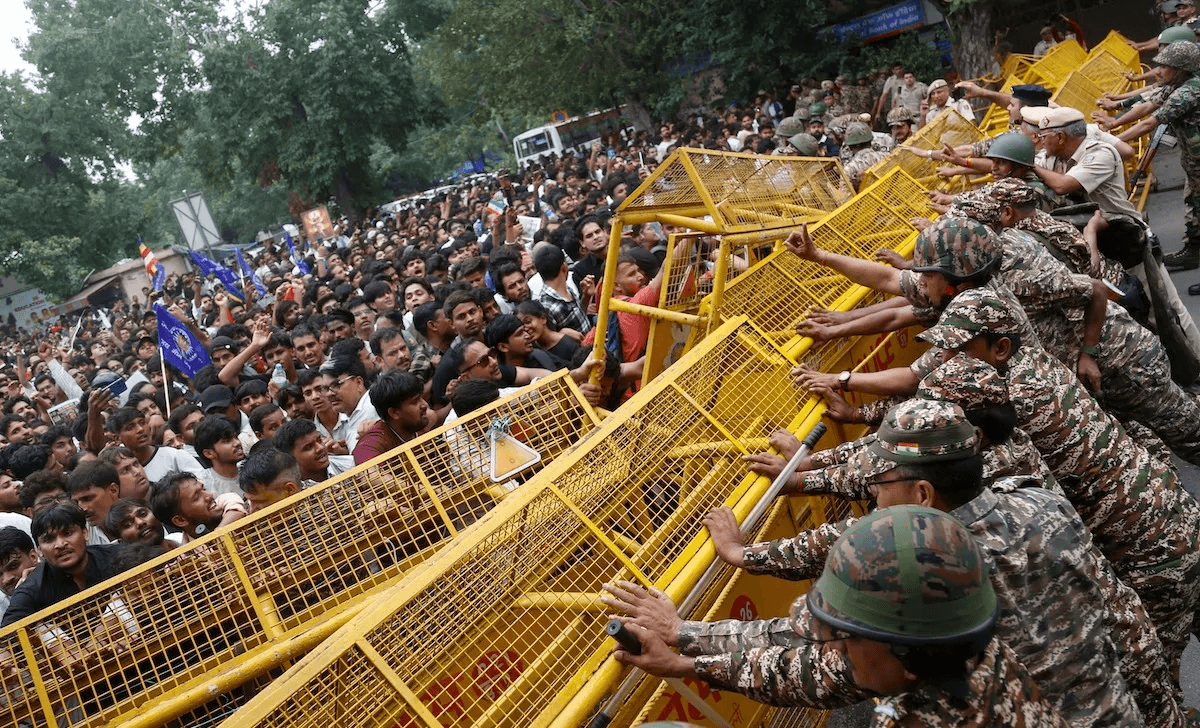
CJP March on Parliament stopped by Tear Gas | Image Source : Google
The women who were never asked
No case study makes the mechanics of a bad sentence clearer than December 2012. A twenty-three-year-old physiotherapy student was gang raped on a moving bus in Delhi, and the country's grief turned to the streets almost immediately, a spontaneous, leaderless convergence of candles and fury outside India Gate. Into that grief walked Abhijit Mukherjee, son of the sitting President and a Congress Member of Parliament, who told a television channel that the protesters were beautiful women, highly dented and painted, likely not students at all, given their age, women who had brought their children along to watch the scene unfold.
The phrase indicted the man who said it, instantly and completely, revealing far more about him than about the women he described. His own sister Sharmistha called the remark shocking and apologised on his behalf within a day, and the wider public treated dented and painted the way a courtroom treats a confession, evidence that stood permanently on the record. A protest against one crime widened into a referendum on how the country's institutions actually regarded the women demanding justice for it, and the sentence meant to dismiss the movement became the reason it grew.
The comment that finally had a name
Move the clock forward to September 2018, and watch the same physics play out in the entertainment industry rather than Parliament. Actor Tanushree Dutta had spent a decade carrying an allegation against Nana Patekar that the industry had quietly chosen to ignore. She had already spoken about the 2008 incident once before, at the time it happened, and watched her career end for the trouble. When she repeated the allegation in an interview a decade later, the sentence landed in a country that had, in the intervening years, watched Harvey Weinstein's accusers give the world a vocabulary for exactly this kind of silence. The single allegation against one actor multiplied within weeks, cascading into accusations across media, cinema, academia, and politics, and eventually forcing a sitting Union Minister to resign. Dutta's statement worked precisely because the culture around her had finally built the container that could hold it. Say the same sentence in 2008 and it disappears. Say it in 2018 and it becomes a reckoning with a hashtag as its shorthand.
The cockroach as national metaphor
Which brings the arc back to 2026, and to the particular genius of what happened after the Chief Justice spoke. Earlier generations of Indian protest reached for gravity, revolution, martyrdom, total war against the old order. Generation Z reached for a cockroach, building an entire satirical political apparatus around the insult itself. The Cockroach Janta Party positioned itself as parody, fluent in meme culture, and used that satire to pull in millions of followers who might never have shown up for a conventional protest but could not resist a punchline this sharp. When climate activist Sonam Wangchuk was detained by police during a hunger strike undertaken in solidarity with the students, the movement's founder announced his own indefinite fast, and the protest that started online moved decisively onto the pavement.
The insult was designed to make young Indians feel small and disposable. The response turned that same word into a crown. There is something almost literary in that reversal, an entire generation deciding that the fastest way to defeat an institution's contempt is to out perform it in wit.
The judiciary's second brush with public fury this year followed the same script with different characters. In August, more than four hundred and fifty students at NALSAR Hyderabad signed a petition objecting to the same Chief Justice's presence at their convocation, joined soon after by students and alumni at NLSIU Bengaluru, turning a single controversial remark from May into a running referendum on judicial accountability that stretched across an entire academic year. One sentence, uttered once, kept generating consequences for months, because the students who inherited it made sure it stayed in the news archive rather than fading out of it.
What each generation actually bought
Line these moments up and a strange inheritance becomes visible, each generation using its defining statement to purchase something the one before it did not have. The independence generation bought sovereignty with Gandhi's two words and Bhagat Singh's pamphlets, exchanging colonial rule for self government at enormous personal cost. The Emergency generation bought back its civil liberties with Sampoorna Kranti, learning firsthand what a government does when total revolution actually threatens it. The Mandal generation bought a version of representation, contested but real, forcing the state to reckon publicly with whose sons and daughters got to sit in its classrooms and offices. The Nirbhaya generation bought a vocabulary for consent and accountability that mainstream Indian discourse simply lacked before December 2012. The MeToo generation bought the right to be believed on the first telling rather than the tenth. The Cockroach generation, watching all of this from a phone screen, is currently buying something harder to name, a guarantee that the people who run the institutions meant to serve them will answer for what they say about them.
Reform in India arrives most often as the aftershock of a sentence someone powerful should have swallowed, followed by a generation deciding, almost instinctively, that the sentence deserves to be remembered rather than forgotten. The Chief Justice of India wanted to talk about fake degrees. He handed an entire generation its mascot, its meme, and its reason to finally show up. That is the oldest trick in the country's long history of resistance, delivered this time with better graphics and a following count no government press release has ever matched.
TO BE CONTINUED, FOR SUBSCRIBERS ONLY.
This is where the surface ends and the reporting begins.
The complete piece, the full archive, and access to The French Press Circle. Reporting answerable only to its readers.
Already a subscriber ?
Login
Read these on the house, with our compliments.
A selection from the current issue, open to all readers. Read them in full. The rest is one decision away.










There is a particular kind of silence that follows a bad sentence in India, the two or three seconds before the country decides what to do with it. In May 2026, Chief Justice of India Surya Kant filled that silence during a Supreme Court hearing by comparing certain individuals to cockroaches and parasites, a line he insisted afterwards was aimed narrowly at people practising law with fake degrees. The remark became the origin point of the Cockroach Janta Party, a parody social media account and eventual protest movement founded by political communications strategist Abhijeet Dipke. The account exploded into relevance almost immediately. Within 78 hours of the page going up, it had drawn 3 million followers, and within a week that number had grown past 20 million, overtaking the official handle of the ruling party along the way. By July, the movement had carried its protest off Instagram entirely, taking to the streets of Delhi, Pune, Bengaluru, and Lucknow, channelling a season of anger over examination leaks, graduate unemployment, and a state that many young Indians felt had stopped listening.
A supporter of the satirical Cockroach Janta Party (CJP) behind a torn banner bearing the movement's symbol | Image: Hindustan Times
The Chief Justice of India meant to insult a small, specific category of people and clarify himself out of the mess by morning. He ended up demonstrating a law of Indian public life that no constitution has ever written down: the republic keeps its receipts, and every generation eventually finds the one sentence that lets it read all the old receipts aloud at once.
The Cockroach movement originated as a social media satire after the chief justice of India referred to young unemployed Indians as 'cockroaches'. | Image: Indranil Mukherjee/AFP
The anatomy of a spark
Cruelty builds movements only in combination with other forces. Indian public life produces cruel statements at an almost agricultural rate, and most rot quietly in the news cycle within a week. A forgettable insult turns into a founding document when three things happen at once, and naming that combination is the closest anyone has come to a science of Indian outrage.
The first is a listening public that was already primed, already carrying grievance it had nowhere to put. The Cockroach Janta Party gave existing youth anger over unemployment and examination fraud a mascot and a punchline, rather than inventing that anger from scratch. The second is a speaker with institutional weight, someone whose words are assumed to carry the authority of the office rather than the opinion of the individual, so the insult reads as the state's true feeling finally slipping out from behind its manners. The third, and the one that modern India has weaponised more completely than any generation before it, is translatability into a form that spreads on its own, a slogan, a meme, a hashtag, an image absurd enough to outcompete the news cycle that produced it.
Put those three together, and a sentence stops behaving like language and starts behaving as a match dropped into a room that has been filling with gas for years.
Abhijeet Dipke, head of the Cockroach Janta Party (CJP),gestures to the supporters of the CJP during a sit-in protest demanding the resignation of Indian Education Minister Dharmendra Pradhan, in New Delhi. | Image Source : Google
A century of sentences
Long before hashtags existed to carry outrage on their backs, India was already a country that organised itself around the memorable line. Mahatma Gandhi closed the Quit India movement of 1942 with two words, do or die, and a nation under colonial rule took him at his word within days. Jayaprakash Narayan stood in Patna in 1974 and called for Sampoorna Kranti, total revolution, turning a student agitation over corruption and price rise into a movement that helped topple a government and usher in the Emergency's messy, necessary reckoning. Bhagat Singh threw pamphlets rather than shrapnel into the Central Legislative Assembly in 1929, trusting correctly that a phrase can travel further than a bomb and last considerably longer in the national memory.
The pattern holds with less romance and more raw grievance as the country modernises. In 1990, the announcement of the Mandal Commission's job reservation quotas reshaped policy and produced a wave of upper caste student protests so intense that self-immolation attempts entered the national vocabulary, opening a debate over merit and representation that continues today. Every generation gets handed its own defining sentence, and what it does with that sentence becomes the shorthand historians later use to describe what that generation valued and what it refused to accept anymore.
CJP March on Parliament stopped by Tear Gas | Image Source : Google
The women who were never asked
No case study makes the mechanics of a bad sentence clearer than December 2012. A twenty-three-year-old physiotherapy student was gang raped on a moving bus in Delhi, and the country's grief turned to the streets almost immediately, a spontaneous, leaderless convergence of candles and fury outside India Gate. Into that grief walked Abhijit Mukherjee, son of the sitting President and a Congress Member of Parliament, who told a television channel that the protesters were beautiful women, highly dented and painted, likely not students at all, given their age, women who had brought their children along to watch the scene unfold.
The phrase indicted the man who said it, instantly and completely, revealing far more about him than about the women he described. His own sister Sharmistha called the remark shocking and apologised on his behalf within a day, and the wider public treated dented and painted the way a courtroom treats a confession, evidence that stood permanently on the record. A protest against one crime widened into a referendum on how the country's institutions actually regarded the women demanding justice for it, and the sentence meant to dismiss the movement became the reason it grew.
The comment that finally had a name
Move the clock forward to September 2018, and watch the same physics play out in the entertainment industry rather than Parliament. Actor Tanushree Dutta had spent a decade carrying an allegation against Nana Patekar that the industry had quietly chosen to ignore. She had already spoken about the 2008 incident once before, at the time it happened, and watched her career end for the trouble. When she repeated the allegation in an interview a decade later, the sentence landed in a country that had, in the intervening years, watched Harvey Weinstein's accusers give the world a vocabulary for exactly this kind of silence. The single allegation against one actor multiplied within weeks, cascading into accusations across media, cinema, academia, and politics, and eventually forcing a sitting Union Minister to resign. Dutta's statement worked precisely because the culture around her had finally built the container that could hold it. Say the same sentence in 2008 and it disappears. Say it in 2018 and it becomes a reckoning with a hashtag as its shorthand.
The cockroach as national metaphor
Which brings the arc back to 2026, and to the particular genius of what happened after the Chief Justice spoke. Earlier generations of Indian protest reached for gravity, revolution, martyrdom, total war against the old order. Generation Z reached for a cockroach, building an entire satirical political apparatus around the insult itself. The Cockroach Janta Party positioned itself as parody, fluent in meme culture, and used that satire to pull in millions of followers who might never have shown up for a conventional protest but could not resist a punchline this sharp. When climate activist Sonam Wangchuk was detained by police during a hunger strike undertaken in solidarity with the students, the movement's founder announced his own indefinite fast, and the protest that started online moved decisively onto the pavement.
The insult was designed to make young Indians feel small and disposable. The response turned that same word into a crown. There is something almost literary in that reversal, an entire generation deciding that the fastest way to defeat an institution's contempt is to out perform it in wit.
The judiciary's second brush with public fury this year followed the same script with different characters. In August, more than four hundred and fifty students at NALSAR Hyderabad signed a petition objecting to the same Chief Justice's presence at their convocation, joined soon after by students and alumni at NLSIU Bengaluru, turning a single controversial remark from May into a running referendum on judicial accountability that stretched across an entire academic year. One sentence, uttered once, kept generating consequences for months, because the students who inherited it made sure it stayed in the news archive rather than fading out of it.
What each generation actually bought
Line these moments up and a strange inheritance becomes visible, each generation using its defining statement to purchase something the one before it did not have. The independence generation bought sovereignty with Gandhi's two words and Bhagat Singh's pamphlets, exchanging colonial rule for self government at enormous personal cost. The Emergency generation bought back its civil liberties with Sampoorna Kranti, learning firsthand what a government does when total revolution actually threatens it. The Mandal generation bought a version of representation, contested but real, forcing the state to reckon publicly with whose sons and daughters got to sit in its classrooms and offices. The Nirbhaya generation bought a vocabulary for consent and accountability that mainstream Indian discourse simply lacked before December 2012. The MeToo generation bought the right to be believed on the first telling rather than the tenth. The Cockroach generation, watching all of this from a phone screen, is currently buying something harder to name, a guarantee that the people who run the institutions meant to serve them will answer for what they say about them.
Reform in India arrives most often as the aftershock of a sentence someone powerful should have swallowed, followed by a generation deciding, almost instinctively, that the sentence deserves to be remembered rather than forgotten. The Chief Justice of India wanted to talk about fake degrees. He handed an entire generation its mascot, its meme, and its reason to finally show up. That is the oldest trick in the country's long history of resistance, delivered this time with better graphics and a following count no government press release has ever matched.
TO BE CONTINUED, FOR SUBSCRIBERS ONLY.
This is where the surface ends and the reporting begins.
The complete piece, the full archive, and access to The French Press Circle. Reporting answerable only to its readers.
Already a subscriber ?
Login
Read these on the house, with our compliments.
A selection from the current issue, open to all readers. Read them in full. The rest is one decision away.