
Let us say it at the outset : only a man like Sunil Sethi could have pulled this off. The Department of Industries and Commerce, Union Territory of Ladakh, conceptualised and facilitated "The Fifth Season: A Fashion Story from Ladakh" with FDCI's support. It took the Chairman of the Fashion Design Council of India to actually make it happen, and to hand Ladakh the final day of Lakmē Fashion Week in partnership with FDCI at Taj Palace, New Delhi, on 18th October. That is a bold call. Sethi made it, and he was right.


Here is the thing. For decades, India has looked at Ladakh and seen monasteries, high passes and a road trip. Its fashion stayed invisible to the rest of the country. Then 18th October happened, and Ladakh arrived. Who would have imagined it?
What walked
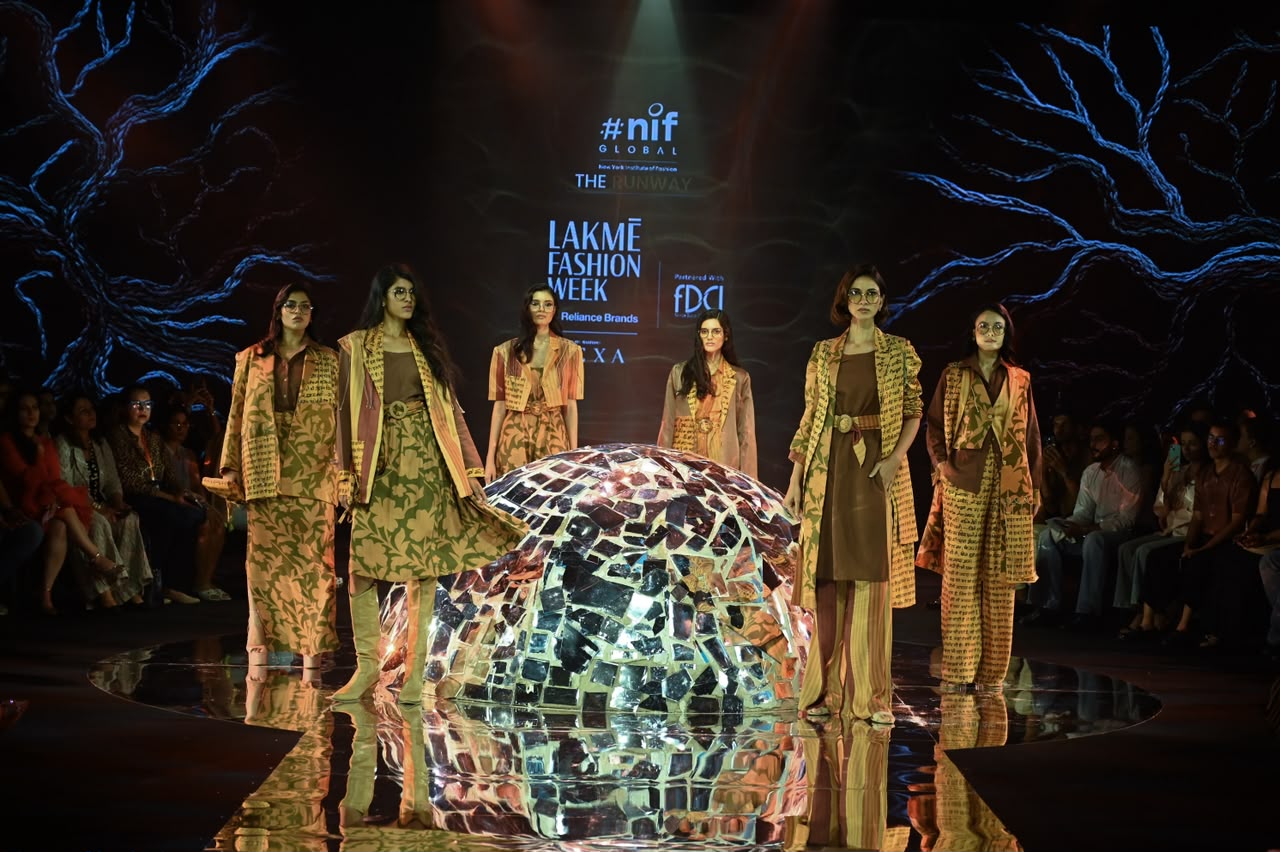
And what clothes. A rust wool coat, long and easy, with a shawl collar, worn over a brocade dress finished in a heavy gold silk fringe. Turn back the cuffs and there is embroidery in coral and turquoise, with 2 gold clasps at the chest that look like the paired golden fish of Buddhist iconography. A chartreuse satin dress, fringed and sequinned, with raw white fleece thrown over one shoulder, the model in braids and old jewellery at her ears and neck. For men, a brown wool jacket with ochre velvet at the collar and cuffs, a mustard band-collar shirt underneath and wide trousers in Zilzom's silk print, the Changthang landscape running down the leg in rust and cream.

Was it international? Completely. The trench coats had a Loro Piana ease to them. The rest was pure Miu Miu: the braids, the fleece thrown on, heirloom pieces against satin, that slightly irreverent styling Miuccia Prada has made her own. The comparison is a reference point for the reader, and a compliment. Ladakh is making clothes that would hold their own anywhere in the world. Think about the Loro Piana parallel for a second. That house built its name on wool from remote high-altitude herds, vicuña in the Andes, cashmere goats in Mongolia. Ladakh has its own herds and its own fibre, right at the source. Now it is telling its own story.

4 labels told it. Namza by Padma Yangchan opened with 18 ensembles in brocade and Pashmina, cut into contemporary silhouettes. Zilzom by Stanzin Palmo showed 18 looks built on her own silk prints, inspired by the landscapes of Changthang, along with new takes on snambu, the hand-woven Ladakhi wool. Changra Ladakh by Deskit Angmo and Charkha Ladakh by Rigzin Yangdol closed with handspun, handwoven Pashmina shawls, and you could see the quality from the front row. Dashugs, the well-known Ladakhi band, played live through the show.

The people behind the cloth
The moment of the evening was the artisans. They were on the runway. Women from Changthang sat on Ladakhi rugs carding raw wool by hand, baskets of fleece at their side, while another sat at her loom with snow peaks projected behind her. The models walked right past the people who make the cloth. Indian fashion talks endlessly about craft and artisans. Here they were, on the ramp, in full view, and the whole show was an ode to them.
Where Pashmina begins
To understand what those women were holding, you have to go to Changthang, the high plateau that stretches south-east from Leh towards Tibet at around 14,000 feet and above. Winters there drop to −40°C. The Changpa, nomadic Buddhist herders who live in yak-hair tents called rebo and move with the seasons, raise the Changra goat. To survive that cold, the goat grows a soft undercoat beneath its rough outer hair. Every spring, as the animals moult, the herders comb it out by hand. The fibre measures roughly 12 to 15 microns, a fraction of the width of a human hair, and each goat gives a small amount every year. That is pashm, the Persian word for wool. The cloth made from it is Pashmina.

Its history is a history of power. Kashmiri weavers turned Ladakhi and Tibetan pashm into the shawls that made Kashmir famous. Sultan Zain-ul-Abidin patronised the craft in the 15th century, and at the Mughal court Akbar wore and gifted shawls as markers of rank. In 1684, the Treaty of Tingmosgang ended a war between Ladakh and Tibet and gave Ladakh the exclusive right to buy the raw fibre of western Tibet. For generations after, caravans carried pashm through Leh to the weavers of Srinagar. The trade was worth enough to shape borders. When the Dogra general Zorawar Singh marched into Ladakh in 1834, control of the pashm route was part of the prize.

Then France fell in love with it. Shawls brought back from the East became an obsession in Napoleonic Paris, and Empress Joséphine owned hundreds of them by some accounts, turning them into gowns, cushions and bedspreads. Mills in Paisley, Scotland, copied the Kashmiri boteh so heavily that the motif still carries the town's name. Even the word cashmere is simply Kashmir as European ears heard it. Through all those centuries, the herders and the plateau stayed out of the story.
"The Fifth Season" puts them back in. The title points to a season beyond the 4 on the fashion calendar, the one that belongs to the herds and the pastures. And the show made a clear case: Ladakh's Pashmina deserves its own name, its own provenance and its own share of the money.

Ladakh since 2019
Now, the politics, because everything is interconnected. Ladakh became a Union Territory in 2019, separated from Jammu and Kashmir, and the years since have been about working out what that status really means. The Leh Apex Body and the Kargil Democratic Alliance continue to push the Centre for statehood and Sixth Schedule protections for land, jobs and a fragile ecology. Leh saw protest and loss in September 2025, and the talks with the Ministry of Home Affairs have been on and off since. This is a region asking serious questions about who its land and its future belong to.
So what does a fashion show have to do with all of that? Everything. Through these years, the Department of Industries and Commerce has been building the craft economy from the ground up, with Common Facility Centres, skill upgradation programmes, better production facilities and support for traditional handloom enterprises under the Raising and Accelerating MSME Performance (RAMP) Scheme. The idea is simple. When the herder, the spinner and the weaver keep more of the money their Pashmina earns, and keep it in Ladakh, the region's identity has an economy behind it. Shri Vinai Kumar Saxena, Lieutenant Governor of Ladakh, made the same point in his virtual address. He spoke about preserving traditional craftsmanship, and about making sure the recognition reaches the herders, weavers, women entrepreneurs and Self Help Groups who keep it alive.
What comes next
Indian fashion is moving towards provenance, and Ladakh now has one of the strongest origin stories in the world. The Ladakh Pashmina Conclave on 23rd and 24th October will bring more than 100 entrepreneurs and buyers together across over 50 stalls to turn this moment into business. The opportunity is right there: Pashmina named for Changthang, traced to its herds, finished by Ladakhi hands and sold with the confidence of the world's great luxury fibres.
Hats off to Sunil Sethi, the FDCI and the Department of Industries and Commerce, UT Ladakh. India got its first real look at what Ladakh is making, and Ladakh got the stage it has always deserved. Ladakh has arrived, and this is only the beginning.

TO BE CONTINUED, FOR SUBSCRIBERS ONLY.
This is where the surface ends and the reporting begins.
The complete piece, the full archive, and access to The French Press Circle. Reporting answerable only to its readers.
Already a subscriber ?
Login
Read these on the house, with our compliments.
A selection from the current issue, open to all readers. Read them in full. The rest is one decision away.





Let us say it at the outset : only a man like Sunil Sethi could have pulled this off. The Department of Industries and Commerce, Union Territory of Ladakh, conceptualised and facilitated "The Fifth Season: A Fashion Story from Ladakh" with FDCI's support. It took the Chairman of the Fashion Design Council of India to actually make it happen, and to hand Ladakh the final day of Lakmē Fashion Week in partnership with FDCI at Taj Palace, New Delhi, on 18th October. That is a bold call. Sethi made it, and he was right.
Here is the thing. For decades, India has looked at Ladakh and seen monasteries, high passes and a road trip. Its fashion stayed invisible to the rest of the country. Then 18th October happened, and Ladakh arrived. Who would have imagined it?
What walked
And what clothes. A rust wool coat, long and easy, with a shawl collar, worn over a brocade dress finished in a heavy gold silk fringe. Turn back the cuffs and there is embroidery in coral and turquoise, with 2 gold clasps at the chest that look like the paired golden fish of Buddhist iconography. A chartreuse satin dress, fringed and sequinned, with raw white fleece thrown over one shoulder, the model in braids and old jewellery at her ears and neck. For men, a brown wool jacket with ochre velvet at the collar and cuffs, a mustard band-collar shirt underneath and wide trousers in Zilzom's silk print, the Changthang landscape running down the leg in rust and cream.
Was it international? Completely. The trench coats had a Loro Piana ease to them. The rest was pure Miu Miu: the braids, the fleece thrown on, heirloom pieces against satin, that slightly irreverent styling Miuccia Prada has made her own. The comparison is a reference point for the reader, and a compliment. Ladakh is making clothes that would hold their own anywhere in the world. Think about the Loro Piana parallel for a second. That house built its name on wool from remote high-altitude herds, vicuña in the Andes, cashmere goats in Mongolia. Ladakh has its own herds and its own fibre, right at the source. Now it is telling its own story.
4 labels told it. Namza by Padma Yangchan opened with 18 ensembles in brocade and Pashmina, cut into contemporary silhouettes. Zilzom by Stanzin Palmo showed 18 looks built on her own silk prints, inspired by the landscapes of Changthang, along with new takes on snambu, the hand-woven Ladakhi wool. Changra Ladakh by Deskit Angmo and Charkha Ladakh by Rigzin Yangdol closed with handspun, handwoven Pashmina shawls, and you could see the quality from the front row. Dashugs, the well-known Ladakhi band, played live through the show.
The people behind the cloth
The moment of the evening was the artisans. They were on the runway. Women from Changthang sat on Ladakhi rugs carding raw wool by hand, baskets of fleece at their side, while another sat at her loom with snow peaks projected behind her. The models walked right past the people who make the cloth. Indian fashion talks endlessly about craft and artisans. Here they were, on the ramp, in full view, and the whole show was an ode to them.
Where Pashmina begins
To understand what those women were holding, you have to go to Changthang, the high plateau that stretches south-east from Leh towards Tibet at around 14,000 feet and above. Winters there drop to −40°C. The Changpa, nomadic Buddhist herders who live in yak-hair tents called rebo and move with the seasons, raise the Changra goat. To survive that cold, the goat grows a soft undercoat beneath its rough outer hair. Every spring, as the animals moult, the herders comb it out by hand. The fibre measures roughly 12 to 15 microns, a fraction of the width of a human hair, and each goat gives a small amount every year. That is pashm, the Persian word for wool. The cloth made from it is Pashmina.
Its history is a history of power. Kashmiri weavers turned Ladakhi and Tibetan pashm into the shawls that made Kashmir famous. Sultan Zain-ul-Abidin patronised the craft in the 15th century, and at the Mughal court Akbar wore and gifted shawls as markers of rank. In 1684, the Treaty of Tingmosgang ended a war between Ladakh and Tibet and gave Ladakh the exclusive right to buy the raw fibre of western Tibet. For generations after, caravans carried pashm through Leh to the weavers of Srinagar. The trade was worth enough to shape borders. When the Dogra general Zorawar Singh marched into Ladakh in 1834, control of the pashm route was part of the prize.
Then France fell in love with it. Shawls brought back from the East became an obsession in Napoleonic Paris, and Empress Joséphine owned hundreds of them by some accounts, turning them into gowns, cushions and bedspreads. Mills in Paisley, Scotland, copied the Kashmiri boteh so heavily that the motif still carries the town's name. Even the word cashmere is simply Kashmir as European ears heard it. Through all those centuries, the herders and the plateau stayed out of the story.
"The Fifth Season" puts them back in. The title points to a season beyond the 4 on the fashion calendar, the one that belongs to the herds and the pastures. And the show made a clear case: Ladakh's Pashmina deserves its own name, its own provenance and its own share of the money.
Ladakh since 2019
Now, the politics, because everything is interconnected. Ladakh became a Union Territory in 2019, separated from Jammu and Kashmir, and the years since have been about working out what that status really means. The Leh Apex Body and the Kargil Democratic Alliance continue to push the Centre for statehood and Sixth Schedule protections for land, jobs and a fragile ecology. Leh saw protest and loss in September 2025, and the talks with the Ministry of Home Affairs have been on and off since. This is a region asking serious questions about who its land and its future belong to.
So what does a fashion show have to do with all of that? Everything. Through these years, the Department of Industries and Commerce has been building the craft economy from the ground up, with Common Facility Centres, skill upgradation programmes, better production facilities and support for traditional handloom enterprises under the Raising and Accelerating MSME Performance (RAMP) Scheme. The idea is simple. When the herder, the spinner and the weaver keep more of the money their Pashmina earns, and keep it in Ladakh, the region's identity has an economy behind it. Shri Vinai Kumar Saxena, Lieutenant Governor of Ladakh, made the same point in his virtual address. He spoke about preserving traditional craftsmanship, and about making sure the recognition reaches the herders, weavers, women entrepreneurs and Self Help Groups who keep it alive.
What comes next
Indian fashion is moving towards provenance, and Ladakh now has one of the strongest origin stories in the world. The Ladakh Pashmina Conclave on 23rd and 24th October will bring more than 100 entrepreneurs and buyers together across over 50 stalls to turn this moment into business. The opportunity is right there: Pashmina named for Changthang, traced to its herds, finished by Ladakhi hands and sold with the confidence of the world's great luxury fibres.
Hats off to Sunil Sethi, the FDCI and the Department of Industries and Commerce, UT Ladakh. India got its first real look at what Ladakh is making, and Ladakh got the stage it has always deserved. Ladakh has arrived, and this is only the beginning.
TO BE CONTINUED, FOR SUBSCRIBERS ONLY.
This is where the surface ends and the reporting begins.
The complete piece, the full archive, and access to The French Press Circle. Reporting answerable only to its readers.
Already a subscriber ?
Login
Read these on the house, with our compliments.
A selection from the current issue, open to all readers. Read them in full. The rest is one decision away.