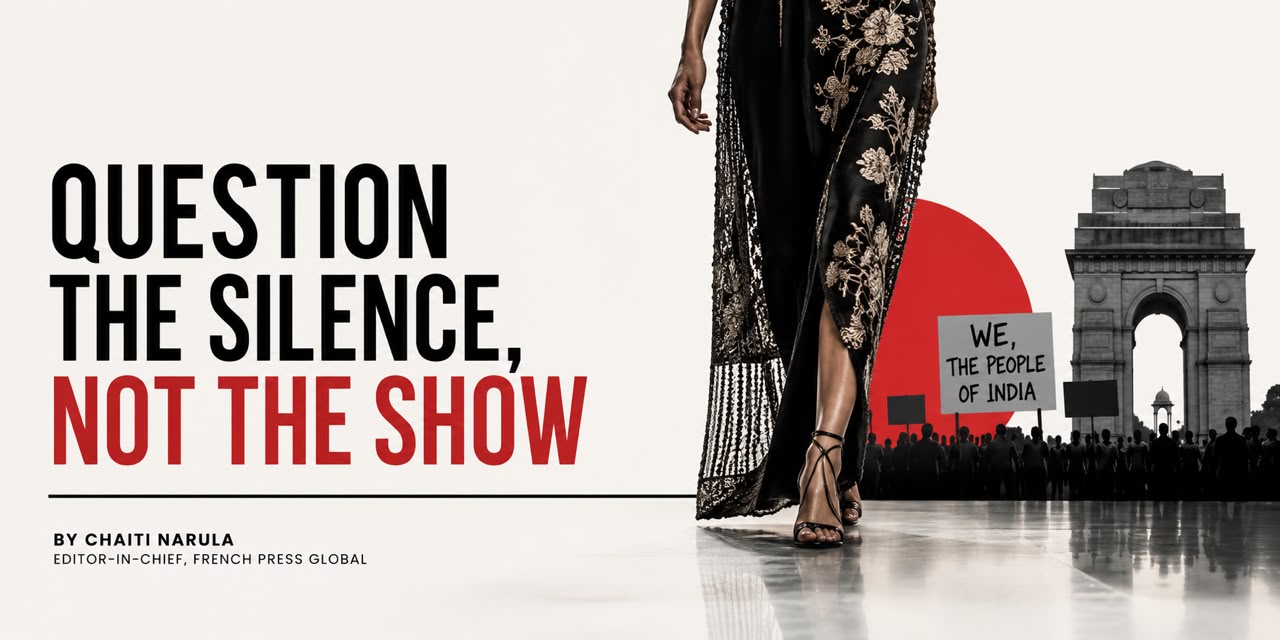
“Shutting this down would be an expensive way of achieving absolutely nothing.” - Tarun Tahiliani
Hold that thought, because the week has been full of people demanding exactly that, and almost none of them have worked out what it would cost or who would pay.
Start with the fairest thing that can be said for fashion right now, which is that this demand has landed on one industry alone. The Monsoon Session is sitting. The markets opened on Thursday and will open on Monday. Cinemas are running their Friday releases. Restaurants are full, weddings are going ahead, and the sporting calendar has not paused for a minute. Of every business operating in this country while several thousand young people sit at Jantar Mantar, exactly one has been told it ought to stop.
That is worth sitting with, and it is where Tarun Tahiliani begins.
"Why is fashion always dragged into this?" he asked me on Thursday. "Were the movie theatres shut down because people do not need idle entertainment?"
He wanted an answer. There is not a good one.
His fuller objection is aimed at the shape of the demand rather than at the people making it, and he draws that line more carefully than most of the argument online has managed.
"I find it absurd, all of this posting. Why do those people not go and sit there and show their solidarity, instead of constantly pointing at other industries and saying, you should be doing this, you should be doing this? Charity, and everything, begins at home. Go and sit there, and then we shall have a discussion. After you have sat there for two weeks. I have been to multiple protests, and the way my studio and my people are treated and run is the culture of our company, and we shall continue to do that."
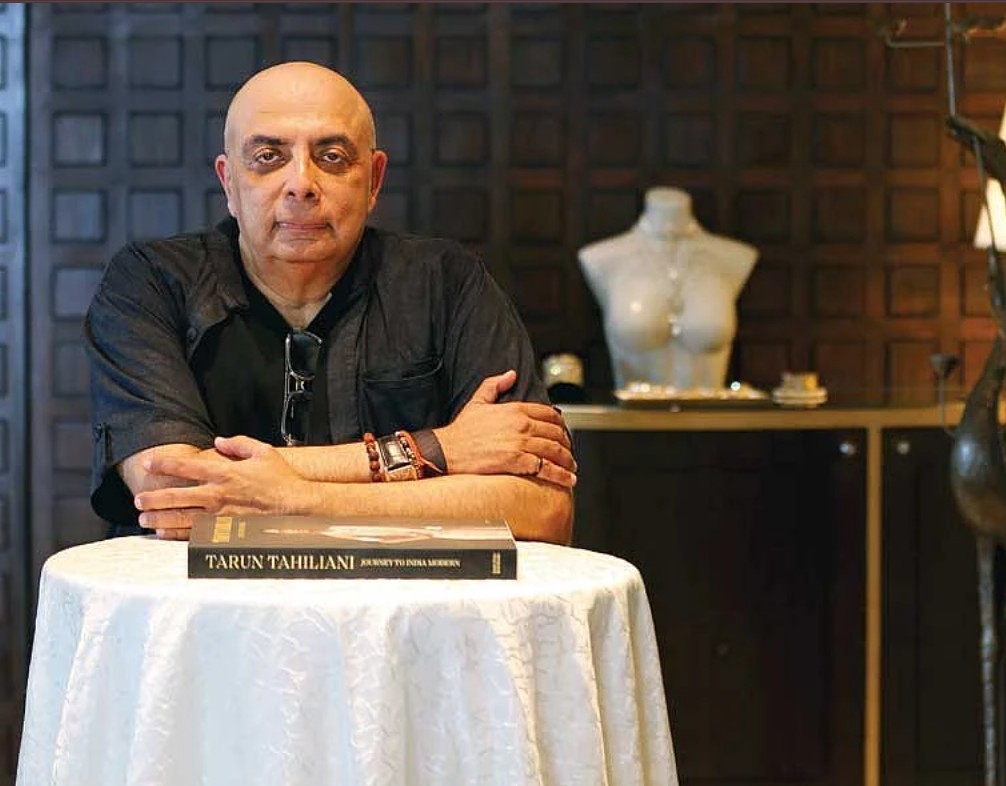
Tarun Tahiliani (Image via Archives)
Read that again, because he is claiming less than his critics assume. He is saying that what you do carries more weight than what you post, that he has turned up in person before, and that he wants to be measured by how the people in his studio are treated. That is a man inviting a particular kind of scrutiny rather than asking to be left alone.
On the substance, he is with the students.
"The youth are protesting being disparaged, which I agree with. They are protesting leaked government papers, which I agree with."
THE STUDENTS NEVER ASKED FOR THIS
Here is the part that almost nobody arguing about couture week this week has bothered to establish.
I have been to the protest site. I have asked, repeatedly, across conversations with well over a hundred people there.
The students are not asking for India Couture Week to be cancelled. They are not asking for anything to be cancelled. Their demands are specific and they have been consistent about them for weeks: the resignation of the Union Education Minister, compensation for the families of students who died, the withdrawal of cases against peaceful protesters, accountability for the police action of 20 July, and a serious answer to a system in which papers leak and children die over it.
Ask them about the fashion week and the answer comes back with a shrug. Let the world go on. We are not standing in anybody's way. Stand with us if you want to.
And when you tell them what this industry employs, they are glad of it. Joblessness is one of the things they are on the street about. A sector that puts millions of people into work sits on their side of the argument. The movement took its name from a remark comparing unemployed young Indians to insects. Handing them the sight of eleven million people losing a fortnight's wages would be an odd way of showing solidarity.
Which leaves the shutdown demand as something generated online, by people who are largely not at Jantar Mantar, and attributed to a protest that has never made it.
The industry has spent the week arguing with a position nobody at the protest site holds.
WHAT WAS ACTUALLY ASKED
The real ask is smaller and considerably harder to dodge.
Media outlets reporting the backlash on 23 July, quoted two unnamed users. One called the timing of the week a display of privilege and detachment. The other addressed Indian-born designers directly: if you build a career on this country, draw on it for your work and speak about your roots when it serves the business, you might also find the courage to stand with its people when they need it. That one ended with three words. We are watching.
Both are complaints about silence. Neither is a demand to stop working.
Look at what each option actually costs. Shutting down takes a fortnight's pay from embroiderers, karigars, tailors, drivers, riggers and backstage crew, none of whom were asked and all of whom need the money. Speaking up takes nothing from anybody except the designer, who loses only the comfort of having stayed out of it.
One bill goes to the people who can least afford it. The other goes to the person who can most easily pay.
That is why the industry has answered the first demand loudly and left the second one alone.
THE COUNCIL SPOKE
To its credit, the Fashion Design Council of India did not hide behind the schedule.
The Council said that India Couture Week hopes and prays that the current situation unfolding at Delhi's Jantar Mantar moves towards a peaceful resolution through mediation and reconciliation.
That is a careful sentence, and I mean it as praise. It acknowledges what is happening a few kilometres from the venue. It declines to pretend the week is taking place in a sealed room. It expresses a hope for resolution while leaving the question of who is right to other people, which is a defensible position for a trade body that works with two Union ministries and represents four hundred members holding four hundred different political views.
Anyone expecting the FDCI to be tone deaf has not been watching how the Council operates. It has never been that, and it is not that now.
What stands out is how few of the houses on the schedule have found any words at all. The Council managed a sentence. Most of its headline names have not attempted one.
WHAT THE FDCI ACTUALLY IS
There is a version of this week that exists only in photographs, and that version is what most of the criticism is aimed at. It is also almost entirely wrong, and it is worth spelling out for anybody who has never stood in the back of house at two in the morning.
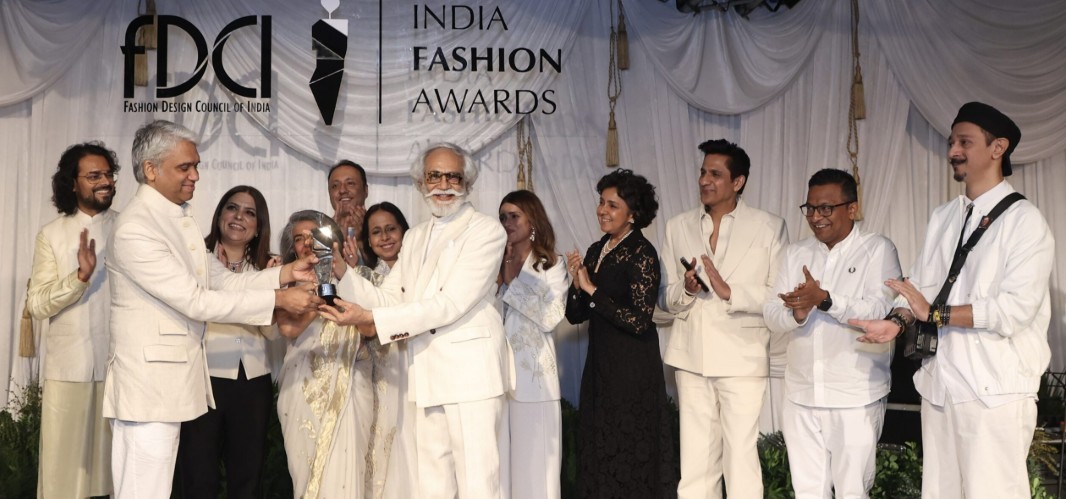
FDCI council at India Fashion Awards
(Image via: FDCI Website)
The Fashion Design Council of India is a not-for-profit. It has more than four hundred members across designers, accessory labels, professionals, institutions and corporates. It works with the Ministry of Textiles and with the Ministry of Commerce and Industry. Its stated purpose is to further the business of fashion and to build export and retail access for Indian designers abroad, and it has been placing them into international stockists for more than two decades. Sunil Sethi has run it since 2008, and he started couture week in the same year, when couture in this country was still treated as the lesser sibling of prêt.
This is the nineteenth edition. It is Hyundai's fourth consecutive year as title partner. It opened outside Delhi for the first time in its history, with Anamika Khanna at Taj Falaknuma Palace in Hyderabad, and it closes with Rahul Mishra on 29 July. In between, order books open, buyers place, and the wedding season that carries a substantial share of this industry's annual revenue gets its only proper window.
The scale underneath it is the part nobody outside the trade seems to hold in their head.
India's textiles sector employs more than 45 million people, which makes it one of the largest generators of livelihoods in the country. It contributes approximately two per cent of national GDP and around eleven per cent of manufacturing gross value added, as of February 2026. Handicraft exports alone, excluding hand-knotted carpets, reached ₹33,122.79 crore in 2024-25, against ₹20,082.53 crore in 2014-15.
Every one of those figures is a person. The zari worker in Bareilly. The chikankari unit in Lucknow. The block printer in Bagru. The weaver in Varanasi. The finisher in Okhla who has been doing hand-rolled hems for twenty years and does them better than any machine ever built.
Photographs are what the week looks like. The order book is what the week is for.
So Tahiliani is right. Shutting this down would be an expensive way of achieving nothing at all.
The trouble starts when you follow his argument all the way to the end.
THE NUMBER THAT APPEARS ON NO INVITATION
The defence rests on employment. Fashion should not stop, because millions depend on it.
So look at what those millions take home.
In May, the Institute for Human Development and the Crafts Council of India published Economics of Indian Craft, a survey led by Professor G.C. Manna, former Director-General of the National Sample Survey organisation. It found that a weaver who spends a month producing a Kanjivaram that retails at ₹30,000 takes home no more than ₹7,000 for the work.
It also found that the state has been counting wrong. The study puts the handicraft and handloom workforce at 113 lakh people nationally. The Economic Survey 2025-26 puts it at 64.66 lakh. The sector this industry invokes in its own defence is roughly twice the size the government thinks it is, and nobody has been keeping proper track of it.
That is the promissory note underneath every press release published this week.
THE STANDARD
Which returns us to Tahiliani's line, and to more work than he may have meant it to do.
Charity, and everything, begins at home.
He aimed it at people posting from a distance, and as an instruction to critics it lands cleanly. As a standard for an industry that has just invoked millions of livelihoods in its own defence, it asks a great deal more.
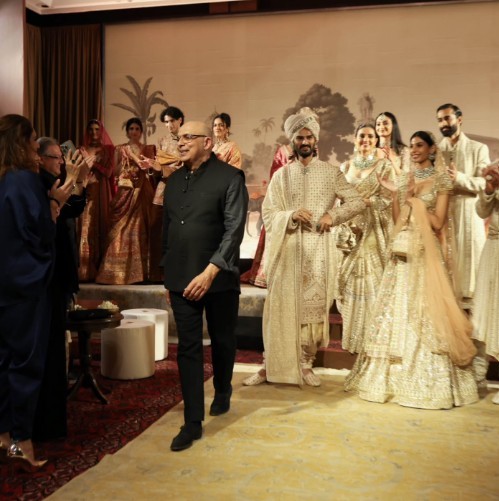
Tarun Tahiliani ICW 2025 showcase (Image Via: ANI)
If the reason this week must go ahead is that millions of people depend on it, the industry has accepted the terms of its own examination. It has said: judge us by the artisans. Very well. The weaver gets ₹7,000 for a month's work on a ₹30,000 sari, and the state does not know how many of him there are.
That is an argument for continuing, and for continuing honestly. The students at Jantar Mantar have said as much themselves. They want the world to keep turning, and they want somebody to stand next to them while it does.
French Press Global is putting three questions to the fashion designers in India. We will publish the answers, and we will publish the refusals.
What do the karigars in your atelier earn per day, and how does that compare with the prescribed minimum wage in the state where they work?
Are they on your books, or on a contractor's?
And on the students at Jantar Mantar, do you have anything to say?
The first two would turn the employment defence into something verifiable. The third is what the country has been asking all week, and it is the smaller of the two asks by a distance. An industry confident enough to keep its calendar during a national protest should be confident enough to answer all three.
Everything begins at home.
Tarun Tahiliani presents at Hyundai India Couture Week on 26 July. The 19th edition runs from 23 to 29 July 2026. Reporting from the Jantar Mantar protest site was carried out by the writer between 20 and 23 July 2026.
TO BE CONTINUED, FOR SUBSCRIBERS ONLY.
This is where the surface ends and the reporting begins.
The complete piece, the full archive, and access to The French Press Circle. Reporting answerable only to its readers.
Already a subscriber ?
Login
Read these on the house, with our compliments.
A selection from the current issue, open to all readers. Read them in full. The rest is one decision away.



“Shutting this down would be an expensive way of achieving absolutely nothing.” - Tarun Tahiliani
Hold that thought, because the week has been full of people demanding exactly that, and almost none of them have worked out what it would cost or who would pay.
Start with the fairest thing that can be said for fashion right now, which is that this demand has landed on one industry alone. The Monsoon Session is sitting. The markets opened on Thursday and will open on Monday. Cinemas are running their Friday releases. Restaurants are full, weddings are going ahead, and the sporting calendar has not paused for a minute. Of every business operating in this country while several thousand young people sit at Jantar Mantar, exactly one has been told it ought to stop.
That is worth sitting with, and it is where Tarun Tahiliani begins.
"Why is fashion always dragged into this?" he asked me on Thursday. "Were the movie theatres shut down because people do not need idle entertainment?"
He wanted an answer. There is not a good one.
His fuller objection is aimed at the shape of the demand rather than at the people making it, and he draws that line more carefully than most of the argument online has managed.
"I find it absurd, all of this posting. Why do those people not go and sit there and show their solidarity, instead of constantly pointing at other industries and saying, you should be doing this, you should be doing this? Charity, and everything, begins at home. Go and sit there, and then we shall have a discussion. After you have sat there for two weeks. I have been to multiple protests, and the way my studio and my people are treated and run is the culture of our company, and we shall continue to do that."
Tarun Tahiliani (Image via Archives)
Read that again, because he is claiming less than his critics assume. He is saying that what you do carries more weight than what you post, that he has turned up in person before, and that he wants to be measured by how the people in his studio are treated. That is a man inviting a particular kind of scrutiny rather than asking to be left alone.
On the substance, he is with the students.
"The youth are protesting being disparaged, which I agree with. They are protesting leaked government papers, which I agree with."
THE STUDENTS NEVER ASKED FOR THIS
Here is the part that almost nobody arguing about couture week this week has bothered to establish.
I have been to the protest site. I have asked, repeatedly, across conversations with well over a hundred people there.
The students are not asking for India Couture Week to be cancelled. They are not asking for anything to be cancelled. Their demands are specific and they have been consistent about them for weeks: the resignation of the Union Education Minister, compensation for the families of students who died, the withdrawal of cases against peaceful protesters, accountability for the police action of 20 July, and a serious answer to a system in which papers leak and children die over it.
Ask them about the fashion week and the answer comes back with a shrug. Let the world go on. We are not standing in anybody's way. Stand with us if you want to.
And when you tell them what this industry employs, they are glad of it. Joblessness is one of the things they are on the street about. A sector that puts millions of people into work sits on their side of the argument. The movement took its name from a remark comparing unemployed young Indians to insects. Handing them the sight of eleven million people losing a fortnight's wages would be an odd way of showing solidarity.
Which leaves the shutdown demand as something generated online, by people who are largely not at Jantar Mantar, and attributed to a protest that has never made it.
The industry has spent the week arguing with a position nobody at the protest site holds.
WHAT WAS ACTUALLY ASKED
The real ask is smaller and considerably harder to dodge.
Media outlets reporting the backlash on 23 July, quoted two unnamed users. One called the timing of the week a display of privilege and detachment. The other addressed Indian-born designers directly: if you build a career on this country, draw on it for your work and speak about your roots when it serves the business, you might also find the courage to stand with its people when they need it. That one ended with three words. We are watching.
Both are complaints about silence. Neither is a demand to stop working.
Look at what each option actually costs. Shutting down takes a fortnight's pay from embroiderers, karigars, tailors, drivers, riggers and backstage crew, none of whom were asked and all of whom need the money. Speaking up takes nothing from anybody except the designer, who loses only the comfort of having stayed out of it.
One bill goes to the people who can least afford it. The other goes to the person who can most easily pay.
That is why the industry has answered the first demand loudly and left the second one alone.
THE COUNCIL SPOKE
To its credit, the Fashion Design Council of India did not hide behind the schedule.
The Council said that India Couture Week hopes and prays that the current situation unfolding at Delhi's Jantar Mantar moves towards a peaceful resolution through mediation and reconciliation.
That is a careful sentence, and I mean it as praise. It acknowledges what is happening a few kilometres from the venue. It declines to pretend the week is taking place in a sealed room. It expresses a hope for resolution while leaving the question of who is right to other people, which is a defensible position for a trade body that works with two Union ministries and represents four hundred members holding four hundred different political views.
Anyone expecting the FDCI to be tone deaf has not been watching how the Council operates. It has never been that, and it is not that now.
What stands out is how few of the houses on the schedule have found any words at all. The Council managed a sentence. Most of its headline names have not attempted one.
WHAT THE FDCI ACTUALLY IS
There is a version of this week that exists only in photographs, and that version is what most of the criticism is aimed at. It is also almost entirely wrong, and it is worth spelling out for anybody who has never stood in the back of house at two in the morning.
FDCI council at India Fashion Awards
(Image via: FDCI Website)
The Fashion Design Council of India is a not-for-profit. It has more than four hundred members across designers, accessory labels, professionals, institutions and corporates. It works with the Ministry of Textiles and with the Ministry of Commerce and Industry. Its stated purpose is to further the business of fashion and to build export and retail access for Indian designers abroad, and it has been placing them into international stockists for more than two decades. Sunil Sethi has run it since 2008, and he started couture week in the same year, when couture in this country was still treated as the lesser sibling of prêt.
This is the nineteenth edition. It is Hyundai's fourth consecutive year as title partner. It opened outside Delhi for the first time in its history, with Anamika Khanna at Taj Falaknuma Palace in Hyderabad, and it closes with Rahul Mishra on 29 July. In between, order books open, buyers place, and the wedding season that carries a substantial share of this industry's annual revenue gets its only proper window.
The scale underneath it is the part nobody outside the trade seems to hold in their head.
India's textiles sector employs more than 45 million people, which makes it one of the largest generators of livelihoods in the country. It contributes approximately two per cent of national GDP and around eleven per cent of manufacturing gross value added, as of February 2026. Handicraft exports alone, excluding hand-knotted carpets, reached ₹33,122.79 crore in 2024-25, against ₹20,082.53 crore in 2014-15.
Every one of those figures is a person. The zari worker in Bareilly. The chikankari unit in Lucknow. The block printer in Bagru. The weaver in Varanasi. The finisher in Okhla who has been doing hand-rolled hems for twenty years and does them better than any machine ever built.
Photographs are what the week looks like. The order book is what the week is for.
So Tahiliani is right. Shutting this down would be an expensive way of achieving nothing at all.
The trouble starts when you follow his argument all the way to the end.
THE NUMBER THAT APPEARS ON NO INVITATION
The defence rests on employment. Fashion should not stop, because millions depend on it.
So look at what those millions take home.
In May, the Institute for Human Development and the Crafts Council of India published Economics of Indian Craft, a survey led by Professor G.C. Manna, former Director-General of the National Sample Survey organisation. It found that a weaver who spends a month producing a Kanjivaram that retails at ₹30,000 takes home no more than ₹7,000 for the work.
It also found that the state has been counting wrong. The study puts the handicraft and handloom workforce at 113 lakh people nationally. The Economic Survey 2025-26 puts it at 64.66 lakh. The sector this industry invokes in its own defence is roughly twice the size the government thinks it is, and nobody has been keeping proper track of it.
That is the promissory note underneath every press release published this week.
THE STANDARD
Which returns us to Tahiliani's line, and to more work than he may have meant it to do.
Charity, and everything, begins at home.
He aimed it at people posting from a distance, and as an instruction to critics it lands cleanly. As a standard for an industry that has just invoked millions of livelihoods in its own defence, it asks a great deal more.
Tarun Tahiliani ICW 2025 showcase (Image Via: ANI)
If the reason this week must go ahead is that millions of people depend on it, the industry has accepted the terms of its own examination. It has said: judge us by the artisans. Very well. The weaver gets ₹7,000 for a month's work on a ₹30,000 sari, and the state does not know how many of him there are.
That is an argument for continuing, and for continuing honestly. The students at Jantar Mantar have said as much themselves. They want the world to keep turning, and they want somebody to stand next to them while it does.
French Press Global is putting three questions to the fashion designers in India. We will publish the answers, and we will publish the refusals.
What do the karigars in your atelier earn per day, and how does that compare with the prescribed minimum wage in the state where they work?
Are they on your books, or on a contractor's?
And on the students at Jantar Mantar, do you have anything to say?
The first two would turn the employment defence into something verifiable. The third is what the country has been asking all week, and it is the smaller of the two asks by a distance. An industry confident enough to keep its calendar during a national protest should be confident enough to answer all three.
Everything begins at home.
Tarun Tahiliani presents at Hyundai India Couture Week on 26 July. The 19th edition runs from 23 to 29 July 2026. Reporting from the Jantar Mantar protest site was carried out by the writer between 20 and 23 July 2026.
TO BE CONTINUED, FOR SUBSCRIBERS ONLY.
This is where the surface ends and the reporting begins.
The complete piece, the full archive, and access to The French Press Circle. Reporting answerable only to its readers.
Already a subscriber ?
Login
Read these on the house, with our compliments.
A selection from the current issue, open to all readers. Read them in full. The rest is one decision away.