
Rohit Bal ended his shows one way for the better part of three decades. The models broke formation and danced. Bollywood songs, played loud and late. Bal walked out into the middle of it dressed in black, and the room came apart. He did it at the Grand Hyatt in Mumbai in 2008, where he and his showstopper and the whole cast sang and danced their way down the runway to close the first HDIL India Couture Week. He did it in October 2024 at The Imperial, at the Lakmé Fashion Week and FDCI grand finale, where four people helped him onto the runway and he danced anyway alongside Ananya Panday. He died on 1 November that year, aged sixty-three.
On Friday night, in the 9.30 slot at Taj Palace, the house closed its collection differently. Six members of the creative team walked out together, to the end of the runway and back. The models held their line. The room rose anyway.
Two things happened in that moment, and they are worth separating.
The first is that a ritual returned to the person it belonged to. Bal's dance was his temperament made public, the same instinct that made him describe himself as an artist rather than a commercial designer. A team can honour that instinct. Performing it is another matter, and the decision to leave it alone is the most self-aware thing this house has done since he died. We have no window into whether it was deliberate, and it would be presumptuous to claim one. The effect is what stands.
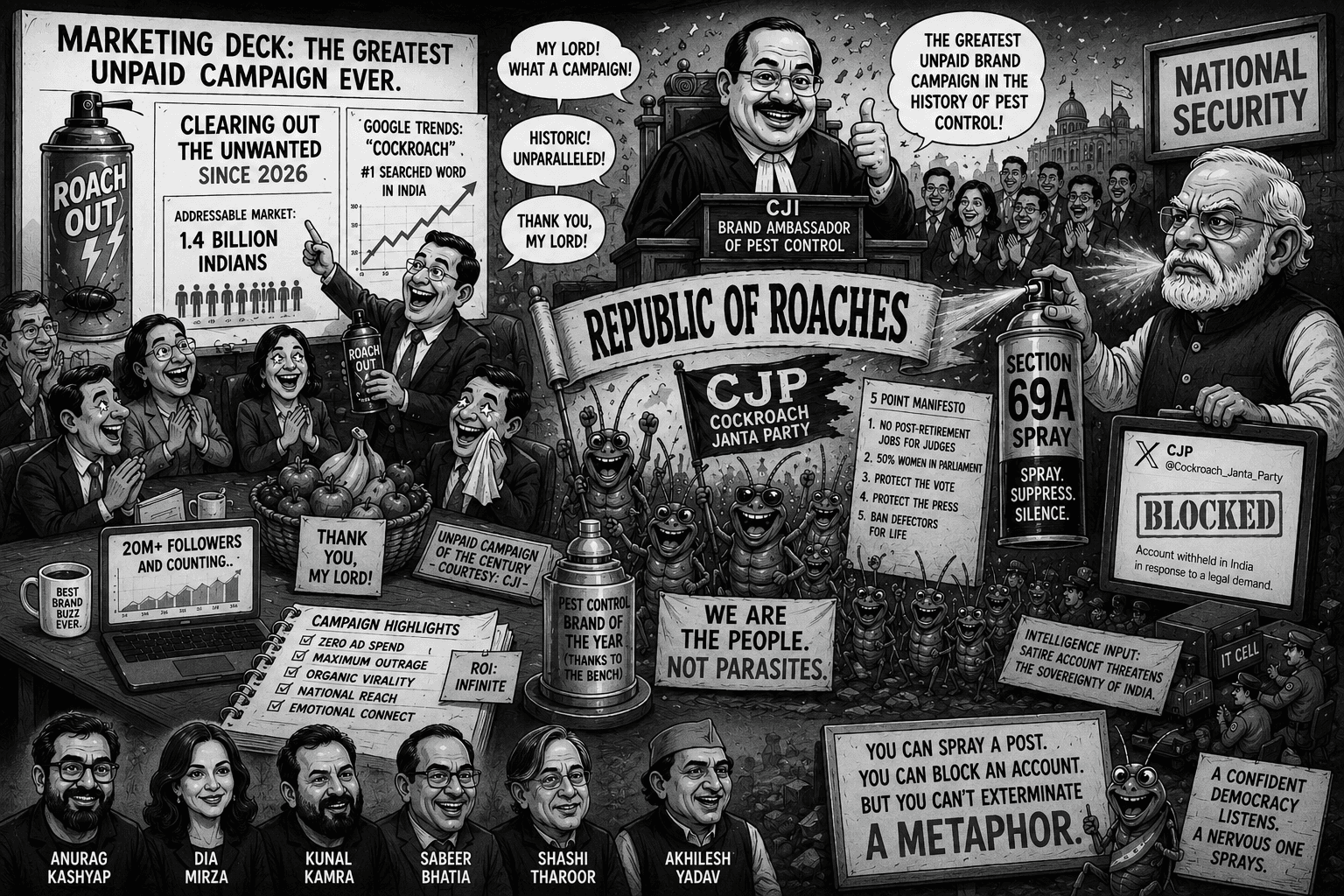
The second is the timing, and here the judgement was exactly right. Delhi has spent this month inside the Cockroach Janta Party's protest at Jantar Mantar over the NEET-UG paper leak, an agitation that has drawn tens of thousands onto the streets, closed metro stations across the capital, prompted a march on Parliament, ended in detentions of senior opposition figures, and carried Sonam Wangchuk through a twenty-six day hunger strike. Fashion happening two kilometres away from that is a fact the industry has to hold, and much of the online criticism aimed at couture week this week has come from precisely that discomfort.
Which is why this publication wants to be plain about where it stands. The Fashion Design Council of India and Sunil Sethi were right to proceed. A couture week is a payroll. It is embroiderers, karigars, pattern cutters, dressers, stylists, hair and make-up teams, technicians, drivers, caterers and the freelancers who live off eight nights a year. Cancelling would have cost those people real income and bought nothing for the students at Jantar Mantar. Going ahead while dialling the celebration down is the correct order of things, and on Friday night that is what happened.
Now, the clothes.
What survived, and how completely
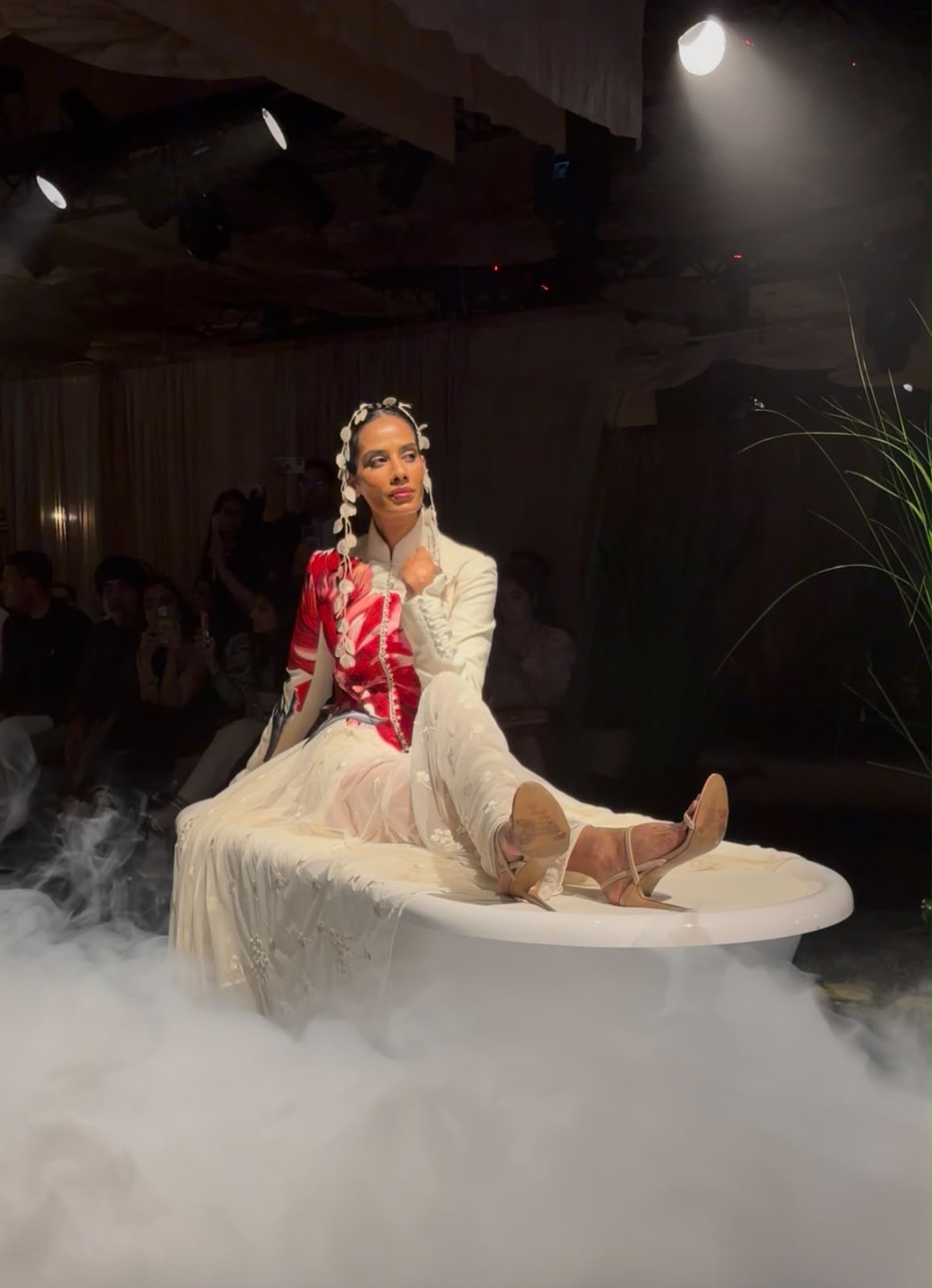
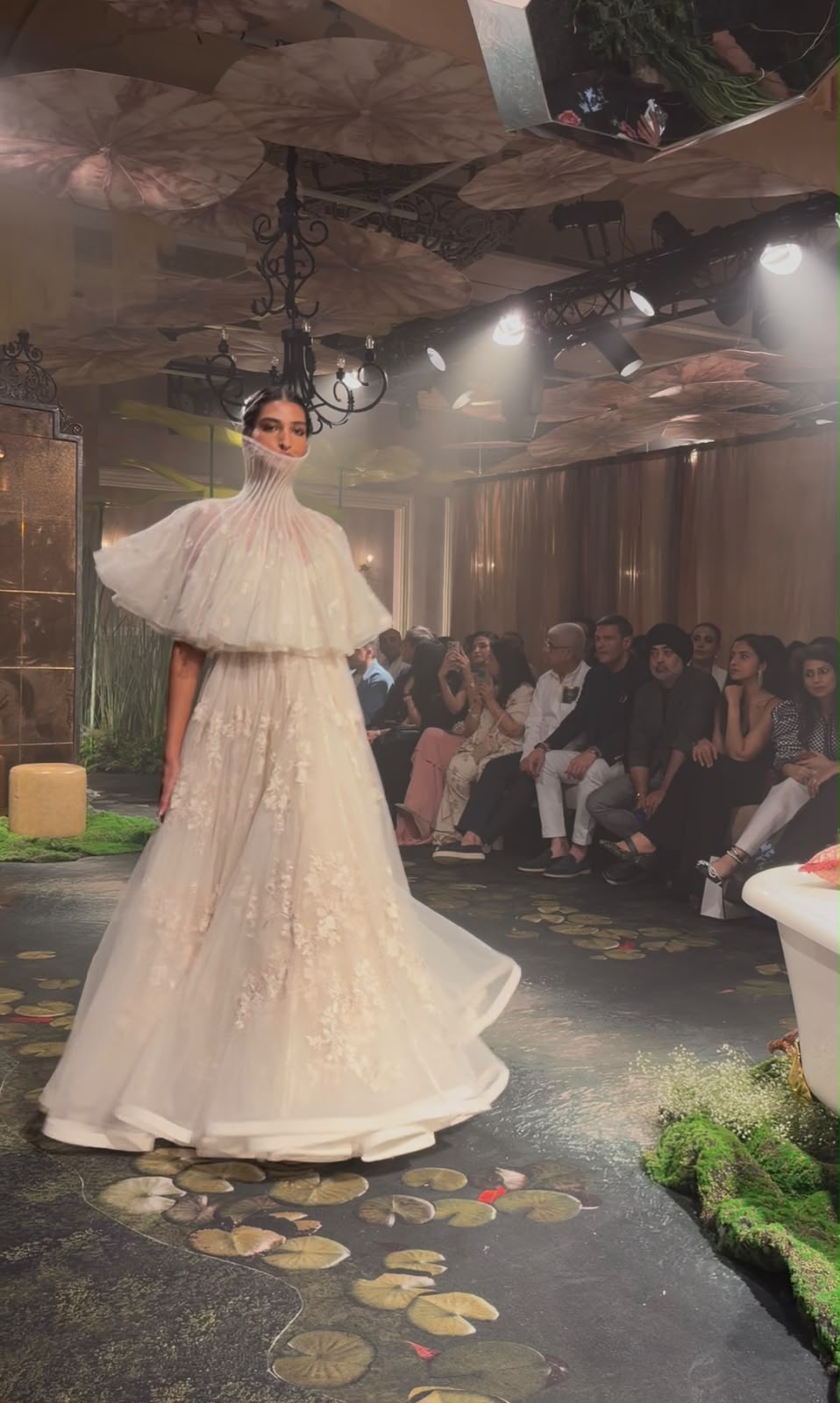
The set was the lotus, at the scale of architecture. The runway was painted as a lily pond, pads and fallen petals underfoot, so every model appeared to be walking on water. Overhead, inverted parasols in dusty rose read as lotus leaves seen from below, with wrought iron chandeliers hung between them. Sheer ivory tulle fell in columns down the sides of the room, hand-painted with florals and birds. A white claw-foot bathtub sat dressed in tulle at the runway's edge. Dry ice pooled at ankle height, thick enough that several looks arrived out of it rather than walked in.
Bal built worlds like this his entire career. Kehkashaan at Bikaner House used withered trees, low light and live instrumental music. Guldastah at Lakmé in 2019 covered the ramp in dry Chinar leaves and lined it with shikaras laden with flowers, and he gave the standing ovation to eight Kashmiri women who had trained with Usha Silai and worked on the collection through a Valley winter. The lotus and the peacock were his two constant motifs, drawn from folklore and history and used across menswear and womenswear alike. Lifting the lotus off the garment and putting it under everyone's feet is the boldest move the design team made on Friday, and the idea belongs entirely to him, executed at a scale he would have enjoyed.
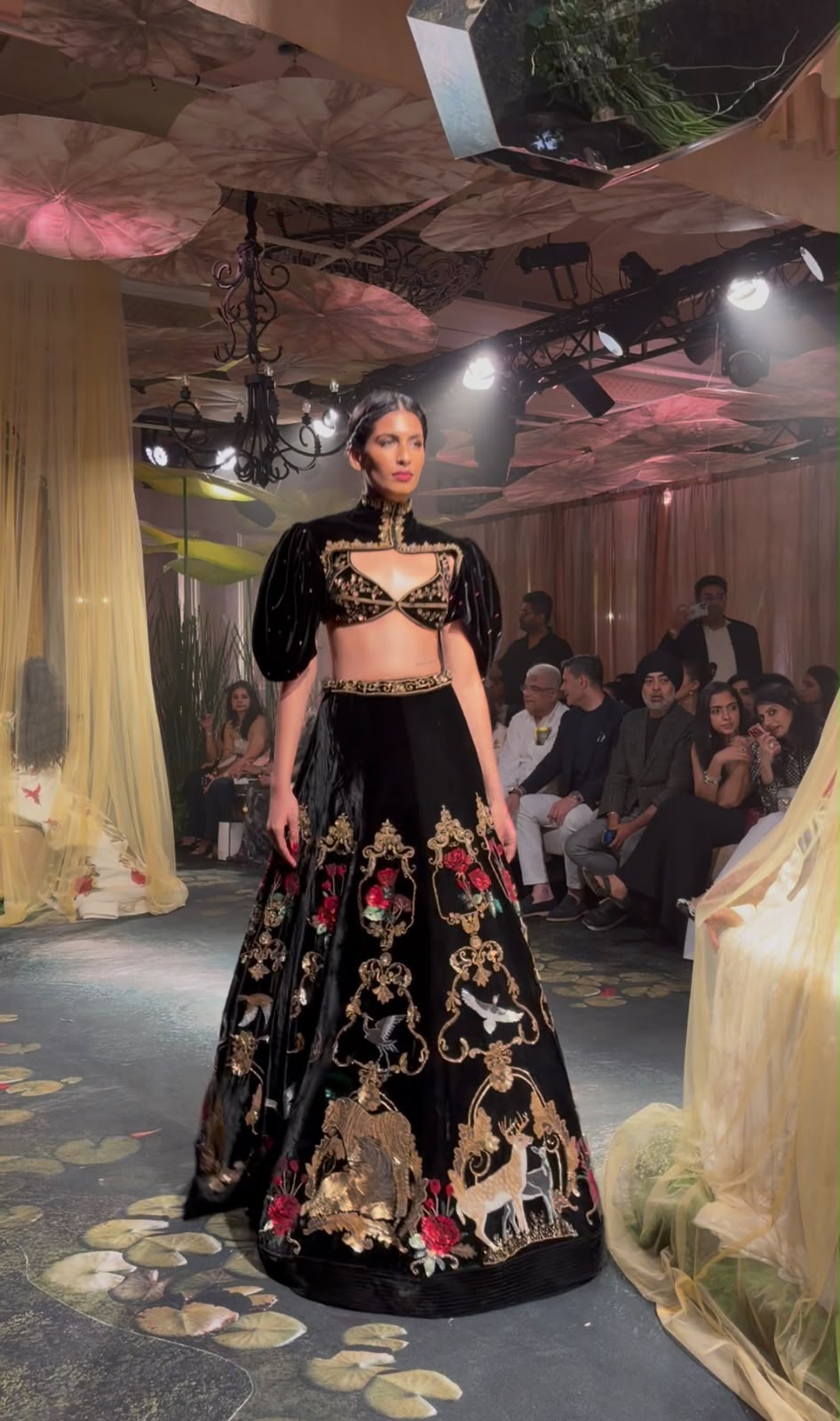
The palette was his, to the letter. Black velvet and ivory formed the spine, deep crimson and wine ran through the middle, and gold was the only metal in the room, worked as zardozi, as tissue and as thread. This is his taste exactly. When he showed Kehkashaan the range ran from white through black to wine, with lotus and peacock in gold zardozi. When his team showed Kash-Gul on this same platform a year ago, the house described the palette as ivory, black and wine, in chanderi, matka silk and velvet, with gold zardozi and fine threadwork. Three collections, three separate eras of the house, the same three colours and the same metal.
The materials held too. Velvet carrying dense gold vine work. Chanderi and fine silks for the ivory passages. Botanical embroidery, birds and foliage on ivory ground, which is the exact territory of Husn-E-Taa'iraat at the Imperial in 2015. In menswear, black velvet under heavy gold zardozi, cut as a cropped bandhgala jacket or run full length as a sherwani. Arjun Rampal walked this runway in velvet from Kash-Gul last July, and it is more or less the register Bal wore to take his own bows.
The departures were narrow. A short pleated peplum over slim trousers gave the menswear a proportion the house has not used before. One ombré lehenga travelled from magenta into purple and sat outside the palette altogether. The beauty look was severe in a way his rarely was, with bleached brows and shaved or slicked heads set against very ornate clothes.
Read only that far and the verdict writes itself. The handwriting is intact. The people running this house know precisely what they are holding.
The more interesting question arrived with the capes.
The capes are the argument
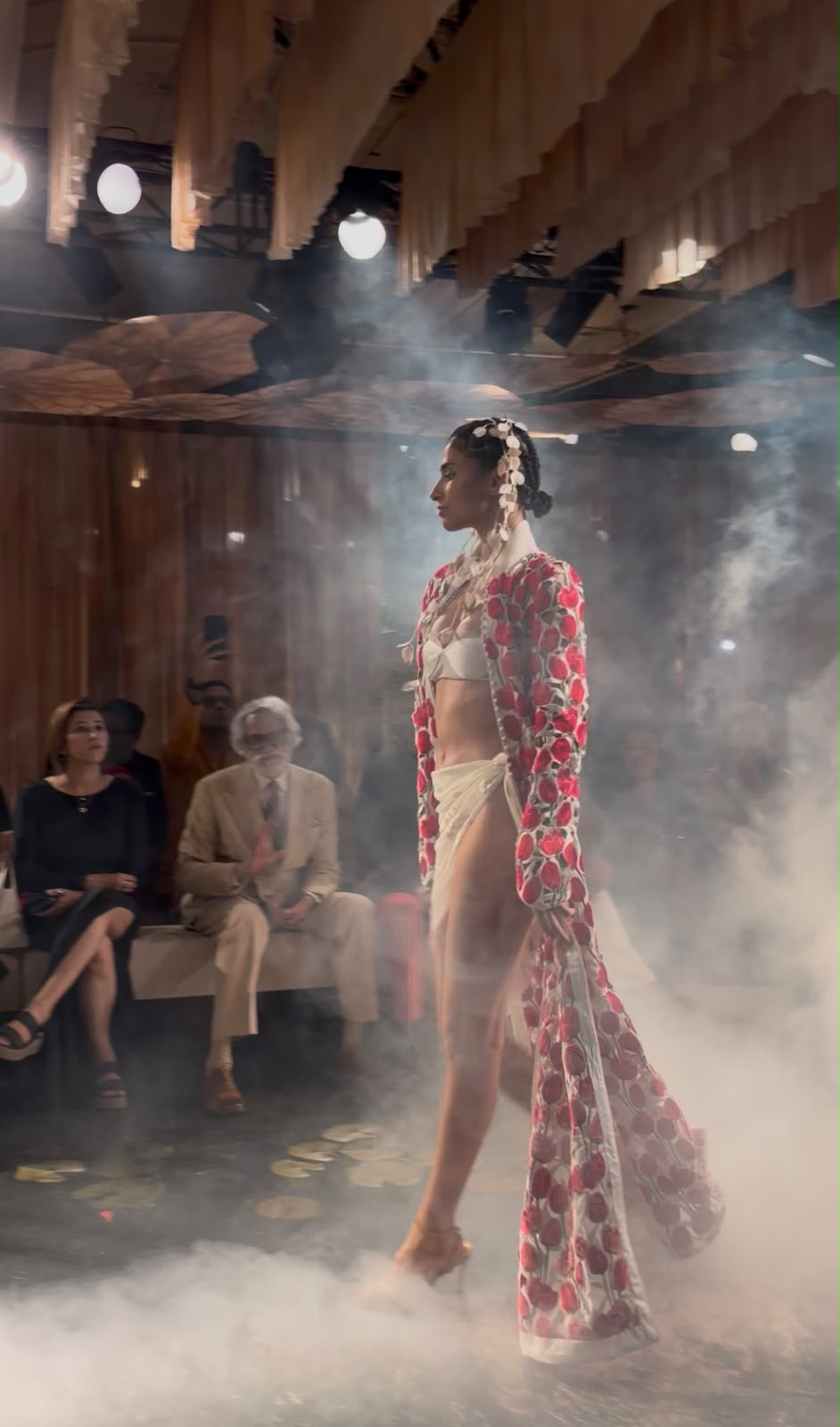
The pearl capes were the finest thing in the collection, and the one thing in it that belongs unmistakably to now.
Seen at close range from the front rows, they read as new work: relief-built surface at cape scale, worked in pearl, carrying weight and light in a way flat embroidery never can. Bal's own final collection put three-dimensional roses onto black velvet, so raised surface is his instinct and his idea. Carrying that instinct into pearl, and into outerwear, is the difference between reciting a sentence he finished and extending one he started.
Authorship is what those capes demonstrate, and they demonstrate it for the first time. Faithfulness has been proved for three seasons running and needs no further evidence.
The line the house cannot escape
Last July, after Kash-Gul, the label's creative director Fraze Tasnim said something that deserved more attention than it received. The show, he said, was a step forward rather than a tribute.
Hold that against Friday night. The palette has stayed put. The motif has stayed put. The technique has stayed put. An occasion this emotional rewards recitation, and it asks a great deal of anyone who wants to take a risk inside a room already prepared to weep.
So the six who walked at the end were making a claim, whether they meant to or otherwise. A house that presents itself as a design team rather than as a ghost is a house asking to be judged as a working label, against Rahul Mishra and Anamika Khanna and Tarun Tahiliani, on their terms. That is the right ask. It is also the harder one, because it means next July the palette will need to move.
The platform is there because someone chose to keep it there. FDCI has held this house on the couture week calendar for a second consecutive year, and decisions of that kind are how a name carries forward. History lets us forget people quickly, and fashion, which measures itself in seasons, forgets faster than most. Sunil Sethi and his council have made certain that Rohit Bal, Gudda to everyone who loved him, stays at the front of the mind rather than in the archive. He was the OG. He remains the OG. Institutions are how that becomes permanent.
Then there is the room itself. The rows at a Rohit Bal show still fill with the designers he trained, encouraged and pushed into the light, and they come back every July because they want to. A man who produced that many careers goes on living inside them, and no calendar can manufacture that.
So the house walks into a room that is full, generous and ready to love it. What it does with that is the open question. A name kept alive is one kind of achievement. A label judged on its current work is another, and the six who walked on Friday looked like people who want the second.
For thirty years that walk was his. It always will be. On Friday night six people made it instead, and the most honest thing anyone can say is that they have earned the right to be judged on what they do next.
The house had not released collection notes at the time of filing and the collection name remains unconfirmed. FPG will update this piece when the label issues its materials.
Hyundai India Couture Week 2026, the nineteenth edition, runs at Taj Palace, New Delhi, until 29 July.
TO BE CONTINUED, FOR SUBSCRIBERS ONLY.
This is where the surface ends and the reporting begins.
The complete piece, the full archive, and access to The French Press Circle. Reporting answerable only to its readers.
Already a subscriber ?
Login
Read these on the house, with our compliments.
A selection from the current issue, open to all readers. Read them in full. The rest is one decision away.




Rohit Bal ended his shows one way for the better part of three decades. The models broke formation and danced. Bollywood songs, played loud and late. Bal walked out into the middle of it dressed in black, and the room came apart. He did it at the Grand Hyatt in Mumbai in 2008, where he and his showstopper and the whole cast sang and danced their way down the runway to close the first HDIL India Couture Week. He did it in October 2024 at The Imperial, at the Lakmé Fashion Week and FDCI grand finale, where four people helped him onto the runway and he danced anyway alongside Ananya Panday. He died on 1 November that year, aged sixty-three.
On Friday night, in the 9.30 slot at Taj Palace, the house closed its collection differently. Six members of the creative team walked out together, to the end of the runway and back. The models held their line. The room rose anyway.
Two things happened in that moment, and they are worth separating.
The first is that a ritual returned to the person it belonged to. Bal's dance was his temperament made public, the same instinct that made him describe himself as an artist rather than a commercial designer. A team can honour that instinct. Performing it is another matter, and the decision to leave it alone is the most self-aware thing this house has done since he died. We have no window into whether it was deliberate, and it would be presumptuous to claim one. The effect is what stands.
The second is the timing, and here the judgement was exactly right. Delhi has spent this month inside the Cockroach Janta Party's protest at Jantar Mantar over the NEET-UG paper leak, an agitation that has drawn tens of thousands onto the streets, closed metro stations across the capital, prompted a march on Parliament, ended in detentions of senior opposition figures, and carried Sonam Wangchuk through a twenty-six day hunger strike. Fashion happening two kilometres away from that is a fact the industry has to hold, and much of the online criticism aimed at couture week this week has come from precisely that discomfort.
Which is why this publication wants to be plain about where it stands. The Fashion Design Council of India and Sunil Sethi were right to proceed. A couture week is a payroll. It is embroiderers, karigars, pattern cutters, dressers, stylists, hair and make-up teams, technicians, drivers, caterers and the freelancers who live off eight nights a year. Cancelling would have cost those people real income and bought nothing for the students at Jantar Mantar. Going ahead while dialling the celebration down is the correct order of things, and on Friday night that is what happened.
Now, the clothes.
What survived, and how completely
The set was the lotus, at the scale of architecture. The runway was painted as a lily pond, pads and fallen petals underfoot, so every model appeared to be walking on water. Overhead, inverted parasols in dusty rose read as lotus leaves seen from below, with wrought iron chandeliers hung between them. Sheer ivory tulle fell in columns down the sides of the room, hand-painted with florals and birds. A white claw-foot bathtub sat dressed in tulle at the runway's edge. Dry ice pooled at ankle height, thick enough that several looks arrived out of it rather than walked in.
Bal built worlds like this his entire career. Kehkashaan at Bikaner House used withered trees, low light and live instrumental music. Guldastah at Lakmé in 2019 covered the ramp in dry Chinar leaves and lined it with shikaras laden with flowers, and he gave the standing ovation to eight Kashmiri women who had trained with Usha Silai and worked on the collection through a Valley winter. The lotus and the peacock were his two constant motifs, drawn from folklore and history and used across menswear and womenswear alike. Lifting the lotus off the garment and putting it under everyone's feet is the boldest move the design team made on Friday, and the idea belongs entirely to him, executed at a scale he would have enjoyed.
The palette was his, to the letter. Black velvet and ivory formed the spine, deep crimson and wine ran through the middle, and gold was the only metal in the room, worked as zardozi, as tissue and as thread. This is his taste exactly. When he showed Kehkashaan the range ran from white through black to wine, with lotus and peacock in gold zardozi. When his team showed Kash-Gul on this same platform a year ago, the house described the palette as ivory, black and wine, in chanderi, matka silk and velvet, with gold zardozi and fine threadwork. Three collections, three separate eras of the house, the same three colours and the same metal.
The materials held too. Velvet carrying dense gold vine work. Chanderi and fine silks for the ivory passages. Botanical embroidery, birds and foliage on ivory ground, which is the exact territory of Husn-E-Taa'iraat at the Imperial in 2015. In menswear, black velvet under heavy gold zardozi, cut as a cropped bandhgala jacket or run full length as a sherwani. Arjun Rampal walked this runway in velvet from Kash-Gul last July, and it is more or less the register Bal wore to take his own bows.
The departures were narrow. A short pleated peplum over slim trousers gave the menswear a proportion the house has not used before. One ombré lehenga travelled from magenta into purple and sat outside the palette altogether. The beauty look was severe in a way his rarely was, with bleached brows and shaved or slicked heads set against very ornate clothes.
Read only that far and the verdict writes itself. The handwriting is intact. The people running this house know precisely what they are holding.
The more interesting question arrived with the capes.
The capes are the argument
The pearl capes were the finest thing in the collection, and the one thing in it that belongs unmistakably to now.
Seen at close range from the front rows, they read as new work: relief-built surface at cape scale, worked in pearl, carrying weight and light in a way flat embroidery never can. Bal's own final collection put three-dimensional roses onto black velvet, so raised surface is his instinct and his idea. Carrying that instinct into pearl, and into outerwear, is the difference between reciting a sentence he finished and extending one he started.
Authorship is what those capes demonstrate, and they demonstrate it for the first time. Faithfulness has been proved for three seasons running and needs no further evidence.
The line the house cannot escape
Last July, after Kash-Gul, the label's creative director Fraze Tasnim said something that deserved more attention than it received. The show, he said, was a step forward rather than a tribute.
Hold that against Friday night. The palette has stayed put. The motif has stayed put. The technique has stayed put. An occasion this emotional rewards recitation, and it asks a great deal of anyone who wants to take a risk inside a room already prepared to weep.
So the six who walked at the end were making a claim, whether they meant to or otherwise. A house that presents itself as a design team rather than as a ghost is a house asking to be judged as a working label, against Rahul Mishra and Anamika Khanna and Tarun Tahiliani, on their terms. That is the right ask. It is also the harder one, because it means next July the palette will need to move.
The platform is there because someone chose to keep it there. FDCI has held this house on the couture week calendar for a second consecutive year, and decisions of that kind are how a name carries forward. History lets us forget people quickly, and fashion, which measures itself in seasons, forgets faster than most. Sunil Sethi and his council have made certain that Rohit Bal, Gudda to everyone who loved him, stays at the front of the mind rather than in the archive. He was the OG. He remains the OG. Institutions are how that becomes permanent.
Then there is the room itself. The rows at a Rohit Bal show still fill with the designers he trained, encouraged and pushed into the light, and they come back every July because they want to. A man who produced that many careers goes on living inside them, and no calendar can manufacture that.
So the house walks into a room that is full, generous and ready to love it. What it does with that is the open question. A name kept alive is one kind of achievement. A label judged on its current work is another, and the six who walked on Friday looked like people who want the second.
For thirty years that walk was his. It always will be. On Friday night six people made it instead, and the most honest thing anyone can say is that they have earned the right to be judged on what they do next.
The house had not released collection notes at the time of filing and the collection name remains unconfirmed. FPG will update this piece when the label issues its materials.
Hyundai India Couture Week 2026, the nineteenth edition, runs at Taj Palace, New Delhi, until 29 July.
TO BE CONTINUED, FOR SUBSCRIBERS ONLY.
This is where the surface ends and the reporting begins.
The complete piece, the full archive, and access to The French Press Circle. Reporting answerable only to its readers.
Already a subscriber ?
Login
Read these on the house, with our compliments.
A selection from the current issue, open to all readers. Read them in full. The rest is one decision away.