Disclosure: Maison French Press, the brand architecture house I founded, represents labels that showcase across fashion weeks, wedding weekends and wedding expositions in this country. French Press Global operates independently of that mandate. Its editorial team and the brand architecture team are entirely separate, with no overlap between them. I am writing this in view of my own interest, because the argument holds regardless of who is making it.
A doctor kept doctoring through the crackdown. A lawyer kept lawyering. The woman who works in my home arrived for her shift. The trainer opened the gym at six. The athlete ran her intervals. Every one of them holds a private view on Dharmendra Pradhan, on the leaked paper, on the students sitting in the rain at Jantar Mantar. Every one of them held that view while doing their job, and the country asked precisely none of them to stop.
The industries being told to stop share one feature, and it is a camera.
Glamour is the real offence in this argument, and glamour is a surface. Underneath it sit the karigars in Bareilly and Lucknow and Howrah whose entire year is priced off a July order book, the finishers and the pattern cutters, the drivers and the light technicians and the freelance stylists who invoice in the fortnight after a couture week and eat for the next four months on it. Ask them whether the week should be happening and you will get a different answer to the one circulating on Instagram this morning.
Which brings me to the fight itself.
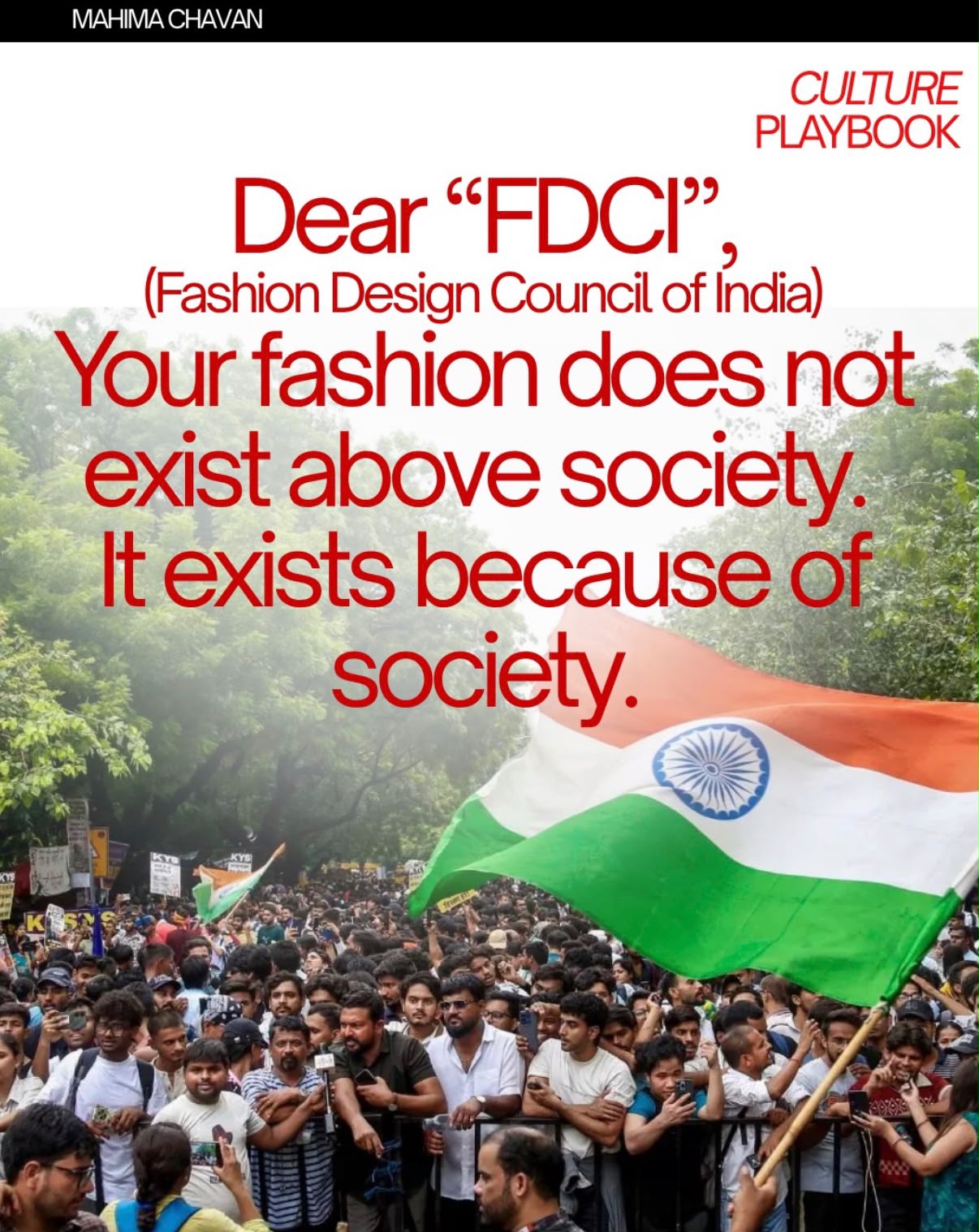
Culture Playbook addressed the Fashion Design Council of India directly, arguing that fashion exists because of society rather than above it.
via culture_playbook
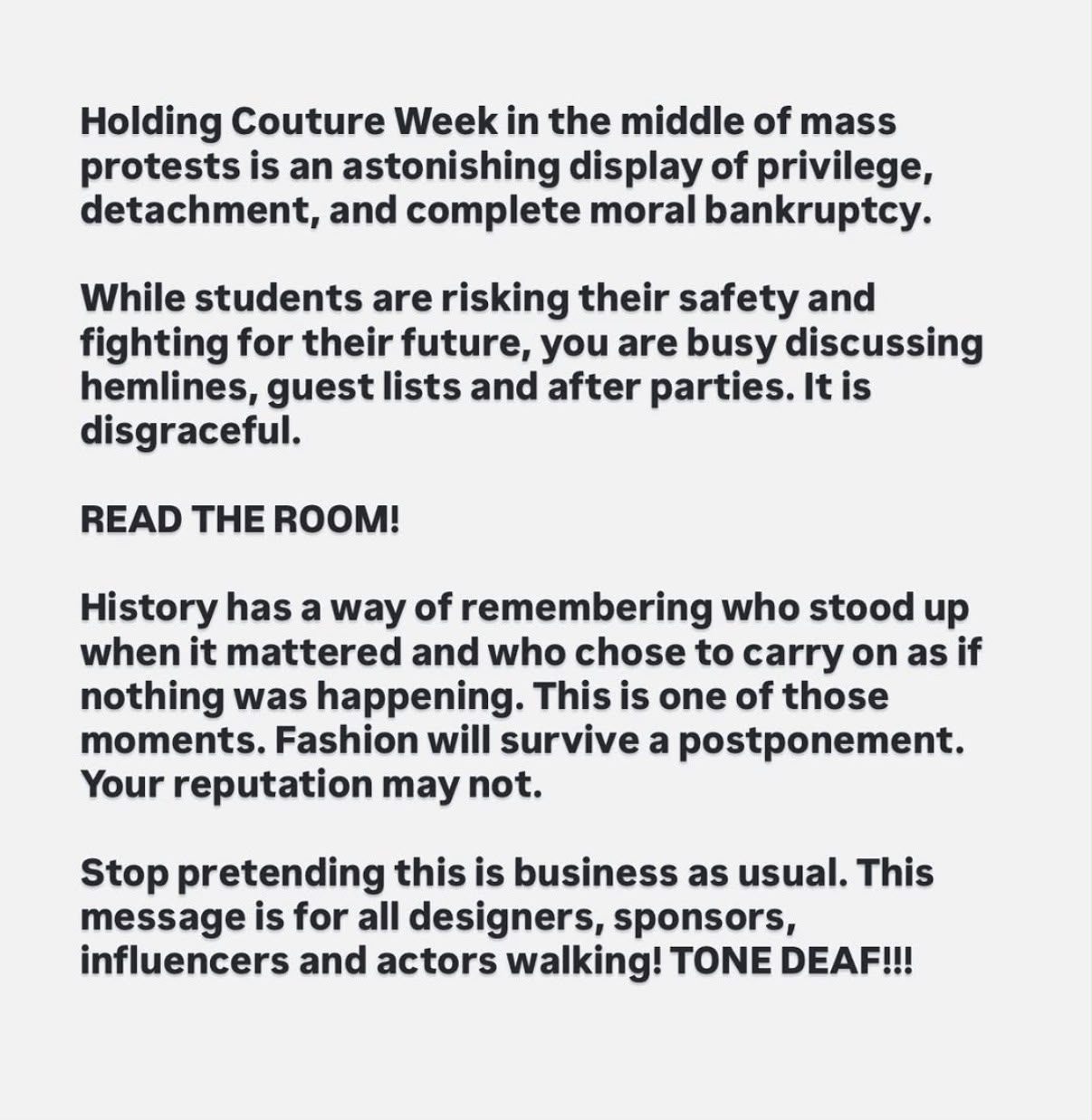
Ishita Mangal widened the target to every designer, sponsor, influencer and actor scheduled to walk, calling the week a display of privilege and asking the industry to read the room. Both posts are moving. Both read the mood correctly. Both arrive at a solution that achieves nothing.
Via Ishita Mangal
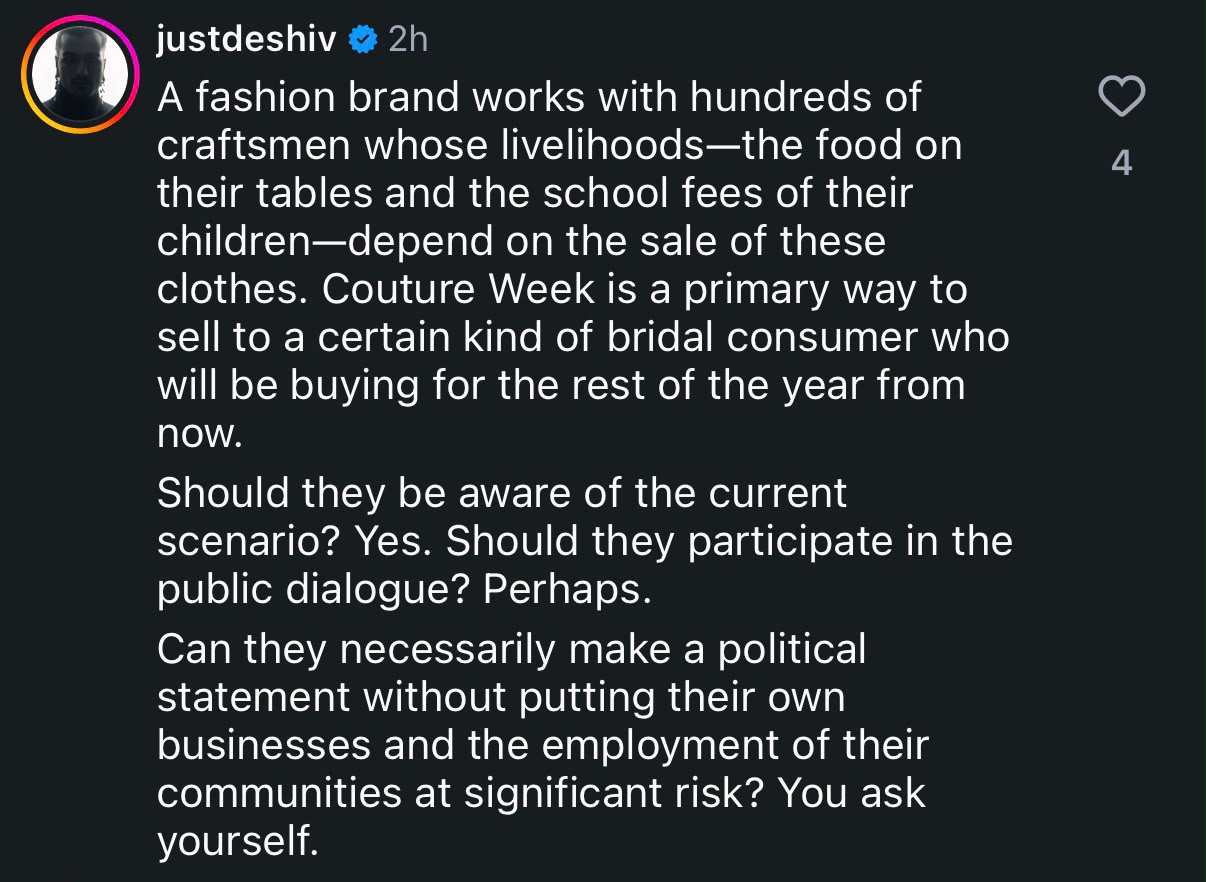
Under the first of them, a fashion professional called Deshiv made the livelihood argument plainly and was told he was turning artisans into a scapegoat. He was doing something more careful than that, and the distinction he drew is the one this entire fight has missed.
Via Deshiv
Read his question again, because it was precise. He asked whether a designer can make a political statement without putting their business and the employment of their community at significant risk. The reply he received answered a different question, about whether a statement of awareness would collapse an industry.
Those two things sit a long way apart, and the entire available ground for Indian fashion this week lies in the gap between them.
Demanding a minister’s resignation is a political act with a price. Acknowledging that ten thousand young people marched in your city three days before your week opened, and that the police met them with tear gas and batons, is an act of basic literacy, and it carries no price at all. Anybody claiming otherwise is protecting something other than a karigar.
Which brings me to the part of this story nobody arguing on Instagram this week has bothered to look up.
In December 2012, in the days after a twenty-three-year-old woman was raped on a moving bus in Delhi, the Fashion Design Council of India sent an email to its designers and its models. The letter asked them to be present at the silent march from Le Meridien to India Gate. It described the moment as one where the industry should collectively show its solidarity, and it was careful to frame that solidarity as sincere rather than politically driven.
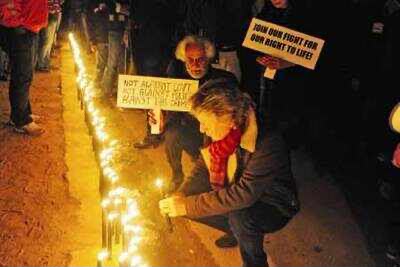
FDCI leads silent march against the rape victim, 2012
(Image courtesy: Times of India)
The council’s instruction was presence. It put its designers and its models on the street, and it kept every one of them in work.
So the question facing FDCI in July 2026 has an answer, and the answer is written in the council’s own correspondence. The precedent exists. It was set by Sunil Sethi, then the council’s president and today its chairman, running this week. The industry has already demonstrated that it knows how to hold a show and a conscience in the same hand, and it did so at a moment of far greater national rawness than a comment section can generate.
Everything after this is a choice, and choices are legible.
What the industry can do costs it very little. It can put out a statement naming the students of this country and the justice they are owed. It can send its designers, its models and its front row to Jantar Mantar in daylight, on the record, for a sit-in that lasts longer than a photograph. It can open a show with thirty seconds of silence and say why. It can hold the finale and the solidarity on the same evening, which is what the council did fourteen years ago and what nobody found tone deaf then.
A handful have already moved, and the range of what they did is instructive.
Bibhu Mohapatra posted to his Instagram Stories. Sandeep Khosla published a post carrying the instruction to stop being silent. Shefalee Vasudev recorded a video with The Voice of Fashion, the title she edits. Nandini Bhalla put the Constitution on The Word magazine’s handle, set the words We, the People of India against the crowds at Jantar Mantar, and let the juxtaposition carry the argument. Four people, four formats, four working days. Each of them was at their desk that week. That list is short enough to read as an indictment of everyone absent from it.
Stopping this week would take income from several thousand people who have no platform, no publicist and no seat at Jantar Mantar, and it would move the government not one inch. Speaking would take a paragraph, and it would put every wire photographer in Delhi and the whole of the front row behind a demand that ten thousand young people walked into tear gas to make.
Fashion is asked to justify its existence every time the country hurts, and it is asked because the industry lets the question stand unanswered. The answer is available. The industry works, the industry employs, the industry speaks, and it does all three at once.
Question their silence. That charge is fair, it is overdue, and stakeholders on this week’s schedule have until the twenty-ninth to answer it. Questioning the work itself asks the least powerful people in this industry to pay for the discomfort of the most visible, and it lets everyone still saying nothing walk away feeling righteous.
Here is what the argument is actually about.
Since the sixth of June, students have held Jantar Mantar under the banner of the Cockroach Janta Party, a movement that took its name from a Chief Justice’s description of unemployed young people as cockroaches and parasites, and wore the insult as a badge. They want Dharmendra Pradhan out over the NEET paper leak and the board marking irregularities. They want the examination system rebuilt. They want compensation for the families of the students who died by suicide in the wake of it. Sonam Wangchuk fasted at the site for twenty days before the police carried him to hospital. On the morning of the twentieth of July more than ten thousand of them moved towards Parliament, and Delhi answered with tear gas, barricades, shuttered metro stations and a mobile internet blackout. Delhi Police put the injured at close to 180, sixty of them protesters, and that is the police’s own count. The nineteenth edition of Hyundai India Couture Week opens tonight.
That is the week the industry is being asked to justify. It is also the week the industry is being given to speak.
The show is not the scandal. The quiet is.
TO BE CONTINUED, FOR SUBSCRIBERS ONLY.
This is where the surface ends and the reporting begins.
The complete piece, the full archive, and access to The French Press Circle. Reporting answerable only to its readers.
Already a subscriber ?
Login
Read these on the house, with our compliments.
A selection from the current issue, open to all readers. Read them in full. The rest is one decision away.



Disclosure: Maison French Press, the brand architecture house I founded, represents labels that showcase across fashion weeks, wedding weekends and wedding expositions in this country. French Press Global operates independently of that mandate. Its editorial team and the brand architecture team are entirely separate, with no overlap between them. I am writing this in view of my own interest, because the argument holds regardless of who is making it.
A doctor kept doctoring through the crackdown. A lawyer kept lawyering. The woman who works in my home arrived for her shift. The trainer opened the gym at six. The athlete ran her intervals. Every one of them holds a private view on Dharmendra Pradhan, on the leaked paper, on the students sitting in the rain at Jantar Mantar. Every one of them held that view while doing their job, and the country asked precisely none of them to stop.
The industries being told to stop share one feature, and it is a camera.
Glamour is the real offence in this argument, and glamour is a surface. Underneath it sit the karigars in Bareilly and Lucknow and Howrah whose entire year is priced off a July order book, the finishers and the pattern cutters, the drivers and the light technicians and the freelance stylists who invoice in the fortnight after a couture week and eat for the next four months on it. Ask them whether the week should be happening and you will get a different answer to the one circulating on Instagram this morning.
Which brings me to the fight itself.
Culture Playbook addressed the Fashion Design Council of India directly, arguing that fashion exists because of society rather than above it.
via culture_playbook
Ishita Mangal widened the target to every designer, sponsor, influencer and actor scheduled to walk, calling the week a display of privilege and asking the industry to read the room. Both posts are moving. Both read the mood correctly. Both arrive at a solution that achieves nothing.
Via Ishita Mangal
Under the first of them, a fashion professional called Deshiv made the livelihood argument plainly and was told he was turning artisans into a scapegoat. He was doing something more careful than that, and the distinction he drew is the one this entire fight has missed.
Via Deshiv
Read his question again, because it was precise. He asked whether a designer can make a political statement without putting their business and the employment of their community at significant risk. The reply he received answered a different question, about whether a statement of awareness would collapse an industry.
Those two things sit a long way apart, and the entire available ground for Indian fashion this week lies in the gap between them.
Demanding a minister’s resignation is a political act with a price. Acknowledging that ten thousand young people marched in your city three days before your week opened, and that the police met them with tear gas and batons, is an act of basic literacy, and it carries no price at all. Anybody claiming otherwise is protecting something other than a karigar.
Which brings me to the part of this story nobody arguing on Instagram this week has bothered to look up.
In December 2012, in the days after a twenty-three-year-old woman was raped on a moving bus in Delhi, the Fashion Design Council of India sent an email to its designers and its models. The letter asked them to be present at the silent march from Le Meridien to India Gate. It described the moment as one where the industry should collectively show its solidarity, and it was careful to frame that solidarity as sincere rather than politically driven.
FDCI leads silent march against the rape victim, 2012
(Image courtesy: Times of India)
The council’s instruction was presence. It put its designers and its models on the street, and it kept every one of them in work.
So the question facing FDCI in July 2026 has an answer, and the answer is written in the council’s own correspondence. The precedent exists. It was set by Sunil Sethi, then the council’s president and today its chairman, running this week. The industry has already demonstrated that it knows how to hold a show and a conscience in the same hand, and it did so at a moment of far greater national rawness than a comment section can generate.
Everything after this is a choice, and choices are legible.
What the industry can do costs it very little. It can put out a statement naming the students of this country and the justice they are owed. It can send its designers, its models and its front row to Jantar Mantar in daylight, on the record, for a sit-in that lasts longer than a photograph. It can open a show with thirty seconds of silence and say why. It can hold the finale and the solidarity on the same evening, which is what the council did fourteen years ago and what nobody found tone deaf then.
A handful have already moved, and the range of what they did is instructive.
Bibhu Mohapatra posted to his Instagram Stories. Sandeep Khosla published a post carrying the instruction to stop being silent. Shefalee Vasudev recorded a video with The Voice of Fashion, the title she edits. Nandini Bhalla put the Constitution on The Word magazine’s handle, set the words We, the People of India against the crowds at Jantar Mantar, and let the juxtaposition carry the argument. Four people, four formats, four working days. Each of them was at their desk that week. That list is short enough to read as an indictment of everyone absent from it.
Stopping this week would take income from several thousand people who have no platform, no publicist and no seat at Jantar Mantar, and it would move the government not one inch. Speaking would take a paragraph, and it would put every wire photographer in Delhi and the whole of the front row behind a demand that ten thousand young people walked into tear gas to make.
Fashion is asked to justify its existence every time the country hurts, and it is asked because the industry lets the question stand unanswered. The answer is available. The industry works, the industry employs, the industry speaks, and it does all three at once.
Question their silence. That charge is fair, it is overdue, and stakeholders on this week’s schedule have until the twenty-ninth to answer it. Questioning the work itself asks the least powerful people in this industry to pay for the discomfort of the most visible, and it lets everyone still saying nothing walk away feeling righteous.
Here is what the argument is actually about.
Since the sixth of June, students have held Jantar Mantar under the banner of the Cockroach Janta Party, a movement that took its name from a Chief Justice’s description of unemployed young people as cockroaches and parasites, and wore the insult as a badge. They want Dharmendra Pradhan out over the NEET paper leak and the board marking irregularities. They want the examination system rebuilt. They want compensation for the families of the students who died by suicide in the wake of it. Sonam Wangchuk fasted at the site for twenty days before the police carried him to hospital. On the morning of the twentieth of July more than ten thousand of them moved towards Parliament, and Delhi answered with tear gas, barricades, shuttered metro stations and a mobile internet blackout. Delhi Police put the injured at close to 180, sixty of them protesters, and that is the police’s own count. The nineteenth edition of Hyundai India Couture Week opens tonight.
That is the week the industry is being asked to justify. It is also the week the industry is being given to speak.
The show is not the scandal. The quiet is.
TO BE CONTINUED, FOR SUBSCRIBERS ONLY.
This is where the surface ends and the reporting begins.
The complete piece, the full archive, and access to The French Press Circle. Reporting answerable only to its readers.
Already a subscriber ?
Login
Read these on the house, with our compliments.
A selection from the current issue, open to all readers. Read them in full. The rest is one decision away.


