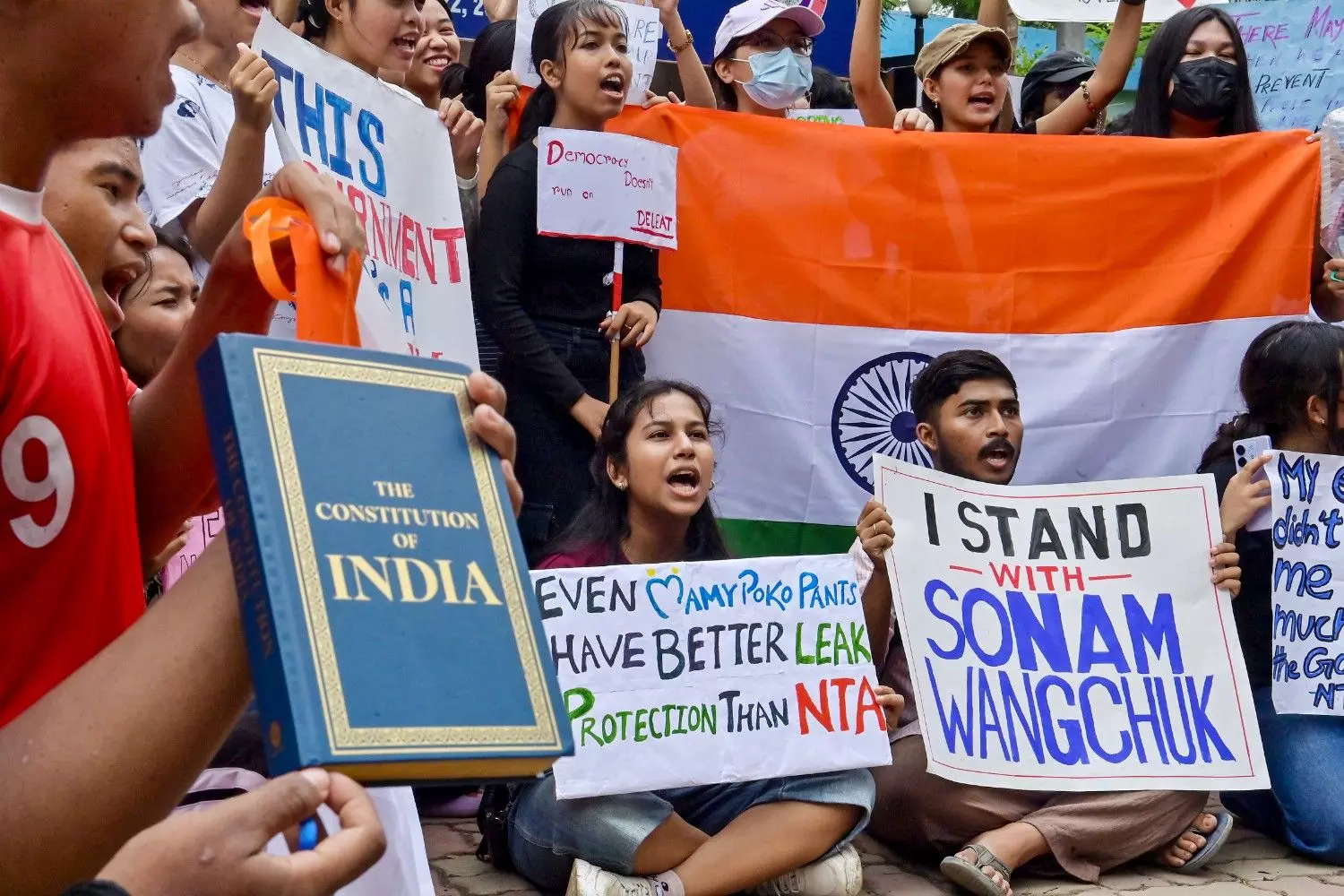
There are protests, and then there are ruptures. Moments a country doesn't just witness but is changed by, quietly and permanently, the way a fault line shifts and nothing built on top of it sits the same way again. What happened this week in India belongs to the second category. Dharmendra Pradhan's resignation is the headline. The real story is a generation proving, in real time and against every institutional incentive built to outlast them, that democracy in this country still answers to the governed.
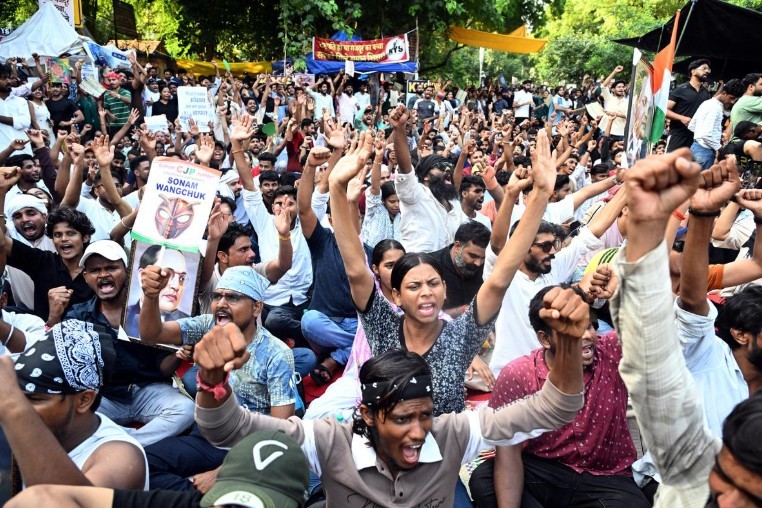
Students protesting at Jantar Mantar for Dharmendra Pradhan's Resignation. (Image via: The Hindu)
Jawaharlal Nehru once described independence as a moment that comes rarely to history, when a nation long suppressed finds its voice. The Cockroach Janta Party built a smaller, sharper version of that moment themselves, out of tear gas and Parliament marches and a month of being told, explicitly and repeatedly, that the minister they wanted gone was untouchable. He wasn't. That's the story, told at its actual size.
Start with what these students were up against. Dharmendra Pradhan wasn't a junior appointee or a symbolic scalp. Four decades in public life, six cabinet portfolios across three prime ministerial terms, a politician whose survival instincts had outlasted party reshuffles, opposition attacks, and two decades of Indian electoral turnover. Two million students sat for NEET-UG 2026, and when they later learned the exam had been compromised before they ever opened their answer sheets, the government followed a script written for exactly this kind of scandal: cancel, apologise procedurally, promise reform for next year, wait for outrage to run its course. That script has worked in India for decades. It counts on public anger burning out faster than a government's patience.
This time, the students out-lasted the government instead. They camped outside Parliament for weeks. They marched into police lines, absorbed baton charges and tear gas, and came back larger every time. The opposition amplified a demand that was already standing on its own. And when BJP leadership finally sat down with movement organisers and asked for one more day, twenty-four hours, to consider a resignation they'd spent a month calling unnecessary, that request was itself an admission. The government had run out of road, and the students were the ones who'd built the wall at the end of it.
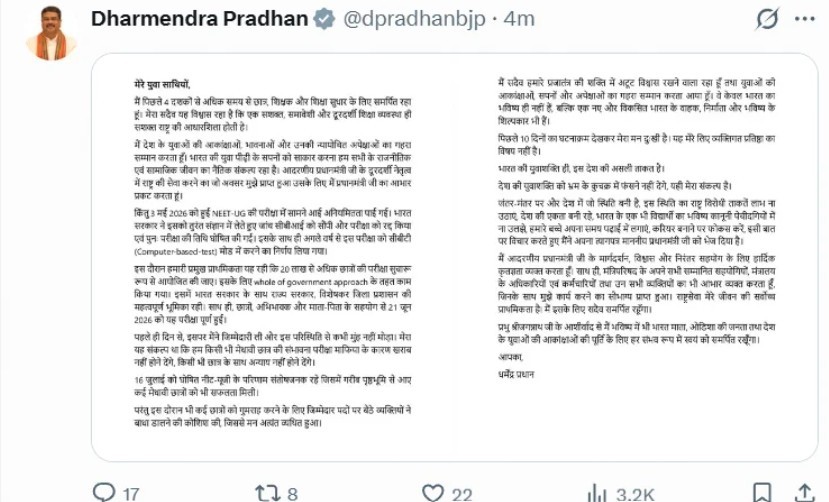
Dharmendra Pradhan's resignation letter. (Image via: Dharmendra Pradhan's X account)
Pradhan's letter, when it came, reached for the register of statesmanship. Four decades associated with students and teachers, a strong and inclusive education system as the foundation of a strong nation, stepping aside in the name of the youth whose trust he claimed to still hold. Set beside Priyank Kharge's question in Parliament days earlier, asking plainly why the Prime Minister seemed so afraid to let this man go, the letter reads like a principle finally being made unavoidable. This movement built that inevitability brick by brick, protest by protest, until the students, not the government, were the ones setting the terms.
Families who lost children to the despair the NEET scandal caused are still owed something real. Compensation exists right now only as an informal government discussion, and it deserves to become policy, loudly and soon, now that the cameras have their resignation story. Naming that unfinished work honours what these students built rather than diminishing it.
Sit with what actually happened here, because it is rare enough to deserve the weight. A government insisted, for a month, on its own untouchability. A generation of students, most of them not yet old enough to have voted in a national election, made that untouchability collapse. Government by consent is a muscle, and every country that stops using it watches it weaken. This week, India's youth used it, fully and without apology. They reminded the government that listening isn't optional. They reminded the rest of us that the phrase "of the people, for the people, by the people" is a living demand, not a museum piece. This week, it got answered.
TO BE CONTINUED, FOR SUBSCRIBERS ONLY.
This is where the surface ends and the reporting begins.
The complete piece, the full archive, and access to The French Press Circle. Reporting answerable only to its readers.
Already a subscriber ?
Login
Read these on the house, with our compliments.
A selection from the current issue, open to all readers. Read them in full. The rest is one decision away.







There are protests, and then there are ruptures. Moments a country doesn't just witness but is changed by, quietly and permanently, the way a fault line shifts and nothing built on top of it sits the same way again. What happened this week in India belongs to the second category. Dharmendra Pradhan's resignation is the headline. The real story is a generation proving, in real time and against every institutional incentive built to outlast them, that democracy in this country still answers to the governed.
Students protesting at Jantar Mantar for Dharmendra Pradhan's Resignation. (Image via: The Hindu)
Jawaharlal Nehru once described independence as a moment that comes rarely to history, when a nation long suppressed finds its voice. The Cockroach Janta Party built a smaller, sharper version of that moment themselves, out of tear gas and Parliament marches and a month of being told, explicitly and repeatedly, that the minister they wanted gone was untouchable. He wasn't. That's the story, told at its actual size.
Start with what these students were up against. Dharmendra Pradhan wasn't a junior appointee or a symbolic scalp. Four decades in public life, six cabinet portfolios across three prime ministerial terms, a politician whose survival instincts had outlasted party reshuffles, opposition attacks, and two decades of Indian electoral turnover. Two million students sat for NEET-UG 2026, and when they later learned the exam had been compromised before they ever opened their answer sheets, the government followed a script written for exactly this kind of scandal: cancel, apologise procedurally, promise reform for next year, wait for outrage to run its course. That script has worked in India for decades. It counts on public anger burning out faster than a government's patience.
This time, the students out-lasted the government instead. They camped outside Parliament for weeks. They marched into police lines, absorbed baton charges and tear gas, and came back larger every time. The opposition amplified a demand that was already standing on its own. And when BJP leadership finally sat down with movement organisers and asked for one more day, twenty-four hours, to consider a resignation they'd spent a month calling unnecessary, that request was itself an admission. The government had run out of road, and the students were the ones who'd built the wall at the end of it.
Dharmendra Pradhan's resignation letter. (Image via: Dharmendra Pradhan's X account)
Pradhan's letter, when it came, reached for the register of statesmanship. Four decades associated with students and teachers, a strong and inclusive education system as the foundation of a strong nation, stepping aside in the name of the youth whose trust he claimed to still hold. Set beside Priyank Kharge's question in Parliament days earlier, asking plainly why the Prime Minister seemed so afraid to let this man go, the letter reads like a principle finally being made unavoidable. This movement built that inevitability brick by brick, protest by protest, until the students, not the government, were the ones setting the terms.
Families who lost children to the despair the NEET scandal caused are still owed something real. Compensation exists right now only as an informal government discussion, and it deserves to become policy, loudly and soon, now that the cameras have their resignation story. Naming that unfinished work honours what these students built rather than diminishing it.
Sit with what actually happened here, because it is rare enough to deserve the weight. A government insisted, for a month, on its own untouchability. A generation of students, most of them not yet old enough to have voted in a national election, made that untouchability collapse. Government by consent is a muscle, and every country that stops using it watches it weaken. This week, India's youth used it, fully and without apology. They reminded the government that listening isn't optional. They reminded the rest of us that the phrase "of the people, for the people, by the people" is a living demand, not a museum piece. This week, it got answered.
TO BE CONTINUED, FOR SUBSCRIBERS ONLY.
This is where the surface ends and the reporting begins.
The complete piece, the full archive, and access to The French Press Circle. Reporting answerable only to its readers.
Already a subscriber ?
Login
Read these on the house, with our compliments.
A selection from the current issue, open to all readers. Read them in full. The rest is one decision away.