
The demand is deafening. Across the country, students, opposition parties and academicians have settled on one name and one word: Pradhan, resign. At Jantar Mantar, the crowds organised by the Cockroach Janta Party have chanted it for weeks, marching on Parliament during the Monsoon Session before their representatives carried the demand to the party president himself. In June, the entire INDIA bloc formalised it. The triggers are a run of failures on his watch, a NEET examination cancelled mid-cycle, a CBSE marking system that scrambled the scripts of lakhs of school leavers, and, by the protesters’ own count, young lives lost along the way.
The party’s response has been silence. No rebuke, no reshuffle, not even the ritual comfort of an inquiry. The most powerful political machine in the country is watching a nationwide storm break over one of its ministers and choosing to do nothing at all.
That silence is arithmetic. Dharmendra Pradhan is the one man the leadership cannot afford to lose, and the clue sits in a fortress that held for twenty-four years until he cracked it, in a rival he beat on her own soil, and in the two men at the very top who reach for him first whenever a state begins to slip.
What he delivered, the record that makes him untouchable, and why the party will absorb any amount of noise before it lets him go, is the real story. And it begins in Odisha.
The state he delivered
For twenty-four years Odisha belonged to Naveen Patnaik’s Biju Janata Dal. In 2024 it fell to the BJP for the first time in the party’s history, and Pradhan was the face of that campaign from start to finish. The party took 78 of 147 assembly seats, reducing the two-decade incumbent to 51. On the Lok Sabha side, the result was close to a clean sweep: 20 of 21 seats to the BJP, the remaining Koraput seat to the Congress, and a blank for the BJD. In the parliamentary vote, the BJP’s share climbed to 45.34 per cent against the BJD’s 37.53 per cent. It marked a leap from just 8 Lok Sabha seats in the state in 2019.
The party fought the contest alone, without the BJD alliance of earlier years, on a mega campaign built around western Odisha’s sense of neglect and sustained outreach to the state’s tribal population, which culminated in the appointment of Mohan Charan Majhi, an Adivasi leader, as chief minister. Pradhan himself was widely seen as the obvious choice for the top job, and the party held back, reportedly because it did not want to surrender a sitting MP after its national Lok Sabha tally had fallen to 240. More than a year into Majhi’s tenure, some observers describe Pradhan’s influence over state affairs as waning, though that reading is interpretation rather than settled fact, and the state unit still treats him as its senior-most figure.
The engine behind the strategy was caste arithmetic. Pradhan was the leader who first pressed the question of OBC welfare against the BJD government, years before the 2024 campaign, in a state where OBCs make up roughly 40 per cent of the population, and the pressure grew loud enough that the Patnaik government set up its own commission for the community. Ahead of 2019, the party paired that plank with Modi’s own OBC identity and used Pradhan’s background to bring other backwards-class leaders into the fold.
Place those 20 seats in their national frame, and the scale becomes clearer still. Nationally, the BJP won 240 of 543 seats in 2024, short of the 272 needed for a majority and a marked fall from the 303 and 282 it had won on its own in 2019 and 2014. The NDA as a whole reached 292, propped up chiefly by Chandrababu Naidu’s Telugu Desam Party and Nitish Kumar’s JD(U). Against that backdrop, Odisha’s swing from 8 seats to 20 stands out as one of the larger gains anywhere in the country, arriving exactly when the party had lost ground elsewhere, most visibly in Uttar Pradesh.
The giant-slayer’s record
Odisha is the headline entry on a much longer sheet. Pradhan steered Uttar Pradesh in 2022, where the party held 255 of 403 seats. He ran Uttarakhand in 2017 and Jharkhand in 2014. He was handed the single hardest assignment in recent memory, Nandigram in 2021, and delivered Suvendu Adhikari’s victory over Mamata Banerjee on her own chosen ground, by a margin of roughly 1,700 votes. Most recently, he served as the party’s election in-charge for Bihar in 2025, where the NDA swept back with 202 of 243 seats, and functionaries credited his handling of ticket distribution and restive allies as central to the result.
Two further reasons keep him in place. He is one of the most prominent OBC faces in the top tier of the government, and the party has been consistently wary of the cost of removing a backwards-class leader from the Union Cabinet, given how central that constituency is to its coalition. And he is described inside the BJP as one of Prime Minister Modi’s most trusted lieutenants, close to Amit Shah, the operator the high command turns to when a state is genuinely in play. A leader with that record is expensive to lose and awkward to replace.
The storm he is being asked to answer for
The pressure itself is real. More than 22 lakh candidates sat the undergraduate NEET on 3 May before the National Testing Agency cancelled the test on 12 May over paper-leak allegations. Class 12 students, separately, alleged that scanned answer sheets uploaded under the new on-screen marking system did not match their own handwriting, raising fears of mismatched scripts.
One detail has drawn particular scrutiny. The CBSE awarded its on-screen marking contract in December 2025 to a Hyderabad firm, Coempt Edu Teck, and rolled it out within weeks, a contractor reporting has since linked to earlier examination controversies. There is also a structural weakness that rarely makes it into the slogans. The National Testing Agency, which conducts many of India’s highest-stakes entrance exams, is a registered society established in 2017 rather than a statutory body created by an Act of Parliament, which means there are few clearly defined legal standards holding it to account when an examination collapses. When NEET-UG 2026 was cancelled, the agency’s formal obligation ran only to carrying registrations forward and refunding the examination fee of 1,700 rupees per candidate, a slight remedy against the months or years some families invest in preparation.
The Supreme Court’s review of the 2024 NEET-UG controversy cleared the exam of large-scale malpractice, even as isolated incidents led to more than 100 arrests, a finding the ministry now leans on whenever fresh allegations surface. And still Pradhan remains firmly in place, with nobody at the top of the party hinting otherwise.
The man behind the minister
Pradhan was born into politics. His father, Debendra Pradhan, was a three-time BJP Odisha president and a Union minister under Atal Bihari Vajpayee, and it was in his father’s footsteps that the younger Pradhan formally joined the BJP in 1998. The apprenticeship had started earlier. As a higher secondary student at Talcher College in 1983, he became an activist with the Akhil Bharatiya Vidyarthi Parishad, the RSS-affiliated student wing, rose to lead the student union in Talcher, and later served as ABVP secretary with organisational charge across Bihar, Karnataka, Uttarakhand and Jharkhand. He went on to head the party’s youth wing from 2004 to 2006.
His own route to elected office has been unusually roundabout. His first win came in the 2000 Odisha assembly election from Pallahara. Four years later he moved to the Lok Sabha, winning Deogarh in 2004. Then came a setback: he lost the 2009 assembly election, contesting after the long-standing BJP-BJD alliance had collapsed. What followed was fifteen years without a direct contest. He built his career instead through the Rajya Sabha, elected from Bihar in 2012 and from Madhya Pradesh in 2018, states with no obvious personal tie to him. Only in 2024 did he return to a direct battle, from Sambalpur, visiting the Samaleswari Temple on the morning of his nomination and leading a two-hour roadshow to file his papers. He won a seat that had gone to three different parties in the three elections before him, a measure of both his value and the party’s confidence in sending him there.
His climb through the Cabinet has been steady. He entered in 2014 as Minister of State for Petroleum and Natural Gas, went on to become the longest-serving holder of that portfolio in independent India, and built the record the party still campaigns on, the Ujjwala scheme of free LPG connections, which lifted Odisha’s coverage from roughly 20 lakh connections in 2014 to close to 78 lakh by early 2019. By 2017, he held Cabinet rank with charge of Petroleum and Steel. In 2021 he moved to Education alongside Skill Development, the portfolio now at the centre of the storm.
What the party has done before
This is familiar territory for the BJP, and its record on resignation demands is the clearest guide to its posture now. In 2015 the Congress-led opposition sought the resignations of External Affairs Minister Sushma Swaraj and Rajasthan Chief Minister Vasundhara Raje over their links to the scam-tainted former IPL commissioner Lalit Modi. The party closed ranks completely. Rajnath Singh said plainly that he disagreed with the demand and that the government stood behind Swaraj. Amit Shah cast her conduct as humanitarian and dismissed the outrage as a bid for political gain. Spokesperson Sudhanshu Trivedi called the very question of action imaginary, and Venkaiah Naidu said there was no question of accepting any ultimatum. Arvind Kejriwal dared the party to move against Swaraj, Raje and Smriti Irani, and the party held its line regardless.
Commentators tracking Pradhan’s situation describe that 2015 stand as the moment refusal effectively hardened into government policy, one that has held since, and note the tension with the party’s own conduct in opposition, when it pursued resignations aggressively over the 2G spectrum case, the Commonwealth Games controversy and the coal allocation scam.
Where that leaves the reader
The facts, set side by side, hold more than one truth at once. Pradhan earned his standing through decades of unpaid student activism, the long way up. He lost as often as he won in his early direct contests, and spent fifteen years in the indirect chamber before returning to the field. He built a scheme that measurably widened cooking-fuel access for millions of poor households in his home state, and his own party credits him with delivering victories across several others. He was passed over for the chief minister position of the state he is most identified with, reportedly to protect the party’s seat count in Parliament. He now runs a ministry that the Supreme Court, in its own review, cleared of large-scale malpractice, even as protesters, opposition parties and academicians keep asking him to go, and even as the party keeps declining to entertain the question.
Both things are true together. What any of it means for his future is, as it has been for other leaders who faced this pressure before him, a call the reader is left to make.
TO BE CONTINUED, FOR SUBSCRIBERS ONLY.
This is where the surface ends and the reporting begins.
The complete piece, the full archive, and access to The French Press Circle. Reporting answerable only to its readers.
Already a subscriber ?
Login
Read these on the house, with our compliments.
A selection from the current issue, open to all readers. Read them in full. The rest is one decision away.



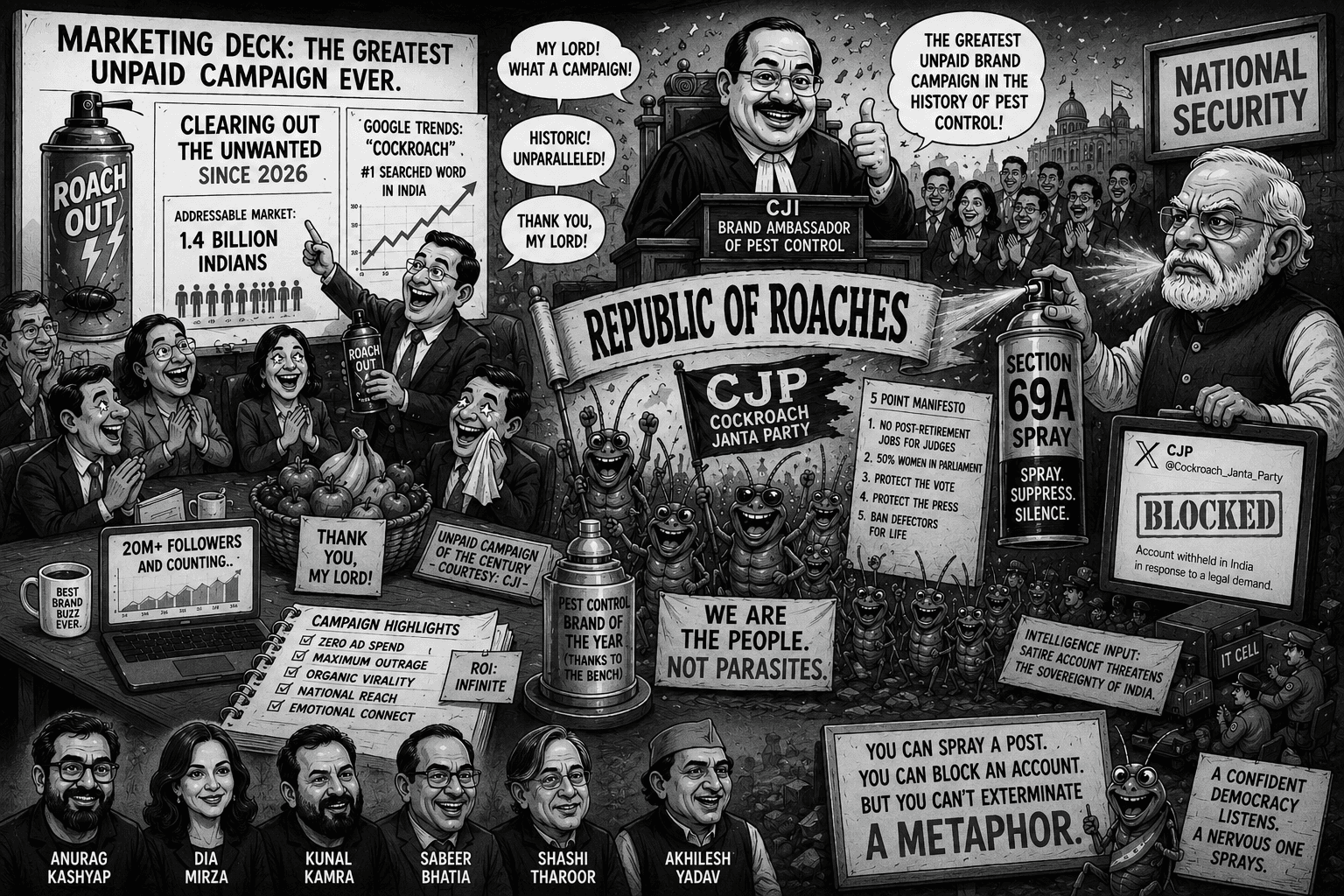


The demand is deafening. Across the country, students, opposition parties and academicians have settled on one name and one word: Pradhan, resign. At Jantar Mantar, the crowds organised by the Cockroach Janta Party have chanted it for weeks, marching on Parliament during the Monsoon Session before their representatives carried the demand to the party president himself. In June, the entire INDIA bloc formalised it. The triggers are a run of failures on his watch, a NEET examination cancelled mid-cycle, a CBSE marking system that scrambled the scripts of lakhs of school leavers, and, by the protesters’ own count, young lives lost along the way.
The party’s response has been silence. No rebuke, no reshuffle, not even the ritual comfort of an inquiry. The most powerful political machine in the country is watching a nationwide storm break over one of its ministers and choosing to do nothing at all.
That silence is arithmetic. Dharmendra Pradhan is the one man the leadership cannot afford to lose, and the clue sits in a fortress that held for twenty-four years until he cracked it, in a rival he beat on her own soil, and in the two men at the very top who reach for him first whenever a state begins to slip.
What he delivered, the record that makes him untouchable, and why the party will absorb any amount of noise before it lets him go, is the real story. And it begins in Odisha.
The state he delivered
For twenty-four years Odisha belonged to Naveen Patnaik’s Biju Janata Dal. In 2024 it fell to the BJP for the first time in the party’s history, and Pradhan was the face of that campaign from start to finish. The party took 78 of 147 assembly seats, reducing the two-decade incumbent to 51. On the Lok Sabha side, the result was close to a clean sweep: 20 of 21 seats to the BJP, the remaining Koraput seat to the Congress, and a blank for the BJD. In the parliamentary vote, the BJP’s share climbed to 45.34 per cent against the BJD’s 37.53 per cent. It marked a leap from just 8 Lok Sabha seats in the state in 2019.
The party fought the contest alone, without the BJD alliance of earlier years, on a mega campaign built around western Odisha’s sense of neglect and sustained outreach to the state’s tribal population, which culminated in the appointment of Mohan Charan Majhi, an Adivasi leader, as chief minister. Pradhan himself was widely seen as the obvious choice for the top job, and the party held back, reportedly because it did not want to surrender a sitting MP after its national Lok Sabha tally had fallen to 240. More than a year into Majhi’s tenure, some observers describe Pradhan’s influence over state affairs as waning, though that reading is interpretation rather than settled fact, and the state unit still treats him as its senior-most figure.
The engine behind the strategy was caste arithmetic. Pradhan was the leader who first pressed the question of OBC welfare against the BJD government, years before the 2024 campaign, in a state where OBCs make up roughly 40 per cent of the population, and the pressure grew loud enough that the Patnaik government set up its own commission for the community. Ahead of 2019, the party paired that plank with Modi’s own OBC identity and used Pradhan’s background to bring other backwards-class leaders into the fold.
Place those 20 seats in their national frame, and the scale becomes clearer still. Nationally, the BJP won 240 of 543 seats in 2024, short of the 272 needed for a majority and a marked fall from the 303 and 282 it had won on its own in 2019 and 2014. The NDA as a whole reached 292, propped up chiefly by Chandrababu Naidu’s Telugu Desam Party and Nitish Kumar’s JD(U). Against that backdrop, Odisha’s swing from 8 seats to 20 stands out as one of the larger gains anywhere in the country, arriving exactly when the party had lost ground elsewhere, most visibly in Uttar Pradesh.
The giant-slayer’s record
Odisha is the headline entry on a much longer sheet. Pradhan steered Uttar Pradesh in 2022, where the party held 255 of 403 seats. He ran Uttarakhand in 2017 and Jharkhand in 2014. He was handed the single hardest assignment in recent memory, Nandigram in 2021, and delivered Suvendu Adhikari’s victory over Mamata Banerjee on her own chosen ground, by a margin of roughly 1,700 votes. Most recently, he served as the party’s election in-charge for Bihar in 2025, where the NDA swept back with 202 of 243 seats, and functionaries credited his handling of ticket distribution and restive allies as central to the result.
Two further reasons keep him in place. He is one of the most prominent OBC faces in the top tier of the government, and the party has been consistently wary of the cost of removing a backwards-class leader from the Union Cabinet, given how central that constituency is to its coalition. And he is described inside the BJP as one of Prime Minister Modi’s most trusted lieutenants, close to Amit Shah, the operator the high command turns to when a state is genuinely in play. A leader with that record is expensive to lose and awkward to replace.
The storm he is being asked to answer for
The pressure itself is real. More than 22 lakh candidates sat the undergraduate NEET on 3 May before the National Testing Agency cancelled the test on 12 May over paper-leak allegations. Class 12 students, separately, alleged that scanned answer sheets uploaded under the new on-screen marking system did not match their own handwriting, raising fears of mismatched scripts.
One detail has drawn particular scrutiny. The CBSE awarded its on-screen marking contract in December 2025 to a Hyderabad firm, Coempt Edu Teck, and rolled it out within weeks, a contractor reporting has since linked to earlier examination controversies. There is also a structural weakness that rarely makes it into the slogans. The National Testing Agency, which conducts many of India’s highest-stakes entrance exams, is a registered society established in 2017 rather than a statutory body created by an Act of Parliament, which means there are few clearly defined legal standards holding it to account when an examination collapses. When NEET-UG 2026 was cancelled, the agency’s formal obligation ran only to carrying registrations forward and refunding the examination fee of 1,700 rupees per candidate, a slight remedy against the months or years some families invest in preparation.
The Supreme Court’s review of the 2024 NEET-UG controversy cleared the exam of large-scale malpractice, even as isolated incidents led to more than 100 arrests, a finding the ministry now leans on whenever fresh allegations surface. And still Pradhan remains firmly in place, with nobody at the top of the party hinting otherwise.
The man behind the minister
Pradhan was born into politics. His father, Debendra Pradhan, was a three-time BJP Odisha president and a Union minister under Atal Bihari Vajpayee, and it was in his father’s footsteps that the younger Pradhan formally joined the BJP in 1998. The apprenticeship had started earlier. As a higher secondary student at Talcher College in 1983, he became an activist with the Akhil Bharatiya Vidyarthi Parishad, the RSS-affiliated student wing, rose to lead the student union in Talcher, and later served as ABVP secretary with organisational charge across Bihar, Karnataka, Uttarakhand and Jharkhand. He went on to head the party’s youth wing from 2004 to 2006.
His own route to elected office has been unusually roundabout. His first win came in the 2000 Odisha assembly election from Pallahara. Four years later he moved to the Lok Sabha, winning Deogarh in 2004. Then came a setback: he lost the 2009 assembly election, contesting after the long-standing BJP-BJD alliance had collapsed. What followed was fifteen years without a direct contest. He built his career instead through the Rajya Sabha, elected from Bihar in 2012 and from Madhya Pradesh in 2018, states with no obvious personal tie to him. Only in 2024 did he return to a direct battle, from Sambalpur, visiting the Samaleswari Temple on the morning of his nomination and leading a two-hour roadshow to file his papers. He won a seat that had gone to three different parties in the three elections before him, a measure of both his value and the party’s confidence in sending him there.
His climb through the Cabinet has been steady. He entered in 2014 as Minister of State for Petroleum and Natural Gas, went on to become the longest-serving holder of that portfolio in independent India, and built the record the party still campaigns on, the Ujjwala scheme of free LPG connections, which lifted Odisha’s coverage from roughly 20 lakh connections in 2014 to close to 78 lakh by early 2019. By 2017, he held Cabinet rank with charge of Petroleum and Steel. In 2021 he moved to Education alongside Skill Development, the portfolio now at the centre of the storm.
What the party has done before
This is familiar territory for the BJP, and its record on resignation demands is the clearest guide to its posture now. In 2015 the Congress-led opposition sought the resignations of External Affairs Minister Sushma Swaraj and Rajasthan Chief Minister Vasundhara Raje over their links to the scam-tainted former IPL commissioner Lalit Modi. The party closed ranks completely. Rajnath Singh said plainly that he disagreed with the demand and that the government stood behind Swaraj. Amit Shah cast her conduct as humanitarian and dismissed the outrage as a bid for political gain. Spokesperson Sudhanshu Trivedi called the very question of action imaginary, and Venkaiah Naidu said there was no question of accepting any ultimatum. Arvind Kejriwal dared the party to move against Swaraj, Raje and Smriti Irani, and the party held its line regardless.
Commentators tracking Pradhan’s situation describe that 2015 stand as the moment refusal effectively hardened into government policy, one that has held since, and note the tension with the party’s own conduct in opposition, when it pursued resignations aggressively over the 2G spectrum case, the Commonwealth Games controversy and the coal allocation scam.
Where that leaves the reader
The facts, set side by side, hold more than one truth at once. Pradhan earned his standing through decades of unpaid student activism, the long way up. He lost as often as he won in his early direct contests, and spent fifteen years in the indirect chamber before returning to the field. He built a scheme that measurably widened cooking-fuel access for millions of poor households in his home state, and his own party credits him with delivering victories across several others. He was passed over for the chief minister position of the state he is most identified with, reportedly to protect the party’s seat count in Parliament. He now runs a ministry that the Supreme Court, in its own review, cleared of large-scale malpractice, even as protesters, opposition parties and academicians keep asking him to go, and even as the party keeps declining to entertain the question.
Both things are true together. What any of it means for his future is, as it has been for other leaders who faced this pressure before him, a call the reader is left to make.
TO BE CONTINUED, FOR SUBSCRIBERS ONLY.
This is where the surface ends and the reporting begins.
The complete piece, the full archive, and access to The French Press Circle. Reporting answerable only to its readers.
Already a subscriber ?
Login
Read these on the house, with our compliments.
A selection from the current issue, open to all readers. Read them in full. The rest is one decision away.


