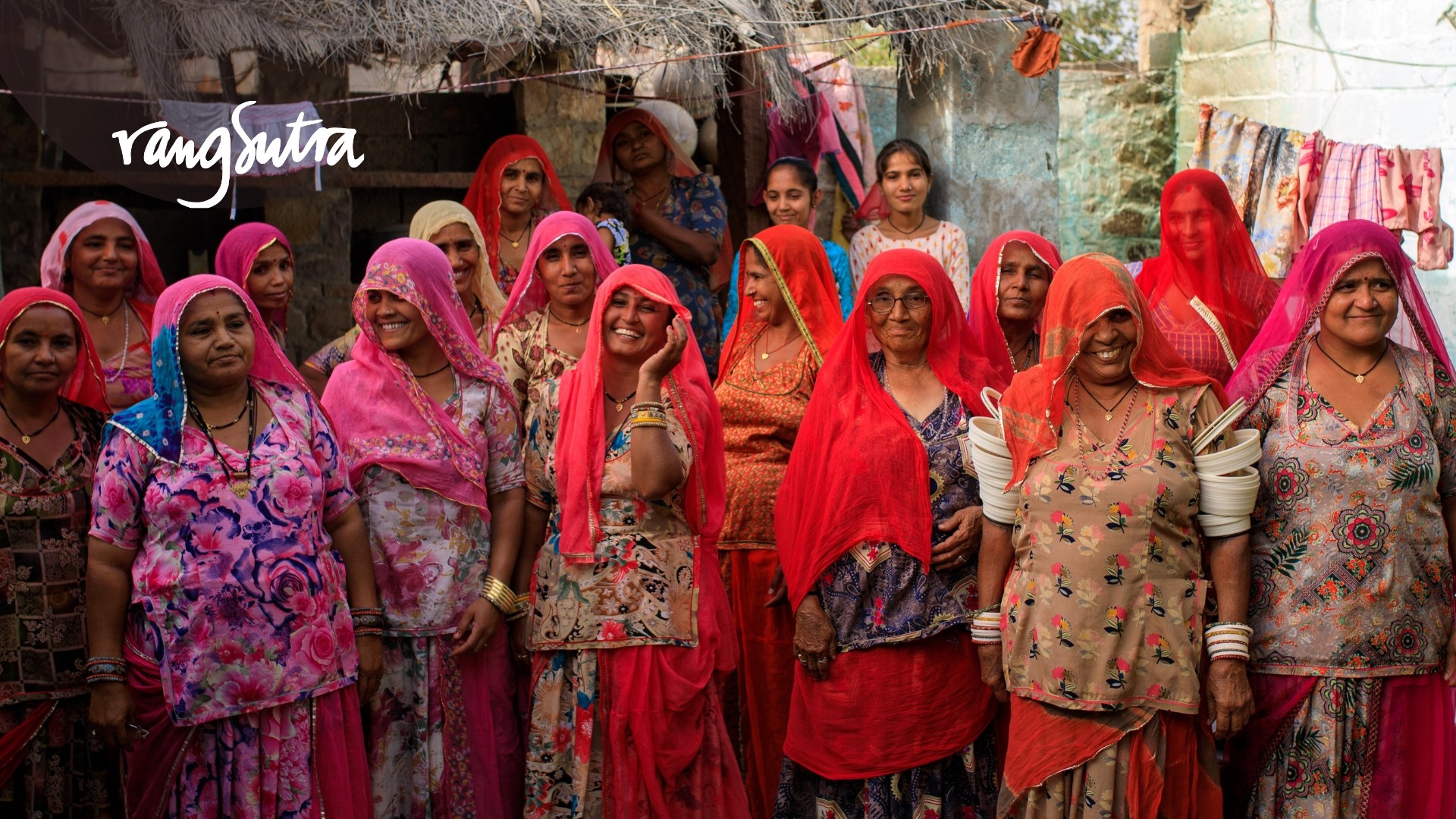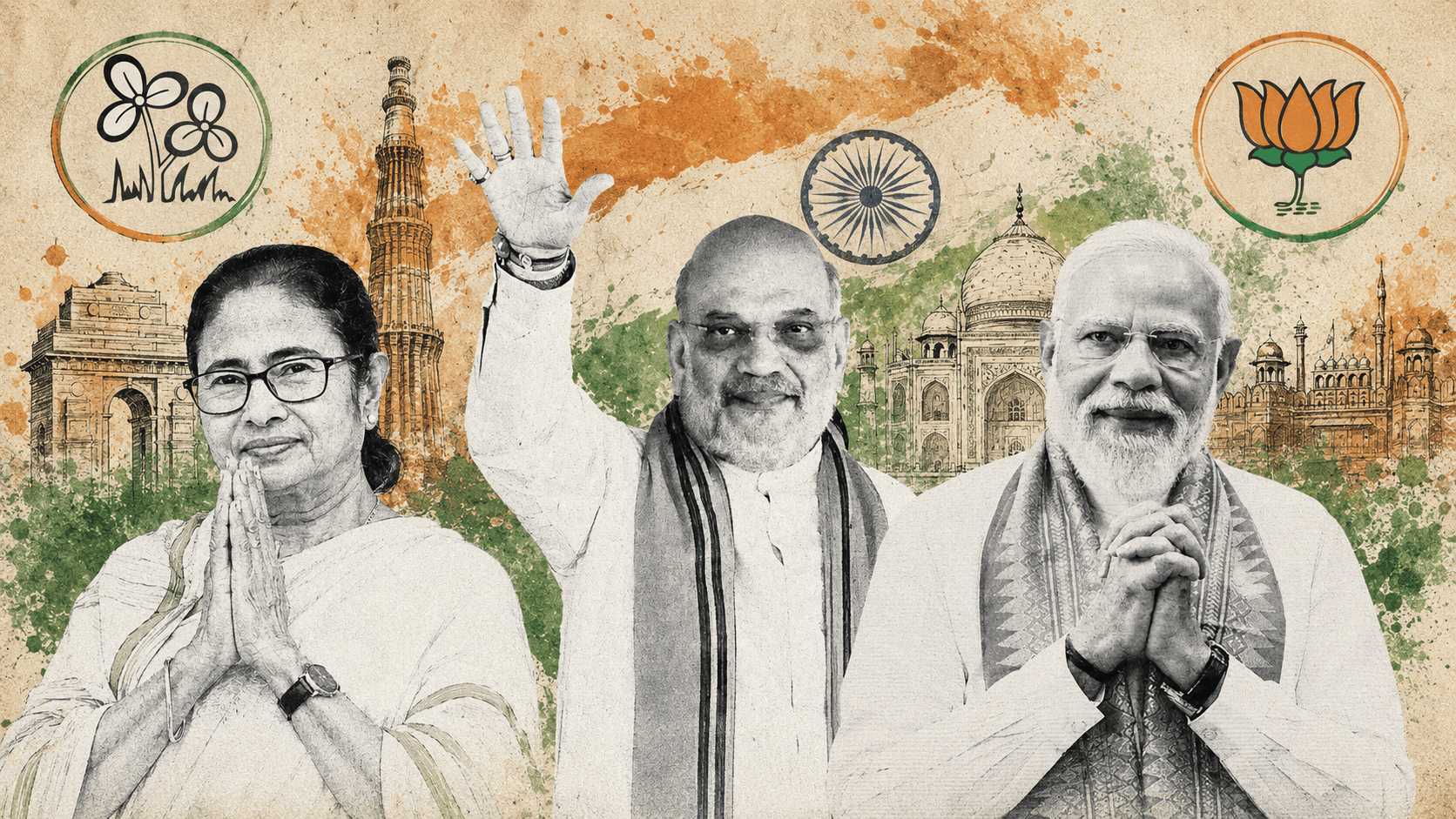
India gets outraged every few months. A Western luxury house drops a collection, somewhere in the embroidery or the silhouette or the motif you can see Rajasthan, you can see Banaras, you can see six centuries of textile knowledge that no design school in Milan taught anyone. The internet mobilises. Our heritage. Our karigars. Our craft, repackaged and resold at a markup that will never find its way back to the hands that inspired it.
The outrage is legitimate, and the conversation is necessary.
Then our own fashion weeks come around, and a Bollywood celebrity who rehearsed her walk twice, 2 hours before the show, closes a collection that took generationally trained karigars six months to hand-embroider, and every headline the next morning is about what the starlet wore, who she arrived with, and what this means for her upcoming film. The craftsman's name appears nowhere.
If India cannot find space for its own craft on its own biggest stages, what exactly is it asking the world to respect?
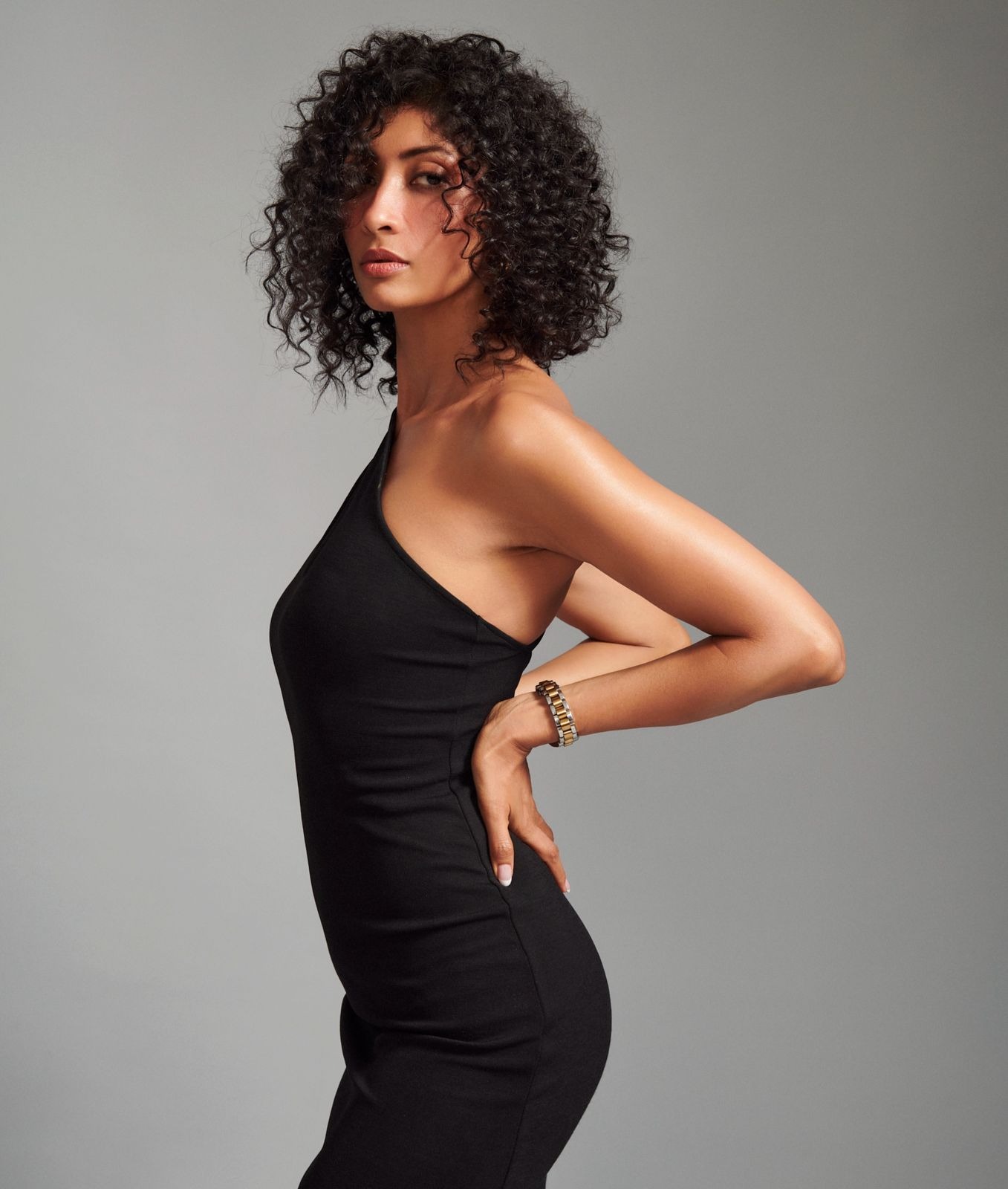
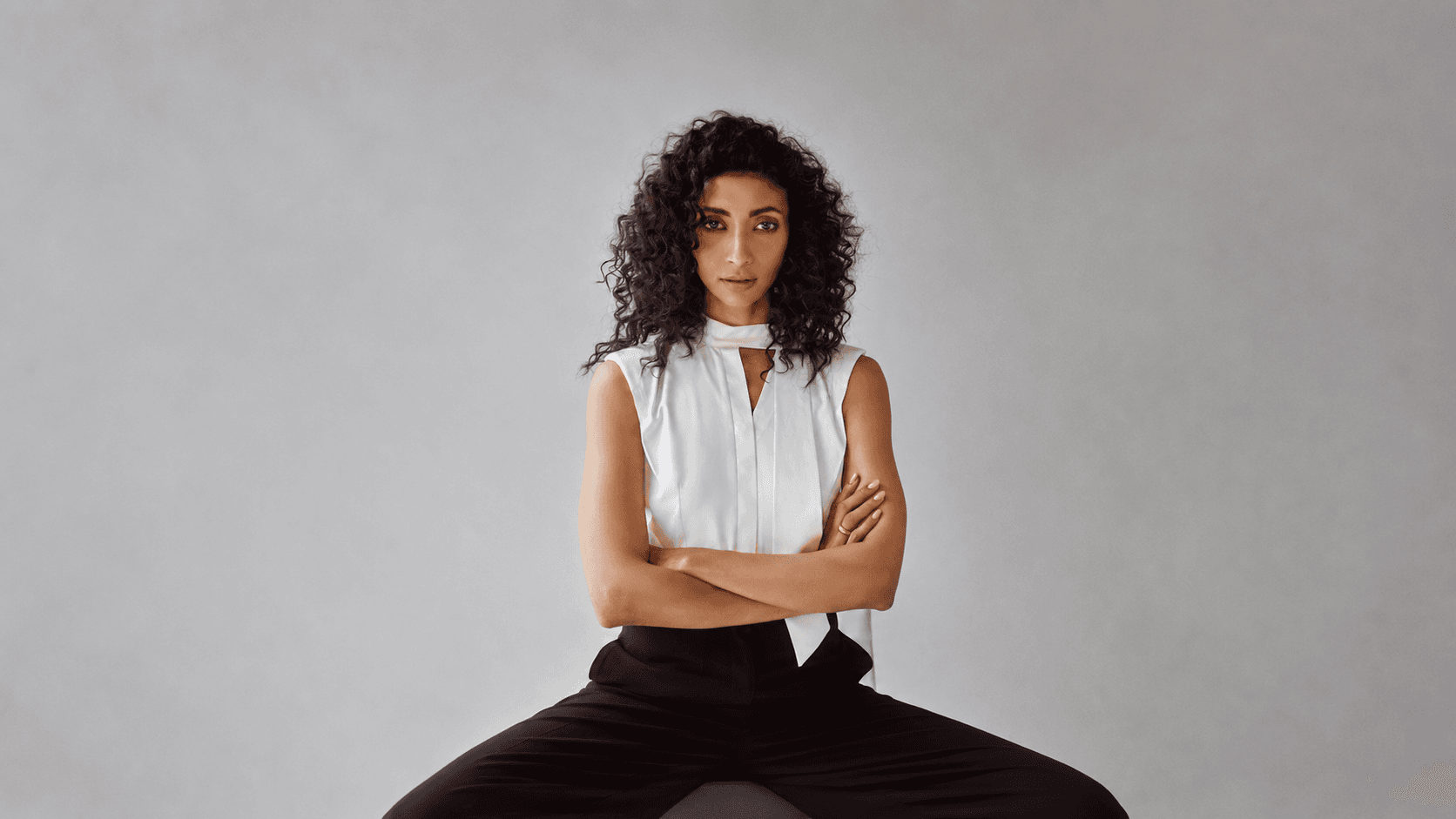
Lakshmi Rana shot by Raju Raman
This is the conversation Indian fashion has been reluctant to have with itself, and it is the conversation Lakshmi Rana has been spearheading for twenty-five years. As one of India's foremost supermodels, the founder of Wilderbee Talent Camp, a show director, and an agency owner, she has occupied every room the industry offers. She has been on the ramp when international buyers filled the front rows and she has watched those same buyers and editors get swapped for Instagram influencers over two decades. She carries the fluency of someone who loves an industry devotedly enough to want more from it.
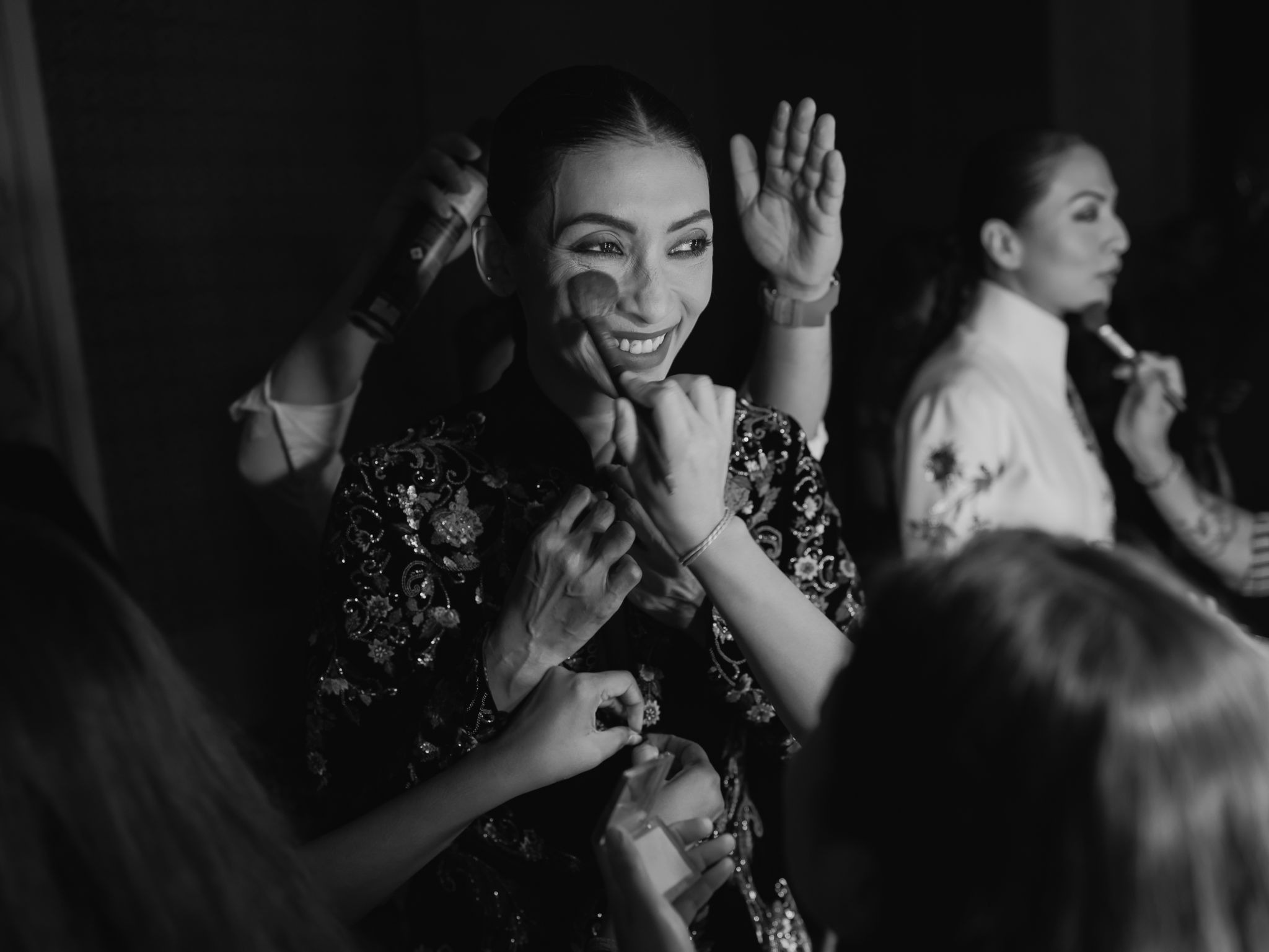
A backstage photo from a Rohit Bal show. Photo courtesy : Nishant Gautam
The Making of a Supermodel
Lakshmi Rana's origin story is far from the usual embellishments. She was a head girl from Dehradun, an army kid, a PCM student with IIT ambitions and fighter plane posters on her bedroom wall, where most teenagers kept film stars. "It's the profession that chooses you finally," she says, "no matter what you do." Her Masi pushed her into a Navy queen contest. Instead of starting with a shoot or campaign, she started her career from the top. Her mother said try for Miss India, and if nothing comes of it, come home and study. A reasonable ask for the then 19-year-old Lakshmi. She entered with a contingency plan and walked out with a direct audition for the first Lakme Fashion Week the country had ever staged.
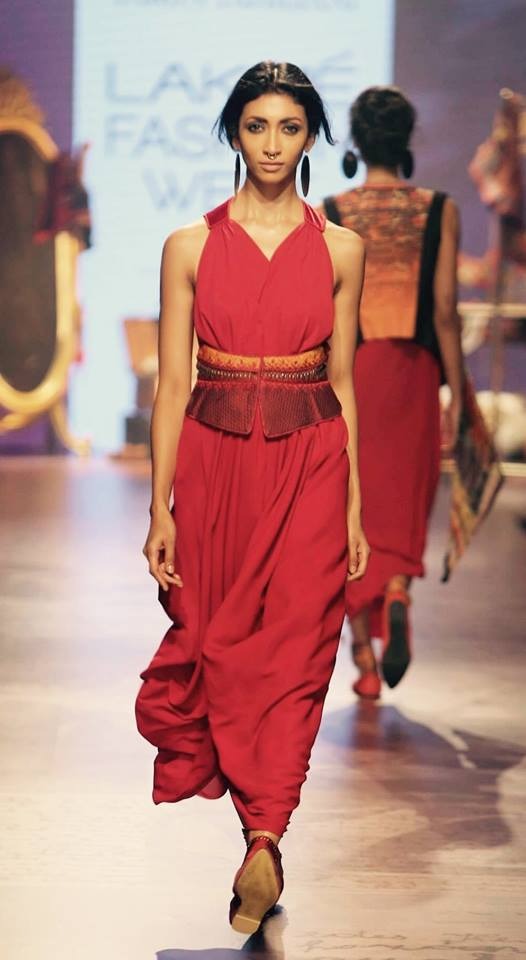
Lakshmi Rana at one of the initial Lakme Fashion Weeks, shot by Gulshan Sachdeva
This was the turn of the millennium, and Indian fashion weeks were operating at a pitch of seriousness that is unheard of for most today. International buyers in the front rows. Editors from Elle, Femina and Cosmopolitan, and later Vogue and Harper’s Bazaar. The ramp was a business proposition as much as a spectacle, and the models who worked it understood that. Sheetal Malhar, Jesse Randhawa, Madhu Sapre, Viveka Babaji, Diandra Soares. "Insanely beautiful, stunning women," Lakshmi says. "All of them had personalities of their own. They spoke well, they dressed well, they conducted themselves well. They were all freelancers, there were no agencies. They knew how to brand themselves, how to demand respect." She studied them with the focus of someone who understood that the industry had no formal education to offer, so the education would have to come from observation.
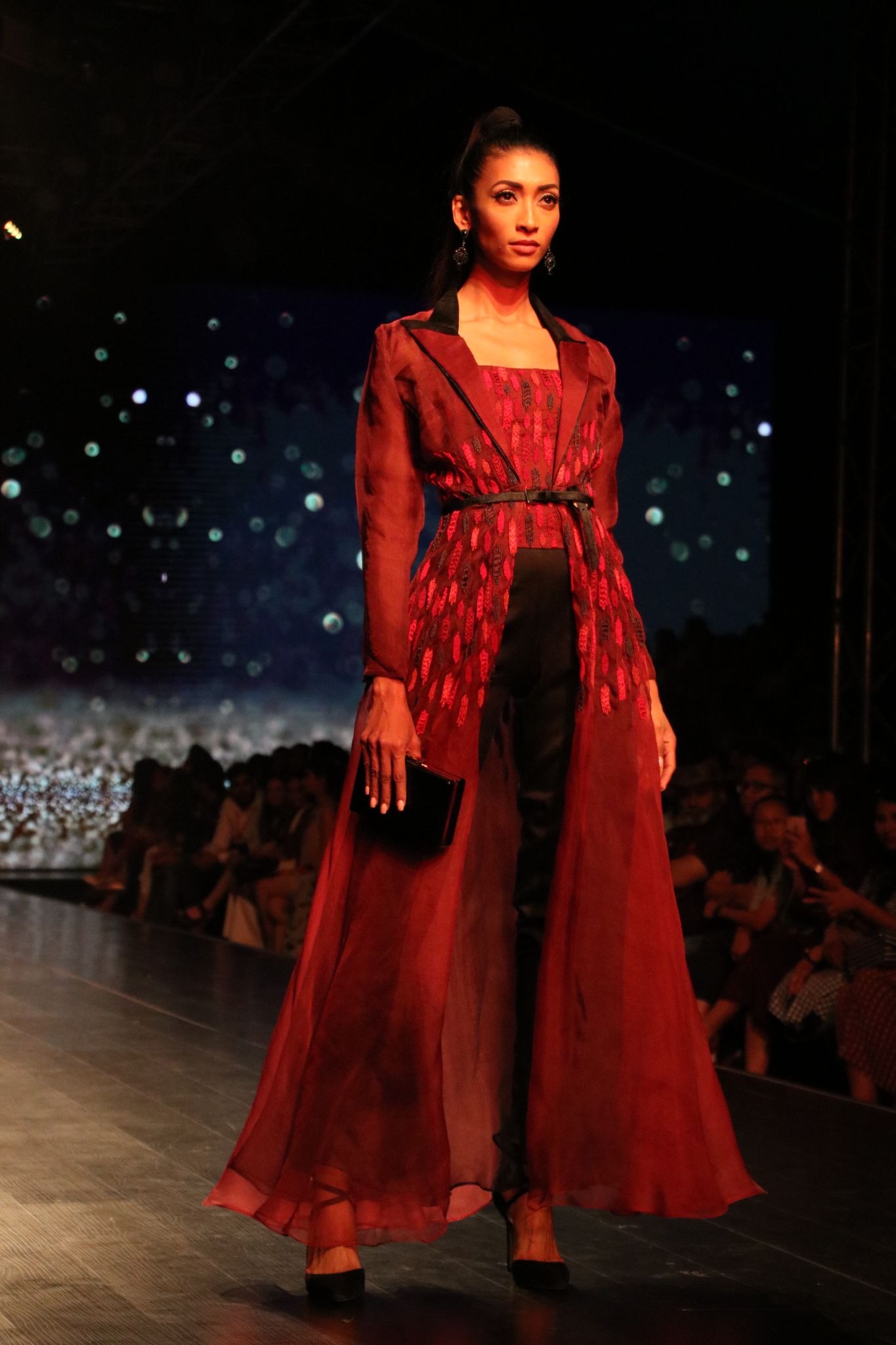
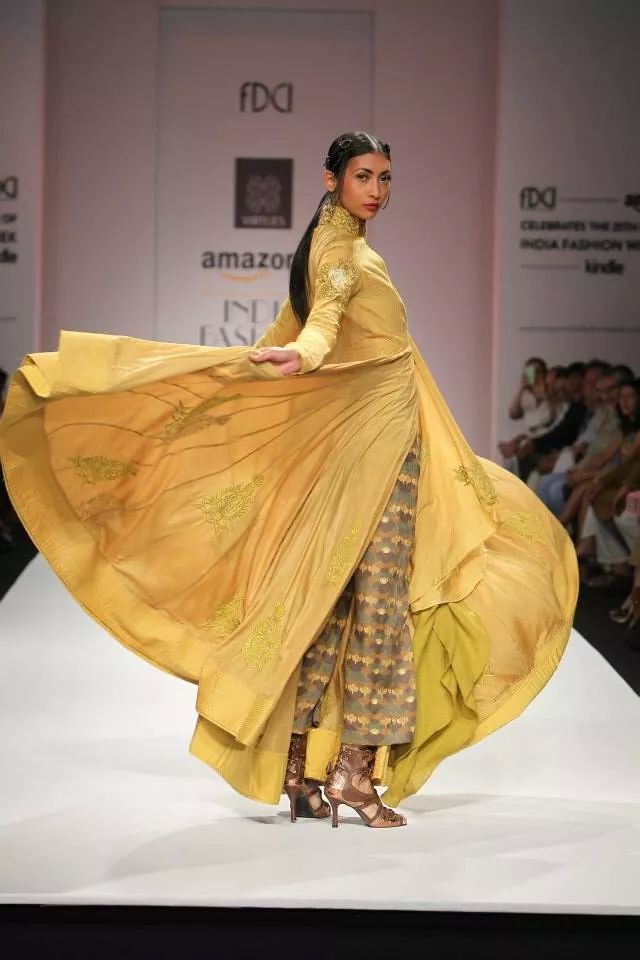
Her ramp presence required no instruction. It was simply hers. Designers noticed it early. "Lakshmi Rana is the finest supermodel in the country," says Nonita Kalra, former editor of Harper's Bazaar India. "From the way she carries the most impossible, exaggerated couture to her signature, feline walk, she is an absolute dream to watch on the ramp." Gaurav Gupta's experience of that presence was even more specific: "She epitomises the power of making an image immortal, with seamless humility." He would eventually name pieces after her, not as a gesture but as a professional acknowledgement that the garment and the woman had become inseparable in the industry's imagination.
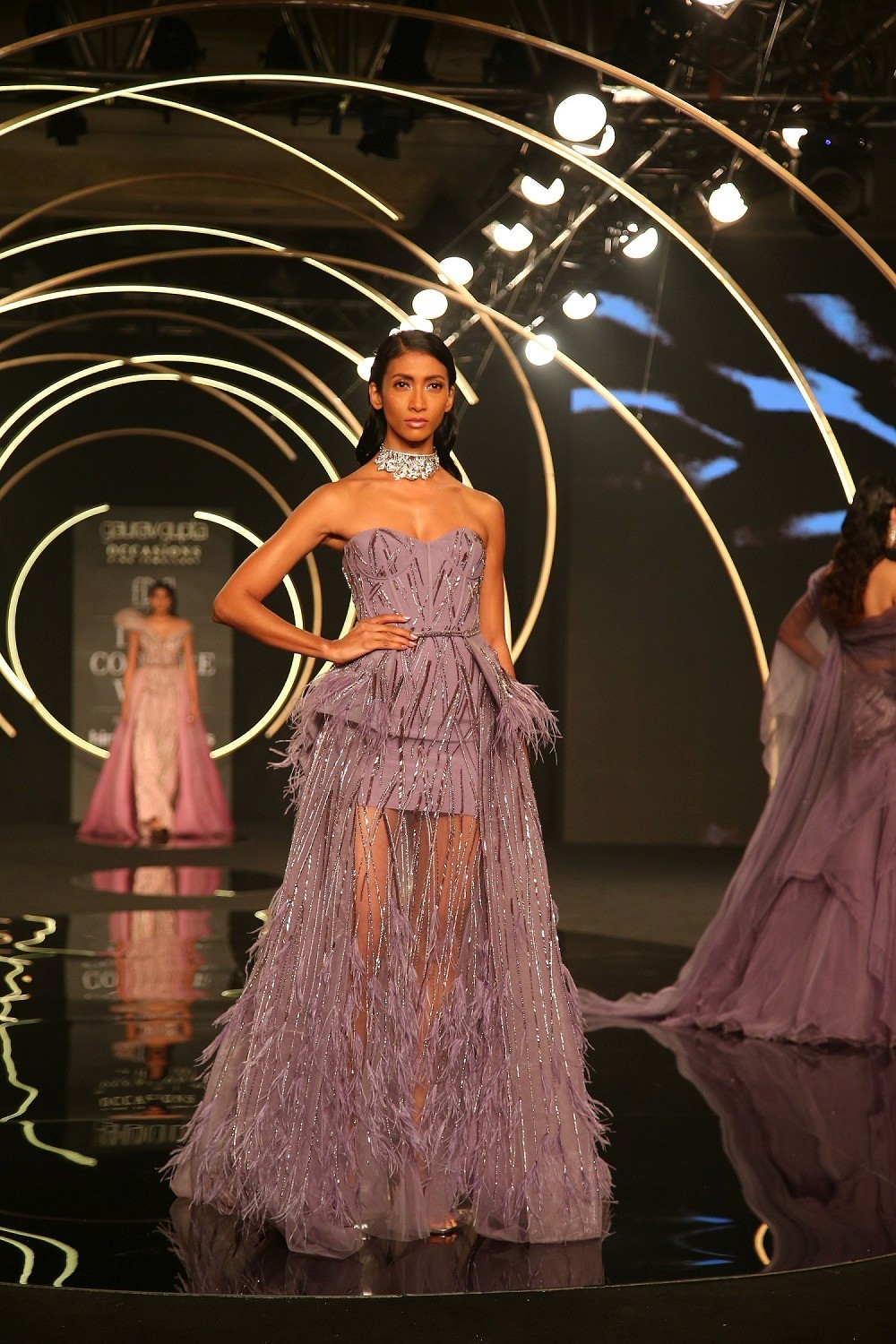
Lakshmi Rana at the Gaurav Gupta Couture show at FDCI India Couture Week 2019, Undercurrent Collection
"My discipline was the difference. Every look, whether it opened the show or closed it, whether it was the designer's centrepiece or a transition piece, received the same complete investment of presence and intention. That consistency is what made designers name pieces after me. When you treat every garment as the most important thing in the room, you stop being the person wearing the clothes and start being the reason people remember them."
The industry's social architecture, however, had its own initiation. Raised with the discipline of an army household, Lakshmi Rana entered the fashion world with an innate sense of professional equity that left no room for the industry’s most tired cliché: the masquerading of exploitation as "opportunity."
Even as a newcomer, she possessed a clarity of self-worth and self dignity that many spend decades searching for. “I was raised like that. I would hold my ground, even before the most formidable names in Indian couture," she reflects. "The narrative was always that I was the novice being granted a 'break.' My response was simple: this is a professional exchange. I provide a specialised service, and that service commands its value. Because of this I did go through various challenges for the first two years but looking back I’m glad I did it because I set my own rules on how I wished to be treated in this industry. “
It’s during those volatile formative years, a vastly different future beckoned, one of immense prestige and national service. Lakshmi had cleared the rigorous Pilot Aptitude Battery Test and the SSB, ultimately receiving a formal call letter to join the Indian Air Force at Secunderabad for the Flying Pilot course. It was a remarkably respectable and coveted path, offering the kind of storied career most only dream of.
“I still have that call letter” she says with a smile, "it was an agonisingly tough decision to choose between the cockpit and the runway ; it wasn't just a career choice, but a weighing of two entirely different lives”. Her mother, who lost her husband when Lakshmi was just seventeen, viewed the unpredictable world of modelling with deep apprehension. When Lakshmi chose the uncertainty of the ramp over the decorated stability of the Air Force, her mother did not speak to her for three months.
"I’m grateful for my own stubbornness," Lakshmi says now, looking back with the perspective of a quarter-century. “The universe guides you. I chose the path less taken, and in return, it gave me a life of my own making."
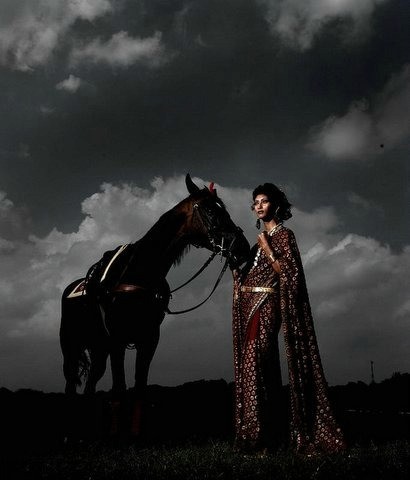
Lakshmi Rana in a custom Sabyasachi saree for her wedding
Perhaps the most defining pillar of Lakshmi’s longevity wasn’t found on a mood board, but in a pragmatic lesson on self-preservation. “My husband who I consider as my biggest pillar of support was then a trusted friend, he is the one who instilled in me a radical financial blueprint” : save fifty percent of every paycheque and invest with clinical precision. It proved to be the most consequential counsel of her career.
"It changed the power dynamic of my life," she notes. "Because of that foundation, after five to six years of saving, there was never a moment where I had to accept a job out of desperation. I never worked because I needed the money."
Twenty-five years of that unwavering fiscal discipline have yielded more than just a portfolio of properties and strategic investments; they have granted her the rarest luxury in fashion : true professional sovereignty. In an industry obsessed with "shelf life," Lakshmi has bypassed the expiration date entirely, operating from a place of choice rather than necessity. Her perspective on this is as unsentimental as it is earned: "If you reach the quarter-century mark and have nothing tangible to show for your labour, you haven't just missed an opportunity, rather, you’ve failed your future self."
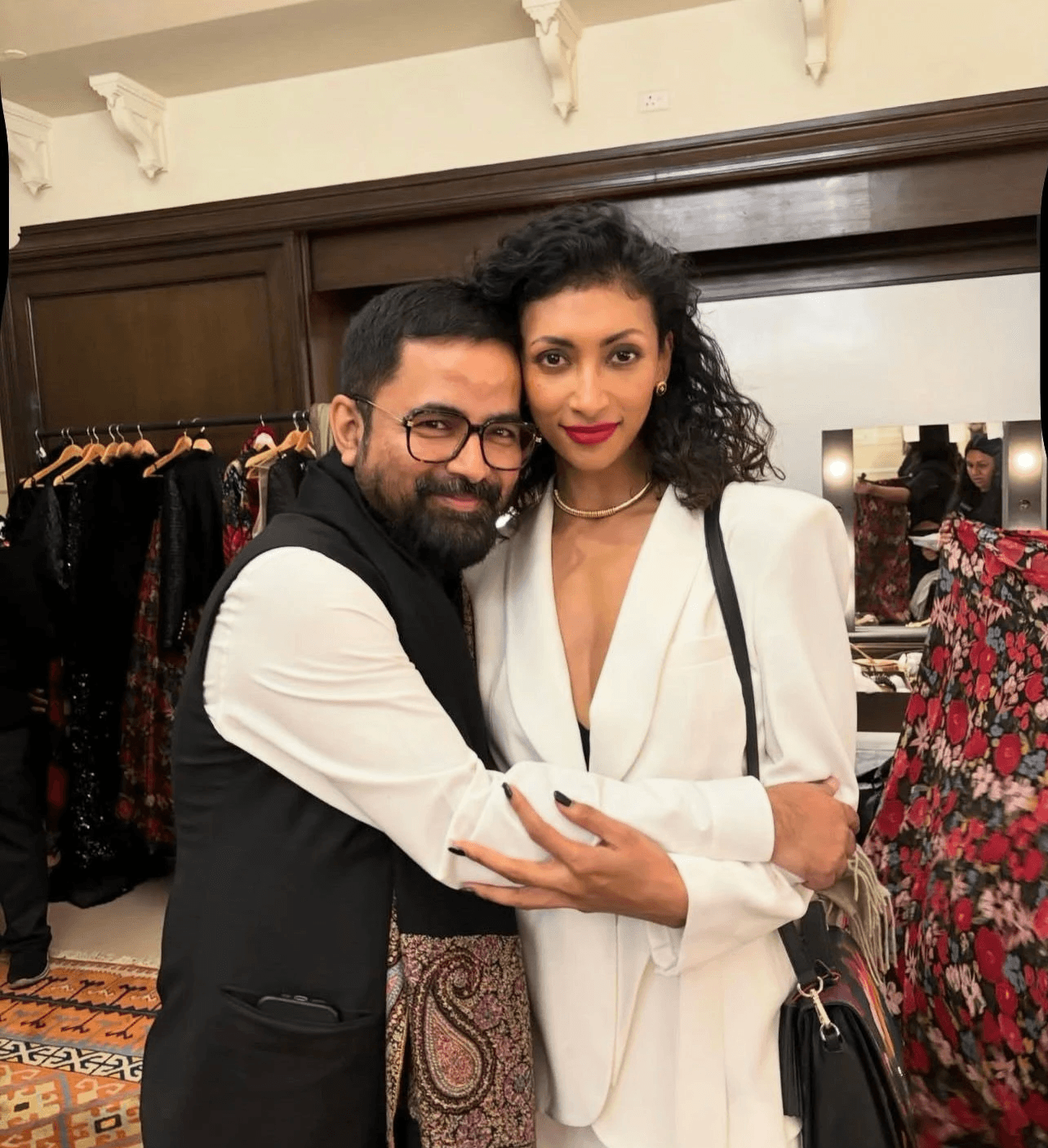
Lakshmi Rana with Sabyasachi Mukherji
The Showstopper Economy
The global fashion industry generated roughly 1.8 trillion dollars in 2023 (McKinsey & Company, State of Fashion 2024), India's fashion and textile sector, home to craft traditions that predate most Western fashion houses by centuries, is projected to reach 350 billion dollars by 2030 at a 10 percent CAGR, according to the India Brand Equity Foundation under the Ministry of Commerce, fuelled in no small part by a global appetite for exactly the kind of handwork, embroidery, and textile intelligence that Indian artisans have been producing for generations. Better late than never, the world is looking at India with admiration.
While the hunger remains for our rich and diverse crafts, the Indian fashion scene feebly attempts to satiate the world’s appetite with Bollywood finales instead.
The showstopper, for those unfamiliar with the institution, is a defining feature of Indian fashion weeks with almost no equivalent anywhere else in the world. A film celebrity, typically accompanied by considerable fanfare and social media pre-coverage, walks the final look of a designer's show. The designer stands at their shoulder. The room erupts. The photographs, predictably, get filed under the celebrity's name rather than the collection's.
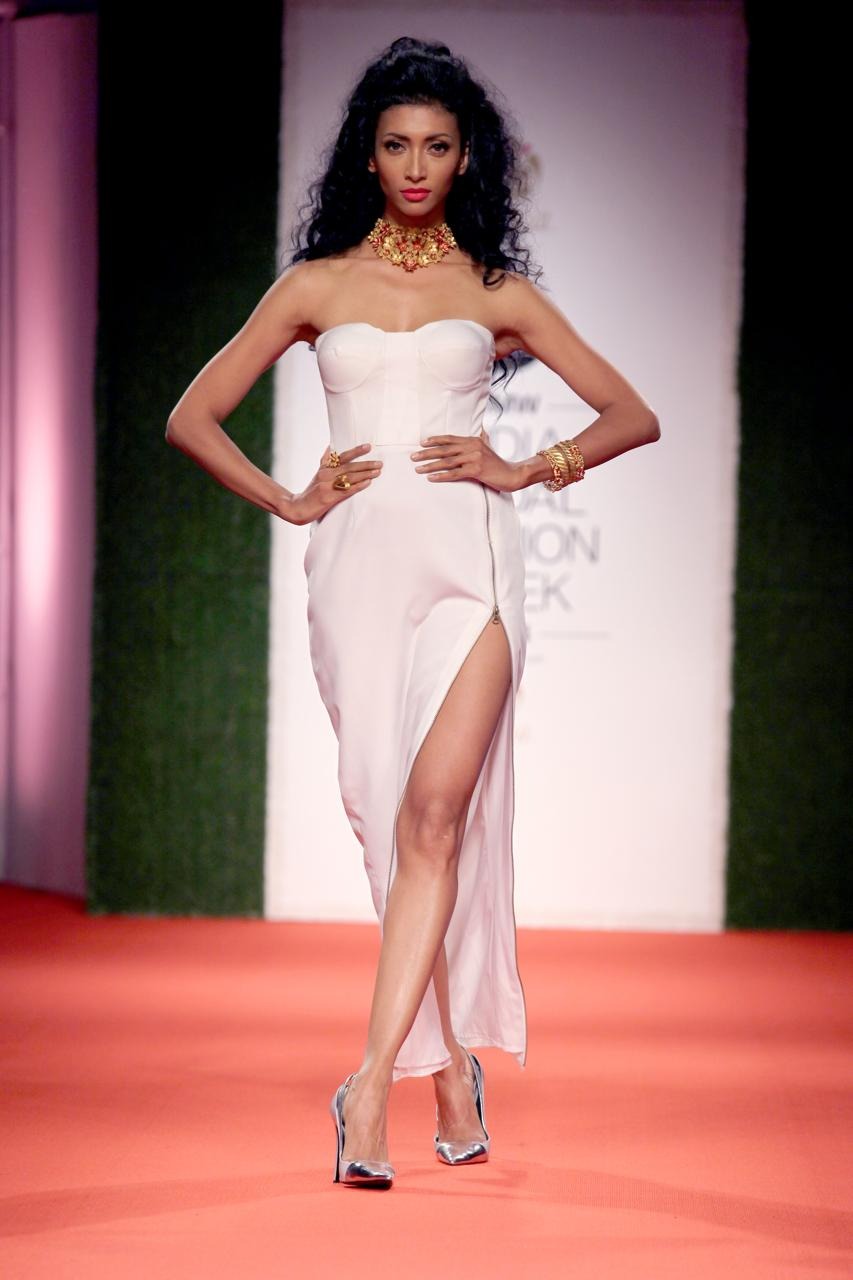
Lakshmi Rana on the ramp of one of the foremost Lakme Fashion Weeks
Lakshmi watched this culture develop from the inside. "When the fashion weeks started in the country, we would see the best of the editors and the stylists and actual buyers sitting on the front row," she says. "We used to be nervous about the fact that the editor of Vogue and the editor of Harper's were sitting there. For us it was a really important thing that we do really well on the ramp." That nervousness had creative value. It oriented the entire production toward the clothes, toward the story the designer attempted to showcase, toward the buyers who would go on to carry Indian design into international retail. "That was the best era of Indian fashion weeks, is how I would remember it."
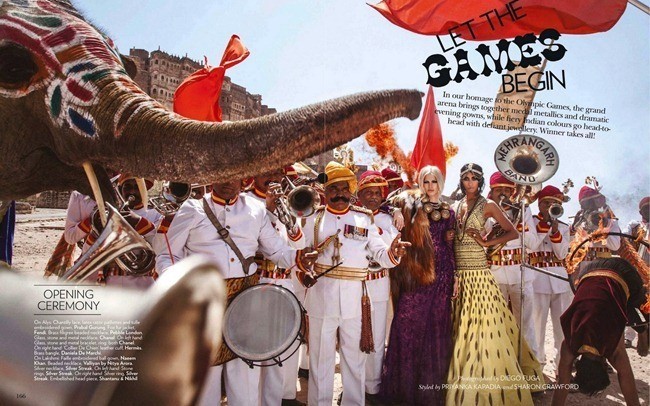
Lakshmi Rana for a Vogue editorial on the Olympics
The shift, when it came, followed a logic that is commercially coherent even if creatively costly. A Bollywood star with ten million followers generates the kind of coverage no collection can produce on its own, which is the bleak reality. Sponsors who fund fashion weeks want that visibility, and in India, visibility has historically had a very specific address. "Today it is because of the digital reach that a Bollywood star can get a brand or a designer. A-list, B-list, C-list. It doesn't matter." The result is that fashion weeks have drifted from being showcases for design into being showcases for celebrity, with the design serving as a backdrop.
"The story is lost. The concept is lost. By the end of it, what the people see, and remember, is that one showstopper in that one outfit."
She was at a press conference for a designer when Urmila Matondkar walked in. The journalists there for fashion spent the session asking about her upcoming film. The designer's collection, the entire reason everyone was in the room, became secondary. "The media is also responsible for this kind of Bollywood frenzy and showstopper attitude that we have." It is a feedback loop that sustains itself: celebrities drive coverage, coverage drives sponsors, sponsors demand celebrities.
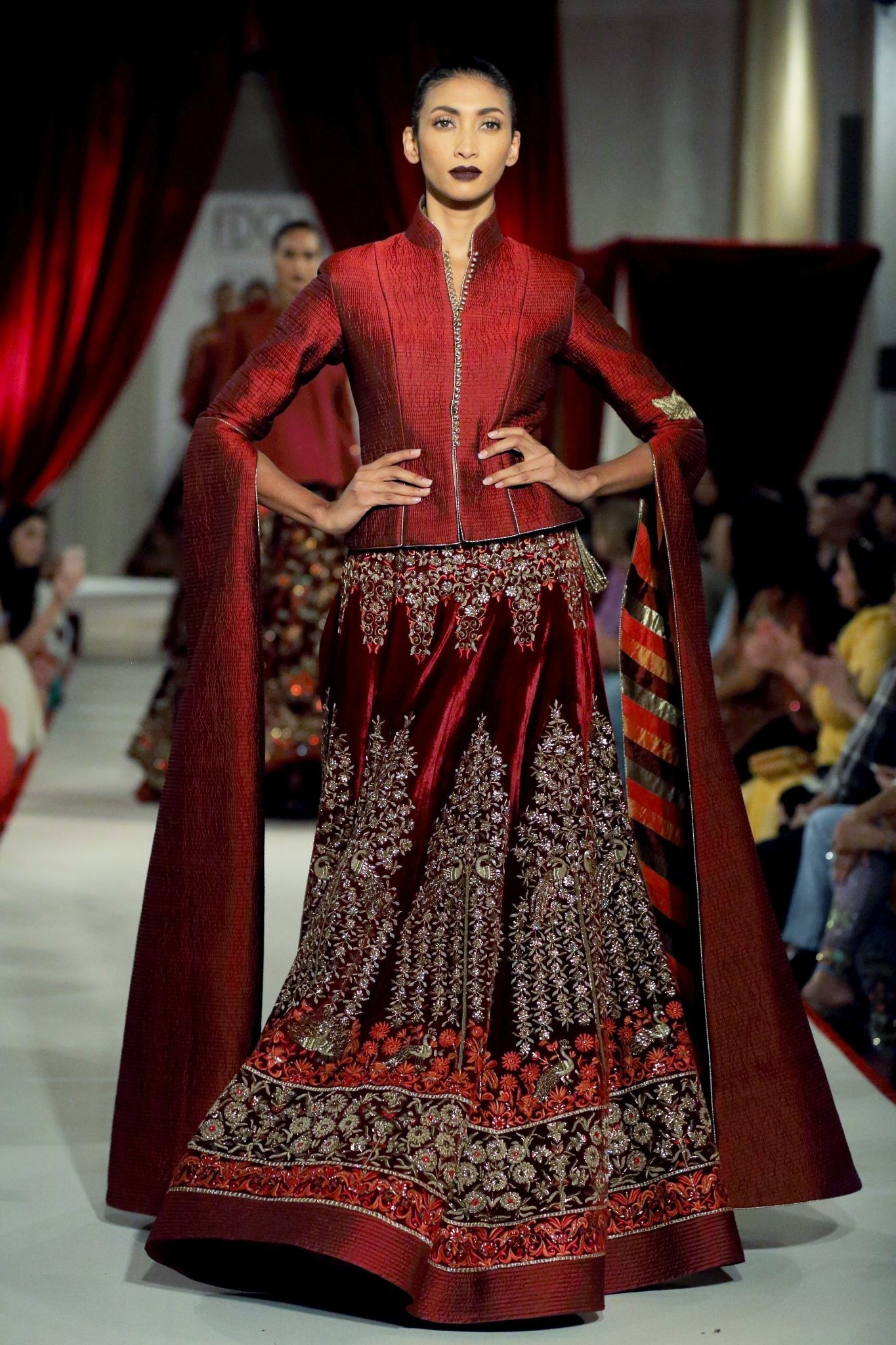
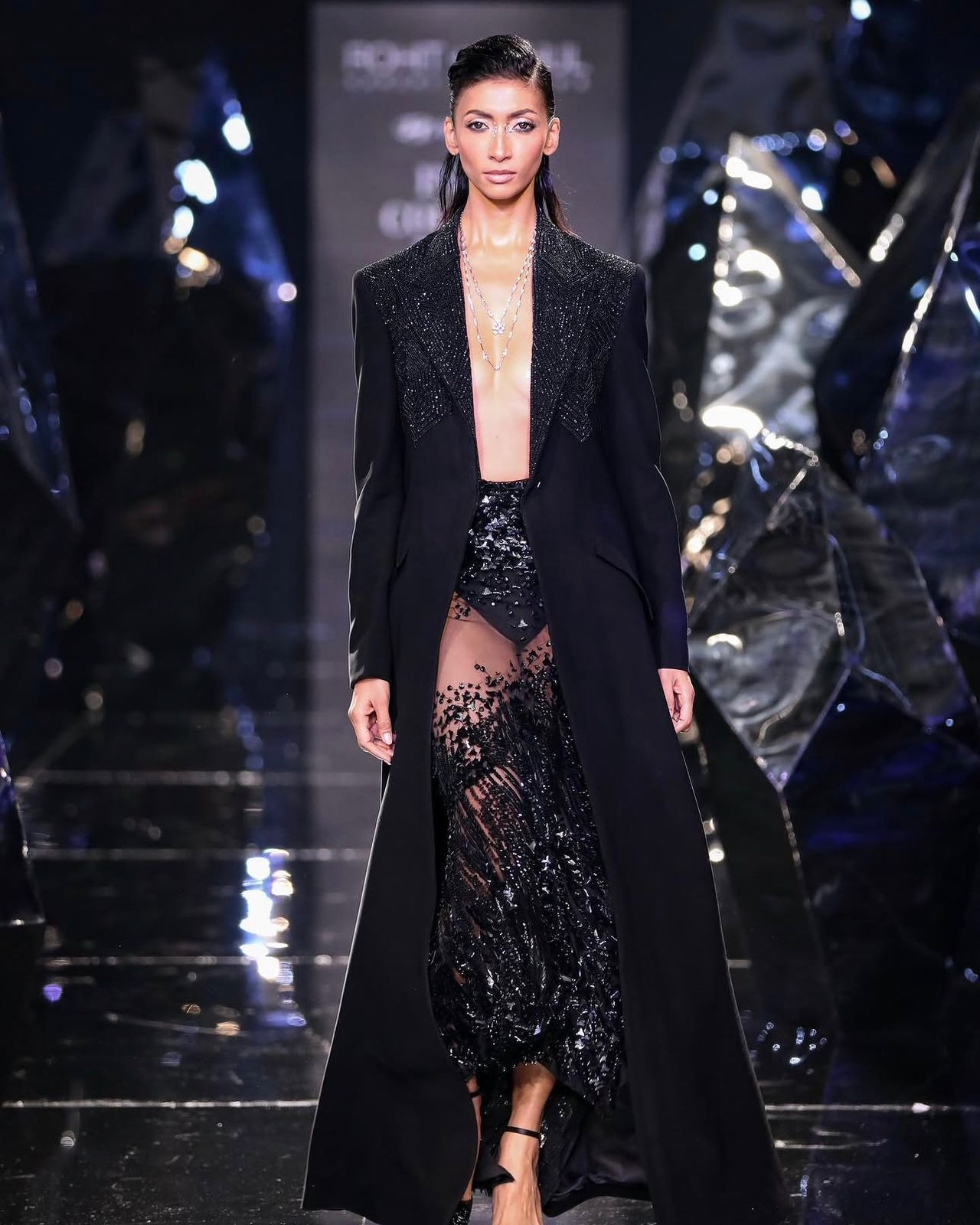
Lakshmi Rana for Rohit Bal
The contrast with how Western fashion weeks handle the same dynamic is instructive, and maybe a model we could follow. At Dior, at Louis Vuitton, at Chanel, celebrity presence is enormous. Stars fill the front rows, wear the collections, even custom pieces, and generate millions of impressions. The association between fashion house and cultural icon is commercially deliberate and visually everywhere. ‘Friends of the Maison’ exist all over, but the ramp remains sacred ground for the best of luxury globally. Trained models carry the collection. The show is about the design, the craftsmanship, the months, sometimes even years of blood, sweat and patterns. "The models have done the job for the designer," Lakshmi says. "It has to be kept separate, because they do not want to lose the essence of what their industry stands for." The celebrity is the amplifier. The craft is the signal. Indian fashion, increasingly, and unfortunately, has been inverting that relationship.
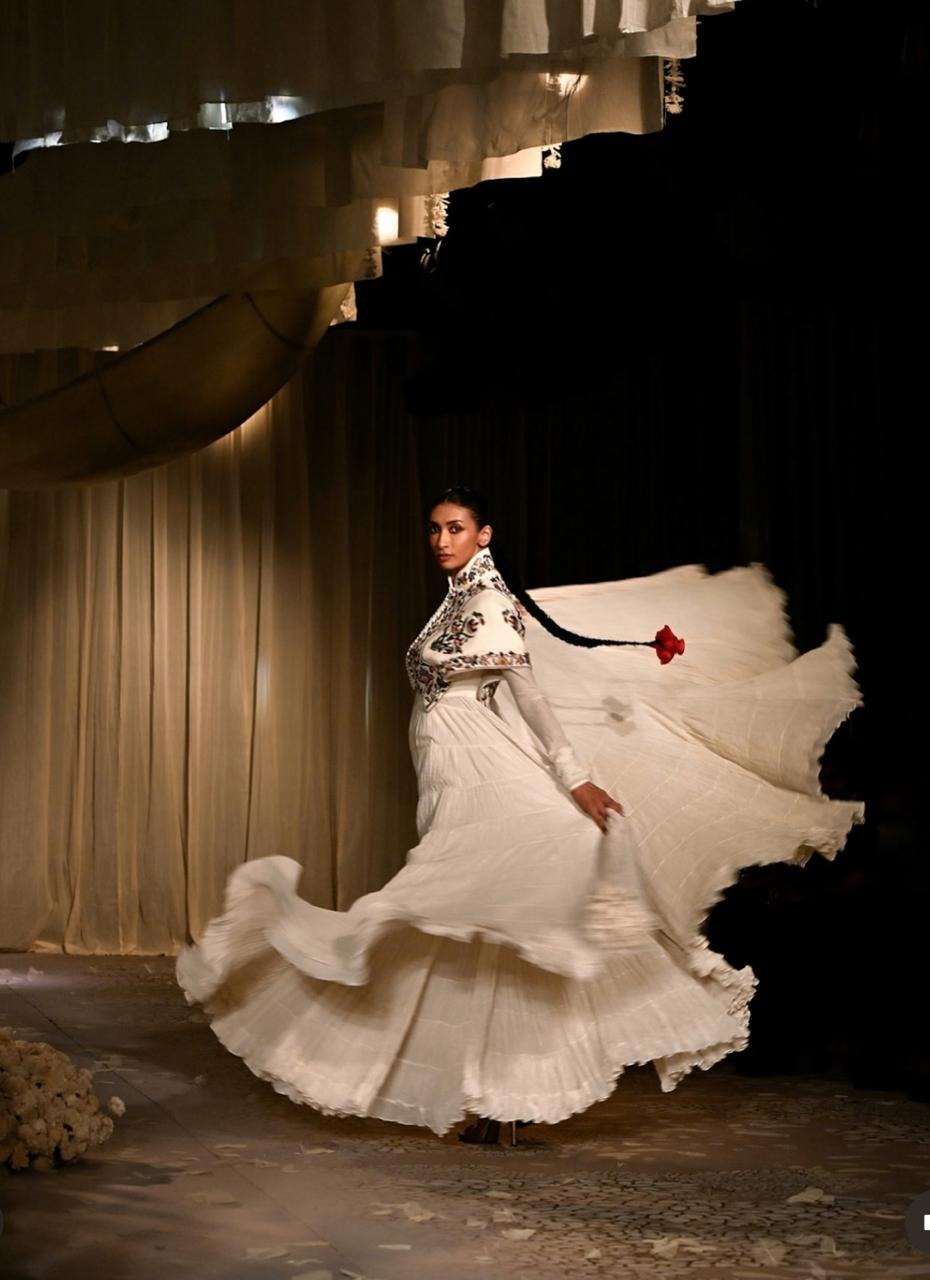
Lakshmi Rana for one of Rohit Bal’s most iconic looks
This is where the cultural appropriation conversation, and the showstopper conversation, converge. When India gets incensed at a Western brand for lifting a Banarasi pattern or referencing a regional craft tradition without credit, the anger is valid. Attribution matters. The economics of cultural borrowing matter. But the more pressing question is what Indian fashion is doing, on its own biggest stages, to establish its craft as the primary focus. A fashion week where the most-covered moment is a celebrity's closing walk is making an argument about what Indian fashion values, and that argument has consequences for how the world perceives it.
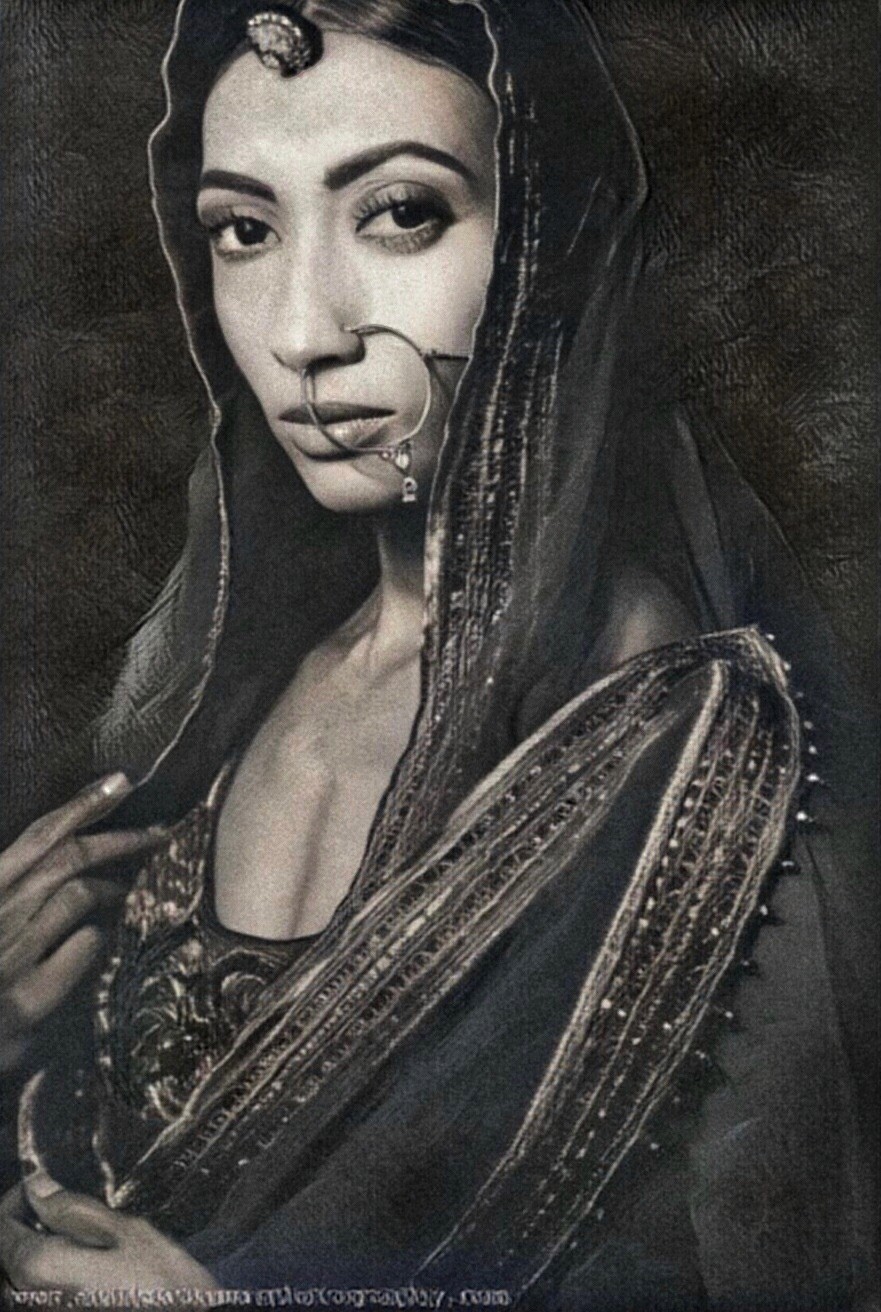
Lakshmi Rana for JJ Valaya, Photo courtesy : JJ Valaya
Lakshmi is careful not to frame her standards as a blanket condemnation of the industry. Instead, she speaks with the nuance of someone who recognises true craftsmanship when she sees it. She acknowledges that the intersection of fashion and celebrity, while often fraught, can be navigated with finesse.
She points to those rare, elevated moments where the presence of a public figure feels integrated rather than staged, where designers treat high-profile appearances as a seamless extension of the creative vision, rather than a mere headline-grabbing tactic. For Lakshmi, there is a profound respect for the creators who understand that the relationship between cinema and the runway can, and should, be handled with subtle sophistication rather than spectacle.
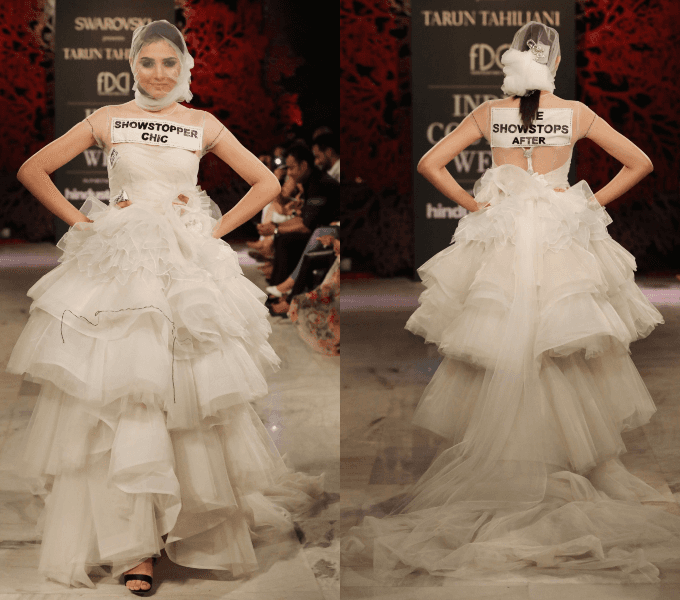
A model walks in a tulle gown and net mask to display "the show stops here" message for the no-showstopper finale as part of Tarun Tahiliani's 2019 ICW collection 'Bloom'.
Tarun Tahiliani, who has been among the most vocal Indian designers about this dynamic, puts it plainly. He once dressed a new model in a white muslin outfit with "Showstopper" printed across the chest and sent her out last at a show at Bikaner House, making the case visually. "I don't need a Bollywood star or a showstopper to help me reach where I want to reach," he has said publicly, and his brand's international standing reflects the confidence of that position. Of Lakshmi specifically, he says: "She will help them define their roadmap to success, going far beyond what to do on the ramp and how to look at the camera." The implication being that the ramp, when treated seriously, is itself a form of communication that requires as much intellect as any other.
A Booming Industry and a Frozen Cheque
The financial reality of Indian modelling is a conversation that happens extensively behind closed doors and almost never in public. Lakshmi Rana, who is the founder of a modelling agency in addition to her training camp, has decided that closed doors are no longer useful, and must be opened to pave the way for a sustainable Indian modelling industry.
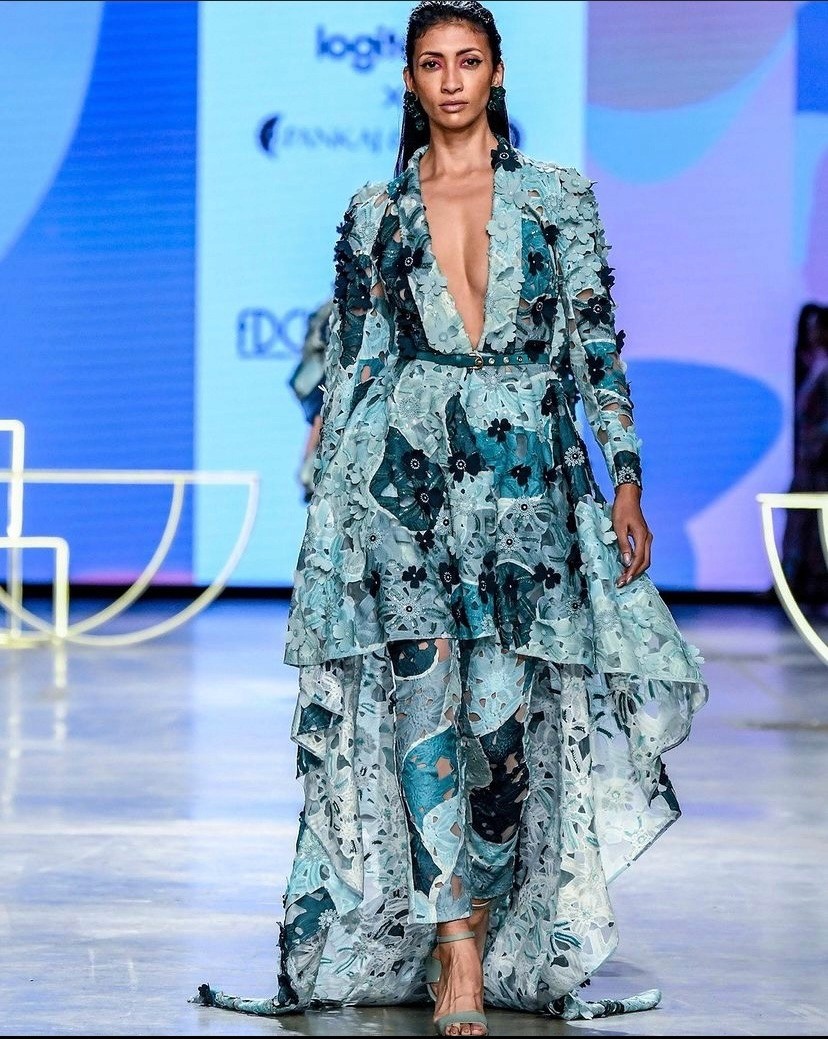
When she walked her first fashion week, she earned approximately seven thousand rupees per show, doing eighteen to twenty shows across the week. A car down payment was possible by the end of it. Today, a newcomer walking three to four shows in a single day earns somewhere between six and eight thousand rupees for the entire day. In the same period, India has become one of the fastest-growing luxury markets in the world. The fashion and textile industry is on a trajectory toward being one of its largest economic contributors. The wages paid to the people whose bodies literally carry the clothes have remained effectively flat, even declining. "I don't mind being quoted on this," she maintains. "There has been no great improvement in those terms."
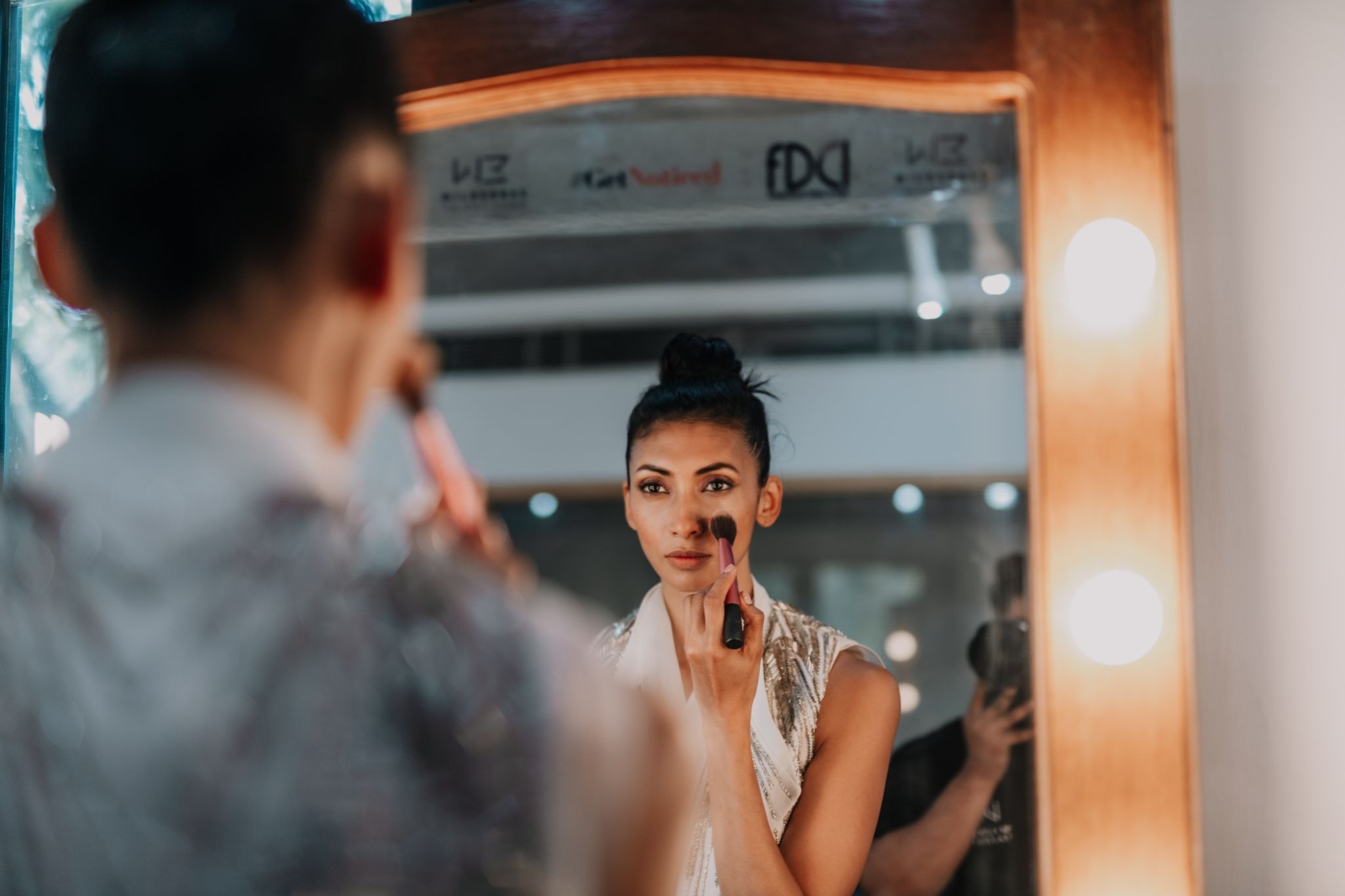
Photo courtesy : Snapsoul Studios
No union. No standardised rates. No overtime regulation. No formal protection against exploitation in casting rooms or on set. "Abroad, after eight hours, you are supposed to pay a model overtime. There is nothing like that here.", Lakshmi comments. Models start young, often at sixteen or seventeen, entering an industry with no formal framework to orient them, no community to warn them about which situations are unsafe, no institutional systems ensuring they get what they are owed.
This is the other side of the showstopper culture's economic story. While fangirls flock to see Khushi Kapoor in a sequinned lehenga that could frankly blind you, we must not be blinded to the ground reality. The budgets allocated to a single celebrity appearance, the negotiation, the entourage, the social media activation, are budgets that exist within a finite production economy. An industry that has normalised significant investment in celebrity closure has, in the same motion, normalised minimal investment in the models who carry every other look in the show, animating the garments made with precision and technique inherited from generations of practice.
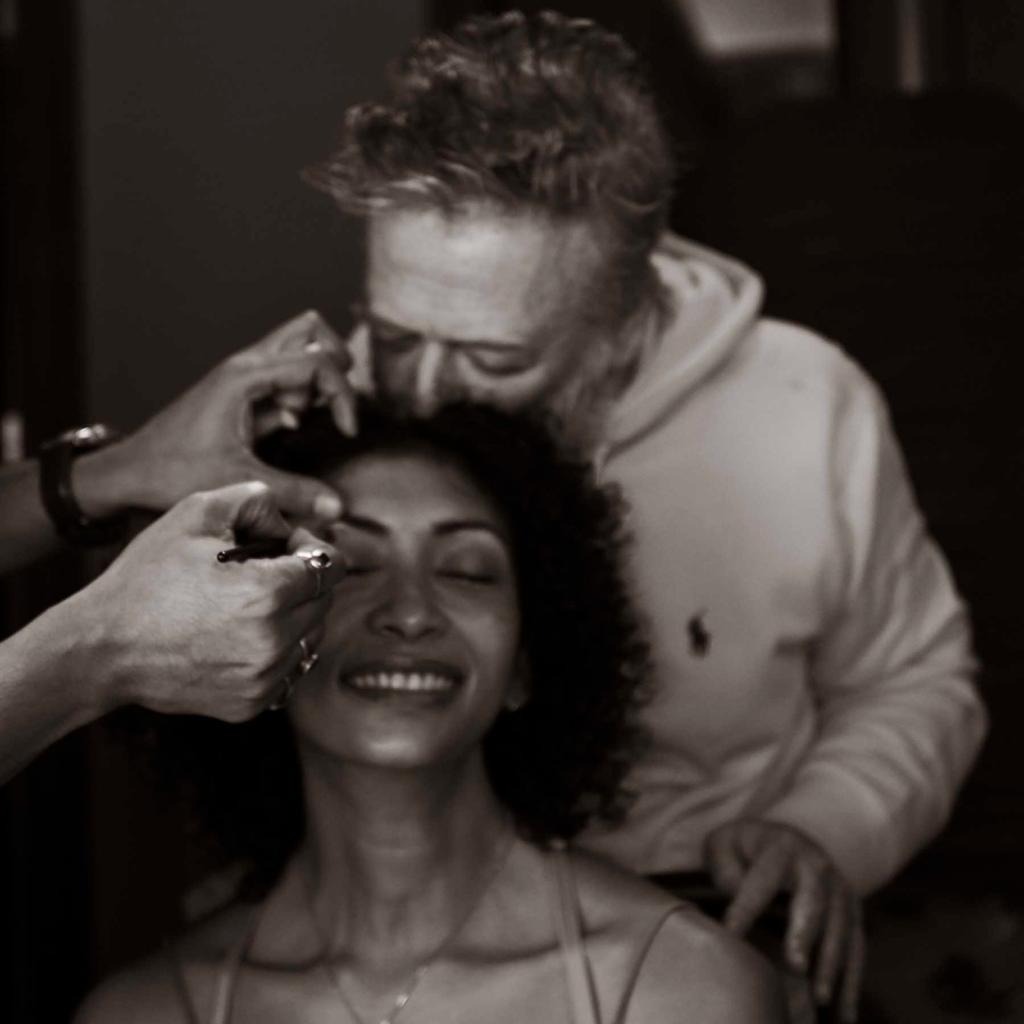
Lakshmi Rana with Rohit Bal in his final days. Photo courtesy : Saurabh Dua
The models garnering major international recognition in the last decade, Bhumika Arora in Paris, Pooja Mor at Louis Vuitton, Radhika Nair at Balenciaga, arrived there through international scouting rather than through domestic development. "Bhumika never got work in India. I remember her coming for auditions and she never made it. It is only when she got scouted abroad that she became big." International fashion houses recognised what the Indian fashion industry had sitting in front of it and had not seen. Gaurav Gupta's international breakthrough was built, as Lakshmi describes it, through singular personal effort: "There are so many designers that I know that I've walked for, supremely talented, but they did not get an opportunity to be showcased or to get that push that our fashion industry could have given them." The infrastructure that should have been identifying and building this talent was, in many cases, occupied with other priorities.
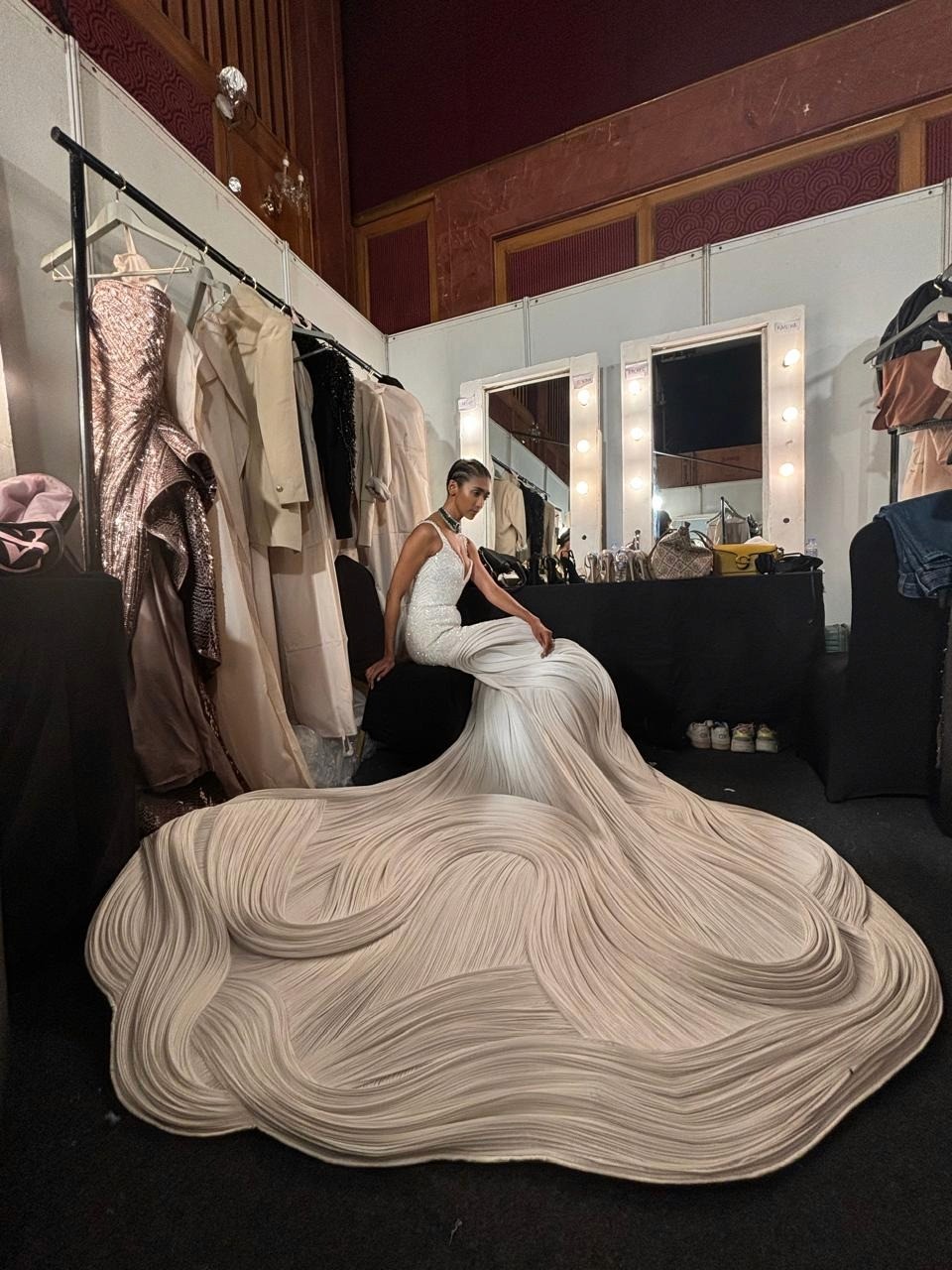
Lakshmi Rana backstage at Gaurav Gupta’s 2024 presentation at India Couture Week
On this, Lakshmi insists, "Indian fashion has a complicated relationship with its own reflection. The models who leave for Paris and return with a Louis Vuitton credit get the covers, the campaigns, the industry's sudden and enthusiastic recognition. Their achievements are genuinely hard-earned and worth celebrating. But the uncomfortable truth sitting beneath that celebration is this: the same industry that applauds them for being validated abroad spent years not validating them at home. And for every model who made it to a Balenciaga casting, there are extraordinary women who made a different choice, to build careers here, to raise families, to seek stability on their own terms, and who are measured against an imported yardstick that was never designed to account for them. When we treat international recognition as the only legitimate form of it, we are not just undervaluing our models. We are declaring our own market a waiting room."
"Why have we failed to institutionalise the Indian supermodel? Why does our talent reach global heights only as outliers, as opposed to a product of a thriving domestic machinery?" This is no longer a rhetorical inquiry; it is a structural critique. For decades, the Indian industry has allowed the 'supermodel', a brand in her own right, to be eclipsed by the gravitational pull of Bollywood, treating models as fleeting vessels for clothes rather than icons of influence.
The responsibility lies in a collective lack of vision: designers who seek mannequins instead of muses, and a media landscape that prioritises cinema over the artistry of the gait. To correct this, the industry must pivot toward intentional brand-building. We must celebrate our homegrown talent with the same fervour we reserve for our crafts. It is time to treat the model not as a secondary character, but as the protagonist of the fashion narrative, the ultimate bridge between Indian heritage and global aspiration.
Notes from the Backstage
For years, in the long waits between hair, makeup, fittings, and curtain calls that make up most of a model's working life, Lakshmi was writing things down. What she wished she had known when she started. What someone should have told her about invoicing, about responding to job inquiries, about which photographers were trustworthy and which were not, about the fact that modelling was a business with learnable rules. "I would write in my journal: I wish I could change this. I wish I could change that." She walked into an industry with no formal structure at the time, and used her dedicated and disciplined character to learn, adapt and register each and every nuance. "My biggest worry was when I would see all the newcomers come in. I would see that they were conducting themselves wrong. They had no information about the industry. They were misguided when it came to what this industry can do for you."
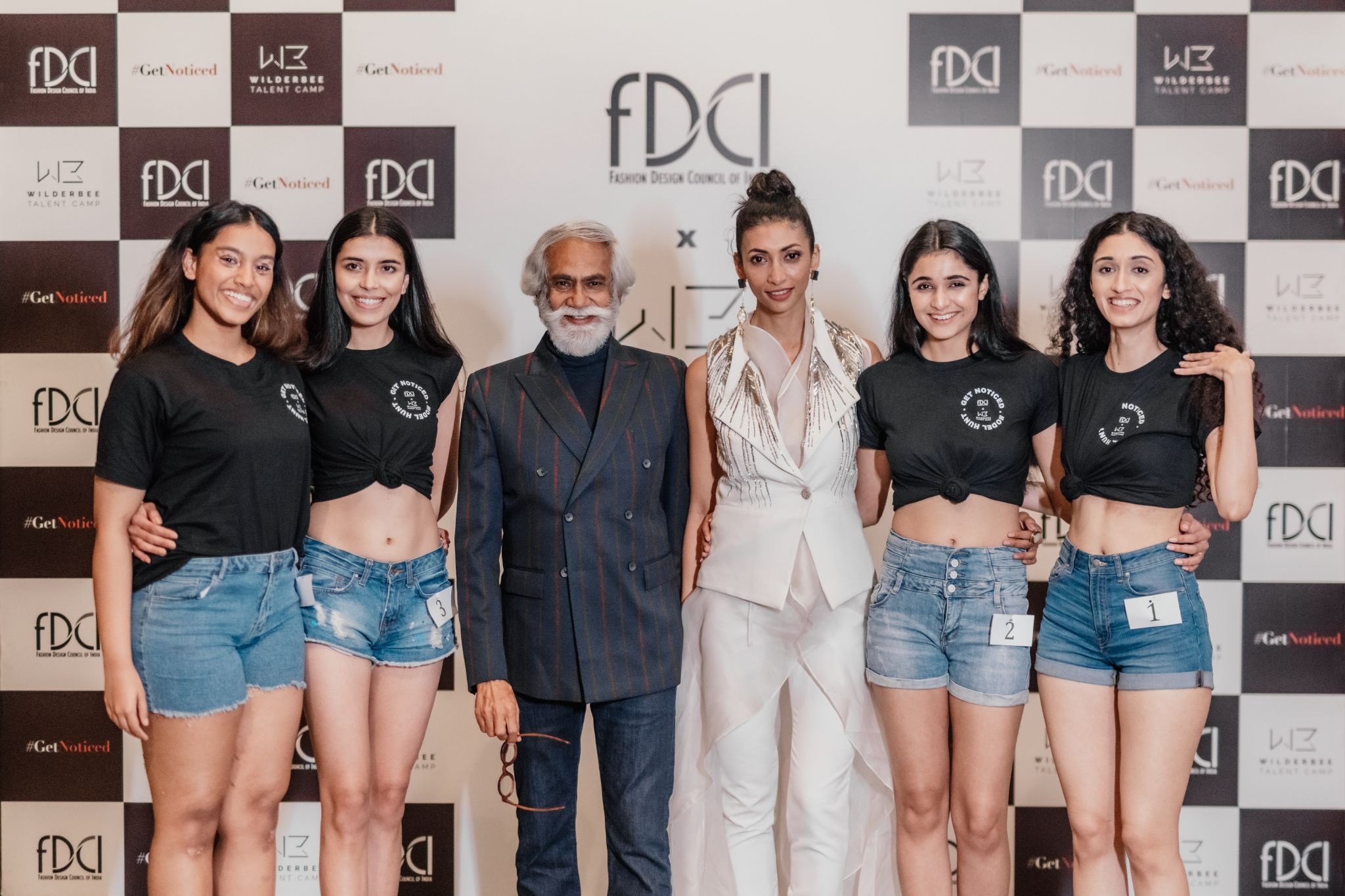
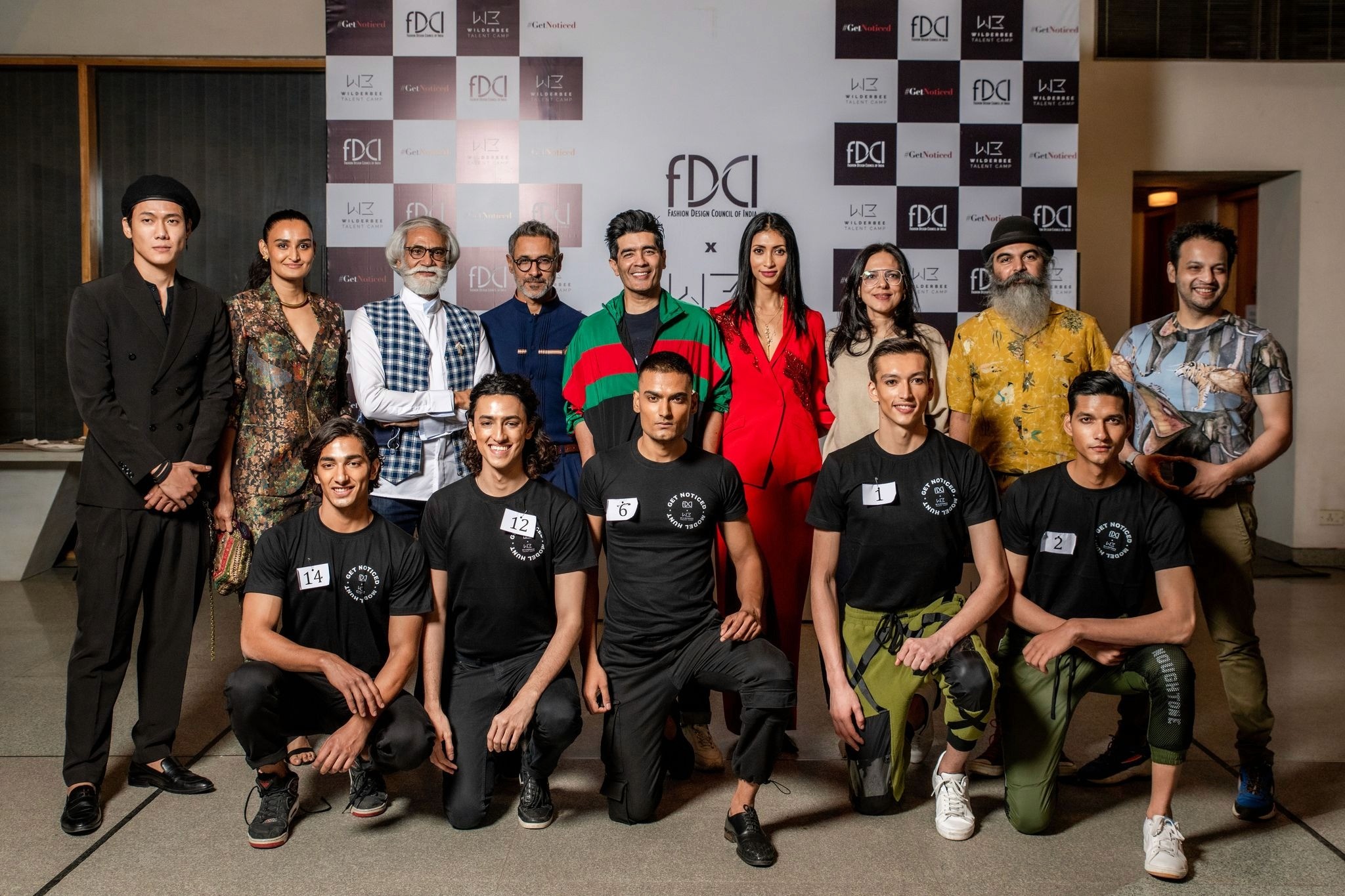
Lakshmi Rana, FDCI President Sunil Sethi and Wilderbee models pictured here. Photo courtesy : Snapsoul Studios
The COVID lockdown gave her the time to turn those notes into a reality she had often dreamt for the future of Indian modelling. Wilderbee Talent Camp formed during the first lockdown, curriculum written from scratch, launched online before the world reopened, and formalised with FDCI for offline courses once it did. The institution she had been imagining for years began to take shape.
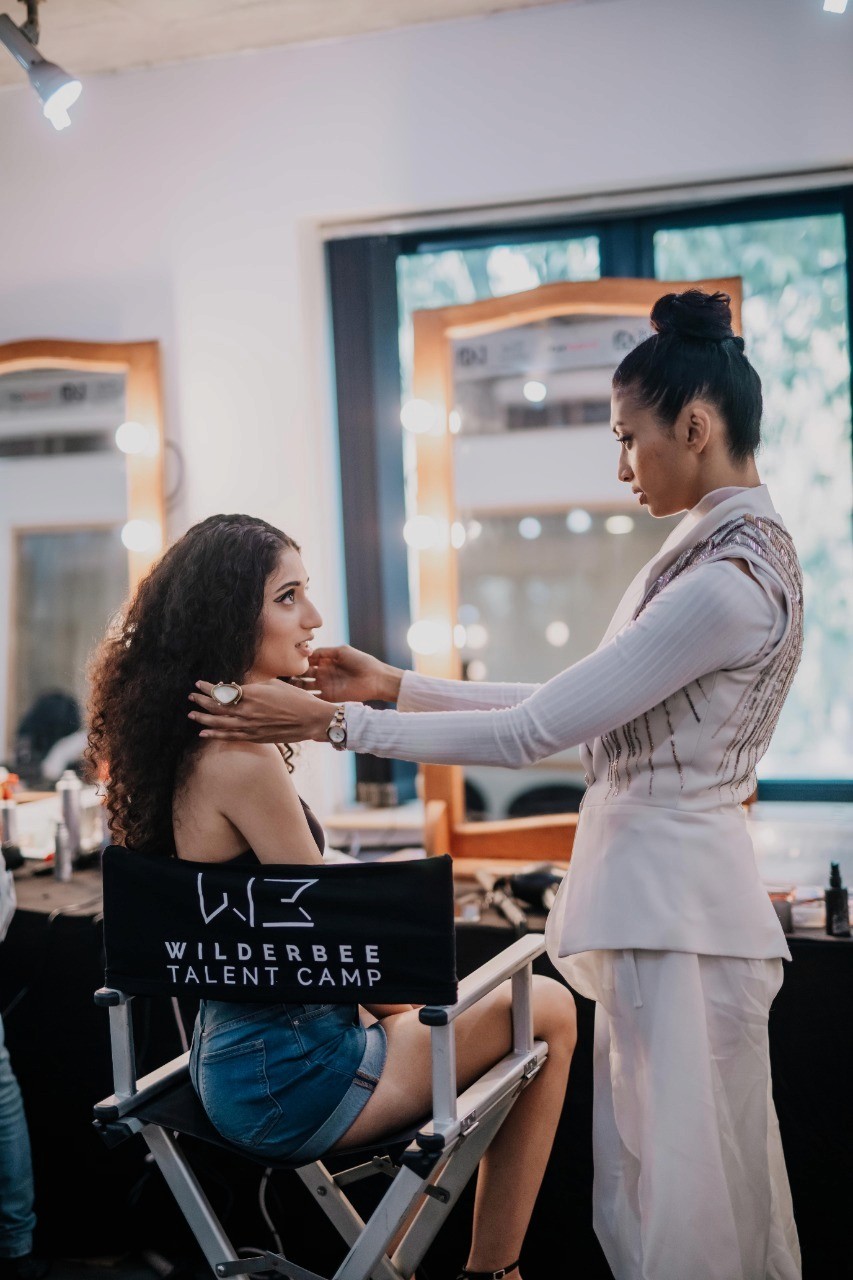
Photo courtesy : Snapsoul Studios
The curriculum is an answer to every gap she has meticulously identified and noted over two and a half decades. Ramp technique and posing, yes, but also invoicing, branding, communication, financial literacy, and safety. There is a WhatsApp community where anyone who has crossed paths with Wilderbee is welcome, and when a suspicious photographer approaches a student, the profile is shared and flagged, building a collaborative community she never had in her 25 years. "This kind of information we never had. We all learn through bad experiences."
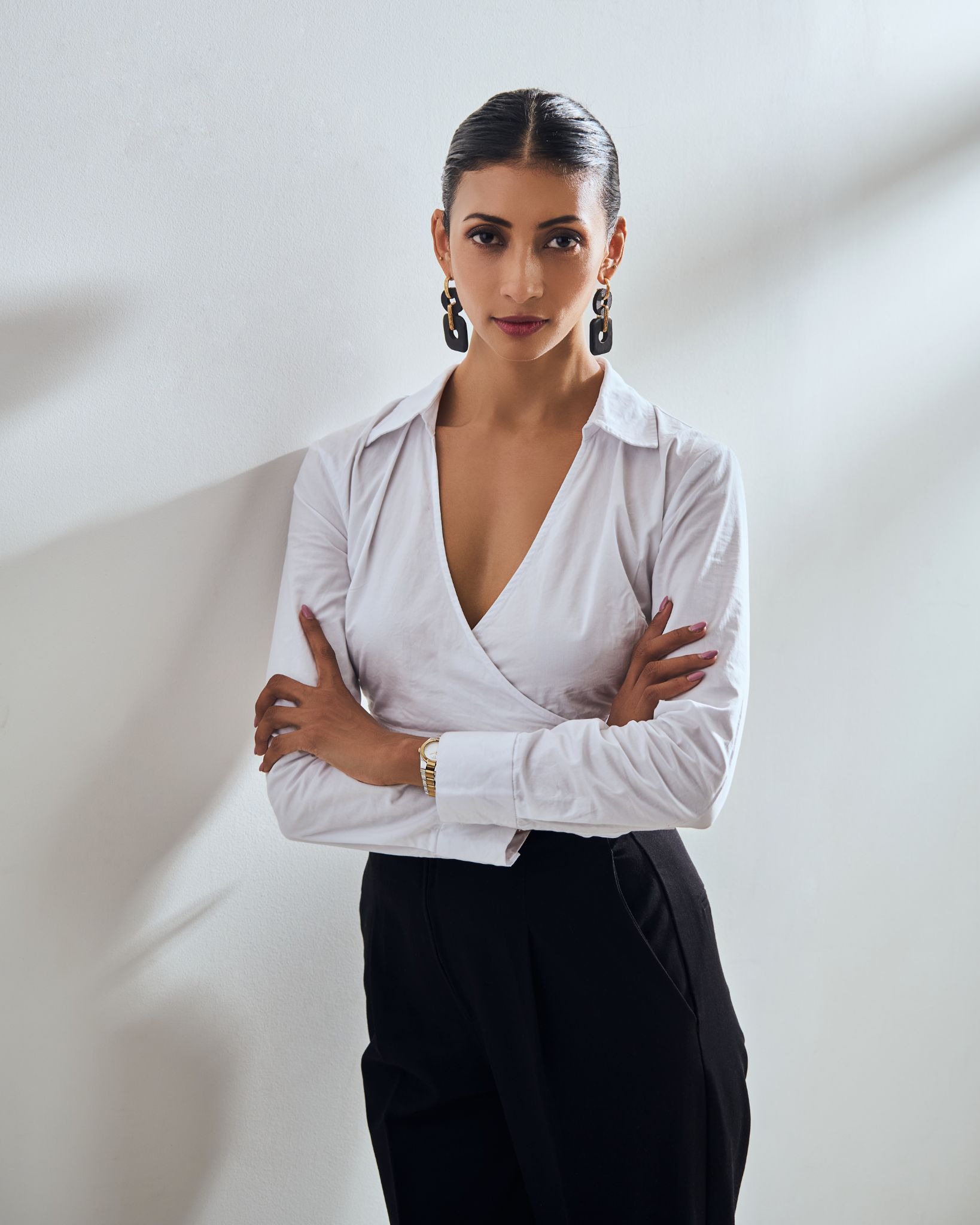
Nonita Kalra, who watched the industry's treatment of models from the vantage point of one of India's most significant fashion publications, frames Wilderbee's significance plainly: "It will be a place of inclusivity, intelligence and most of all integrity." Integrity, in the context of an industry that has routinely asked its talent to absorb exploitation silently, is not a small offering.
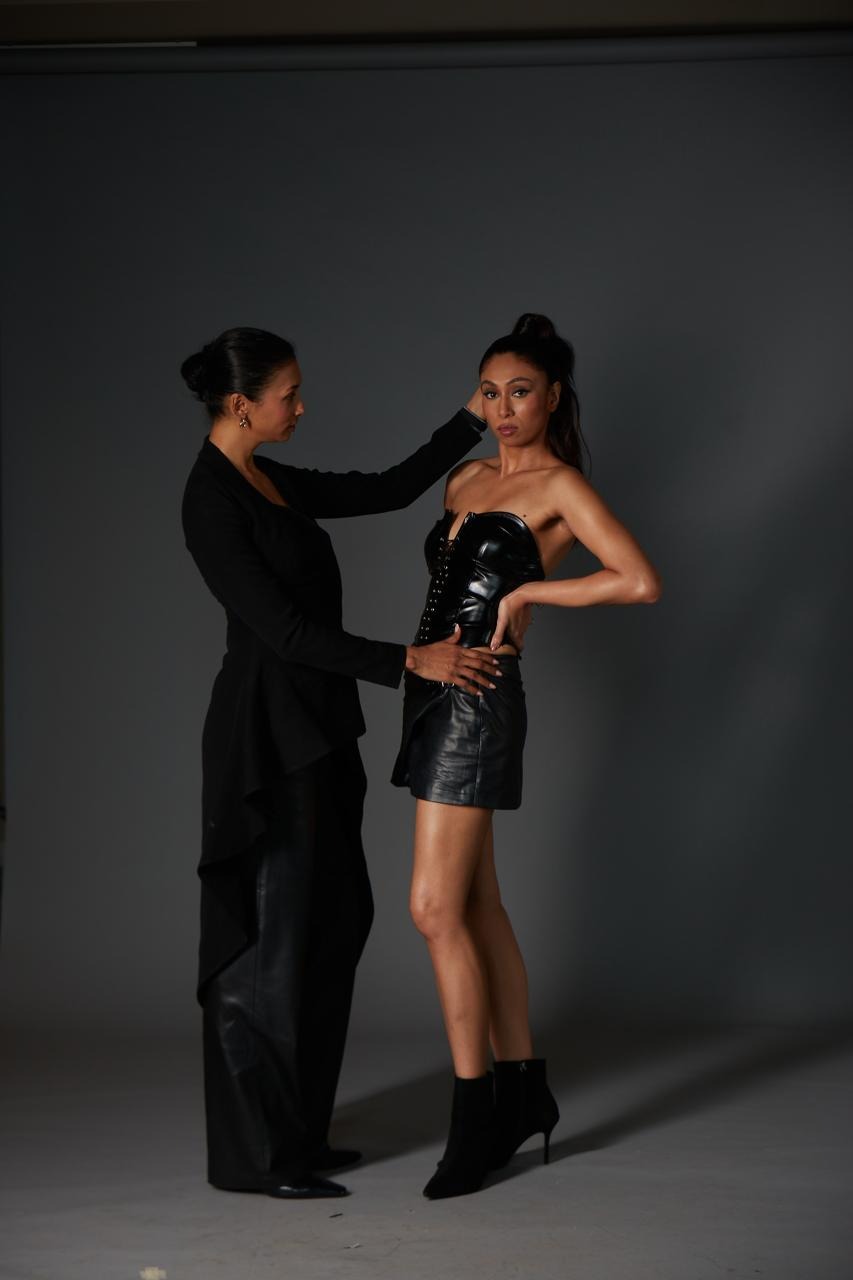
Lakshmi Rana at Wilderbee Training Camp with a student. Photo courtesy : Mohit Bhatia
At a Lakme Fashion Week fitting, Sakshi Sindhwani, a plus-size influencer brought in as a representative of inclusive beauty, broke down in front of Lakshmi after designers attempted to put her in a size eight. Nobody had made clothes to her measurements. "I was furious. You cannot do inclusivity just for the sake of tokenism. Either don't do it, or if you are doing it, do it well." The incident defined something she had been watching for years: diversity as seasonal gesture, present in the press release and absent in the fitting room.
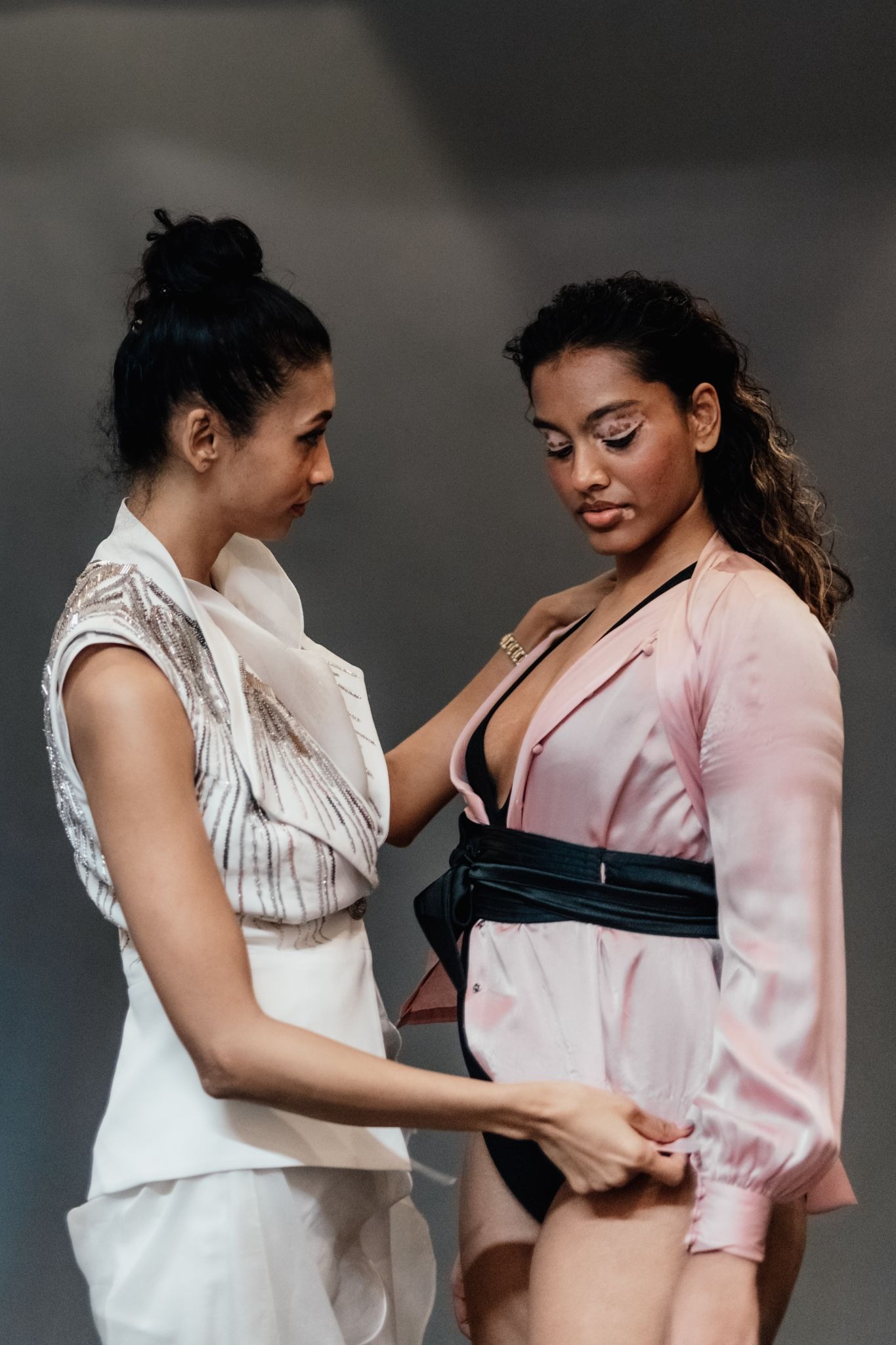
Photo courtesy : Snapsoul Studios
"My concept of starting Wilderbee was not that I wanted to make only models. I wanted to make people comfortable in their own skin. I wanted to celebrate beauty in all its forms." The students who arrive are doctors, lawyers, accountants, people in their sixties, people moving through depression, people who want to stand in front of a camera and feel like they belong there. Parents have come to her door asking her to talk to daughters who struggled with eating disorders. Fashion, she has recognised since long before it was fashionable to say so, does not just sell clothes. It declares to the world what beauty is permitted to look like, and for much of Indian fashion's recent history, that permission has been narrow in ways that had little to do with Indian beauty and a great deal to do with inherited standards that were never ours to begin with. A post-colonial mindset that refuses to fade even after 78 years of independence.
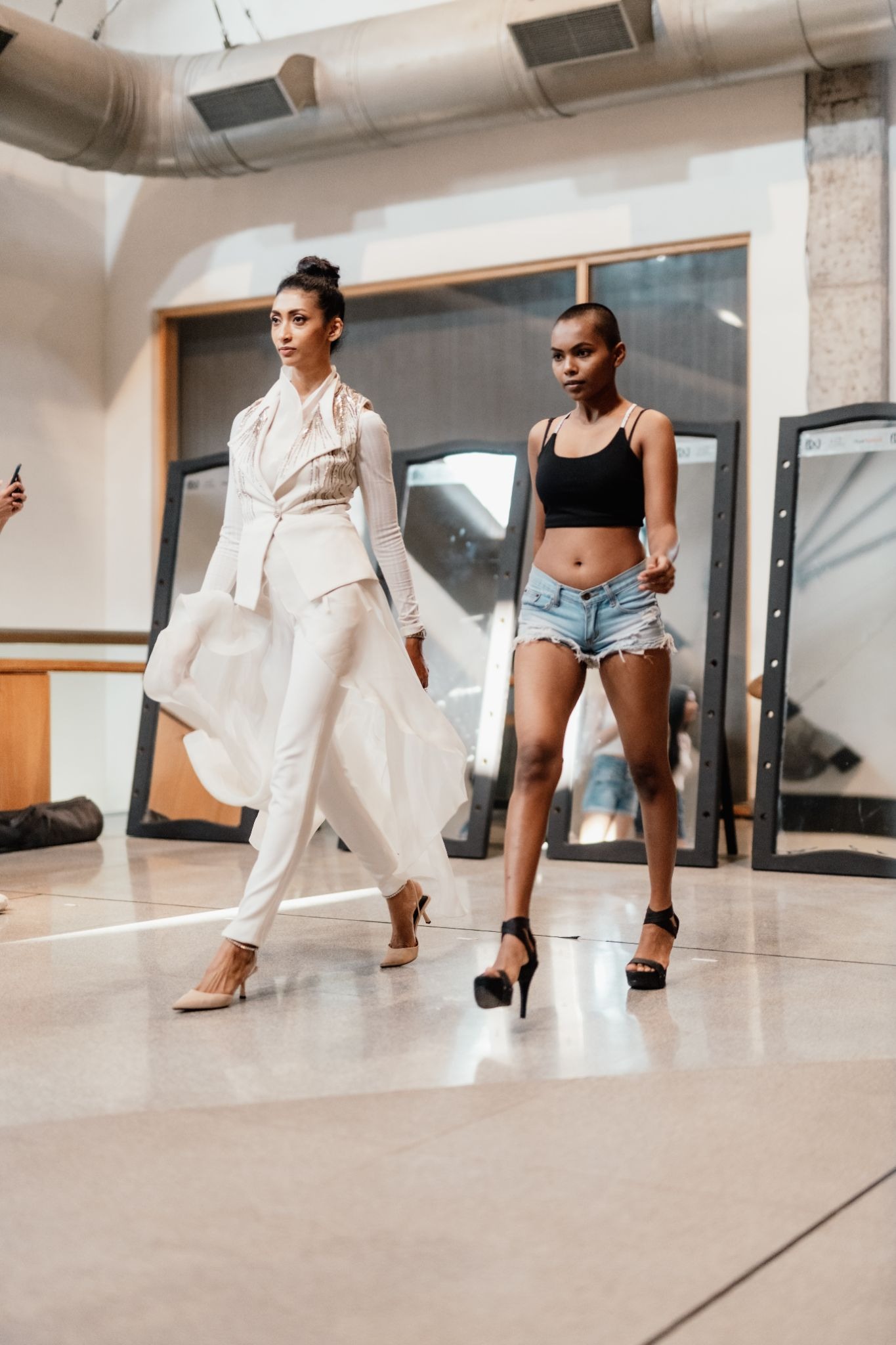
Photo courtesy : Snapsoul Studios
Supermodel Archana Akil Kumar, who came up in the same industry, speaks to what that kind of mentorship means from the inside: "She has been a great inspiration to me as a person and has mentored and helped me in my earlier days when I joined the industry with all the patience and warmth as a human being."
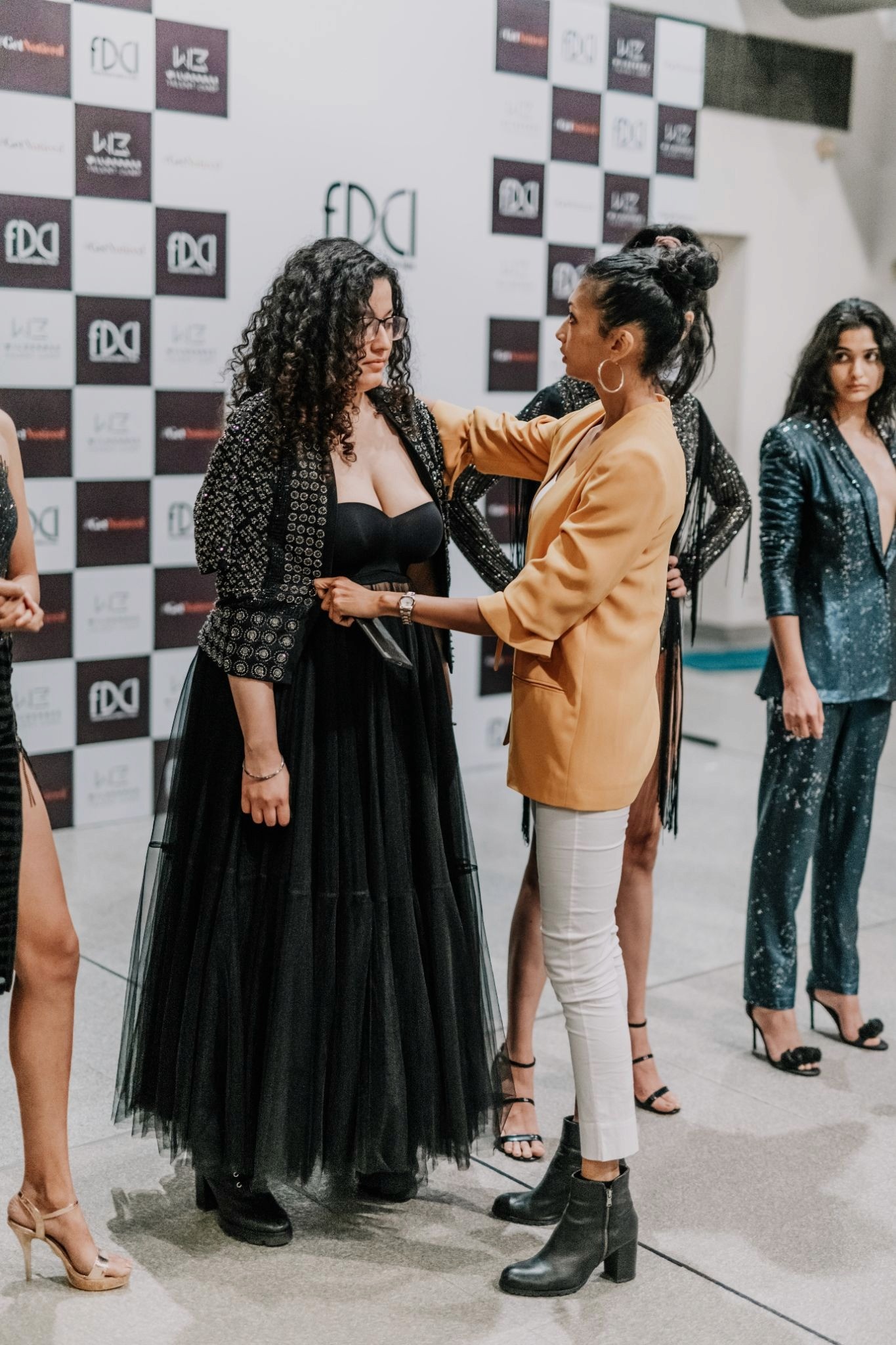
Photo courtesy : Snapsoul Studios
Her ambition for show direction arrived through the same intellectual restlessness that had her, during long backstage waits, asking light designers how they built a cue and production managers how they sequenced a show. The first major show she directed was for DLF Emporio, for Suneet Varma and Ravi Bajaj. FDCI and Lakme followed. The Gaurav Gupta show in Hyderabad was most recent. "Right now I am still working as a model. I have a unique understanding of a model's mind, I’m in tune with what happens backstage, and I can put myself in their shoes and motivate them to do their best on the ramp accordingly."
The Infrastructure of Legacy
Indian fashion is at a generational inflection point. The world is studying its textiles, its craft vocabulary is being borrowed by houses that charge ten times what the original karigar earns, and its design talent is finally breaking through on international stages. This is the moment the industry has been building toward. And Lakshmi Rana, who has watched it from the inside for twenty-five years, is expanding her work precisely because she understands that the moment only means something if the infrastructure beneath it is sound.
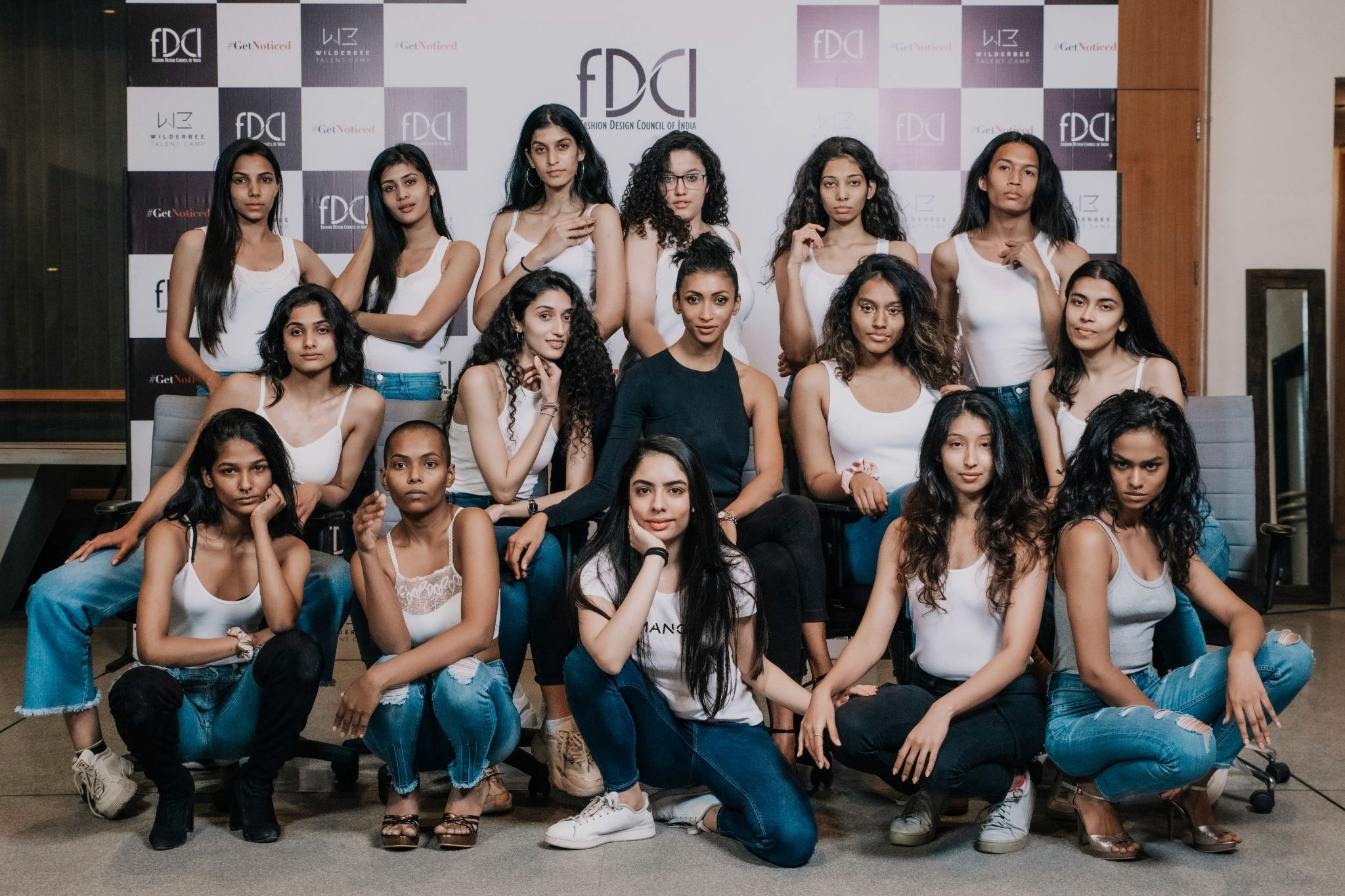
Photo courtesy : Snapsoul Studios
Wilderbee, which began as a modelling education platform, is growing into something with a wider mandate. Confidence building. Mental health advocacy. Image transformation. Personality development. "It is not only going to be for people who are interested in modelling. I want to be somebody who can bring about a change in how a person feels about themselves." This expansion follows directly from what she observed across two and a half decades of watching the industry's relationship with the people inside it: that the damage the fashion world does to how people see themselves is not a modelling industry problem. It is a cultural problem that the fashion industry accelerates, with beauty standards changing quicker than trend cycles.
The next chapter, for both Lakshmi and for Indian fashion at large, depends on whether the industry is ready to embrace the talent rather than the headline. The future of Indian fashion cannot be built on the fragility of a headline; it must be anchored in the strength of our collective talent. We are standing at a global precipice where our craft is finally being recognised as extraordinary, but for this moment to become a legacy, the runway must be treated with the unwavering seriousness it deserves. It is our most potent argument on the world stage.
To achieve this, we need a unified council of change, a synergy between visionary editors, influential governing bodies, show directors, and seasoned designers. Our goal must be a massive, structural shift: one that moves beyond the spectacle to build a safe, growth-oriented ecosystem for the entire force behind the curtain. We must uplift our models, our production units, our backstage crews, and our hair and makeup artists, ensuring they have a platform that doesn’t just help them survive rising costs and inflation, but allows them to thrive with dignity.
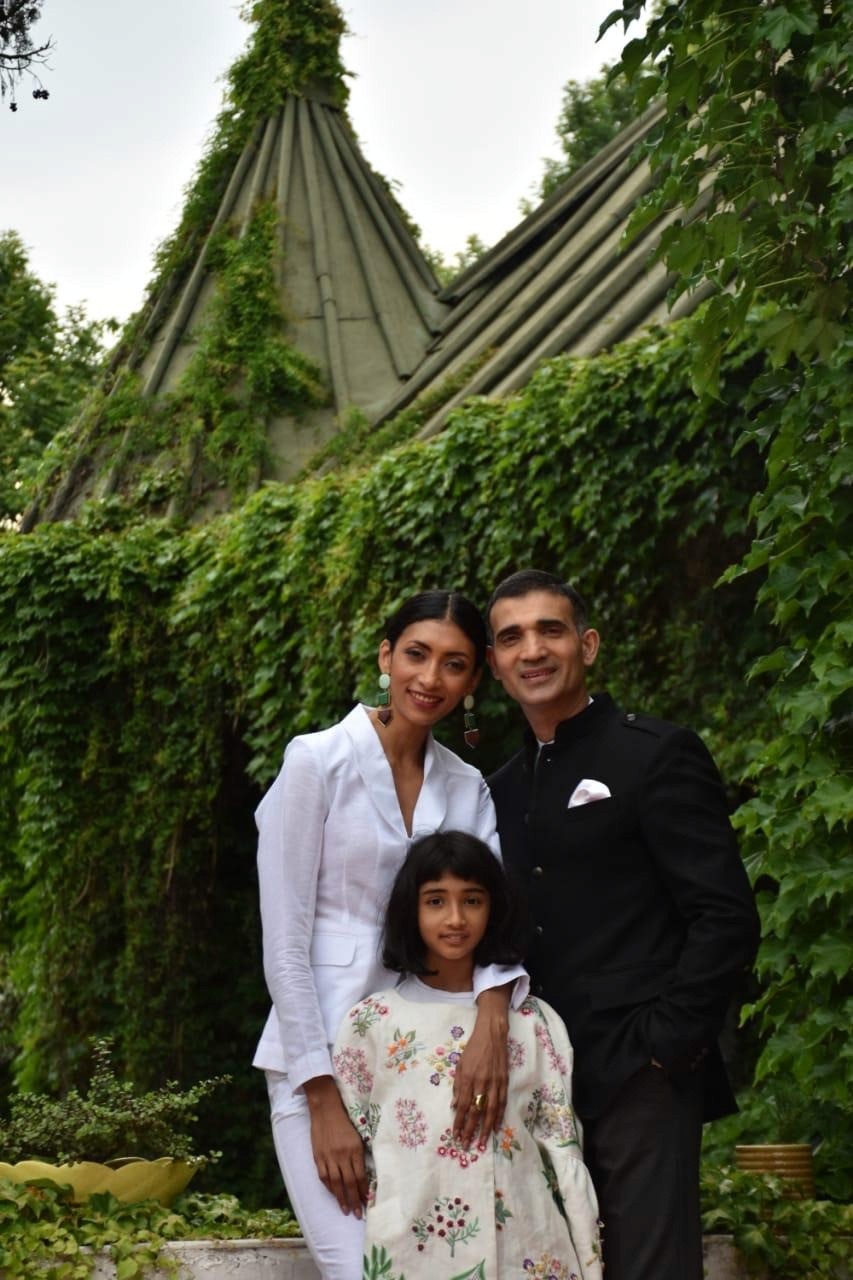
Lakshmi Rana with her husband and daughter
Tarun Tahiliani, who has known Lakshmi's work across the full arc of her career, puts the stakes of that work clearly: "For newcomers who hope to make a mark in this industry, I cannot think of a better tutor, mentor or exacting teacher than Lakshmi Rana." Gaurav Gupta, whose creations she has carried on her back for years, is more expansive: "Anyone would be fortunate to learn from this real life goddess, one just has to make the effort."
That sentence belongs to a woman who chose a runway over a cockpit, fought for everything she was owed, whether it was measured in rupees or respect, saved half of everything she earned, built an institution from personal observations, and is still, twenty-five years in, asking the industry to be what she always believed it could be. The ground beneath Indian fashion has never been more fertile. What gets built on it now is what demands our immediate attention.
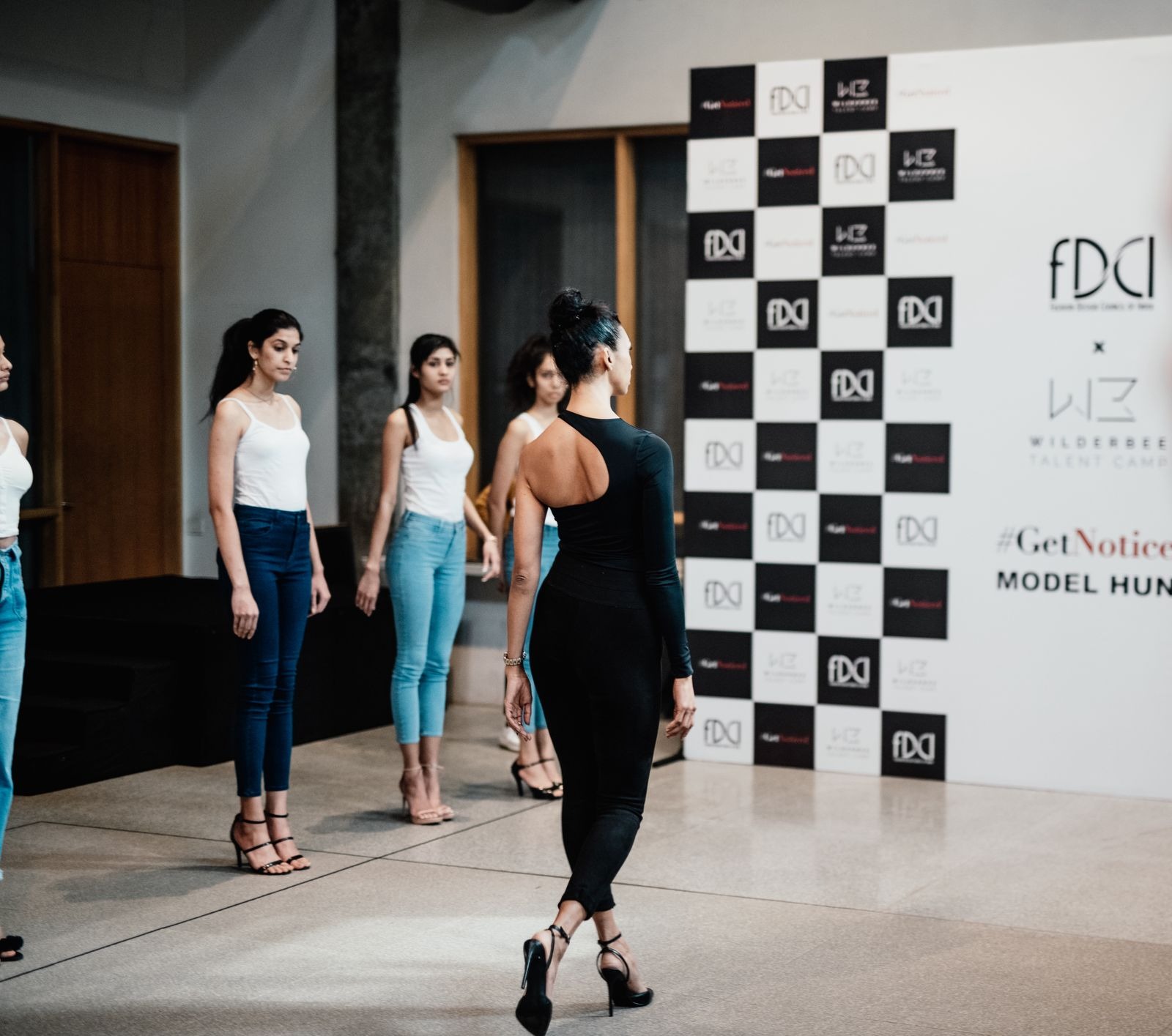
Photo courtesy : Snapsoul Studios
TO BE CONTINUED, FOR SUBSCRIBERS ONLY.
This is where the surface ends and the reporting begins.
The complete piece, the full archive, and access to The French Press Circle. Reporting answerable only to its readers.
Already a subscriber ?
Login
Read these on the house, with our compliments.
A selection from the current issue, open to all readers. Read them in full. The rest is one decision away.





India gets outraged every few months. A Western luxury house drops a collection, somewhere in the embroidery or the silhouette or the motif you can see Rajasthan, you can see Banaras, you can see six centuries of textile knowledge that no design school in Milan taught anyone. The internet mobilises. Our heritage. Our karigars. Our craft, repackaged and resold at a markup that will never find its way back to the hands that inspired it.
The outrage is legitimate, and the conversation is necessary.
Then our own fashion weeks come around, and a Bollywood celebrity who rehearsed her walk twice, 2 hours before the show, closes a collection that took generationally trained karigars six months to hand-embroider, and every headline the next morning is about what the starlet wore, who she arrived with, and what this means for her upcoming film. The craftsman's name appears nowhere.
If India cannot find space for its own craft on its own biggest stages, what exactly is it asking the world to respect?
Lakshmi Rana shot by Raju Raman
This is the conversation Indian fashion has been reluctant to have with itself, and it is the conversation Lakshmi Rana has been spearheading for twenty-five years. As one of India's foremost supermodels, the founder of Wilderbee Talent Camp, a show director, and an agency owner, she has occupied every room the industry offers. She has been on the ramp when international buyers filled the front rows and she has watched those same buyers and editors get swapped for Instagram influencers over two decades. She carries the fluency of someone who loves an industry devotedly enough to want more from it.
A backstage photo from a Rohit Bal show. Photo courtesy : Nishant Gautam
The Making of a Supermodel
Lakshmi Rana's origin story is far from the usual embellishments. She was a head girl from Dehradun, an army kid, a PCM student with IIT ambitions and fighter plane posters on her bedroom wall, where most teenagers kept film stars. "It's the profession that chooses you finally," she says, "no matter what you do." Her Masi pushed her into a Navy queen contest. Instead of starting with a shoot or campaign, she started her career from the top. Her mother said try for Miss India, and if nothing comes of it, come home and study. A reasonable ask for the then 19-year-old Lakshmi. She entered with a contingency plan and walked out with a direct audition for the first Lakme Fashion Week the country had ever staged.
Lakshmi Rana at one of the initial Lakme Fashion Weeks, shot by Gulshan Sachdeva
This was the turn of the millennium, and Indian fashion weeks were operating at a pitch of seriousness that is unheard of for most today. International buyers in the front rows. Editors from Elle, Femina and Cosmopolitan, and later Vogue and Harper’s Bazaar. The ramp was a business proposition as much as a spectacle, and the models who worked it understood that. Sheetal Malhar, Jesse Randhawa, Madhu Sapre, Viveka Babaji, Diandra Soares. "Insanely beautiful, stunning women," Lakshmi says. "All of them had personalities of their own. They spoke well, they dressed well, they conducted themselves well. They were all freelancers, there were no agencies. They knew how to brand themselves, how to demand respect." She studied them with the focus of someone who understood that the industry had no formal education to offer, so the education would have to come from observation.
Her ramp presence required no instruction. It was simply hers. Designers noticed it early. "Lakshmi Rana is the finest supermodel in the country," says Nonita Kalra, former editor of Harper's Bazaar India. "From the way she carries the most impossible, exaggerated couture to her signature, feline walk, she is an absolute dream to watch on the ramp." Gaurav Gupta's experience of that presence was even more specific: "She epitomises the power of making an image immortal, with seamless humility." He would eventually name pieces after her, not as a gesture but as a professional acknowledgement that the garment and the woman had become inseparable in the industry's imagination.
Lakshmi Rana at the Gaurav Gupta Couture show at FDCI India Couture Week 2019, Undercurrent Collection
"My discipline was the difference. Every look, whether it opened the show or closed it, whether it was the designer's centrepiece or a transition piece, received the same complete investment of presence and intention. That consistency is what made designers name pieces after me. When you treat every garment as the most important thing in the room, you stop being the person wearing the clothes and start being the reason people remember them."
The industry's social architecture, however, had its own initiation. Raised with the discipline of an army household, Lakshmi Rana entered the fashion world with an innate sense of professional equity that left no room for the industry’s most tired cliché: the masquerading of exploitation as "opportunity."
Even as a newcomer, she possessed a clarity of self-worth and self dignity that many spend decades searching for. “I was raised like that. I would hold my ground, even before the most formidable names in Indian couture," she reflects. "The narrative was always that I was the novice being granted a 'break.' My response was simple: this is a professional exchange. I provide a specialised service, and that service commands its value. Because of this I did go through various challenges for the first two years but looking back I’m glad I did it because I set my own rules on how I wished to be treated in this industry. “
It’s during those volatile formative years, a vastly different future beckoned, one of immense prestige and national service. Lakshmi had cleared the rigorous Pilot Aptitude Battery Test and the SSB, ultimately receiving a formal call letter to join the Indian Air Force at Secunderabad for the Flying Pilot course. It was a remarkably respectable and coveted path, offering the kind of storied career most only dream of.
“I still have that call letter” she says with a smile, "it was an agonisingly tough decision to choose between the cockpit and the runway ; it wasn't just a career choice, but a weighing of two entirely different lives”. Her mother, who lost her husband when Lakshmi was just seventeen, viewed the unpredictable world of modelling with deep apprehension. When Lakshmi chose the uncertainty of the ramp over the decorated stability of the Air Force, her mother did not speak to her for three months.
"I’m grateful for my own stubbornness," Lakshmi says now, looking back with the perspective of a quarter-century. “The universe guides you. I chose the path less taken, and in return, it gave me a life of my own making."
Lakshmi Rana in a custom Sabyasachi saree for her wedding
Perhaps the most defining pillar of Lakshmi’s longevity wasn’t found on a mood board, but in a pragmatic lesson on self-preservation. “My husband who I consider as my biggest pillar of support was then a trusted friend, he is the one who instilled in me a radical financial blueprint” : save fifty percent of every paycheque and invest with clinical precision. It proved to be the most consequential counsel of her career.
"It changed the power dynamic of my life," she notes. "Because of that foundation, after five to six years of saving, there was never a moment where I had to accept a job out of desperation. I never worked because I needed the money."
Twenty-five years of that unwavering fiscal discipline have yielded more than just a portfolio of properties and strategic investments; they have granted her the rarest luxury in fashion : true professional sovereignty. In an industry obsessed with "shelf life," Lakshmi has bypassed the expiration date entirely, operating from a place of choice rather than necessity. Her perspective on this is as unsentimental as it is earned: "If you reach the quarter-century mark and have nothing tangible to show for your labour, you haven't just missed an opportunity, rather, you’ve failed your future self."
Lakshmi Rana with Sabyasachi Mukherji
The Showstopper Economy
The global fashion industry generated roughly 1.8 trillion dollars in 2023 (McKinsey & Company, State of Fashion 2024), India's fashion and textile sector, home to craft traditions that predate most Western fashion houses by centuries, is projected to reach 350 billion dollars by 2030 at a 10 percent CAGR, according to the India Brand Equity Foundation under the Ministry of Commerce, fuelled in no small part by a global appetite for exactly the kind of handwork, embroidery, and textile intelligence that Indian artisans have been producing for generations. Better late than never, the world is looking at India with admiration.
While the hunger remains for our rich and diverse crafts, the Indian fashion scene feebly attempts to satiate the world’s appetite with Bollywood finales instead.
The showstopper, for those unfamiliar with the institution, is a defining feature of Indian fashion weeks with almost no equivalent anywhere else in the world. A film celebrity, typically accompanied by considerable fanfare and social media pre-coverage, walks the final look of a designer's show. The designer stands at their shoulder. The room erupts. The photographs, predictably, get filed under the celebrity's name rather than the collection's.
Lakshmi Rana on the ramp of one of the foremost Lakme Fashion Weeks
Lakshmi watched this culture develop from the inside. "When the fashion weeks started in the country, we would see the best of the editors and the stylists and actual buyers sitting on the front row," she says. "We used to be nervous about the fact that the editor of Vogue and the editor of Harper's were sitting there. For us it was a really important thing that we do really well on the ramp." That nervousness had creative value. It oriented the entire production toward the clothes, toward the story the designer attempted to showcase, toward the buyers who would go on to carry Indian design into international retail. "That was the best era of Indian fashion weeks, is how I would remember it."
Lakshmi Rana for a Vogue editorial on the Olympics
The shift, when it came, followed a logic that is commercially coherent even if creatively costly. A Bollywood star with ten million followers generates the kind of coverage no collection can produce on its own, which is the bleak reality. Sponsors who fund fashion weeks want that visibility, and in India, visibility has historically had a very specific address. "Today it is because of the digital reach that a Bollywood star can get a brand or a designer. A-list, B-list, C-list. It doesn't matter." The result is that fashion weeks have drifted from being showcases for design into being showcases for celebrity, with the design serving as a backdrop.
"The story is lost. The concept is lost. By the end of it, what the people see, and remember, is that one showstopper in that one outfit."
She was at a press conference for a designer when Urmila Matondkar walked in. The journalists there for fashion spent the session asking about her upcoming film. The designer's collection, the entire reason everyone was in the room, became secondary. "The media is also responsible for this kind of Bollywood frenzy and showstopper attitude that we have." It is a feedback loop that sustains itself: celebrities drive coverage, coverage drives sponsors, sponsors demand celebrities.
Lakshmi Rana for Rohit Bal
The contrast with how Western fashion weeks handle the same dynamic is instructive, and maybe a model we could follow. At Dior, at Louis Vuitton, at Chanel, celebrity presence is enormous. Stars fill the front rows, wear the collections, even custom pieces, and generate millions of impressions. The association between fashion house and cultural icon is commercially deliberate and visually everywhere. ‘Friends of the Maison’ exist all over, but the ramp remains sacred ground for the best of luxury globally. Trained models carry the collection. The show is about the design, the craftsmanship, the months, sometimes even years of blood, sweat and patterns. "The models have done the job for the designer," Lakshmi says. "It has to be kept separate, because they do not want to lose the essence of what their industry stands for." The celebrity is the amplifier. The craft is the signal. Indian fashion, increasingly, and unfortunately, has been inverting that relationship.
Lakshmi Rana for one of Rohit Bal’s most iconic looks
This is where the cultural appropriation conversation, and the showstopper conversation, converge. When India gets incensed at a Western brand for lifting a Banarasi pattern or referencing a regional craft tradition without credit, the anger is valid. Attribution matters. The economics of cultural borrowing matter. But the more pressing question is what Indian fashion is doing, on its own biggest stages, to establish its craft as the primary focus. A fashion week where the most-covered moment is a celebrity's closing walk is making an argument about what Indian fashion values, and that argument has consequences for how the world perceives it.
Lakshmi Rana for JJ Valaya, Photo courtesy : JJ Valaya
Lakshmi is careful not to frame her standards as a blanket condemnation of the industry. Instead, she speaks with the nuance of someone who recognises true craftsmanship when she sees it. She acknowledges that the intersection of fashion and celebrity, while often fraught, can be navigated with finesse.
She points to those rare, elevated moments where the presence of a public figure feels integrated rather than staged, where designers treat high-profile appearances as a seamless extension of the creative vision, rather than a mere headline-grabbing tactic. For Lakshmi, there is a profound respect for the creators who understand that the relationship between cinema and the runway can, and should, be handled with subtle sophistication rather than spectacle.
A model walks in a tulle gown and net mask to display "the show stops here" message for the no-showstopper finale as part of Tarun Tahiliani's 2019 ICW collection 'Bloom'.
Tarun Tahiliani, who has been among the most vocal Indian designers about this dynamic, puts it plainly. He once dressed a new model in a white muslin outfit with "Showstopper" printed across the chest and sent her out last at a show at Bikaner House, making the case visually. "I don't need a Bollywood star or a showstopper to help me reach where I want to reach," he has said publicly, and his brand's international standing reflects the confidence of that position. Of Lakshmi specifically, he says: "She will help them define their roadmap to success, going far beyond what to do on the ramp and how to look at the camera." The implication being that the ramp, when treated seriously, is itself a form of communication that requires as much intellect as any other.
A Booming Industry and a Frozen Cheque
The financial reality of Indian modelling is a conversation that happens extensively behind closed doors and almost never in public. Lakshmi Rana, who is the founder of a modelling agency in addition to her training camp, has decided that closed doors are no longer useful, and must be opened to pave the way for a sustainable Indian modelling industry.
When she walked her first fashion week, she earned approximately seven thousand rupees per show, doing eighteen to twenty shows across the week. A car down payment was possible by the end of it. Today, a newcomer walking three to four shows in a single day earns somewhere between six and eight thousand rupees for the entire day. In the same period, India has become one of the fastest-growing luxury markets in the world. The fashion and textile industry is on a trajectory toward being one of its largest economic contributors. The wages paid to the people whose bodies literally carry the clothes have remained effectively flat, even declining. "I don't mind being quoted on this," she maintains. "There has been no great improvement in those terms."
Photo courtesy : Snapsoul Studios
No union. No standardised rates. No overtime regulation. No formal protection against exploitation in casting rooms or on set. "Abroad, after eight hours, you are supposed to pay a model overtime. There is nothing like that here.", Lakshmi comments. Models start young, often at sixteen or seventeen, entering an industry with no formal framework to orient them, no community to warn them about which situations are unsafe, no institutional systems ensuring they get what they are owed.
This is the other side of the showstopper culture's economic story. While fangirls flock to see Khushi Kapoor in a sequinned lehenga that could frankly blind you, we must not be blinded to the ground reality. The budgets allocated to a single celebrity appearance, the negotiation, the entourage, the social media activation, are budgets that exist within a finite production economy. An industry that has normalised significant investment in celebrity closure has, in the same motion, normalised minimal investment in the models who carry every other look in the show, animating the garments made with precision and technique inherited from generations of practice.
Lakshmi Rana with Rohit Bal in his final days. Photo courtesy : Saurabh Dua
The models garnering major international recognition in the last decade, Bhumika Arora in Paris, Pooja Mor at Louis Vuitton, Radhika Nair at Balenciaga, arrived there through international scouting rather than through domestic development. "Bhumika never got work in India. I remember her coming for auditions and she never made it. It is only when she got scouted abroad that she became big." International fashion houses recognised what the Indian fashion industry had sitting in front of it and had not seen. Gaurav Gupta's international breakthrough was built, as Lakshmi describes it, through singular personal effort: "There are so many designers that I know that I've walked for, supremely talented, but they did not get an opportunity to be showcased or to get that push that our fashion industry could have given them." The infrastructure that should have been identifying and building this talent was, in many cases, occupied with other priorities.
Lakshmi Rana backstage at Gaurav Gupta’s 2024 presentation at India Couture Week
On this, Lakshmi insists, "Indian fashion has a complicated relationship with its own reflection. The models who leave for Paris and return with a Louis Vuitton credit get the covers, the campaigns, the industry's sudden and enthusiastic recognition. Their achievements are genuinely hard-earned and worth celebrating. But the uncomfortable truth sitting beneath that celebration is this: the same industry that applauds them for being validated abroad spent years not validating them at home. And for every model who made it to a Balenciaga casting, there are extraordinary women who made a different choice, to build careers here, to raise families, to seek stability on their own terms, and who are measured against an imported yardstick that was never designed to account for them. When we treat international recognition as the only legitimate form of it, we are not just undervaluing our models. We are declaring our own market a waiting room."
"Why have we failed to institutionalise the Indian supermodel? Why does our talent reach global heights only as outliers, as opposed to a product of a thriving domestic machinery?" This is no longer a rhetorical inquiry; it is a structural critique. For decades, the Indian industry has allowed the 'supermodel', a brand in her own right, to be eclipsed by the gravitational pull of Bollywood, treating models as fleeting vessels for clothes rather than icons of influence.
The responsibility lies in a collective lack of vision: designers who seek mannequins instead of muses, and a media landscape that prioritises cinema over the artistry of the gait. To correct this, the industry must pivot toward intentional brand-building. We must celebrate our homegrown talent with the same fervour we reserve for our crafts. It is time to treat the model not as a secondary character, but as the protagonist of the fashion narrative, the ultimate bridge between Indian heritage and global aspiration.
Notes from the Backstage
For years, in the long waits between hair, makeup, fittings, and curtain calls that make up most of a model's working life, Lakshmi was writing things down. What she wished she had known when she started. What someone should have told her about invoicing, about responding to job inquiries, about which photographers were trustworthy and which were not, about the fact that modelling was a business with learnable rules. "I would write in my journal: I wish I could change this. I wish I could change that." She walked into an industry with no formal structure at the time, and used her dedicated and disciplined character to learn, adapt and register each and every nuance. "My biggest worry was when I would see all the newcomers come in. I would see that they were conducting themselves wrong. They had no information about the industry. They were misguided when it came to what this industry can do for you."
Lakshmi Rana, FDCI President Sunil Sethi and Wilderbee models pictured here. Photo courtesy : Snapsoul Studios
The COVID lockdown gave her the time to turn those notes into a reality she had often dreamt for the future of Indian modelling. Wilderbee Talent Camp formed during the first lockdown, curriculum written from scratch, launched online before the world reopened, and formalised with FDCI for offline courses once it did. The institution she had been imagining for years began to take shape.
Photo courtesy : Snapsoul Studios
The curriculum is an answer to every gap she has meticulously identified and noted over two and a half decades. Ramp technique and posing, yes, but also invoicing, branding, communication, financial literacy, and safety. There is a WhatsApp community where anyone who has crossed paths with Wilderbee is welcome, and when a suspicious photographer approaches a student, the profile is shared and flagged, building a collaborative community she never had in her 25 years. "This kind of information we never had. We all learn through bad experiences."
Nonita Kalra, who watched the industry's treatment of models from the vantage point of one of India's most significant fashion publications, frames Wilderbee's significance plainly: "It will be a place of inclusivity, intelligence and most of all integrity." Integrity, in the context of an industry that has routinely asked its talent to absorb exploitation silently, is not a small offering.
Lakshmi Rana at Wilderbee Training Camp with a student. Photo courtesy : Mohit Bhatia
At a Lakme Fashion Week fitting, Sakshi Sindhwani, a plus-size influencer brought in as a representative of inclusive beauty, broke down in front of Lakshmi after designers attempted to put her in a size eight. Nobody had made clothes to her measurements. "I was furious. You cannot do inclusivity just for the sake of tokenism. Either don't do it, or if you are doing it, do it well." The incident defined something she had been watching for years: diversity as seasonal gesture, present in the press release and absent in the fitting room.
Photo courtesy : Snapsoul Studios
"My concept of starting Wilderbee was not that I wanted to make only models. I wanted to make people comfortable in their own skin. I wanted to celebrate beauty in all its forms." The students who arrive are doctors, lawyers, accountants, people in their sixties, people moving through depression, people who want to stand in front of a camera and feel like they belong there. Parents have come to her door asking her to talk to daughters who struggled with eating disorders. Fashion, she has recognised since long before it was fashionable to say so, does not just sell clothes. It declares to the world what beauty is permitted to look like, and for much of Indian fashion's recent history, that permission has been narrow in ways that had little to do with Indian beauty and a great deal to do with inherited standards that were never ours to begin with. A post-colonial mindset that refuses to fade even after 78 years of independence.
Photo courtesy : Snapsoul Studios
Supermodel Archana Akil Kumar, who came up in the same industry, speaks to what that kind of mentorship means from the inside: "She has been a great inspiration to me as a person and has mentored and helped me in my earlier days when I joined the industry with all the patience and warmth as a human being."
Photo courtesy : Snapsoul Studios
Her ambition for show direction arrived through the same intellectual restlessness that had her, during long backstage waits, asking light designers how they built a cue and production managers how they sequenced a show. The first major show she directed was for DLF Emporio, for Suneet Varma and Ravi Bajaj. FDCI and Lakme followed. The Gaurav Gupta show in Hyderabad was most recent. "Right now I am still working as a model. I have a unique understanding of a model's mind, I’m in tune with what happens backstage, and I can put myself in their shoes and motivate them to do their best on the ramp accordingly."
The Infrastructure of Legacy
Indian fashion is at a generational inflection point. The world is studying its textiles, its craft vocabulary is being borrowed by houses that charge ten times what the original karigar earns, and its design talent is finally breaking through on international stages. This is the moment the industry has been building toward. And Lakshmi Rana, who has watched it from the inside for twenty-five years, is expanding her work precisely because she understands that the moment only means something if the infrastructure beneath it is sound.
Photo courtesy : Snapsoul Studios
Wilderbee, which began as a modelling education platform, is growing into something with a wider mandate. Confidence building. Mental health advocacy. Image transformation. Personality development. "It is not only going to be for people who are interested in modelling. I want to be somebody who can bring about a change in how a person feels about themselves." This expansion follows directly from what she observed across two and a half decades of watching the industry's relationship with the people inside it: that the damage the fashion world does to how people see themselves is not a modelling industry problem. It is a cultural problem that the fashion industry accelerates, with beauty standards changing quicker than trend cycles.
The next chapter, for both Lakshmi and for Indian fashion at large, depends on whether the industry is ready to embrace the talent rather than the headline. The future of Indian fashion cannot be built on the fragility of a headline; it must be anchored in the strength of our collective talent. We are standing at a global precipice where our craft is finally being recognised as extraordinary, but for this moment to become a legacy, the runway must be treated with the unwavering seriousness it deserves. It is our most potent argument on the world stage.
To achieve this, we need a unified council of change, a synergy between visionary editors, influential governing bodies, show directors, and seasoned designers. Our goal must be a massive, structural shift: one that moves beyond the spectacle to build a safe, growth-oriented ecosystem for the entire force behind the curtain. We must uplift our models, our production units, our backstage crews, and our hair and makeup artists, ensuring they have a platform that doesn’t just help them survive rising costs and inflation, but allows them to thrive with dignity.
Lakshmi Rana with her husband and daughter
Tarun Tahiliani, who has known Lakshmi's work across the full arc of her career, puts the stakes of that work clearly: "For newcomers who hope to make a mark in this industry, I cannot think of a better tutor, mentor or exacting teacher than Lakshmi Rana." Gaurav Gupta, whose creations she has carried on her back for years, is more expansive: "Anyone would be fortunate to learn from this real life goddess, one just has to make the effort."
That sentence belongs to a woman who chose a runway over a cockpit, fought for everything she was owed, whether it was measured in rupees or respect, saved half of everything she earned, built an institution from personal observations, and is still, twenty-five years in, asking the industry to be what she always believed it could be. The ground beneath Indian fashion has never been more fertile. What gets built on it now is what demands our immediate attention.
Photo courtesy : Snapsoul Studios
TO BE CONTINUED, FOR SUBSCRIBERS ONLY.
This is where the surface ends and the reporting begins.
The complete piece, the full archive, and access to The French Press Circle. Reporting answerable only to its readers.
Already a subscriber ?
Login
Read these on the house, with our compliments.
A selection from the current issue, open to all readers. Read them in full. The rest is one decision away.