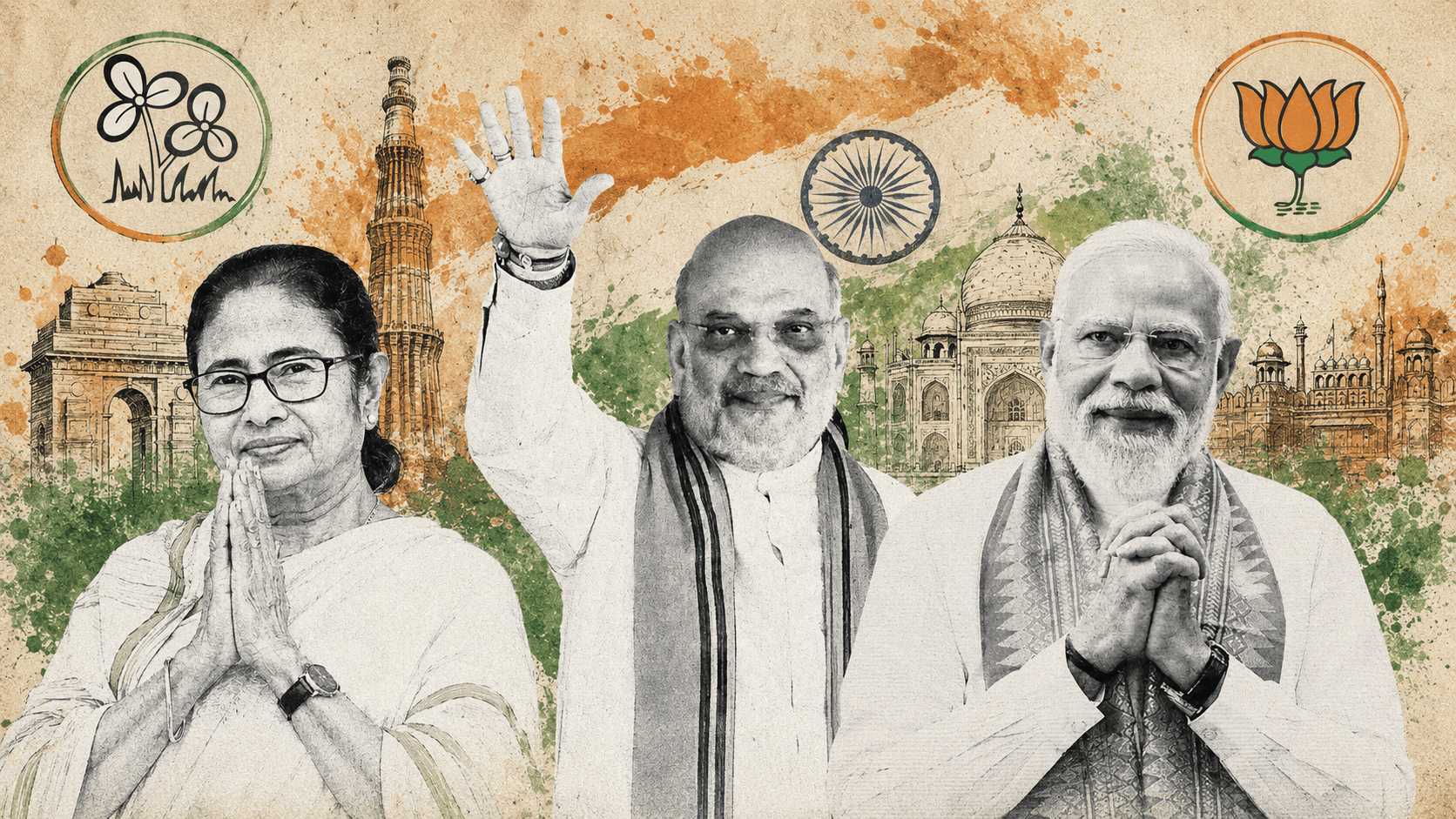
There is a map circulating on Indian news channels this week. It is almost entirely saffron. West Bengal, for the first time in the Bharatiya Janata Party’s 46-year history, has turned. Assam has returned BJP to power for a third consecutive term. The NDA and its allies now govern 20 states and 2 union territories, with their footprint touching 22 of India’s 36 states and territories. The map looks like consolidation. What it actually looks like is a warning.
This editorial is about what happens to any democracy when one party is allowed to run uncontested through the architecture of a nation. Read it as an institutional question, a structural one, entirely separate from the merits or failures of any single leader.
Let us be precise about what just occurred. West Bengal was not simply won. It was a state where, before a single vote was cast, over 9 million names were removed from electoral rolls in a Special Intensive Revision exercise. Political commentator Yogendra Yadav has noted that the deletion of 2.7 million votes alone amounts to 4.3 percent of votes cast in West Bengal, in an election where the BJP’s lead over the TMC was approximately 5 percent. The margin of victory and the margin of deletion are almost perfectly aligned. That is a question which a functioning opposition would be raising loudly in every chamber, on every platform, in every court. The INDIA bloc’s response has been fragmented, reactive, and too late.
Mamata Banerjee, who lost her own seat in Bhabanipur to Suvendu Adhikari, alleged the BJP took more than 100 seats by force and called the Election Commission “the BJP’s commission.” She has promised to bounce back. The question India needs to be asking is whether its democracy can wait for that bounce.
Banerjee had positioned herself as a key leader to unite regional parties against the BJP. Her defeat is likely to weaken her leverage within an opposition bloc already divided by regional power struggles. The TMC was one of the last standing regional pillars of anything resembling a coherent opposition strategy. With West Bengal gone, the map of resistance shrinks further. Kerala has returned to Congress. Tamil Nadu has produced a film star’s debut government. These are not the building blocks of a national counter-narrative. These are islands.
The structural crisis at the heart of Indian democracy right now is institutional, systemic, and entirely separate from whether you admire Modi’s governance record or loathe his politics. A functioning democracy requires a functioning opposition as a constitutional imperative, not as a courtesy. The opposition exists to interrogate power, to offer the electorate an alternative, to ensure that the machinery of the state does not fold entirely into the machinery of a single party. When that opposition is fragmented and too fractured by ego and regional calculation to speak with a common voice, the guardrails fall away.
The DMK and Banerjee’s TMC were the main pillars of the Congress-led INDIA alliance. That alliance jointly fought the 2024 general election and deprived Modi of an outright majority in parliament, forcing him to rely on coalition support. These state elections, however, are expected to significantly weaken opposition to Modi as he heads toward 2029. 
The 2024 result was the last time a coordinated opposition strategy produced a meaningful outcome. Since then, the alliance has unravelled at every seam.
The opposition destroyed itself. It entered every election cycle carrying personality in place of policy and protest in place of platform. Congress has failed to rebuild its grassroots apparatus in any meaningful way. Regional satraps have consistently prioritised their own state calculations over the larger democratic project. The INDIA alliance, when it mattered most, spent months in attrition over seat-sharing rather than strategy. And now, with West Bengal fallen and Assam deepened, the bill for that failure has come due.
Despite trying for decades, Modi’s BJP has been unable to make a significant dent in Kerala and Tamil Nadu. Yet even in those two states, the BJP’s vote percentage continues to rise. The south has held. For now. Holding, though, is distinct from pushing back, and incremental percentage gains accumulate into elections. The south’s resistance is cultural and linguistic, rooted in Dravidian identity politics that predate BJP as a force. It is durable. It is also finite, if an alternative national political imagination never takes shape.
What India requires is an opposition with the discipline to function as an institution rather than a coalition of grievances. One that builds cadre, articulates economic vision, speaks to young Indians on jobs and aspiration, and shows up in states it has written off. The BJP has spent twelve years doing the institutional work. The opposition has spent twelve years looking for the shortcut. There are no shortcuts left. There is only the map, almost entirely saffron, and the question of what comes next.
A democracy without a credible opposition is a democracy in name only, waiting for the name to change too.
French Press Global publishes editorial opinion at the intersection of power, culture, and consequence.
TO BE CONTINUED, FOR SUBSCRIBERS ONLY.
This is where the surface ends and the reporting begins.
The complete piece, the full archive, and access to The French Press Circle. Reporting answerable only to its readers.
Already a subscriber ?
Login
Read these on the house, with our compliments.
A selection from the current issue, open to all readers. Read them in full. The rest is one decision away.






There is a map circulating on Indian news channels this week. It is almost entirely saffron. West Bengal, for the first time in the Bharatiya Janata Party’s 46-year history, has turned. Assam has returned BJP to power for a third consecutive term. The NDA and its allies now govern 20 states and 2 union territories, with their footprint touching 22 of India’s 36 states and territories. The map looks like consolidation. What it actually looks like is a warning.
This editorial is about what happens to any democracy when one party is allowed to run uncontested through the architecture of a nation. Read it as an institutional question, a structural one, entirely separate from the merits or failures of any single leader.
Let us be precise about what just occurred. West Bengal was not simply won. It was a state where, before a single vote was cast, over 9 million names were removed from electoral rolls in a Special Intensive Revision exercise. Political commentator Yogendra Yadav has noted that the deletion of 2.7 million votes alone amounts to 4.3 percent of votes cast in West Bengal, in an election where the BJP’s lead over the TMC was approximately 5 percent. The margin of victory and the margin of deletion are almost perfectly aligned. That is a question which a functioning opposition would be raising loudly in every chamber, on every platform, in every court. The INDIA bloc’s response has been fragmented, reactive, and too late.
Mamata Banerjee, who lost her own seat in Bhabanipur to Suvendu Adhikari, alleged the BJP took more than 100 seats by force and called the Election Commission “the BJP’s commission.” She has promised to bounce back. The question India needs to be asking is whether its democracy can wait for that bounce.
Banerjee had positioned herself as a key leader to unite regional parties against the BJP. Her defeat is likely to weaken her leverage within an opposition bloc already divided by regional power struggles. The TMC was one of the last standing regional pillars of anything resembling a coherent opposition strategy. With West Bengal gone, the map of resistance shrinks further. Kerala has returned to Congress. Tamil Nadu has produced a film star’s debut government. These are not the building blocks of a national counter-narrative. These are islands.
The structural crisis at the heart of Indian democracy right now is institutional, systemic, and entirely separate from whether you admire Modi’s governance record or loathe his politics. A functioning democracy requires a functioning opposition as a constitutional imperative, not as a courtesy. The opposition exists to interrogate power, to offer the electorate an alternative, to ensure that the machinery of the state does not fold entirely into the machinery of a single party. When that opposition is fragmented and too fractured by ego and regional calculation to speak with a common voice, the guardrails fall away.
The DMK and Banerjee’s TMC were the main pillars of the Congress-led INDIA alliance. That alliance jointly fought the 2024 general election and deprived Modi of an outright majority in parliament, forcing him to rely on coalition support. These state elections, however, are expected to significantly weaken opposition to Modi as he heads toward 2029. 
The 2024 result was the last time a coordinated opposition strategy produced a meaningful outcome. Since then, the alliance has unravelled at every seam.
The opposition destroyed itself. It entered every election cycle carrying personality in place of policy and protest in place of platform. Congress has failed to rebuild its grassroots apparatus in any meaningful way. Regional satraps have consistently prioritised their own state calculations over the larger democratic project. The INDIA alliance, when it mattered most, spent months in attrition over seat-sharing rather than strategy. And now, with West Bengal fallen and Assam deepened, the bill for that failure has come due.
Despite trying for decades, Modi’s BJP has been unable to make a significant dent in Kerala and Tamil Nadu. Yet even in those two states, the BJP’s vote percentage continues to rise. The south has held. For now. Holding, though, is distinct from pushing back, and incremental percentage gains accumulate into elections. The south’s resistance is cultural and linguistic, rooted in Dravidian identity politics that predate BJP as a force. It is durable. It is also finite, if an alternative national political imagination never takes shape.
What India requires is an opposition with the discipline to function as an institution rather than a coalition of grievances. One that builds cadre, articulates economic vision, speaks to young Indians on jobs and aspiration, and shows up in states it has written off. The BJP has spent twelve years doing the institutional work. The opposition has spent twelve years looking for the shortcut. There are no shortcuts left. There is only the map, almost entirely saffron, and the question of what comes next.
A democracy without a credible opposition is a democracy in name only, waiting for the name to change too.
French Press Global publishes editorial opinion at the intersection of power, culture, and consequence.
TO BE CONTINUED, FOR SUBSCRIBERS ONLY.
This is where the surface ends and the reporting begins.
The complete piece, the full archive, and access to The French Press Circle. Reporting answerable only to its readers.
Already a subscriber ?
Login
Read these on the house, with our compliments.
A selection from the current issue, open to all readers. Read them in full. The rest is one decision away.