
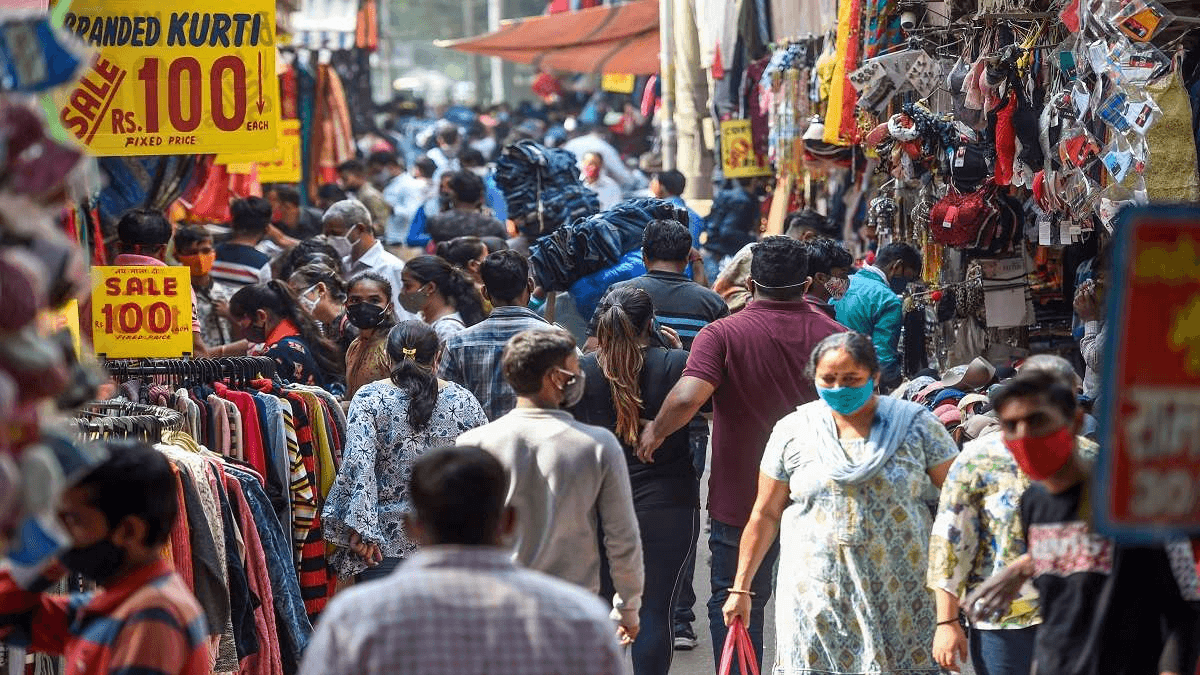
At a stall in Sarojini Nagar, vendor Saddam, who sells 'trendy tops', says footfall has been declining and there are fewer customers than before. Nearby, Vicky and Vikas, another set of vendors at Sarojini, who source their stock from two different ends of India, Tripura and Tamil Nadu, have something to add to that. People who used to come here now shop online. If the t-shirt they sell for ₹200 is available online for ₹100, why would anyone come to Sarojini?
Before it becomes a conversation about footfall and competition, we need to look at what these markets really are and what they have always been. Just like Sarojini Nagar in Delhi, we have Gariahat in Kolkata, Hill Road in Mumbai, and Commercial Street in Bangalore. These are not thrift markets in any ideological sense.
Gariahat has a history dating back to the colonial era, originally established as a small bazaar in the late 19th century, growing into one of South Kolkata's most enduring neighbourhood markets. Sarojini Nagar Market was developed in the 1950s and 60s as part of post-Partition resettlement planning, a functional market built to serve the residential colony named after freedom fighter Sarojini Naidu, which itself had been allocated to refugees displaced by Partition. What began as a utilitarian neighbourhood bazaar gradually became something else entirely, a destination. By the 1980s and 90s, it had developed a secondary identity as a hub for export surplus and factory overruns, garments that had cleared quality checks for international brands but, due to order cancellations or excess production, never made it onto a foreign retail floor. The prices were low because the supply chain was irregular, not because the clothes were.
Hill Road in Bandra, Mumbai, followed a different arc. Bandra's identity as a Catholic-influenced, cosmopolitan neighbourhood, shaped by its Portuguese colonial history, meant that Hill Road's market culture was always slightly more eclectic than the average bazaar. By the latter half of the 20th century, it had grown into a dense stretch of readymade garments, street fashion, and accessories, catering to a younger, style-conscious demographic from across the city. It was never purely a working-class market; it occupied a middle ground, affordable enough to be accessible, busy enough to feel like a scene.
Commercial Street in Bangalore has perhaps the longest continuous retail identity of them all. Originally developed during the British colonial period in the late 19th century to serve the cantonment area, it was, true to its name, a commercial artery from the start. It grew through the 20th century into a sprawling, layered market covering fabrics, garments, jewellery, and accessories, drawing everyone from tailors sourcing cloth to students hunting for bargains. As Bangalore transformed into a tech city in the 1990s and 2000s, Commercial Street held its ground, even as malls multiplied around it.
These markets, in other words, were never countercultural gestures. They were infrastructural. They existed because cities needed places where clothes could be bought cheaply, reliably, and in volume. The ideological framing, thrift, sustainability, and anti-consumption came much later, retrofitted by a generation that discovered these places through aesthetics rather than necessity.
A Word Being Stretched Too Far
Thrifting, in its original sense, means buying secondhand or surplus stock, garments being given a second life rather than ending up discarded in landfills. The ethics of thrifting rest specifically on that secondhand part. Something that might have ended up in a dump yard is being rescued and worn instead.
In India right now, the word has come to mean something considerably looser. It means shopping at Sarojini on a Saturday or from an Instagram page with a curated grid and a drop schedule. It means buying a belt sourced from Chandni Chowk or a jacket that came off a supplier's rack in Tamil Nadu, at Sarojini, and calling it a ‘cheap thrift find’ when it is not even thrift.
This isn't to accuse people of slapping the word ‘thrift’ on everything but to understand what is happening under this label on ground level, across both physical markets and Instagram stores, here in India, and this requires separating the things that have been quietly bundled together.
The Reality Behind Sarojini “Thrift”
Chandravadi, another vendor at Sarojini, offers the most unsentimental read of his own market, "Difference kuch nahi in market…trend chal rha hai." Nothing has really changed about what's available. What has changed is that going to Sarojini has become a thing to include in the bucket of Delhi or a story to post. The clothes are largely the same but the branding has changed. A lot of the garments sold here are still from the surplus stock produced by the bigger industries. The factories contracted to make clothes by them make 3% more of what is required so that the rejected pieces can be sold to vendors at markets like Sarojini, in bulk at lower prices than what is sold to us. This amounts to an average of 20% of profit for them. This is why the term ‘sustainable’ does not mix into Sarojini.
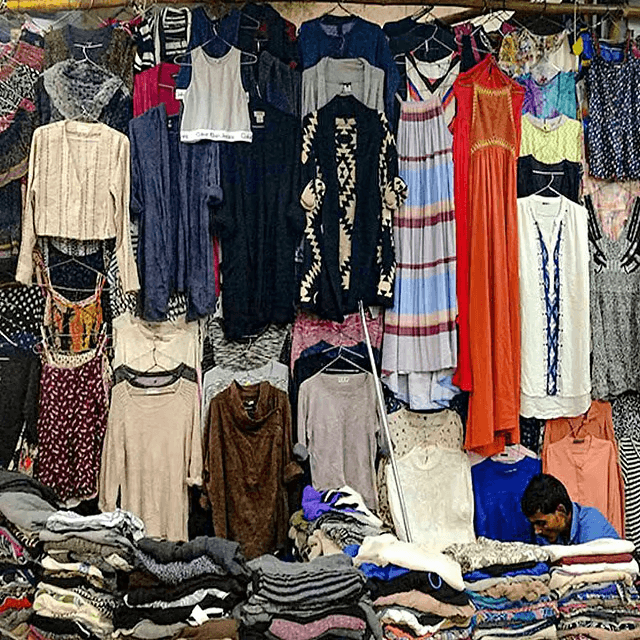
Vicky and Vikas watch their customers leave with bags stuffed full and note that much of what's being bought is local product or brand copies and not secondhand in any meaningful sense. Customers mostly don't ask where things come from. Meaning, the people calling it all a “thrift find” to sound like a conscious have no idea that it might have come from child labour. In September 2021, a raid by the SDM office recovered 23 children aged between five and twelve from within the market. This goes under the rug when you call it thrift.
The Sarojini crowd, in large part, is not a conscious consumer base that has discovered sustainable fashion. It is a trend-following crowd that has found a new destination, instead of shopping malls. The motivation is still cheap, abundant, aesthetically trendy clothing, only, the location and the label have shifted. The underlying behaviour remains the same.
What the Instagram Stores Are Truly Offering
The Instagram thrift store ecosystem is a more complicated and more interesting story. Pages like Fitso_hard, NekoAngel and Vault.no3 have built real communities around curation and personal style, creating access to clothing that falls outside the mainstream retail ecosystem. They all have something in common, which is, they all started out as someone sourcing for themselves and eventually ventured out into the idea of making personal style more accessible through curation.
As the founder of Fitso_hard, Disha Chaudhary sources from "a variety of places including suppliers, local markets and secondhand," selecting pieces based on quality, uniqueness, and wearability. For Vault.no3, Shivanshu Sonker says, “We dig through global vintage lots and commercial surplus…it must have an effortless cool factor, an interesting silhouette, a total statement piece that adds value to people’s lives.” Their sourcing also involves pieces from Nagaland and export lots where they truly find the vintage pieces that catches their eye.
That miscellaneous sourcing is openly acknowledged. These stores accept that they are not fully thrifted. Some stock is secondhand, some comes directly from suppliers or manufacturers, some is sourced from local markets. It is an honest mixed model, and most sellers do not claim otherwise when asked directly. Mehzabeen Memon, who runs NekoAngel, is honest about acknowledging that most of her stock comes through suppliers and manufacturers rather than secondhand channels. She is selling alternative fashion, individuality, and pieces that are hard to find in mainstream India.
It becomes even more complicated in the Indian context because secondhand clothing carries a social stigma that has never fully been lifted. In a country where hand-me-downs were historically associated with poverty, with not being able to afford new, wearing someone else's clothes was, and in many households still is, a marker of class. The family that passed clothes down did so out of necessity, not philosophy. The idea that you would choose to buy secondhand, and pay for it, is relatively new, and it arrived largely through the language of Western sustainability culture rather than any homegrown tradition of archiving or preserving clothing.
These types of businesses do offer secondhand options but they are open to the fact that it is not what they solely offer. This transparency by the small business owners matters, because it points to what Instagram stores are actually offering, not a fully sustainable supply chain, but a type relationship to fashion different than the one that dominates the industry. They operate without the vast extractive machinery of large fast fashion corporations, the exploited labour chains, the mass overproduction, the deliberate engineering of disposability. The carbon footprint of a small seller sourcing selectively and selling in limited quantities is not the same as the footprint of industrial scale fast fashion, even if neither is fully clean. As Disha puts it, "Thrifting won't alone make the problem of fast fashion disappear as this problem needs to be dealt with at a larger scale. At the end of the day, thrifting is keeping many clothes from ending in a dump yard."
It's a measured and accurate claim. It doesn't pretend these stores can solve fashion's sustainability problem, but it doesn't ignore the alternatives they create either.
The Label That Doesn't Fit
Where things get murkier is when the word ‘thrifting’ gets applied uniformly across all of this, be it the secondhand piece sourced carefully or a jhola full of clothes without looking at labels. In the last 20 years, the average consumer has more than doubled the number of garments they buy, and global apparel consumption is projected to grow from 62 million tonnes today to 102 million tonnes by 2030. This makes the scale of fashion's consumption problem hard to ignore.
The word flattens real distinctions and, in doing so, lets a lot of different things claim the same ethical credibility. That semantic convenience doesn’t exist in a vacuum. It was, in many ways, built for, and by, the same industry that needed a pressure valve. Fast fashion brands discovered that slapping a conscious collection label on a polyester blend or launching a garment take-back programme, that critics argue cannot keep pace with the scale of production, was cheaper than restructuring supply chains. Greenwashing gave consumers a way to feel responsible without changing anything, and it gave brands a way to keep producing at volume while wearing sustainability as a marketing layer. The fake thrift market is, in part, its direct offspring, a space where the aesthetic of secondhand has been commodified so thoroughly that it generates its own waste cycle, just with better Instagram captions.
Mehzabeen puts it most clearly, “It (Instagram) has helped people discover alternatives to mainstream fashion and connect with niche communities, but it has also created new forms of trend-driven consumption." She is describing her own industry without protecting it. That kind of acceptance or honesty is precisely what the word "thrifting," used carelessly, tends to obscure.
The Instagram stores that are doing something truly valuable, building communities, offering alternatives, being transparent about their sourcing, don't need the thrift label to justify themselves. The small business model, the selective curation, the absence of exploitative scale, these just stand on their own.
And at Sarojini, where Saddam watches the crowds thin and, Vicky and Vikas count their remaining customers, the stock from Tamil Nadu and Chandni Chowk sits in piles that nobody is asking questions about. The jhola gets filled. The trend moves on. Somewhere on Instagram, it gets a new name.
Citations
https://timesofindia.indiatimes.com/city/kolkata/shopping-para-gariahat/articleshow/121540456.cms?
https://www.pajasaapartments.com/blog/bandra-the-changing-face-of-mumbais-historic-suburb/
https://www.past-india.com/photos-items/st-marys-church-view-from-commercial-street-bangalore-1920/
https://www.punnaka.com/blog-info/shopping-places/hill-road-bandra-market-mumbai
https://thepatriot.in/delhi-ncr/sarojini-nagar-a-market-and-memory-under-siege-70744
TO BE CONTINUED, FOR SUBSCRIBERS ONLY.
This is where the surface ends and the reporting begins.
The complete piece, the full archive, and access to The French Press Circle. Reporting answerable only to its readers.
Already a subscriber ?
Login
Read these on the house, with our compliments.
A selection from the current issue, open to all readers. Read them in full. The rest is one decision away.











At a stall in Sarojini Nagar, vendor Saddam, who sells 'trendy tops', says footfall has been declining and there are fewer customers than before. Nearby, Vicky and Vikas, another set of vendors at Sarojini, who source their stock from two different ends of India, Tripura and Tamil Nadu, have something to add to that. People who used to come here now shop online. If the t-shirt they sell for ₹200 is available online for ₹100, why would anyone come to Sarojini?
Before it becomes a conversation about footfall and competition, we need to look at what these markets really are and what they have always been. Just like Sarojini Nagar in Delhi, we have Gariahat in Kolkata, Hill Road in Mumbai, and Commercial Street in Bangalore. These are not thrift markets in any ideological sense.
Gariahat has a history dating back to the colonial era, originally established as a small bazaar in the late 19th century, growing into one of South Kolkata's most enduring neighbourhood markets. Sarojini Nagar Market was developed in the 1950s and 60s as part of post-Partition resettlement planning, a functional market built to serve the residential colony named after freedom fighter Sarojini Naidu, which itself had been allocated to refugees displaced by Partition. What began as a utilitarian neighbourhood bazaar gradually became something else entirely, a destination. By the 1980s and 90s, it had developed a secondary identity as a hub for export surplus and factory overruns, garments that had cleared quality checks for international brands but, due to order cancellations or excess production, never made it onto a foreign retail floor. The prices were low because the supply chain was irregular, not because the clothes were.
Hill Road in Bandra, Mumbai, followed a different arc. Bandra's identity as a Catholic-influenced, cosmopolitan neighbourhood, shaped by its Portuguese colonial history, meant that Hill Road's market culture was always slightly more eclectic than the average bazaar. By the latter half of the 20th century, it had grown into a dense stretch of readymade garments, street fashion, and accessories, catering to a younger, style-conscious demographic from across the city. It was never purely a working-class market; it occupied a middle ground, affordable enough to be accessible, busy enough to feel like a scene.
Commercial Street in Bangalore has perhaps the longest continuous retail identity of them all. Originally developed during the British colonial period in the late 19th century to serve the cantonment area, it was, true to its name, a commercial artery from the start. It grew through the 20th century into a sprawling, layered market covering fabrics, garments, jewellery, and accessories, drawing everyone from tailors sourcing cloth to students hunting for bargains. As Bangalore transformed into a tech city in the 1990s and 2000s, Commercial Street held its ground, even as malls multiplied around it.
These markets, in other words, were never countercultural gestures. They were infrastructural. They existed because cities needed places where clothes could be bought cheaply, reliably, and in volume. The ideological framing, thrift, sustainability, and anti-consumption came much later, retrofitted by a generation that discovered these places through aesthetics rather than necessity.
A Word Being Stretched Too Far
Thrifting, in its original sense, means buying secondhand or surplus stock, garments being given a second life rather than ending up discarded in landfills. The ethics of thrifting rest specifically on that secondhand part. Something that might have ended up in a dump yard is being rescued and worn instead.
In India right now, the word has come to mean something considerably looser. It means shopping at Sarojini on a Saturday or from an Instagram page with a curated grid and a drop schedule. It means buying a belt sourced from Chandni Chowk or a jacket that came off a supplier's rack in Tamil Nadu, at Sarojini, and calling it a ‘cheap thrift find’ when it is not even thrift.
This isn't to accuse people of slapping the word ‘thrift’ on everything but to understand what is happening under this label on ground level, across both physical markets and Instagram stores, here in India, and this requires separating the things that have been quietly bundled together.
The Reality Behind Sarojini “Thrift”
Chandravadi, another vendor at Sarojini, offers the most unsentimental read of his own market, "Difference kuch nahi in market…trend chal rha hai." Nothing has really changed about what's available. What has changed is that going to Sarojini has become a thing to include in the bucket of Delhi or a story to post. The clothes are largely the same but the branding has changed. A lot of the garments sold here are still from the surplus stock produced by the bigger industries. The factories contracted to make clothes by them make 3% more of what is required so that the rejected pieces can be sold to vendors at markets like Sarojini, in bulk at lower prices than what is sold to us. This amounts to an average of 20% of profit for them. This is why the term ‘sustainable’ does not mix into Sarojini.
Vicky and Vikas watch their customers leave with bags stuffed full and note that much of what's being bought is local product or brand copies and not secondhand in any meaningful sense. Customers mostly don't ask where things come from. Meaning, the people calling it all a “thrift find” to sound like a conscious have no idea that it might have come from child labour. In September 2021, a raid by the SDM office recovered 23 children aged between five and twelve from within the market. This goes under the rug when you call it thrift.
The Sarojini crowd, in large part, is not a conscious consumer base that has discovered sustainable fashion. It is a trend-following crowd that has found a new destination, instead of shopping malls. The motivation is still cheap, abundant, aesthetically trendy clothing, only, the location and the label have shifted. The underlying behaviour remains the same.
What the Instagram Stores Are Truly Offering
The Instagram thrift store ecosystem is a more complicated and more interesting story. Pages like Fitso_hard, NekoAngel and Vault.no3 have built real communities around curation and personal style, creating access to clothing that falls outside the mainstream retail ecosystem. They all have something in common, which is, they all started out as someone sourcing for themselves and eventually ventured out into the idea of making personal style more accessible through curation.
As the founder of Fitso_hard, Disha Chaudhary sources from "a variety of places including suppliers, local markets and secondhand," selecting pieces based on quality, uniqueness, and wearability. For Vault.no3, Shivanshu Sonker says, “We dig through global vintage lots and commercial surplus…it must have an effortless cool factor, an interesting silhouette, a total statement piece that adds value to people’s lives.” Their sourcing also involves pieces from Nagaland and export lots where they truly find the vintage pieces that catches their eye.
That miscellaneous sourcing is openly acknowledged. These stores accept that they are not fully thrifted. Some stock is secondhand, some comes directly from suppliers or manufacturers, some is sourced from local markets. It is an honest mixed model, and most sellers do not claim otherwise when asked directly. Mehzabeen Memon, who runs NekoAngel, is honest about acknowledging that most of her stock comes through suppliers and manufacturers rather than secondhand channels. She is selling alternative fashion, individuality, and pieces that are hard to find in mainstream India.
It becomes even more complicated in the Indian context because secondhand clothing carries a social stigma that has never fully been lifted. In a country where hand-me-downs were historically associated with poverty, with not being able to afford new, wearing someone else's clothes was, and in many households still is, a marker of class. The family that passed clothes down did so out of necessity, not philosophy. The idea that you would choose to buy secondhand, and pay for it, is relatively new, and it arrived largely through the language of Western sustainability culture rather than any homegrown tradition of archiving or preserving clothing.
These types of businesses do offer secondhand options but they are open to the fact that it is not what they solely offer. This transparency by the small business owners matters, because it points to what Instagram stores are actually offering, not a fully sustainable supply chain, but a type relationship to fashion different than the one that dominates the industry. They operate without the vast extractive machinery of large fast fashion corporations, the exploited labour chains, the mass overproduction, the deliberate engineering of disposability. The carbon footprint of a small seller sourcing selectively and selling in limited quantities is not the same as the footprint of industrial scale fast fashion, even if neither is fully clean. As Disha puts it, "Thrifting won't alone make the problem of fast fashion disappear as this problem needs to be dealt with at a larger scale. At the end of the day, thrifting is keeping many clothes from ending in a dump yard."
It's a measured and accurate claim. It doesn't pretend these stores can solve fashion's sustainability problem, but it doesn't ignore the alternatives they create either.
The Label That Doesn't Fit
Where things get murkier is when the word ‘thrifting’ gets applied uniformly across all of this, be it the secondhand piece sourced carefully or a jhola full of clothes without looking at labels. In the last 20 years, the average consumer has more than doubled the number of garments they buy, and global apparel consumption is projected to grow from 62 million tonnes today to 102 million tonnes by 2030. This makes the scale of fashion's consumption problem hard to ignore.
The word flattens real distinctions and, in doing so, lets a lot of different things claim the same ethical credibility. That semantic convenience doesn’t exist in a vacuum. It was, in many ways, built for, and by, the same industry that needed a pressure valve. Fast fashion brands discovered that slapping a conscious collection label on a polyester blend or launching a garment take-back programme, that critics argue cannot keep pace with the scale of production, was cheaper than restructuring supply chains. Greenwashing gave consumers a way to feel responsible without changing anything, and it gave brands a way to keep producing at volume while wearing sustainability as a marketing layer. The fake thrift market is, in part, its direct offspring, a space where the aesthetic of secondhand has been commodified so thoroughly that it generates its own waste cycle, just with better Instagram captions.
Mehzabeen puts it most clearly, “It (Instagram) has helped people discover alternatives to mainstream fashion and connect with niche communities, but it has also created new forms of trend-driven consumption." She is describing her own industry without protecting it. That kind of acceptance or honesty is precisely what the word "thrifting," used carelessly, tends to obscure.
The Instagram stores that are doing something truly valuable, building communities, offering alternatives, being transparent about their sourcing, don't need the thrift label to justify themselves. The small business model, the selective curation, the absence of exploitative scale, these just stand on their own.
And at Sarojini, where Saddam watches the crowds thin and, Vicky and Vikas count their remaining customers, the stock from Tamil Nadu and Chandni Chowk sits in piles that nobody is asking questions about. The jhola gets filled. The trend moves on. Somewhere on Instagram, it gets a new name.
Citations
https://timesofindia.indiatimes.com/city/kolkata/shopping-para-gariahat/articleshow/121540456.cms?
https://www.pajasaapartments.com/blog/bandra-the-changing-face-of-mumbais-historic-suburb/
https://www.past-india.com/photos-items/st-marys-church-view-from-commercial-street-bangalore-1920/
https://www.punnaka.com/blog-info/shopping-places/hill-road-bandra-market-mumbai
https://thepatriot.in/delhi-ncr/sarojini-nagar-a-market-and-memory-under-siege-70744
TO BE CONTINUED, FOR SUBSCRIBERS ONLY.
This is where the surface ends and the reporting begins.
The complete piece, the full archive, and access to The French Press Circle. Reporting answerable only to its readers.
Already a subscriber ?
Login
Read these on the house, with our compliments.
A selection from the current issue, open to all readers. Read them in full. The rest is one decision away.