
I wonder what kind of world we live in where we have to prove our pain exists, or wait for it to get worse to be taken seriously.
Koshy Brahmatmaj was diagnosed with endometriosis in 2020, after laparoscopic surgery confirmed what years of pain had already been trying to say. But the pain itself began around 2016, when she was a student in London, severe enough to land her in the ER more than once, persistent enough to take her to multiple doctors. It was a classmate, not a clinician, who first pointed her toward the word endometriosis. She spent those years without a name for what was happening to her body, and therefore, without standing.
Artist Koshy Brahmatmaj spent years in pain before being diagnosed with endometriosis in 2020. Her exhibition ‘How do i make you believe’ turns that struggle into embroidery. She uses art as a medium rather than a cure. Her story reflects a larger systemic failure, medicine that treated the male body as default, leaving women's conditions under-researched and their pain dismissed.
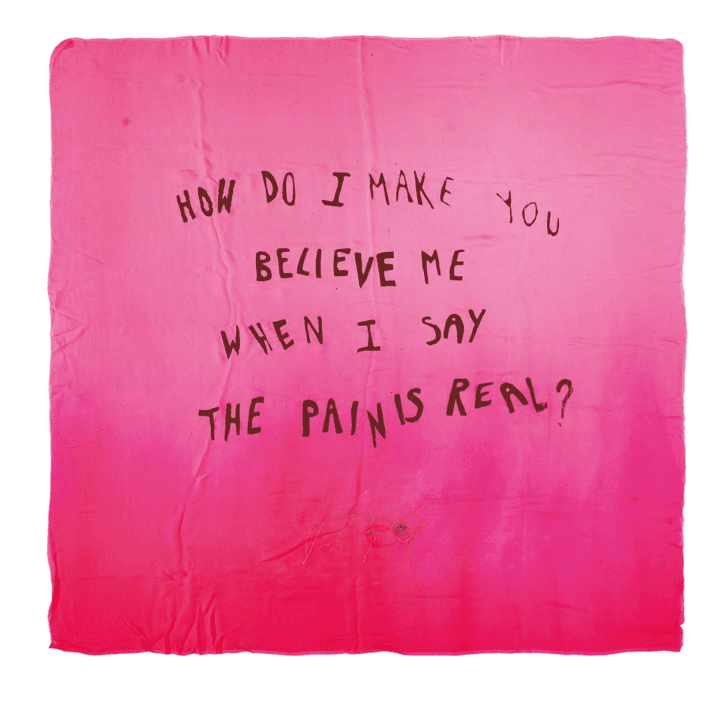
How Do I Make You Believe Me
When I Say the Pain Is Real?
Serigraphy and hand embroidery on satin-crepe
45 x 42 inches
2022 - 2026
In a conversation with Koshy, she made it clear that her title, ‘How do i make you believe’, isn't a question but a statement. No question mark and the lower case “I” is her conscious choice. This is what happens when you constantly have to explain your pain, the question fades into exhaustion. The burden of proof, she explains, always falls on the person who is suffering.
During the same conversation, Koshy brought up a news story that had stayed with them. “The news of that old man digging up his dead sister and bringing along a corpse to a bank…He’s also asking pretty much the same question, How do I make you believe?” The absurdity and cruelty of that act stayed with them because it reflected something much larger about the world we live in. Whether it is identity, citizenship, or illness, people are constantly expected to produce evidence before they are believed.

For Koshy, the answer lies in art. Their chosen medium, embroidery, becomes a way of translating an invisible experience into something tangible. They speak about embroidery almost as though it is a companion. On good days, they can work sitting at a desk. On bad days, when pain makes movement difficult, they can lie in bed and embroider. When travelling, they carry a small project with them. The medium adapts to the body rather than demanding that the body adapt to it.
This is not to say that Koshy believes art is the cure to chronic illness. In fact, they reject that idea, “If I'm in pain, art is not going to help me, it is an ibuprofen that is going to help me.” Art allows them to sit with it, understand it, and slowly develop a language around it but it cannot replace medicine. That language then becomes useful not just for the artwork but for conversations with doctors as well as the other people who struggle to comprehend an invisible illness. Thus, for her, this collection serves as testimony to her pain rather than a cure.
And what is disheartening is that her story is one of many from a system that continues to ignore and under-research on disorders related to women’s reproductive health. Endometriosis affects about 247 million women globally and about 42 million women in India. PCOD affects an estimated 9% to 22% of women in India. PMOS (earlier known as PCOS) affects every 1 in 8 women, which equates to more than 170 million women worldwide. All of them have something in common, they are all conditions related to the uterus, with no cure or definitive cause found yet.
This is structural, and the studies prove it.. Medicine has historically treated the male body as its default research conducted on male cells, male mice, male patients, producing data that effectively discounted half the population. "Normal" meant "male." Women's pain, when it didn't fit that model, was relabeled: anxiety, stress, a low threshold, an overreaction. There is even a name for this, bikini medicine, which is the long-held medical assumption that men and women are interchangeable except for the parts a bikini would cover.

Koshy doesn't need to cite studies because her work arrives at the same conclusion. The body she has spent years trying to make legible, is one that medicine spent a very long time not bothering to properly see and researchers are finally catching up to that.
How do i make you believe is, thus, about expressing the pain and making way for your existence. The exhibition gives shape to experiences that are often dismissed, ignored, or left without language. Koshy's practice becomes a means of documenting a body that has repeatedly had to prove itself, turning personal suffering into a collective conversation. Rather than seeking answers, the work confronts the systems that demand evidence of pain before offering care. It is, ultimately, a quiet but firm assertion of the right to exist without justification.
—
https://www.bbc.com/news/articles/clypl5jrjqlo
https://pmc.ncbi.nlm.nih.gov/articles/PMC7615030/
https://www.apollohospitals.com/diseases-and-conditions/pcod-polycystic-ovarian-disease
https://www.medicoverhospitals.in/articles/bikini-view-of-womens-health
TO BE CONTINUED, FOR SUBSCRIBERS ONLY.
This is where the surface ends and the reporting begins.
The complete piece, the full archive, and access to The French Press Circle. Reporting answerable only to its readers.
Already a subscriber ?
Login
Read these on the house, with our compliments.
A selection from the current issue, open to all readers. Read them in full. The rest is one decision away.




I wonder what kind of world we live in where we have to prove our pain exists, or wait for it to get worse to be taken seriously.
Koshy Brahmatmaj was diagnosed with endometriosis in 2020, after laparoscopic surgery confirmed what years of pain had already been trying to say. But the pain itself began around 2016, when she was a student in London, severe enough to land her in the ER more than once, persistent enough to take her to multiple doctors. It was a classmate, not a clinician, who first pointed her toward the word endometriosis. She spent those years without a name for what was happening to her body, and therefore, without standing.
Artist Koshy Brahmatmaj spent years in pain before being diagnosed with endometriosis in 2020. Her exhibition ‘How do i make you believe’ turns that struggle into embroidery. She uses art as a medium rather than a cure. Her story reflects a larger systemic failure, medicine that treated the male body as default, leaving women's conditions under-researched and their pain dismissed.
How Do I Make You Believe Me
When I Say the Pain Is Real?
Serigraphy and hand embroidery on satin-crepe
45 x 42 inches
2022 - 2026
In a conversation with Koshy, she made it clear that her title, ‘How do i make you believe’, isn't a question but a statement. No question mark and the lower case “I” is her conscious choice. This is what happens when you constantly have to explain your pain, the question fades into exhaustion. The burden of proof, she explains, always falls on the person who is suffering.
During the same conversation, Koshy brought up a news story that had stayed with them. “The news of that old man digging up his dead sister and bringing along a corpse to a bank…He’s also asking pretty much the same question, How do I make you believe?” The absurdity and cruelty of that act stayed with them because it reflected something much larger about the world we live in. Whether it is identity, citizenship, or illness, people are constantly expected to produce evidence before they are believed.
For Koshy, the answer lies in art. Their chosen medium, embroidery, becomes a way of translating an invisible experience into something tangible. They speak about embroidery almost as though it is a companion. On good days, they can work sitting at a desk. On bad days, when pain makes movement difficult, they can lie in bed and embroider. When travelling, they carry a small project with them. The medium adapts to the body rather than demanding that the body adapt to it.
This is not to say that Koshy believes art is the cure to chronic illness. In fact, they reject that idea, “If I'm in pain, art is not going to help me, it is an ibuprofen that is going to help me.” Art allows them to sit with it, understand it, and slowly develop a language around it but it cannot replace medicine. That language then becomes useful not just for the artwork but for conversations with doctors as well as the other people who struggle to comprehend an invisible illness. Thus, for her, this collection serves as testimony to her pain rather than a cure.
And what is disheartening is that her story is one of many from a system that continues to ignore and under-research on disorders related to women’s reproductive health. Endometriosis affects about 247 million women globally and about 42 million women in India. PCOD affects an estimated 9% to 22% of women in India. PMOS (earlier known as PCOS) affects every 1 in 8 women, which equates to more than 170 million women worldwide. All of them have something in common, they are all conditions related to the uterus, with no cure or definitive cause found yet.
This is structural, and the studies prove it.. Medicine has historically treated the male body as its default research conducted on male cells, male mice, male patients, producing data that effectively discounted half the population. "Normal" meant "male." Women's pain, when it didn't fit that model, was relabeled: anxiety, stress, a low threshold, an overreaction. There is even a name for this, bikini medicine, which is the long-held medical assumption that men and women are interchangeable except for the parts a bikini would cover.
Koshy doesn't need to cite studies because her work arrives at the same conclusion. The body she has spent years trying to make legible, is one that medicine spent a very long time not bothering to properly see and researchers are finally catching up to that.
How do i make you believe is, thus, about expressing the pain and making way for your existence. The exhibition gives shape to experiences that are often dismissed, ignored, or left without language. Koshy's practice becomes a means of documenting a body that has repeatedly had to prove itself, turning personal suffering into a collective conversation. Rather than seeking answers, the work confronts the systems that demand evidence of pain before offering care. It is, ultimately, a quiet but firm assertion of the right to exist without justification.
—
https://www.bbc.com/news/articles/clypl5jrjqlo
https://pmc.ncbi.nlm.nih.gov/articles/PMC7615030/
https://www.apollohospitals.com/diseases-and-conditions/pcod-polycystic-ovarian-disease
https://www.medicoverhospitals.in/articles/bikini-view-of-womens-health
TO BE CONTINUED, FOR SUBSCRIBERS ONLY.
This is where the surface ends and the reporting begins.
The complete piece, the full archive, and access to The French Press Circle. Reporting answerable only to its readers.
Already a subscriber ?
Login
Read these on the house, with our compliments.
A selection from the current issue, open to all readers. Read them in full. The rest is one decision away.