
Spain and Argentina walk out at MetLife Stadium on Sunday for a final that will decide who lifts the trophy. Somewhere in the middle of that match sit eleven minutes that were never really about football at all. Madonna, Shakira, BTS, and Justin Bieber will take the same stage, curated into a single show by Coldplay’s Chris Martin, and for those eleven minutes the World Cup will stop being a football tournament and start being a fundraiser with better lighting.
The arithmetic tells the real story. FIFA is sitting on a tournament expected to generate billions in broadcast rights, sponsorship, and ticketing, the most-watched sporting event in human history, by its own estimate. Against that number, the organisation is donating one dollar from every match ticket sold to the FIFA Global Citizen Education Fund, a contribution that has crossed $50 million on its way to a $100 million target. A dollar a ticket costs a finance department almost nothing to approve and buys an enormous amount of goodwill in return. That is the guilt tax: priced to be invisible to the payer, and highly visible to everyone watching the halftime show.
The fund’s own governance gives the game away. Its advisory board is described, in FIFA’s language, as “non-fiduciary”, a phrase that grants the optics of oversight while removing the liability that usually comes with it. Gianni Infantino sits on that board. Shakira sits on it too, one of the very performers headlining the show her own board is raising money for. Ivanka Trump sits on it. So does a co-president of Bank of America. This reads less like a governance structure and more like a seating chart for a press photograph.
Global Citizen has run this exact model for over a decade at its own annual festival, and the criticism has followed it the whole way. Occupy Wall Street co-founder Micah White once called the format the commercialisation of activism itself, a system that trades a tweet or a petition signature for a concert ticket and calls the exchange participation. An academic quoted years earlier described it as a “shotgun approach,” wide in reach and shallow in effect. Even Charity Navigator’s approving score for the organisation comes with a footnote worth reading twice: the rating measures overhead efficiency, never whether the programmes actually work. FIFA didn’t invent this machine. It just bolted the world’s biggest football tournament onto one that already existed.
This is where the story stops being a curiosity about American pop culture and becomes something French Press Global’s readers should feel a little closer to home, because the same machine is already running in India, dressed in different language.
Naman Pugalia, Chief Business Officer for Live Events at BookMyShow, frames India’s concert boom as a story about belonging. “India’s live entertainment industry is experiencing a fundamental shift in the way audiences engage with culture,” he says. “People today are increasingly seeking participation over passive consumption, choosing experiences that create memories, foster a sense of belonging and bring them closer to the artists, stories and communities they care about.” The numbers back him up: the EY-Parthenon-BookMyShow report Beyond Attention. Into Immersion found that 78% of Indian consumers now prefer spending on experiences over products, while 59% recalled the brands they encountered at live events and 55% reported higher purchase intent afterward. Pugalia reads this as audiences rewarding brands that “participate meaningfully in culture rather than simply advertise around it.” It’s a generous read, and a convenient one, because it lets a brand’s marketing spend and an audience’s emotional experience look like the exact same thing, which is the same sleight of hand FIFA is running at a global scale, just with a bigger stage and better production value.
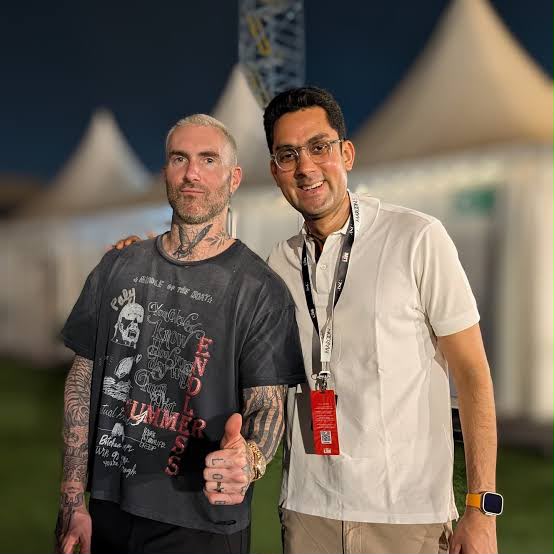
Naman Pugalia
Pugalia’s economic numbers are real, and worth taking seriously on their own terms. Coldplay’s Ahmedabad concerts pulled over a third of their attendees from non-metro cities. Post Malone’s Guwahati show generated an estimated ₹43 crore in regional economic impact, rippling into hospitality, transport, and local business well beyond the venue gates. India is becoming an essential stop on the global touring circuit, and that claim is measurably true. What his statement doesn’t do, and maybe can’t do, from where he sits, is answer the question FIFA’s halftime show forces into the open: when a brand’s presence at a concert gets dressed in the language of culture and community, who decides that it counts as meaningful participation rather than advertising with a live soundtrack?

Virat Munjal, Music Producer & DJ
Virat Munjal, a music producer and DJ who has spent his career inside these shows rather than above them, answers that question without much polish. “I don’t mind it, honestly. Any contribution is a good thing,” he says. “But when a company is making billions, it’s fair for people to ask whether it’s genuine generosity or just good marketing. The real question is the impact it creates.” On the celebrities-versus-cause tension driving FIFA’s halftime show, he’s just as direct: “The celebrities bring the spotlight, no doubt. But ideally, the cause should be what people remember after the lights go off.” It’s a quieter version of the same argument this piece has been building, that spectacle isn’t evidence of sincerity, and applause was never an audit.
FIFA’s halftime show runs eleven minutes, engineered to make a nine-figure marketing exercise feel like a nine-figure act of conscience. India’s concert economy hasn’t built its own eleven-minute spectacle of moral alibi yet, but the infrastructure is already there: the CSR tags, the impact decks, the brand recall statistics, the non-metro footfall numbers that double as proof of good done. A cause isn’t what a company says it is. A cause is what survives being checked, and on Sunday, while Spain and Argentina fight for a trophy, the halftime show will be counting on nobody checking too closely.
TO BE CONTINUED, FOR SUBSCRIBERS ONLY.
This is where the surface ends and the reporting begins.
The complete piece, the full archive, and access to The French Press Circle. Reporting answerable only to its readers.
Already a subscriber ?
Login
Read these on the house, with our compliments.
A selection from the current issue, open to all readers. Read them in full. The rest is one decision away.








Spain and Argentina walk out at MetLife Stadium on Sunday for a final that will decide who lifts the trophy. Somewhere in the middle of that match sit eleven minutes that were never really about football at all. Madonna, Shakira, BTS, and Justin Bieber will take the same stage, curated into a single show by Coldplay’s Chris Martin, and for those eleven minutes the World Cup will stop being a football tournament and start being a fundraiser with better lighting.
The arithmetic tells the real story. FIFA is sitting on a tournament expected to generate billions in broadcast rights, sponsorship, and ticketing, the most-watched sporting event in human history, by its own estimate. Against that number, the organisation is donating one dollar from every match ticket sold to the FIFA Global Citizen Education Fund, a contribution that has crossed $50 million on its way to a $100 million target. A dollar a ticket costs a finance department almost nothing to approve and buys an enormous amount of goodwill in return. That is the guilt tax: priced to be invisible to the payer, and highly visible to everyone watching the halftime show.
The fund’s own governance gives the game away. Its advisory board is described, in FIFA’s language, as “non-fiduciary”, a phrase that grants the optics of oversight while removing the liability that usually comes with it. Gianni Infantino sits on that board. Shakira sits on it too, one of the very performers headlining the show her own board is raising money for. Ivanka Trump sits on it. So does a co-president of Bank of America. This reads less like a governance structure and more like a seating chart for a press photograph.
Global Citizen has run this exact model for over a decade at its own annual festival, and the criticism has followed it the whole way. Occupy Wall Street co-founder Micah White once called the format the commercialisation of activism itself, a system that trades a tweet or a petition signature for a concert ticket and calls the exchange participation. An academic quoted years earlier described it as a “shotgun approach,” wide in reach and shallow in effect. Even Charity Navigator’s approving score for the organisation comes with a footnote worth reading twice: the rating measures overhead efficiency, never whether the programmes actually work. FIFA didn’t invent this machine. It just bolted the world’s biggest football tournament onto one that already existed.
This is where the story stops being a curiosity about American pop culture and becomes something French Press Global’s readers should feel a little closer to home, because the same machine is already running in India, dressed in different language.
Naman Pugalia, Chief Business Officer for Live Events at BookMyShow, frames India’s concert boom as a story about belonging. “India’s live entertainment industry is experiencing a fundamental shift in the way audiences engage with culture,” he says. “People today are increasingly seeking participation over passive consumption, choosing experiences that create memories, foster a sense of belonging and bring them closer to the artists, stories and communities they care about.” The numbers back him up: the EY-Parthenon-BookMyShow report Beyond Attention. Into Immersion found that 78% of Indian consumers now prefer spending on experiences over products, while 59% recalled the brands they encountered at live events and 55% reported higher purchase intent afterward. Pugalia reads this as audiences rewarding brands that “participate meaningfully in culture rather than simply advertise around it.” It’s a generous read, and a convenient one, because it lets a brand’s marketing spend and an audience’s emotional experience look like the exact same thing, which is the same sleight of hand FIFA is running at a global scale, just with a bigger stage and better production value.
Naman Pugalia
Pugalia’s economic numbers are real, and worth taking seriously on their own terms. Coldplay’s Ahmedabad concerts pulled over a third of their attendees from non-metro cities. Post Malone’s Guwahati show generated an estimated ₹43 crore in regional economic impact, rippling into hospitality, transport, and local business well beyond the venue gates. India is becoming an essential stop on the global touring circuit, and that claim is measurably true. What his statement doesn’t do, and maybe can’t do, from where he sits, is answer the question FIFA’s halftime show forces into the open: when a brand’s presence at a concert gets dressed in the language of culture and community, who decides that it counts as meaningful participation rather than advertising with a live soundtrack?
Virat Munjal, Music Producer & DJ
Virat Munjal, a music producer and DJ who has spent his career inside these shows rather than above them, answers that question without much polish. “I don’t mind it, honestly. Any contribution is a good thing,” he says. “But when a company is making billions, it’s fair for people to ask whether it’s genuine generosity or just good marketing. The real question is the impact it creates.” On the celebrities-versus-cause tension driving FIFA’s halftime show, he’s just as direct: “The celebrities bring the spotlight, no doubt. But ideally, the cause should be what people remember after the lights go off.” It’s a quieter version of the same argument this piece has been building, that spectacle isn’t evidence of sincerity, and applause was never an audit.
FIFA’s halftime show runs eleven minutes, engineered to make a nine-figure marketing exercise feel like a nine-figure act of conscience. India’s concert economy hasn’t built its own eleven-minute spectacle of moral alibi yet, but the infrastructure is already there: the CSR tags, the impact decks, the brand recall statistics, the non-metro footfall numbers that double as proof of good done. A cause isn’t what a company says it is. A cause is what survives being checked, and on Sunday, while Spain and Argentina fight for a trophy, the halftime show will be counting on nobody checking too closely.
TO BE CONTINUED, FOR SUBSCRIBERS ONLY.
This is where the surface ends and the reporting begins.
The complete piece, the full archive, and access to The French Press Circle. Reporting answerable only to its readers.
Already a subscriber ?
Login
Read these on the house, with our compliments.
A selection from the current issue, open to all readers. Read them in full. The rest is one decision away.