
A brooding silence settles over Colaba during a downpour. Waiters stand at restaurant doorways under awnings, watching traffic glide past on roads that have absorbed the water rather than surrendered to it. Twenty kilometres north, in Kalyan or Dombivli, that same hour of rain turns lanes into channels, shopfronts into sandbagged bunkers, and commutes into gambles. In Delhi, the contrast plays out on an east-west axis rather than a north-south one. The broad, tree-lined avenues of Lutyens' Delhi drain within the hour, while Mehrauli, Chhattarpur, and Sangam Vihar sit in standing water for days, rain or no rain. This is the visible result of a century of decisions about where drains get built first, where they get desilted on schedule, and whose complaints get logged.
The rain doesn't discriminate. The drains do.
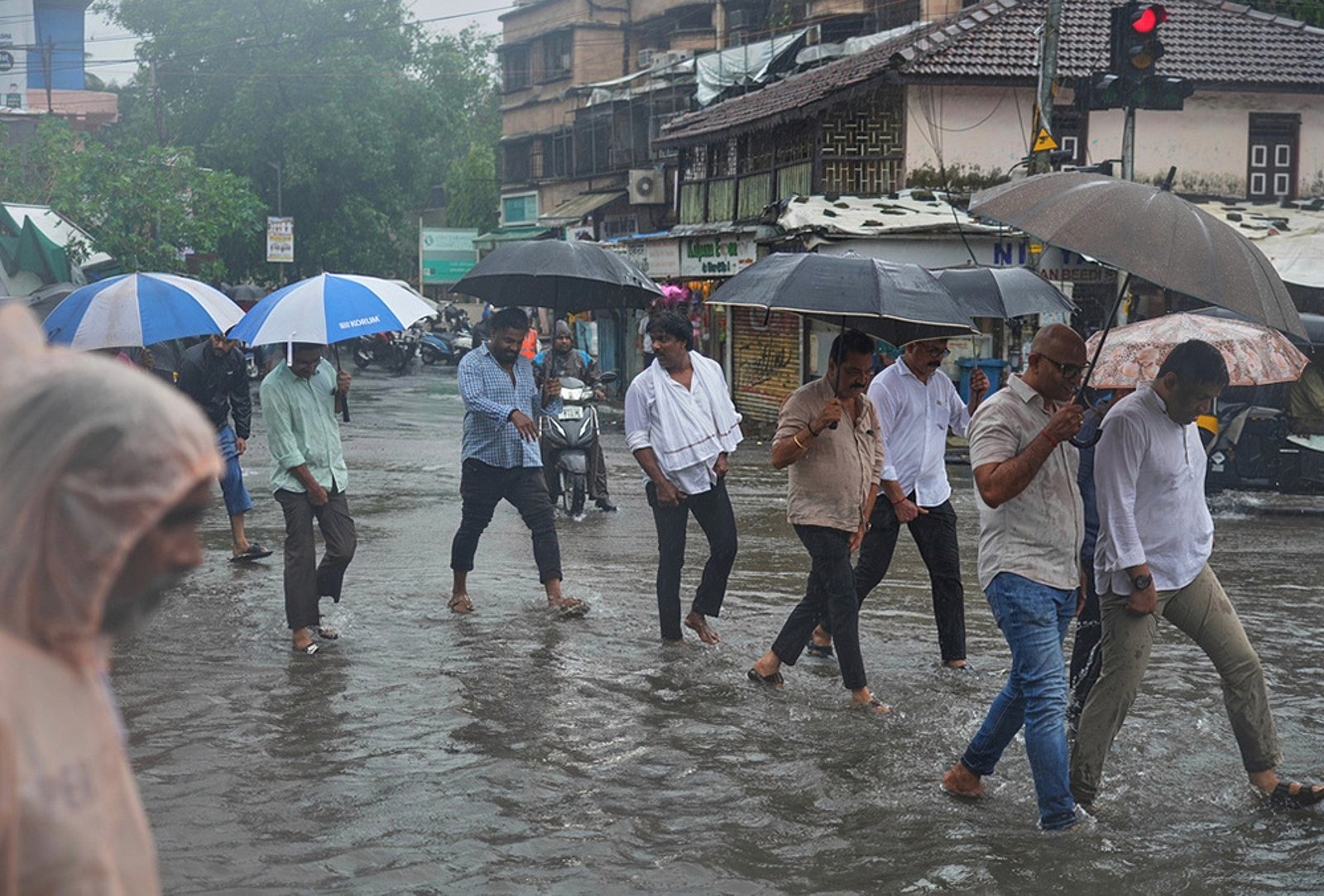
People hold umbrellas as they walk on a water-logged street during monsoon rains in Mumbai, July 6, 2026. Photo: AP/Rafiq Maqbool.
A Season That Arrived Late And Hit Hard
Mumbai's monsoon showed up thirteen days behind schedule this year, finally breaking on June 24, tied among the latest onset dates the city has recorded since 1951. The delay bought the city nothing. Within hours of the season's first spell, automatic weather stations logged more than 200 mm of rain in eight hours across parts of the city, and Saki Naka, Andheri, King Circle, and Everard Nagar were already underwater. The Andheri Subway, a recurring flashpoint every season, went under again.
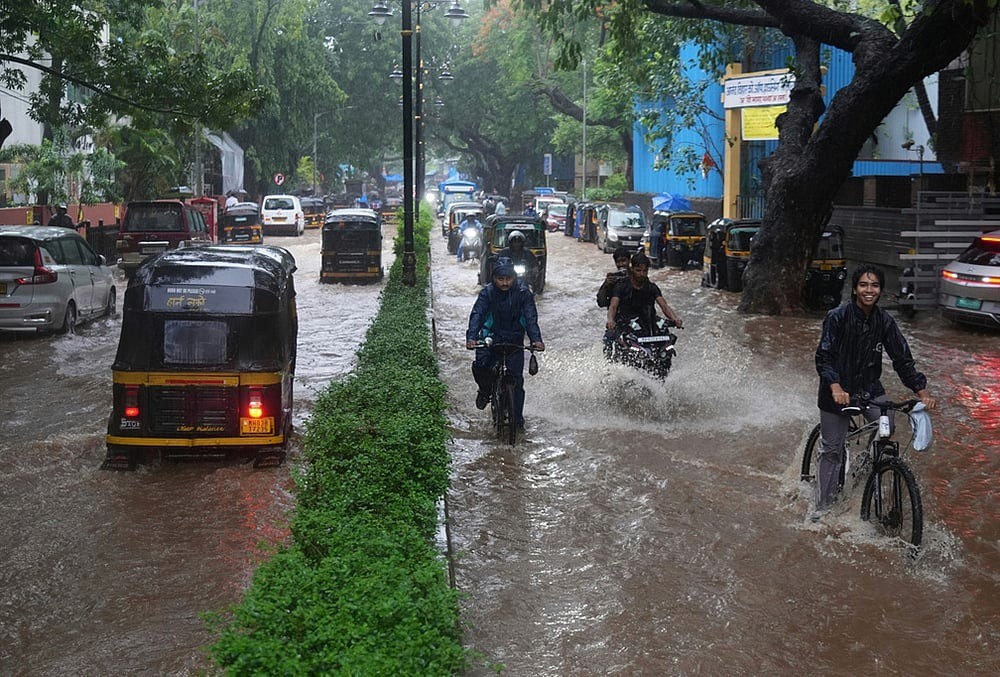
Vehicles drive through a waterlogged street on the season's first heavy day, Mumbai, July 1, 2026. Photo: AP/Rafiq Maqbool.
By the first week of July, the picture had turned severe enough for the India Meteorological Department to issue four consecutive red alerts, its highest warning category, in seven days. Colaba's observatory recorded 791 mm of rainfall that week, more than the area's entire climatological average for the month, while Santacruz logged 879 mm, nearly its full monthly normal, within a single week. Some neighbourhoods took in 200 to 300 mm in a single 24-hour stretch, more than double a typical heavy monsoon spell, per IMD figures reported at the time. The BMC shut schools, advised residents to work from home, and watched trains and flights back up: local media reported 17 cancellations and more than 200 delays on a single day.
On paper, South Mumbai took the heavier battering. And yet residents of the same city watched a familiar split-screen unfold. Colaba's roads cleared within hours, while Thane, Mulund, Kalyan, and Dombivli stayed underwater for days, with a road collapse in Dombivli and flooded underpasses in Navi Mumbai serving as recurring backdrops to the season. Low-lying pockets such as Chembur and Vikhroli were repeatedly inundated alongside Andheri. In Kalyan, the disparity has become routine enough that residents have reportedly stopped filing complaints, choosing instead to plan their movements around the water rather than wait for it to be addressed.
Amira Kamat, 21, a business development and marketing intern at a Mumbai firm, sees the split running along income lines rather than rainfall totals. "Even the wealthy areas in Mumbai flood occasionally, but it doesn't come to the point of danger like it does for others," she said. "The wealthy don't have to worry about basic survival."
The Deaths That Punctuated The Season
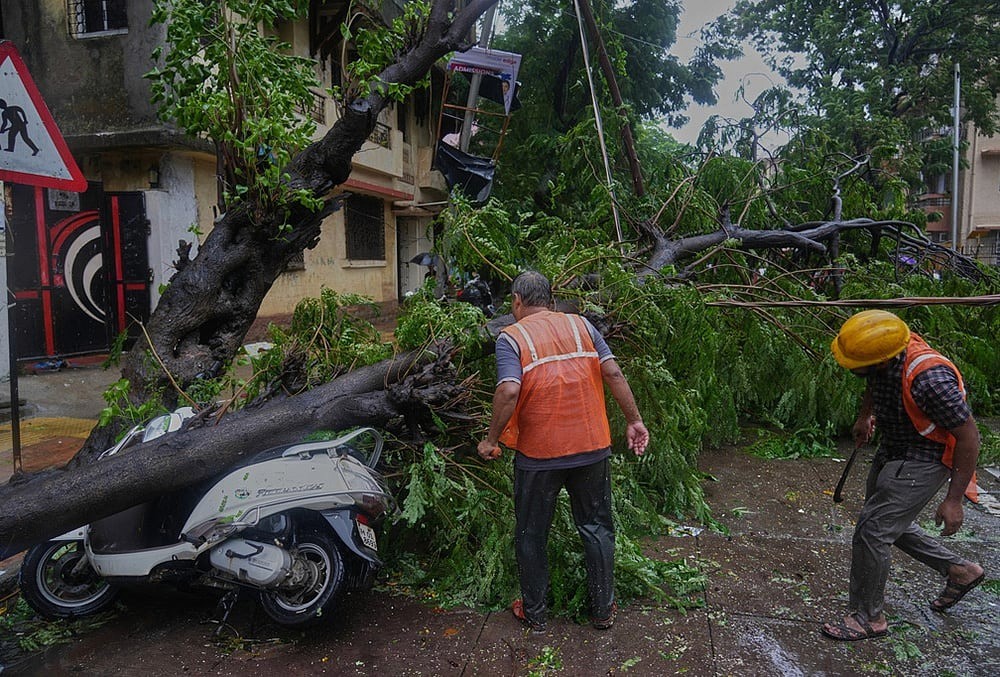
Workers clear a fallen tree from a Mumbai street during the same week's rains, July 5, 2026. Photo: AP/Rafiq Maqbool.
Two deaths in quick succession turned the season's abstractions into headlines. In late June, a tree fell on a school bus carrying 18 children in Chembur, killing an eleven-year-old boy and seriously injuring five others. Barely a week later, on July 2, a 55-year-old Andheri East resident named Aslam Isak Shaikh fell into an open manhole on Khairani Road near Sakinaka while walking home, looking at his phone in the rain. Contractual workers had removed the manhole cover to install a protective mesh, a mandatory monsoon safety measure, but left the site without barricades or anyone posted to warn pedestrians. Rescue teams searched for over three hours and recovered only his umbrella and slippers before finding his body.
Sidhant Madan, a Gurugram resident, cited the same incident without prompting when asked whether recurring flooding is a climate, infrastructure, or political problem. "Officials claimed the city was fully prepared for the monsoon, yet almost immediately a man fell into an open manhole during heavy rains," he said. "Incidents like these highlight the gap between official assurances and the reality on the ground."
Municipal Commissioner Ashwini Bhide suspended four officials, including an Assistant Municipal Commissioner, and ordered a seven-day inquiry. Mumbai Mayor Ritu Tawade, speaking to reporters after visiting the site, called it "a huge lapse on the part of the administration," adding that she had held meetings on the exact issue and instructed officials to finish covering manholes before the monsoon began. On the floor of the Maharashtra Assembly, Speaker Rahul Narwekar called the death tantamount to culpable homicide and asked the state government to place a detailed statement before the House. NCP (Sharad Pawar faction) MLA Rohit Pawar, in comments to television reporters, put a number to the gap: the BMC's budget runs to roughly ₹81,000 crore by his account, of which about ₹250 crore goes toward pre-monsoon work on manholes, drains, and trees. "Unfortunately, people fall into these manholes and lose their lives due to a lack of proper maintenance, this is a recurring annual issue," Pawar said, adding that junior workers face consequences while senior officers rarely do.
In 2017, gastroenterologist Dr Deepak Amarapurkar died after falling into an open manhole in Prabhadevi, an incident that drew comparable outrage at the time. In September 2024, a woman died after falling into a stormwater drain in Andheri during a downpour. Nine years and two administrations on, Sakinaka produced the same suspensions and the same inquiry committee.
Infrastructure Has An Address
The mechanics behind the divide are neither mysterious nor new. South Mumbai's roads were engineered generations ago with gradients that carry water away from the surface, alongside stormwater drains and tree cover built as functioning infrastructure rather than landscaping. The suburbs, expanded rapidly and informally to house a growing population, absorbed density without a matching investment in the systems meant to carry that density's waste and runoff.
Hussain Indorewala, who teaches at the Kamla Raheja Vidyanidhi Institute for Architecture and Environmental Studies, told reporters covering the season that the city has "not enough drains for the water to run off," calling Mumbai "impermeable" even as its groundwater table falls. "This is a general crisis of urban planning," he said. "Over the past two to three decades, we've seen that planning is oriented towards the real estate sector." Sheema Fatima, a professor at NMIMS's Balwant Sheth School of Architecture, made a related point in the same coverage about what gets left out of development plans: common spaces, drainage, and tree cover give way to car parks and housing valuations in the calculations builders and planners actually run.
Jai Nakra, 23, a law student at NMIMS Mumbai, put the comparison at street level. "Areas such as South Mumbai, where wealthier people live, experience comparatively less flooding," he said. "Meanwhile, places like Ville Parle, which is not even a slum, or areas such as Bandra East often experience severe flooding where roads become almost unusable." He carried the same comparison over to Gurugram: infrastructure clusters where influential or wealthy people live, he said, while ordinary localities wait, a pattern he called "unequal planning" rather than simply poor planning.
In Gurugram, a city built largely by private developers, Sidhant Madan traced the gap in more than road quality. "The groundwater table in many parts of Gurugram has fallen so drastically that numerous residential societies rely on private water tankers every single day," Madan said. "Those who can afford these services continue their daily lives with relatively little disruption, while others face water shortages and unreliable public supply." He drew the comparison out directly: "DLF Phases I to V often seem to have better-maintained roads, drainage, and overall upkeep, which helps them remain functional during heavy rainfall. In contrast, areas like Golf Course Extension Road, Badshahpur, and parts of Old Gurgaon are much more prone to waterlogging and can become difficult to access."
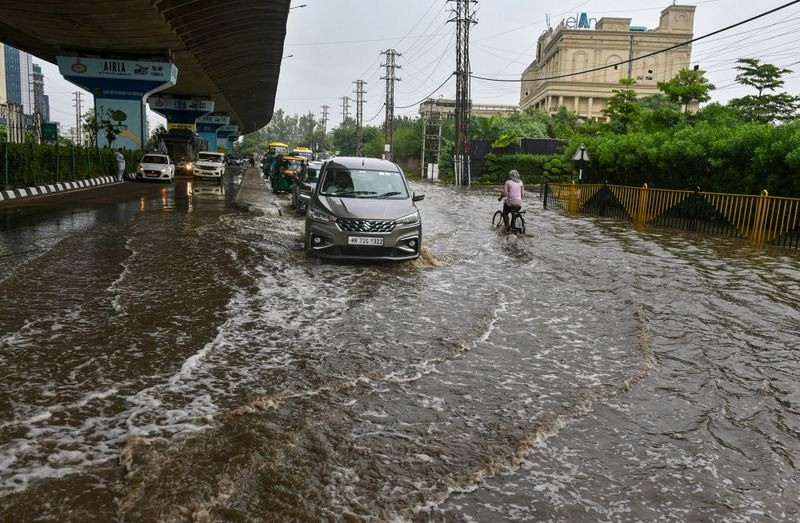
Vehicles wade through a waterlogged road at Badshahpur, Gurugram, July 8, 2026. Photo: PTI, via The Tribune.
The season put the comparison to a test. In early July, the district recorded 350 mm of rain over two days, according to official rainfall data, enough to paralyse Gurugram. The worst of it landed on the National Highway 8 corridor near Narsinghpur, where a road caved in at a site where the Gurugram Metropolitan Development Authority had been using trenchless technology to lay a stormwater culvert. The National Highways Authority of India held GMDA responsible in a post on its official X account, saying water had seeped through utility ducts and washed away the soil supporting the carriageway. GMDA officials, for their part, told local reporters that AIT Chowk, Tulip Chowk, Medanta Road, and the Southern Peripheral Road corridor had held up because their drains had been desilted in time. Municipal Corporation of Gurugram Mayor Rajrani Malhotra credited the de-watering of 28 ponds, in comments to the press, for keeping Rajendra Park, Sector 17, and two other wards flood-free. More than a thousand personnel were deployed citywide, and drivers still abandoned their vehicles at Hero Honda Chowk and waded through the water. GMDA's own count, cited by its Chief Executive Officer, puts the number of known waterlogging-prone locations across the city at 42.
Delhi's Fragmented Flood
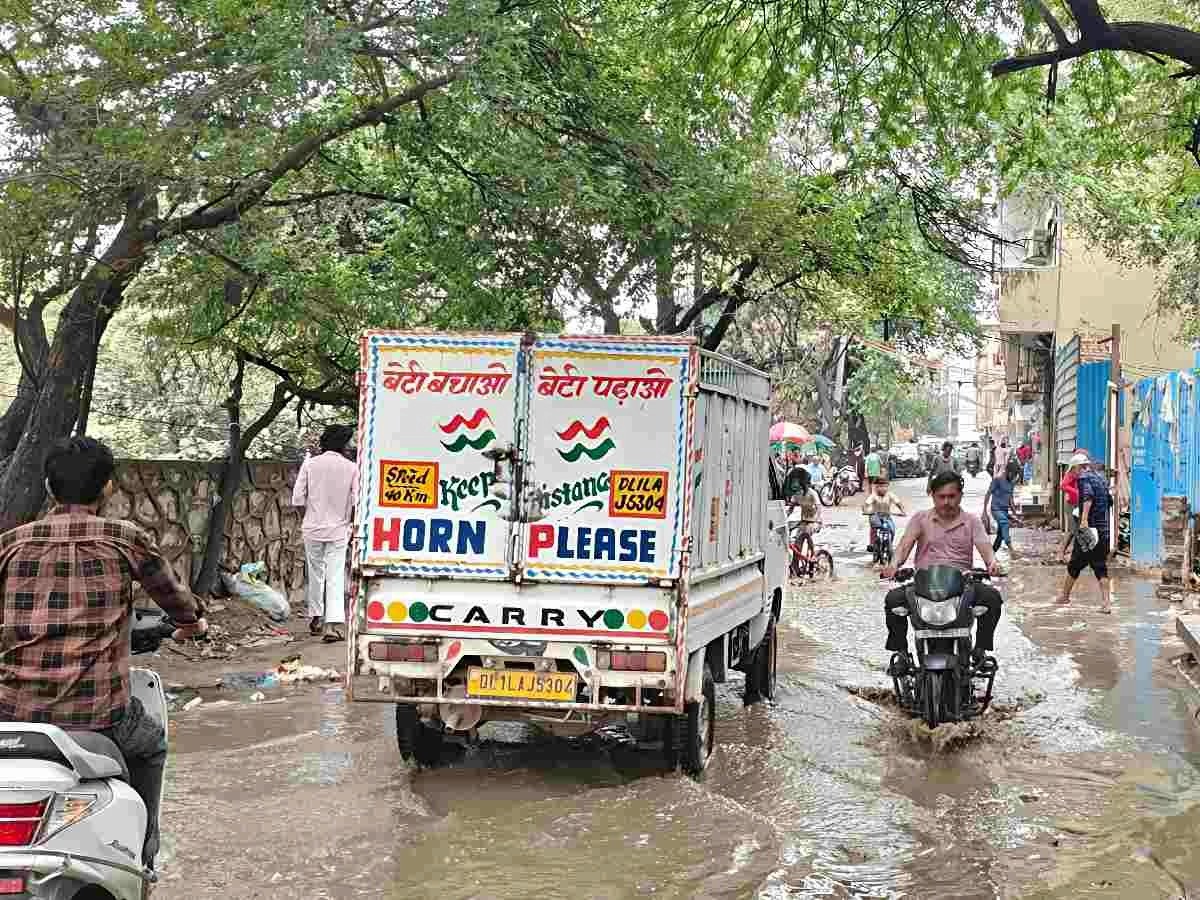
Vehicles pass through a waterlogged road in Hargovind Enclave, Chhattarpur, weeks before Delhi's monsoon officially arrived. Photo: The Patriot.
When Mehrauli, Chhattarpur, Katwaria Sarai, Vasant Kunj, and Saket recorded stagnant water on their roads despite days of largely dry weather, residents pointed not to rainfall but to drains that had simply stopped functioning as drains. An auto-rickshaw driver working the Saket-Chhattarpur-Mehrauli route put it plainly: the danger was never the water sitting on the surface, but the potholes hiding underneath it, invisible until a wheel finds one.
Delhi Traffic Police identified 169 waterlogging points across the capital ahead of the 2026 monsoon, a modest improvement from the 194 flagged the year before, concentrated in Old Rajendra Nagar, Sangam Vihar, Najafgarh, Nangloi, Burari, Kirari, Mundka, Rohtak Road, and the long, battered stretch of the Mehrauli-Badarpur Road. Of those 169 points, the Municipal Corporation of Delhi acknowledged responsibility for only nine, attributing the rest to the Public Works Department. A public interest litigation filed this monsoon in the Delhi High Court laid out the resulting arrangement: with the Government of NCT of Delhi, the MCD, the PWD, the Delhi Jal Board, the Irrigation and Flood Control Department, the NDMC, the DDA, and the Delhi Disaster Management Authority all holding partial jurisdiction, the same neighbourhoods flood every year while no single body owns the failure. The petition invokes the citizens' rights to life and equality under Articles 14 and 21.
Chief Minister Rekha Gupta, at a high-level review meeting reported by multiple outlets, issued a Flood Control Order-2026 ahead of the season, appointing a nodal officer for every identified waterlogging point and warning that negligence would not be tolerated. Officials at the same meeting said the city's pump count had passed 243, with 41 emergency boats added and desilting work under way across 793 drains deeper than four feet, and control rooms running in all twelve municipal zones. When heavy rain hit Delhi-NCR on July 9, the Chief Minister's Office said in a statement that the waterlogging situation was under control within hours, crediting round-the-clock work by the Jal Board, PWD, and MCD. The High Court petition, filed before that statement, was already asking whether a nodal-officer system could hold across a jurisdiction map split eight ways.
What The Money Reveals
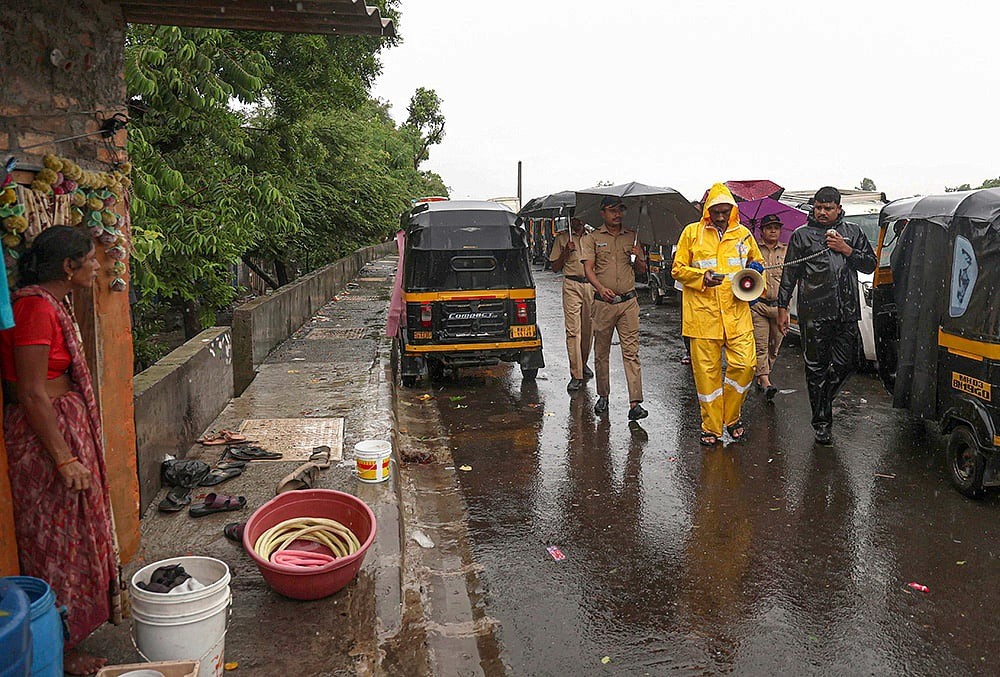
Police and administration officials patrol as the Mithi river rises towards the danger mark, Mumbai, July 6, 2026. Photo: PTI.
Follow the money and the picture sharpens further. The Brihanmumbai Municipal Corporation is among the wealthiest civic bodies in the country, yet the desilting contract for the Mithi river, the channel that carries the bulk of the western suburbs' stormwater, was cleared only in April 2026, according to state assembly proceedings, and remained short of the halfway mark with barely two weeks left before the BMC's own deadline. The river has been narrowed to half its original width over three decades, according to urban researchers who have studied the channel, partly by commercial development, including the Bandra-Kurla Complex, built on land reclaimed from its wetlands. State auditors have flagged unaccounted spending on Mithi clean-up contracts between 2013 and 2016, and the Supreme Court rebuked civic authorities over the river's neglect as far back as 2017. The state government has since approved, per assembly proceedings, a Rs 13,000-crore flood control plan targeting 370 vulnerable hotspots, even as the BMC was, until recently, sitting on fixed deposits worth roughly Rs 78,000 crore while basic drainage work went underfunded. One study covering the decade through 2015 put the annual cost of Mumbai's heavy rains at roughly 2,718 deaths and $1.2 billion in losses.
Money, on these numbers, is rarely the shortage. What varies is where it is directed first, and which neighbourhoods have the standing to make sure it arrives on schedule. A well-connected commercial district can mobilise contractors, media attention, and political pressure within hours of a flood. A settlement without formal land titles, without ratepayer associations, and without proximity to the seats of power, waits its turn, sometimes for a generation.
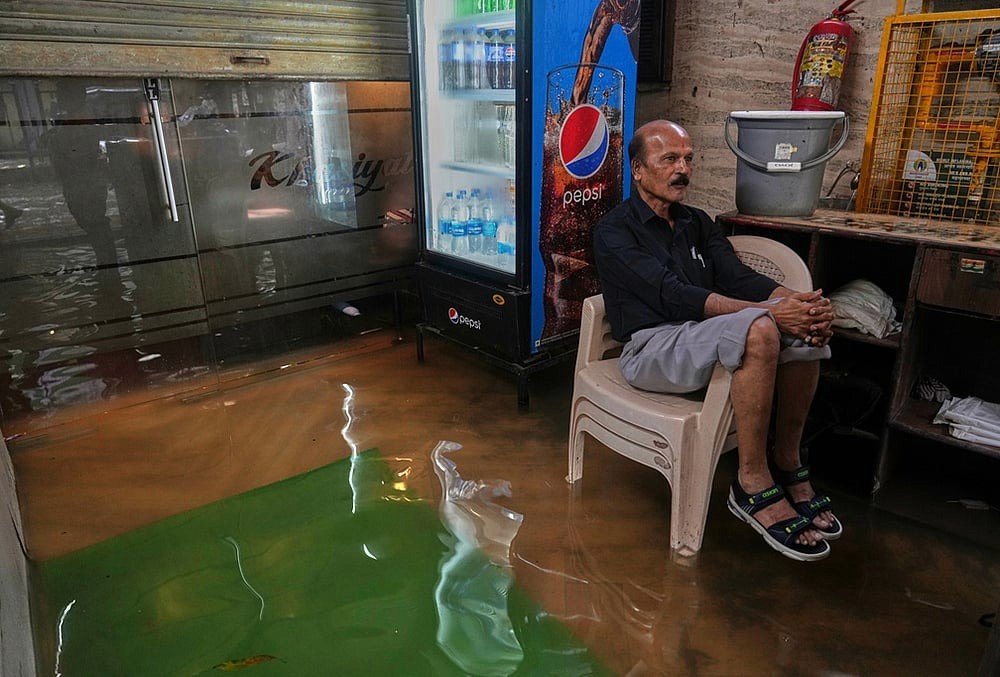
A shopkeeper watches the water level rise inside a shop during monsoon rains in Mumbai, July 4, 2026. Photo: AP/Rafiq Maqbool.
Jai Nakra pushed the cause a step further back than any single budget line. "A significant amount of public money is allocated towards infrastructure, yet we continue to see poor-quality roads, inadequate drainage systems, and cities that are unable to cope with predictable monsoon rainfall," he said. "Corruption is rampant. Money that is meant for public infrastructure often does not reach where it is supposed to." The root cause, in his account, sits further back still, in education: communities that cannot read a budget or question an official have limited means to hold either accountable.
What Makes A City Livable
"Luxury amenities are always a plus, but they are not required for a city to be livable," Amira Kamat said, asked what makes a city livable. "Resilient infrastructure, however, absolutely is. It is the bare minimum that a city should provide to its people." Jai Nakra reached for a different image: "Asking this question is like asking what defines a healthy human being: expensive clothes and luxury watches, or healthy organs. Luxury amenities are only the cherry on top; they are not the cake itself."
Sidhant Madan pointed abroad for a working model. "Singapore is a great example because it combines modern amenities with excellent public infrastructure," he said. "The city is highly walkable, with wide, well-maintained footpaths, safe pedestrian crossings, shaded walkways, and reliable public transport that make it easy to travel without depending on a car. These everyday features, not luxury amenities, are what truly make a city livable."
Flooding As An Invisible Indicator Of Privilege
Asked directly whether flooding has become an indicator of privilege, all three respondents said yes, each pointing to a different fault line. Amira Kamat pointed to income pockets within wealthy neighbourhoods rather than the neighbourhoods themselves. "Even in a wealthy area like SoBo in general, there are still rich and poor pockets," she said. "The people living in the richer parts don't have to worry about the rains because even if it gets bad, they have the option to work from home. But the people living just fifteen minutes away might not have that choice and have to depend on daily travel for their jobs."
Jai Nakra pointed to Mumbai's wider contrast, a city that is home to Asia's largest slum and one of the highest concentrations of billionaires on the continent, within the same municipal limits. "This difference is not because the rain falls differently," he said of the split between rich and poor neighbourhoods. "It is because investment and governance are unequal."
Sidhant Madan returned to the developer-by-developer texture of Gurugram he had described earlier. "There is a noticeable difference between areas developed and actively managed by large, established developers such as DLF, and many other parts of the city," he said, repeating the comparison between DLF's phases and Golf Course Extension Road, Badshahpur, and Old Gurgaon. "This makes me wonder whether some developers invest more in long-term maintenance and infrastructure, while others focus primarily on construction and leave supporting infrastructure to civic authorities."
Economic Hubs Or Vulnerable Communities
Asked whether urban planning should prioritise economic hubs or the most vulnerable communities when a flooding city has to choose where relief and resources go first, the three answered differently. "The people who actually do the work to keep the economic hubs standing, like cleaners, security guards, and other blue-collar workers, are the ones who fall under the vulnerable parts of the city," Amira Kamat said, treating the two categories as overlapping rather than competing. Jai Nakra put the question in constitutional terms rather than as a matter of preference. "As a socialist democracy, India is expected to use public resources to uplift weaker sections of society rather than disproportionately benefiting those who already have wealth and influence," he said, adding that the larger fix has to be eliminating the corruption that diverts funds meant for either group.
Sidhant Madan came down closer to economic hubs, on the reasoning that disruption there ripples outward through jobs and government revenue, while stressing that this should not come at the cost of neglecting vulnerable communities. His preference, in the end, was to leave the call to the people it affects: "I think the priorities should ultimately be decided by the people living in that particular area, because every city and locality has different needs."
Who Is Accountable, And What Accountability Should Look Like
Blame in these situations tends to diffuse until it disappears. Ask who is responsible for a flooded neighbourhood in Delhi, and the honest answer sits somewhere between the eight overlapping agencies named in the Delhi High Court petition, each holding partial jurisdiction, a fragmentation the Flood Control Order-2026 is at least partly an attempt to resolve. Ask in Mumbai, and the answer moves between a municipal corporation with an ₹81,000-crore budget by MLA Rohit Pawar's account, a state government, and a chain of contractors whose desilting numbers are frequently self-reported rather than independently verified, the same gap that let a manhole sit unbarricaded on Khairani Road until it killed someone.
Asked whether recurring flooding in the same localities is a failure of governance, accountability, or planning, all three respondents answered: all of it. "Everyone already knows that Mumbai floods every single monsoon, yet we still haven't seen any real action or proper response from the government," Amira Kamat said. Jai Nakra called corruption the thread running through all three failures, arguing that transparent budgeting and independent media scrutiny are what would let citizens actually enforce accountability rather than simply demand it. Sidhant Madan, pressed to pick one, chose accountability specifically: "Most authorities already know which areas flood every monsoon, yet the same problems continue year after year. This suggests that either long-term solutions are not being implemented, or there is little accountability for ensuring they are completed and maintained."
Real accountability would require three shifts that neither city has fully committed to yet. First, desilting and drainage maintenance need independent, third-party audits rather than contractor self-certification, closing the loophole that has allowed padded and occasionally fictitious silt-removal claims to pass unchecked in the past. Second, jurisdiction over drains, roads, and stormwater systems needs to be consolidated under a single accountable authority in each city, so a flooded lane in Mehrauli cannot be indefinitely batted between the MCD and the PWD while residents wade through it. Third, capital works budgets need to follow population density and vulnerability data rather than land value, ensuring that a settlement's distance from a five-star hotel has no bearing on how quickly its drains get cleared.
Engineers and urban planners have published the diagnosis for years: ageing pipe networks undersized for today's rainfall intensity, unchecked concretisation that has erased the natural sponge of wetlands and mangroves, and construction on floodplains that were never meant to hold buildings. Akshay Deoras, a senior research scientist at the University of Reading, told reporters covering the season that a warming Arabian Sea is altering Mumbai's monsoon pattern from steady seasonal rain toward hyper-concentrated downpours, with the city taking in roughly 80 percent of its typical July rainfall within a matter of days this season, according to his analysis of the data. A widely cited academic account of the city's drainage puts monsoon precipitation over Mumbai up nearly 15 percent between 2001 and 2024 compared to the two decades before it. A drainage system sized for the rainfall patterns of the 1980s was never going to hold against the storms of 2026, in any neighbourhood. Some neighbourhoods were built with a margin for that failure. Others were not.
A Season That Keeps Repeating Itself

Debris clearance work underway after a three-storey chawl collapses in Mumbai's Mankhurd area following heavy rain, July 6, 2026. Photo: PTI.
Every monsoon, the same script plays out with minor variations in place names. This year it was a collapsed chawl in Mankhurd, a landslide on the Mumbai-Pune highway, an eleven-year-old boy killed by a falling tree in Chembur, a fifty-five-year-old man killed by an open manhole in Sakinaka, a road caving in on NH-8 outside Gurugram, and Mehrauli residents watching water sit on their roads for days after the rain had stopped. It was a High Court petition asking, in essence, why a city's poorer half should have to litigate for the drainage its wealthier half takes for granted, and it was a Municipal Corporation of Gurugram press conference the same week claiming that pre-monsoon desilting had kept entire sectors dry a few kilometres from where NHAI and GMDA were publicly blaming each other for a highway collapse.
Each of the three respondents closed with the same instinct: a direct question to the people who run these cities. Amira Kamat wants to know where the taxpayers' money is actually going when the roads, the infrastructure, the safety, and the public transport keep failing in the same way, year after year. Jai Nakra wants an explanation for why localities that authorities have known about for years keep flooding despite the public money allocated for exactly that problem, and who is being held responsible for the failure to deliver a lasting fix. Sidhant Madan's question is the simplest of the three, and the hardest one to answer with a single name: who is truly responsible for a city's monsoon preparedness?
The rain itself will keep intensifying. That much is now a matter of climate record rather than speculation. What remains a matter of choice is whether the infrastructure meant to meet it gets built for the whole city, or continues to trail off exactly where the property prices do.
Data and reporting referenced from IMD rainfall bulletins, the Brihanmumbai Municipal Corporation, the Municipal Corporation of Delhi's 2026 monsoon preparedness report, the Delhi High Court PIL filings, the Delhi government's Flood Control Order-2026, the Gurugram Metropolitan Development Authority and Municipal Corporation of Gurugram, the National Highways Authority of India, Maharashtra assembly proceedings, and interviews conducted by French Press Global with Amira Kamat, Jai Nakra, and Sidhant Madan, July 2026.
Photo Credits
Header: People hold umbrellas on a water-logged Mumbai street, July 6, 2026. AP/Rafiq Maqbool, via Outlook India.
Vehicles drive through a waterlogged Mumbai street on the season's first heavy day, July 1, 2026. AP/Rafiq Maqbool, via Outlook India.
Workers clear a fallen tree from a Mumbai street, July 5, 2026. AP/Rafiq Maqbool, via Outlook India.
Police and administration officials patrol as the Mithi river nears its danger mark, July 6, 2026. PTI, via Outlook India.
Vehicles wade through a waterlogged road at Badshahpur, Gurugram, July 8, 2026. PTI, via The Tribune.
Vehicles pass through a waterlogged road in Hargovind Enclave, Chhattarpur, Delhi. The Patriot.
A shopkeeper watches the water level rise inside a shop, Mumbai, July 4, 2026. AP/Rafiq Maqbool, via Outlook India.
Debris clearance after a chawl collapse in Mankhurd, Mumbai, July 6, 2026. PTI, via Outlook India.
TO BE CONTINUED, FOR SUBSCRIBERS ONLY.
This is where the surface ends and the reporting begins.
The complete piece, the full archive, and access to The French Press Circle. Reporting answerable only to its readers.
Already a subscriber ?
Login
Read these on the house, with our compliments.
A selection from the current issue, open to all readers. Read them in full. The rest is one decision away.









A brooding silence settles over Colaba during a downpour. Waiters stand at restaurant doorways under awnings, watching traffic glide past on roads that have absorbed the water rather than surrendered to it. Twenty kilometres north, in Kalyan or Dombivli, that same hour of rain turns lanes into channels, shopfronts into sandbagged bunkers, and commutes into gambles. In Delhi, the contrast plays out on an east-west axis rather than a north-south one. The broad, tree-lined avenues of Lutyens' Delhi drain within the hour, while Mehrauli, Chhattarpur, and Sangam Vihar sit in standing water for days, rain or no rain. This is the visible result of a century of decisions about where drains get built first, where they get desilted on schedule, and whose complaints get logged.
The rain doesn't discriminate. The drains do.
People hold umbrellas as they walk on a water-logged street during monsoon rains in Mumbai, July 6, 2026. Photo: AP/Rafiq Maqbool.
A Season That Arrived Late And Hit Hard
Mumbai's monsoon showed up thirteen days behind schedule this year, finally breaking on June 24, tied among the latest onset dates the city has recorded since 1951. The delay bought the city nothing. Within hours of the season's first spell, automatic weather stations logged more than 200 mm of rain in eight hours across parts of the city, and Saki Naka, Andheri, King Circle, and Everard Nagar were already underwater. The Andheri Subway, a recurring flashpoint every season, went under again.
Vehicles drive through a waterlogged street on the season's first heavy day, Mumbai, July 1, 2026. Photo: AP/Rafiq Maqbool.
By the first week of July, the picture had turned severe enough for the India Meteorological Department to issue four consecutive red alerts, its highest warning category, in seven days. Colaba's observatory recorded 791 mm of rainfall that week, more than the area's entire climatological average for the month, while Santacruz logged 879 mm, nearly its full monthly normal, within a single week. Some neighbourhoods took in 200 to 300 mm in a single 24-hour stretch, more than double a typical heavy monsoon spell, per IMD figures reported at the time. The BMC shut schools, advised residents to work from home, and watched trains and flights back up: local media reported 17 cancellations and more than 200 delays on a single day.
On paper, South Mumbai took the heavier battering. And yet residents of the same city watched a familiar split-screen unfold. Colaba's roads cleared within hours, while Thane, Mulund, Kalyan, and Dombivli stayed underwater for days, with a road collapse in Dombivli and flooded underpasses in Navi Mumbai serving as recurring backdrops to the season. Low-lying pockets such as Chembur and Vikhroli were repeatedly inundated alongside Andheri. In Kalyan, the disparity has become routine enough that residents have reportedly stopped filing complaints, choosing instead to plan their movements around the water rather than wait for it to be addressed.
Amira Kamat, 21, a business development and marketing intern at a Mumbai firm, sees the split running along income lines rather than rainfall totals. "Even the wealthy areas in Mumbai flood occasionally, but it doesn't come to the point of danger like it does for others," she said. "The wealthy don't have to worry about basic survival."
The Deaths That Punctuated The Season
Workers clear a fallen tree from a Mumbai street during the same week's rains, July 5, 2026. Photo: AP/Rafiq Maqbool.
Two deaths in quick succession turned the season's abstractions into headlines. In late June, a tree fell on a school bus carrying 18 children in Chembur, killing an eleven-year-old boy and seriously injuring five others. Barely a week later, on July 2, a 55-year-old Andheri East resident named Aslam Isak Shaikh fell into an open manhole on Khairani Road near Sakinaka while walking home, looking at his phone in the rain. Contractual workers had removed the manhole cover to install a protective mesh, a mandatory monsoon safety measure, but left the site without barricades or anyone posted to warn pedestrians. Rescue teams searched for over three hours and recovered only his umbrella and slippers before finding his body.
Sidhant Madan, a Gurugram resident, cited the same incident without prompting when asked whether recurring flooding is a climate, infrastructure, or political problem. "Officials claimed the city was fully prepared for the monsoon, yet almost immediately a man fell into an open manhole during heavy rains," he said. "Incidents like these highlight the gap between official assurances and the reality on the ground."
Municipal Commissioner Ashwini Bhide suspended four officials, including an Assistant Municipal Commissioner, and ordered a seven-day inquiry. Mumbai Mayor Ritu Tawade, speaking to reporters after visiting the site, called it "a huge lapse on the part of the administration," adding that she had held meetings on the exact issue and instructed officials to finish covering manholes before the monsoon began. On the floor of the Maharashtra Assembly, Speaker Rahul Narwekar called the death tantamount to culpable homicide and asked the state government to place a detailed statement before the House. NCP (Sharad Pawar faction) MLA Rohit Pawar, in comments to television reporters, put a number to the gap: the BMC's budget runs to roughly ₹81,000 crore by his account, of which about ₹250 crore goes toward pre-monsoon work on manholes, drains, and trees. "Unfortunately, people fall into these manholes and lose their lives due to a lack of proper maintenance, this is a recurring annual issue," Pawar said, adding that junior workers face consequences while senior officers rarely do.
In 2017, gastroenterologist Dr Deepak Amarapurkar died after falling into an open manhole in Prabhadevi, an incident that drew comparable outrage at the time. In September 2024, a woman died after falling into a stormwater drain in Andheri during a downpour. Nine years and two administrations on, Sakinaka produced the same suspensions and the same inquiry committee.
Infrastructure Has An Address
The mechanics behind the divide are neither mysterious nor new. South Mumbai's roads were engineered generations ago with gradients that carry water away from the surface, alongside stormwater drains and tree cover built as functioning infrastructure rather than landscaping. The suburbs, expanded rapidly and informally to house a growing population, absorbed density without a matching investment in the systems meant to carry that density's waste and runoff.
Hussain Indorewala, who teaches at the Kamla Raheja Vidyanidhi Institute for Architecture and Environmental Studies, told reporters covering the season that the city has "not enough drains for the water to run off," calling Mumbai "impermeable" even as its groundwater table falls. "This is a general crisis of urban planning," he said. "Over the past two to three decades, we've seen that planning is oriented towards the real estate sector." Sheema Fatima, a professor at NMIMS's Balwant Sheth School of Architecture, made a related point in the same coverage about what gets left out of development plans: common spaces, drainage, and tree cover give way to car parks and housing valuations in the calculations builders and planners actually run.
Jai Nakra, 23, a law student at NMIMS Mumbai, put the comparison at street level. "Areas such as South Mumbai, where wealthier people live, experience comparatively less flooding," he said. "Meanwhile, places like Ville Parle, which is not even a slum, or areas such as Bandra East often experience severe flooding where roads become almost unusable." He carried the same comparison over to Gurugram: infrastructure clusters where influential or wealthy people live, he said, while ordinary localities wait, a pattern he called "unequal planning" rather than simply poor planning.
In Gurugram, a city built largely by private developers, Sidhant Madan traced the gap in more than road quality. "The groundwater table in many parts of Gurugram has fallen so drastically that numerous residential societies rely on private water tankers every single day," Madan said. "Those who can afford these services continue their daily lives with relatively little disruption, while others face water shortages and unreliable public supply." He drew the comparison out directly: "DLF Phases I to V often seem to have better-maintained roads, drainage, and overall upkeep, which helps them remain functional during heavy rainfall. In contrast, areas like Golf Course Extension Road, Badshahpur, and parts of Old Gurgaon are much more prone to waterlogging and can become difficult to access."
Vehicles wade through a waterlogged road at Badshahpur, Gurugram, July 8, 2026. Photo: PTI, via The Tribune.
The season put the comparison to a test. In early July, the district recorded 350 mm of rain over two days, according to official rainfall data, enough to paralyse Gurugram. The worst of it landed on the National Highway 8 corridor near Narsinghpur, where a road caved in at a site where the Gurugram Metropolitan Development Authority had been using trenchless technology to lay a stormwater culvert. The National Highways Authority of India held GMDA responsible in a post on its official X account, saying water had seeped through utility ducts and washed away the soil supporting the carriageway. GMDA officials, for their part, told local reporters that AIT Chowk, Tulip Chowk, Medanta Road, and the Southern Peripheral Road corridor had held up because their drains had been desilted in time. Municipal Corporation of Gurugram Mayor Rajrani Malhotra credited the de-watering of 28 ponds, in comments to the press, for keeping Rajendra Park, Sector 17, and two other wards flood-free. More than a thousand personnel were deployed citywide, and drivers still abandoned their vehicles at Hero Honda Chowk and waded through the water. GMDA's own count, cited by its Chief Executive Officer, puts the number of known waterlogging-prone locations across the city at 42.
Delhi's Fragmented Flood
Vehicles pass through a waterlogged road in Hargovind Enclave, Chhattarpur, weeks before Delhi's monsoon officially arrived. Photo: The Patriot.
When Mehrauli, Chhattarpur, Katwaria Sarai, Vasant Kunj, and Saket recorded stagnant water on their roads despite days of largely dry weather, residents pointed not to rainfall but to drains that had simply stopped functioning as drains. An auto-rickshaw driver working the Saket-Chhattarpur-Mehrauli route put it plainly: the danger was never the water sitting on the surface, but the potholes hiding underneath it, invisible until a wheel finds one.
Delhi Traffic Police identified 169 waterlogging points across the capital ahead of the 2026 monsoon, a modest improvement from the 194 flagged the year before, concentrated in Old Rajendra Nagar, Sangam Vihar, Najafgarh, Nangloi, Burari, Kirari, Mundka, Rohtak Road, and the long, battered stretch of the Mehrauli-Badarpur Road. Of those 169 points, the Municipal Corporation of Delhi acknowledged responsibility for only nine, attributing the rest to the Public Works Department. A public interest litigation filed this monsoon in the Delhi High Court laid out the resulting arrangement: with the Government of NCT of Delhi, the MCD, the PWD, the Delhi Jal Board, the Irrigation and Flood Control Department, the NDMC, the DDA, and the Delhi Disaster Management Authority all holding partial jurisdiction, the same neighbourhoods flood every year while no single body owns the failure. The petition invokes the citizens' rights to life and equality under Articles 14 and 21.
Chief Minister Rekha Gupta, at a high-level review meeting reported by multiple outlets, issued a Flood Control Order-2026 ahead of the season, appointing a nodal officer for every identified waterlogging point and warning that negligence would not be tolerated. Officials at the same meeting said the city's pump count had passed 243, with 41 emergency boats added and desilting work under way across 793 drains deeper than four feet, and control rooms running in all twelve municipal zones. When heavy rain hit Delhi-NCR on July 9, the Chief Minister's Office said in a statement that the waterlogging situation was under control within hours, crediting round-the-clock work by the Jal Board, PWD, and MCD. The High Court petition, filed before that statement, was already asking whether a nodal-officer system could hold across a jurisdiction map split eight ways.
What The Money Reveals
Police and administration officials patrol as the Mithi river rises towards the danger mark, Mumbai, July 6, 2026. Photo: PTI.
Follow the money and the picture sharpens further. The Brihanmumbai Municipal Corporation is among the wealthiest civic bodies in the country, yet the desilting contract for the Mithi river, the channel that carries the bulk of the western suburbs' stormwater, was cleared only in April 2026, according to state assembly proceedings, and remained short of the halfway mark with barely two weeks left before the BMC's own deadline. The river has been narrowed to half its original width over three decades, according to urban researchers who have studied the channel, partly by commercial development, including the Bandra-Kurla Complex, built on land reclaimed from its wetlands. State auditors have flagged unaccounted spending on Mithi clean-up contracts between 2013 and 2016, and the Supreme Court rebuked civic authorities over the river's neglect as far back as 2017. The state government has since approved, per assembly proceedings, a Rs 13,000-crore flood control plan targeting 370 vulnerable hotspots, even as the BMC was, until recently, sitting on fixed deposits worth roughly Rs 78,000 crore while basic drainage work went underfunded. One study covering the decade through 2015 put the annual cost of Mumbai's heavy rains at roughly 2,718 deaths and $1.2 billion in losses.
Money, on these numbers, is rarely the shortage. What varies is where it is directed first, and which neighbourhoods have the standing to make sure it arrives on schedule. A well-connected commercial district can mobilise contractors, media attention, and political pressure within hours of a flood. A settlement without formal land titles, without ratepayer associations, and without proximity to the seats of power, waits its turn, sometimes for a generation.
A shopkeeper watches the water level rise inside a shop during monsoon rains in Mumbai, July 4, 2026. Photo: AP/Rafiq Maqbool.
Jai Nakra pushed the cause a step further back than any single budget line. "A significant amount of public money is allocated towards infrastructure, yet we continue to see poor-quality roads, inadequate drainage systems, and cities that are unable to cope with predictable monsoon rainfall," he said. "Corruption is rampant. Money that is meant for public infrastructure often does not reach where it is supposed to." The root cause, in his account, sits further back still, in education: communities that cannot read a budget or question an official have limited means to hold either accountable.
What Makes A City Livable
"Luxury amenities are always a plus, but they are not required for a city to be livable," Amira Kamat said, asked what makes a city livable. "Resilient infrastructure, however, absolutely is. It is the bare minimum that a city should provide to its people." Jai Nakra reached for a different image: "Asking this question is like asking what defines a healthy human being: expensive clothes and luxury watches, or healthy organs. Luxury amenities are only the cherry on top; they are not the cake itself."
Sidhant Madan pointed abroad for a working model. "Singapore is a great example because it combines modern amenities with excellent public infrastructure," he said. "The city is highly walkable, with wide, well-maintained footpaths, safe pedestrian crossings, shaded walkways, and reliable public transport that make it easy to travel without depending on a car. These everyday features, not luxury amenities, are what truly make a city livable."
Flooding As An Invisible Indicator Of Privilege
Asked directly whether flooding has become an indicator of privilege, all three respondents said yes, each pointing to a different fault line. Amira Kamat pointed to income pockets within wealthy neighbourhoods rather than the neighbourhoods themselves. "Even in a wealthy area like SoBo in general, there are still rich and poor pockets," she said. "The people living in the richer parts don't have to worry about the rains because even if it gets bad, they have the option to work from home. But the people living just fifteen minutes away might not have that choice and have to depend on daily travel for their jobs."
Jai Nakra pointed to Mumbai's wider contrast, a city that is home to Asia's largest slum and one of the highest concentrations of billionaires on the continent, within the same municipal limits. "This difference is not because the rain falls differently," he said of the split between rich and poor neighbourhoods. "It is because investment and governance are unequal."
Sidhant Madan returned to the developer-by-developer texture of Gurugram he had described earlier. "There is a noticeable difference between areas developed and actively managed by large, established developers such as DLF, and many other parts of the city," he said, repeating the comparison between DLF's phases and Golf Course Extension Road, Badshahpur, and Old Gurgaon. "This makes me wonder whether some developers invest more in long-term maintenance and infrastructure, while others focus primarily on construction and leave supporting infrastructure to civic authorities."
Economic Hubs Or Vulnerable Communities
Asked whether urban planning should prioritise economic hubs or the most vulnerable communities when a flooding city has to choose where relief and resources go first, the three answered differently. "The people who actually do the work to keep the economic hubs standing, like cleaners, security guards, and other blue-collar workers, are the ones who fall under the vulnerable parts of the city," Amira Kamat said, treating the two categories as overlapping rather than competing. Jai Nakra put the question in constitutional terms rather than as a matter of preference. "As a socialist democracy, India is expected to use public resources to uplift weaker sections of society rather than disproportionately benefiting those who already have wealth and influence," he said, adding that the larger fix has to be eliminating the corruption that diverts funds meant for either group.
Sidhant Madan came down closer to economic hubs, on the reasoning that disruption there ripples outward through jobs and government revenue, while stressing that this should not come at the cost of neglecting vulnerable communities. His preference, in the end, was to leave the call to the people it affects: "I think the priorities should ultimately be decided by the people living in that particular area, because every city and locality has different needs."
Who Is Accountable, And What Accountability Should Look Like
Blame in these situations tends to diffuse until it disappears. Ask who is responsible for a flooded neighbourhood in Delhi, and the honest answer sits somewhere between the eight overlapping agencies named in the Delhi High Court petition, each holding partial jurisdiction, a fragmentation the Flood Control Order-2026 is at least partly an attempt to resolve. Ask in Mumbai, and the answer moves between a municipal corporation with an ₹81,000-crore budget by MLA Rohit Pawar's account, a state government, and a chain of contractors whose desilting numbers are frequently self-reported rather than independently verified, the same gap that let a manhole sit unbarricaded on Khairani Road until it killed someone.
Asked whether recurring flooding in the same localities is a failure of governance, accountability, or planning, all three respondents answered: all of it. "Everyone already knows that Mumbai floods every single monsoon, yet we still haven't seen any real action or proper response from the government," Amira Kamat said. Jai Nakra called corruption the thread running through all three failures, arguing that transparent budgeting and independent media scrutiny are what would let citizens actually enforce accountability rather than simply demand it. Sidhant Madan, pressed to pick one, chose accountability specifically: "Most authorities already know which areas flood every monsoon, yet the same problems continue year after year. This suggests that either long-term solutions are not being implemented, or there is little accountability for ensuring they are completed and maintained."
Real accountability would require three shifts that neither city has fully committed to yet. First, desilting and drainage maintenance need independent, third-party audits rather than contractor self-certification, closing the loophole that has allowed padded and occasionally fictitious silt-removal claims to pass unchecked in the past. Second, jurisdiction over drains, roads, and stormwater systems needs to be consolidated under a single accountable authority in each city, so a flooded lane in Mehrauli cannot be indefinitely batted between the MCD and the PWD while residents wade through it. Third, capital works budgets need to follow population density and vulnerability data rather than land value, ensuring that a settlement's distance from a five-star hotel has no bearing on how quickly its drains get cleared.
Engineers and urban planners have published the diagnosis for years: ageing pipe networks undersized for today's rainfall intensity, unchecked concretisation that has erased the natural sponge of wetlands and mangroves, and construction on floodplains that were never meant to hold buildings. Akshay Deoras, a senior research scientist at the University of Reading, told reporters covering the season that a warming Arabian Sea is altering Mumbai's monsoon pattern from steady seasonal rain toward hyper-concentrated downpours, with the city taking in roughly 80 percent of its typical July rainfall within a matter of days this season, according to his analysis of the data. A widely cited academic account of the city's drainage puts monsoon precipitation over Mumbai up nearly 15 percent between 2001 and 2024 compared to the two decades before it. A drainage system sized for the rainfall patterns of the 1980s was never going to hold against the storms of 2026, in any neighbourhood. Some neighbourhoods were built with a margin for that failure. Others were not.
A Season That Keeps Repeating Itself
Debris clearance work underway after a three-storey chawl collapses in Mumbai's Mankhurd area following heavy rain, July 6, 2026. Photo: PTI.
Every monsoon, the same script plays out with minor variations in place names. This year it was a collapsed chawl in Mankhurd, a landslide on the Mumbai-Pune highway, an eleven-year-old boy killed by a falling tree in Chembur, a fifty-five-year-old man killed by an open manhole in Sakinaka, a road caving in on NH-8 outside Gurugram, and Mehrauli residents watching water sit on their roads for days after the rain had stopped. It was a High Court petition asking, in essence, why a city's poorer half should have to litigate for the drainage its wealthier half takes for granted, and it was a Municipal Corporation of Gurugram press conference the same week claiming that pre-monsoon desilting had kept entire sectors dry a few kilometres from where NHAI and GMDA were publicly blaming each other for a highway collapse.
Each of the three respondents closed with the same instinct: a direct question to the people who run these cities. Amira Kamat wants to know where the taxpayers' money is actually going when the roads, the infrastructure, the safety, and the public transport keep failing in the same way, year after year. Jai Nakra wants an explanation for why localities that authorities have known about for years keep flooding despite the public money allocated for exactly that problem, and who is being held responsible for the failure to deliver a lasting fix. Sidhant Madan's question is the simplest of the three, and the hardest one to answer with a single name: who is truly responsible for a city's monsoon preparedness?
The rain itself will keep intensifying. That much is now a matter of climate record rather than speculation. What remains a matter of choice is whether the infrastructure meant to meet it gets built for the whole city, or continues to trail off exactly where the property prices do.
Data and reporting referenced from IMD rainfall bulletins, the Brihanmumbai Municipal Corporation, the Municipal Corporation of Delhi's 2026 monsoon preparedness report, the Delhi High Court PIL filings, the Delhi government's Flood Control Order-2026, the Gurugram Metropolitan Development Authority and Municipal Corporation of Gurugram, the National Highways Authority of India, Maharashtra assembly proceedings, and interviews conducted by French Press Global with Amira Kamat, Jai Nakra, and Sidhant Madan, July 2026.
Photo Credits
Header: People hold umbrellas on a water-logged Mumbai street, July 6, 2026. AP/Rafiq Maqbool, via Outlook India.
Vehicles drive through a waterlogged Mumbai street on the season's first heavy day, July 1, 2026. AP/Rafiq Maqbool, via Outlook India.
Workers clear a fallen tree from a Mumbai street, July 5, 2026. AP/Rafiq Maqbool, via Outlook India.
Police and administration officials patrol as the Mithi river nears its danger mark, July 6, 2026. PTI, via Outlook India.
Vehicles wade through a waterlogged road at Badshahpur, Gurugram, July 8, 2026. PTI, via The Tribune.
Vehicles pass through a waterlogged road in Hargovind Enclave, Chhattarpur, Delhi. The Patriot.
A shopkeeper watches the water level rise inside a shop, Mumbai, July 4, 2026. AP/Rafiq Maqbool, via Outlook India.
Debris clearance after a chawl collapse in Mankhurd, Mumbai, July 6, 2026. PTI, via Outlook India.
TO BE CONTINUED, FOR SUBSCRIBERS ONLY.
This is where the surface ends and the reporting begins.
The complete piece, the full archive, and access to The French Press Circle. Reporting answerable only to its readers.
Already a subscriber ?
Login
Read these on the house, with our compliments.
A selection from the current issue, open to all readers. Read them in full. The rest is one decision away.