
The docket reads Original Application No. 137 of 2026, Aakash Ranison versus the Central Pollution Control Board and eighteen respondent companies, and it has been sitting before the Principal Bench of the National Green Tribunal in New Delhi since January. The matter remains sub judice. Nothing in this piece should be read as an assertion of wrongdoing against any party named or unnamed in the filing, and every reference to the respondent side stays deliberately general, because a tribunal is still weighing facts that a magazine is not entitled to pre-judge.

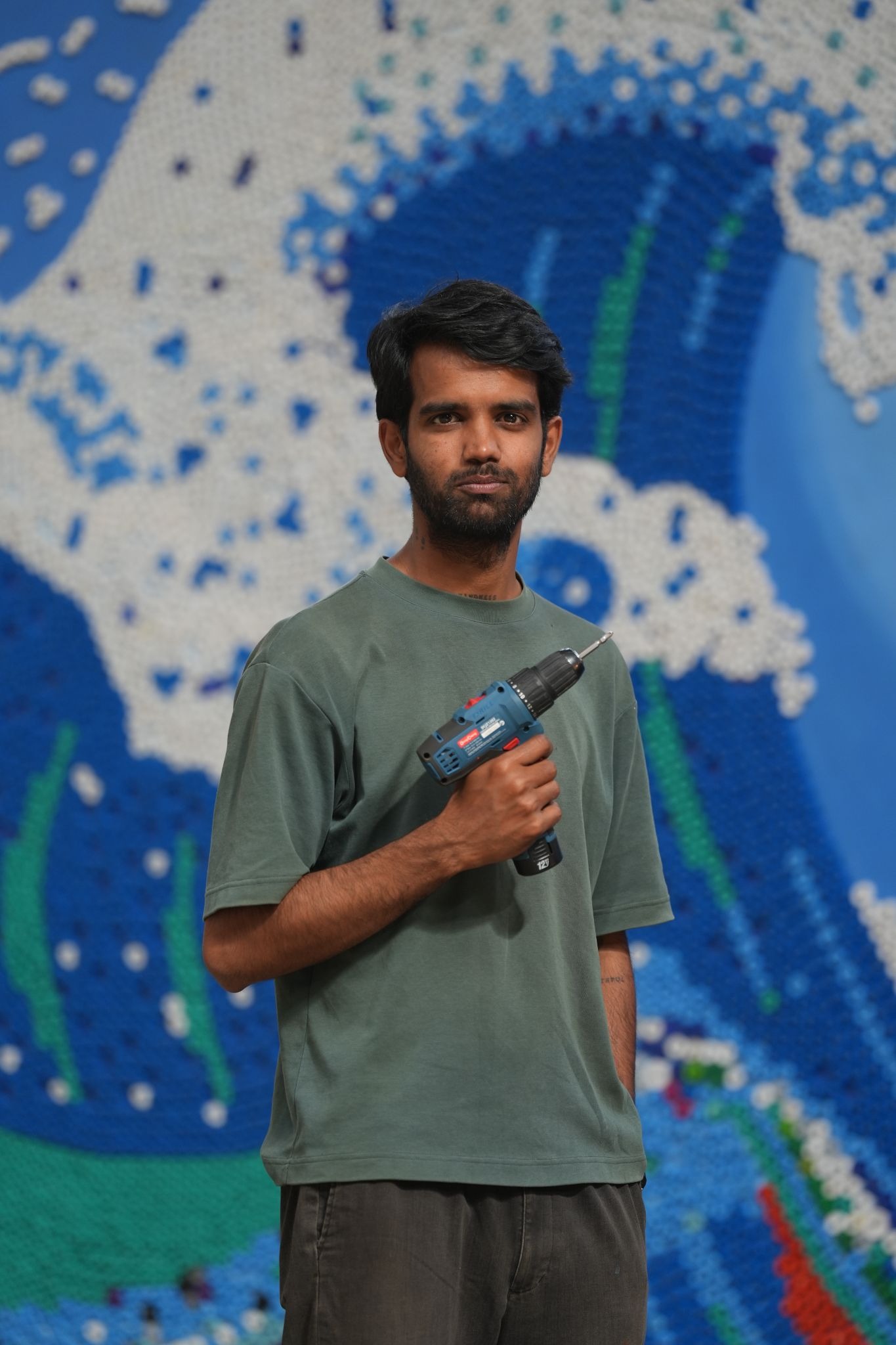
Aakash Rainson in front of his bottle-cap rendering of Hokusai’s Great Wave.
What can be reported plainly is the regulator's own account of the underlying problem, and it is a striking one. In a response filed directly in this matter, the Central Pollution Control Board told the tribunal that Category I rigid plastic, the packaging class that legally includes both beverage bottles and their caps, had achieved roughly 76 per cent compliance against its Extended Producer Responsibility target between the 2022 and 2025 financial years. The board's own figures put the target at 58.67 lakh tonnes and the fulfilment at 44.64 lakh tonnes, a gap of nearly fourteen lakh tonnes sitting unaccounted for inside a rule that, on paper, already covers the very object Ranison built his sculpture from. The regulator's data does not identify which caps went missing or where. It simply confirms that a compliance shortfall exists at the category level the petition addresses, filed by the CPCB itself, in this proceeding, before this bench.
The tribunal has since folded Ranison's petition into a wider inquiry, clubbing it with two older applications, OA 993 of 2024 and OA 926 of 2024, both already examining whether India's plastic collection and recycling framework needs structural reform. Replies from respondent companies have continued arriving through the year, with filings logged as recently as early September, and this magazine has sought confirmation directly from the CPCB and the registry on the status of the listing and the next scheduled date, a step every fact in this piece has been checked against ahead of print. Legal counsel has reviewed this copy before layout, and any detail that could not be independently confirmed against the order sheet has been left out rather than assumed.
None of this explains why a bottle cap sits on the cover of this issue. For that, the story has to move from the registry to the gallery floor, and from the gallery floor back to Ranison himself, who insists the two were never separate projects to begin with.
"THE WHOLE POINT IS SPEED"
Ranison is unusually candid about how procedural the fight has already become. "We filed the petition in January, and from then to now, we've mostly just been waiting for all eighteen companies to submit their replies," he says. "We've already had three hearings pushed just for that." He counts the delay in months rather than milestones. "So necessarily, ten months have passed largely in that waiting period." Asked whether the argument that this belongs with a ministry rather than a tribunal has any real weight behind it, he does not dismiss it outright. "To an extent, they're technically right, this may sit more naturally with the ministry than with a tribunal," he says. "But part of what's happening is that this technicality is also being used to delay things." His response has been to try to fold the ministry into the same proceeding rather than fight the jurisdictional question. "Our approach is to bring the Environment Ministry into this process directly, if that's what's needed to actually move the policy forward, we're ready to involve them rather than treat the distinction as a wall."
Rainson filed his petition in January, ten months on the matter is still waiting on replies.
He is equally clear about what a technical loss would still mean to him. "Yes, I'd count that as a win," he says, of a scenario where the tribunal decides the matter needs formal rule-making rather than a direct order. "Since our approach isn't to fight the rule-making process, it's to bring the Ministry of Environment in as a party to the same petition. All the brands are already talking about this issue now, that momentum alone matters."
Asked what success looks like six months from now, he reaches past the courtroom entirely. "I'd want to see the government actively involved," he says. "I'd count it as a success if there are real, active talks underway about forming a committee or coalition dedicated to shaping tethered cap policy in India. That, to me, would mean the idea has moved from a petition into something the country is genuinely building toward."
And pressed on whether he would still call his own art a success if the litigation failed outright, he answers without hesitation. "Honestly, it won't fail," he says. "The policy will come, it's just a matter of time, and all we're doing is pushing for urgency, because every day caps stay untethered is another day they're littered. We're late already, so speed is the point." He goes further, predicting the companies now filing replies will eventually claim the outcome as their own. "Right now they're opposing and delaying it, but once it happens, they'll want to be seen leading it. So really, this is less a policy matter and more a nationwide awareness campaign against plastic pollution, one that happens to run through a tribunal."
THE ARGUMENT ITSELF
The petition asks for something narrower than most environmental litigation attempts. Ranison is not asking the tribunal to punish anyone for the past. He is asking it to mandate a redesign for the future, specifically the tethered cap already required across the European Union, which keeps a bottle's lid physically fused to its neck so the two travel through the waste stream together rather than the cap detaching and vanishing. "Better enforcement depends on trusting people to follow rules, and that's exactly where the system keeps failing, we already have policies, but people find loopholes," he says. "A design mandate significantly reduces that dependency. Once the cap design changes, it changes forever, I don't have to police anyone or check in every year." He describes enforcement as a contest with no finish line. "Enforcement is a never-ending fight with no confirmed finish line, even at a hundred per cent compliance, you'd have to keep maintaining it. A design fix, once done, is done."

Working on the crest of the wave. Every cap goes on by hand, one screw at a time.
He traces the cap's original design back to a negotiation that never included the one party now filing objections to changing it. "When a bottle cap was first designed, there were essentially three people at the table, the client who wanted the bottle, the designer or technologist building it, and the government checking food and consumer safety," he says. "Nobody was representing the environment. That's what a tethered cap mandate does, it puts the environment in that room."
A WAVE MADE OF WHAT THE SEA REFUSES
The Wave predates the petition's filing by several months, and Ranison is precise about the order of operations. "The petition was the first idea, since bringing real change was always the goal," he says. "But while I was in the process of filing it, I realized the petition alone wouldn't be enough to actually win this. And my own skills lean into communication, so I thought about how to use that, and that's when the art came in." The trigger for turning a legal filing into a public artwork was practical rather than dramatic. "The petition was the actual trigger, wanting real change in India was always the starting point. The art installation came after, as a deliberate choice, something I added to turn this into a public movement people could actually take part in."

Sections of the wave are assembled flat on the floor before they are raised onto the wall.
The image itself arrived from a chance sighting on a street in Berlin. "I first saw a tethered cap on a bottle in Berlin, during an incubation program, sometime around September," he says. "I noticed it around the city a few times but didn't think much of it, just appreciated it and moved on." The thought did not fully land until he was back in Himachal Pradesh. "It wasn't until November 2025, back in Mansari, that the real thought landed, why doesn't India have this. That's when I started researching and found my advocate, and we began working toward filing a Public Interest Litigation at the National Green Tribunal." Writing felt too slow for what he wanted to say and a documentary felt too narrow in reach, so he turned to a material he had never worked with. "I decided to make art out of the bottle cap itself, something I'd never done before, and learned as I went."
Two versions of the sculpture now exist. "The first installation, Captured Earth, with Godrej Conscious Collective, took about fifteen thousand to sixteen thousand bottle caps," he says. "The second, with the Global Methane Hub and Purpose, took about thirty thousand." Sourcing that volume of material, he says, is never simple. "Sourcing them isn't simple, honestly it's hard to even trace a clean origin, because we work through rag pickers, waste collectors, segregators, recyclers, and collection centers, mostly unorganized sectors with no formal structure. We open every channel we can to plastic waste workers and pull from wherever we can."
On why he chose Hokusai's composition specifically, he is direct about the projection he wanted to put in front of people. "What we wanted to communicate through it was one projection, by 2050, there could be more plastic in the ocean than fish, by weight," he says. "We were installing this in Bombay, right next to the sea, so it felt urgent to put that fact directly in front of people." He describes the original painting's power in terms that map neatly onto his own installation. "The painting gave us the form, since it already puts the wave front and center, so large it pushes Mount Fuji into the background. That's what art historians read into the original too, the wave shown looming over the fishermen, about to swallow them, nature made larger than everything else, both feared and respected." The participatory element was deliberate. "We let them screw a cap onto it themselves. Every cap someone added became their vote for the tethered cap mandate in India."

Building the sun, cap by cap, in orange, red and yellow.
"I FEEL LIKE A KID"
Ranison resists the language typically applied to artists who work with salvaged material. Asked whether he sees himself as a collector, a curator, or a restorer, he takes the question seriously rather than deflecting it with a rehearsed answer. "Honestly, no one's asked me that before, and when I sit with it, none of those labels fit how it actually feels," he says. "When I'm making the piece, I feel like a kid, just doing something because it's fun, not thinking about what to call the process. I'm not a trained artist, I never studied this, I do it because I enjoy it."
He is equally candid about the tension between restoration as a word and what his sculptures actually do. "By strict circularity, that plastic and those golf balls should just go straight back to being recycled," he says of an earlier installation. "But I take a small portion of that material and put it toward a larger message instead, because I think the bigger impact justifies it." He builds in a safeguard against that justification curdling into waste. "With the bottle caps, gluing them to the base would be faster and cheaper, but glue introduces new material into the plastic, so we screw them instead, purely so they can be unscrewed later and sent back to recycling once the installation's done touring."
The material, he insists, always follows the message rather than leading it. "I don't start by picking a material. I start with the climate conversation I want to have, the impact I'm trying to create, and the material follows from that," he says. "For the below-two-degree installation with Karma Lakelands, once I knew the message I wanted to communicate, I looked at what was already being wasted on-site, and golf balls fit both the story and the location. For the Wave, the message was the tethered cap mandate, and the moment that clicked, bottle caps were the obvious material."
INDORE TO THE TRIBUNAL
Ranison's route to a courtroom did not begin with a law degree. It began at fifteen, in eleventh grade in Indore, with a boy he describes without any of the polish that usually accompanies an origin story. "At fifteen, I was in eleventh grade, and honestly, I was a mischievous kid who just wanted to have fun, enjoy life, chill," he says. "But underneath that, I was deeply under-confident, disappointed in myself, and angry with life. I remember crying at home, asking why I'd even been given this life if this was what it was going to be." He measures the distance between that version of himself and the present one in gratitude rather than triumph. "So when I think about that fifteen-year-old meeting the thirty-one-year-old I am today, I feel proud, and genuinely grateful, for both of us."

The finished wall, with the last of the tools still on the floor.
The years of travel that followed, walking, cycling, and hitchhiking across India and beyond, rarely get connected in coverage to the environmental work that now defines him publicly, and he considers that the real gap in his own story. "Back when I was traveling, walking across India to Nepal, crossing Kashmir to Kanyakumari, cycling and hitchhiking and trekking across countries, I was the story," he says. "Now the work is the story, and that's a good thing, it should be that way. What rarely gets talked about is how much that earlier life of adventure quietly built the person doing this work now."
He carries multiple titles today, artist, author, petitioner, and rejects all of them as the honest answer to a simple question. "If you ask me who I am, my honest answer is, I'm a happy guy," he says. "That one line carries the essence of everything I do." When a title becomes unavoidable, he reaches for one he coined himself. "So to make it easier I give them a simpler word, environmentalist. It covers everything, whether I'm making art, filming a documentary, writing a book, or just getting things done."
His life today runs almost entirely without a fixed center. He leases a small glass house in Mansari, in Himachal Pradesh's Kullu district, and treats it as home in theory more than in practice. "Since November I've actually managed to spend only two months there," he says. "The rest of the time, I'm still on the road." He does not experience that instability as a burden. "There's no ordinary day in my life, honestly, because something new is always cooking. If a friend calls and says they're in another city, I can just go, overnight, without thinking twice."
HOLDING BOTH AT ONCE
Ranison has described himself elsewhere as a climate optimist even while admitting the scale of the problem sometimes brings him to tears before it moves him to act, and he does not treat that as a contradiction to resolve. "I think we're all complete beings, all these emotions live in us at once, and sometimes pain becomes the very thing that inspires the work," he says. He locates the source of his optimism in a childhood shaped by scarcity rather than privilege. "I never finished school in the conventional sense, I failed classes, never went to college because I couldn't afford it. Getting to where I am now took a lot of pushing forward without knowing what the outcome would be, and that's what optimism has given me." And he is careful to separate the discipline of the work from any expectation of a sudden win. "I also don't wake up every day trying to save the world. I wake up doing what I genuinely enjoy, being in nature, making documentaries, writing, building an installation. Over time, all of that adds up into the environmental work. That's what lets me sustain it, not expecting a miracle every single day, just showing up for what I love."
The next listing in Original Application No. 137 of 2026 will determine how much longer eighteen respondents, a statutory board, and a man who once measured his life in kilometers walked rather than years lived continue this particular argument in front of a bench in Delhi. Whatever the tribunal ultimately decides about where policy ends and litigation begins, the object at the center of it, small enough to lose without noticing, has already stopped being ordinary.
TO BE CONTINUED, FOR SUBSCRIBERS ONLY.
This is where the surface ends and the reporting begins.
The complete piece, the full archive, and access to The French Press Circle. Reporting answerable only to its readers.
Already a subscriber ?
Login
Read these on the house, with our compliments.
A selection from the current issue, open to all readers. Read them in full. The rest is one decision away.





The docket reads Original Application No. 137 of 2026, Aakash Ranison versus the Central Pollution Control Board and eighteen respondent companies, and it has been sitting before the Principal Bench of the National Green Tribunal in New Delhi since January. The matter remains sub judice. Nothing in this piece should be read as an assertion of wrongdoing against any party named or unnamed in the filing, and every reference to the respondent side stays deliberately general, because a tribunal is still weighing facts that a magazine is not entitled to pre-judge.
Aakash Rainson in front of his bottle-cap rendering of Hokusai’s Great Wave.
What can be reported plainly is the regulator's own account of the underlying problem, and it is a striking one. In a response filed directly in this matter, the Central Pollution Control Board told the tribunal that Category I rigid plastic, the packaging class that legally includes both beverage bottles and their caps, had achieved roughly 76 per cent compliance against its Extended Producer Responsibility target between the 2022 and 2025 financial years. The board's own figures put the target at 58.67 lakh tonnes and the fulfilment at 44.64 lakh tonnes, a gap of nearly fourteen lakh tonnes sitting unaccounted for inside a rule that, on paper, already covers the very object Ranison built his sculpture from. The regulator's data does not identify which caps went missing or where. It simply confirms that a compliance shortfall exists at the category level the petition addresses, filed by the CPCB itself, in this proceeding, before this bench.
The tribunal has since folded Ranison's petition into a wider inquiry, clubbing it with two older applications, OA 993 of 2024 and OA 926 of 2024, both already examining whether India's plastic collection and recycling framework needs structural reform. Replies from respondent companies have continued arriving through the year, with filings logged as recently as early September, and this magazine has sought confirmation directly from the CPCB and the registry on the status of the listing and the next scheduled date, a step every fact in this piece has been checked against ahead of print. Legal counsel has reviewed this copy before layout, and any detail that could not be independently confirmed against the order sheet has been left out rather than assumed.
None of this explains why a bottle cap sits on the cover of this issue. For that, the story has to move from the registry to the gallery floor, and from the gallery floor back to Ranison himself, who insists the two were never separate projects to begin with.
"THE WHOLE POINT IS SPEED"
Ranison is unusually candid about how procedural the fight has already become. "We filed the petition in January, and from then to now, we've mostly just been waiting for all eighteen companies to submit their replies," he says. "We've already had three hearings pushed just for that." He counts the delay in months rather than milestones. "So necessarily, ten months have passed largely in that waiting period." Asked whether the argument that this belongs with a ministry rather than a tribunal has any real weight behind it, he does not dismiss it outright. "To an extent, they're technically right, this may sit more naturally with the ministry than with a tribunal," he says. "But part of what's happening is that this technicality is also being used to delay things." His response has been to try to fold the ministry into the same proceeding rather than fight the jurisdictional question. "Our approach is to bring the Environment Ministry into this process directly, if that's what's needed to actually move the policy forward, we're ready to involve them rather than treat the distinction as a wall."
Rainson filed his petition in January, ten months on the matter is still waiting on replies.
He is equally clear about what a technical loss would still mean to him. "Yes, I'd count that as a win," he says, of a scenario where the tribunal decides the matter needs formal rule-making rather than a direct order. "Since our approach isn't to fight the rule-making process, it's to bring the Ministry of Environment in as a party to the same petition. All the brands are already talking about this issue now, that momentum alone matters."
Asked what success looks like six months from now, he reaches past the courtroom entirely. "I'd want to see the government actively involved," he says. "I'd count it as a success if there are real, active talks underway about forming a committee or coalition dedicated to shaping tethered cap policy in India. That, to me, would mean the idea has moved from a petition into something the country is genuinely building toward."
And pressed on whether he would still call his own art a success if the litigation failed outright, he answers without hesitation. "Honestly, it won't fail," he says. "The policy will come, it's just a matter of time, and all we're doing is pushing for urgency, because every day caps stay untethered is another day they're littered. We're late already, so speed is the point." He goes further, predicting the companies now filing replies will eventually claim the outcome as their own. "Right now they're opposing and delaying it, but once it happens, they'll want to be seen leading it. So really, this is less a policy matter and more a nationwide awareness campaign against plastic pollution, one that happens to run through a tribunal."
THE ARGUMENT ITSELF
The petition asks for something narrower than most environmental litigation attempts. Ranison is not asking the tribunal to punish anyone for the past. He is asking it to mandate a redesign for the future, specifically the tethered cap already required across the European Union, which keeps a bottle's lid physically fused to its neck so the two travel through the waste stream together rather than the cap detaching and vanishing. "Better enforcement depends on trusting people to follow rules, and that's exactly where the system keeps failing, we already have policies, but people find loopholes," he says. "A design mandate significantly reduces that dependency. Once the cap design changes, it changes forever, I don't have to police anyone or check in every year." He describes enforcement as a contest with no finish line. "Enforcement is a never-ending fight with no confirmed finish line, even at a hundred per cent compliance, you'd have to keep maintaining it. A design fix, once done, is done."
Working on the crest of the wave. Every cap goes on by hand, one screw at a time.
He traces the cap's original design back to a negotiation that never included the one party now filing objections to changing it. "When a bottle cap was first designed, there were essentially three people at the table, the client who wanted the bottle, the designer or technologist building it, and the government checking food and consumer safety," he says. "Nobody was representing the environment. That's what a tethered cap mandate does, it puts the environment in that room."
A WAVE MADE OF WHAT THE SEA REFUSES
The Wave predates the petition's filing by several months, and Ranison is precise about the order of operations. "The petition was the first idea, since bringing real change was always the goal," he says. "But while I was in the process of filing it, I realized the petition alone wouldn't be enough to actually win this. And my own skills lean into communication, so I thought about how to use that, and that's when the art came in." The trigger for turning a legal filing into a public artwork was practical rather than dramatic. "The petition was the actual trigger, wanting real change in India was always the starting point. The art installation came after, as a deliberate choice, something I added to turn this into a public movement people could actually take part in."
Sections of the wave are assembled flat on the floor before they are raised onto the wall.
The image itself arrived from a chance sighting on a street in Berlin. "I first saw a tethered cap on a bottle in Berlin, during an incubation program, sometime around September," he says. "I noticed it around the city a few times but didn't think much of it, just appreciated it and moved on." The thought did not fully land until he was back in Himachal Pradesh. "It wasn't until November 2025, back in Mansari, that the real thought landed, why doesn't India have this. That's when I started researching and found my advocate, and we began working toward filing a Public Interest Litigation at the National Green Tribunal." Writing felt too slow for what he wanted to say and a documentary felt too narrow in reach, so he turned to a material he had never worked with. "I decided to make art out of the bottle cap itself, something I'd never done before, and learned as I went."
Two versions of the sculpture now exist. "The first installation, Captured Earth, with Godrej Conscious Collective, took about fifteen thousand to sixteen thousand bottle caps," he says. "The second, with the Global Methane Hub and Purpose, took about thirty thousand." Sourcing that volume of material, he says, is never simple. "Sourcing them isn't simple, honestly it's hard to even trace a clean origin, because we work through rag pickers, waste collectors, segregators, recyclers, and collection centers, mostly unorganized sectors with no formal structure. We open every channel we can to plastic waste workers and pull from wherever we can."
On why he chose Hokusai's composition specifically, he is direct about the projection he wanted to put in front of people. "What we wanted to communicate through it was one projection, by 2050, there could be more plastic in the ocean than fish, by weight," he says. "We were installing this in Bombay, right next to the sea, so it felt urgent to put that fact directly in front of people." He describes the original painting's power in terms that map neatly onto his own installation. "The painting gave us the form, since it already puts the wave front and center, so large it pushes Mount Fuji into the background. That's what art historians read into the original too, the wave shown looming over the fishermen, about to swallow them, nature made larger than everything else, both feared and respected." The participatory element was deliberate. "We let them screw a cap onto it themselves. Every cap someone added became their vote for the tethered cap mandate in India."
Building the sun, cap by cap, in orange, red and yellow.
"I FEEL LIKE A KID"
Ranison resists the language typically applied to artists who work with salvaged material. Asked whether he sees himself as a collector, a curator, or a restorer, he takes the question seriously rather than deflecting it with a rehearsed answer. "Honestly, no one's asked me that before, and when I sit with it, none of those labels fit how it actually feels," he says. "When I'm making the piece, I feel like a kid, just doing something because it's fun, not thinking about what to call the process. I'm not a trained artist, I never studied this, I do it because I enjoy it."
He is equally candid about the tension between restoration as a word and what his sculptures actually do. "By strict circularity, that plastic and those golf balls should just go straight back to being recycled," he says of an earlier installation. "But I take a small portion of that material and put it toward a larger message instead, because I think the bigger impact justifies it." He builds in a safeguard against that justification curdling into waste. "With the bottle caps, gluing them to the base would be faster and cheaper, but glue introduces new material into the plastic, so we screw them instead, purely so they can be unscrewed later and sent back to recycling once the installation's done touring."
The material, he insists, always follows the message rather than leading it. "I don't start by picking a material. I start with the climate conversation I want to have, the impact I'm trying to create, and the material follows from that," he says. "For the below-two-degree installation with Karma Lakelands, once I knew the message I wanted to communicate, I looked at what was already being wasted on-site, and golf balls fit both the story and the location. For the Wave, the message was the tethered cap mandate, and the moment that clicked, bottle caps were the obvious material."
INDORE TO THE TRIBUNAL
Ranison's route to a courtroom did not begin with a law degree. It began at fifteen, in eleventh grade in Indore, with a boy he describes without any of the polish that usually accompanies an origin story. "At fifteen, I was in eleventh grade, and honestly, I was a mischievous kid who just wanted to have fun, enjoy life, chill," he says. "But underneath that, I was deeply under-confident, disappointed in myself, and angry with life. I remember crying at home, asking why I'd even been given this life if this was what it was going to be." He measures the distance between that version of himself and the present one in gratitude rather than triumph. "So when I think about that fifteen-year-old meeting the thirty-one-year-old I am today, I feel proud, and genuinely grateful, for both of us."
The finished wall, with the last of the tools still on the floor.
The years of travel that followed, walking, cycling, and hitchhiking across India and beyond, rarely get connected in coverage to the environmental work that now defines him publicly, and he considers that the real gap in his own story. "Back when I was traveling, walking across India to Nepal, crossing Kashmir to Kanyakumari, cycling and hitchhiking and trekking across countries, I was the story," he says. "Now the work is the story, and that's a good thing, it should be that way. What rarely gets talked about is how much that earlier life of adventure quietly built the person doing this work now."
He carries multiple titles today, artist, author, petitioner, and rejects all of them as the honest answer to a simple question. "If you ask me who I am, my honest answer is, I'm a happy guy," he says. "That one line carries the essence of everything I do." When a title becomes unavoidable, he reaches for one he coined himself. "So to make it easier I give them a simpler word, environmentalist. It covers everything, whether I'm making art, filming a documentary, writing a book, or just getting things done."
His life today runs almost entirely without a fixed center. He leases a small glass house in Mansari, in Himachal Pradesh's Kullu district, and treats it as home in theory more than in practice. "Since November I've actually managed to spend only two months there," he says. "The rest of the time, I'm still on the road." He does not experience that instability as a burden. "There's no ordinary day in my life, honestly, because something new is always cooking. If a friend calls and says they're in another city, I can just go, overnight, without thinking twice."
HOLDING BOTH AT ONCE
Ranison has described himself elsewhere as a climate optimist even while admitting the scale of the problem sometimes brings him to tears before it moves him to act, and he does not treat that as a contradiction to resolve. "I think we're all complete beings, all these emotions live in us at once, and sometimes pain becomes the very thing that inspires the work," he says. He locates the source of his optimism in a childhood shaped by scarcity rather than privilege. "I never finished school in the conventional sense, I failed classes, never went to college because I couldn't afford it. Getting to where I am now took a lot of pushing forward without knowing what the outcome would be, and that's what optimism has given me." And he is careful to separate the discipline of the work from any expectation of a sudden win. "I also don't wake up every day trying to save the world. I wake up doing what I genuinely enjoy, being in nature, making documentaries, writing, building an installation. Over time, all of that adds up into the environmental work. That's what lets me sustain it, not expecting a miracle every single day, just showing up for what I love."
The next listing in Original Application No. 137 of 2026 will determine how much longer eighteen respondents, a statutory board, and a man who once measured his life in kilometers walked rather than years lived continue this particular argument in front of a bench in Delhi. Whatever the tribunal ultimately decides about where policy ends and litigation begins, the object at the center of it, small enough to lose without noticing, has already stopped being ordinary.
TO BE CONTINUED, FOR SUBSCRIBERS ONLY.
This is where the surface ends and the reporting begins.
The complete piece, the full archive, and access to The French Press Circle. Reporting answerable only to its readers.
Already a subscriber ?
Login
Read these on the house, with our compliments.
A selection from the current issue, open to all readers. Read them in full. The rest is one decision away.