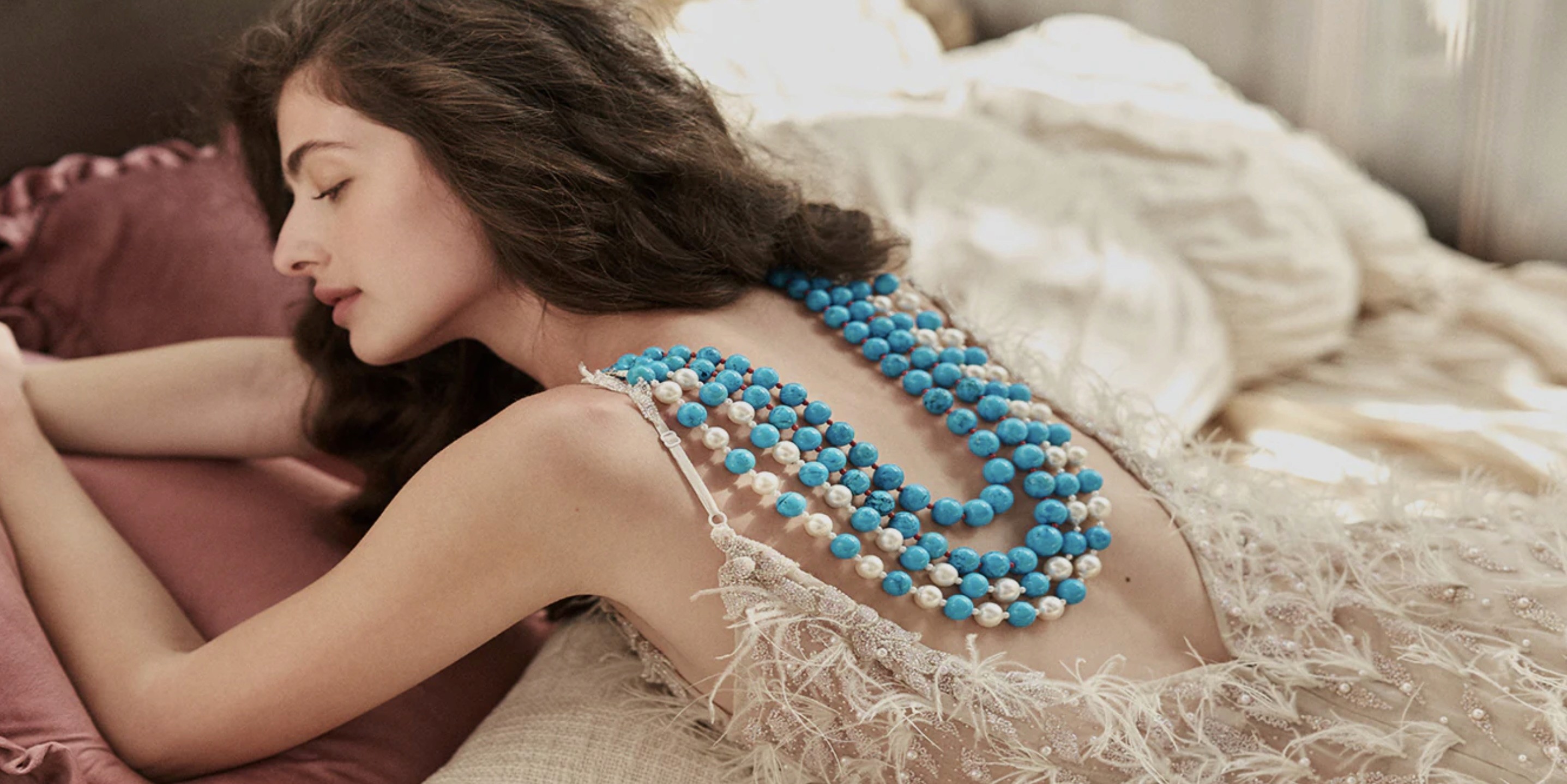
The Stone Before the Setting
A gemstone worth holding announces itself before a jeweller touches it. Manik Jain, Creative Director and Partner at Isvari, a fourth-generation jewellery house operating out of Defence Colony in New Delhi, describes the moment plainly: "The moment I see a gemstone, the design starts flowing. The correct shape and size of the gemstone is very important when you think of a design or a pattern." For Manik Jain, the stone dictates everything. The setting is a consequence, not a starting point.
This logic separates serious gemstone work from the broader jewellery trade, and it matters more now than it has in decades. According to Future Market Insights, India's coloured gemstone market is projected to grow from USD 0.9 billion in 2025 to USD 2.3 billion by 2035, at a compound annual growth rate of 10.5%. Within that market, rubies account for 47.2% of stone type demand in 2025 and emeralds hold 41.7%, per the same report. The numbers reflect a shift that people working closely with gemstones have been watching for years: the slow but unmistakable turn away from diamonds toward stones that carry colour, provenance, and an irreproducible specificity.
Manik Jain frames the historical picture directly: "The past two decades were dominated by diamonds, but the shift has moved to coloured gemstones." He grounds it in cultural context too: "Colour gemstones are an important part of Indian jewellery. Our culture is very bright and colourful in terms of couture and jewellery, especially the wedding jewellery." The diamonds that once defined Indian luxury were always, to some degree, a managed category. Coloured gemstones are not.
Rarity Is Supply, Not Perception
The most common misunderstanding in the coloured gemstone market is that value is a function of how desirable a stone looks. Manik Jain corrects this without hesitation: "Yes, price is driven by demand, but it is more to do with supply. That is what we need to understand."
According to the Sri Lanka Export Development Board's 2026 market report, Colombia is responsible for over 80% of the world's emeralds, while Myanmar produces 90% of gem-quality rubies. Those are not comfortably reproducible statistics. Kashmir sapphire mines are closed. According to the US Department of State, sanctions imposed on Myanmar due to political unrest have significantly affected the global ruby supply chain. In December 2025, per Market Data Forecast's global gemstones report, Gemfields Group temporarily suspended operations at its Kagem emerald mine in Zambia due to market pressures and geopolitical instability.
Manik Jain's hierarchy for investment-grade stones is specific. When asked directly what separates an expensive stone from one truly worth holding, he names four: "Burmese ruby. Colombian emerald. Kashmir sapphire. Natural Basra pearl. They are the best investment as they are getting extinct day by day, and each of these gemstones has its own beauty which adds more value to them." His investment reasoning is grounded in supply logic: "Gemstone today is a great investment due to the harsh mining conditions at all the major mines which produced quality gemstones. The prices have gone up day by day, and you never hear that there is a crash in the gemstone market."
The auction market confirms this. According to the Sri Lanka Export Development Board's 2026 market analysis, 19 top-tier sapphire jewellery items sold at recent Sotheby's auctions for USD 12 million, exceeding high estimates by 169%.
Within any category, Manik Jain is clear that the investment case rests on being at the very top of that category. For ruby, that means Burmese origin, untreated where possible, blood-red colour saturation. "If you find that blood-red colour, nice and bright and beautiful, that is the kind of piece an investor should hold so that it does give value whenever required." He adds a dimension on natural discovery that underscores the supply argument: "Natural will always remain natural. Nothing can beat it. You cannot replace the gifts and blessings of Mother Nature. Every time you think you understand it, there is a new surprise. A recent discovery found a rough stone in Myanmar weighing more than 11,000 carats."
What Makes a Stone Investment-Worthy
Chitwn Malhotra, Founder and Creative Director of Dillano Jewels in Delhi and a GIA-certified gemology expert whose work has been recognised by the World Gold Council, draws the line between beauty and value with precision: "Beauty can be immediate, but value reveals itself over time. What truly lasts is a combination of rarity, integrity of the stone, origin, and how well it has been cut and preserved."
The parameters that determine whether a stone holds long-term worth are origin, natural formation, treatment status, colour saturation, clarity relative to what is natural for the stone type, cut quality, and provenance documentation. Devika Prakash Sharma, co-founder of Maison de Nura, puts it simply: "It is not only the price of the stone. The clarity, colour, origin, cut, polish, treatment. All these parameters have to be taken into account. Then the price is decided."
Emeralds are instructive here. They are almost never internally clean. Inclusions in an emerald are accepted within the trade as natural to the stone, described by the French term jardin, meaning garden, because the internal landscape of fractures and minerals resembles one. An emerald that appears flawless to the naked eye, what gemologists call eye-clean, is already exceptional. Devika Prakash Sharma puts the implication directly: "Emeralds are never super clean. It can be eye-clean, definitely, but not absolutely clean. That is the whole idea behind it. That is the beauty of that stone." In an era where near-perfect replication is available across most luxury categories, the imperfection of a fine emerald is precisely what confirms its naturalness and its worth.
Manik Jain goes further on what Indian consumers still misunderstand: "The biggest misconception of Indian consumers is that stones do not have any value. But the biggest numbers at any auction across the world are gemstones. All the big jewellery houses across the world are producing more and more rare gemstone jewellery for ultra-luxury clients. Any timepiece that starts with a diamond is of lesser value than one that starts with a gemstone." He invokes cultural depth to reinforce the argument: "A modern cut diamond has been known to us for approximately 400 years. But we see gemstones in our deep-rooted culture, which goes back to the start of mankind. The Navratna represents the nine planets which rule the universe. The historic value of gemstones is a hundred percent over the value of diamonds."
Manik Jain also speaks to how design emerges from the stone itself: "Sourcing the right gemstone, the right cut, the right size, and then creating a piece of jewellery with different techniques, that is not less than a piece of art."
What the Ambanis Did to the Market
For two decades, diamonds dominated the Indian fine jewellery conversation. The turn toward coloured stones had been building, but the event that pulled it into mainstream awareness was the Anant Ambani-Radhika Merchant wedding in July 2024. According to Tatler Asia's July 2024 coverage, Isha Ambani wore a Navratna necklace featuring nine different gemstones including pearls, hessonite garnet, yellow and blue sapphires, ruby, coral, diamond, cat's eye, and a magnificent emerald at the centre, each stone approximately 40 carats, the family having taken nearly three years to source the full set. Radhika Merchant wore a paraiba tourmaline at one function. Isha Ambani also chose mismatched earrings, wearing a natural diamond stud on one ear and an emerald on the other.
Devika Prakash Sharma is direct about the causality: "The biggest shift that came in the market was after the Ambani wedding. Mrs Ambani wore these beautiful emeralds, and people understood that there is something there. Then Isha Ambani wore a beautiful western take on the Navratna. That is when people started shifting." According to Retail Jeweller India's September 2024 analysis of the Ambani wedding's market impact, Umesh Kapoor, Founder of Umesh's Malliram Designer Jewellery in Amritsar, confirmed that 75% of his store's new inventory was being made in emeralds. The same report noted that Ramesh Narang, Director of Hazoorilal Legacy, described the wedding as having extended its impact to the middle-income group, adding that before Nita Ambani wore her emerald and diamond necklace at Jamnagar, they already had three similar necklaces in stock.
What the Ambani moment did, in Devika Prakash Sharma's reading, was accelerate an existing current. "Even before the Ambani wedding, there was a growing preference for the big three: rubies, emeralds, and sapphires." The collector's instinct, the knowledge-based appreciation for origin and rarity, was already forming. "India has always been a place where there are collectors. Everybody wants to pass things to the next generation. Jewellery becomes an heirloom of every family."
The Lab-Grown Question
The disruption that has materially affected diamond valuations does not carry the same weight for natural coloured gemstones, and Devika Prakash Sharma is precise about why. "Lab-grown diamonds and natural diamonds are almost exactly the same. But lab-grown gemstones and natural gemstones are not. Not at all." The structural differences, the internal growth patterns that record geological time, are visible under a loupe. "When you look at the stone under a microscope, you will know that this is lab-grown and this is natural. With diamonds, this is very difficult to figure out as a layman. With gemstones, if you just have a little bit of knowledge, you will know. There is a vast difference."
According to Future Market Insights' global coloured gemstone market report for 2025 to 2035, lab-grown coloured stones share only the chemical composition with natural ones, with structural differences that a trained eye can identify. The practical consequence is that lab-grown coloured stones serve a different buyer, one purchasing for colour rather than provenance. "Somebody who cannot go for Colombian emeralds will go for lab-grown. It is way cheaper," says Devika Prakash Sharma. That buyer is real and growing, but represents a distinct market from the investment or heirloom buyer.
Manik Jain reinforces the permanence of natural stones from a supply perspective: "Natural will always remain natural. Nothing can beat it. You cannot replace the gifts and blessings of Mother Nature."
Astrology, Emotion, and the Indian Gemstone Psyche
India's relationship with gemstones runs older and deeper than the investment conversation. Manik Jain places the Navratna at the centre of that history: "We see gemstones in our deep-rooted culture, which goes back from the start of mankind. The Navratna represents the nine planets which rule the universe." As Devika Prakash Sharma observes, in 99 out of 100 Indian households there is some association between gemstone choice and astrological counsel. Manik Jain frames the same idea through the lens of wellness: "The Indian market has always believed in gemstones for astrological reasons. On the other hand, gemstones are also signs of wellness, prosperity, and good health."
Birthstones have become a significant driver of younger purchasing behaviour. Devika Prakash Sharma describes clients arriving with a specific request: this is my birthstone, what can I make? "That is also a form of wearing your identity out loud, which is what fashion exists for in the first place." The purchase sits between the emotional and the symbolic, and it is building a new category of engaged buyer who arrives with a reason to learn.
For Maison de Nura, founded by Devika Prakash Sharma and Neha Puri during the pandemic, the brand philosophy is built on the same recognition: every piece is one of a kind because no two gemstones are identical. "We do not repeat our designs. We do one piece in one design," says Devika Prakash Sharma. "Rare gemstones are exactly like art. Only if you could put them under a microscope and see what goes on inside, you will know."
Manik Jain speaks to the provenance dimension of storytelling as a commercial driver: "At Isvari, the distinction goes beyond the design. It is as much in each gemstone used as in the design it ultimately develops into." According to Retail Jeweller India's June 2026 profile of the brand, over 50% of Isvari's business now comes from story-led pieces. "The day we decide on a concept, our sales team is part of that discussion. So when a client walks in, they do not feel outside the concept. They already know the journey of that piece."
The Bridal Market and the Bride Who Buys the Jewellery First
Devika Prakash Sharma's advice for the bridal buyer is structural: buy the jewellery before the clothes. "Jewellery is something that will stay forever. What is more expensive, and what is something you have to wear forever? Everybody does the other way around. You should buy the jewellery first and then go for the outfit." The inversion of the conventional trousseau sequence reflects a growing awareness that the gemstone outlasts the occasion it was purchased for.
For the bridal market specifically, Devika Prakash Sharma observes that the shift toward coloured stones is real but uneven. "Brides have moved to coloured gemstones. But in most cases, it does not matter if that stone is Colombian, Zambian, or lab-grown. They want that colour." The buyer choosing emerald green as a colour, and the buyer choosing a Colombian emerald as an asset, are two different people at two different stages of knowledge. "That collector's shift is still to come."
Manik Jain's position on bridal jewellery connects back to cultural lineage. For Maalya by Isvari, the brand's mala-centred line launched in New Delhi at an event produced by Maison French Press, the brand architecture and strategic house under French Press Global, the starting point is the mala itself as the first piece of jewellery in Indian visual history. "The beard necklace we call the mala is the first piece of jewellery you see on rajas, maharajas, gods, and goddesses. It is traditional from the beginning of our roots, and we are trying to modernise those designs for everyday as well as occasional wearing." The collection brought together stones collected across seventy years of the Isvari house's history, including exceptional sapphires, velvety rubies, rare tanzanites, Japanese keshi pearls, and natural oyster pearls. Manik Jain describes the collection's ethos plainly: "These are contemporary heirlooms. Stones gathered across seventy years, now strung into compositions that celebrate both legacy and modernity. Jewellery that moves between generations without ever losing relevance."
Chitwn Malhotra of Dillano Jewels describes the evolving heirloom in similar terms: "An heirloom today is something that reflects a person's identity, something they have worn, lived in, and formed a connection with. It is less about preserving something untouched, and more about passing on something that has already been lived and loved."
The Stones to Watch
Manik Jain names tanzanite and rubellite tourmaline as the stones he considers the new gold: "My favourite will always be emeralds and rubies, but the new gold is tanzanite, rubellites, and tourmalines." Devika Prakash Sharma points to the same direction, noting that when clients come in focused on the traditional three, blue sapphires, rubies, and emeralds, she and Neha Puri show them other options. "We also show clients tourmalines, tanzanites, and many others. We have to tell them the story. That gets them excited and makes them want to learn."
According to the Sri Lanka Export Development Board's 2026 market analysis, alexandrite, paraiba tourmalines, and fancy-coloured sapphires are experiencing particularly strong collector and investor demand globally. Paraiba tourmaline from Brazil, whose copper-bearing neon-blue-green colour has no equivalent in the gem world, appeared at the highest profile Indian wedding of 2024 when Radhika Merchant wore one at a pre-wedding function for the Ambani-Merchant celebrations, per Tatler Asia's July 2024 coverage. The Indian market is building literacy around these stones, and the trajectory is clear.
Within any category, Chitwn Malhotra of Dillano Jewels holds that value concentration sits at the individual piece level. "Even within an undervalued category, only a small percentage truly holds long-term potential." The collecting discipline the Indian market is building is the understanding that the difference between a fine Burmese ruby and a good Mozambican ruby is not origin snobbery. It is compound value across decades.
Devika Prakash Sharma's closing read on the market is honest: "Right now the market is definitely trend-driven. The shift is happening. People are moving toward these things for investment as well. It is happening. But it will just be slow."
Manik Jain's position is the oldest and the simplest: "Natural will always remain natural."
The stone has to earn its place. So does the eye that chooses it.
TO BE CONTINUED, FOR SUBSCRIBERS ONLY.
This is where the surface ends and the reporting begins.
The complete piece, the full archive, and access to The French Press Circle. Reporting answerable only to its readers.
Already a subscriber ?
Login
Read these on the house, with our compliments.
A selection from the current issue, open to all readers. Read them in full. The rest is one decision away.



The Stone Before the Setting
A gemstone worth holding announces itself before a jeweller touches it. Manik Jain, Creative Director and Partner at Isvari, a fourth-generation jewellery house operating out of Defence Colony in New Delhi, describes the moment plainly: "The moment I see a gemstone, the design starts flowing. The correct shape and size of the gemstone is very important when you think of a design or a pattern." For Manik Jain, the stone dictates everything. The setting is a consequence, not a starting point.
This logic separates serious gemstone work from the broader jewellery trade, and it matters more now than it has in decades. According to Future Market Insights, India's coloured gemstone market is projected to grow from USD 0.9 billion in 2025 to USD 2.3 billion by 2035, at a compound annual growth rate of 10.5%. Within that market, rubies account for 47.2% of stone type demand in 2025 and emeralds hold 41.7%, per the same report. The numbers reflect a shift that people working closely with gemstones have been watching for years: the slow but unmistakable turn away from diamonds toward stones that carry colour, provenance, and an irreproducible specificity.
Manik Jain frames the historical picture directly: "The past two decades were dominated by diamonds, but the shift has moved to coloured gemstones." He grounds it in cultural context too: "Colour gemstones are an important part of Indian jewellery. Our culture is very bright and colourful in terms of couture and jewellery, especially the wedding jewellery." The diamonds that once defined Indian luxury were always, to some degree, a managed category. Coloured gemstones are not.
Rarity Is Supply, Not Perception
The most common misunderstanding in the coloured gemstone market is that value is a function of how desirable a stone looks. Manik Jain corrects this without hesitation: "Yes, price is driven by demand, but it is more to do with supply. That is what we need to understand."
According to the Sri Lanka Export Development Board's 2026 market report, Colombia is responsible for over 80% of the world's emeralds, while Myanmar produces 90% of gem-quality rubies. Those are not comfortably reproducible statistics. Kashmir sapphire mines are closed. According to the US Department of State, sanctions imposed on Myanmar due to political unrest have significantly affected the global ruby supply chain. In December 2025, per Market Data Forecast's global gemstones report, Gemfields Group temporarily suspended operations at its Kagem emerald mine in Zambia due to market pressures and geopolitical instability.
Manik Jain's hierarchy for investment-grade stones is specific. When asked directly what separates an expensive stone from one truly worth holding, he names four: "Burmese ruby. Colombian emerald. Kashmir sapphire. Natural Basra pearl. They are the best investment as they are getting extinct day by day, and each of these gemstones has its own beauty which adds more value to them." His investment reasoning is grounded in supply logic: "Gemstone today is a great investment due to the harsh mining conditions at all the major mines which produced quality gemstones. The prices have gone up day by day, and you never hear that there is a crash in the gemstone market."
The auction market confirms this. According to the Sri Lanka Export Development Board's 2026 market analysis, 19 top-tier sapphire jewellery items sold at recent Sotheby's auctions for USD 12 million, exceeding high estimates by 169%.
Within any category, Manik Jain is clear that the investment case rests on being at the very top of that category. For ruby, that means Burmese origin, untreated where possible, blood-red colour saturation. "If you find that blood-red colour, nice and bright and beautiful, that is the kind of piece an investor should hold so that it does give value whenever required." He adds a dimension on natural discovery that underscores the supply argument: "Natural will always remain natural. Nothing can beat it. You cannot replace the gifts and blessings of Mother Nature. Every time you think you understand it, there is a new surprise. A recent discovery found a rough stone in Myanmar weighing more than 11,000 carats."
What Makes a Stone Investment-Worthy
Chitwn Malhotra, Founder and Creative Director of Dillano Jewels in Delhi and a GIA-certified gemology expert whose work has been recognised by the World Gold Council, draws the line between beauty and value with precision: "Beauty can be immediate, but value reveals itself over time. What truly lasts is a combination of rarity, integrity of the stone, origin, and how well it has been cut and preserved."
The parameters that determine whether a stone holds long-term worth are origin, natural formation, treatment status, colour saturation, clarity relative to what is natural for the stone type, cut quality, and provenance documentation. Devika Prakash Sharma, co-founder of Maison de Nura, puts it simply: "It is not only the price of the stone. The clarity, colour, origin, cut, polish, treatment. All these parameters have to be taken into account. Then the price is decided."
Emeralds are instructive here. They are almost never internally clean. Inclusions in an emerald are accepted within the trade as natural to the stone, described by the French term jardin, meaning garden, because the internal landscape of fractures and minerals resembles one. An emerald that appears flawless to the naked eye, what gemologists call eye-clean, is already exceptional. Devika Prakash Sharma puts the implication directly: "Emeralds are never super clean. It can be eye-clean, definitely, but not absolutely clean. That is the whole idea behind it. That is the beauty of that stone." In an era where near-perfect replication is available across most luxury categories, the imperfection of a fine emerald is precisely what confirms its naturalness and its worth.
Manik Jain goes further on what Indian consumers still misunderstand: "The biggest misconception of Indian consumers is that stones do not have any value. But the biggest numbers at any auction across the world are gemstones. All the big jewellery houses across the world are producing more and more rare gemstone jewellery for ultra-luxury clients. Any timepiece that starts with a diamond is of lesser value than one that starts with a gemstone." He invokes cultural depth to reinforce the argument: "A modern cut diamond has been known to us for approximately 400 years. But we see gemstones in our deep-rooted culture, which goes back to the start of mankind. The Navratna represents the nine planets which rule the universe. The historic value of gemstones is a hundred percent over the value of diamonds."
Manik Jain also speaks to how design emerges from the stone itself: "Sourcing the right gemstone, the right cut, the right size, and then creating a piece of jewellery with different techniques, that is not less than a piece of art."
What the Ambanis Did to the Market
For two decades, diamonds dominated the Indian fine jewellery conversation. The turn toward coloured stones had been building, but the event that pulled it into mainstream awareness was the Anant Ambani-Radhika Merchant wedding in July 2024. According to Tatler Asia's July 2024 coverage, Isha Ambani wore a Navratna necklace featuring nine different gemstones including pearls, hessonite garnet, yellow and blue sapphires, ruby, coral, diamond, cat's eye, and a magnificent emerald at the centre, each stone approximately 40 carats, the family having taken nearly three years to source the full set. Radhika Merchant wore a paraiba tourmaline at one function. Isha Ambani also chose mismatched earrings, wearing a natural diamond stud on one ear and an emerald on the other.
Devika Prakash Sharma is direct about the causality: "The biggest shift that came in the market was after the Ambani wedding. Mrs Ambani wore these beautiful emeralds, and people understood that there is something there. Then Isha Ambani wore a beautiful western take on the Navratna. That is when people started shifting." According to Retail Jeweller India's September 2024 analysis of the Ambani wedding's market impact, Umesh Kapoor, Founder of Umesh's Malliram Designer Jewellery in Amritsar, confirmed that 75% of his store's new inventory was being made in emeralds. The same report noted that Ramesh Narang, Director of Hazoorilal Legacy, described the wedding as having extended its impact to the middle-income group, adding that before Nita Ambani wore her emerald and diamond necklace at Jamnagar, they already had three similar necklaces in stock.
What the Ambani moment did, in Devika Prakash Sharma's reading, was accelerate an existing current. "Even before the Ambani wedding, there was a growing preference for the big three: rubies, emeralds, and sapphires." The collector's instinct, the knowledge-based appreciation for origin and rarity, was already forming. "India has always been a place where there are collectors. Everybody wants to pass things to the next generation. Jewellery becomes an heirloom of every family."
The Lab-Grown Question
The disruption that has materially affected diamond valuations does not carry the same weight for natural coloured gemstones, and Devika Prakash Sharma is precise about why. "Lab-grown diamonds and natural diamonds are almost exactly the same. But lab-grown gemstones and natural gemstones are not. Not at all." The structural differences, the internal growth patterns that record geological time, are visible under a loupe. "When you look at the stone under a microscope, you will know that this is lab-grown and this is natural. With diamonds, this is very difficult to figure out as a layman. With gemstones, if you just have a little bit of knowledge, you will know. There is a vast difference."
According to Future Market Insights' global coloured gemstone market report for 2025 to 2035, lab-grown coloured stones share only the chemical composition with natural ones, with structural differences that a trained eye can identify. The practical consequence is that lab-grown coloured stones serve a different buyer, one purchasing for colour rather than provenance. "Somebody who cannot go for Colombian emeralds will go for lab-grown. It is way cheaper," says Devika Prakash Sharma. That buyer is real and growing, but represents a distinct market from the investment or heirloom buyer.
Manik Jain reinforces the permanence of natural stones from a supply perspective: "Natural will always remain natural. Nothing can beat it. You cannot replace the gifts and blessings of Mother Nature."
Astrology, Emotion, and the Indian Gemstone Psyche
India's relationship with gemstones runs older and deeper than the investment conversation. Manik Jain places the Navratna at the centre of that history: "We see gemstones in our deep-rooted culture, which goes back from the start of mankind. The Navratna represents the nine planets which rule the universe." As Devika Prakash Sharma observes, in 99 out of 100 Indian households there is some association between gemstone choice and astrological counsel. Manik Jain frames the same idea through the lens of wellness: "The Indian market has always believed in gemstones for astrological reasons. On the other hand, gemstones are also signs of wellness, prosperity, and good health."
Birthstones have become a significant driver of younger purchasing behaviour. Devika Prakash Sharma describes clients arriving with a specific request: this is my birthstone, what can I make? "That is also a form of wearing your identity out loud, which is what fashion exists for in the first place." The purchase sits between the emotional and the symbolic, and it is building a new category of engaged buyer who arrives with a reason to learn.
For Maison de Nura, founded by Devika Prakash Sharma and Neha Puri during the pandemic, the brand philosophy is built on the same recognition: every piece is one of a kind because no two gemstones are identical. "We do not repeat our designs. We do one piece in one design," says Devika Prakash Sharma. "Rare gemstones are exactly like art. Only if you could put them under a microscope and see what goes on inside, you will know."
Manik Jain speaks to the provenance dimension of storytelling as a commercial driver: "At Isvari, the distinction goes beyond the design. It is as much in each gemstone used as in the design it ultimately develops into." According to Retail Jeweller India's June 2026 profile of the brand, over 50% of Isvari's business now comes from story-led pieces. "The day we decide on a concept, our sales team is part of that discussion. So when a client walks in, they do not feel outside the concept. They already know the journey of that piece."
The Bridal Market and the Bride Who Buys the Jewellery First
Devika Prakash Sharma's advice for the bridal buyer is structural: buy the jewellery before the clothes. "Jewellery is something that will stay forever. What is more expensive, and what is something you have to wear forever? Everybody does the other way around. You should buy the jewellery first and then go for the outfit." The inversion of the conventional trousseau sequence reflects a growing awareness that the gemstone outlasts the occasion it was purchased for.
For the bridal market specifically, Devika Prakash Sharma observes that the shift toward coloured stones is real but uneven. "Brides have moved to coloured gemstones. But in most cases, it does not matter if that stone is Colombian, Zambian, or lab-grown. They want that colour." The buyer choosing emerald green as a colour, and the buyer choosing a Colombian emerald as an asset, are two different people at two different stages of knowledge. "That collector's shift is still to come."
Manik Jain's position on bridal jewellery connects back to cultural lineage. For Maalya by Isvari, the brand's mala-centred line launched in New Delhi at an event produced by Maison French Press, the brand architecture and strategic house under French Press Global, the starting point is the mala itself as the first piece of jewellery in Indian visual history. "The beard necklace we call the mala is the first piece of jewellery you see on rajas, maharajas, gods, and goddesses. It is traditional from the beginning of our roots, and we are trying to modernise those designs for everyday as well as occasional wearing." The collection brought together stones collected across seventy years of the Isvari house's history, including exceptional sapphires, velvety rubies, rare tanzanites, Japanese keshi pearls, and natural oyster pearls. Manik Jain describes the collection's ethos plainly: "These are contemporary heirlooms. Stones gathered across seventy years, now strung into compositions that celebrate both legacy and modernity. Jewellery that moves between generations without ever losing relevance."
Chitwn Malhotra of Dillano Jewels describes the evolving heirloom in similar terms: "An heirloom today is something that reflects a person's identity, something they have worn, lived in, and formed a connection with. It is less about preserving something untouched, and more about passing on something that has already been lived and loved."
The Stones to Watch
Manik Jain names tanzanite and rubellite tourmaline as the stones he considers the new gold: "My favourite will always be emeralds and rubies, but the new gold is tanzanite, rubellites, and tourmalines." Devika Prakash Sharma points to the same direction, noting that when clients come in focused on the traditional three, blue sapphires, rubies, and emeralds, she and Neha Puri show them other options. "We also show clients tourmalines, tanzanites, and many others. We have to tell them the story. That gets them excited and makes them want to learn."
According to the Sri Lanka Export Development Board's 2026 market analysis, alexandrite, paraiba tourmalines, and fancy-coloured sapphires are experiencing particularly strong collector and investor demand globally. Paraiba tourmaline from Brazil, whose copper-bearing neon-blue-green colour has no equivalent in the gem world, appeared at the highest profile Indian wedding of 2024 when Radhika Merchant wore one at a pre-wedding function for the Ambani-Merchant celebrations, per Tatler Asia's July 2024 coverage. The Indian market is building literacy around these stones, and the trajectory is clear.
Within any category, Chitwn Malhotra of Dillano Jewels holds that value concentration sits at the individual piece level. "Even within an undervalued category, only a small percentage truly holds long-term potential." The collecting discipline the Indian market is building is the understanding that the difference between a fine Burmese ruby and a good Mozambican ruby is not origin snobbery. It is compound value across decades.
Devika Prakash Sharma's closing read on the market is honest: "Right now the market is definitely trend-driven. The shift is happening. People are moving toward these things for investment as well. It is happening. But it will just be slow."
Manik Jain's position is the oldest and the simplest: "Natural will always remain natural."
The stone has to earn its place. So does the eye that chooses it.
TO BE CONTINUED, FOR SUBSCRIBERS ONLY.
This is where the surface ends and the reporting begins.
The complete piece, the full archive, and access to The French Press Circle. Reporting answerable only to its readers.
Already a subscriber ?
Login
Read these on the house, with our compliments.
A selection from the current issue, open to all readers. Read them in full. The rest is one decision away.