
Tarun Tahiliani woke up on the morning of his show, and by afternoon he had decided to say it out loud. In front of a room, hours before he presented at the nineteenth edition of FDCI’s Hyundai India Couture Week, he rose and spoke about the fortnight the country had just lived through, plainly. He opened with an apology, and he addressed it to the young. In his own words, unedited:
“I woke up this morning with smile on my face but reborn. I mean, who would have thought even a week or two weeks or three weeks back? I’m apologising to you, Gen Zs, because our generation has allowed this to happen. We never put our foot down. We just went along and everyone said, even if I see something to you, someone would come and say, no no no no no. Don’t talk like this. You are in the public eye, and we’ve all had many nasty things to say about our Gen Z and what we thought they were. But there’s ideals, there’s values, there’s vision, and the way that we do it, Gandhi did it. And yesterday, we’ve seen it again. And I think I woke up with a huge sense of really a renewal and hope. You know? I’m not leaving this country. I love it here. I love my work here. I have learned India by traveling around and working with these crafts people. And so I just hope that we all can look at everything fresh and rebirth the way we function as Indians for Indians.”
He said this the day after the movement he was describing reached its conclusion, and he presented Navaratan that same afternoon. He had also set the runway aside for this edition, staging the collection as a walkthrough built so a viewer could stop and look rather than watch the garment pass, and it is a genuinely smart decision. It comes from a designer who has arrived at a point in his career where the word OG fits him properly, and the work explains why. There are barely words for how light, how easy, how wearable his craftsmanship has become: he designs for the bride who wants to dance all night without ever feeling like she is bearing kilos of lehenga on her body. That is Tahiliani’s technique, refined over decades, and it is why he stands today as the master couturier of this country. The show makes an argument of its own too, that a couture garment holds far more of the hand than a runway can ever reveal, and deserves to be seen long enough to register it.
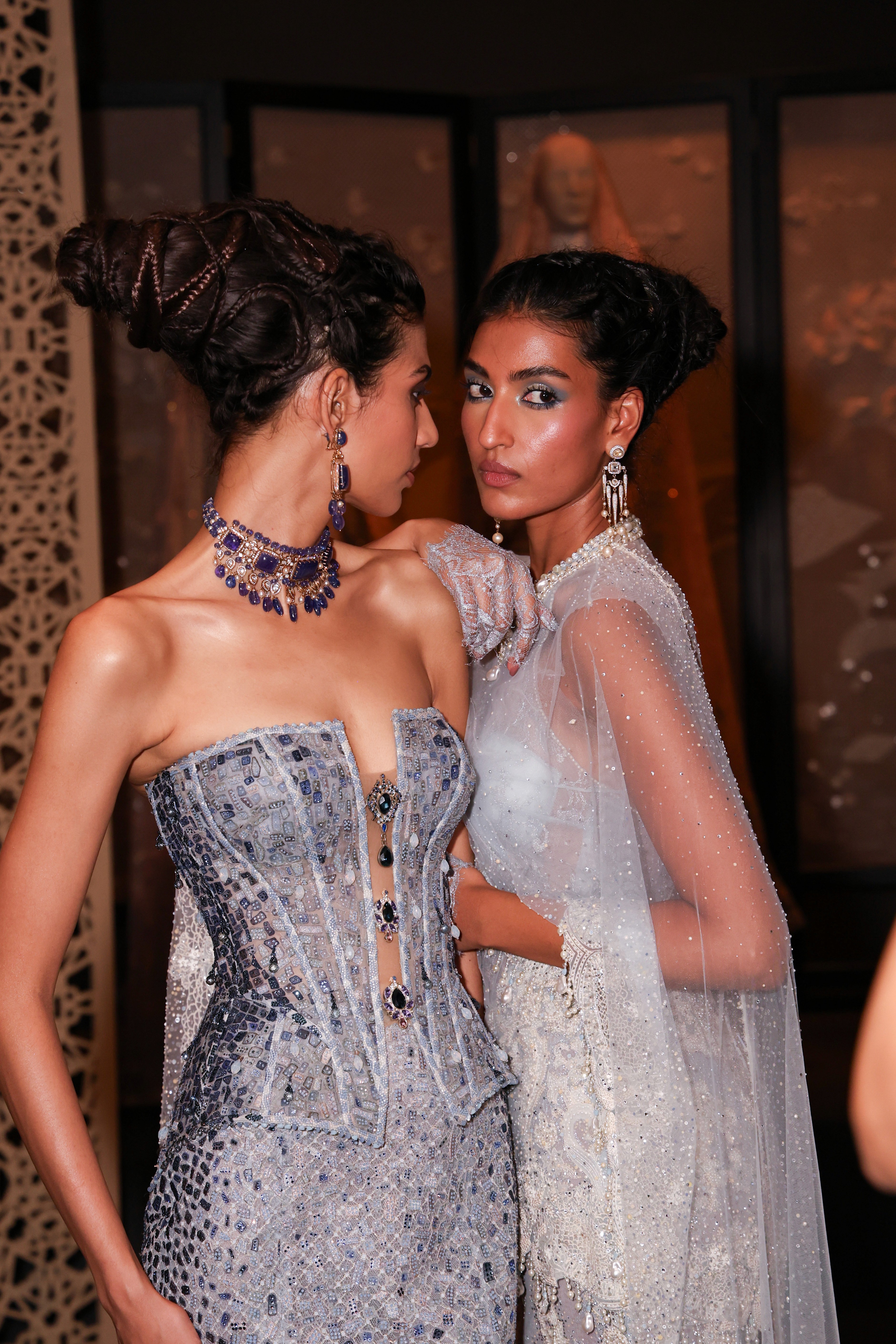
Navratna by Tarun Tahiliani, presented at Bikaner House as a part of the Hyundai India Couture Week 2026 Showcase
The Week It Arrived In
In the lead-up to the show, Tahiliani said plainly what had gone largely unspoken, that fashion alone had been told to stop while the rest of Delhi carried on. As he put it, “Why is fashion always dragged into this? Were the movie theatres shut down because people do not need idle entertainment?”
What comes through is a designer asking to be judged by his conduct.
The moment landed against a nationwide reckoning already underway, weeks of youth protest that had just forced the Union Education Minister’s resignation on the eve of his show.
Comfort as the Rarest Luxury
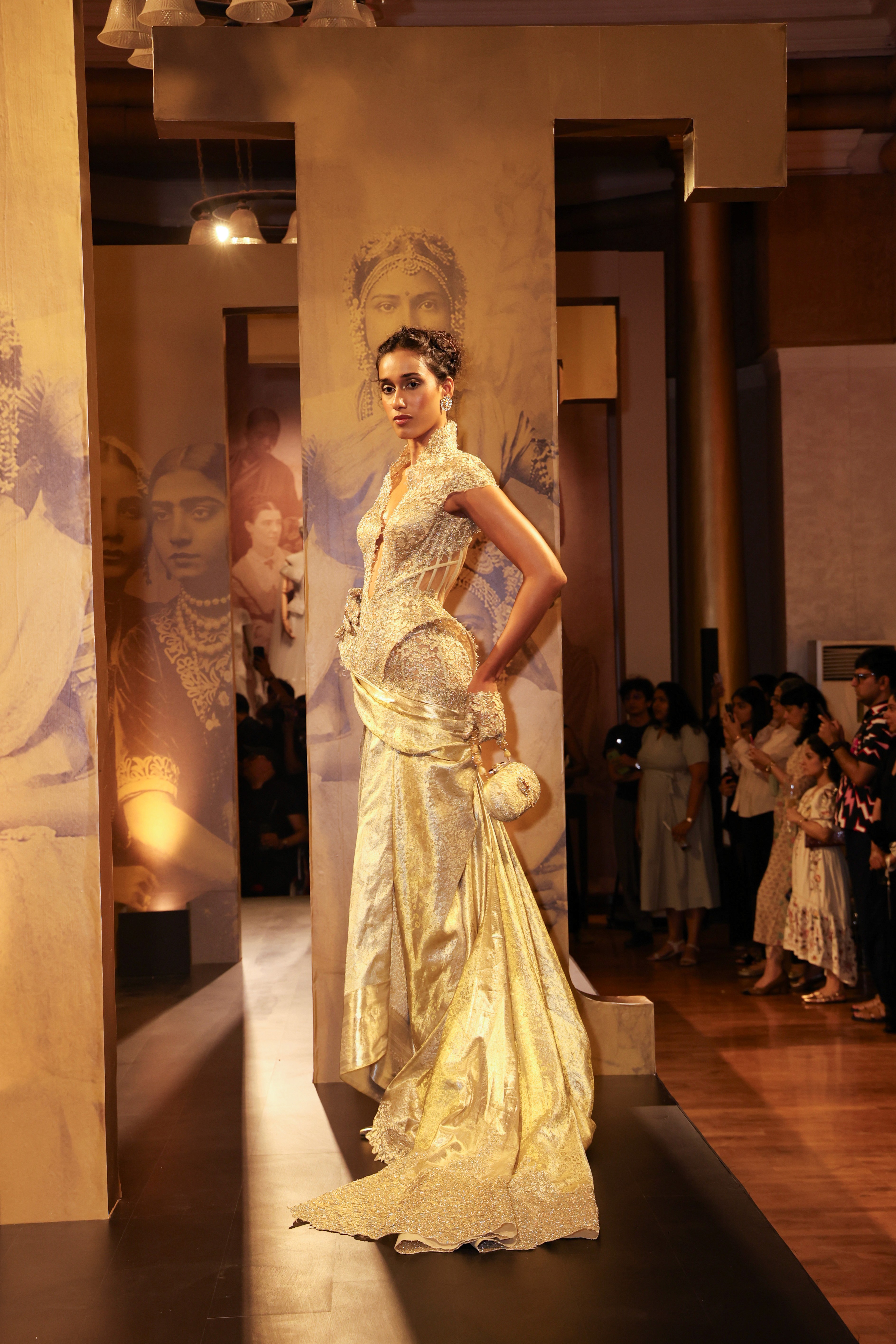
Navratna by Tarun Tahiliani, presented at Bikaner House as a part of the Hyundai India Couture Week 2026 Showcase
Weight is the problem Tahiliani has spent a career solving. A bridal lehenga that a generation ago would have pinned a woman to a chair, he rebuilt in silk georgette and layered tulle so she could move through her own wedding. The labour once carried by a bride’s endurance is transferred into the construction and returned to her as freedom, which is why the word that trails him, lightness, means far more than it appears to. Aditi Rao Hydari, opening a couture week for him years ago, said it from inside the clothes: a gossamer veil lets a bride get up and dance like a free spirit. He calls the principle the lightness of being, and it is a discipline built over decades, not a slogan. Fabrics are lighter than ever, sheer tulles and organzas layered over intricate hand embroidery, so that grandeur and ease finally occupy the same garment. In his hands comfort stopped being the trade-off opulence makes and became opulence’s most exacting form, the hardest thing a couturier can engineer and the thing he has refined more completely than anyone working in Indian couture.
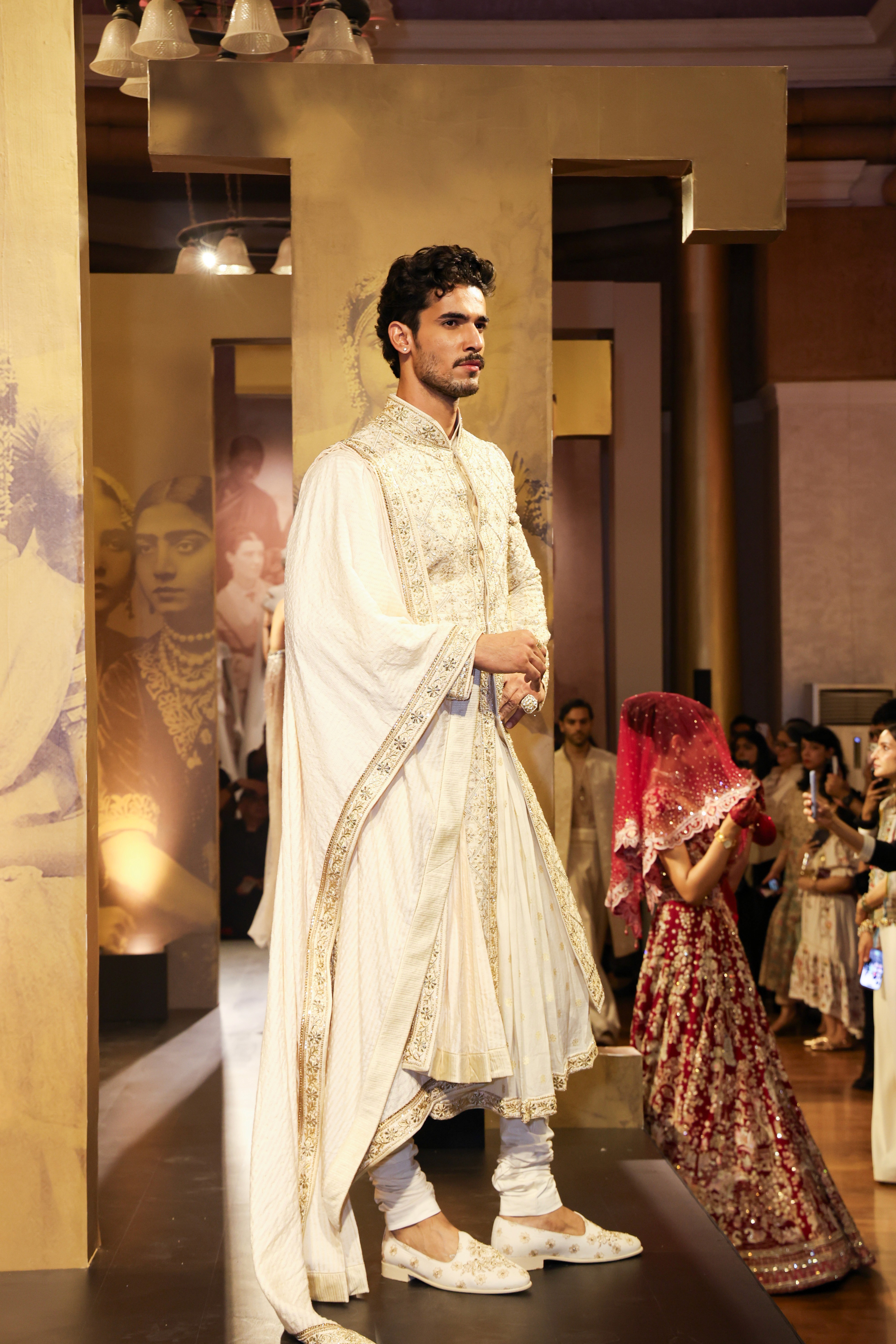
Navratna by Tarun Tahiliani, presented at Bikaner House as a part of the Hyundai India Couture Week 2026 Showcase
Navaratan is that mastery at rest, a house doing what only this house does with the ease of a designer who has nothing left to prove and the judgement to slow the format down so the work can be seen. He remains the reference point of Indian couture, less for volume than for having understood first that the scarcest luxury is the liberty to forget what you are wearing, then spending three decades perfecting it while others chased spectacle. Charity begins at home, he said, and read as he intended it, it is also the most exacting standard a house could hold for itself. He is the designer best equipped to meet it.
The Collection
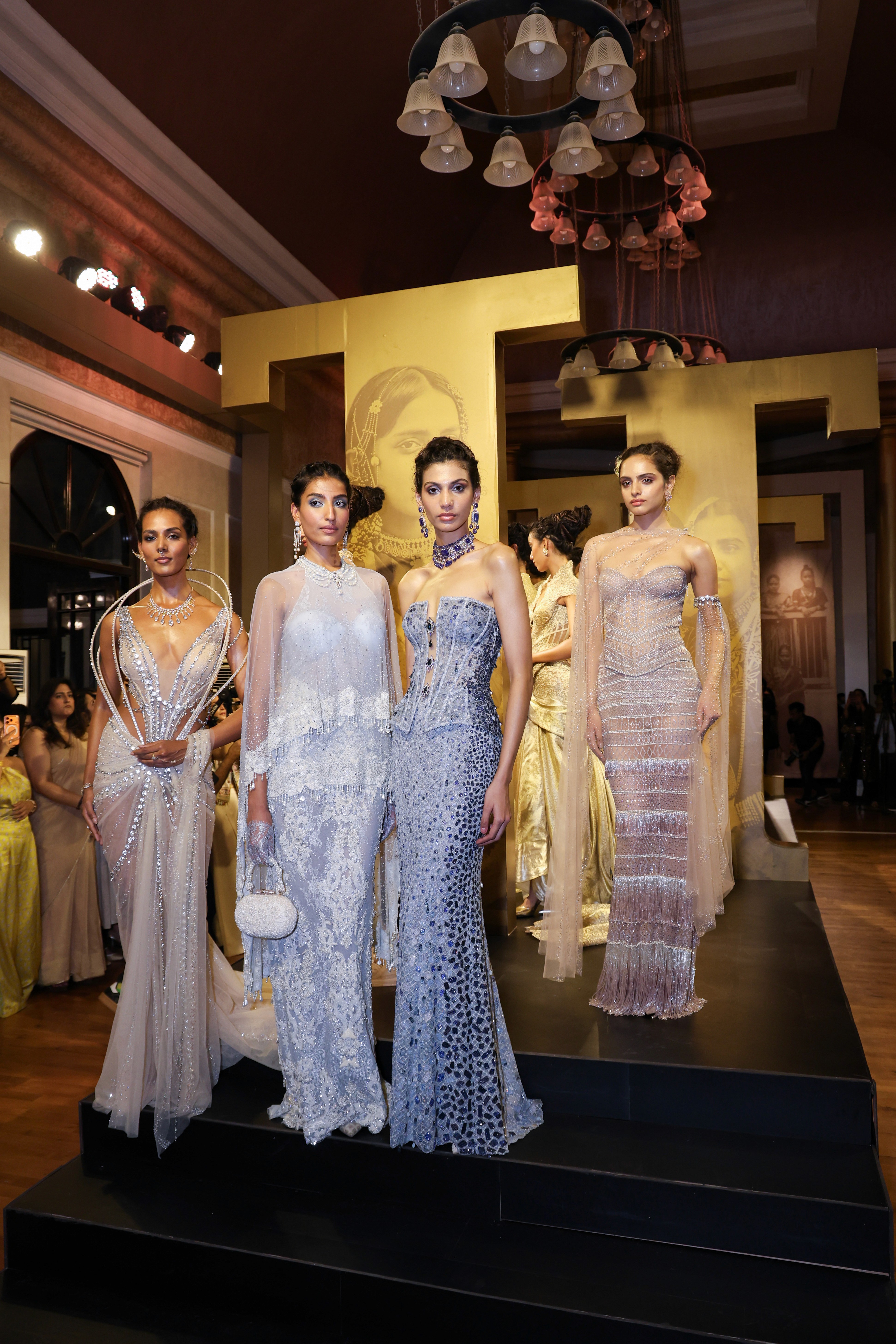
Navratna by Tarun Tahiliani, presented at Bikaner House as a part of the Hyundai India Couture Week 2026 Showcase
Nine gemstones organise the collection. For the nineteenth edition of FDCI’s Hyundai India Couture Week, Tarun Tahiliani has retired the runway in favour of Navaratan, “nine jewels,” staged at Bikaner House as an immersive walkthrough of nine distinct craft languages, projection-mapped and hand-drawn, built so a viewer can stop at a single seam instead of losing it in the seconds a passing model allows. His stated reasoning has the shape of a curatorial argument. A couture garment holds countless hours of work by hand, and the conventional show is a format designed to erase that labour at the very moment it earns attention.
Tahiliani has described the thinking behind it directly: couture, in his account, has always been about craftsmanship, and every garment the house makes carries months of labour, generations of artisanal knowledge and a great deal of emotion. Navaratan draws on three decades of the atelier’s craft traditions, sequenced so a guest can pause on any single expression of the house rather than absorb the whole of it in the compressed minutes a runway allows.

Navratna by Tarun Tahiliani, presented at Bikaner House as a part of the Hyundai India Couture Week 2026 Showcase
The palette does the structural work of the theme. Ivory, antique gold and blush open the sequence before it deepens into the emerald, ruby, sapphire and amethyst of the navaratna itself, each tone selected, in the house’s own account, to keep the embroidery leading rather than competing. Fluid drapes, sculpted corsetry, contemporary saris, sharply tailored jackets, voluminous lehengas and architectural gowns move through the rooms as a survey of everything the atelier does, and the connective tissue across all of it is a sophisticated ease that persists even where the construction is most elaborate.
A veil of feather-light tulle adorned with lace, the garment that long ago replaced the smothering ghunghat with something a bride can actually see through, falls over a lehenga worked in vertical, temple-architecture embroidery, set against an illustrated dreamscape of pale domes and minarets. Surface carries the narrative, construction lets it breathe, and the effect is monumental without any of the heft such a silhouette once demanded. The bridal centerpiece is the entire house ethos compressed into one look, and it withstands the scrutiny the exhibition format invites, which a runway would never have permitted.

Navratna by Tarun Tahiliani, presented at Bikaner House as a part of the Hyundai India Couture Week 2026 Showcase
The eveningwear carries the same philosophy into sharper light. Sculpted, near-liquid gowns, a crimson lace sheath trailing a draped panel, pewter and dove-grey second-skin figures with gossamer capes stand before enormous sepia portraits of women from an earlier century. The scenography carries a genuine idea rather than mere atmosphere. Positioning the modern sculpted silhouette directly beneath the ancestral face proposes a hundred years of continuity, the same woman, differently attired, and it rhymes precisely with the Ravi Varma muses and the maharanis painted in miniature from whom Tahiliani first drew the inspiration for his signature drape. The corsetry vanishes into the fabric where the collection is most itself. A handful of the gowns lean enough into fluid international glamour that the cut’s distinctly Indian sensibility softens, and those pieces read as lovely before they read as unmistakably his, a mild loosening of the drape-versus-structure tension that has always been the house signature. Across a body of work this ambitious it registers as a footnote rather than a defect.
Why the Format Matters
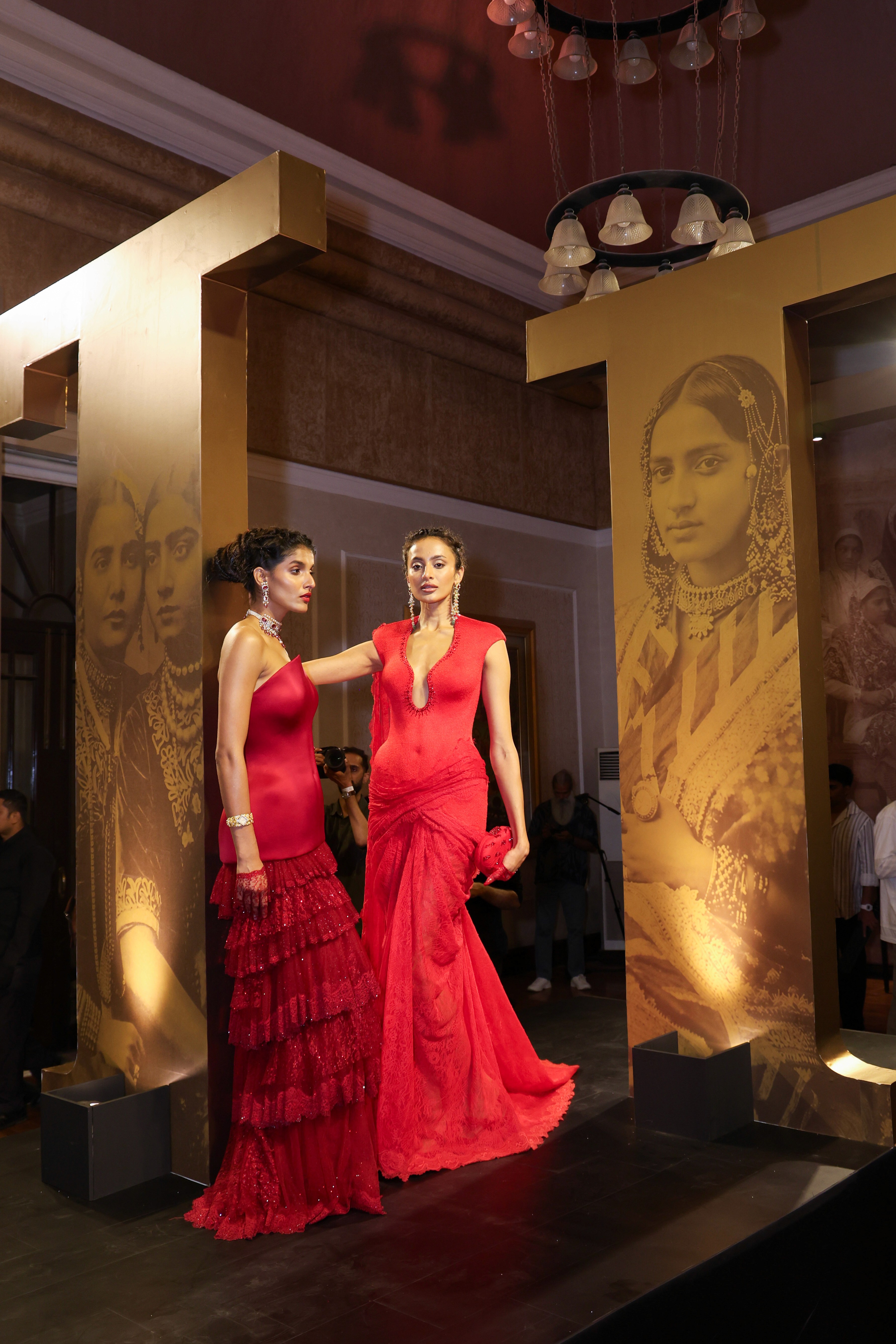
Navratna by Tarun Tahiliani, presented at Bikaner House as a part of the Hyundai India Couture Week 2026 Showcase
Storytelling has always been part of Tahiliani’s shows, and the Bikaner House walkthrough is simply the fullest version of that instinct, a room built to make the handwork itself the subject. Technology here frames the craft rather than replacing it, which is exactly the right order for a house whose entire claim rests on the hand.
Tarun Tahiliani presented Navaratan at FDCI’s Hyundai India Couture Week 2026 on 26 July. The nineteenth edition runs 23 to 29 July.
TO BE CONTINUED, FOR SUBSCRIBERS ONLY.
This is where the surface ends and the reporting begins.
The complete piece, the full archive, and access to The French Press Circle. Reporting answerable only to its readers.
Already a subscriber ?
Login
Read these on the house, with our compliments.
A selection from the current issue, open to all readers. Read them in full. The rest is one decision away.




Tarun Tahiliani woke up on the morning of his show, and by afternoon he had decided to say it out loud. In front of a room, hours before he presented at the nineteenth edition of FDCI’s Hyundai India Couture Week, he rose and spoke about the fortnight the country had just lived through, plainly. He opened with an apology, and he addressed it to the young. In his own words, unedited:
“I woke up this morning with smile on my face but reborn. I mean, who would have thought even a week or two weeks or three weeks back? I’m apologising to you, Gen Zs, because our generation has allowed this to happen. We never put our foot down. We just went along and everyone said, even if I see something to you, someone would come and say, no no no no no. Don’t talk like this. You are in the public eye, and we’ve all had many nasty things to say about our Gen Z and what we thought they were. But there’s ideals, there’s values, there’s vision, and the way that we do it, Gandhi did it. And yesterday, we’ve seen it again. And I think I woke up with a huge sense of really a renewal and hope. You know? I’m not leaving this country. I love it here. I love my work here. I have learned India by traveling around and working with these crafts people. And so I just hope that we all can look at everything fresh and rebirth the way we function as Indians for Indians.”
He said this the day after the movement he was describing reached its conclusion, and he presented Navaratan that same afternoon. He had also set the runway aside for this edition, staging the collection as a walkthrough built so a viewer could stop and look rather than watch the garment pass, and it is a genuinely smart decision. It comes from a designer who has arrived at a point in his career where the word OG fits him properly, and the work explains why. There are barely words for how light, how easy, how wearable his craftsmanship has become: he designs for the bride who wants to dance all night without ever feeling like she is bearing kilos of lehenga on her body. That is Tahiliani’s technique, refined over decades, and it is why he stands today as the master couturier of this country. The show makes an argument of its own too, that a couture garment holds far more of the hand than a runway can ever reveal, and deserves to be seen long enough to register it.
Navratna by Tarun Tahiliani, presented at Bikaner House as a part of the Hyundai India Couture Week 2026 Showcase
The Week It Arrived In
In the lead-up to the show, Tahiliani said plainly what had gone largely unspoken, that fashion alone had been told to stop while the rest of Delhi carried on. As he put it, “Why is fashion always dragged into this? Were the movie theatres shut down because people do not need idle entertainment?”
What comes through is a designer asking to be judged by his conduct.
The moment landed against a nationwide reckoning already underway, weeks of youth protest that had just forced the Union Education Minister’s resignation on the eve of his show.
Comfort as the Rarest Luxury
Navratna by Tarun Tahiliani, presented at Bikaner House as a part of the Hyundai India Couture Week 2026 Showcase
Weight is the problem Tahiliani has spent a career solving. A bridal lehenga that a generation ago would have pinned a woman to a chair, he rebuilt in silk georgette and layered tulle so she could move through her own wedding. The labour once carried by a bride’s endurance is transferred into the construction and returned to her as freedom, which is why the word that trails him, lightness, means far more than it appears to. Aditi Rao Hydari, opening a couture week for him years ago, said it from inside the clothes: a gossamer veil lets a bride get up and dance like a free spirit. He calls the principle the lightness of being, and it is a discipline built over decades, not a slogan. Fabrics are lighter than ever, sheer tulles and organzas layered over intricate hand embroidery, so that grandeur and ease finally occupy the same garment. In his hands comfort stopped being the trade-off opulence makes and became opulence’s most exacting form, the hardest thing a couturier can engineer and the thing he has refined more completely than anyone working in Indian couture.
Navratna by Tarun Tahiliani, presented at Bikaner House as a part of the Hyundai India Couture Week 2026 Showcase
Navaratan is that mastery at rest, a house doing what only this house does with the ease of a designer who has nothing left to prove and the judgement to slow the format down so the work can be seen. He remains the reference point of Indian couture, less for volume than for having understood first that the scarcest luxury is the liberty to forget what you are wearing, then spending three decades perfecting it while others chased spectacle. Charity begins at home, he said, and read as he intended it, it is also the most exacting standard a house could hold for itself. He is the designer best equipped to meet it.
The Collection
Navratna by Tarun Tahiliani, presented at Bikaner House as a part of the Hyundai India Couture Week 2026 Showcase
Nine gemstones organise the collection. For the nineteenth edition of FDCI’s Hyundai India Couture Week, Tarun Tahiliani has retired the runway in favour of Navaratan, “nine jewels,” staged at Bikaner House as an immersive walkthrough of nine distinct craft languages, projection-mapped and hand-drawn, built so a viewer can stop at a single seam instead of losing it in the seconds a passing model allows. His stated reasoning has the shape of a curatorial argument. A couture garment holds countless hours of work by hand, and the conventional show is a format designed to erase that labour at the very moment it earns attention.
Tahiliani has described the thinking behind it directly: couture, in his account, has always been about craftsmanship, and every garment the house makes carries months of labour, generations of artisanal knowledge and a great deal of emotion. Navaratan draws on three decades of the atelier’s craft traditions, sequenced so a guest can pause on any single expression of the house rather than absorb the whole of it in the compressed minutes a runway allows.
Navratna by Tarun Tahiliani, presented at Bikaner House as a part of the Hyundai India Couture Week 2026 Showcase
The palette does the structural work of the theme. Ivory, antique gold and blush open the sequence before it deepens into the emerald, ruby, sapphire and amethyst of the navaratna itself, each tone selected, in the house’s own account, to keep the embroidery leading rather than competing. Fluid drapes, sculpted corsetry, contemporary saris, sharply tailored jackets, voluminous lehengas and architectural gowns move through the rooms as a survey of everything the atelier does, and the connective tissue across all of it is a sophisticated ease that persists even where the construction is most elaborate.
A veil of feather-light tulle adorned with lace, the garment that long ago replaced the smothering ghunghat with something a bride can actually see through, falls over a lehenga worked in vertical, temple-architecture embroidery, set against an illustrated dreamscape of pale domes and minarets. Surface carries the narrative, construction lets it breathe, and the effect is monumental without any of the heft such a silhouette once demanded. The bridal centerpiece is the entire house ethos compressed into one look, and it withstands the scrutiny the exhibition format invites, which a runway would never have permitted.
Navratna by Tarun Tahiliani, presented at Bikaner House as a part of the Hyundai India Couture Week 2026 Showcase
The eveningwear carries the same philosophy into sharper light. Sculpted, near-liquid gowns, a crimson lace sheath trailing a draped panel, pewter and dove-grey second-skin figures with gossamer capes stand before enormous sepia portraits of women from an earlier century. The scenography carries a genuine idea rather than mere atmosphere. Positioning the modern sculpted silhouette directly beneath the ancestral face proposes a hundred years of continuity, the same woman, differently attired, and it rhymes precisely with the Ravi Varma muses and the maharanis painted in miniature from whom Tahiliani first drew the inspiration for his signature drape. The corsetry vanishes into the fabric where the collection is most itself. A handful of the gowns lean enough into fluid international glamour that the cut’s distinctly Indian sensibility softens, and those pieces read as lovely before they read as unmistakably his, a mild loosening of the drape-versus-structure tension that has always been the house signature. Across a body of work this ambitious it registers as a footnote rather than a defect.
Why the Format Matters
Navratna by Tarun Tahiliani, presented at Bikaner House as a part of the Hyundai India Couture Week 2026 Showcase
Storytelling has always been part of Tahiliani’s shows, and the Bikaner House walkthrough is simply the fullest version of that instinct, a room built to make the handwork itself the subject. Technology here frames the craft rather than replacing it, which is exactly the right order for a house whose entire claim rests on the hand.
Tarun Tahiliani presented Navaratan at FDCI’s Hyundai India Couture Week 2026 on 26 July. The nineteenth edition runs 23 to 29 July.
TO BE CONTINUED, FOR SUBSCRIBERS ONLY.
This is where the surface ends and the reporting begins.
The complete piece, the full archive, and access to The French Press Circle. Reporting answerable only to its readers.
Already a subscriber ?
Login
Read these on the house, with our compliments.
A selection from the current issue, open to all readers. Read them in full. The rest is one decision away.