There is a pattern so consistent, so structurally embedded in how societies across the world handle male violence, that it has become functionally invisible, not because it is subtle, but because it is so routine that it has been absorbed into the background noise of ordinary life. The man acts. The woman spends the rest of her life managing the consequences of what he did. He escalates, or disappears, or is counselled and quietly absolved by a system that has always found more language for his anguish than for hers. She, the one who did nothing except exist in proximity to his desire, is left to carry the physical, psychological, legal, and social wreckage of what he chose, and the carrying is rarely acknowledged as a burden. It is simply expected of her. It is called moving forward. It is called healing. It is, if she is lucky, called survival.
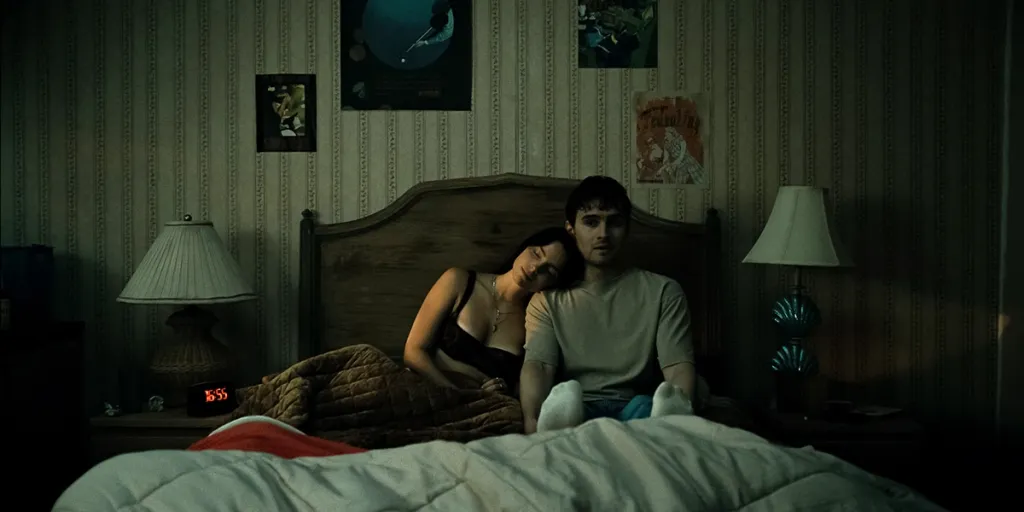
Curry Barker's horror film Obsession arrived in cinemas in May 2026 and made an almost indecent amount of money for something budgeted under a million dollars, nearly $300 million worldwide and counting, an Oscar campaign already being whispered about, and sequels in early conversation. The film's premise is deceptively simple: Bear, a shy music store employee, cannot find the courage to tell his coworker, Nikki, how he feels, so instead of honesty, he buys a supernatural trinket that grants him the wish that she fall in love with him. He gets exactly what he asked for. What follows, for her, is where the real horror lives, because the wish is his and the consequences are entirely hers. Her interiority is erased. Her will is overwritten. She becomes, effectively, the vessel for his desire, and what happens to that vessel once the desire has been granted is the question the film is smart enough to ask and uncomfortable enough not to answer cleanly.

IndieWire's David Ehrlich noted that Barker almost seems to be daring his audience to ask how many "good guys" in the theatre could be capable of a similar lapse in judgment under the right circumstances, and that men and women would feel two very different kinds of dread thinking about the answer. That discomfort is the film's real achievement, more than any of its genuinely effective horror sequences. It understands something that most films about obsession, love, and possession either miss or deliberately look away from: that the cost of a man's unchecked desire is almost never paid by him.
Obsession is one entry point into a much larger and much older conversation, one that deserves to be had plainly.
The Architecture of What Gets Left Behind
To understand the burden, you have to resist the abstraction that language tends to pull it toward, words like "trauma" and "aftermath" that have been used so frequently they have begun to float free of their specific, bodily, financial, and legal meanings. So let's be particular.
When women leave abusive relationships, and the getting-out is its own months-long negotiation of fear, logistics, and shame, research consistently shows that their lives after separation are marked by loneliness, trauma, financial insecurity, and damaged relationships in ways that persist for years, often decades. Between 31 and 84 per cent of women who experience intimate partner violence develop PTSD, a prevalence significantly higher than that observed in the general population, and those numbers come from studies across different geographies and methodologies, which means the floor of that range, 31 per cent, is not an outlier. It is a floor. Women at the lower end of the clinical spectrum are still, years after the violence stopped, navigating flashbacks, hypervigilance, emotional numbness, and a kind of bodily memory that no amount of wanting to move on can simply override. Meanwhile, globally, an estimated 840 million women, almost one in three, have experienced physical or sexual intimate partner violence at least once in their lives, and while 60 per cent of all female homicides are committed by intimate partners or family members, only 11 per cent of male homicides occur in that same private sphere.
Read that last statistic slowly. The home, the relationship, the domestic space, is where women are most likely to be killed. It is, for men, where they are safest. The same institution generates diametrically opposite experiences based entirely on gender, and this is not an accident of nature or culture or individual psychology. It is something produced, maintained, and quietly defended by systems that have always found it easier to manage women's grief than men's accountability.
The Vocabulary of Mitigation
There is a specific language reserved for men who hurt women, and it is, almost always, a language of softening. He was heartbroken. He snapped. He just couldn't handle it. He loved her too much. These phrases are so familiar they arrive already wearing the patina of common sense, as though describing a man's violence as the overflow of feeling is not a choice but simply an accurate account of events, as though the woman who received that overflow was incidental, rather than targeted.
Sociologist Myrna Dawson's research on men convicted of killing their female family members found that they receive measurably shorter prison sentences than men who kill strangers, a phenomenon she has named the "intimacy discount." The reason for this leniency, she argues, is not merely sentimentality about love gone wrong but something more structural: that across the criminal justice system, women murdered by male partners are implicitly treated as property. And property, by definition, cannot press charges. For centuries, the common law has recognised a heat-of-passion defence in homicide cases, the legal provision that killings may be treated less harshly if the killer was in a state of passion that any reasonable person would find disordering, and the textbook example cited in legal scholarship is almost always a man who discovers his wife with another man. The textbook example is always a man's rage at a woman's autonomy. Her autonomy, in this framing, is the provocation.

Sikta Deo, Contributing Editor and Senior Anchor at NDTV, who has spent years covering crimes against women from the ground, is precise on what this does to how we tell these stories: "I've often heard phrases like 'he loved her too much,' 'he lost control,' or 'he couldn't handle the rejection.' Such explanations shift attention away from the victim and the choices the perpetrator made. Rejection is painful, but violence is a decision. It's important that we don't confuse an explanation with a justification."
The distinction between explanation and justification is the one that cultural and legal language has been quietly collapsing for centuries, and the collapsing always happens in one direction.
The Specifics of What Rejection Costs Her
In India, the data on acid attacks is a compressed study of exactly how much a woman's refusal can cost her; 78 per cent of acid attack incidents in India stem from the refusal of marriage proposals, rejection of romantic advances, or personal relationship conflicts. The overwhelming majority of victims are women and girls; the perpetrators are almost always men. Independent agencies estimate that 60 per cent of attacks go unreported, because survivors, and the word "survivor" here is not metaphorical, these are women who have had corrosive substances thrown at their faces, are embarrassed, or afraid of the perpetrators who remain in their communities, or simply do not believe that the system will hold the man accountable, rather than interrogate their choices.
That last instinct is not paranoia. It is pattern recognition.
What makes acid attacks particularly illuminating as a category of violence is what they reveal about intent. Unlike other violent crimes, the perpetrator's goal is not necessarily to kill but to inflict lasting damage that affects every aspect of the victim's life, permanently and visibly. The face is targeted because it is the most legible site of identity, because disfiguring it is a way of saying, in the most permanent possible language, that she will carry this forever. The attacker may serve time, or may not. He will, in either case, eventually be released, or was never arrested, or was quietly encouraged to leave town. She will continue to undergo surgeries. Continue to mourn her sight, if she lost it. Continue to construct an identity around a wound that the community, family, and law have all conspired to make her responsible for not provoking.
The sentence, it's always the victim who drives the criminal into committing the crime, is not hyperbole. It is a precise description of how cause and effect are consistently reassigned in cases of male violence against women, until the woman's existence becomes the origin point of a harm she did not choose and a man's violence becomes the understandable consequence of her existing in the wrong place, at the wrong time, in the wrong way.
The Hopeless Romantic and What He's Actually Asking For
Barker's film does something quietly devastating with the figure of the "hopeless romantic": it takes the term seriously as a cultural construction rather than an endearing one. Bear is not presented as a villain in the conventional sense. He is shy. He is gentle. He clearly cares about Nikki. But his caring, in the logic of the film, does not include any particular interest in her inner life, in what she actually wants, who she actually is, what she might feel about being wanted in this way. He cannot find the courage to be honest with her, so instead of honesty, he finds a mechanism to override her entirely. The horror of the film is not that the wish backfires. It is that the cost of his shortcut, his unwillingness to accept the possibility of rejection, is paid almost entirely by her. She loses herself. He remains, watching. The structure of the film is the structure of the problem.

This is the cultural instruction that Aditya Sundar Bandyopadhyay, a Mass Communication and Videography student at St. Xavier's College in Kolkata, identifies in Indian cinema specifically: "A man's obsession with a woman is seen as the action of a heartbroken lover who is just trying to win back the love of his life. This is further reinforced by the films we see around us, especially in India, with heroes often getting back the love of their lives after stalker-like behaviour." The romantic pursuit that ignores 'no,' in this storytelling tradition, is not a warning. It is a blueprint. It is the plot. It is what the hero does, and the woman eventually understands. What she understands, beneath the choreography of it, is that her refusal was never the final word, that persistence, if sufficiently romantic in its framing, is allowed to override her.
A man who won't let go is heartbroken. A woman who won't let go is crazy. That asymmetry lives in the language, in the law, in the cinema, and in the way communities respond when something goes badly wrong, which is to say, when a man decides that a woman's continued refusal has exhausted his patience.
What Was Taught, What Was Permitted, What Continues
The question of whether male violence is innate or learned tends to produce more heat than clarity, in part because it allows the conversation to remain theoretical at the moment when it most needs to be practical. Even granting the most biological reading of male anger, even if you accept that some portion of what drives men to violence in these situations is hardwired, the question of what we do with that is entirely a cultural and social one. Most men face rejection. The overwhelming majority do not respond with violence. This is the fact that dismantles every framework of inevitability on which the heat-of-passion defence and its cultural equivalents rely. If it were truly uncontrollable, every rejected man would be dangerous. They are not. The ones who have been given, somewhere in their formation, permission, direct or structural, spoken or absorbed, to understand their rage as a reasonable response to a woman's refusal.
Sikta Deo, from years of sitting with the families that remain after violence, draws the line clearly: "Most people face rejection without becoming violent, which suggests the problem is not rejection itself but how some individuals are taught to deal with it. Family attitudes, peer groups, social conditioning, and the glorification of possessive behaviour can all play a role." Teaching emotional intelligence and healthy ways to handle disappointment would benefit not only boys themselves but everyone around them, which is perhaps the most measured and devastating indictment possible of the current approach, since "everyone around them" means, primarily, women.
The pipeline from "men don't cry" to "she drove me to it" is shorter than most parents want to believe. When boys are systematically taught that vulnerability is weakness, that grief is feminised, that emotional expression outside of anger invites ridicule, when the sentence "don't cry like a girl" is delivered before a child is old enough to understand what gender even means, the emotional vocabulary that remains available to them is a narrow one. They feel hurt, and fear, and grief, and longing. But the only one of those that the culture has given them permission to express outwardly is anger. And anger, when it is directed at a woman who has said no, tends not to stay abstract.
The Audience That Scrolled Past
There is a specifically modern dimension to all of this that deserves its own accounting, which is what happens to collective empathy when it is subjected to a constant, high-volume stream of horror, when violence against women becomes content, becomes trending discourse, becomes a three-day conversation that peaks and then is replaced by the next thing.
Desensitisation doesn't only blunt reactions to explicit violence. It quietly reassigns who counts as a real victim and whose suffering is sufficiently novel to warrant sustained attention. When women's pain becomes scroll material, when it generates a news cycle and then an outrage cycle and then an irony cycle and then silence, the women inside those stories become abstract. The man still moves on. Now the audience does too. What remains is a kind of ambient awareness that these things happen, decoupled from any particular sense of responsibility about the systems that make them happen, or the specific people they are happening to.
What Does Not Get Said in the Sentencing Report
Here is what a woman who survives male violence is frequently left to manage, largely alone and without adequate institutional support: the legal proceedings, which in India and elsewhere can extend for years and require her to reconstruct the worst event of her life in granular, cross-examined detail at regular intervals, for a system that may ultimately produce little accountability. The medical costs, which can be financially ruinous and are frequently inadequately covered. The housing crisis, in cases where she shared a home with the man who hurt her, which is in most cases. The social repositioning, the quiet but pervasive way communities tend to look at a survivor and see complication, disruption, something that requires management, rather than a person who was wronged and deserves straightforward support. The exhausting, ongoing labour of convincing people, family, police, journalists, medical professionals, judges, that what happened to her was real, that it mattered, that she is telling the truth about it.

He, meanwhile, moves through these same systems with the ease of someone they were never really designed to be held accountable. He may receive a reduced sentence on the basis that he acted out of passion. He may receive no sentence at all, because the case ran long, and witnesses became unavailable, and memories were challenged. He may receive bail and return to the neighbourhood where she is trying to rebuild. He has been given, by culture, law, language, and cinema, the infrastructure to move on. She has not. She is still there, in the therapy session, in the courtroom, in the body that remembers what the mind is working very hard to outrun, managing the aftermath of something she didn't choose, that he did, that the world has quietly decided is primarily her problem to solve.
The man moves on. That is, distilled to its simplest form, the whole problem. Not the violence alone, as terrible as it is, but the systematic way that its consequences are transferred from the one who acted to the one who suffered the action, and the way that transfer is normalised, codified, narrativised, and above all, left unexamined. Until that examination happens, in courts, in classrooms, in families, in the stories we tell about what love looks like and what rejection is allowed to cost, she will remain there. Paying, indefinitely, for something that was never hers to owe.
TO BE CONTINUED, FOR SUBSCRIBERS ONLY.
This is where the surface ends and the reporting begins.
The complete piece, the full archive, and access to The French Press Circle. Reporting answerable only to its readers.
Already a subscriber ?
Login
Read these on the house, with our compliments.
A selection from the current issue, open to all readers. Read them in full. The rest is one decision away.






There is a pattern so consistent, so structurally embedded in how societies across the world handle male violence, that it has become functionally invisible, not because it is subtle, but because it is so routine that it has been absorbed into the background noise of ordinary life. The man acts. The woman spends the rest of her life managing the consequences of what he did. He escalates, or disappears, or is counselled and quietly absolved by a system that has always found more language for his anguish than for hers. She, the one who did nothing except exist in proximity to his desire, is left to carry the physical, psychological, legal, and social wreckage of what he chose, and the carrying is rarely acknowledged as a burden. It is simply expected of her. It is called moving forward. It is called healing. It is, if she is lucky, called survival.
Curry Barker's horror film Obsession arrived in cinemas in May 2026 and made an almost indecent amount of money for something budgeted under a million dollars, nearly $300 million worldwide and counting, an Oscar campaign already being whispered about, and sequels in early conversation. The film's premise is deceptively simple: Bear, a shy music store employee, cannot find the courage to tell his coworker, Nikki, how he feels, so instead of honesty, he buys a supernatural trinket that grants him the wish that she fall in love with him. He gets exactly what he asked for. What follows, for her, is where the real horror lives, because the wish is his and the consequences are entirely hers. Her interiority is erased. Her will is overwritten. She becomes, effectively, the vessel for his desire, and what happens to that vessel once the desire has been granted is the question the film is smart enough to ask and uncomfortable enough not to answer cleanly.
IndieWire's David Ehrlich noted that Barker almost seems to be daring his audience to ask how many "good guys" in the theatre could be capable of a similar lapse in judgment under the right circumstances, and that men and women would feel two very different kinds of dread thinking about the answer. That discomfort is the film's real achievement, more than any of its genuinely effective horror sequences. It understands something that most films about obsession, love, and possession either miss or deliberately look away from: that the cost of a man's unchecked desire is almost never paid by him.
Obsession is one entry point into a much larger and much older conversation, one that deserves to be had plainly.
The Architecture of What Gets Left Behind
To understand the burden, you have to resist the abstraction that language tends to pull it toward, words like "trauma" and "aftermath" that have been used so frequently they have begun to float free of their specific, bodily, financial, and legal meanings. So let's be particular.
When women leave abusive relationships, and the getting-out is its own months-long negotiation of fear, logistics, and shame, research consistently shows that their lives after separation are marked by loneliness, trauma, financial insecurity, and damaged relationships in ways that persist for years, often decades. Between 31 and 84 per cent of women who experience intimate partner violence develop PTSD, a prevalence significantly higher than that observed in the general population, and those numbers come from studies across different geographies and methodologies, which means the floor of that range, 31 per cent, is not an outlier. It is a floor. Women at the lower end of the clinical spectrum are still, years after the violence stopped, navigating flashbacks, hypervigilance, emotional numbness, and a kind of bodily memory that no amount of wanting to move on can simply override. Meanwhile, globally, an estimated 840 million women, almost one in three, have experienced physical or sexual intimate partner violence at least once in their lives, and while 60 per cent of all female homicides are committed by intimate partners or family members, only 11 per cent of male homicides occur in that same private sphere.
Read that last statistic slowly. The home, the relationship, the domestic space, is where women are most likely to be killed. It is, for men, where they are safest. The same institution generates diametrically opposite experiences based entirely on gender, and this is not an accident of nature or culture or individual psychology. It is something produced, maintained, and quietly defended by systems that have always found it easier to manage women's grief than men's accountability.
The Vocabulary of Mitigation
There is a specific language reserved for men who hurt women, and it is, almost always, a language of softening. He was heartbroken. He snapped. He just couldn't handle it. He loved her too much. These phrases are so familiar they arrive already wearing the patina of common sense, as though describing a man's violence as the overflow of feeling is not a choice but simply an accurate account of events, as though the woman who received that overflow was incidental, rather than targeted.
Sociologist Myrna Dawson's research on men convicted of killing their female family members found that they receive measurably shorter prison sentences than men who kill strangers, a phenomenon she has named the "intimacy discount." The reason for this leniency, she argues, is not merely sentimentality about love gone wrong but something more structural: that across the criminal justice system, women murdered by male partners are implicitly treated as property. And property, by definition, cannot press charges. For centuries, the common law has recognised a heat-of-passion defence in homicide cases, the legal provision that killings may be treated less harshly if the killer was in a state of passion that any reasonable person would find disordering, and the textbook example cited in legal scholarship is almost always a man who discovers his wife with another man. The textbook example is always a man's rage at a woman's autonomy. Her autonomy, in this framing, is the provocation.
Sikta Deo, Contributing Editor and Senior Anchor at NDTV, who has spent years covering crimes against women from the ground, is precise on what this does to how we tell these stories: "I've often heard phrases like 'he loved her too much,' 'he lost control,' or 'he couldn't handle the rejection.' Such explanations shift attention away from the victim and the choices the perpetrator made. Rejection is painful, but violence is a decision. It's important that we don't confuse an explanation with a justification."
The distinction between explanation and justification is the one that cultural and legal language has been quietly collapsing for centuries, and the collapsing always happens in one direction.
The Specifics of What Rejection Costs Her
In India, the data on acid attacks is a compressed study of exactly how much a woman's refusal can cost her; 78 per cent of acid attack incidents in India stem from the refusal of marriage proposals, rejection of romantic advances, or personal relationship conflicts. The overwhelming majority of victims are women and girls; the perpetrators are almost always men. Independent agencies estimate that 60 per cent of attacks go unreported, because survivors, and the word "survivor" here is not metaphorical, these are women who have had corrosive substances thrown at their faces, are embarrassed, or afraid of the perpetrators who remain in their communities, or simply do not believe that the system will hold the man accountable, rather than interrogate their choices.
That last instinct is not paranoia. It is pattern recognition.
What makes acid attacks particularly illuminating as a category of violence is what they reveal about intent. Unlike other violent crimes, the perpetrator's goal is not necessarily to kill but to inflict lasting damage that affects every aspect of the victim's life, permanently and visibly. The face is targeted because it is the most legible site of identity, because disfiguring it is a way of saying, in the most permanent possible language, that she will carry this forever. The attacker may serve time, or may not. He will, in either case, eventually be released, or was never arrested, or was quietly encouraged to leave town. She will continue to undergo surgeries. Continue to mourn her sight, if she lost it. Continue to construct an identity around a wound that the community, family, and law have all conspired to make her responsible for not provoking.
The sentence, it's always the victim who drives the criminal into committing the crime, is not hyperbole. It is a precise description of how cause and effect are consistently reassigned in cases of male violence against women, until the woman's existence becomes the origin point of a harm she did not choose and a man's violence becomes the understandable consequence of her existing in the wrong place, at the wrong time, in the wrong way.
The Hopeless Romantic and What He's Actually Asking For
Barker's film does something quietly devastating with the figure of the "hopeless romantic": it takes the term seriously as a cultural construction rather than an endearing one. Bear is not presented as a villain in the conventional sense. He is shy. He is gentle. He clearly cares about Nikki. But his caring, in the logic of the film, does not include any particular interest in her inner life, in what she actually wants, who she actually is, what she might feel about being wanted in this way. He cannot find the courage to be honest with her, so instead of honesty, he finds a mechanism to override her entirely. The horror of the film is not that the wish backfires. It is that the cost of his shortcut, his unwillingness to accept the possibility of rejection, is paid almost entirely by her. She loses herself. He remains, watching. The structure of the film is the structure of the problem.
This is the cultural instruction that Aditya Sundar Bandyopadhyay, a Mass Communication and Videography student at St. Xavier's College in Kolkata, identifies in Indian cinema specifically: "A man's obsession with a woman is seen as the action of a heartbroken lover who is just trying to win back the love of his life. This is further reinforced by the films we see around us, especially in India, with heroes often getting back the love of their lives after stalker-like behaviour." The romantic pursuit that ignores 'no,' in this storytelling tradition, is not a warning. It is a blueprint. It is the plot. It is what the hero does, and the woman eventually understands. What she understands, beneath the choreography of it, is that her refusal was never the final word, that persistence, if sufficiently romantic in its framing, is allowed to override her.
A man who won't let go is heartbroken. A woman who won't let go is crazy. That asymmetry lives in the language, in the law, in the cinema, and in the way communities respond when something goes badly wrong, which is to say, when a man decides that a woman's continued refusal has exhausted his patience.
What Was Taught, What Was Permitted, What Continues
The question of whether male violence is innate or learned tends to produce more heat than clarity, in part because it allows the conversation to remain theoretical at the moment when it most needs to be practical. Even granting the most biological reading of male anger, even if you accept that some portion of what drives men to violence in these situations is hardwired, the question of what we do with that is entirely a cultural and social one. Most men face rejection. The overwhelming majority do not respond with violence. This is the fact that dismantles every framework of inevitability on which the heat-of-passion defence and its cultural equivalents rely. If it were truly uncontrollable, every rejected man would be dangerous. They are not. The ones who have been given, somewhere in their formation, permission, direct or structural, spoken or absorbed, to understand their rage as a reasonable response to a woman's refusal.
Sikta Deo, from years of sitting with the families that remain after violence, draws the line clearly: "Most people face rejection without becoming violent, which suggests the problem is not rejection itself but how some individuals are taught to deal with it. Family attitudes, peer groups, social conditioning, and the glorification of possessive behaviour can all play a role." Teaching emotional intelligence and healthy ways to handle disappointment would benefit not only boys themselves but everyone around them, which is perhaps the most measured and devastating indictment possible of the current approach, since "everyone around them" means, primarily, women.
The pipeline from "men don't cry" to "she drove me to it" is shorter than most parents want to believe. When boys are systematically taught that vulnerability is weakness, that grief is feminised, that emotional expression outside of anger invites ridicule, when the sentence "don't cry like a girl" is delivered before a child is old enough to understand what gender even means, the emotional vocabulary that remains available to them is a narrow one. They feel hurt, and fear, and grief, and longing. But the only one of those that the culture has given them permission to express outwardly is anger. And anger, when it is directed at a woman who has said no, tends not to stay abstract.
The Audience That Scrolled Past
There is a specifically modern dimension to all of this that deserves its own accounting, which is what happens to collective empathy when it is subjected to a constant, high-volume stream of horror, when violence against women becomes content, becomes trending discourse, becomes a three-day conversation that peaks and then is replaced by the next thing.
Desensitisation doesn't only blunt reactions to explicit violence. It quietly reassigns who counts as a real victim and whose suffering is sufficiently novel to warrant sustained attention. When women's pain becomes scroll material, when it generates a news cycle and then an outrage cycle and then an irony cycle and then silence, the women inside those stories become abstract. The man still moves on. Now the audience does too. What remains is a kind of ambient awareness that these things happen, decoupled from any particular sense of responsibility about the systems that make them happen, or the specific people they are happening to.
What Does Not Get Said in the Sentencing Report
Here is what a woman who survives male violence is frequently left to manage, largely alone and without adequate institutional support: the legal proceedings, which in India and elsewhere can extend for years and require her to reconstruct the worst event of her life in granular, cross-examined detail at regular intervals, for a system that may ultimately produce little accountability. The medical costs, which can be financially ruinous and are frequently inadequately covered. The housing crisis, in cases where she shared a home with the man who hurt her, which is in most cases. The social repositioning, the quiet but pervasive way communities tend to look at a survivor and see complication, disruption, something that requires management, rather than a person who was wronged and deserves straightforward support. The exhausting, ongoing labour of convincing people, family, police, journalists, medical professionals, judges, that what happened to her was real, that it mattered, that she is telling the truth about it.
He, meanwhile, moves through these same systems with the ease of someone they were never really designed to be held accountable. He may receive a reduced sentence on the basis that he acted out of passion. He may receive no sentence at all, because the case ran long, and witnesses became unavailable, and memories were challenged. He may receive bail and return to the neighbourhood where she is trying to rebuild. He has been given, by culture, law, language, and cinema, the infrastructure to move on. She has not. She is still there, in the therapy session, in the courtroom, in the body that remembers what the mind is working very hard to outrun, managing the aftermath of something she didn't choose, that he did, that the world has quietly decided is primarily her problem to solve.
The man moves on. That is, distilled to its simplest form, the whole problem. Not the violence alone, as terrible as it is, but the systematic way that its consequences are transferred from the one who acted to the one who suffered the action, and the way that transfer is normalised, codified, narrativised, and above all, left unexamined. Until that examination happens, in courts, in classrooms, in families, in the stories we tell about what love looks like and what rejection is allowed to cost, she will remain there. Paying, indefinitely, for something that was never hers to owe.
TO BE CONTINUED, FOR SUBSCRIBERS ONLY.
This is where the surface ends and the reporting begins.
The complete piece, the full archive, and access to The French Press Circle. Reporting answerable only to its readers.
Already a subscriber ?
Login
Read these on the house, with our compliments.
A selection from the current issue, open to all readers. Read them in full. The rest is one decision away.