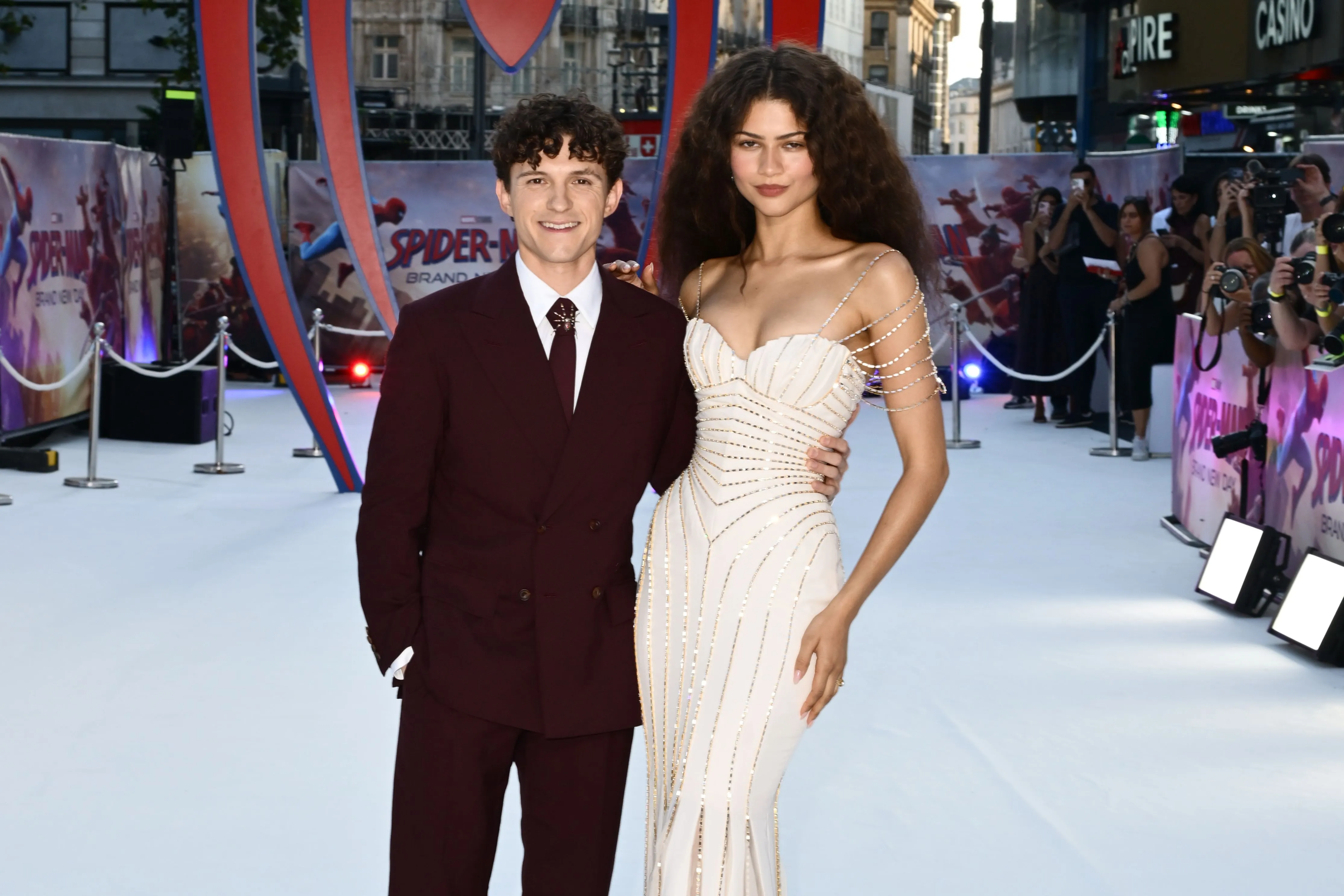
There is a governing rule to the way Zendaya has dressed for the last decade, and it is one of restraint. The trick of method dressing, the practice of building red carpet looks around the film being promoted, is to gesture toward the material while stopping short of reenacting it. A tennis silhouette rather than a tennis racket. A spiderweb woven into couture rather than a costume pulled from wardrobe. For Spider-Man: Brand New Day, which arrives in theatres today, an entire international press cycle has tested exactly how far that gesture can be pushed before it tips into literalism. The answer, gathered across roughly ten cities and several wardrobes, tells us as much about the audience as it does about the clothes.
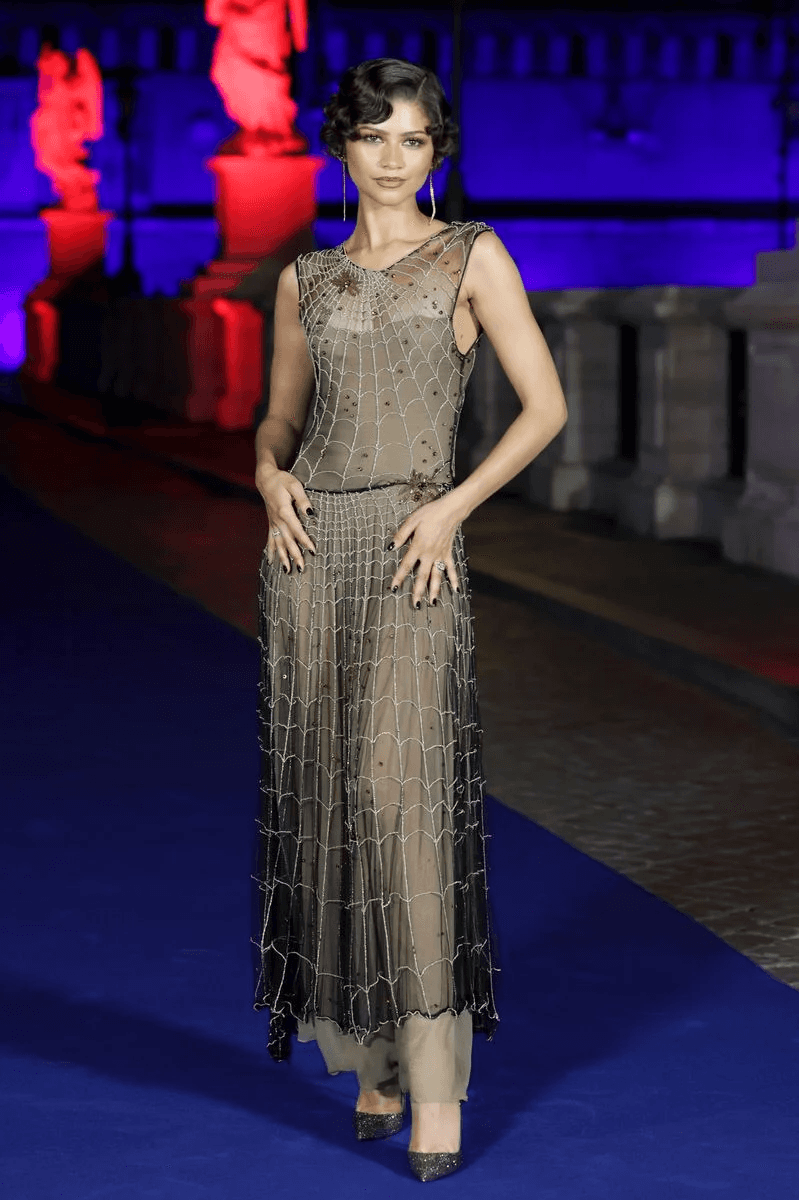
Zendaya at the Rome premiere in a vintage Giorgio Armani spring 1990 gown embroidered with a crystalline spiderweb motif. Image by Vittorio Zunino Celotto
What Method Dressing Actually Does
Before the looks, the phenomenon deserves examination, because method dressing has slowly become one of the more revealing cultural rituals of the streaming age. On its surface it is marketing. Beneath that surface it performs something subtler: it invites the audience into an act of decoding, and in doing so converts a passive viewer into a participant.
The term itself is credited to the journalist Andre Wheeler, who described method dressing as a chance to extend a project's cinematic universe onto the red carpet even before the film's premiere. The technique borrows its logic from method acting. The concept borrows from method acting, the approach in which an actor carries their character into daily life rather than leaving it at the stage door, and applies it to fashion; a premiere look is selected for its narrative coherence with the character, the world, and the themes of the film being promoted. The practice has deep roots. While the term is recent, it has precedents in how fashion and performance have always intersected, as in Marlene Dietrich's sustained public adoption of menswear tailoring throughout the 1930s and 1940s, a performance of a specific femininity inseparable from her screen persona.
What makes the contemporary version sociologically distinct is the audience's role in completing it. A spiderweb sewn into an archival gown means little until a viewer recognises it, names it, and shares the recognition. The look becomes a small puzzle whose solving produces a flicker of belonging, the pleasure of being fluent in a shared visual language. In an attention economy where films compete against infinite distraction, method dressing manufactures intimacy at scale. It flatters the audience's cultural literacy and rewards fandom with a sense of authorship. The red carpet stops being a place where stars are looked at and becomes a place where fans are spoken to.
That participatory quality explains why the technique proliferated so quickly beyond any single star. Margot Robbie's Barbie campaign in 2023 remains the most complete demonstration of the form as populist spectacle. Working with stylist Andrew Mukamal, Robbie sported high-fashion versions of iconic outfits worn by Barbie across different eras, from the black and white striped swimsuit of the first 1959 doll to the hot pink day-to-night working woman ensemble of 1985. Each look sent fans back to the Mattel archive to find the reference, turning a global press tour into a scavenger hunt that mirrored the film's own nostalgic project.
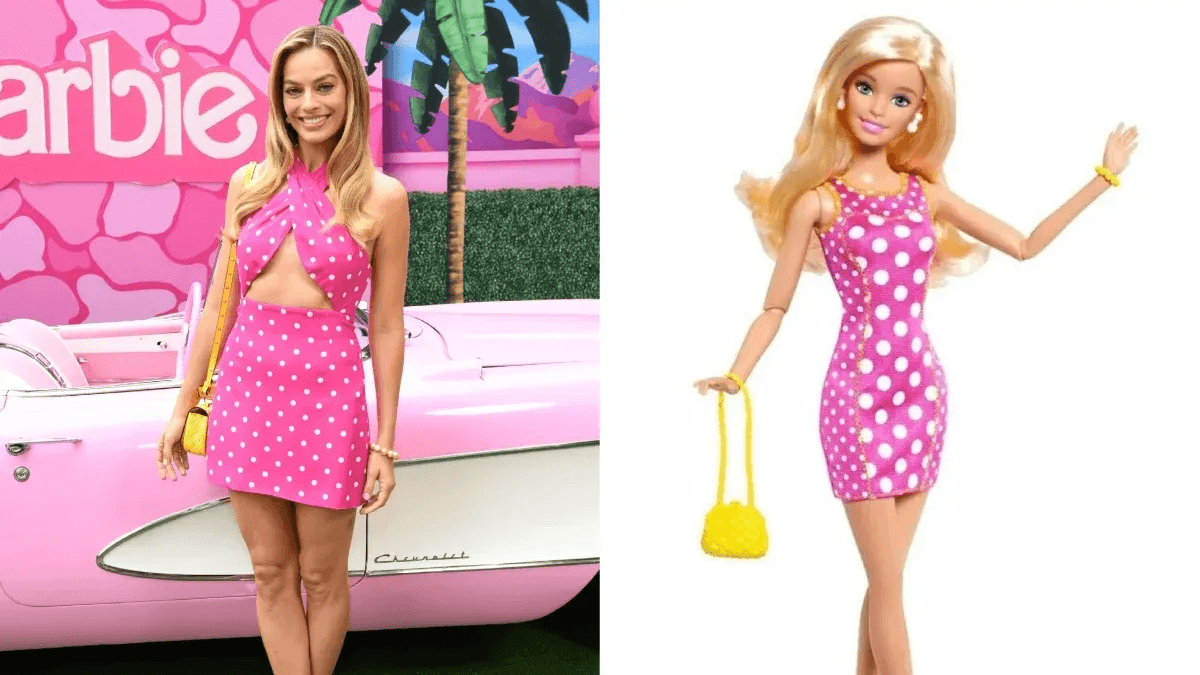
Margot Robbie's 2023 Barbie tour, which recreated specific dolls and remains method dressing's most populist expression.
The same grammar recurs across recent culture, from Jenna Ortega's gothic register for Wednesday to Halle Bailey's aquatic gowns for The Little Mermaid. It is worth anticipating, too, the sequel campaigns already circling this logic; a project like a Devil Wears Prada follow-up would arrive pre-loaded with sartorial expectation, since its very subject is the moral and creative weight of clothing. Method dressing has become the default second text of the modern release, a film about the film, told in fabric.
A Franchise Rehearsed Over a Decade
Against that backdrop, the Zendaya and Roach partnership occupies a specific position: not the originators, but the practitioners who raised the form to sustained authorship. While they may not have been the first to take this approach, they are undeniably doing it on a different level and have brought it into the mainstream. Their 2024 Dune: Part Two campaign leaned into desert-planet futurism, culminating in a vintage silver Mugler "robot" suit from 1995 that circulated widely. For Challengers that year, the styling cycled through palettes keyed to the film's love triangle. For The Drama, the pair built a bridal narrative around the rhyme "something old, something new, something borrowed, something blue."
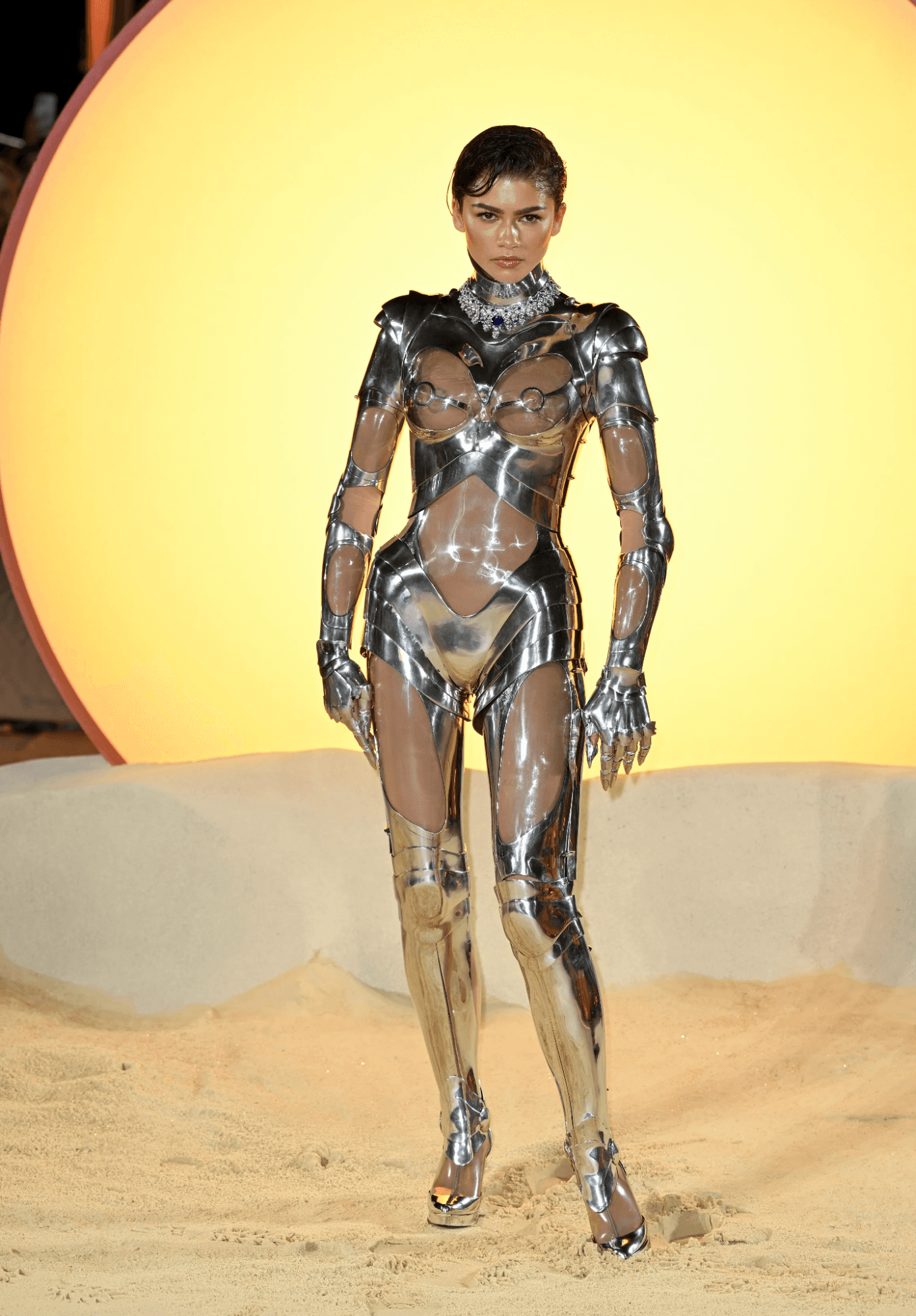
The 1995 Mugler "robot" suit worn to the 2024 Dune: Part Two premiere, an earlier high point of the approach. Image via WWD.
Spider-Man, though, is the rare case where the subject returns. Zendaya has dressed around this franchise since 2017, when her first major press tour for Spider-Man: Homecoming found her still finding her fashion voice, with looks not yet cohesive around a theme. The 2021 No Way Home cycle is now widely read as the origin point of her method-dressing era. At the end of her 2021 Spider-Man: No Way Home outing, fans got a taste of her future method-dressing sensibilities when Roach dressed her in a spiderweb-covered Valentino Haute Couture gown with a coordinating black Spider-Man headpiece.
Returning to a motif already delivered definitively raises the degree of difficulty. The current tour answers partly through self-reference. The Rome look, a sheer black vintage Giorgio Armani dress from the designer's spring 1990 collection covered in glitzy spiderweb beadwork with tonal beaded spiders across the front and back, shared remarkably similar details to that Valentino dress from five years earlier, creating a full-circle method-dressing moment. The tour, in this sense, has become a text about its own history, legible chiefly to those who have followed the whole arc.
Reading the Looks, Hits and Misses
The strongest entries this cycle succeed because the reference is structural rather than printed. The London appearance offered the tour's most sophisticated sleight of hand: a 28-year-old John Galliano slip dress whose front read as abstract galaxy print while its statement hid on the reverse. An elaborate spiderweb crafted from sterling silver, diamond-encrusted charms and chainmail jewellery transformed the vintage gown into one of the most talked-about looks of the tour. Placing the reference where it was visible only when she turned represents the technique at its most confident, and Roach himself, asked to name a favorite, shouted out the archival spiderweb dress from John Galliano's 1997 "Circus" collection worn at the London premiere.
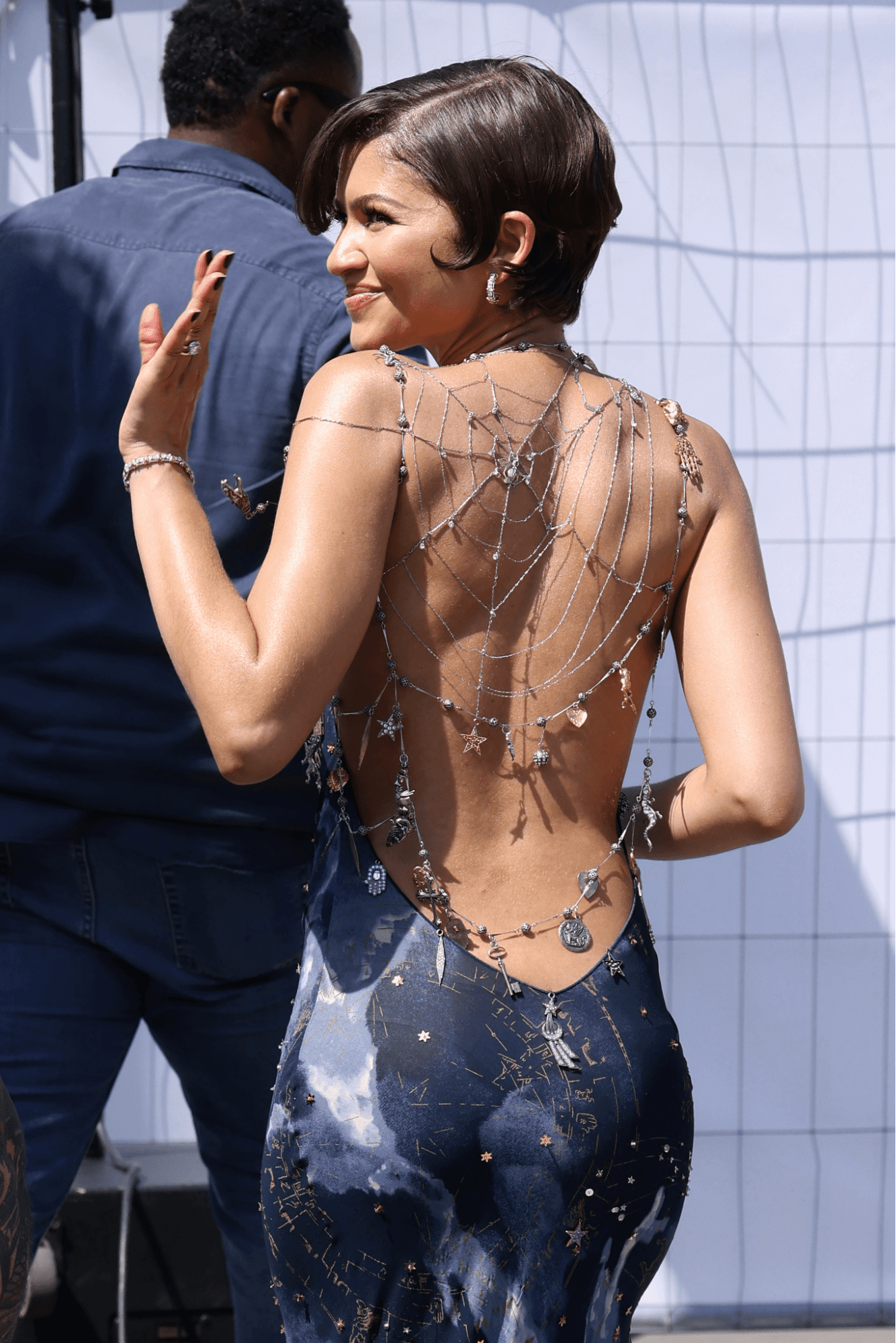
The archival John Galliano dress in London, its spiderweb concealed as a silver-and-chainmail detail across the back. Image via Marie Claire
The Madrid premiere, where Zendaya and Tom Holland made their red carpet debut as a married couple, with Zendaya in a vintage lace and silk Christian Cowan fringed gown and Holland in a Jacquemus black suit worn with a red shirt, demonstrated the technique's coordinated register: the colour logic of red and black threaded quietly through the pairing, doing the referential work without announcing it.
The tour's most rewarding detail came in London, on the two smallest surfaces of the night. At the base of Zendaya's spine, on the reverse of her cream Tamara Ralph gown, sat a gilded spider by Keren Wolf, a piece originally built into a spiderweb headpiece and repurposed to reward anyone who watched her walk away. Holland answered in kind. Into the Windsor knot of his burgundy tie he pinned a spider of his own, an eight-legged Pragnell jewel set with black opals and diamonds, its body catching red and green under the carpet lights. Photographed in close-up, the two rhyme without matching. Hers is warm gold and hidden until she turns; his is dark and iridescent and worn at the throat. The coordination is the point. This is the couple's married-couple register at its most legible, a shared motif split across two backs and one tie knot, the newlyweds dressing as a single web with a spider at each end.
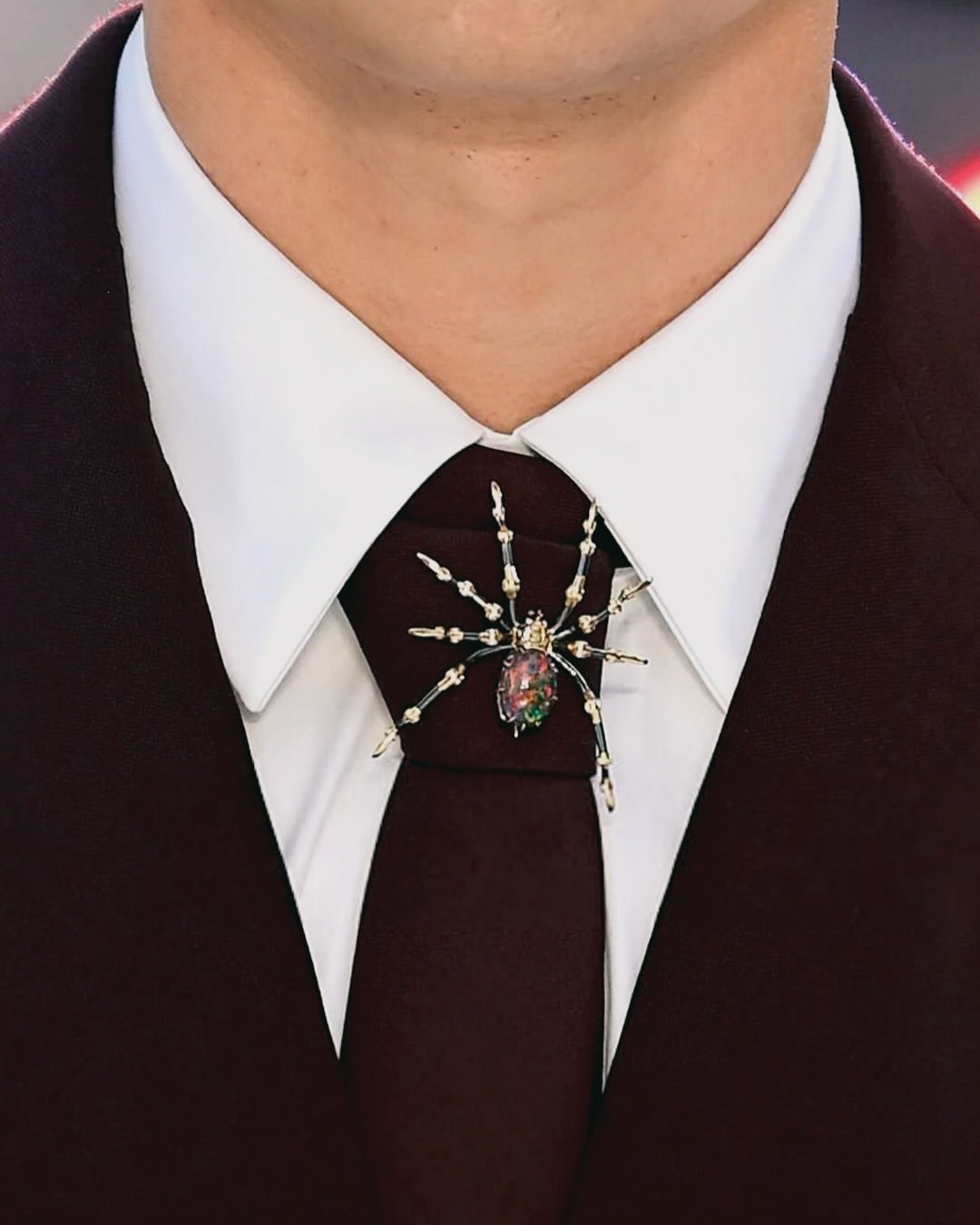
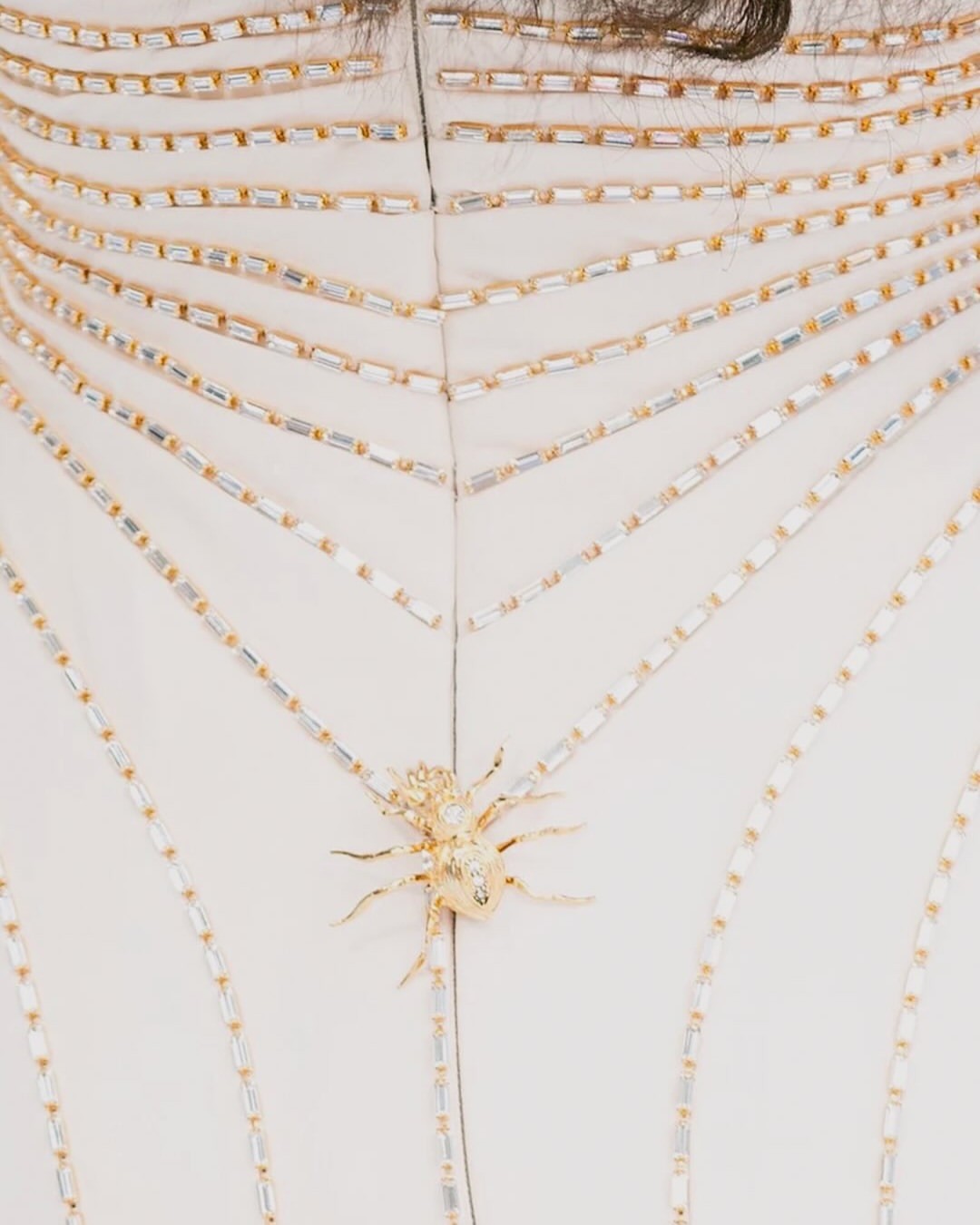
Holland deserves particular note here, because his contribution is easy to overlook and is the more disciplined half of the equation. Across the tour he holds to tailoring, threading the franchise's palette through burgundy and red without a single literal flourish. At the Los Angeles premiere he opted for understated elegance in a deep burgundy suit worn with a vibrant red shirt and navy tie while his co-star commanded the couture. It reads as a deliberate division of labour, one figure carrying the spectacle while the other holds the line, and the restraint is its own kind of skill.
The finale in Los Angeles pushed the concept to its most conceptual extreme. Zendaya stepped out in a couture Ashi Studio dress meant to convey a very abstract vision of arachnid anatomy, an architectural asymmetrical silhouette with sharp fabric appendages extending from the neckline, from the house's fall 2027 couture collection, which took nearly 200 hours to make. Roach framed it as transformation rather than costume. "It's kind of an abstract way to present the spider," he said, "in our mind, it's like this metamorphosis of this woman into this thing." As a thesis statement for the whole tour it is elegant; the woman does not wear the spider, she becomes it.
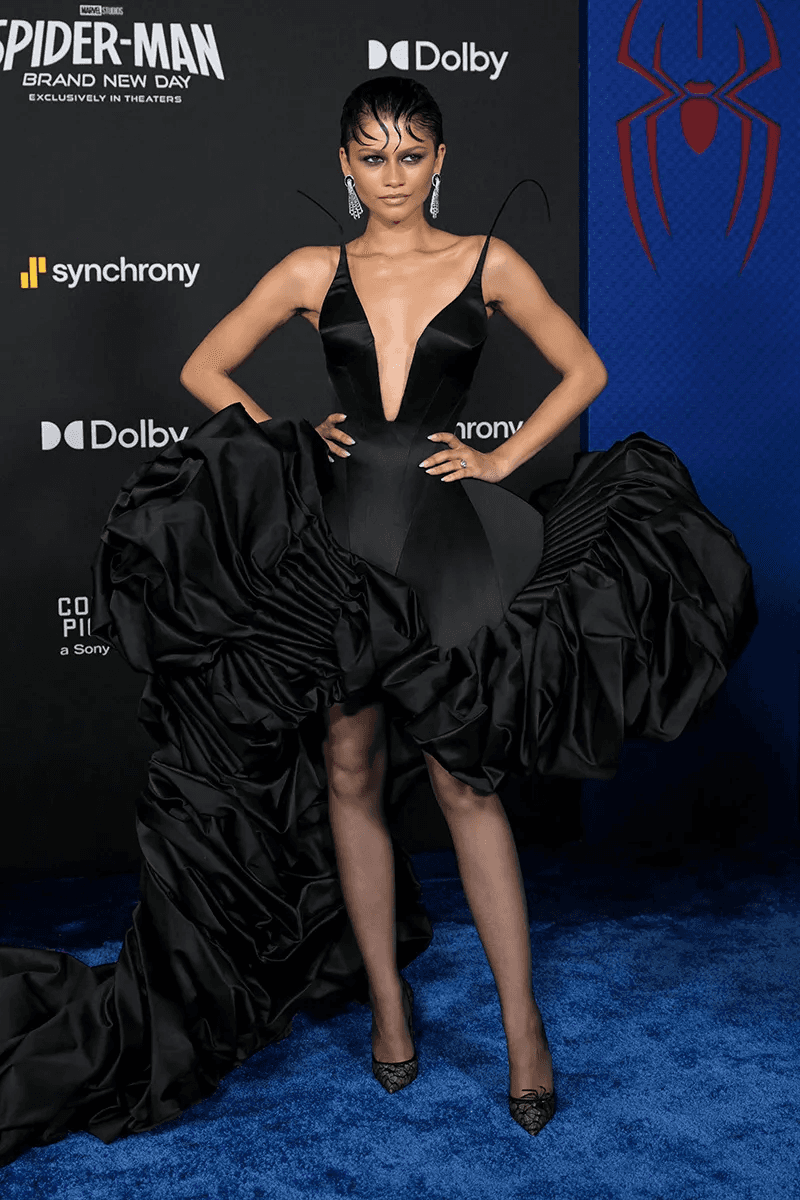
The Ashi Studio finale in Los Angeles, an abstract "metamorphosis" that took nearly 200 hours to construct. Image via WWD
Where the tour is least persuasive is at the literal end of its own spectrum. The Rome Armani dress, admired as it was, is also fairly described as one of the most literal Spider-Man tributes of the tour, its beaded spiders rendered legibly enough that the decoding pleasure evaporates; the puzzle solves itself. Set beside the concealed Galliano or the abstract Ashi Studio finale, the explicit entries feel like the tour explaining a joke it has already told with more wit elsewhere. The viral Paris moment sits in a similar critical grey zone. At a Paris photocall, Zendaya wore a vintage oversized Spider-Man T-shirt with nothing but Christian Louboutin pumps, a piece Roach revealed was purchased off eBay for $34.99. As a gesture of high-low confidence it is truly clever, a pressure release valve in a tour otherwise defined by archival rarity. Its achievement, though, is worth naming precisely: fans noted that whether they loved every styling choice or wanted more accessories, the outfit succeeded in getting people talking. The win is located in the conversation rather than the clothing, which is a revealing thing to say about an outfit and a quiet sign of the technique straining toward spectacle for its own sake.
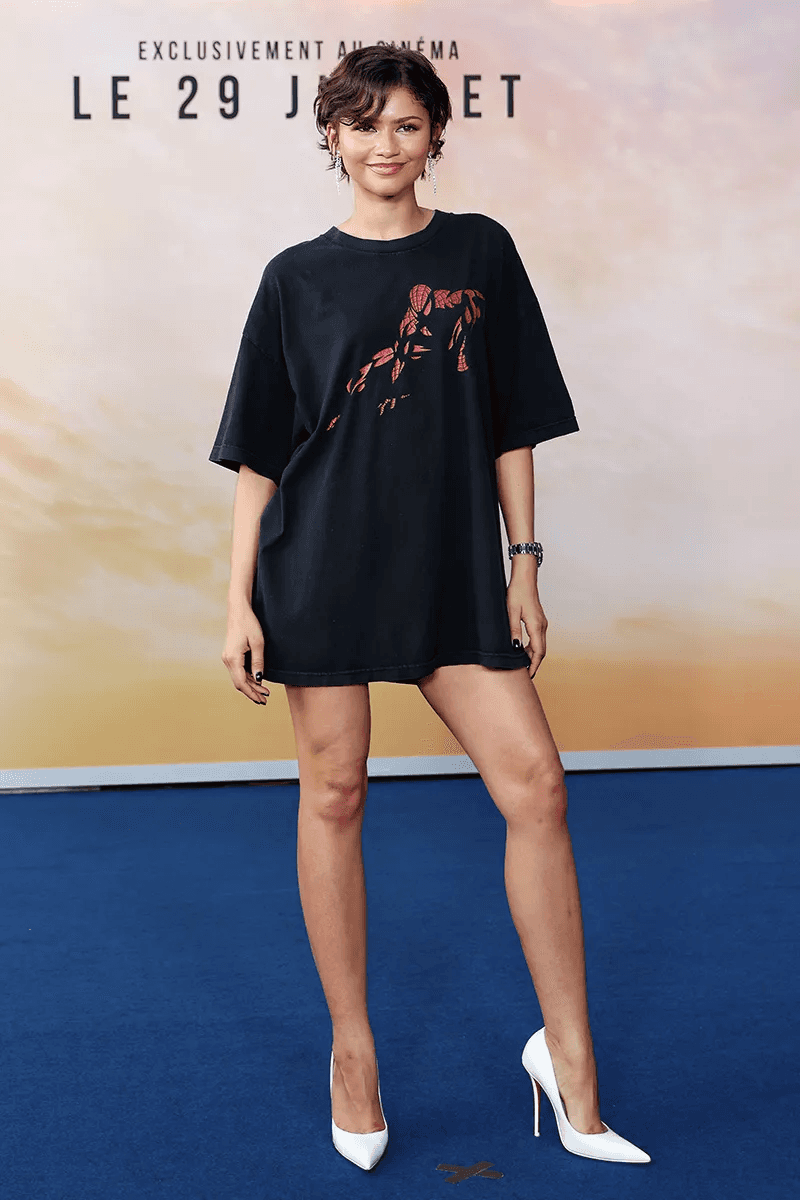
The $34.99 eBay Spider-Man tee worn as a dress in Paris, the tour's most discussed and most debated moment.
The Rest of the Cast
A tour this fashion-forward risks flattening everyone else into background, and the ensemble's own choices are instructive precisely because they mostly opt out of the game. Sadie Sink, whose role in the film has been guarded closely, made the sharpest independent statement. She wore a silvery grey embellished backless Prada gown, its open back the strongest element of the dress, adding a touch of drama. Read one way, the choice becomes its own coded gesture; fans quickly noted the colour as a possible hint about her secret character, which turns a styling decision into a piece of narrative speculation and shows method dressing's logic seeping outward from its central practitioner into the whole cast's reception.
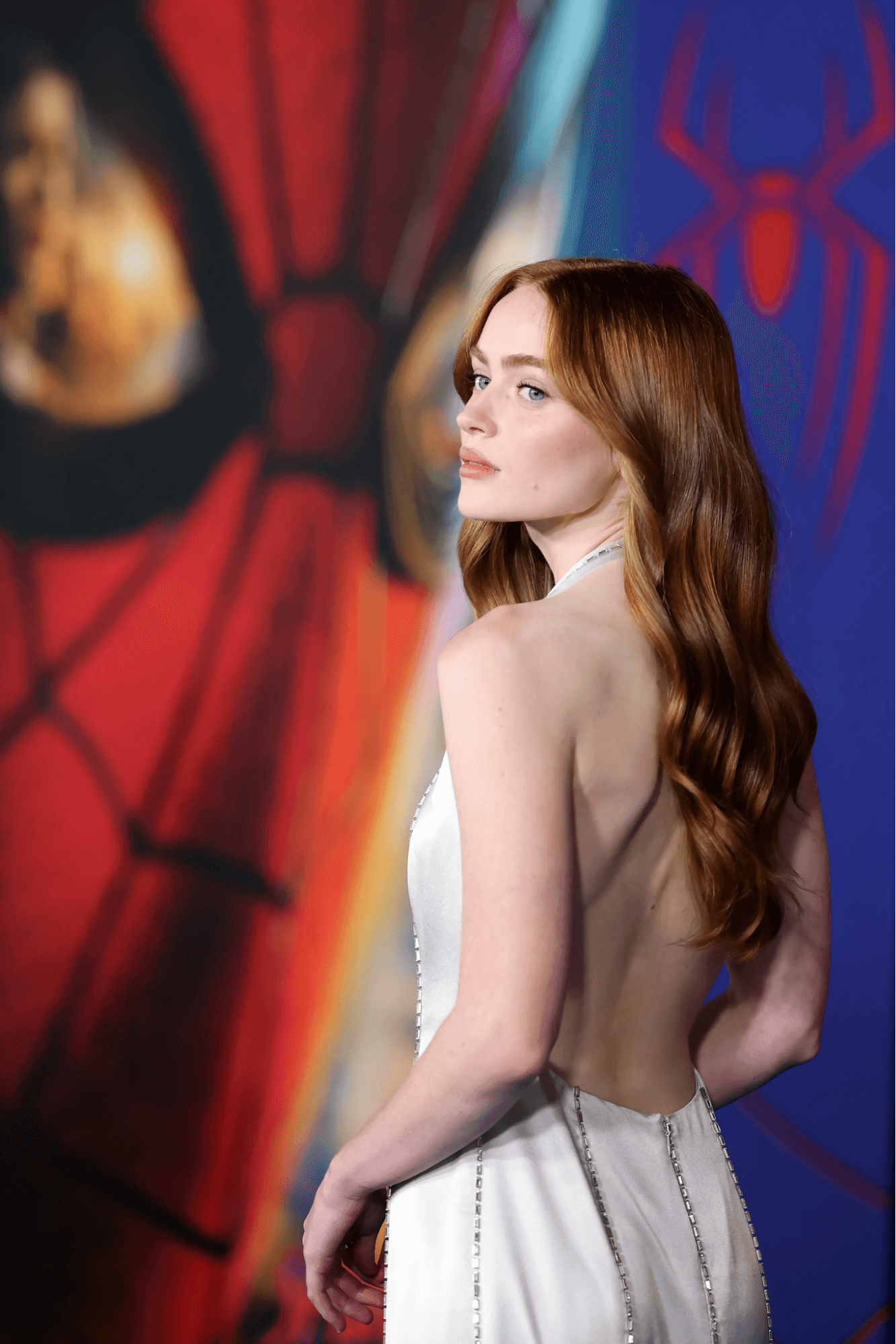
Sadie Sink in backless Prada, a look fans read as a possible clue to her secret role.
The wider ensemble, including Tramell Tillman in Tom Ford with Jacques Marie Mage sunglasses, alongside Liza Colón-Zayas, Jon Bernthal, Jacob Batalon and Michael Mando, largely honored classic red carpet tailoring rather than theme. That contrast is itself worth reading. When one or two figures carry the entire conceptual weight of a campaign while the rest dress conventionally, method dressing reveals its true nature as a specialist discipline rather than a democratic one. It requires an archive, an image architect, and years of accumulated visual narrative to execute at the level the audience now expects. Not everyone can play, and the gap between those who can and those who dress well without the apparatus is part of what the red carpet now quietly displays.
What the Tour Finally Tells Us
The Brand New Day campaign confirms the mastery of a form its central duo did more than anyone to popularise, built over a collaboration that began in 2011 when Zendaya was 14 and still on Disney Channel. It also marks a moment of maturity that edges toward saturation. When a technique becomes this fluent, its finest expressions turn inward, legible mainly to the initiated, while its broadest gestures reach for virality and settle for conversation. The audience it once surprised now arrives expecting to be spoken to, and expectation is a harder thing to satisfy than surprise.
That is the tension beneath all this beauty. Method dressing began as a way to make the audience feel like insiders. Its very success has produced an audience so fluent that the insider's pleasure grows harder to deliver. The web here is spun with real virtuosity, thread by archival thread. The question it leaves suspended is whether a form built entirely on transformation can keep transforming, or whether its highest achievement now is to perform its own history with grace. For a technique whose whole premise is becoming something new, arriving somewhere familiar, however exquisitely, is the one outcome it was never designed to reach.
Reporting drawn from Variety, WWD, W Magazine, The Hollywood Reporter, Marie Claire, The Zoe Report, CNN Style, TIME, and Just Jared. Method dressing is a promotional practice, and coverage of it, including this article, forms part of the ecosystem it describes.
TO BE CONTINUED, FOR SUBSCRIBERS ONLY.
This is where the surface ends and the reporting begins.
The complete piece, the full archive, and access to The French Press Circle. Reporting answerable only to its readers.
Already a subscriber ?
Login
Read these on the house, with our compliments.
A selection from the current issue, open to all readers. Read them in full. The rest is one decision away.



There is a governing rule to the way Zendaya has dressed for the last decade, and it is one of restraint. The trick of method dressing, the practice of building red carpet looks around the film being promoted, is to gesture toward the material while stopping short of reenacting it. A tennis silhouette rather than a tennis racket. A spiderweb woven into couture rather than a costume pulled from wardrobe. For Spider-Man: Brand New Day, which arrives in theatres today, an entire international press cycle has tested exactly how far that gesture can be pushed before it tips into literalism. The answer, gathered across roughly ten cities and several wardrobes, tells us as much about the audience as it does about the clothes.
Zendaya at the Rome premiere in a vintage Giorgio Armani spring 1990 gown embroidered with a crystalline spiderweb motif. Image by Vittorio Zunino Celotto
What Method Dressing Actually Does
Before the looks, the phenomenon deserves examination, because method dressing has slowly become one of the more revealing cultural rituals of the streaming age. On its surface it is marketing. Beneath that surface it performs something subtler: it invites the audience into an act of decoding, and in doing so converts a passive viewer into a participant.
The term itself is credited to the journalist Andre Wheeler, who described method dressing as a chance to extend a project's cinematic universe onto the red carpet even before the film's premiere. The technique borrows its logic from method acting. The concept borrows from method acting, the approach in which an actor carries their character into daily life rather than leaving it at the stage door, and applies it to fashion; a premiere look is selected for its narrative coherence with the character, the world, and the themes of the film being promoted. The practice has deep roots. While the term is recent, it has precedents in how fashion and performance have always intersected, as in Marlene Dietrich's sustained public adoption of menswear tailoring throughout the 1930s and 1940s, a performance of a specific femininity inseparable from her screen persona.
What makes the contemporary version sociologically distinct is the audience's role in completing it. A spiderweb sewn into an archival gown means little until a viewer recognises it, names it, and shares the recognition. The look becomes a small puzzle whose solving produces a flicker of belonging, the pleasure of being fluent in a shared visual language. In an attention economy where films compete against infinite distraction, method dressing manufactures intimacy at scale. It flatters the audience's cultural literacy and rewards fandom with a sense of authorship. The red carpet stops being a place where stars are looked at and becomes a place where fans are spoken to.
That participatory quality explains why the technique proliferated so quickly beyond any single star. Margot Robbie's Barbie campaign in 2023 remains the most complete demonstration of the form as populist spectacle. Working with stylist Andrew Mukamal, Robbie sported high-fashion versions of iconic outfits worn by Barbie across different eras, from the black and white striped swimsuit of the first 1959 doll to the hot pink day-to-night working woman ensemble of 1985. Each look sent fans back to the Mattel archive to find the reference, turning a global press tour into a scavenger hunt that mirrored the film's own nostalgic project.
Margot Robbie's 2023 Barbie tour, which recreated specific dolls and remains method dressing's most populist expression.
The same grammar recurs across recent culture, from Jenna Ortega's gothic register for Wednesday to Halle Bailey's aquatic gowns for The Little Mermaid. It is worth anticipating, too, the sequel campaigns already circling this logic; a project like a Devil Wears Prada follow-up would arrive pre-loaded with sartorial expectation, since its very subject is the moral and creative weight of clothing. Method dressing has become the default second text of the modern release, a film about the film, told in fabric.
A Franchise Rehearsed Over a Decade
Against that backdrop, the Zendaya and Roach partnership occupies a specific position: not the originators, but the practitioners who raised the form to sustained authorship. While they may not have been the first to take this approach, they are undeniably doing it on a different level and have brought it into the mainstream. Their 2024 Dune: Part Two campaign leaned into desert-planet futurism, culminating in a vintage silver Mugler "robot" suit from 1995 that circulated widely. For Challengers that year, the styling cycled through palettes keyed to the film's love triangle. For The Drama, the pair built a bridal narrative around the rhyme "something old, something new, something borrowed, something blue."
The 1995 Mugler "robot" suit worn to the 2024 Dune: Part Two premiere, an earlier high point of the approach. Image via WWD.
Spider-Man, though, is the rare case where the subject returns. Zendaya has dressed around this franchise since 2017, when her first major press tour for Spider-Man: Homecoming found her still finding her fashion voice, with looks not yet cohesive around a theme. The 2021 No Way Home cycle is now widely read as the origin point of her method-dressing era. At the end of her 2021 Spider-Man: No Way Home outing, fans got a taste of her future method-dressing sensibilities when Roach dressed her in a spiderweb-covered Valentino Haute Couture gown with a coordinating black Spider-Man headpiece.
Returning to a motif already delivered definitively raises the degree of difficulty. The current tour answers partly through self-reference. The Rome look, a sheer black vintage Giorgio Armani dress from the designer's spring 1990 collection covered in glitzy spiderweb beadwork with tonal beaded spiders across the front and back, shared remarkably similar details to that Valentino dress from five years earlier, creating a full-circle method-dressing moment. The tour, in this sense, has become a text about its own history, legible chiefly to those who have followed the whole arc.
Reading the Looks, Hits and Misses
The strongest entries this cycle succeed because the reference is structural rather than printed. The London appearance offered the tour's most sophisticated sleight of hand: a 28-year-old John Galliano slip dress whose front read as abstract galaxy print while its statement hid on the reverse. An elaborate spiderweb crafted from sterling silver, diamond-encrusted charms and chainmail jewellery transformed the vintage gown into one of the most talked-about looks of the tour. Placing the reference where it was visible only when she turned represents the technique at its most confident, and Roach himself, asked to name a favorite, shouted out the archival spiderweb dress from John Galliano's 1997 "Circus" collection worn at the London premiere.
The archival John Galliano dress in London, its spiderweb concealed as a silver-and-chainmail detail across the back. Image via Marie Claire
The Madrid premiere, where Zendaya and Tom Holland made their red carpet debut as a married couple, with Zendaya in a vintage lace and silk Christian Cowan fringed gown and Holland in a Jacquemus black suit worn with a red shirt, demonstrated the technique's coordinated register: the colour logic of red and black threaded quietly through the pairing, doing the referential work without announcing it.
The tour's most rewarding detail came in London, on the two smallest surfaces of the night. At the base of Zendaya's spine, on the reverse of her cream Tamara Ralph gown, sat a gilded spider by Keren Wolf, a piece originally built into a spiderweb headpiece and repurposed to reward anyone who watched her walk away. Holland answered in kind. Into the Windsor knot of his burgundy tie he pinned a spider of his own, an eight-legged Pragnell jewel set with black opals and diamonds, its body catching red and green under the carpet lights. Photographed in close-up, the two rhyme without matching. Hers is warm gold and hidden until she turns; his is dark and iridescent and worn at the throat. The coordination is the point. This is the couple's married-couple register at its most legible, a shared motif split across two backs and one tie knot, the newlyweds dressing as a single web with a spider at each end.
Holland deserves particular note here, because his contribution is easy to overlook and is the more disciplined half of the equation. Across the tour he holds to tailoring, threading the franchise's palette through burgundy and red without a single literal flourish. At the Los Angeles premiere he opted for understated elegance in a deep burgundy suit worn with a vibrant red shirt and navy tie while his co-star commanded the couture. It reads as a deliberate division of labour, one figure carrying the spectacle while the other holds the line, and the restraint is its own kind of skill.
The finale in Los Angeles pushed the concept to its most conceptual extreme. Zendaya stepped out in a couture Ashi Studio dress meant to convey a very abstract vision of arachnid anatomy, an architectural asymmetrical silhouette with sharp fabric appendages extending from the neckline, from the house's fall 2027 couture collection, which took nearly 200 hours to make. Roach framed it as transformation rather than costume. "It's kind of an abstract way to present the spider," he said, "in our mind, it's like this metamorphosis of this woman into this thing." As a thesis statement for the whole tour it is elegant; the woman does not wear the spider, she becomes it.
The Ashi Studio finale in Los Angeles, an abstract "metamorphosis" that took nearly 200 hours to construct. Image via WWD
Where the tour is least persuasive is at the literal end of its own spectrum. The Rome Armani dress, admired as it was, is also fairly described as one of the most literal Spider-Man tributes of the tour, its beaded spiders rendered legibly enough that the decoding pleasure evaporates; the puzzle solves itself. Set beside the concealed Galliano or the abstract Ashi Studio finale, the explicit entries feel like the tour explaining a joke it has already told with more wit elsewhere. The viral Paris moment sits in a similar critical grey zone. At a Paris photocall, Zendaya wore a vintage oversized Spider-Man T-shirt with nothing but Christian Louboutin pumps, a piece Roach revealed was purchased off eBay for $34.99. As a gesture of high-low confidence it is truly clever, a pressure release valve in a tour otherwise defined by archival rarity. Its achievement, though, is worth naming precisely: fans noted that whether they loved every styling choice or wanted more accessories, the outfit succeeded in getting people talking. The win is located in the conversation rather than the clothing, which is a revealing thing to say about an outfit and a quiet sign of the technique straining toward spectacle for its own sake.
The $34.99 eBay Spider-Man tee worn as a dress in Paris, the tour's most discussed and most debated moment.
The Rest of the Cast
A tour this fashion-forward risks flattening everyone else into background, and the ensemble's own choices are instructive precisely because they mostly opt out of the game. Sadie Sink, whose role in the film has been guarded closely, made the sharpest independent statement. She wore a silvery grey embellished backless Prada gown, its open back the strongest element of the dress, adding a touch of drama. Read one way, the choice becomes its own coded gesture; fans quickly noted the colour as a possible hint about her secret character, which turns a styling decision into a piece of narrative speculation and shows method dressing's logic seeping outward from its central practitioner into the whole cast's reception.
Sadie Sink in backless Prada, a look fans read as a possible clue to her secret role.
The wider ensemble, including Tramell Tillman in Tom Ford with Jacques Marie Mage sunglasses, alongside Liza Colón-Zayas, Jon Bernthal, Jacob Batalon and Michael Mando, largely honored classic red carpet tailoring rather than theme. That contrast is itself worth reading. When one or two figures carry the entire conceptual weight of a campaign while the rest dress conventionally, method dressing reveals its true nature as a specialist discipline rather than a democratic one. It requires an archive, an image architect, and years of accumulated visual narrative to execute at the level the audience now expects. Not everyone can play, and the gap between those who can and those who dress well without the apparatus is part of what the red carpet now quietly displays.
What the Tour Finally Tells Us
The Brand New Day campaign confirms the mastery of a form its central duo did more than anyone to popularise, built over a collaboration that began in 2011 when Zendaya was 14 and still on Disney Channel. It also marks a moment of maturity that edges toward saturation. When a technique becomes this fluent, its finest expressions turn inward, legible mainly to the initiated, while its broadest gestures reach for virality and settle for conversation. The audience it once surprised now arrives expecting to be spoken to, and expectation is a harder thing to satisfy than surprise.
That is the tension beneath all this beauty. Method dressing began as a way to make the audience feel like insiders. Its very success has produced an audience so fluent that the insider's pleasure grows harder to deliver. The web here is spun with real virtuosity, thread by archival thread. The question it leaves suspended is whether a form built entirely on transformation can keep transforming, or whether its highest achievement now is to perform its own history with grace. For a technique whose whole premise is becoming something new, arriving somewhere familiar, however exquisitely, is the one outcome it was never designed to reach.
Reporting drawn from Variety, WWD, W Magazine, The Hollywood Reporter, Marie Claire, The Zoe Report, CNN Style, TIME, and Just Jared. Method dressing is a promotional practice, and coverage of it, including this article, forms part of the ecosystem it describes.
TO BE CONTINUED, FOR SUBSCRIBERS ONLY.
This is where the surface ends and the reporting begins.
The complete piece, the full archive, and access to The French Press Circle. Reporting answerable only to its readers.
Already a subscriber ?
Login
Read these on the house, with our compliments.
A selection from the current issue, open to all readers. Read them in full. The rest is one decision away.