
Disclosure: Roseroom by Isha Jajodia is a client of Maison French Press, the brand architecture house of French Press Global.
Lace carries a long association with prettiness and applied ornament, something laid over a garment to soften it. That reputation goes back a long way. In the sumptuary economies of seventeenth-century Flanders and Venice, a collar of Burano needlepoint could cost more than a house, which meant the most expensive object in the room was engineered to look like the lightest. Softly, Strong, ROSEROOM's fourth consecutive collection for Hyundai India Couture Week, honours that history and rewrites its terms with real ambition. Across more than fifty looks, Isha Jajodia keeps every hour of labour in the lace and reassigns the lightness, building the silhouette out of the textile itself so that it bears weight rather than decorates a surface. The lace holds the garment up, and the elegance of that idea carries the whole evening.
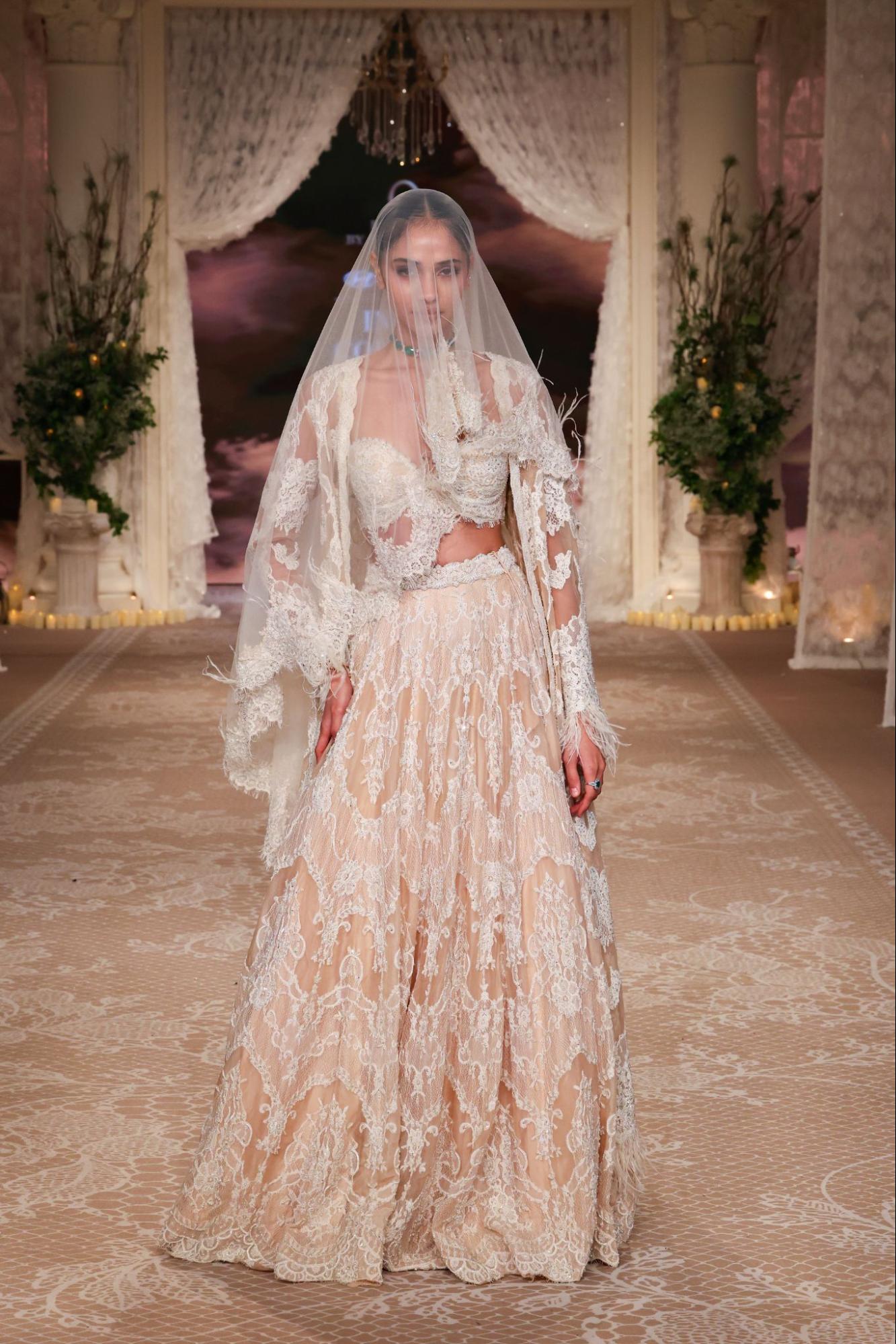
A lace veiled bridal look from the collection
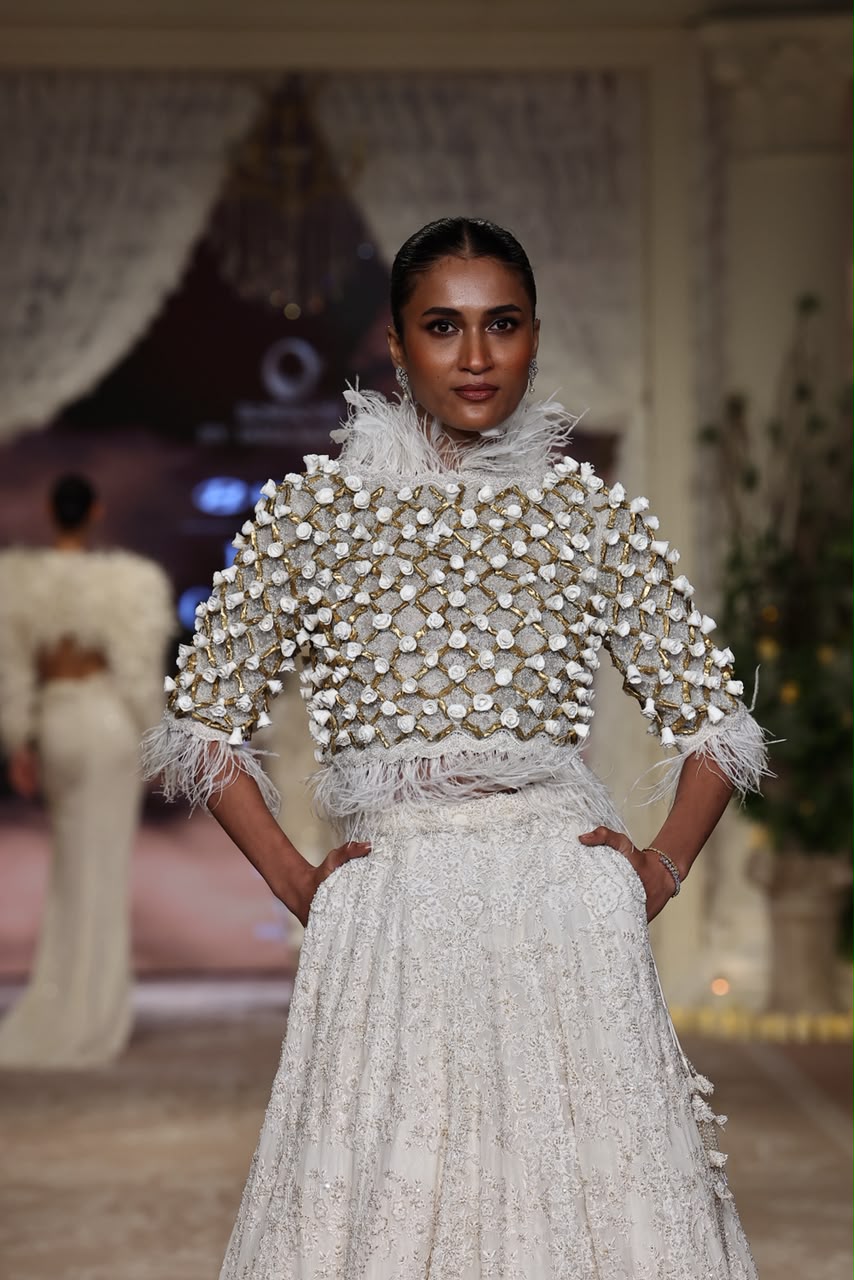
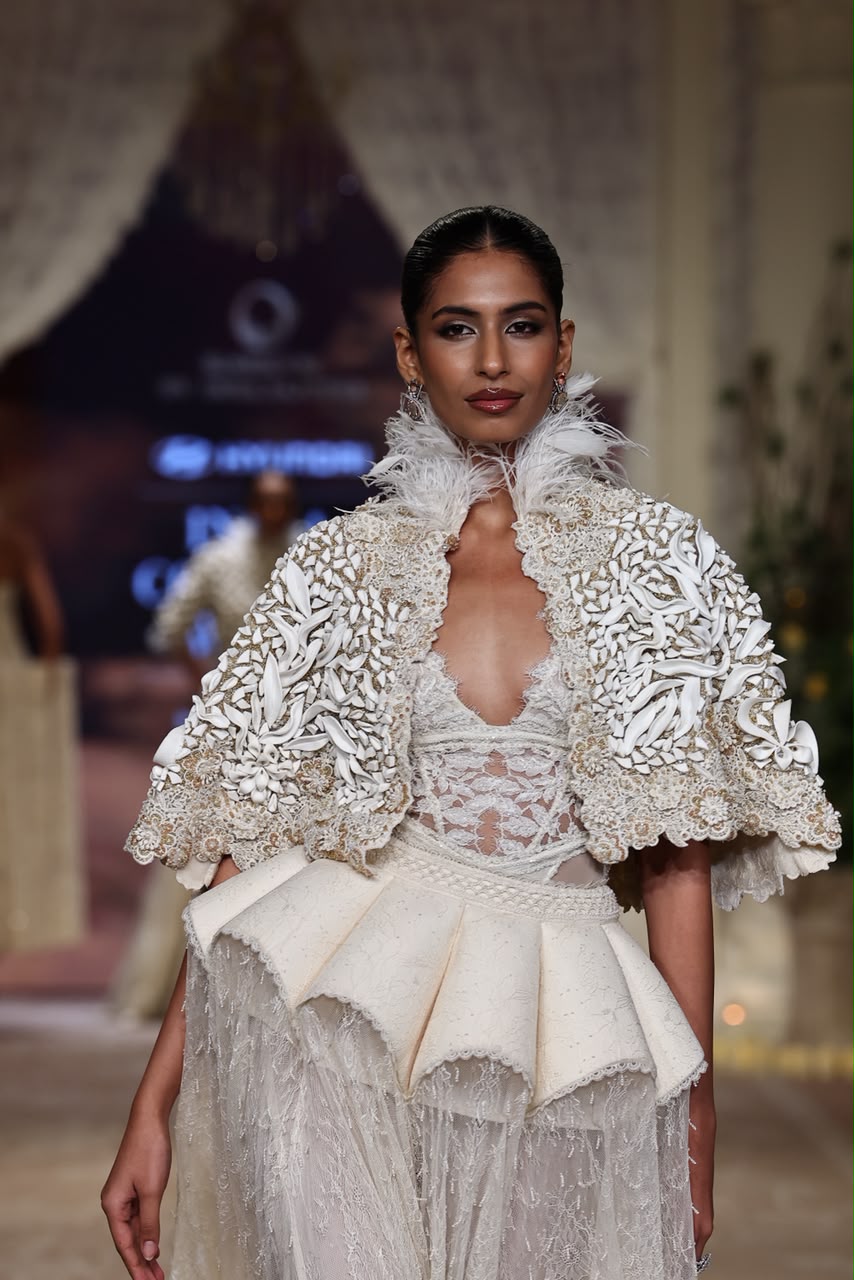
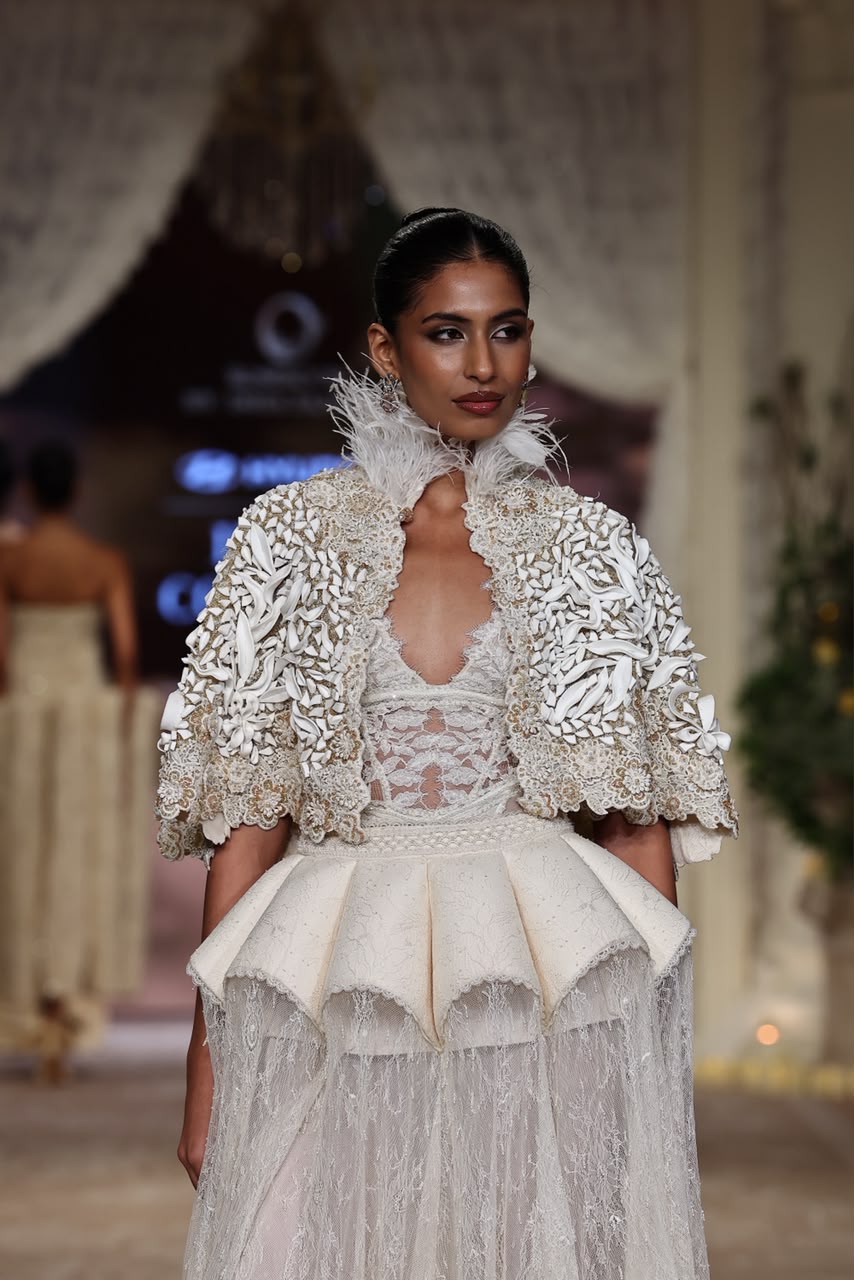
Looks featuring hand-moulded clay pressed into floral detail, set into lace
The house began with lace, and this season gathers every technique the atelier has accumulated into a single, assured room: layered Chantilly, corded and guipure laces, hand-appliqué set into the ground, florals built in three dimensions, and, for the first time, hand-moulded clay pressed into floral and sculptural detail and set into lace so the two materials become one continuous surface. Pearls and Swarovski crystals anchor the transparencies with precision. The references Jajodia names run to European romanticism, French architecture and vintage femininity, and she holds them to Indian craftsmanship, the tradition equipped to execute them at this level of finish.
Architecture Worn on the Body
Corsetry functions as the skeleton of the collection, lace as the skin, and clay as the ornamental relief a stonemason might carve into a façade. Jajodia has described corsetry as the heart of the house, and this season she reworks it with confidence into forms that move well past the conventional bodice: sculpted sarees, pannier-inspired belts, corseted lehengas, tailored jackets, jumpsuits and tweed separates. She leaves the boning visible in the seaming, the way structural lines in a building announce how the weight is carried, and that candour is one of the collection's real pleasures. The corset carries a contested history, read for a century as an instrument of constraint and, since the revisionist work of historians like Valerie Steele, reconsidered as a garment women often chose and controlled. ROSEROOM sits gracefully inside that revised reading, treating the corset as a chassis rather than a cage.

A meticulously constructed lace gown from ROSEROOM’s Softly Strong
The clay-and-lace innovation deserves admiration, and it invites a comparison with the Dutch couturier Iris van Herpen, whose 3D-printed dresses ask technology to imitate organic growth. Jajodia arrives at a comparably sculptural surface from the opposite direction, through the hand rather than the printer, clay pressed and set by fingers into the ground of the lace until relief and tracery read as one material. The raised florals across the champagne and ivory looks catch light in strata, behaving more like carved stone than embroidery, and the achievement is quietly radical within a bridal vocabulary.
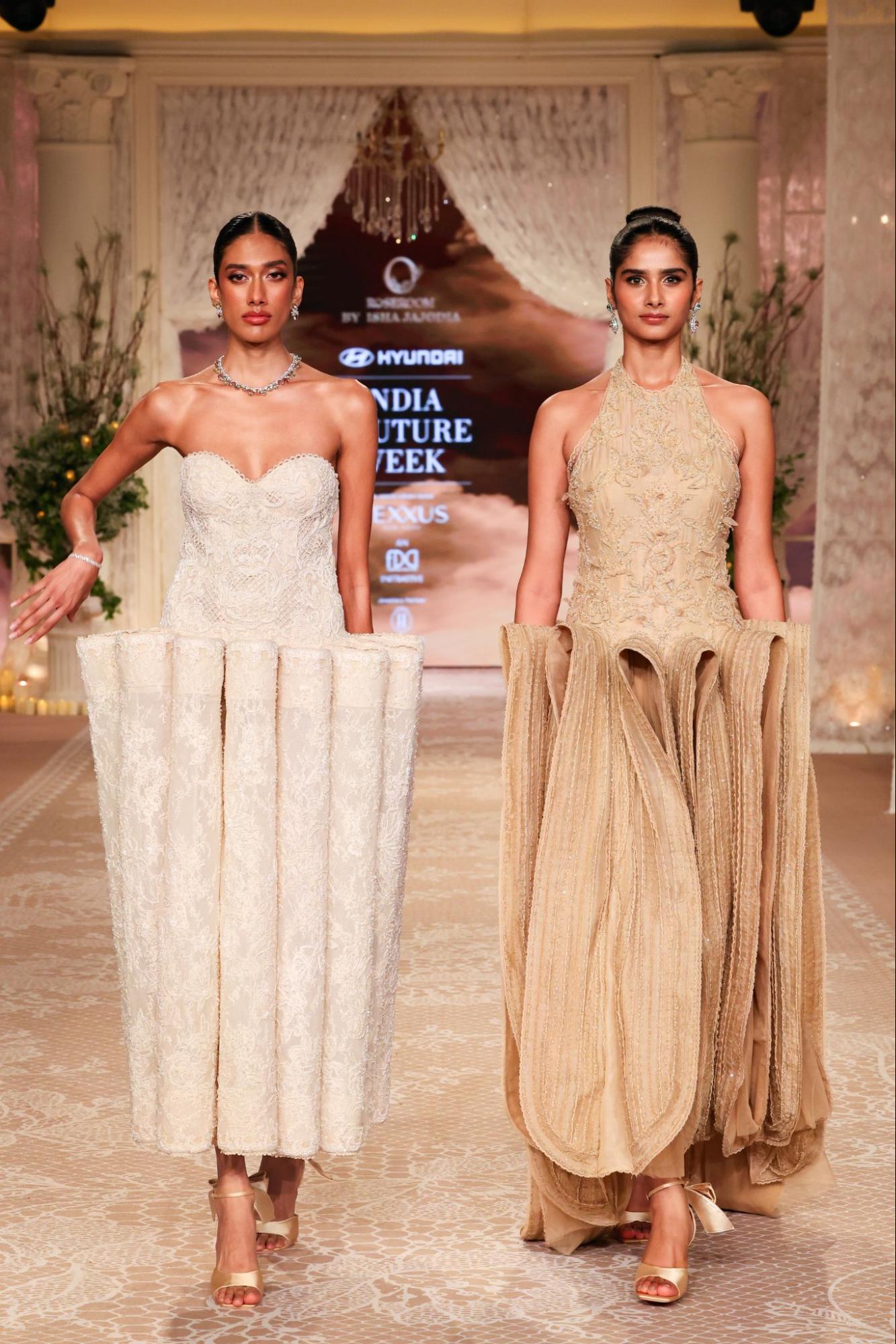
The Pannier inspired gowns with ROSEROOM’s signature treatment
The pannier gowns shown side by side, one ivory and one champagne gold, took the architectural idea to its most exhilarating point. Jajodia lifted the silhouette from eighteenth-century European court dress, the pannier, which extended a skirt outward at the hips while keeping it flat front and back, the same architecture Marie Antoinette wore at Versailles and the caricaturists of the period loved to exaggerate. She rebuilt it as a freestanding cage of vertical lace-covered ribs, the skirt held wide off the body like scaffolding made wearable. The ivory version, sweetheart-necklined and worked in dense floral lace, has the fluted grandeur of a colonnade rendered in fabric. The gold halter version opens the same structure into looping ribbons of beaded tulle. Both quote the history of Western construction with real fluency and rebuild it through Indian hands.
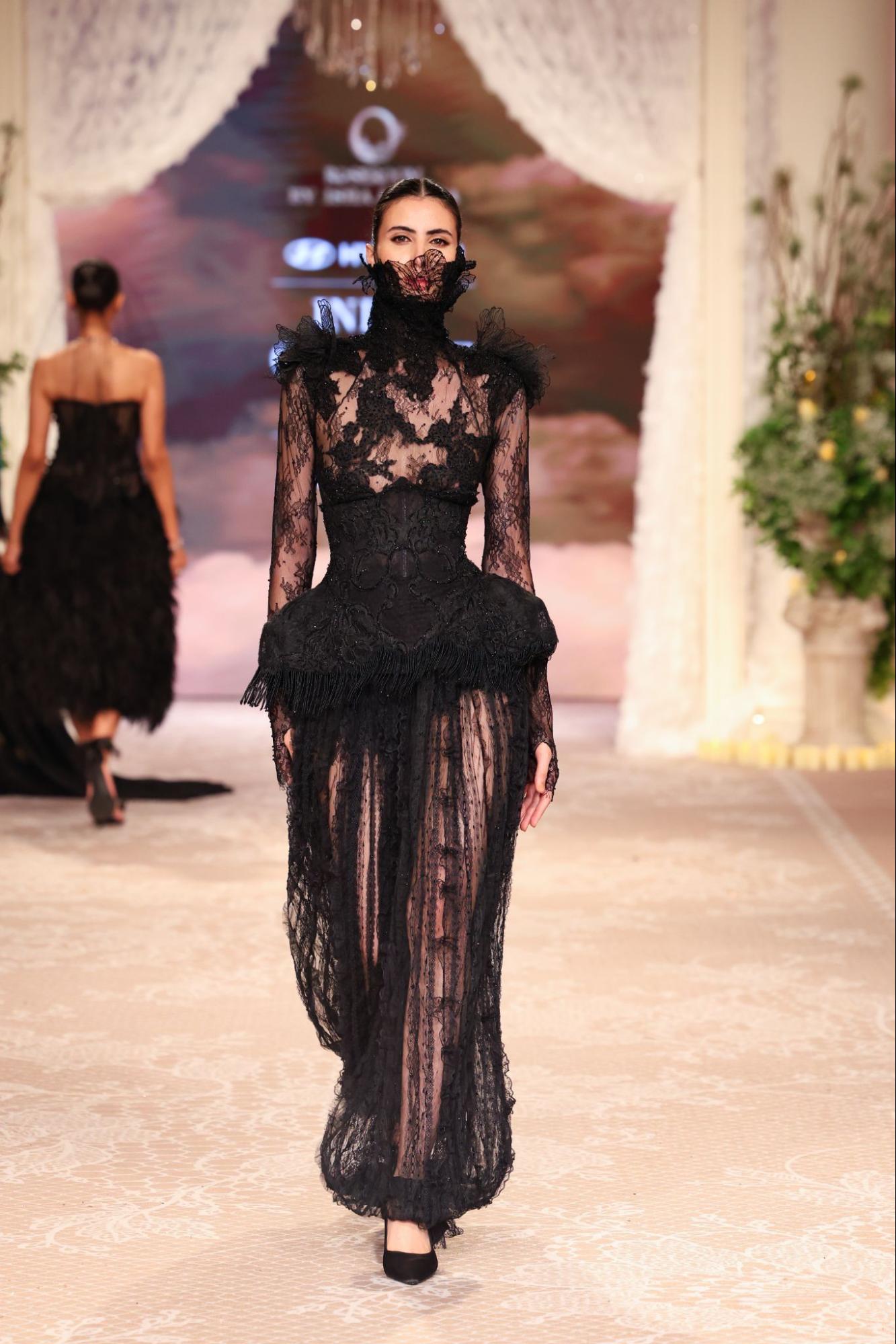
A sheer black lace gown look from the collection that caught everyone’s eye. Styled by Gautam Kalra & team.
The sheer black high-neck gown ranked among the most technically accomplished pieces of the evening. A ruffed collar rises to the jaw, the bodice is corseted into a sharp basque waist edged with fringing, and the skirt falls away into transparent Chantilly through which the body is visible. It carries the vocabulary of Victorian mourning dress, the black lace of a Sargent portrait, with an ease that keeps the density out, the corset holding the whole thing upright while the lace does the work of suggestion. A related look pushed the drama further with great flair, a black fringe midi with beaded tendrils cascading from the hem like something between a 1920s flapper dress and a chandelier, worn over sheer floral-patterned hosiery.
The Colour Story
Jajodia sequenced the palette to track the collection's title with a composer's sense of movement, describing it herself as a journey from softness toward strength. It opens in ivory, silver, blush, lilac, powder blue and mint, tones pale enough that the eye registers texture before hue. The mint-green lehenga with its sheer scalloped Chantilly cape trailing into a long train belongs to this luminous opening chapter, the beadwork catching light against skin. From there the palette deepens with intent through teal, ruby, scarlet, ROSEROOM's signature register, gold and finally black.
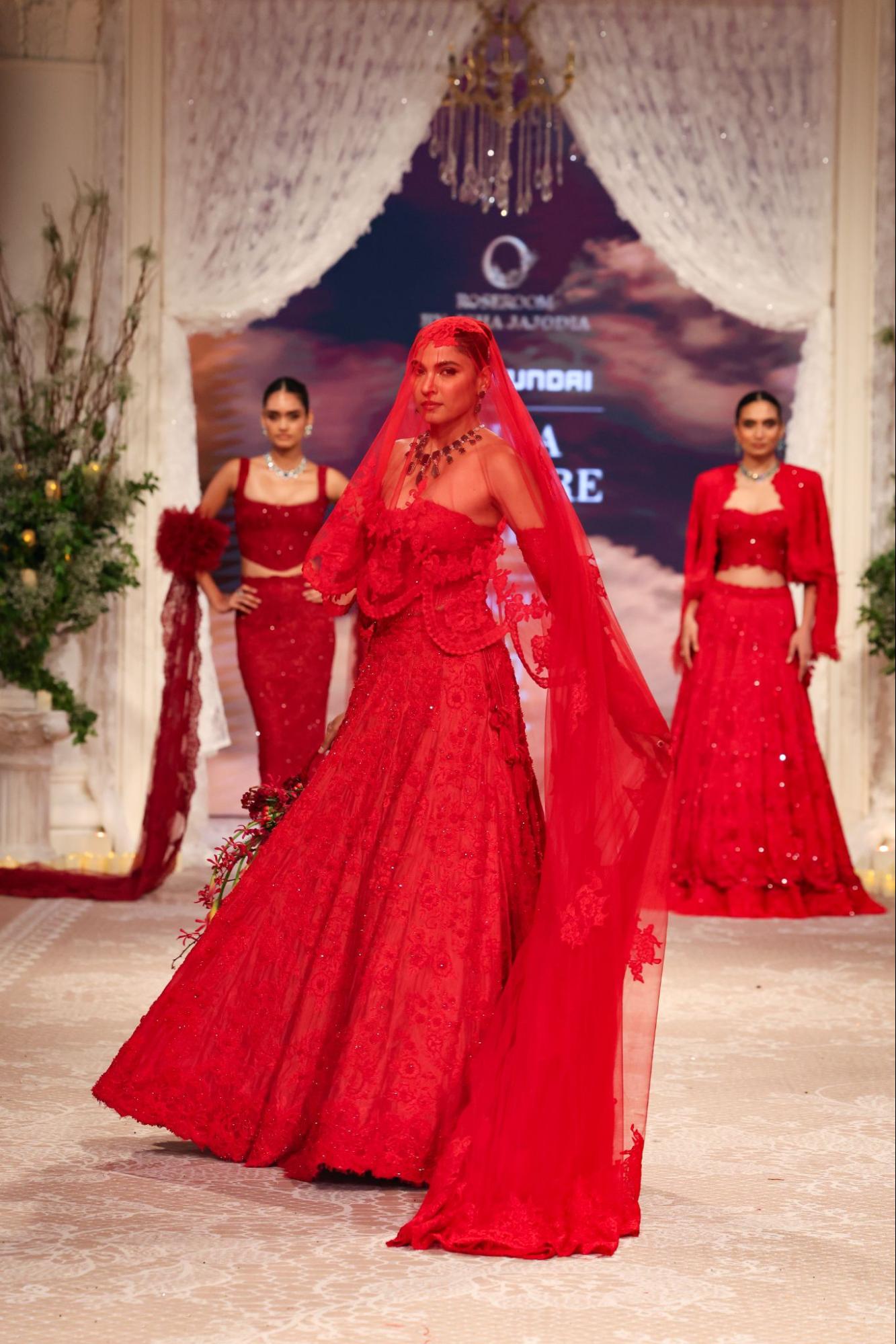
The Red Bride, reimagined by ROSEROOM by Isha Jajodia
The scarlet looks form the emotional centre and carry a genuine charge. A red lehenga with a cropped feather-cuffed jacket, paired with emerald jewellery, delivers the heat the ivory openings hold in reserve. Red at an Indian wedding carries its own weight, the traditional colour of the bride, and Jajodia routes her signature scarlet straight through that association with knowing confidence. By the time the black pieces arrive, the palette has completed a beautifully judged progression from pale to saturated, one that recalls the tonal discipline running from Balenciaga's late black period to the architecture of Alaïa, the softness of the opening and the certainty of the close reading as the same collection at two temperatures.
The Women Who Walked
Jajodia opened her runway to a cross-generational line-up of Indian models whose careers span two decades of the country's fashion history, and their presence enriched the collection's idea of a woman whose strength accumulates with the life she has lived. Carol Gracias, a L'Oréal Elite Look of the Year winner who has anchored Indian runways since the mid-2000s, walked in mint-green lace with her signature curls and a diamond choker, every bit the runway force she has long been. Vasuki Sunkavalli, the lawyer and Miss Universe India 2011, carried the sheer-caped mint lehenga through the opening passage with poise. Avanti Nagrath, who in 2022 became the first Indian model to open a Versace show at Milan Fashion Week and has since walked for Dior, Hermès, Chanel and Bottega Veneta, brought the register of the global runway into the room.

(Left to right) Avanti Nagrath, Isha Jajodia and Vasuki Punj at the finale of the show
A model at the start of her international ascent and women who defined the Indian runway a generation earlier moved through the same collection, and the range of experience on the runway matched the range Jajodia builds into her clothes. When Jacqueline Fernandez closed a ROSEROOM show at ICW 2024, she described the work as romantic and feminine with a subdued power. Softly, Strong extends that same quality with new assurance, the romance handled as a discipline rather than a mood.
The ROSEROOM Woman
She appears consistently and vividly across the images. She wears a bridal veil in one look and a black feathered fascinator with a face-veil in another, crossing between the sacramental and the theatrical without altering her carriage. She is composed in nude lace that reveals as much as it conceals, and equally composed in a black lace jacket-and-column with a pillbox hat, a look that carries the tailored severity of mid-century Parisian couture and something of the women Cecil Beaton photographed, whose glamour registered as self-possession. Jajodia frames her as a woman who has stopped treating strength and femininity as a choice, because she has always held both, and the clothes make that woman legible through construction, delicate at the surface and rigorous underneath.
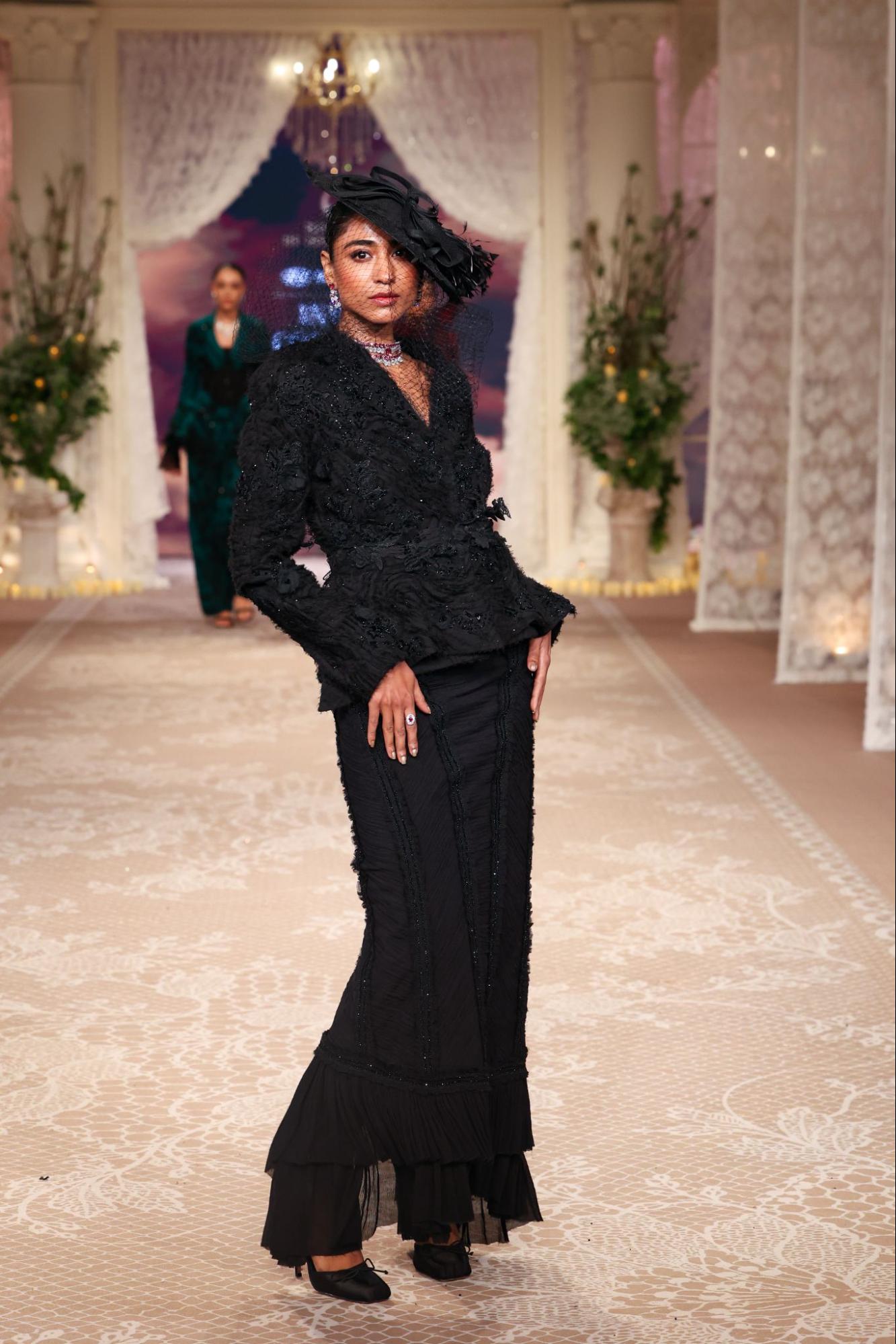
A Parisienne inspired look from Softly, Strong by ROSEROOM by Isha Jajodia
In her own words, Jajodia locates the collection entirely in the person who wears it. "This collection is about the woman who wears it," she says. "She has lived enough to know that softness is never weakness, that grace can be powerful, and that vulnerability and resilience can exist in the same breath. She no longer needs to choose between strength and femininity, because she has always carried both." The clothes carry that conviction into construction, and four seasons in, it reads as the settled philosophy of the house rather than a single season's theme.
An Evening of Industry Leaders
Softly, Strong drew together some of the most influential names across fashion, luxury, media, design and culture, a front row that mirrored the standing of the collection within India's creative landscape. Among those in attendance were model and entrepreneur Indrani Dasgupta, stylist and creative director Anaita Shroff Adajania, Hema Bose, Noelle Kadar, Divya Balakrishnan, Prachi Raniwala, Nayare Ali, architect and designer Ashiesh Shah, Kavita Bhartia, Tina Tahiliani Parikh, Aria Tahiliani, Divyani Jaipuria and interior designer Shalini Misra. The gathering of couturiers' family, established stylists, design figures and cultural tastemakers in a single room placed Softly, Strong squarely within the conversation the house has been building across four consecutive years at Hyundai India Couture Week.
The Hands That Built It
A couture house is a workforce before it is anything else, and Softly, Strong represents many thousands of hours of handwork carried out across ROSEROOM's ateliers over many months, the greater part of it done by women. A number of them work from home, in the towns and villages they once expected to leave, using skills inherited from their mothers, for wages that arrive in their own names. Through the Spread the Smile collaboration, artisans in rural communities handcrafted a substantial proportion of the three-dimensional floral motifs, work that carries from the runway into the show invitations and the gifting.

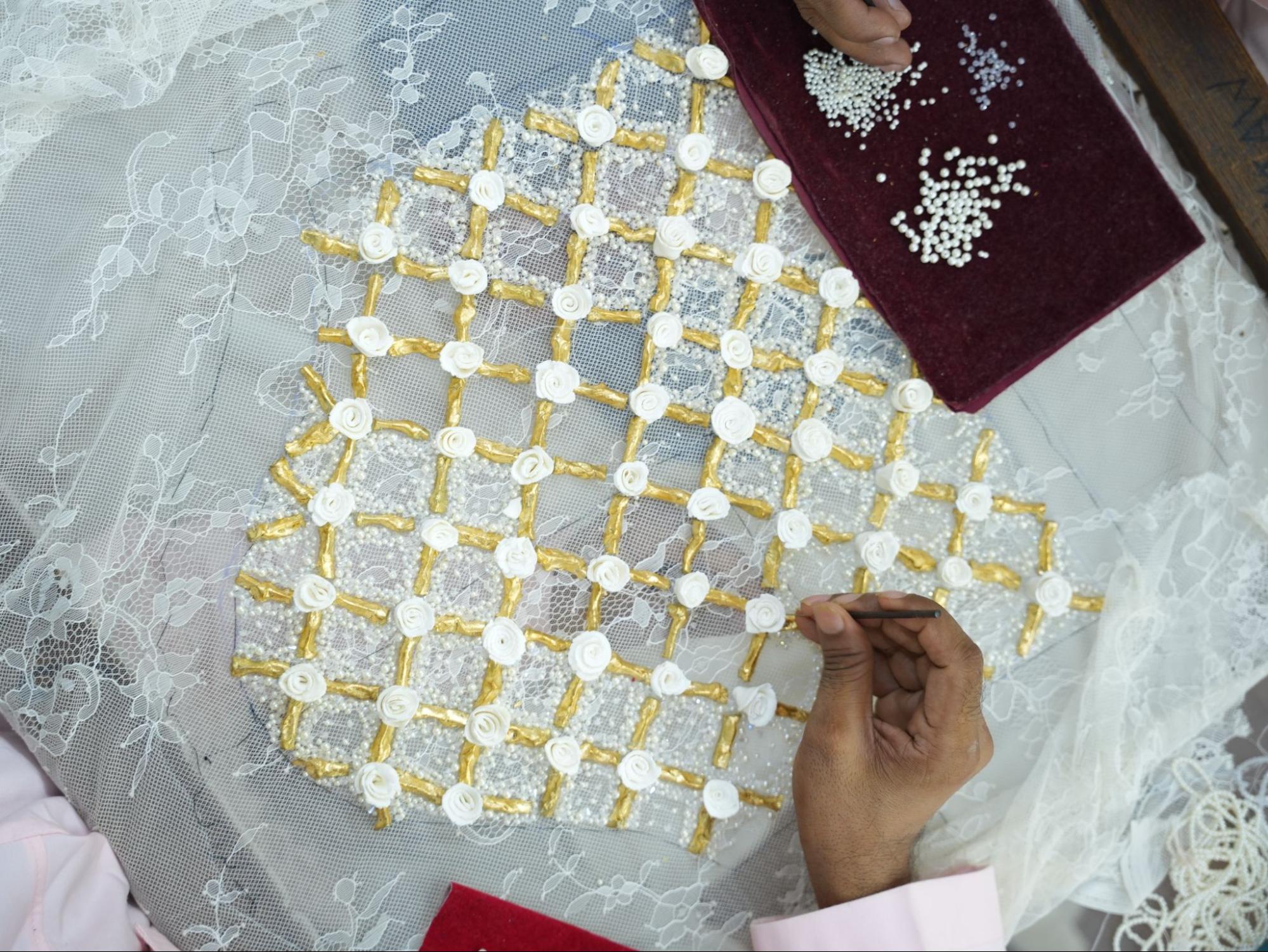
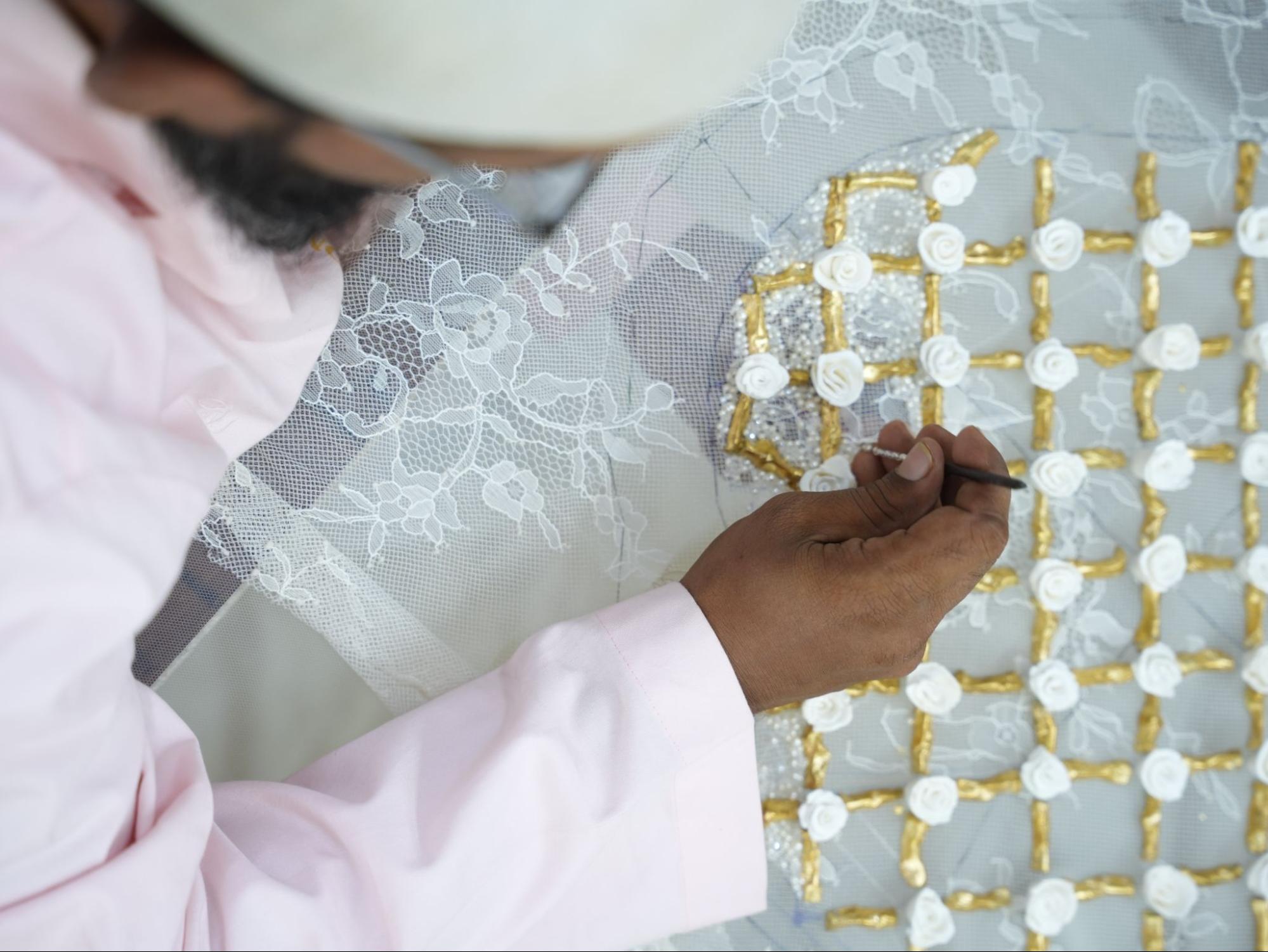
The process behind the collection
The making is continuous with the aesthetics, and that coherence is one of the collection's deepest strengths. There is a long argument in craft theory, running from William Morris and the Arts and Crafts movement to the slow-fashion writing of today, that how a thing is made cannot be separated from what it means. A raised floral built by a woman working from within her own community is a different object from an identical motif produced anonymously at scale, even when the two look the same. Every clay-and-lace fusion and every pearl-anchored transparency in the collection carries that authorship. Hazoorilal Legacy supplied the jewellery, conceived, in the house's account, so that silhouette and stone were imagined in the same breath, the emerald and diamond pieces reading as natural extensions of the garments.
The Finale
Softly, Strong closed on movement, and it was a joy to watch. Jayant Luthra's music carried the room, and as the finale gathered, the walk loosened into celebration. Jajodia came out to close the show and the runway broke into dance, the models moving with her, the scarlet and black and ivory looks mixing together as the formality dissolved into pure delight. Carol Gracias in her curls, Vasuki in mint-green lace, the models in black fringe and red feathers, dancing rather than parading. For a collection built around softness as strength, ending in shared celebration completed the thought with grace. The house built on the hands of women closed by letting those women move without restriction, and conclude with jubilation.
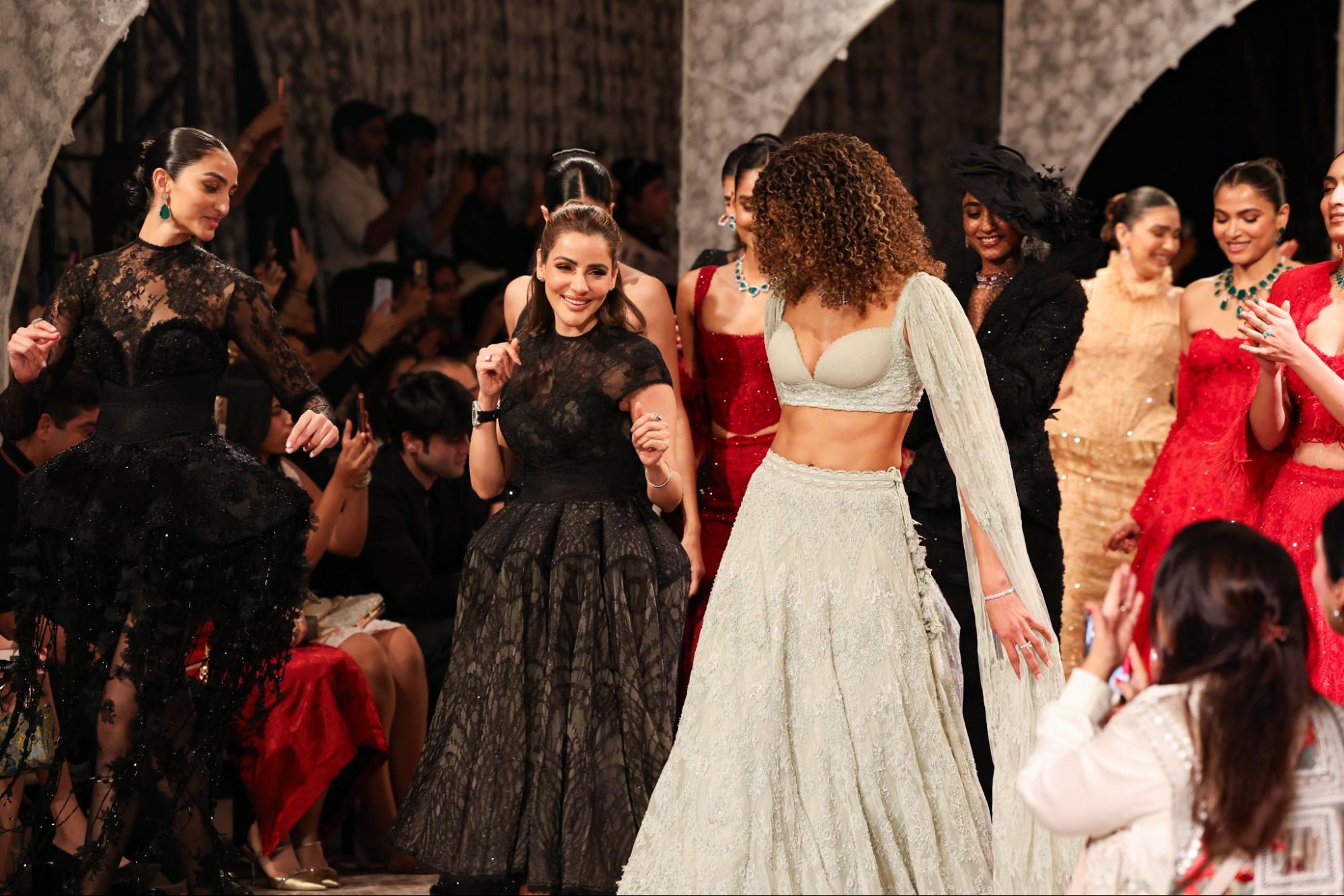
The show concluded with the designer Isha Jajodia walking down the runway with all the models in the show for the final bow, as the room broke into dance, celebration and joy, truly reminiscent of the soft yet strong ROSEROOM woman.
What Sets It Apart
The clay-and-lace fusion gives ROSEROOM a truly innovative material surface, sculptural in a way conventional lacework rarely reaches. The corset runs as a structural through-line across gowns, sarees, tuxedos, jumpsuits and trousers, extending a bridal vocabulary into a full occasion wardrobe. The palette advances as a beautifully deliberate arc, ivory to scarlet to black, that mirrors the collection's central idea.
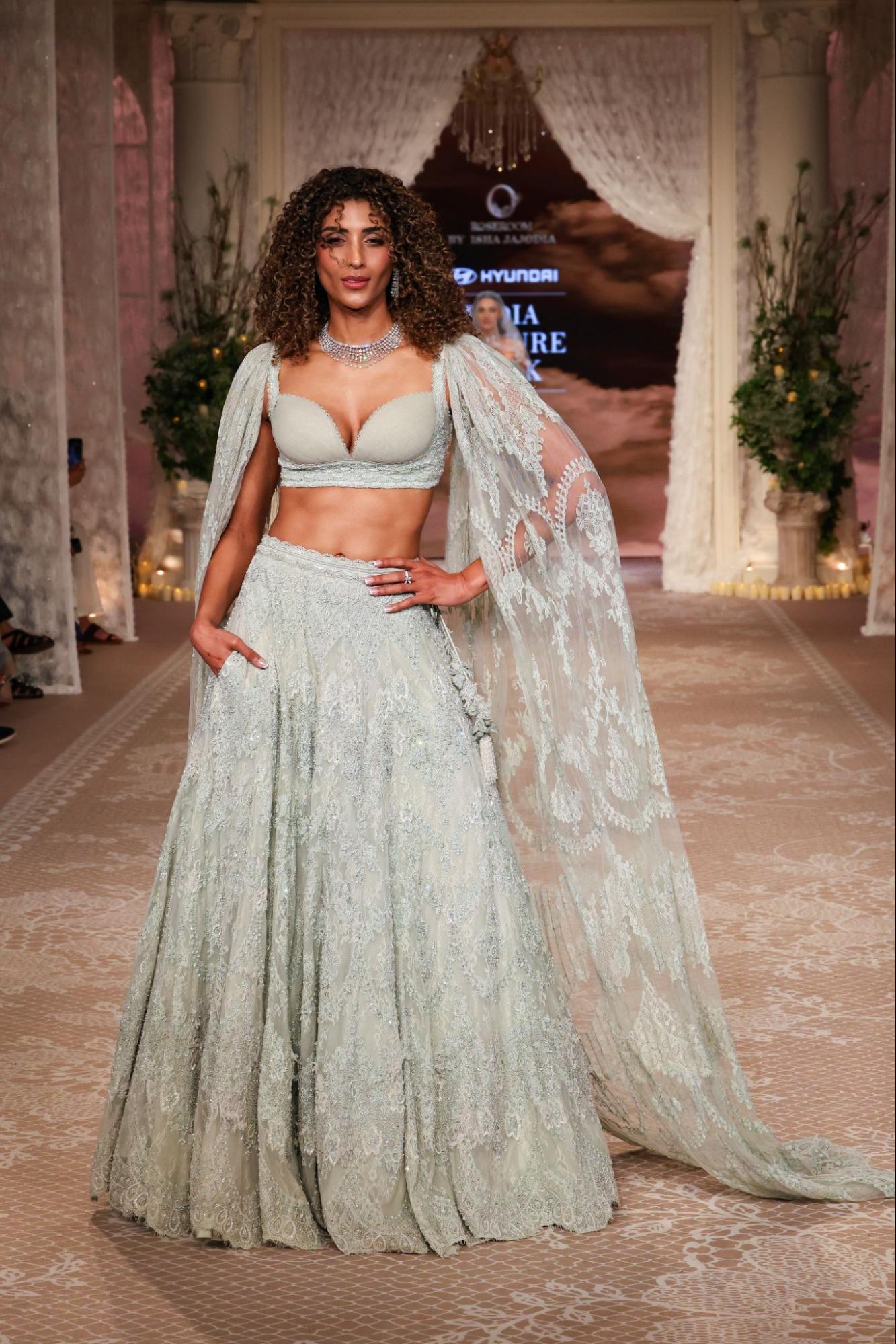
Vasuki Sunkavalli in a mint green lace lehenga
Jajodia has now shown at Hyundai India Couture Week for four consecutive years, and the body of work holds a consistent and increasingly confident position: lace built as structure, femininity built as strength, and a house understood as the sum of the hands that make it. Softly, Strong draws every technique the atelier has learned into a single room, and lets the architecture, and the celebration that closed it, carry the collection to a place of real certainty.
TO BE CONTINUED, FOR SUBSCRIBERS ONLY.
This is where the surface ends and the reporting begins.
The complete piece, the full archive, and access to The French Press Circle. Reporting answerable only to its readers.
Already a subscriber ?
Login
Read these on the house, with our compliments.
A selection from the current issue, open to all readers. Read them in full. The rest is one decision away.



Disclosure: Roseroom by Isha Jajodia is a client of Maison French Press, the brand architecture house of French Press Global.
Lace carries a long association with prettiness and applied ornament, something laid over a garment to soften it. That reputation goes back a long way. In the sumptuary economies of seventeenth-century Flanders and Venice, a collar of Burano needlepoint could cost more than a house, which meant the most expensive object in the room was engineered to look like the lightest. Softly, Strong, ROSEROOM's fourth consecutive collection for Hyundai India Couture Week, honours that history and rewrites its terms with real ambition. Across more than fifty looks, Isha Jajodia keeps every hour of labour in the lace and reassigns the lightness, building the silhouette out of the textile itself so that it bears weight rather than decorates a surface. The lace holds the garment up, and the elegance of that idea carries the whole evening.
A lace veiled bridal look from the collection
Looks featuring hand-moulded clay pressed into floral detail, set into lace
The house began with lace, and this season gathers every technique the atelier has accumulated into a single, assured room: layered Chantilly, corded and guipure laces, hand-appliqué set into the ground, florals built in three dimensions, and, for the first time, hand-moulded clay pressed into floral and sculptural detail and set into lace so the two materials become one continuous surface. Pearls and Swarovski crystals anchor the transparencies with precision. The references Jajodia names run to European romanticism, French architecture and vintage femininity, and she holds them to Indian craftsmanship, the tradition equipped to execute them at this level of finish.
Architecture Worn on the Body
Corsetry functions as the skeleton of the collection, lace as the skin, and clay as the ornamental relief a stonemason might carve into a façade. Jajodia has described corsetry as the heart of the house, and this season she reworks it with confidence into forms that move well past the conventional bodice: sculpted sarees, pannier-inspired belts, corseted lehengas, tailored jackets, jumpsuits and tweed separates. She leaves the boning visible in the seaming, the way structural lines in a building announce how the weight is carried, and that candour is one of the collection's real pleasures. The corset carries a contested history, read for a century as an instrument of constraint and, since the revisionist work of historians like Valerie Steele, reconsidered as a garment women often chose and controlled. ROSEROOM sits gracefully inside that revised reading, treating the corset as a chassis rather than a cage.
A meticulously constructed lace gown from ROSEROOM’s Softly Strong
The clay-and-lace innovation deserves admiration, and it invites a comparison with the Dutch couturier Iris van Herpen, whose 3D-printed dresses ask technology to imitate organic growth. Jajodia arrives at a comparably sculptural surface from the opposite direction, through the hand rather than the printer, clay pressed and set by fingers into the ground of the lace until relief and tracery read as one material. The raised florals across the champagne and ivory looks catch light in strata, behaving more like carved stone than embroidery, and the achievement is quietly radical within a bridal vocabulary.
The Pannier inspired gowns with ROSEROOM’s signature treatment
The pannier gowns shown side by side, one ivory and one champagne gold, took the architectural idea to its most exhilarating point. Jajodia lifted the silhouette from eighteenth-century European court dress, the pannier, which extended a skirt outward at the hips while keeping it flat front and back, the same architecture Marie Antoinette wore at Versailles and the caricaturists of the period loved to exaggerate. She rebuilt it as a freestanding cage of vertical lace-covered ribs, the skirt held wide off the body like scaffolding made wearable. The ivory version, sweetheart-necklined and worked in dense floral lace, has the fluted grandeur of a colonnade rendered in fabric. The gold halter version opens the same structure into looping ribbons of beaded tulle. Both quote the history of Western construction with real fluency and rebuild it through Indian hands.
A sheer black lace gown look from the collection that caught everyone’s eye. Styled by Gautam Kalra & team.
The sheer black high-neck gown ranked among the most technically accomplished pieces of the evening. A ruffed collar rises to the jaw, the bodice is corseted into a sharp basque waist edged with fringing, and the skirt falls away into transparent Chantilly through which the body is visible. It carries the vocabulary of Victorian mourning dress, the black lace of a Sargent portrait, with an ease that keeps the density out, the corset holding the whole thing upright while the lace does the work of suggestion. A related look pushed the drama further with great flair, a black fringe midi with beaded tendrils cascading from the hem like something between a 1920s flapper dress and a chandelier, worn over sheer floral-patterned hosiery.
The Colour Story
Jajodia sequenced the palette to track the collection's title with a composer's sense of movement, describing it herself as a journey from softness toward strength. It opens in ivory, silver, blush, lilac, powder blue and mint, tones pale enough that the eye registers texture before hue. The mint-green lehenga with its sheer scalloped Chantilly cape trailing into a long train belongs to this luminous opening chapter, the beadwork catching light against skin. From there the palette deepens with intent through teal, ruby, scarlet, ROSEROOM's signature register, gold and finally black.
The Red Bride, reimagined by ROSEROOM by Isha Jajodia
The scarlet looks form the emotional centre and carry a genuine charge. A red lehenga with a cropped feather-cuffed jacket, paired with emerald jewellery, delivers the heat the ivory openings hold in reserve. Red at an Indian wedding carries its own weight, the traditional colour of the bride, and Jajodia routes her signature scarlet straight through that association with knowing confidence. By the time the black pieces arrive, the palette has completed a beautifully judged progression from pale to saturated, one that recalls the tonal discipline running from Balenciaga's late black period to the architecture of Alaïa, the softness of the opening and the certainty of the close reading as the same collection at two temperatures.
The Women Who Walked
Jajodia opened her runway to a cross-generational line-up of Indian models whose careers span two decades of the country's fashion history, and their presence enriched the collection's idea of a woman whose strength accumulates with the life she has lived. Carol Gracias, a L'Oréal Elite Look of the Year winner who has anchored Indian runways since the mid-2000s, walked in mint-green lace with her signature curls and a diamond choker, every bit the runway force she has long been. Vasuki Sunkavalli, the lawyer and Miss Universe India 2011, carried the sheer-caped mint lehenga through the opening passage with poise. Avanti Nagrath, who in 2022 became the first Indian model to open a Versace show at Milan Fashion Week and has since walked for Dior, Hermès, Chanel and Bottega Veneta, brought the register of the global runway into the room.
(Left to right) Avanti Nagrath, Isha Jajodia and Vasuki Punj at the finale of the show
A model at the start of her international ascent and women who defined the Indian runway a generation earlier moved through the same collection, and the range of experience on the runway matched the range Jajodia builds into her clothes. When Jacqueline Fernandez closed a ROSEROOM show at ICW 2024, she described the work as romantic and feminine with a subdued power. Softly, Strong extends that same quality with new assurance, the romance handled as a discipline rather than a mood.
The ROSEROOM Woman
She appears consistently and vividly across the images. She wears a bridal veil in one look and a black feathered fascinator with a face-veil in another, crossing between the sacramental and the theatrical without altering her carriage. She is composed in nude lace that reveals as much as it conceals, and equally composed in a black lace jacket-and-column with a pillbox hat, a look that carries the tailored severity of mid-century Parisian couture and something of the women Cecil Beaton photographed, whose glamour registered as self-possession. Jajodia frames her as a woman who has stopped treating strength and femininity as a choice, because she has always held both, and the clothes make that woman legible through construction, delicate at the surface and rigorous underneath.
A Parisienne inspired look from Softly, Strong by ROSEROOM by Isha Jajodia
In her own words, Jajodia locates the collection entirely in the person who wears it. "This collection is about the woman who wears it," she says. "She has lived enough to know that softness is never weakness, that grace can be powerful, and that vulnerability and resilience can exist in the same breath. She no longer needs to choose between strength and femininity, because she has always carried both." The clothes carry that conviction into construction, and four seasons in, it reads as the settled philosophy of the house rather than a single season's theme.
An Evening of Industry Leaders
Softly, Strong drew together some of the most influential names across fashion, luxury, media, design and culture, a front row that mirrored the standing of the collection within India's creative landscape. Among those in attendance were model and entrepreneur Indrani Dasgupta, stylist and creative director Anaita Shroff Adajania, Hema Bose, Noelle Kadar, Divya Balakrishnan, Prachi Raniwala, Nayare Ali, architect and designer Ashiesh Shah, Kavita Bhartia, Tina Tahiliani Parikh, Aria Tahiliani, Divyani Jaipuria and interior designer Shalini Misra. The gathering of couturiers' family, established stylists, design figures and cultural tastemakers in a single room placed Softly, Strong squarely within the conversation the house has been building across four consecutive years at Hyundai India Couture Week.
The Hands That Built It
A couture house is a workforce before it is anything else, and Softly, Strong represents many thousands of hours of handwork carried out across ROSEROOM's ateliers over many months, the greater part of it done by women. A number of them work from home, in the towns and villages they once expected to leave, using skills inherited from their mothers, for wages that arrive in their own names. Through the Spread the Smile collaboration, artisans in rural communities handcrafted a substantial proportion of the three-dimensional floral motifs, work that carries from the runway into the show invitations and the gifting.
The process behind the collection
The making is continuous with the aesthetics, and that coherence is one of the collection's deepest strengths. There is a long argument in craft theory, running from William Morris and the Arts and Crafts movement to the slow-fashion writing of today, that how a thing is made cannot be separated from what it means. A raised floral built by a woman working from within her own community is a different object from an identical motif produced anonymously at scale, even when the two look the same. Every clay-and-lace fusion and every pearl-anchored transparency in the collection carries that authorship. Hazoorilal Legacy supplied the jewellery, conceived, in the house's account, so that silhouette and stone were imagined in the same breath, the emerald and diamond pieces reading as natural extensions of the garments.
The Finale
Softly, Strong closed on movement, and it was a joy to watch. Jayant Luthra's music carried the room, and as the finale gathered, the walk loosened into celebration. Jajodia came out to close the show and the runway broke into dance, the models moving with her, the scarlet and black and ivory looks mixing together as the formality dissolved into pure delight. Carol Gracias in her curls, Vasuki in mint-green lace, the models in black fringe and red feathers, dancing rather than parading. For a collection built around softness as strength, ending in shared celebration completed the thought with grace. The house built on the hands of women closed by letting those women move without restriction, and conclude with jubilation.
The show concluded with the designer Isha Jajodia walking down the runway with all the models in the show for the final bow, as the room broke into dance, celebration and joy, truly reminiscent of the soft yet strong ROSEROOM woman.
What Sets It Apart
The clay-and-lace fusion gives ROSEROOM a truly innovative material surface, sculptural in a way conventional lacework rarely reaches. The corset runs as a structural through-line across gowns, sarees, tuxedos, jumpsuits and trousers, extending a bridal vocabulary into a full occasion wardrobe. The palette advances as a beautifully deliberate arc, ivory to scarlet to black, that mirrors the collection's central idea.
Vasuki Sunkavalli in a mint green lace lehenga
Jajodia has now shown at Hyundai India Couture Week for four consecutive years, and the body of work holds a consistent and increasingly confident position: lace built as structure, femininity built as strength, and a house understood as the sum of the hands that make it. Softly, Strong draws every technique the atelier has learned into a single room, and lets the architecture, and the celebration that closed it, carry the collection to a place of real certainty.
TO BE CONTINUED, FOR SUBSCRIBERS ONLY.
This is where the surface ends and the reporting begins.
The complete piece, the full archive, and access to The French Press Circle. Reporting answerable only to its readers.
Already a subscriber ?
Login
Read these on the house, with our compliments.
A selection from the current issue, open to all readers. Read them in full. The rest is one decision away.