
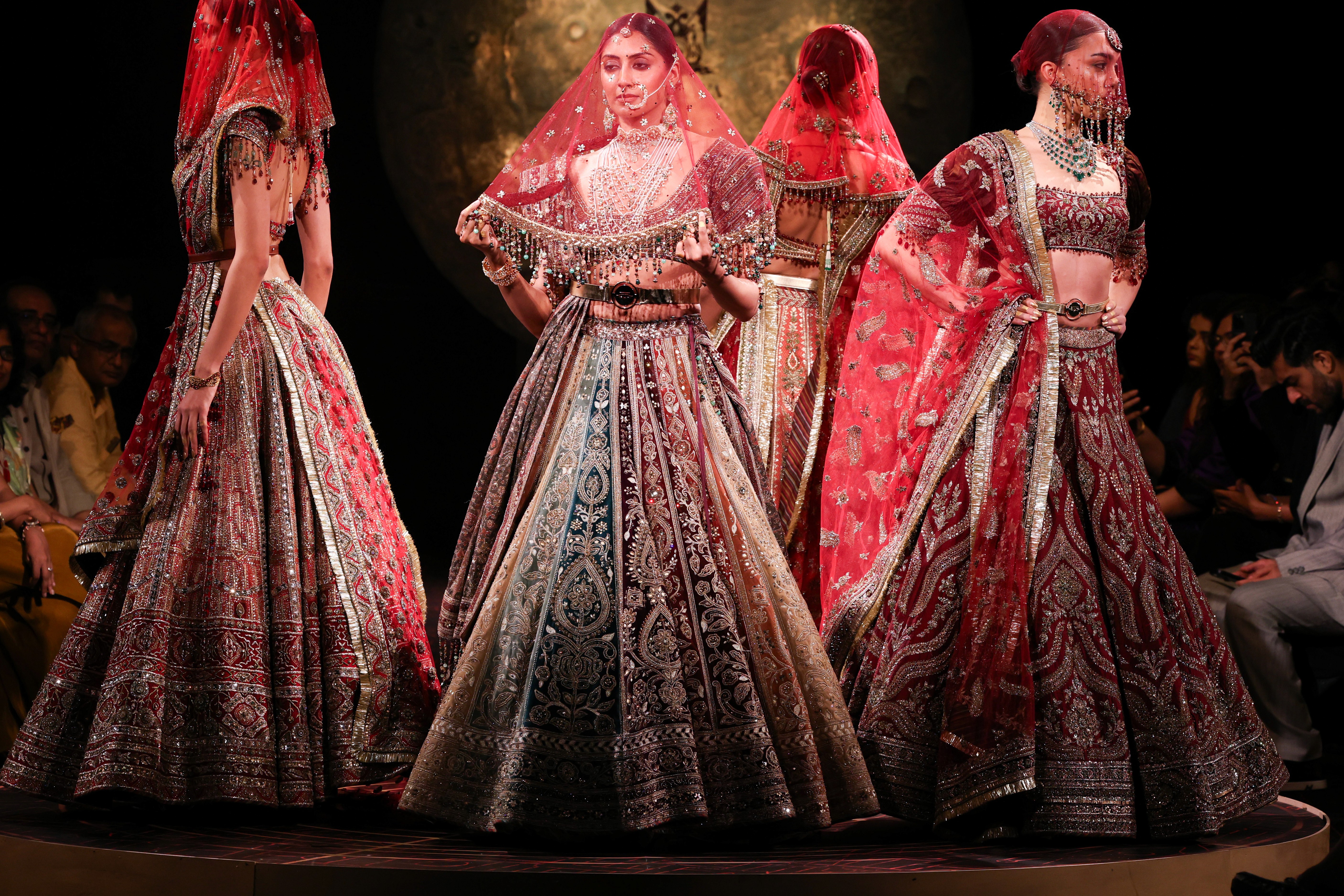
Next year, JJ Valaya completes thirty-five years, and the countdown has quietly begun. The arc of his house has been building since Tabriz broke a three-year sabbatical in 2019. Through the virtual couture weeks of the pandemic and the run of live shows since, the momentum has grown, season on season, into a long crescendo: the move back to the live runway, his grand return to Mumbai after twenty-four years, the menswear chapters, the closing turn at last summer’s India Couture Week. This year’s show sits one note short of the summit, and you can feel him building toward it.
Images Via: Gulshan Sachdeva
He said as much when we sat together in Chandigarh last week. “Thirty-five years, it’s a big, big moment,” he told me, describing the run so far as amazing, even brilliant, to look back on. He said it in the plain, unguarded way that is entirely his.
Valaya is the rare figure at this altitude of fashion whom you can be completely frank with, real and easy in conversation, holding no airs about himself or his standing. Behind him has always stood his brother, TJ Singh, the business force of the house, steadfast as a rock and among the most generous people you could hope to meet. Both brothers are, quite simply, some of the finest human beings in this industry, grounded and cultivated in equal measure, closer to family than acquaintance. Everything they make carries something of who they are.
Images Via: Gulshan Sachdeva
On the runway in Delhi, the floor gave it away first. Concentric rings of gold light spiralled across a labyrinth of oxblood and ink, the sort of set that asks a room to settle and pay attention before a single model appears. Above it rose towering portraits, the hair sculpted into vast, architectural volumes, presiding over the evening like presences from a dream. Then the music began, live as it always is at a Valaya show, the sound wrapping the room, and the procession started its slow orbit.
Images Via: Gulshan Sachdeva
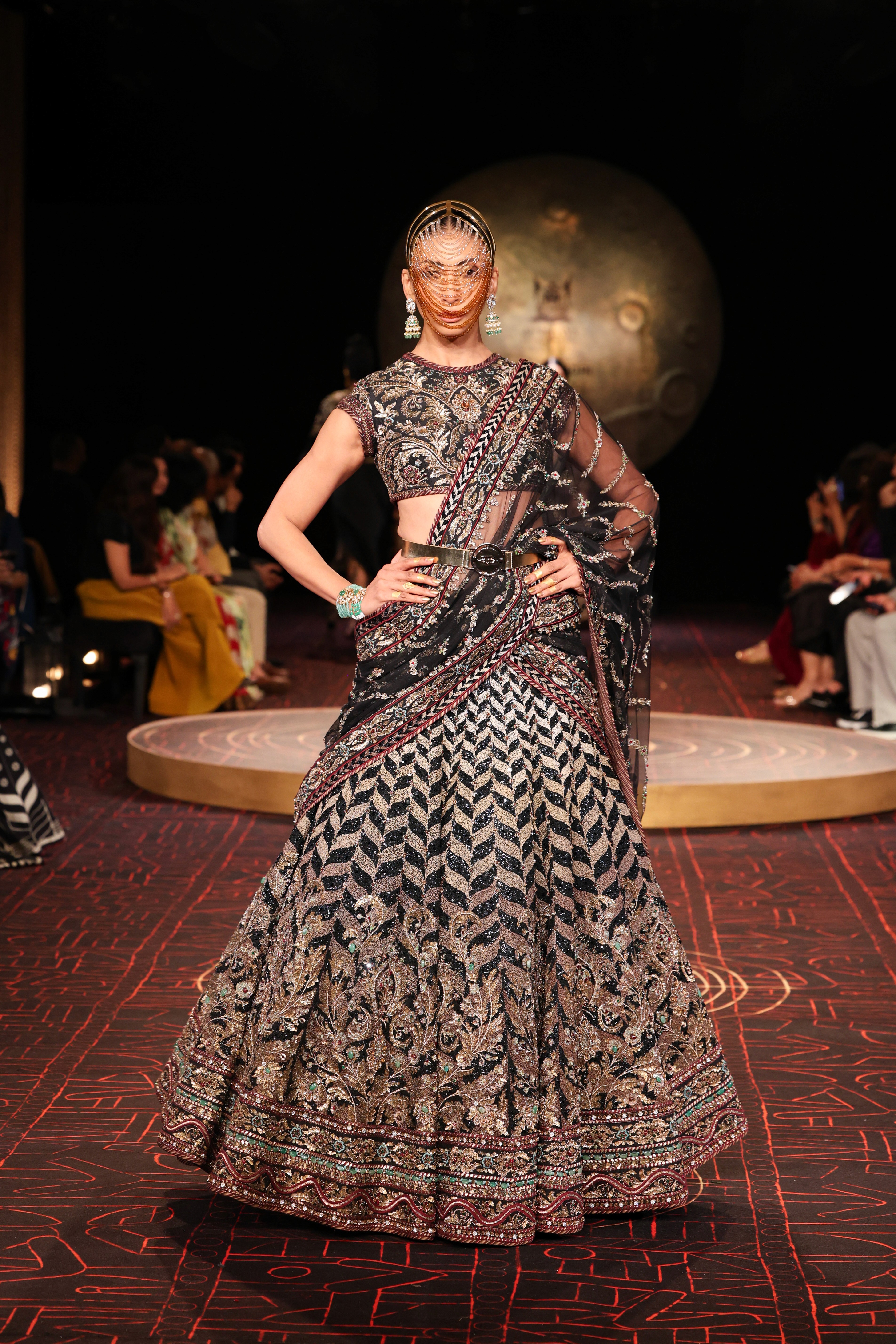
The front row held the couture press in its usual ranks and the industry’s inner circle, and the clothes rewarded the vantage. At this distance you could catch the weight of each tassel and the way a single bead took the light.
Images Via: Gulshan Sachdeva
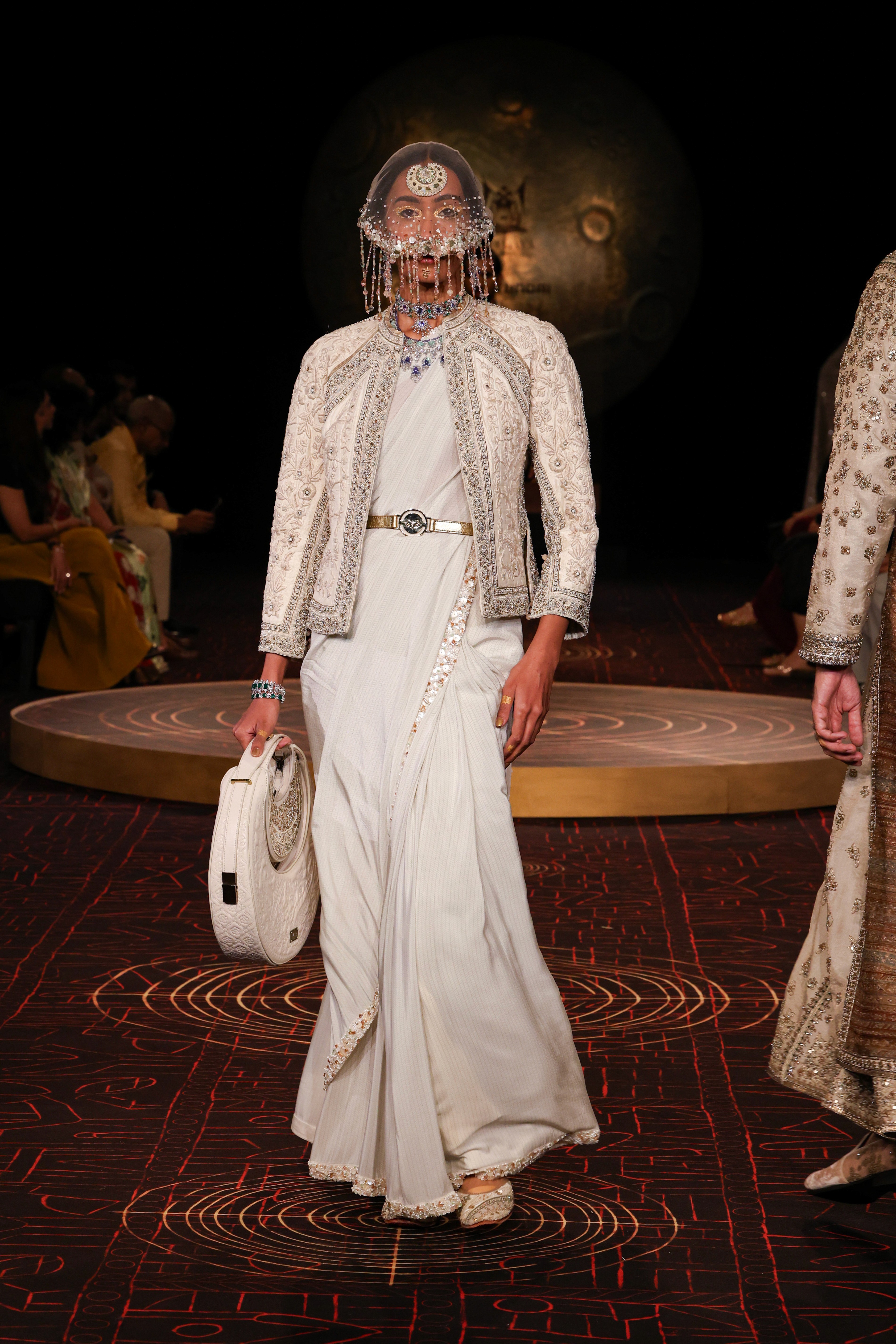
Valaya has spent more than three decades as fashion’s great traveller, and travel remains the engine of everything he makes. He calls his house the Royal Nomads, a people forever in motion, forever gathering. Over the years the caravan has pitched its tents in Ottoman Bursa, in Moroccan Fez, across the Balkans and the Far East, each expedition returning laden with silk, motif and story. This season the mood turned to the nomad herself, the woman of the caravan, her hair swept into big, untamed shapes, her bearing regal and a little wild, everything recast in the grammar he has always spoken: Rajput opulence, Mughal geometry, the swagger of the old courts.
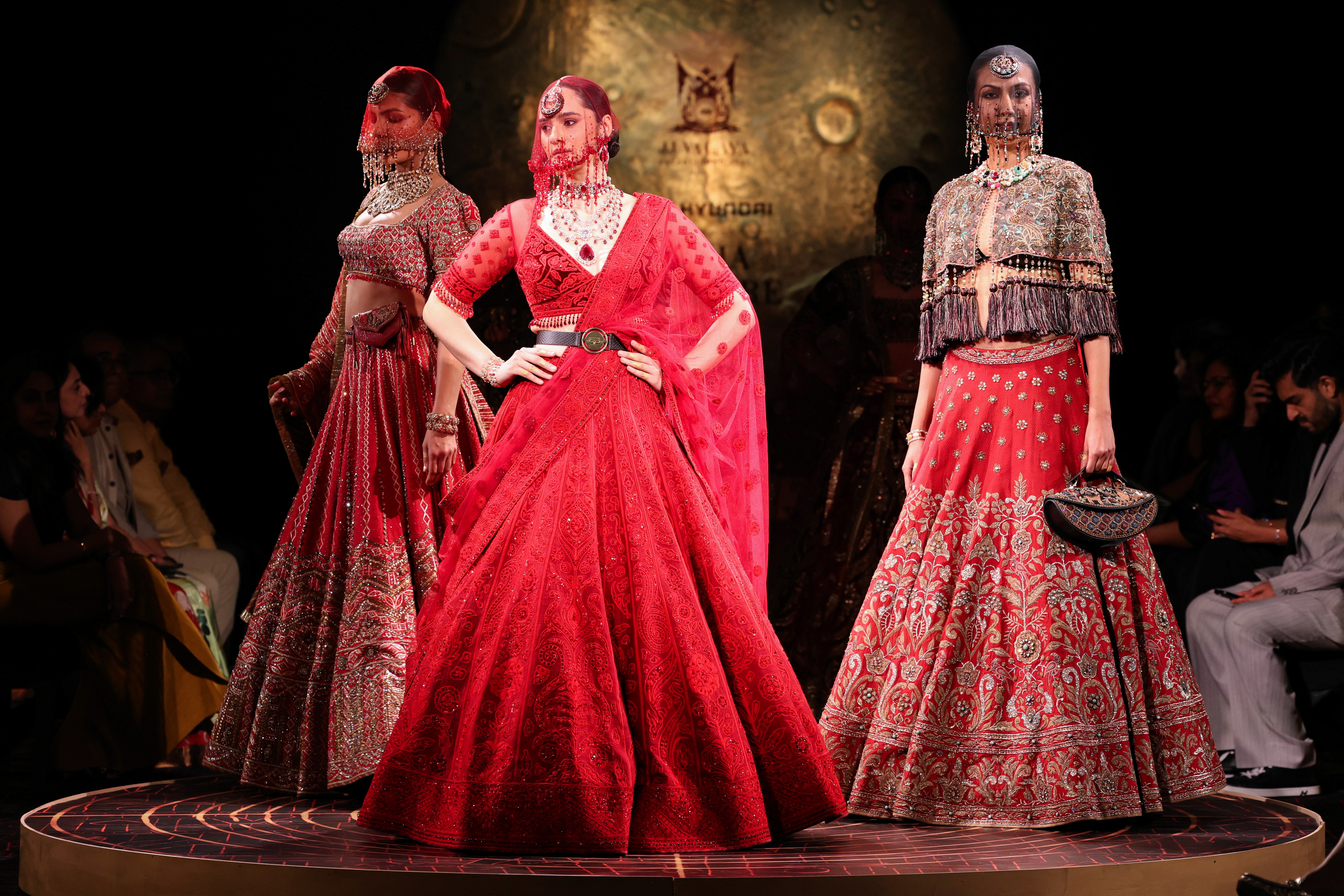
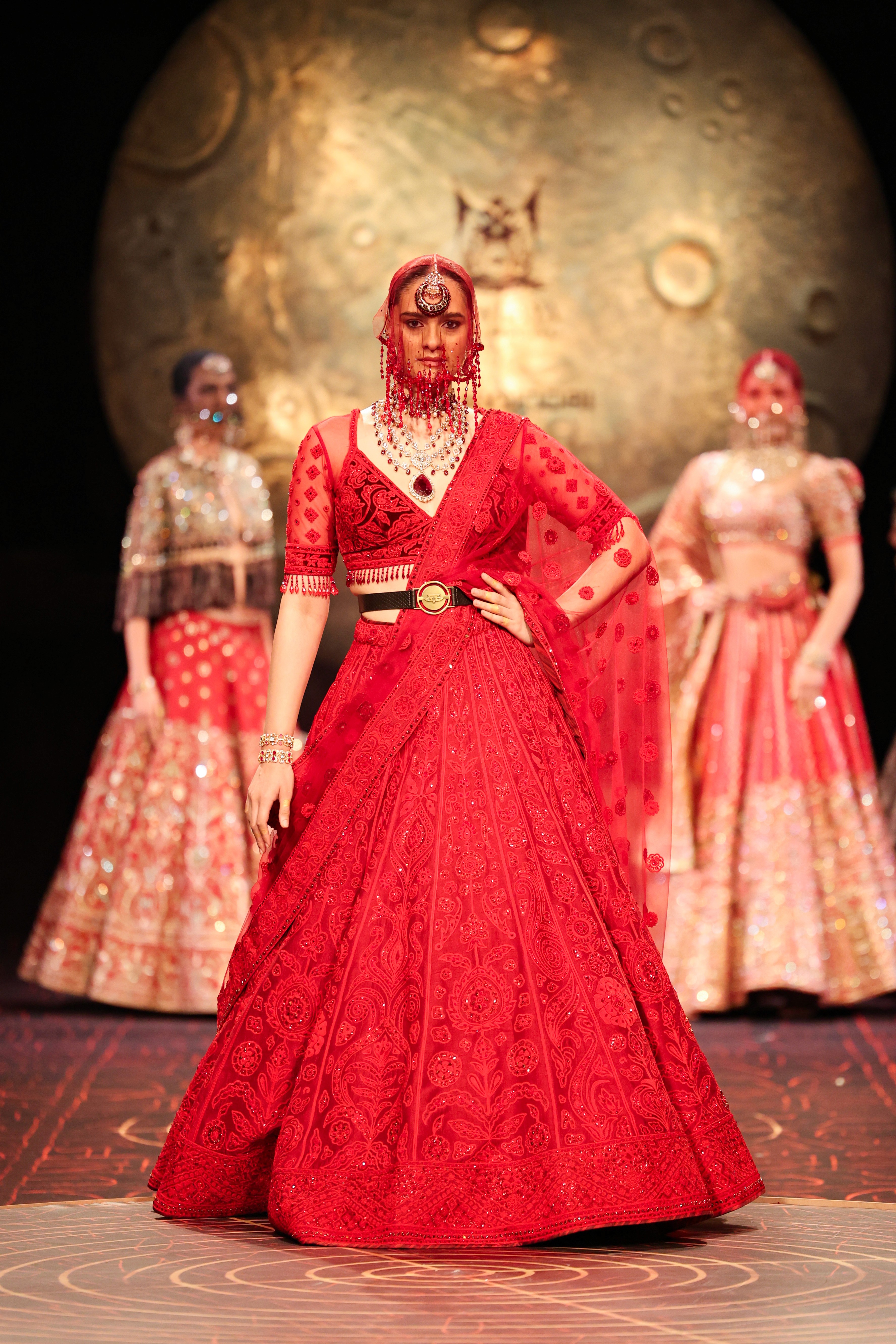
Consider the micro veil, a small curtain of beadwork and glass drawn close over the face, at once a bridal gesture and a piece of armour. On the vermilion look that anchored the line-up, a red so saturated it read as a declaration, the veil fell in a beaded cascade over gold and framed the eyes and nothing else. Red has always been Valaya’s home key, the colour he reaches for when he wants a room to hold its breath, and here it ran through the collection like a bloodline.
Images Via: Gulshan Sachdeva
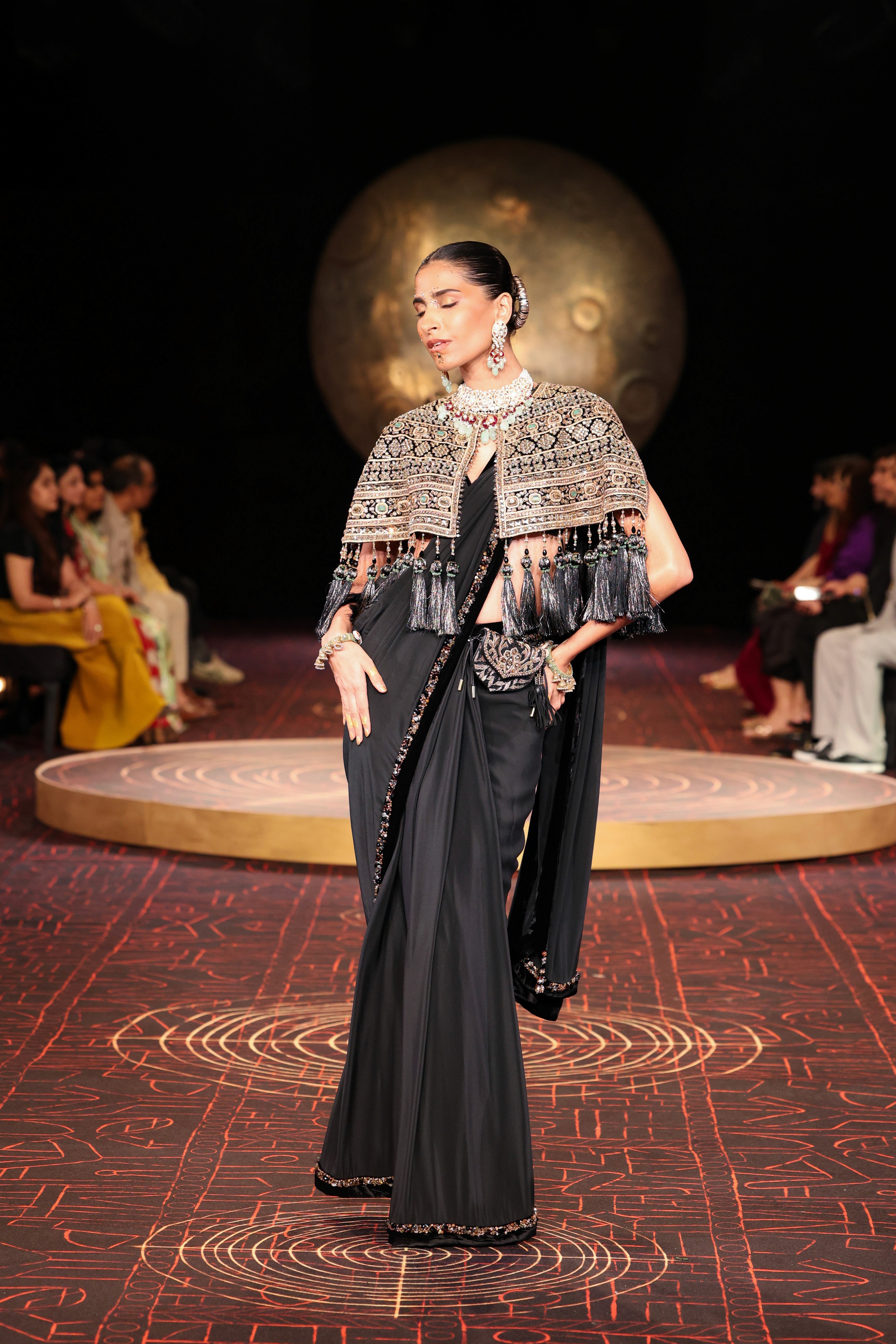
The batua, most intimate of Indian pouches, climbed from the hand to the waist and became a belt in its own right, now a rounded gilt disc, now a small embossed satchel hung on a fine chain across embroidered silk. Broad monochrome belts in deep leather, fastened with one round buckle, drew flowing anarkalis and lehengas into an almost equestrian discipline, a single clean line cutting through acres of handwork. The crescent returned as both motif and object, half-moon bags in deep green, embossed and carried like heirlooms, a shape that has quietly entered the house vocabulary.

Images Via: Gulshan Sachdeva
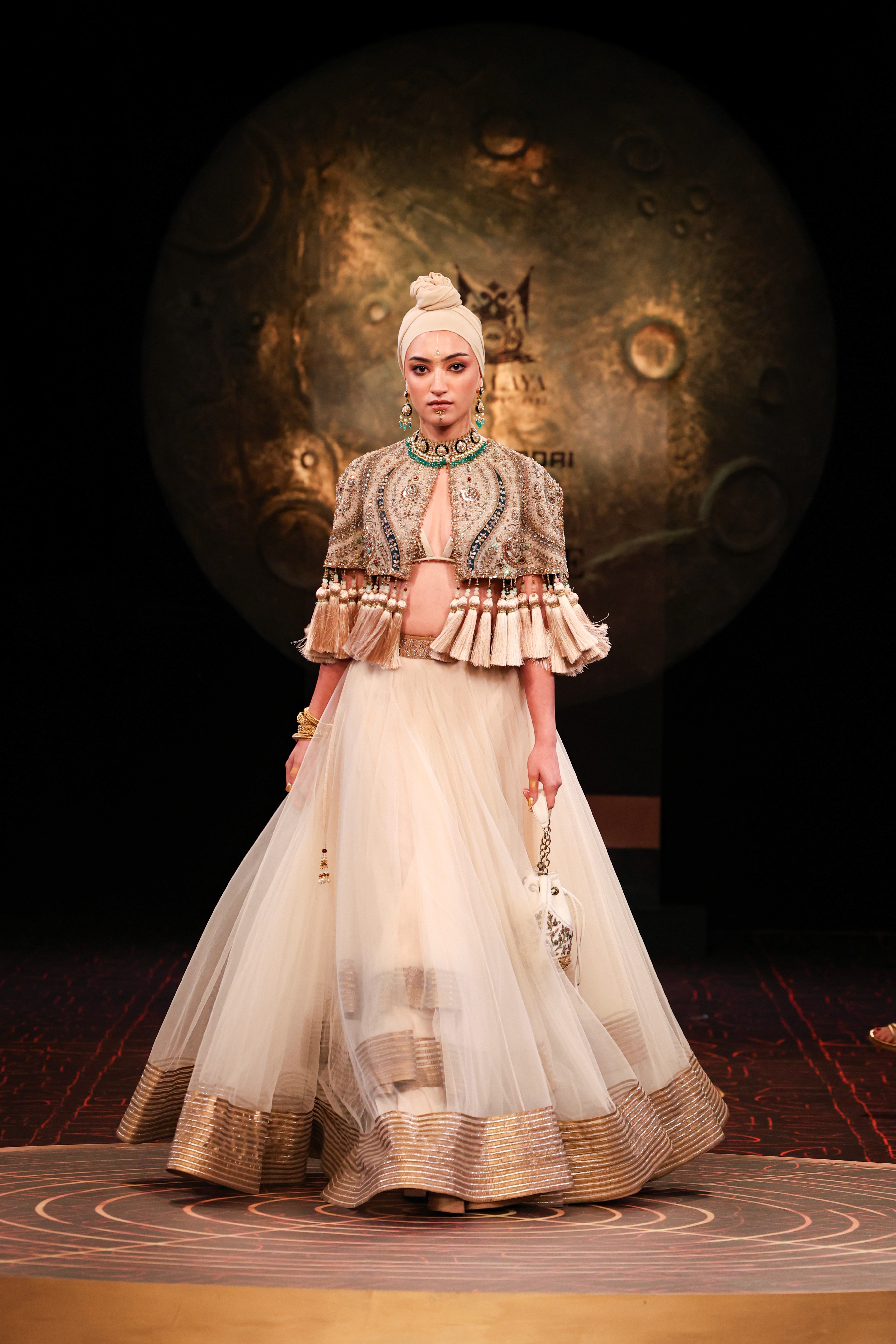
Silhouette carried its own news. The leg-of-mutton sleeve, that theatrical nineteenth-century flourish, full and proud at the shoulder before it narrows to the wrist, made a full return, lending the women a bearing somewhere between empress and aviatrix. Cape blouses swung with enormous tassels at the hem, long enough to graze the hip and weighted enough to move on their own, so that stillness on the runway still read as motion. Velvet gowns in forest green and deep teal pooled with swirling, almost psychedelic embellishment, the kind of pattern that seems to travel as the light moves over it. Everywhere ran the zari braid, metallic cording woven and laid along a seam or an edge the way another hand might use piping, turning structure into ornament.
Images Via: Gulshan Sachdeva
Valaya belongs to the founding class of Indian couture, one of the originals who set out alongside Tarun Tahiliani and Ritu Kumar and built the vocabulary the rest of the industry now speaks. A founding member of the FDCI, the first global brand ambassador Swarovski ever appointed, the man the Maharani of Kapurthala once called the future of the past: the honours read like a short history of the field itself. What keeps him relevant is conviction rather than nostalgia. He designs for permanence, for the garment a daughter inherits, and he has long insisted that he makes for today rather than tomorrow, trusting the years to prove him right.
One year out from thirty-five, the Royal Nomad is still packing for the next crossing. The map, for Valaya, has always been the point.
TO BE CONTINUED, FOR SUBSCRIBERS ONLY.
This is where the surface ends and the reporting begins.
The complete piece, the full archive, and access to The French Press Circle. Reporting answerable only to its readers.
Already a subscriber ?
Login
Read these on the house, with our compliments.
A selection from the current issue, open to all readers. Read them in full. The rest is one decision away.


Next year, JJ Valaya completes thirty-five years, and the countdown has quietly begun. The arc of his house has been building since Tabriz broke a three-year sabbatical in 2019. Through the virtual couture weeks of the pandemic and the run of live shows since, the momentum has grown, season on season, into a long crescendo: the move back to the live runway, his grand return to Mumbai after twenty-four years, the menswear chapters, the closing turn at last summer’s India Couture Week. This year’s show sits one note short of the summit, and you can feel him building toward it.
Images Via: Gulshan Sachdeva
He said as much when we sat together in Chandigarh last week. “Thirty-five years, it’s a big, big moment,” he told me, describing the run so far as amazing, even brilliant, to look back on. He said it in the plain, unguarded way that is entirely his.
Valaya is the rare figure at this altitude of fashion whom you can be completely frank with, real and easy in conversation, holding no airs about himself or his standing. Behind him has always stood his brother, TJ Singh, the business force of the house, steadfast as a rock and among the most generous people you could hope to meet. Both brothers are, quite simply, some of the finest human beings in this industry, grounded and cultivated in equal measure, closer to family than acquaintance. Everything they make carries something of who they are.
Images Via: Gulshan Sachdeva
On the runway in Delhi, the floor gave it away first. Concentric rings of gold light spiralled across a labyrinth of oxblood and ink, the sort of set that asks a room to settle and pay attention before a single model appears. Above it rose towering portraits, the hair sculpted into vast, architectural volumes, presiding over the evening like presences from a dream. Then the music began, live as it always is at a Valaya show, the sound wrapping the room, and the procession started its slow orbit.
Images Via: Gulshan Sachdeva
The front row held the couture press in its usual ranks and the industry’s inner circle, and the clothes rewarded the vantage. At this distance you could catch the weight of each tassel and the way a single bead took the light.
Images Via: Gulshan Sachdeva
Valaya has spent more than three decades as fashion’s great traveller, and travel remains the engine of everything he makes. He calls his house the Royal Nomads, a people forever in motion, forever gathering. Over the years the caravan has pitched its tents in Ottoman Bursa, in Moroccan Fez, across the Balkans and the Far East, each expedition returning laden with silk, motif and story. This season the mood turned to the nomad herself, the woman of the caravan, her hair swept into big, untamed shapes, her bearing regal and a little wild, everything recast in the grammar he has always spoken: Rajput opulence, Mughal geometry, the swagger of the old courts.
Consider the micro veil, a small curtain of beadwork and glass drawn close over the face, at once a bridal gesture and a piece of armour. On the vermilion look that anchored the line-up, a red so saturated it read as a declaration, the veil fell in a beaded cascade over gold and framed the eyes and nothing else. Red has always been Valaya’s home key, the colour he reaches for when he wants a room to hold its breath, and here it ran through the collection like a bloodline.
Images Via: Gulshan Sachdeva
The batua, most intimate of Indian pouches, climbed from the hand to the waist and became a belt in its own right, now a rounded gilt disc, now a small embossed satchel hung on a fine chain across embroidered silk. Broad monochrome belts in deep leather, fastened with one round buckle, drew flowing anarkalis and lehengas into an almost equestrian discipline, a single clean line cutting through acres of handwork. The crescent returned as both motif and object, half-moon bags in deep green, embossed and carried like heirlooms, a shape that has quietly entered the house vocabulary.
Images Via: Gulshan Sachdeva
Silhouette carried its own news. The leg-of-mutton sleeve, that theatrical nineteenth-century flourish, full and proud at the shoulder before it narrows to the wrist, made a full return, lending the women a bearing somewhere between empress and aviatrix. Cape blouses swung with enormous tassels at the hem, long enough to graze the hip and weighted enough to move on their own, so that stillness on the runway still read as motion. Velvet gowns in forest green and deep teal pooled with swirling, almost psychedelic embellishment, the kind of pattern that seems to travel as the light moves over it. Everywhere ran the zari braid, metallic cording woven and laid along a seam or an edge the way another hand might use piping, turning structure into ornament.
Images Via: Gulshan Sachdeva
Valaya belongs to the founding class of Indian couture, one of the originals who set out alongside Tarun Tahiliani and Ritu Kumar and built the vocabulary the rest of the industry now speaks. A founding member of the FDCI, the first global brand ambassador Swarovski ever appointed, the man the Maharani of Kapurthala once called the future of the past: the honours read like a short history of the field itself. What keeps him relevant is conviction rather than nostalgia. He designs for permanence, for the garment a daughter inherits, and he has long insisted that he makes for today rather than tomorrow, trusting the years to prove him right.
One year out from thirty-five, the Royal Nomad is still packing for the next crossing. The map, for Valaya, has always been the point.
TO BE CONTINUED, FOR SUBSCRIBERS ONLY.
This is where the surface ends and the reporting begins.
The complete piece, the full archive, and access to The French Press Circle. Reporting answerable only to its readers.
Already a subscriber ?
Login
Read these on the house, with our compliments.
A selection from the current issue, open to all readers. Read them in full. The rest is one decision away.


