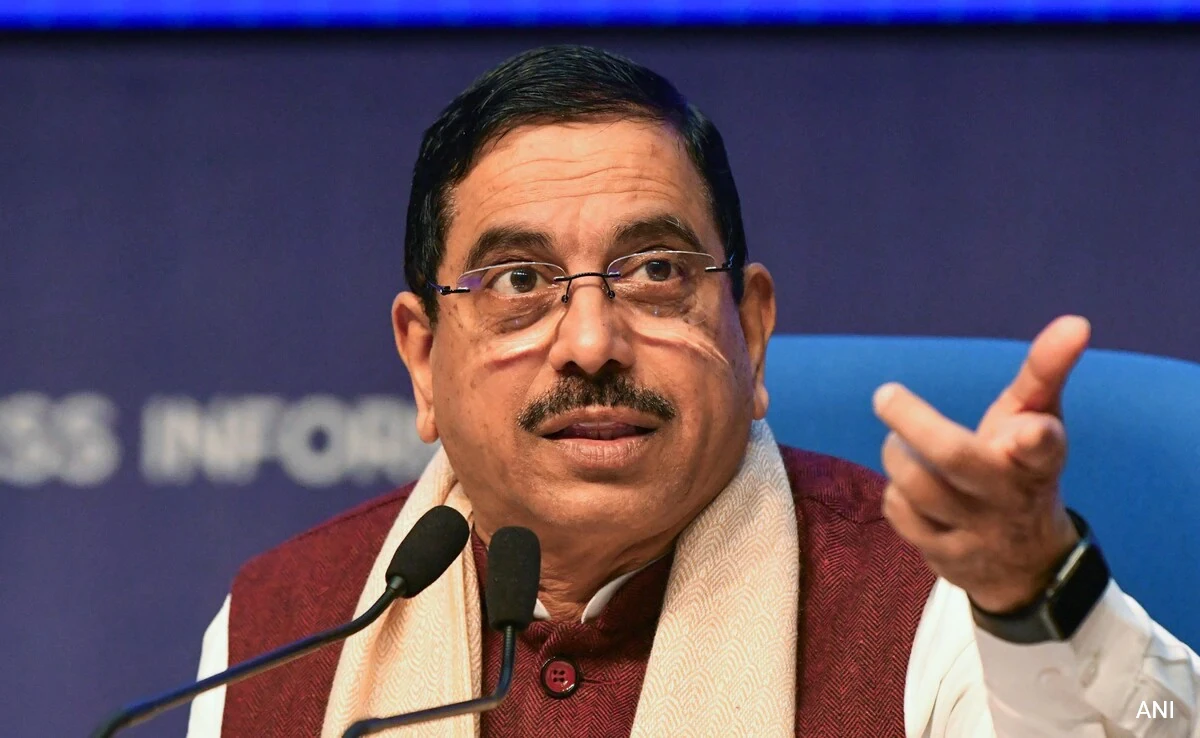
The Appointment
Dharmendra Pradhan resigned as Union Education Minister on Saturday, July 25, amid weeks of student protests over the alleged NEET-UG 2026 paper leak and the earlier cancellation of the UGC-NET exam. President Droupadi Murmu accepted the resignation the same day, and Pralhad Joshi was named his successor within hours. The move was an addition to his workload rather than a clean handover. He retains his existing charges of Consumer Affairs, Food and Public Distribution, and New and Renewable Energy, which means he now runs four ministries at once, at the exact moment education needs undivided attention.
Four Decades In The Party
Joshi was born on November 27, 1962, in Vijayapura, Karnataka, into a railway employee’s family, and earned a Bachelor of Arts from Kadasiddeshwar Arts College, Hubballi, in 1983 before working as an industrialist. He built his early public profile through the RSS-backed campaign to hoist the national flag at Hubballi’s Idgah Maidan between 1992 and 1994, a movement its supporters called an assertion of national pride and its critics said deepened communal tension in the region. That visibility carried him to the post of BJP’s Dharwad district president and then, in 2004, to the Dharwad Lok Sabha seat itself, which he has now held across five consecutive elections. He led the Karnataka BJP as state president from 2014 to 2016, entered the Union Cabinet in 2019 to hold Parliamentary Affairs, Coal and Mines, and moved to Consumer Affairs, Food and Public Distribution and New and Renewable Energy after the 2024 election.
A Delivery Record With Real Output
Set against the politics is a functional record that is hard to dismiss outright. Government figures from his tenure as Coal Minister put growth in commercial and captive mine production at 216% over six years, and as Renewable Energy Minister he has overseen the Green Hydrogen Mission and represented India as president of the International Solar Alliance. His own ministerial office also credits his Consumer Affairs portfolio with steady food subsidy delivery, though those particular figures come from his office rather than an independent audit, and deserve to be read with that caveat attached.
Where The Trouble Starts
The concern is not administrative capacity. It is his instinct whenever education itself becomes the subject. The pattern becomes clear once each episode is placed back in the moment it happened, rather than read as a stray quote.
In February 2022, with thousands of Indian students trapped inside a warzone as Russian forces advanced on Ukrainian cities, and days after a Karnataka student named Naveen was killed in shelling in Kharkiv while evacuation flights were still being organised, Joshi, then Parliamentary Affairs Minister, chose that moment to tell reporters that around 90 percent of Indians who study medicine abroad fail to clear qualifying exams once they return to India, adding that it was not the right time to debate why students were going abroad in the first place, a line that read less like reassurance and more like an excuse for why the government had not built enough seats at home.
Weeks later, as the hijab controversy that had started in a Udupi college in December 2021 spread across Karnataka into stone pelting, counter-protests with saffron shawls, and a state government forced to shut schools and colleges for days at a stretch while the High Court heard petitions from Muslim students seeking the right to attend class in a headscarf, Joshi described the unrest as the work of “fanatics” turning a routine uniform policy into an issue, and separately told the state government not to hesitate to arrest outsiders who came to campuses in support of the students, treating a live constitutional dispute over religious rights as a law and order problem to be cleared rather than a claim to be heard.
Around the same period, when protesters gathered outside a Bengaluru civil court against Karnataka’s proposed revisions to SSLC textbooks, revisions their opponents said amounted to the saffronisation of the state’s curriculum, Joshi told reporters that people unable to tolerate the BJP’s ideology were manufacturing the controversy, dismissing the objection before the revised textbooks had even been made public for anyone to read.
And after three Kashmiri students at a Hubballi engineering institute were booked for sedition over pro-Pakistan and “Azadi” slogans shouted on campus, Joshi said students who avail educational benefits from the Indian government have no business speaking against their own country and warned that stern action would follow, a comment that made continued access to education conditional on a specific kind of political loyalty rather than on due process.
Each of these moments arrived at a point when the people at the centre of them, stranded students, teenage girls fighting for the right to attend class, protesters objecting to a curriculum change, or undergraduates in the middle of a legal process, needed a minister willing to slow down and listen. Joshi’s instinct, on every occasion the subject was education itself, was to speed past the complaint and question the character of whoever was making it.
The Exception That Complicates The Picture
An honest account has to sit that pattern next to a more constructive strand of his record, the one built around language rights in education. Joshi asked Parliament to amend the Constitution so that mother tongue becomes the medium of primary education nationwide, after the Supreme Court struck down Karnataka’s own rule mandating Kannada as the compulsory medium in its primary schools.
He pushed back publicly when Kannada was dropped from a national bank recruitment exam that had promised regional-language options, and when Amit Shah called for Hindi to serve as India’s unifying identity, Joshi told reporters that Kannada, Tamil and the other regional languages deserved equal standing, without conceding that Hindi should dominate. Away from live protest, on a structural policy question, he has been a measured and consistent voice for regional interests, which makes the enforcement reflex visible elsewhere in his record harder to write off as simply who he is.
The Rest Of The File
The controversies outside education follow a similar rhetorical style without the same stakes attached. An FIR was registered against him in 2018 for allegedly comparing a Hubballi neighbourhood to Pakistan, booked under IPC sections covering promotion of religious enmity and insult to religious feelings, and it has not produced a conviction. During the 2022 coal shortage, he answered Rahul Gandhi’s questions about supply figures by calling him a “fake astrologer” instead of engaging the numbers. And in 2021, responding to criticism of the Centre’s Covid response, he said the Congress was “allergic to Hindu rituals,” converting a public health argument into a religious one. None of this has resulted in a judicial finding of wrongdoing against him, and that distinction is worth stating plainly rather than blurring for effect.
Weighing The Fit
Joshi is not a novice, and dismissing him as one would be its own kind of dishonesty. Five terms in Parliament, a state party presidency and two prior Cabinet portfolios make him one of the more experienced administrators in Modi’s council of ministers, and the coal and renewable energy numbers show he can execute against a clearly defined target. But education is not a tonnage problem or a subsidy rollout. It is a trust crisis, accumulated over two years of exam leaks, built by students who no longer believe the system guarding their futures is secure, and trust of that kind is rebuilt through steady reassurance rather than through the rhetorical combativeness that has defined most of Joshi’s public career.
He now carries that crisis as a fourth ministerial responsibility, arriving with a track record that rewards decisive delivery and answers dissent with dismissal. Whether the language - rights version of Joshi or the hijab - row version of Joshi shows up first for students will likely decide whether this ministry finally stabilises, or simply stays exactly where Pradhan left it.
TO BE CONTINUED, FOR SUBSCRIBERS ONLY.
This is where the surface ends and the reporting begins.
The complete piece, the full archive, and access to The French Press Circle. Reporting answerable only to its readers.
Already a subscriber ?
Login
Read these on the house, with our compliments.
A selection from the current issue, open to all readers. Read them in full. The rest is one decision away.





The Appointment
Dharmendra Pradhan resigned as Union Education Minister on Saturday, July 25, amid weeks of student protests over the alleged NEET-UG 2026 paper leak and the earlier cancellation of the UGC-NET exam. President Droupadi Murmu accepted the resignation the same day, and Pralhad Joshi was named his successor within hours. The move was an addition to his workload rather than a clean handover. He retains his existing charges of Consumer Affairs, Food and Public Distribution, and New and Renewable Energy, which means he now runs four ministries at once, at the exact moment education needs undivided attention.
Four Decades In The Party
Joshi was born on November 27, 1962, in Vijayapura, Karnataka, into a railway employee’s family, and earned a Bachelor of Arts from Kadasiddeshwar Arts College, Hubballi, in 1983 before working as an industrialist. He built his early public profile through the RSS-backed campaign to hoist the national flag at Hubballi’s Idgah Maidan between 1992 and 1994, a movement its supporters called an assertion of national pride and its critics said deepened communal tension in the region. That visibility carried him to the post of BJP’s Dharwad district president and then, in 2004, to the Dharwad Lok Sabha seat itself, which he has now held across five consecutive elections. He led the Karnataka BJP as state president from 2014 to 2016, entered the Union Cabinet in 2019 to hold Parliamentary Affairs, Coal and Mines, and moved to Consumer Affairs, Food and Public Distribution and New and Renewable Energy after the 2024 election.
A Delivery Record With Real Output
Set against the politics is a functional record that is hard to dismiss outright. Government figures from his tenure as Coal Minister put growth in commercial and captive mine production at 216% over six years, and as Renewable Energy Minister he has overseen the Green Hydrogen Mission and represented India as president of the International Solar Alliance. His own ministerial office also credits his Consumer Affairs portfolio with steady food subsidy delivery, though those particular figures come from his office rather than an independent audit, and deserve to be read with that caveat attached.
Where The Trouble Starts
The concern is not administrative capacity. It is his instinct whenever education itself becomes the subject. The pattern becomes clear once each episode is placed back in the moment it happened, rather than read as a stray quote.
In February 2022, with thousands of Indian students trapped inside a warzone as Russian forces advanced on Ukrainian cities, and days after a Karnataka student named Naveen was killed in shelling in Kharkiv while evacuation flights were still being organised, Joshi, then Parliamentary Affairs Minister, chose that moment to tell reporters that around 90 percent of Indians who study medicine abroad fail to clear qualifying exams once they return to India, adding that it was not the right time to debate why students were going abroad in the first place, a line that read less like reassurance and more like an excuse for why the government had not built enough seats at home.
Weeks later, as the hijab controversy that had started in a Udupi college in December 2021 spread across Karnataka into stone pelting, counter-protests with saffron shawls, and a state government forced to shut schools and colleges for days at a stretch while the High Court heard petitions from Muslim students seeking the right to attend class in a headscarf, Joshi described the unrest as the work of “fanatics” turning a routine uniform policy into an issue, and separately told the state government not to hesitate to arrest outsiders who came to campuses in support of the students, treating a live constitutional dispute over religious rights as a law and order problem to be cleared rather than a claim to be heard.
Around the same period, when protesters gathered outside a Bengaluru civil court against Karnataka’s proposed revisions to SSLC textbooks, revisions their opponents said amounted to the saffronisation of the state’s curriculum, Joshi told reporters that people unable to tolerate the BJP’s ideology were manufacturing the controversy, dismissing the objection before the revised textbooks had even been made public for anyone to read.
And after three Kashmiri students at a Hubballi engineering institute were booked for sedition over pro-Pakistan and “Azadi” slogans shouted on campus, Joshi said students who avail educational benefits from the Indian government have no business speaking against their own country and warned that stern action would follow, a comment that made continued access to education conditional on a specific kind of political loyalty rather than on due process.
Each of these moments arrived at a point when the people at the centre of them, stranded students, teenage girls fighting for the right to attend class, protesters objecting to a curriculum change, or undergraduates in the middle of a legal process, needed a minister willing to slow down and listen. Joshi’s instinct, on every occasion the subject was education itself, was to speed past the complaint and question the character of whoever was making it.
The Exception That Complicates The Picture
An honest account has to sit that pattern next to a more constructive strand of his record, the one built around language rights in education. Joshi asked Parliament to amend the Constitution so that mother tongue becomes the medium of primary education nationwide, after the Supreme Court struck down Karnataka’s own rule mandating Kannada as the compulsory medium in its primary schools.
He pushed back publicly when Kannada was dropped from a national bank recruitment exam that had promised regional-language options, and when Amit Shah called for Hindi to serve as India’s unifying identity, Joshi told reporters that Kannada, Tamil and the other regional languages deserved equal standing, without conceding that Hindi should dominate. Away from live protest, on a structural policy question, he has been a measured and consistent voice for regional interests, which makes the enforcement reflex visible elsewhere in his record harder to write off as simply who he is.
The Rest Of The File
The controversies outside education follow a similar rhetorical style without the same stakes attached. An FIR was registered against him in 2018 for allegedly comparing a Hubballi neighbourhood to Pakistan, booked under IPC sections covering promotion of religious enmity and insult to religious feelings, and it has not produced a conviction. During the 2022 coal shortage, he answered Rahul Gandhi’s questions about supply figures by calling him a “fake astrologer” instead of engaging the numbers. And in 2021, responding to criticism of the Centre’s Covid response, he said the Congress was “allergic to Hindu rituals,” converting a public health argument into a religious one. None of this has resulted in a judicial finding of wrongdoing against him, and that distinction is worth stating plainly rather than blurring for effect.
Weighing The Fit
Joshi is not a novice, and dismissing him as one would be its own kind of dishonesty. Five terms in Parliament, a state party presidency and two prior Cabinet portfolios make him one of the more experienced administrators in Modi’s council of ministers, and the coal and renewable energy numbers show he can execute against a clearly defined target. But education is not a tonnage problem or a subsidy rollout. It is a trust crisis, accumulated over two years of exam leaks, built by students who no longer believe the system guarding their futures is secure, and trust of that kind is rebuilt through steady reassurance rather than through the rhetorical combativeness that has defined most of Joshi’s public career.
He now carries that crisis as a fourth ministerial responsibility, arriving with a track record that rewards decisive delivery and answers dissent with dismissal. Whether the language - rights version of Joshi or the hijab - row version of Joshi shows up first for students will likely decide whether this ministry finally stabilises, or simply stays exactly where Pradhan left it.
TO BE CONTINUED, FOR SUBSCRIBERS ONLY.
This is where the surface ends and the reporting begins.
The complete piece, the full archive, and access to The French Press Circle. Reporting answerable only to its readers.
Already a subscriber ?
Login
Read these on the house, with our compliments.
A selection from the current issue, open to all readers. Read them in full. The rest is one decision away.