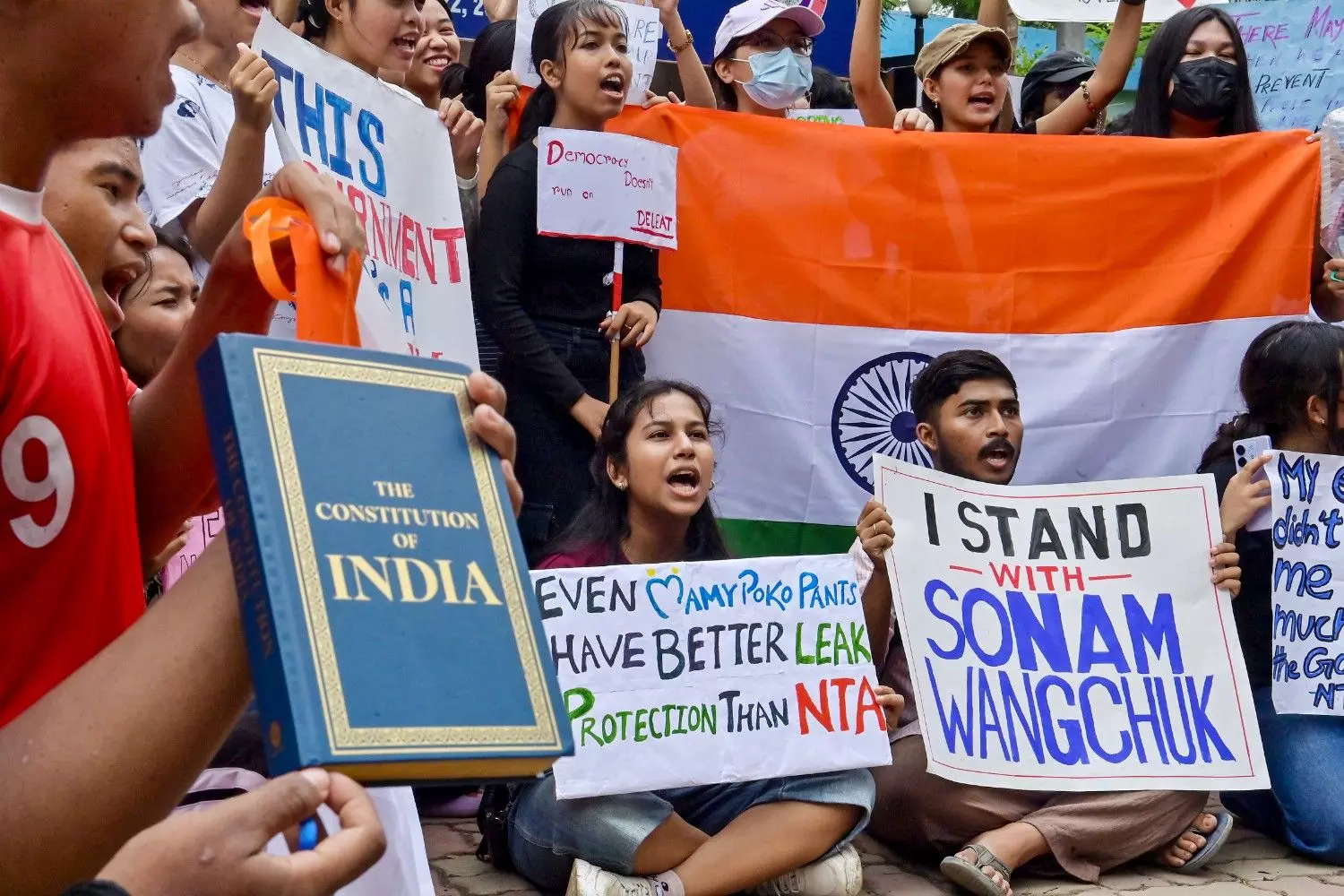
On 28 June, Sonam Wangchuk sat down at Jantar Mantar and began an indefinite hunger strike, alongside six students of the All India Students' Association (AISA), including its National President and an independent student activist. He was fasting in solidarity with the Cockroach Janta Party (CJP), a youth movement demanding accountability over the NEET-UG 2026 paper leak. On Friday, 24 July, after 26 days, Wangchuk broke his fast at Medanta Hospital in Gurugram in the presence of Union Ministers JP Nadda and Dr Jitendra Singh. A PTI video showed Singh helping him sit up in bed and Nadda helping him sip from a cup. "I am grateful and happy to break my fast," Wangchuk said.
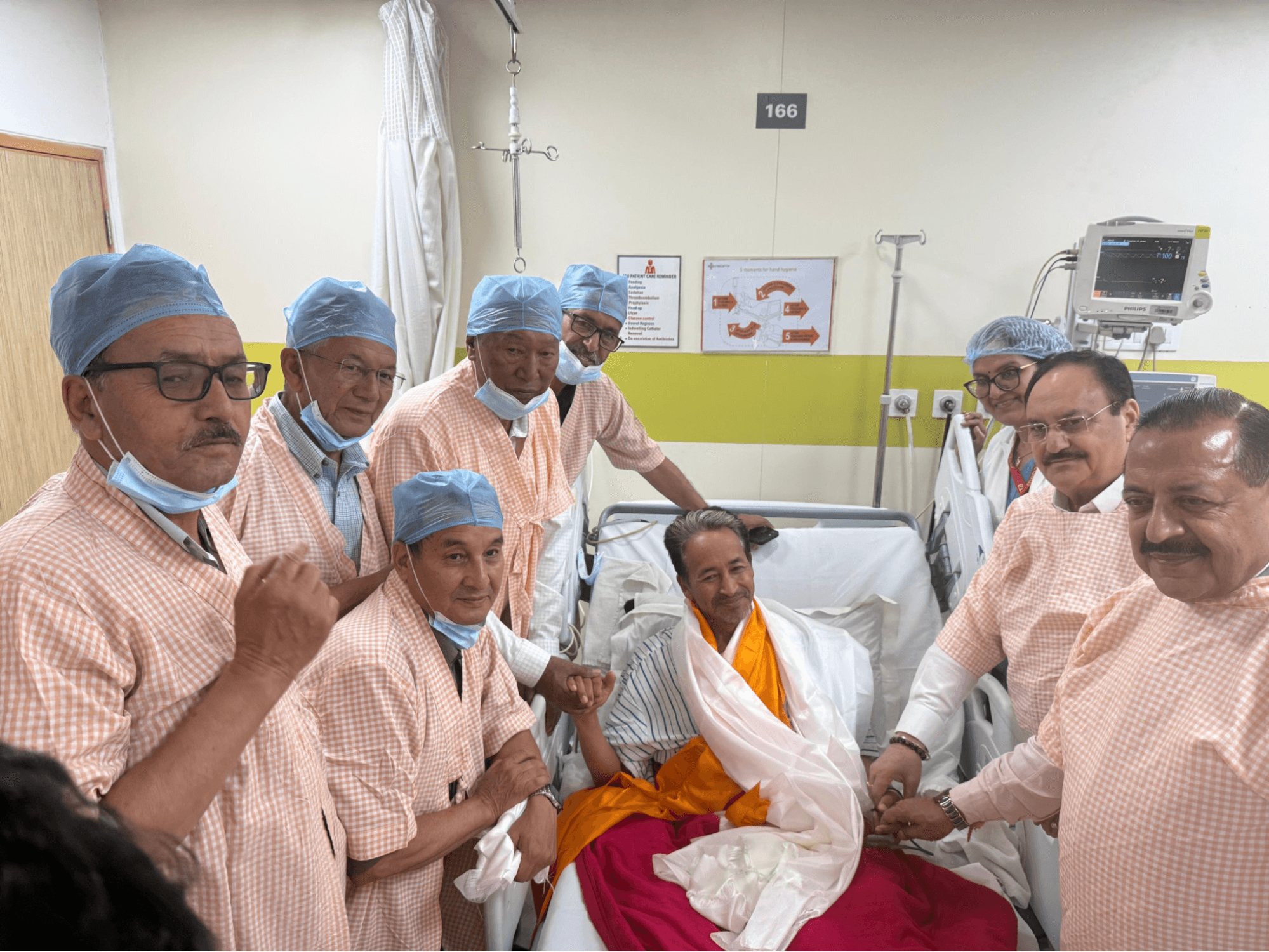
Image via X / @Wangchuk66
Wangchuk said 65 Members of Parliament across parties had urged him to end the strike, and that he had done so "after a long negotiation on various conditions and in view of possible violence in the country," promising to explain the specific conditions in a separate video. Dipke, addressing him directly on social media, wrote: "Thank you, sir, for your extraordinary courage and sacrifice. By putting your own life on the line, you awakened the conscience of an entire nation." He confirmed CJP's protest at Jantar Mantar would continue "till Union Education Minister Dharmendra Pradhan resigns," the movement's founding demand, which the fast's resolution did not secure.
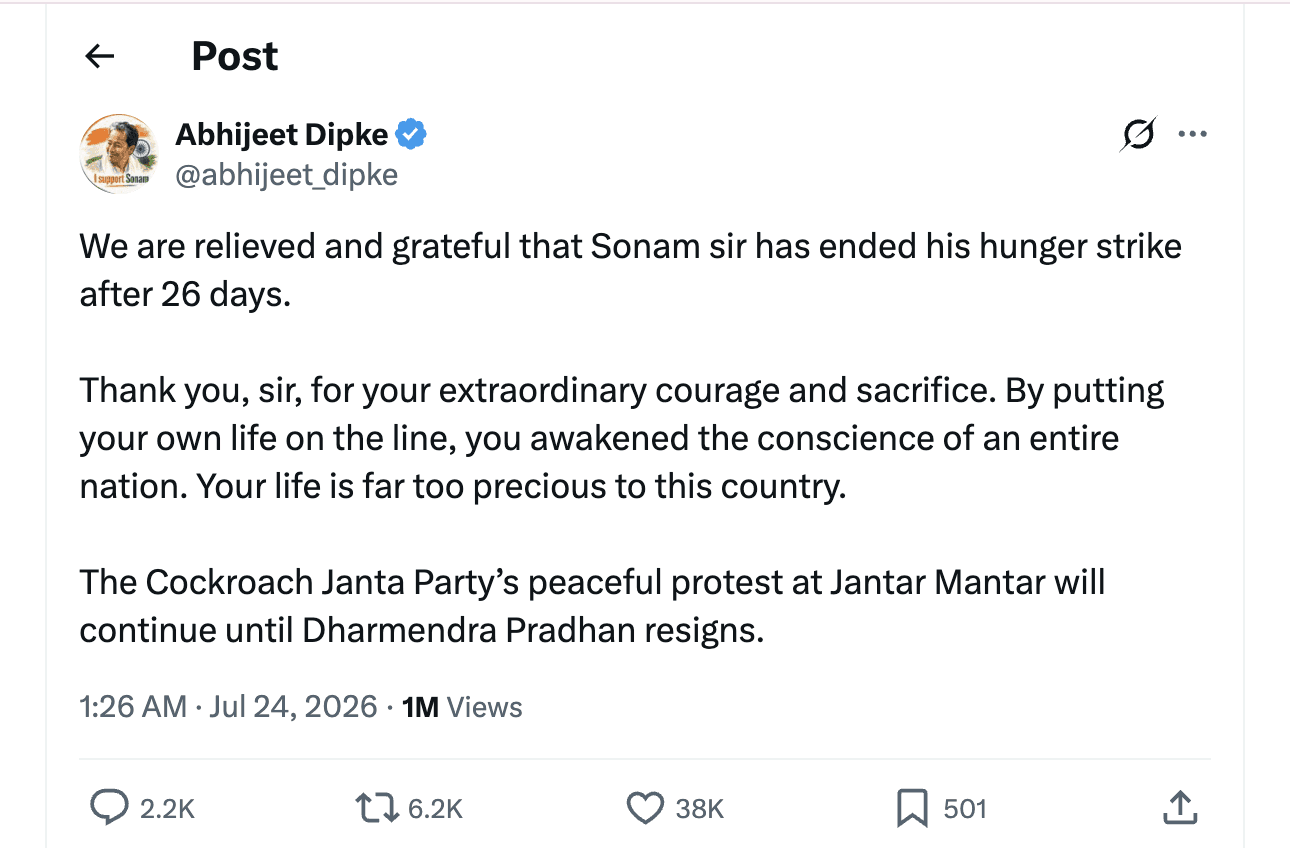
Abhijeet Dipke via X
Along the way, Wangchuk was moved twice, from Jantar Mantar to Safdarjung Hospital by the Delhi Police on 18 July, and then, by Delhi High Court order on 21 July, to Medanta Hospital in Gurugram, where his fast ultimately ended. Hours before he broke it, Prime Minister Narendra Modi posted that the government had decided to set up fast-track courts for paper-leak cases, without naming Pradhan or CJP.
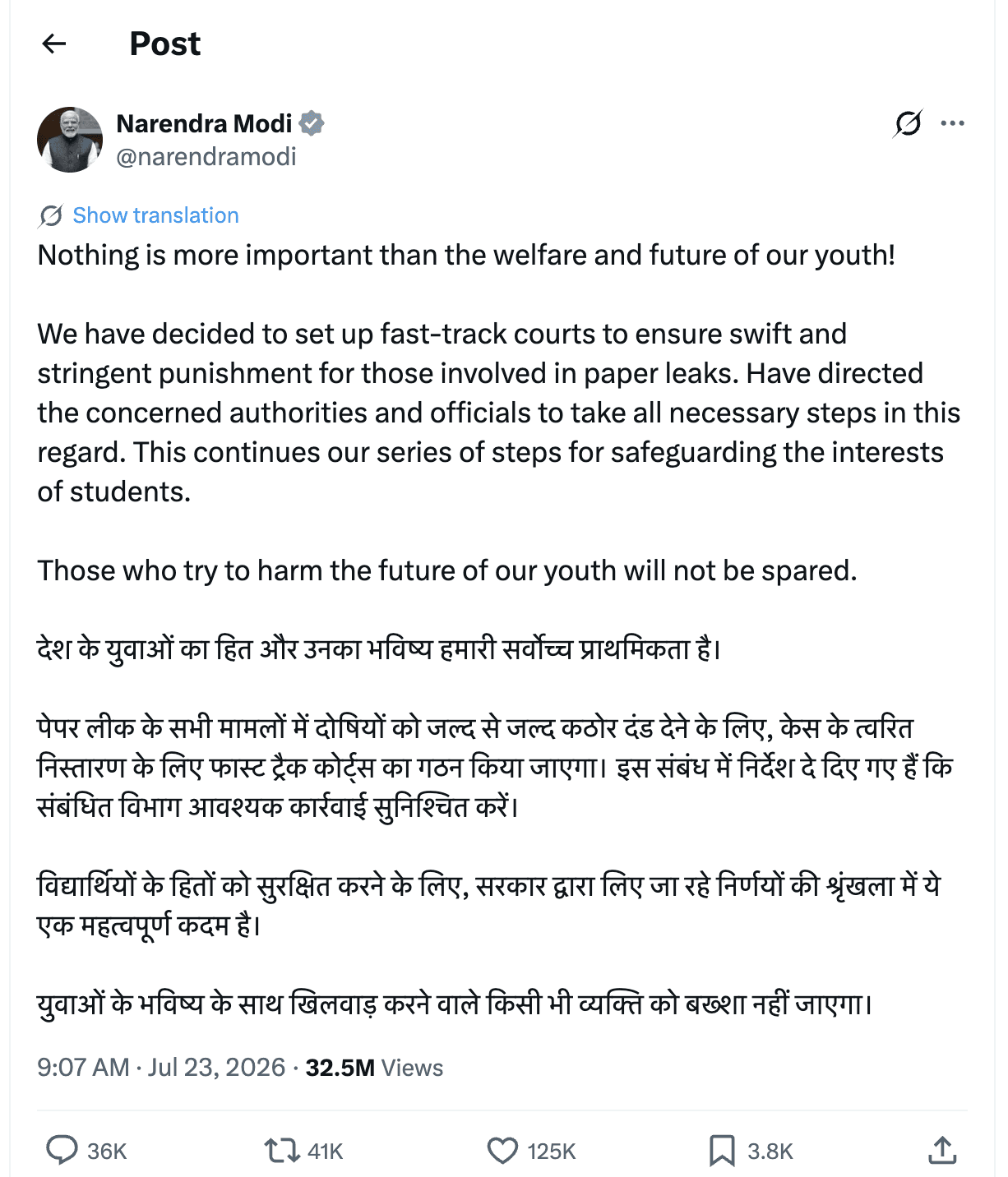
Narendra Modi via X
Who Is Sonam Wangchuk
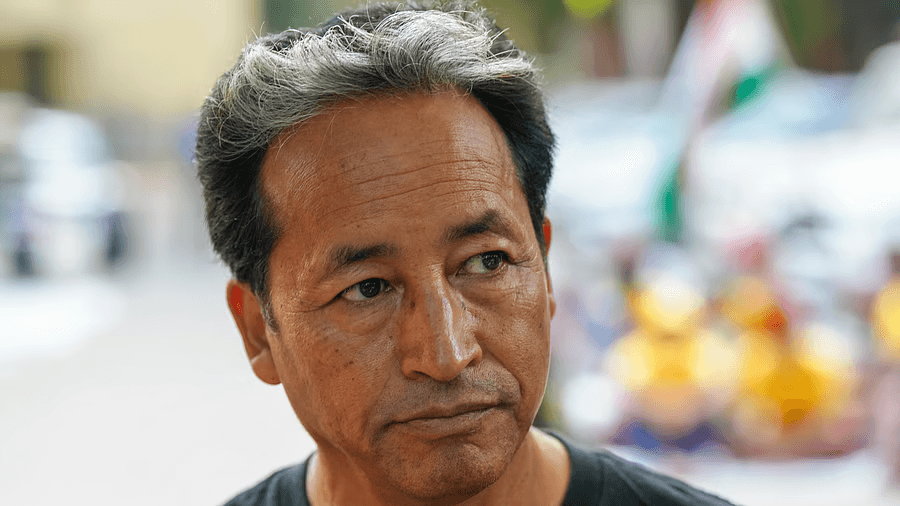
Wangchuk during an earlier Ladakh hunger strike. Credit: PTI, via Deccan Herald
Wangchuk was born on 1 September 1966 in Alchi, Ladakh. His father, Sonam Wangyal, was a Jammu and Kashmir government minister who himself once fasted for tribal protections for Ladakhis, a strike Prime Minister Indira Gandhi broke personally, according to Britannica. Wangchuk co-founded the Students' Educational and Cultural Movement of Ladakh (SECMOL) in 1988, to address a 95 per cent failure rate in Ladakh's state exams. He later developed the "Ice Stupa" artificial glacier for winter irrigation, and co-founded the Himalayan Institute of Alternatives, Ladakh, with his wife, Gitanjali Angmo. He inspired the character Phunsukh Wangdu in "3 Idiots" and won the Ramon Magsaysay Award in 2018.
Since 2023, this is his sixth hunger strike, following four fasts in Ladakh over constitutional safeguards for the region and a fifth, in September 2025, that ended differently from the rest. Protests in Leh that month turned violent, killing four civilians. Wangchuk was detained under the National Security Act two days later and held in Jodhpur Central Jail for nearly six months, before his detention was revoked in March 2026.
"I Am No Modern Gandhi"
Wangchuk has spent much of this fast actively refusing the role the public keeps trying to hand him. On the 14th day of his strike, addressing supporters, he pushed back directly against comparisons that had begun circulating online. "Many people call me the Gandhi of the 21st century or a modern Gandhi. Others call me a hero," he said. "These comments make me uncomfortable. I am neither Gandhi nor a hero. I am just an ordinary citizen who has tried to fulfil his responsibilities." He urged the public to stop outsourcing responsibility to a single figure. "Please don't look for a hero in someone else. Be the hero of your own life," he said.
The gesture toward Gandhi was not accidental on his own part, either. Before the fast began, Wangchuk and Dipke visited Rajghat, invoking Gandhi's philosophy of peaceful resistance, according to Outlook India. In an interview with the Indian Express, Wangchuk insisted the protest had "no political colour" and appealed directly to Prime Minister Narendra Modi for dialogue. That tension, between a man who keeps declining the mantle of a national symbol and a public and media apparatus that keeps offering it to him anyway, has itself become part of the story, particularly as CJP's satirical branding, built for virality, collided with a fast that daily bulletins now track in kilograms and blood potassium levels.
What A Hunger Strike Is, And Why It Works Differently
A hunger strike is a form of non-violent protest that shifts pressure onto a single body and a single decision to stop eating, rather than onto numbers or slogans, forcing the state to answer a hard question: how does it respond when a citizen risks his own health for a public cause. Mahatma Gandhi called fasting "a great weapon in the armoury of Satyagraha" and used it at least twenty times. Potti Sriramulu's 1952 fast led to the creation of Andhra State. Irom Sharmila fasted for nearly 16 years against AFSPA, kept alive by force-feeding. Anna Hazare's 13-day fast in 2011 pushed the Lokpal Bill through Parliament. India's Supreme Court, in its Ramlila Maidan judgment, held that hunger strikes derive legitimacy from Gandhi's tradition of satyagraha and are not unconstitutional merely for involving self-denial. The historian Rajmohan Gandhi, Mahatma Gandhi's grandson, has written that his grandfather saw fasting less as a tool for pressuring governments than as a means of stirring people's minds and conscience.
Internationally, suffragette Marion Wallace-Dunlop pioneered the hunger strike in Britain in 1909. Cesar Chavez fasted repeatedly to build the United Farm Workers' movement in the US. Bobby Sands, an IRA prisoner, died in 1981 after 66 days without food, a strike that triggered international condemnation of the British government's refusal to negotiate.
The Cockroaches' Case
CJP was founded on 16 May by Abhijeet Dipke, a political communications strategist and PR graduate of Boston University formerly with the Aam Aadmi Party. It began as satire: a day earlier, Chief Justice Surya Kant had remarked that unemployed youth were "like cockroaches." Dipke turned the insult into a "platform for all the cockroaches out there." The satire found a serious cause weeks later. NEET-UG 2026, India's mandatory medical entrance exam sat by roughly two million students competing for 130,000 seats, was cancelled by the National Testing Agency on 12 May after the CBI found a leaked "guess paper" matching roughly 120 of its 4,101 questions. Over 22 lakh candidates were affected. A forced re-examination followed on 21 June. At least 13 student deaths by suicide were linked to the leak and its aftermath, according to Outlook India's mid-June count; subsequent reporting suggests the toll has continued to rise.
CJP's central demand is that Education Minister Dharmendra Pradhan take moral responsibility and resign. Its demands have since widened to include ₹1 crore compensation for affected students' families, a judicial probe into the leak, NTA accountability, and reform of the National Education Policy 2020.
Jai Nakra, a 23-year-old law student in Mumbai who attended a solidarity protest at Shivaji Park, argued CJP has moved well past its satirical origins. "CJP does not propel itself using comedy or satire," he said. "It only managed to gain popularity because of that, but that is not what it currently stands for. They have listed out their demands: they want Dharmendra Pradhan to resign, and they want reformative education policies. The cockroach joke has left us far behind. It did bring them popularity and gave them a stage, which is a good thing, because now they are using that stage to propel certain good ideas. I'm not a complete fan, it's not as though they are perfect, but they have used that stage to bring up certain issues that no one else was bringing up before."
Why Wangchuk Joined
Wangchuk had called himself an "honorary cockroach" before formally joining the fast on 28 June, and said his reasons were solidarity with the NEET protesters and hope that the moment might also revive Ladakh's unresolved constitutional demands. Zoya Kharmawphlang, a 21-year-old PR executive from Gurugram who was at the 20 July march, called it consistent with his history but a significant turn all the same. "Historically, his hunger strikes in Ladakh were tied to local realities: constitutional safeguards under the Sixth Schedule, ecological preservation of the fragile Himalayan landscape, and local democratic representation," she said. "Fasting in our country's national capital over a cause outside his immediate home region speaks volumes about his personal philosophy and the current civic climate. His approach of non-violent protest, satyagraha, is something I truly respect. Wangchuk's fast from the confines of a hospital room amidst police efforts to remove him demonstrates that his actions stem from a deep personal conviction rather than a political goal." She read his presence at the protest as evidence of something wider knitting together. "His presence alongside civil society organisations and student parties indicates a unity in Indian social life that was long overdue," she said. "The image of a veteran Himalayan reformer standing alongside students highlights how deeply national exam integrity and youth futures resonate across contemporary India, despite the diversity of culture and geography."
Vedika, a 23-year-old postgraduate clinical psychology student and Delhi resident who was also at the march, put it more simply. "He didn't have to make this his fight, but he chose to," she said. "That shows he believes that if something is unjust, you don't have to be personally affected to stand up for it."
Jai Nakra took the opposite view of how much Wangchuk's Ladakhi background matters to the protest's meaning. "His background does not add symbolism for me, but the fact that he is doing it does," he said. "It does not matter, in this particular fight, where the person has come from, because the entire public has united under a single cause. People are flying in from across India. A man went on a hunger strike and, instead of hearing him for over twenty days, they detained him. That enraged a bunch of people and united them under a single cause. Mr. Sonam Wangchuk's Ladakhi background has nothing to do with this."
The Fast Begins
Wangchuk sustained himself initially on salt water. Shaurya Rajgarhia, a student from Gurugram, said he does not read Wangchuk's fast against the weight of India's history of hunger strikes at all. "Hunger strike is just a medium that's been widely popular with our country's protests," he said. "I don't draw any contrast from previous protests, I think that can become dangerously misleading."
By mid-July, public concern was building; on 16 July, Arundhati Roy, Naseeruddin Shah, and others appealed publicly for him to stop. He refused. "I am weak from the outside but very strong inside," he told supporters. "I will stay alive till July 20 at any cost." By day 19, doctors recorded a weight loss of around 9.1 kilograms and warned of possible organ damage.
Jai Nakra offered a physical account of what that stretch would mean. "If you go even three days without food, you would start to think crazy thoughts," he said. "Wangchuk has gone for around 20 days. I don't think, in his current state, he is thinking about this as a test for the camera. The only thing keeping him going is his willpower, and willpower stems from will, and his will must obviously be for reform, otherwise how would he step forward." Asked whether six fasts since 2023 dilutes the act's power, he disagreed. "Take a soldier," he said. "Does that mean that every time he puts his life on the line, the gratitude you feel for him is diluted because he has done it before? I would not say so. Just because he has done it before does not mean that it does not hurt now."
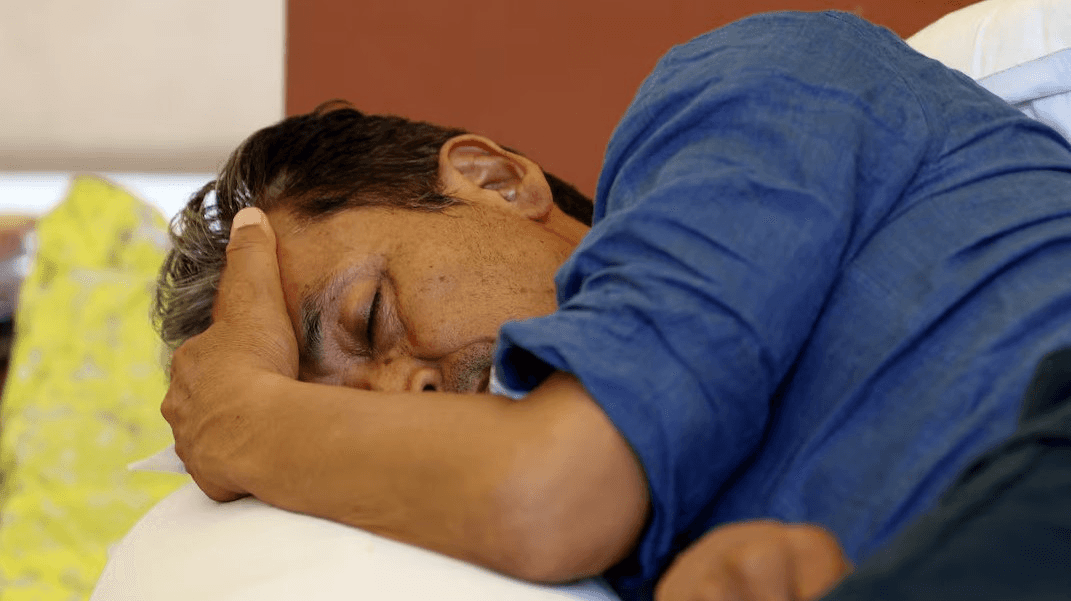
Wangchuk resting on stage at Jantar Mantar, 14 July. Credit: Reuters/Bhawika Chhabra, via TBS News
By day 19 of the fast, doctors treating him had also recorded worsening blood readings. Jai Nakra argued that publicising those readings, rather than making the fast feel more like spectacle, gives the public a clearer, more accountable picture. "That actually gives us a better idea of where the person stands, how far away from death they are, and how much pain and suffering they are going through," he said. "It mitigates the risk to the person's life. Having someone monitor their health seems good to me. It also means that if he is approaching death, the fast can be stopped. We are not heading into it blindly."
The Removal From Jantar Mantar
In the early hours of Saturday, 18 July, on the 21st day of Wangchuk's fast, Delhi Police assembled under the pretext of a security drill ahead of Parliament's Monsoon Session, according to The Indian Express, whose reporting was subsequently carried by Outlook India, Newslaundry, and The News Minute. Officers were briefed at Mandir Marg police station on an operation to remove Wangchuk within roughly 30 seconds, timed to a short window each morning when CJP founder Abhijeet Dipke would step away from the site. A phone jammer was reportedly installed nearby, and a white curtain was placed across the protest stage at around 6:30am before Wangchuk was moved into a waiting ambulance within two minutes. The operation followed the Union Home Ministry's replacement of Delhi Police Commissioner Satish Golchha with Anurag Kumar a day earlier, a change The Indian Express linked directly to the CJP protest.
Multiple protesters alleged police shoved, beat, and verbally abused those who tried to intervene, and smashed phones recording the incident, according to Newslaundry. CJP spokesperson Ashutosh Ranka said Wangchuk had been "manhandled and forcefully removed." Delhi Police said the operation was conducted "peacefully with maximum restraint" and cited a Delhi High Court order and medical advice. Safdarjung Hospital recorded his admission at 7:40am, describing him as weak but stable, with signs of dehydration, compensated acidosis, and low serum potassium.
Wangchuk assisted by supporters the night before his removal, 17 July. Credit: PTI, via Outlook India's coverage of the removal operation
Nandini Singh, a 25-year-old creative director from Delhi who was present at the site, rejected the state's framing of the operation as protective. "In the name of protection of the protesters, it would have been much easier to actually come down to sit and talk to the aggrieved people," she said. "The kids are asking for their exams to be taken, what discourse is this? But they abducted him. Illegally, forcefully. They have kept him hostage. This is all a way to fear us, but it had the opposite impact. People are more enraged than ever. And I feel, it's still not enough."
Zoya Kharmawphlang described the removal as pre-empting, not protecting. "Watching someone fast for three weeks with zero official response, only to be whisked away under the guise of a medical emergency right before a planned march to Parliament, felt deeply dystopian," she said. "The sudden urgency wasn't about saving a life, it was about clearing the street. Word quickly spread from Safdarjung about the heavy police presence, restricted access, and family being kept at arm's length. It made one thing clear: to authority, a frail man fasting quietly in a locked hospital room is far more dangerous than thousands shouting on a road. When you're standing in that crowd, you realise the fight isn't just about an exam anymore. It's about whether ordinary citizens are allowed to stand up and say this is broken without being treated as a threat to public order."
Rajgarhia set a specific condition for when he would view state intervention as legitimate. "If there would have been a dialogue between the govt and Sonam Wangchuk, if the govt had at least tried to put forward their side, and this would have been an absolute fact that the govt and Sonam cannot reach a point they can agree on, then by all means, a state intervention to save a life is justified," he said, "again it would have still been questionable but at least it would have been a difference in opinions. With no dialogue, no press conferences, no statements, not even an apology, this is more of an act of hooliganism."
Jai Nakra was blunter about what the removal, absent any dialogue, revealed. "I definitely see it as the latter," he said, asked whether state intervention reads as protecting a life or defusing a symbol it could not otherwise silence. "They were not even willing to hold a conversation. They simply, in a sense, detained him and shut him up. That's it."
Dipke's Fast, And Who Broke Theirs Before The March
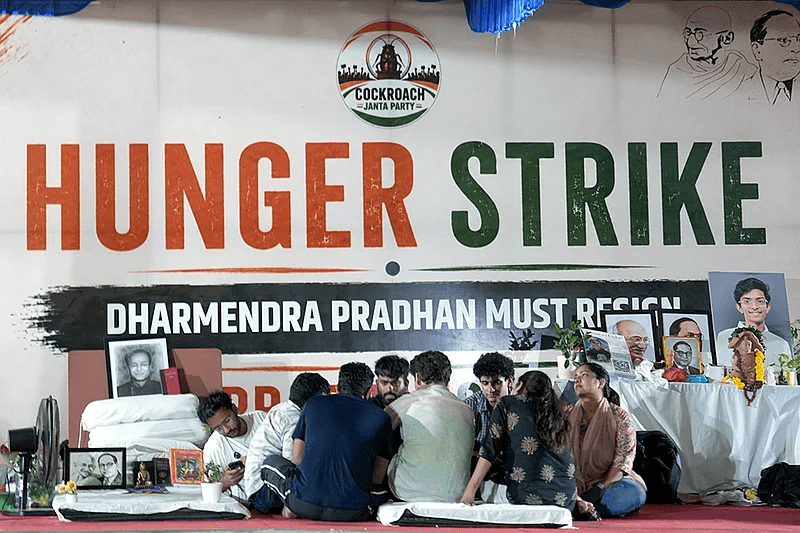
Dipke declared his own indefinite hunger strike within minutes of Wangchuk's removal. During it, an unidentified person threw a blue ink-like liquid at him at the protest site.
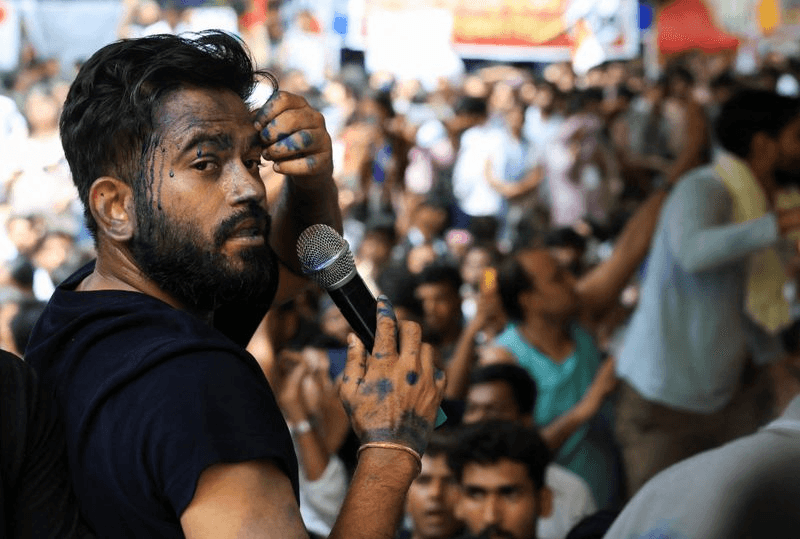
Abhijeet Dipke after an unidentified person threw blue ink-like liquid at him during his own strike. Credit: Reuters, via The Tribune
Dipke did not carry his fast into the 20 July march. At Wangchuk's own request, he broke it that morning with juice offered by the father of Ria, a Dehradun NEET aspirant who had died by suicide the previous month, so he would have the strength to lead the march. The same day, three AISA activists who had fasted alongside Wangchuk since 28 June, Neha, Manish, and Aameen, ended their 23-day strike after an appeal from a delegation of opposition MPs, senior advocate Prashant Bhushan, activist Yogendra Yadav, and actors Prakash Raj and Shabana Azmi, who assured them their demands would be raised in Parliament. "This is not the breaking of the hunger strike," Yadav told them, "but the conclusion of this form of struggle."
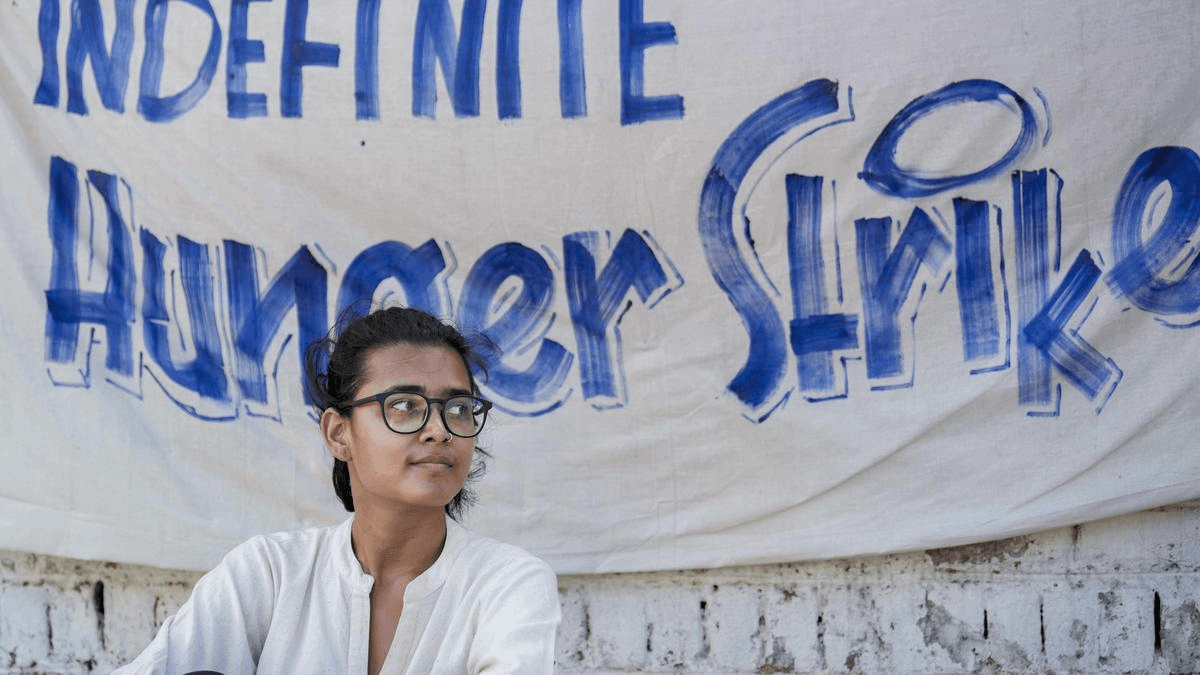
Activist Neha during the hunger strike demanding action over alleged irregularities in examinations and seeking the resignation of Union Education Minister Dharmendra Pradhan. File | Photo Credit: PTI
Wangchuk alone did not break his. From his hospital bed, he set three written conditions for ending it: government accountability for the education system's failures by 20 July; or CJP's leadership reaching Parliament's doorstep with an MP assurance the issue would be raised; or, if his health barred travel, MPs visiting his hospital to give the same assurance. None was met.
Dobhal, former Editor-in-Chief of Cosmopolitan India and a creative tech evangelist, situated the divergence within three separate elements of the act itself: a striker's capacity for sacrifice, the body's physical limits, and the willingness of loved ones to monitor and support the protest closely. On Wangchuk's decision to fast again, for a cause outside his own region and now from a hospital bed, she said: "It speaks highly of his sacrificial nature and principal ideology of resistance."
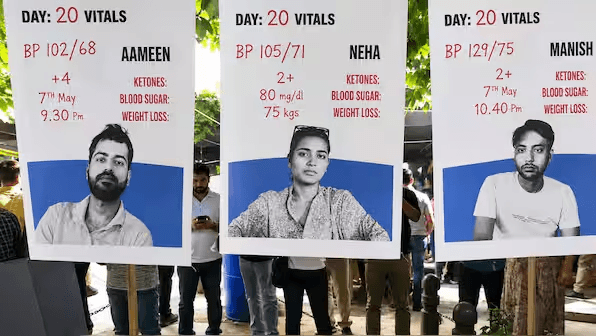
All three hunger strikers have ended their indefinite fast. Image courtesy: X
Zoya Kharmawphlang described the same divergence as structural rather than a measure of commitment. "When student leaders break a fast while a major figure like Wangchuk keeps going, it shows how hunger strikes work in practice: it's a relay, not a monolith," she said. "Neha, Manish, and Aameen's job was to ignite the fire and build pressure. After 23 days and dangerous physical decline, their body's limit had been reached. Having civil society leaders publicly step in and ask them to break their fast wasn't a surrender, but rather a handoff. As an established, globally recognised figure, Wangchuk's fast plays a different role. It is an unyielding moral anchor. By continuing his fast from a hospital bed, he ensures the government can't just claim the story is over and sweep it under the rug. Student activists use the fast to force momentum, then hand off the baton to survive and organise another day. A figurehead like Wangchuk holds onto the fast to deny the state a quiet exit. One is a spark; the other is a stake driven into the ground."
Vedika saw no hierarchy of commitment in the split. "I don't think ending a hunger strike means someone is less committed," she said. "Different people have different roles in a movement. Some continue because they feel it's necessary, while others stop after achieving a strategic objective or at the request of fellow protesters. Both decisions can come from commitment rather than weakness."
Cockroaches And Conscience
Views differed on how CJP's satirical origin sits beside a fast now before the courts. Nandini Singh saw the two registers as reinforcing each other. "Only because it started off as a satirical movement, it did allow more people to participate and spread awareness," she said. "Humour is always best when shared, no? And people are stronger together. We saw so much of that on the 20th. People were ready to take one for the team. And that's our only power. Us. Together."
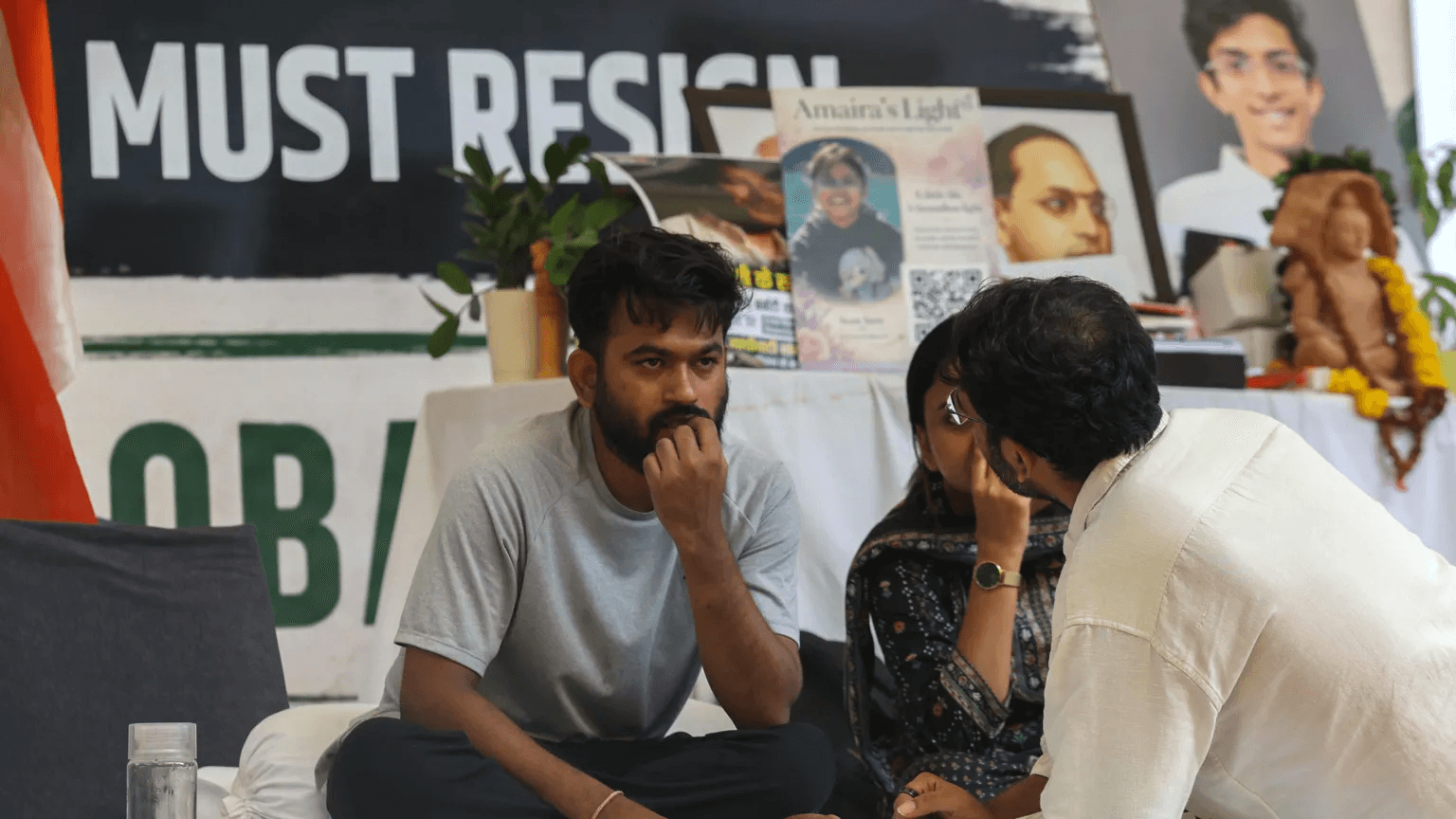
Abhijeet Dipke refused food after hunger striker Sonam Wangchuk was taken away to hospital, but Dipke heeded calls to end his fast on Monday. Image via EPA
Zoya Kharmawphlang argued the combination scrambles the state's options entirely. "Far from pulling the story apart, combining humour and sacrifice creates a moral trap the state simply doesn't know how to handle," she said. "Humour brings people, Gen Z particularly, in; sacrifice makes them stay. Reclaiming a slur like cockroach gives angry, exhausted students a disarming shield against despair. But humour alone can be written off as a viral stunt. When a respected reformer sits on the same tarp and puts his life on the line, that absurdity suddenly carries deadly serious weight. It completely scrambles the state's reaction. If you crack down on the students, you look ridiculous. If you ignore Wangchuk, you risk a national crisis. Humour keeps the movement resilient so people don't burn out. Sacrifice gives it teeth so the government can't look away."
Vedika agreed the two registers complement rather than compete. "The satire makes the movement approachable and gets people talking, while the hunger strike reminds everyone that the issues are deeply serious," she said. "Together, they reach people in different ways."
Jai Nakra credited CJP's grasp of short-form media, more than satire itself, with holding public attention for a slow, punishing act in a culture built for speed. "This is what the CJP has been doing, and not just the CJP," he said. "They adopted the current Reels format of posting an update every day in a 30- or 40-second clip. This has really captivated people's minds, because it is something people are already addicted to: watching progress videos, such as Day 1 of this, Day 2 of that. The CJP has shown that there is a very successful model for holding the current generation's attention, and that is through short-form content itself."
The March To Parliament, And The Crackdown
CJP's "Chalo Sansad" march began on the morning of 20 July from Mandi House Metro Station, moving through Jantar Mantar toward Parliament. Police estimated the crowd at 8,000; several ground accounts suggested more. Clashes broke out near Patel Chowk, where police and the Rapid Action Force deployed tear gas and a lathi charge in the rain; protesters were reported to have thrown bottles in response. Dipke was picked up by police during the march. Over 70 protesters were detained.
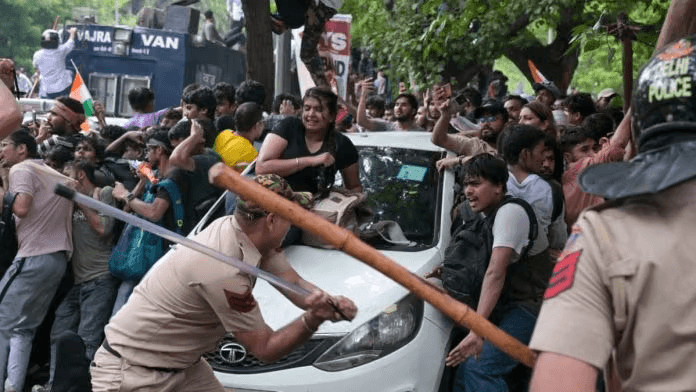
Tear gas near Patel Chowk during the 20 July march. Credit: Praveen Jain/ThePrint and Suraj Singh Bisht
Wangchuk had asked to be temporarily released to join. The request was refused. In a note shared through his wife, he said he would continue fasting "until the youth leaders are allowed to meet the Parliamentarians at the Sansad Bhawan or I am allowed to meet them here at the Hospital." Home Minister Amit Shah met Pradhan inside Parliament as the clashes unfolded outside.
Nandini Singh called the day confirmation of something she already believed. "We are not a democracy," she said. "We haven't been one for a while now, but yesterday, and the weeks leading up to the march, have shown us very loud and clear reality, and this should be enough for us to know we live in a tyrannical regime. There is no two ways to say this, but you do not entrap innocent kids within the protest grounds, blocking the exits and metro stations to ensure absolutely no escape, and beat them up. They hurt far too many innocent and peaceful protesters. The state does not care about us. No other way but a revolution."
Zoya Kharmawphlang read the same day as the state losing, not winning, control. "If you were standing in the downpour, wiping rain and sweat from your face while watching tear gas canisters fly, and your friends get dragged into police buses, it didn't feel like a defeat," she said. "It felt like a mask slipping off. The state isn't containing this, it's panicking. Containment is when you successfully keep a protest quiet, small, and invisible. Yesterday was the exact opposite. They locked Wangchuk in a hospital room and refused his plea to march. They shut metro stations, lined the streets with barricades, and brought out lathis and water cannons. Yet thousands of students still pushed right up to Parliament's doorstep in the pouring rain. When a government has to use that much raw force against young people asking about exam papers, it's not showing control, it's admitting it has lost the argument."
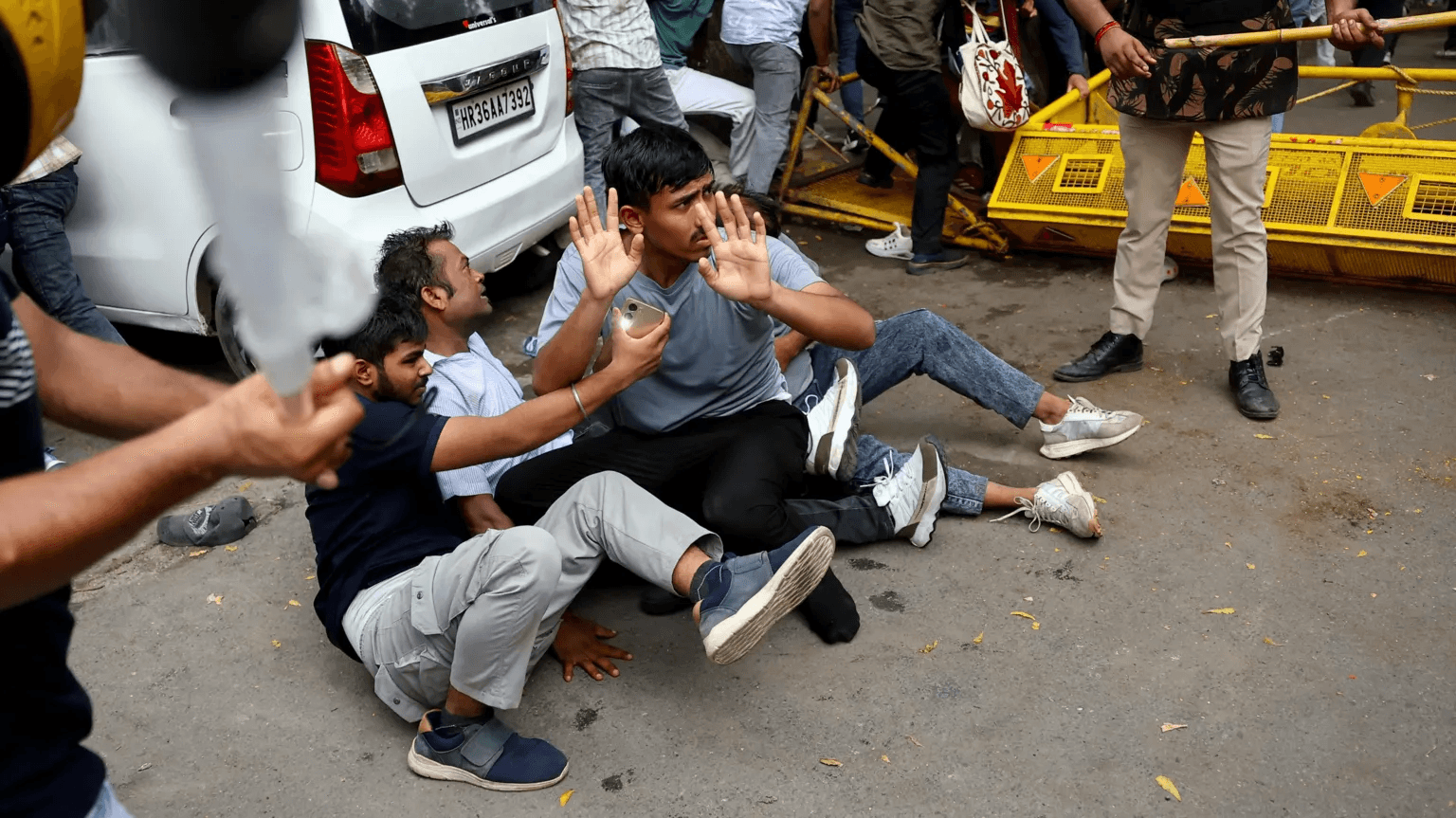
Scores of people were injured when police tried to disperse Monday's huge crowd with baton charges and tear gas. Image via Reuters
Vedika drew a narrower conclusion from the same events. "The number of people who came out showed the movement has support, but the detentions and lathi charge also showed how difficult it can be to keep that momentum going," she said. "It's hard to say it's one or the other. But I think the fact that people are still there, okay to be beaten up, says a lot."
Dobhal read the day within the arc of the movement so far. "It speaks volumes about how the state responds to peaceful protests," she said. "Perhaps their silence prior to the outburst should have been interpreted as cautionary of the eventual use of brute force. It stands at a tipping point where what started as a singular demand will grow into many demands seeking accountability and transparent governance."
The Conclusion Of The Fast
Wangchuk's health declined steadily through mid-July; by the time he was moved to Medanta on 21 July, hospital bulletins were tracking pancytopenia, low serum potassium, and low blood sugar. He broke his fast just after midnight on 24 July, 26 days in, at Medanta Hospital, in the presence of Union Ministers JP Nadda and Dr Jitendra Singh. The specific terms of that resolution, what the government has and hasn't committed to in writing, are covered in French Press Global's companion report on the negotiation itself.
What sits outside that political story is the human cost that continued to surface through the same fortnight. A 19-year-old protester, Sahil Lochab of Najafgarh, was hit by a pellet gun during police action at the 20 July march and may lose vision in his right eye, according to his family; he underwent surgery to remove the pellets at AIIMS. Mumbai Police separately registered 13 FIRs connected to solidarity protests in the city since 18 July, naming around 400 people under provisions related to unlawful assembly and breach of prohibitory orders. Dipke, in a message posted after Wangchuk broke his fast, wrote: "Thank you, sir, for your extraordinary courage and sacrifice. By putting your own life on the line, you awakened the conscience of an entire nation."
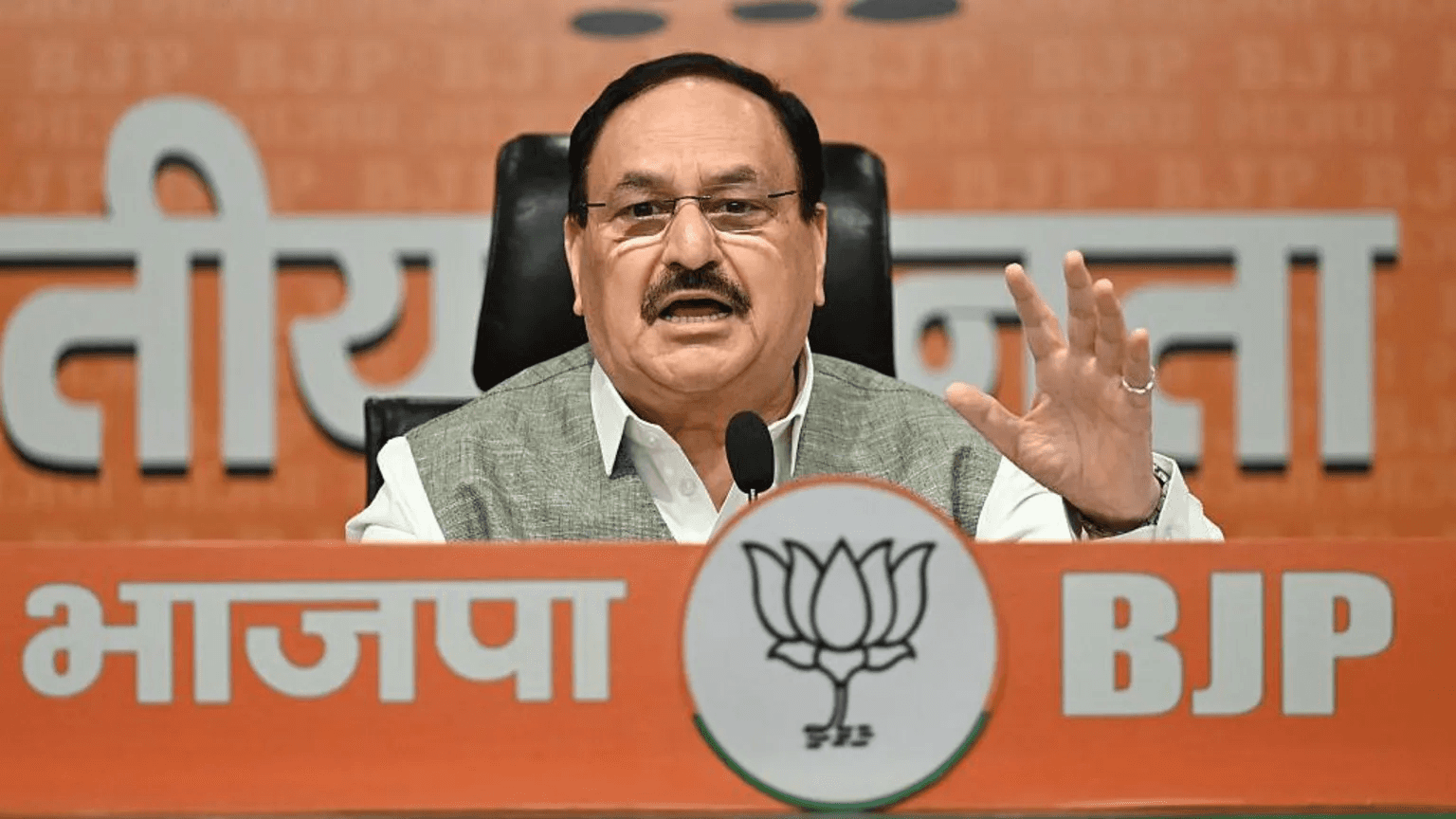
Health Minister JP Nadda visited the activist at the hospital and said he had requested him to break his fast. Image via Hindustan Times
Dobhal, speaking before the fast ended, had already flagged what she saw as the shape of the government's likely response. "JP Nadda's response didn't signal that the government had finally heard the protest appeals," she said. "They have been covertly listening, given the protest was allowed to take place at Jantar Mantar all this while. They have not yet acknowledged what the protesters are seeking." She called the state's approach across the strike "a tactical waiting game, losing ground with delayed response and action every single day," a description that, as of Wangchuk's decision to eat again, has not yet been fully overtaken by events: the fast is over, but Pradhan is still in office.
Zoya Kharmawphlang described the government's outreach as damage control rather than a change of heart. "This series of events shows that under this government, the merits of an argument rarely get you a seat at the table, and more often than not, only the size of your disruption does," she said. "A 23-day sit-in and a hunger strike were easy for them to ignore because they were quiet and contained. But forced hospitalisations generate bad headlines, and thousands marching toward Parliament directly threaten political optical control. The offer of talks wasn't a sudden moment of empathy or a realisation that the cause was right. It was a tactical de-escalation, and seemed more like a PR cleanup."
Vedika placed the same sequence differently. "I only think they agreed to listen because they knew what was coming their way, a massive sea of mouths questioning them," she said, "and when the police did what they did, the government went back to not acknowledging."
Nandini Singh placed the government's silence against what she believes past governments have owed protesters. "Elected governments before have always at least held a conversation," she said. "They may have been late in the process. But they have always shown concern, held a dialogue, and led the way to conclude the hunger strikes. This time, we have utter silence from our Prime Minister, and they really don't care about us." Asked how she thinks the state calculates its response more broadly, she added: "They want us to fear them. They want to be the deciding force of our future, our needs, our rights, and who gets anything."
What The Protest Has Come To Represent
The demand has widened over 25 days. "For the first week it was just about the resignation of our education minister," Rajgarhia said, "but now it has become an outrage towards the ignorance of our govt. Why is it taking you 20 days to provide any sorts of justifications or answers to the youth of your country." He did not read the widening as a departure from the original cause, but as a pattern only now becoming visible. "People have finally woken up and have seen the pattern of our govt towards any major decision," he said. "We have ignored it when it was just subject to the more vulnerable sections of our society, but now everyone is afraid that tomorrow they'll suffer a loss because of the hooliganism of our govt. I would like to believe our people are finally understanding that a mandir would probably not solve all our problems."
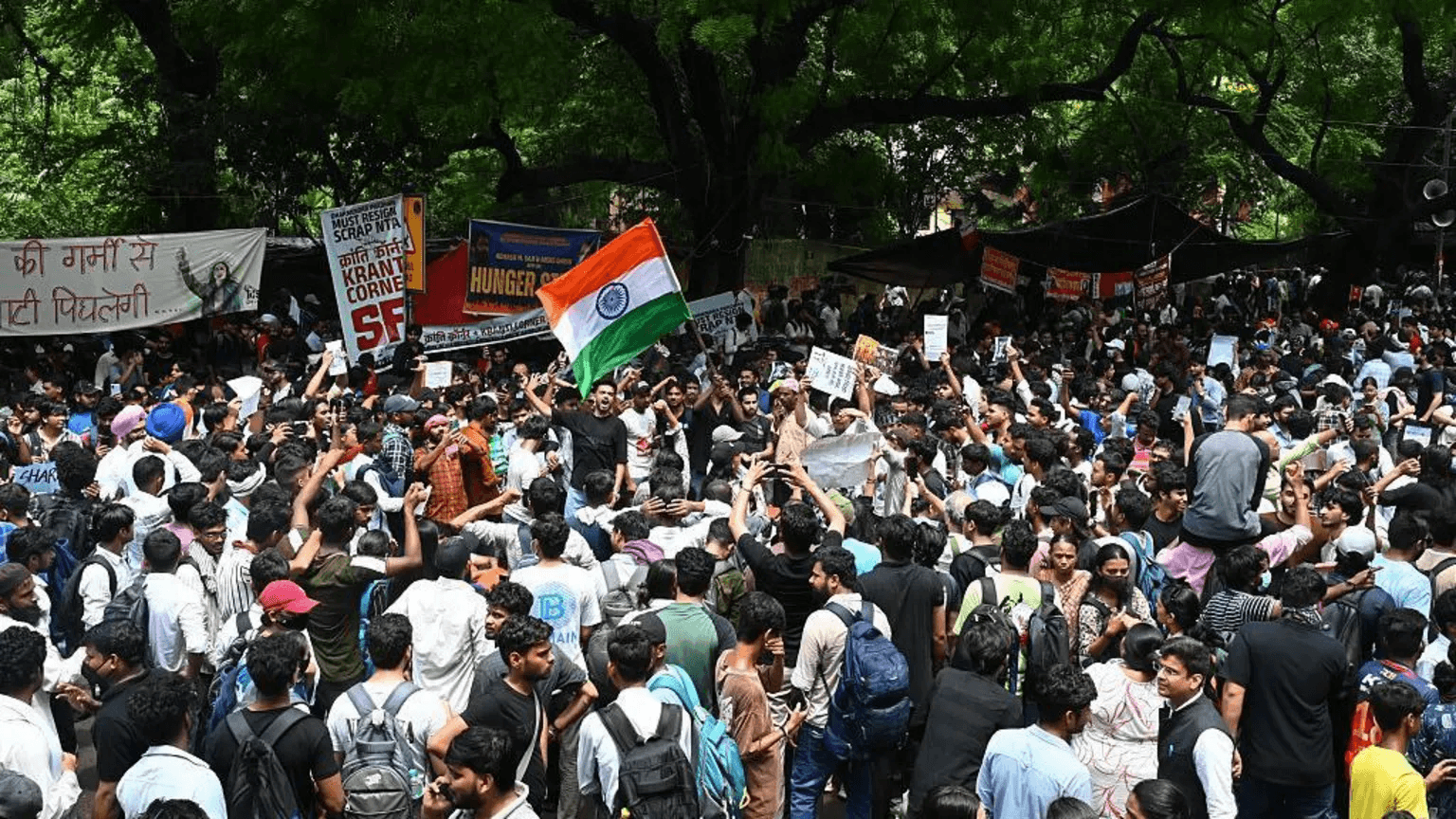
Huge crowds continue to gather around the protest site in Delhi. Image via Hindustan Times
Sohema Rahman, a twelfth-grade student, described a similar widening. "The protest has become a referendum on the exam system itself," she said. "If the Pradhan resigns then it will serve for a much broader motive than just singularly his resignation." She placed the leak within a longer pattern her generation has carried. "Us as students or a generation have been observing disparities and discrimination since a long time, whether it's sly comments by certain relatives, misogyny, getting hit or bullied by teachers in schools," she said, calling the leak "the breaking point of a much larger revolution." She went further in describing the protest as no longer specific to NEET aspirants. "This protest is not just about NEET students, it is an overall fight and movement against a corrupt political system that has failed a majority of us time and time again," she said, citing failures in criminal justice, the treatment of rape victims, and hate crimes against minorities as part of the same pattern. "These students have spent most of their lives striving for a better future. When that hope is shattered, there's bound to be some sort of outbreak, because these kids don't just live for themselves, they live for their parents, their siblings, to provide a better life for them too."
Vedika described the same shift more plainly. "It feels like the protest has grown beyond just the NEET paper leak," she said. "It's also become about accountability, the right to protest, and whether citizens feel heard when they raise concerns, and actually basic human rights, how far will this government go to shift propaganda."
Measuring A Protest Against Itself
Nandini Singh set a specific bar. "Dialogue would be the first sign of the hunger strike working," she said. "Going in the right direction. Historically speaking, seven out of ten times, we get there. But dialogue without real, systemic changes would be in vain. The way to measure a success would be to actually hold the system accountable, discuss and establish reforms, all done in a peaceful order. We have reached no stage of any of this. We haven't had our prime minister and elected leaders hold even a single conversation. This strike is nowhere near the end yet. But one thing it definitely was successful in: get the masses up."
Rajgarhia called the hunger strike one of the few tools that resists being reframed by the state. "I think a hunger strike is a powerful tool, especially if your country has witnessed all of its protests going futile in the last decade," he said. "It's self damaging, it creates trust because you're not just being peaceful towards the people you disagree with, you're harming yourself to put your point forward. Leaves little room for others to turn the narrative."

Protestors during the peaceful sit-in protest at Jantar Mantar. Image via IANS
Shikha, a 24-year-old experiential marketing manager who sat NEET in a previous year and was present at the 20 July march, was less certain the method moves anyone at all. Her scepticism traced back to her own experience of the exam. "I believe the system is designed in such a way that it entraps you unless you're lucky or rich," she said. "Education was never the agenda, it was a planned chaos." Asked whether a hunger strike still works as pressure on an unresponsive system, she said those in power "won't give a [redacted] if it's a biggie or a scientist. They care about what's working in their favour." Asked what it would mean if Wangchuk's health collapsed without a government response, her answer was one word: "ZERO." She drew a comparison to youth unrest in Nepal that turned violent, calling that outcome, in her words, "needed," while distinguishing it from what she sees in Wangchuk's approach. "I highly respect Sonam Sir to still resort to peaceful means, and what I myself witnessed in the protest," she said. "Gen Z may be unserious, but they ain't heartless, as the ruthless fatsos warming the seats for nothing good."
The Difference Between An Answer And A Gesture
Rahman named a sequence rather than a single outcome. "Accountability would first look like a personal apology to each family affected," she said, "then it would be all three: resignation, compensation, and prosecution." On whether the movement could fade if a mass strike underperformed, she said: "As long as the issues remain and are rising, the movement cannot die down."
Zoya Kharmawphlang set out the sharpest distinction between a real resolution and what she called a "cheap brush-off." "If you've been sitting on these tarps since June, watching people faint, sleeping in the rain, and watching Sonam sir's body waste away day after day, you learn to spot political spin from a mile off," she said. "We aren't interested in a polite photo-op, a vague tweet, or another high-level committee. That isn't a resolution, but an exit strategy for them." She listed three things that would count as a genuine one: "real accountability at the top," including resignations and an independent audit of the testing system; "a legal guarantee for clean exams," with binding rules on how leaks are handled; and "dropping all charges against students," every FIR filed against protesters wiped clean. "A real resolution isn't about convincing the kids to pack up and go home," she said. "It's about fixing the broken ladder. If we walk away with just empty promises and a polite handshake, then everything we suffered on these streets was traded for nothing."
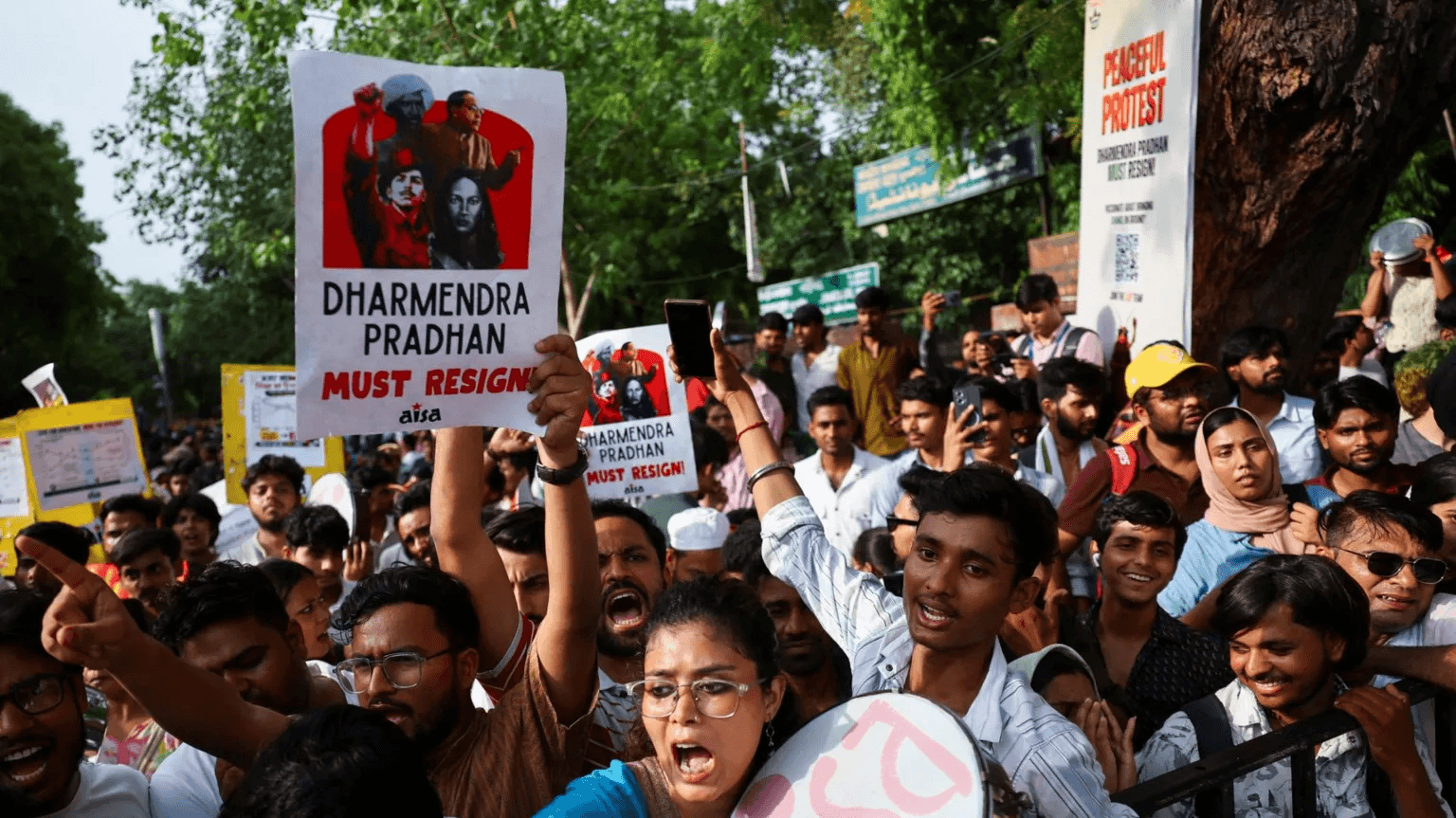
Students and activists from across the country have gathered at Jantar Mantar, all calling for reforms to India's education system. Image via Reuters
Vedika's bar was similar, if shorter in form. "A real resolution would be one that addresses the protesters' core demands in a transparent and meaningful way, not just one that ends the protest," she said. "If people have put their health and safety on the line, the outcome should include genuine dialogue and concrete action, not simply a return to normal."
Jai Nakra hoped the question would become unnecessary. "Looking to the future, I would not say that a hunger strike is merited," he said. "I hope no one has to go on a hunger strike again. I really hope that the government finds a way to keep itself accountable so that no one ever has to feel the need to."
The Uncomfortable Question
Jai Nakra was the most openly critical of Wangchuk specifically among those we spoke to, even while supporting the cause. He approved of the daily health monitoring, but drew a sharper line elsewhere. "The issue does not lie with the doctors tracking Wangchuk's health," he said. "It lies with the fact that Wangchuk is on a stage, in a comfortable area, with beds and doctors there to take care of him. What about the students he is fighting for, who are also on hunger strikes but are on the road instead of on the stage? Why is there no mention of them? They have not been covered by the CJP at all. Why is Mr. Wangchuk not fasting with them, either on the road or by inviting them onto the stage? Why the discrepancy? Why not offer the same doctors and medical treatment to the same students he is fighting for?"
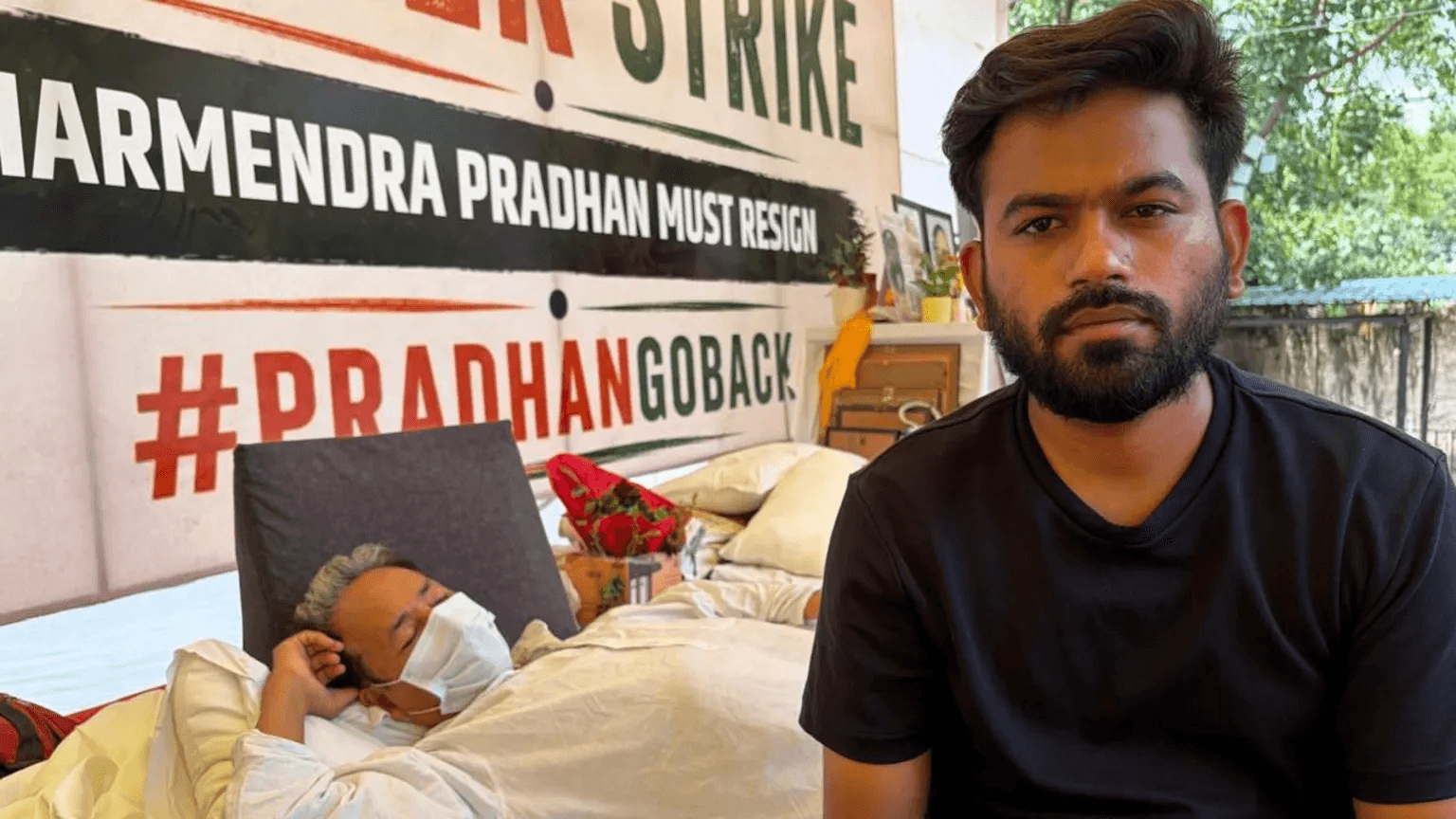
Sonam Wangchuk on day 20 of his hunger strike pictured alongside CJP founder Abhijeet Dipke at the protest site in Jantar Mantar. Image shot by Geeta Pandey.
He also questioned whether the fast's intent could be separated from its media strategy, before concluding it did not matter either way. "I would personally hope that its intent is not some media strategy but to actually fight for the people," he said. "But even if it is an outdated media strategy, I would not say that it matters, because we do not always look at the intent. The action is that a man is sacrificing himself, and the outcome is that people are seeing the government for what it is."
Their Own Stake In It
Rajgarhia was candid about having no personal stake in NEET. "I have been against the current govt for a while," he said. "But this is outrageous. 21 student lives, emphasis on words like STUDENTS, YOUTH, FUTURE. They had their entire lives ahead of them. I come from privilege and I am also part of the problem, and whatever words I've used or the little support I've given, doesn't call for any admiration. And it hurts to admit but I have to be honest, I am only drawn towards this protest because of the guilt I carry coming from a privileged place, and it's true for a lot of other people, and there's no shame in it, but again doesn't exactly call for a medal of honour as well." He closed with a line about how the country treats its public figures: "If you make someone an absolute figure, if you consciously gave someone credit for every imaginable achievement that country of 1.5 billion people had, then please treat the faults and the blames in the same way."
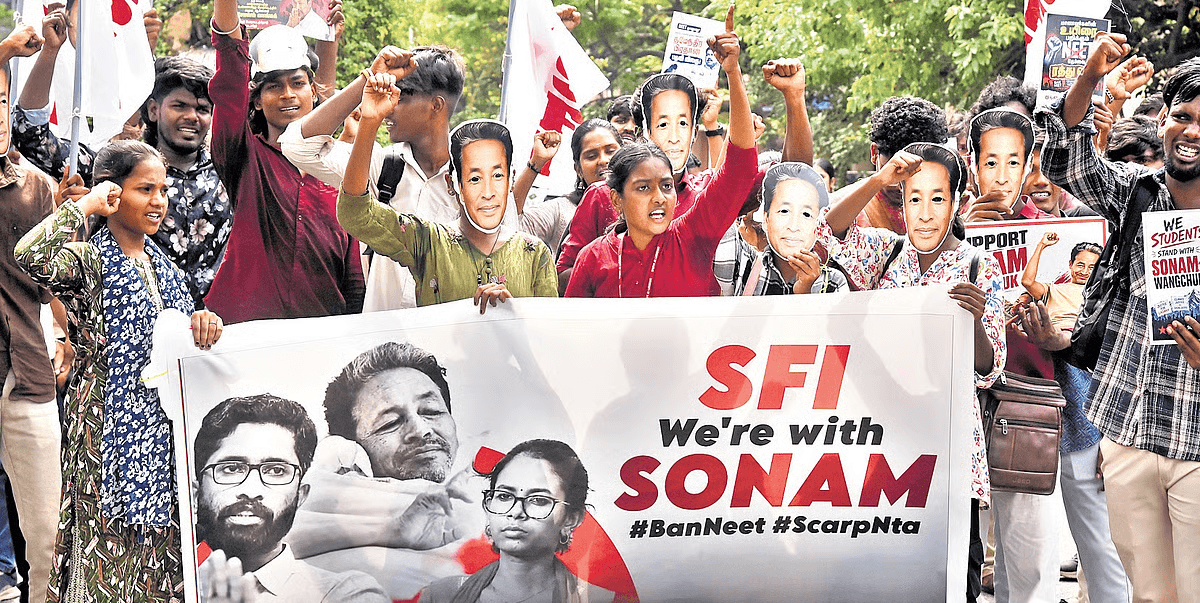
University of Madras students, affiliated with the SFI, staging a demonstration on the premises of the institution on Monday, condemning the forcible hospitalisation of activist Sonam Wangchuk in New Delhi. Photo shot by P Ravikumar.
Mukul Bhatt, a 28-year-old artist from Mumbai, said what struck him most was what coverage had missed. "The biggest thing missing is the human side," he said. "The media focuses on the politics, but not on the frustration. People are not just angry about one issue anymore, they're angry because they feel this has become the only way to make the government listen. That's the real story, and it's sad that we have to take this route to make our own government listen, and that too in our own country." On the mood at the site, he said: "It's a mix of exhaustion and determination, but underneath it all is anger. Not just at the lack of response, but at the feeling that I am not politically useful, my voice doesn't matter. We all are asking a simple question: if peaceful protest doesn't get a response, then what exactly are we supposed to do in a democracy?" He also described his own hesitation, as an artist, to speak publicly. "I carry a fear that speaking up could affect my career, and trust me the fear is absolutely real, but staying silent has started to feel heavier," he said. "What saddened me most wasn't just the tragedy, but the silence that followed. I grew up looking up to artists, musicians, actors, and public figures who inspired people. Seeing so many choose not to speak is just so weird." The issue is personal for him, he said, because his younger sister is preparing for the civil services exams. "When I think of the students who lost their lives or their futures, I don't see numbers, I am looking at the dreams, families, and years of hard work. My heart goes out to every student and every family affected."
Shikha's own scepticism toward the system traced back to her years of preparing for NEET. "What I and my family went through, mentally and physically, was brutal too," she said. "I'm an empath, and for the past five years, each year when I read headlines about NEET not being handled well, it stung. It was always very personal, given my history. I always knew the gov was a curse." Her closing reflection extended past that scepticism into something closer to hope. "I believe we still have hope," she said. "I really believe if we build from ground up, which of course is a time and grit investment, it mustn't involve uneducated, filthy, corrupt, and in fact rapists that walk into the gov parties or parliamentary infrastructure backed by security in the current times. NTA, right after being brought into force, had failed. See history. History mustn't be repeated. It's learning to evolve and become better human beings. I'm betting on better times, only possible if we all rose."
Hope, In Spite Of It
Twenty-six days after Wangchuk sat down at Jantar Mantar, his fast is over. The protest that surrounded it included a 30-second removal plan, two hospital transfers, a court case over bodily autonomy, a march that ended in tear gas and detentions, and a government that answered with fast-track courts rather than the resignation CJP had asked for from the outset. Dipke broke his fast to lead the march. Three AISA activists broke theirs on a delegation's assurance. Wangchuk broke his last, in a hospital room in Gurugram, in front of the two ministers who came to ask him to. CJP says its protest at Jantar Mantar continues regardless.
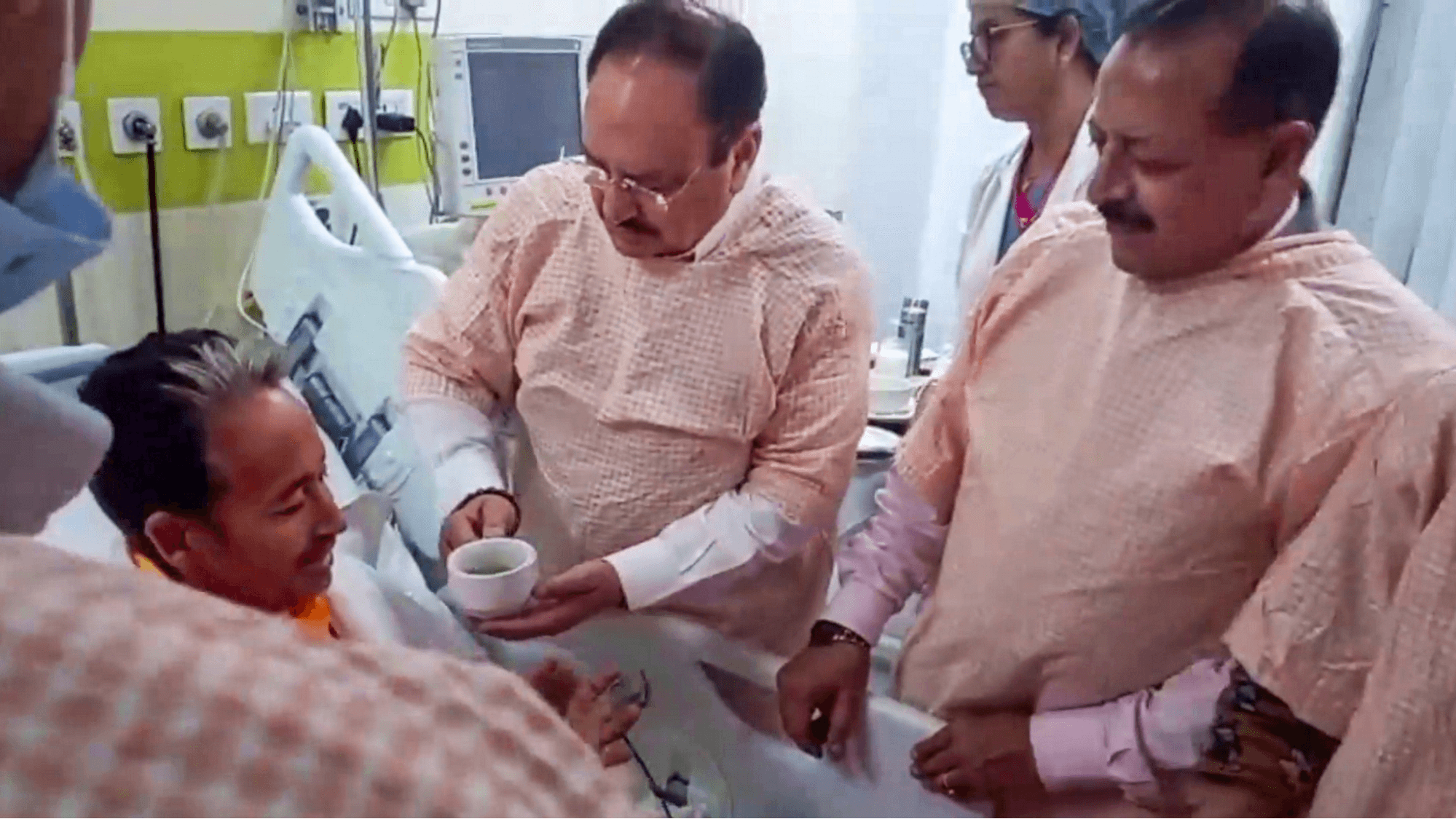
Sonam Wangchuk ends hunger strike.Credit: PTI
Bhatt closed his account without despair. "I still believe in this country, our people," he said, "and that's exactly why I believe we all must keep asking it to do better. Jai Hind."
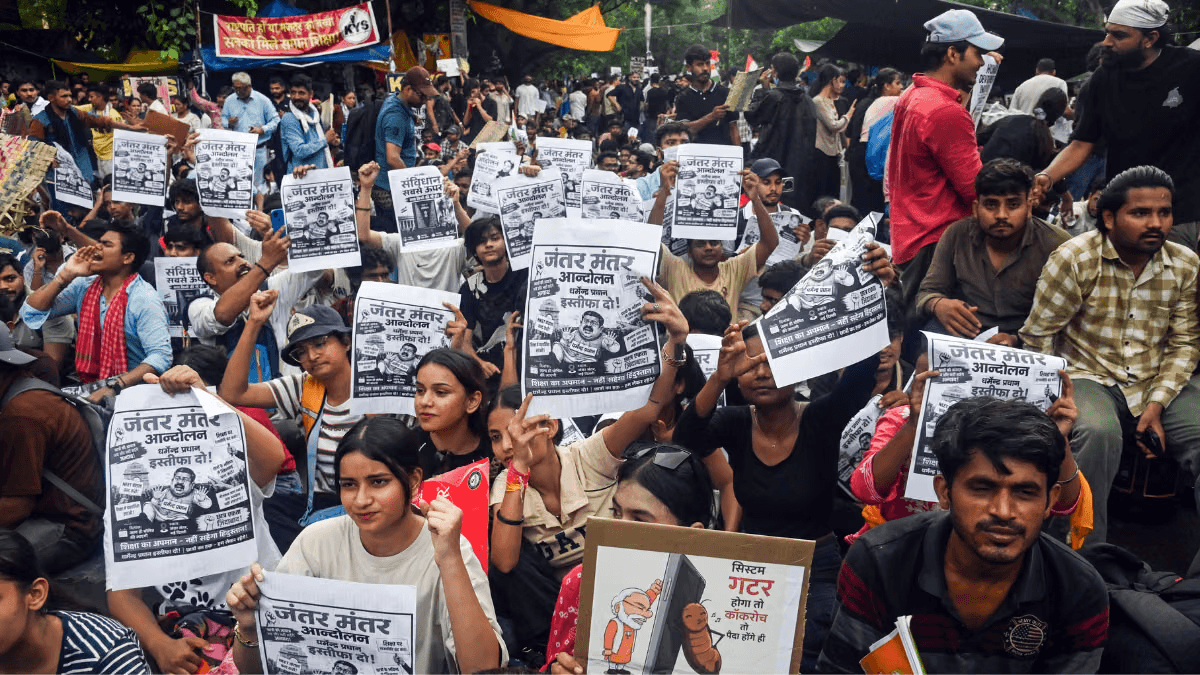
CJP protestors on 21st July, recollecting at the protest site post the police brutality at the 20th July protest march. Photo via ANI
This is a developing story. French Press Global will continue reporting as CJP's protest and the government's response proceed.
If this piece has raised concerns for you around suicide or mental health, support is available through the KIRAN mental health helpline (1800-599-0019) or iCall (9152987821).
TO BE CONTINUED, FOR SUBSCRIBERS ONLY.
This is where the surface ends and the reporting begins.
The complete piece, the full archive, and access to The French Press Circle. Reporting answerable only to its readers.
Already a subscriber ?
Login
Read these on the house, with our compliments.
A selection from the current issue, open to all readers. Read them in full. The rest is one decision away.




On 28 June, Sonam Wangchuk sat down at Jantar Mantar and began an indefinite hunger strike, alongside six students of the All India Students' Association (AISA), including its National President and an independent student activist. He was fasting in solidarity with the Cockroach Janta Party (CJP), a youth movement demanding accountability over the NEET-UG 2026 paper leak. On Friday, 24 July, after 26 days, Wangchuk broke his fast at Medanta Hospital in Gurugram in the presence of Union Ministers JP Nadda and Dr Jitendra Singh. A PTI video showed Singh helping him sit up in bed and Nadda helping him sip from a cup. "I am grateful and happy to break my fast," Wangchuk said.
Image via X / @Wangchuk66
Wangchuk said 65 Members of Parliament across parties had urged him to end the strike, and that he had done so "after a long negotiation on various conditions and in view of possible violence in the country," promising to explain the specific conditions in a separate video. Dipke, addressing him directly on social media, wrote: "Thank you, sir, for your extraordinary courage and sacrifice. By putting your own life on the line, you awakened the conscience of an entire nation." He confirmed CJP's protest at Jantar Mantar would continue "till Union Education Minister Dharmendra Pradhan resigns," the movement's founding demand, which the fast's resolution did not secure.
Abhijeet Dipke via X
Along the way, Wangchuk was moved twice, from Jantar Mantar to Safdarjung Hospital by the Delhi Police on 18 July, and then, by Delhi High Court order on 21 July, to Medanta Hospital in Gurugram, where his fast ultimately ended. Hours before he broke it, Prime Minister Narendra Modi posted that the government had decided to set up fast-track courts for paper-leak cases, without naming Pradhan or CJP.
Narendra Modi via X
Who Is Sonam Wangchuk
Wangchuk during an earlier Ladakh hunger strike. Credit: PTI, via Deccan Herald
Wangchuk was born on 1 September 1966 in Alchi, Ladakh. His father, Sonam Wangyal, was a Jammu and Kashmir government minister who himself once fasted for tribal protections for Ladakhis, a strike Prime Minister Indira Gandhi broke personally, according to Britannica. Wangchuk co-founded the Students' Educational and Cultural Movement of Ladakh (SECMOL) in 1988, to address a 95 per cent failure rate in Ladakh's state exams. He later developed the "Ice Stupa" artificial glacier for winter irrigation, and co-founded the Himalayan Institute of Alternatives, Ladakh, with his wife, Gitanjali Angmo. He inspired the character Phunsukh Wangdu in "3 Idiots" and won the Ramon Magsaysay Award in 2018.
Since 2023, this is his sixth hunger strike, following four fasts in Ladakh over constitutional safeguards for the region and a fifth, in September 2025, that ended differently from the rest. Protests in Leh that month turned violent, killing four civilians. Wangchuk was detained under the National Security Act two days later and held in Jodhpur Central Jail for nearly six months, before his detention was revoked in March 2026.
"I Am No Modern Gandhi"
Wangchuk has spent much of this fast actively refusing the role the public keeps trying to hand him. On the 14th day of his strike, addressing supporters, he pushed back directly against comparisons that had begun circulating online. "Many people call me the Gandhi of the 21st century or a modern Gandhi. Others call me a hero," he said. "These comments make me uncomfortable. I am neither Gandhi nor a hero. I am just an ordinary citizen who has tried to fulfil his responsibilities." He urged the public to stop outsourcing responsibility to a single figure. "Please don't look for a hero in someone else. Be the hero of your own life," he said.
The gesture toward Gandhi was not accidental on his own part, either. Before the fast began, Wangchuk and Dipke visited Rajghat, invoking Gandhi's philosophy of peaceful resistance, according to Outlook India. In an interview with the Indian Express, Wangchuk insisted the protest had "no political colour" and appealed directly to Prime Minister Narendra Modi for dialogue. That tension, between a man who keeps declining the mantle of a national symbol and a public and media apparatus that keeps offering it to him anyway, has itself become part of the story, particularly as CJP's satirical branding, built for virality, collided with a fast that daily bulletins now track in kilograms and blood potassium levels.
What A Hunger Strike Is, And Why It Works Differently
A hunger strike is a form of non-violent protest that shifts pressure onto a single body and a single decision to stop eating, rather than onto numbers or slogans, forcing the state to answer a hard question: how does it respond when a citizen risks his own health for a public cause. Mahatma Gandhi called fasting "a great weapon in the armoury of Satyagraha" and used it at least twenty times. Potti Sriramulu's 1952 fast led to the creation of Andhra State. Irom Sharmila fasted for nearly 16 years against AFSPA, kept alive by force-feeding. Anna Hazare's 13-day fast in 2011 pushed the Lokpal Bill through Parliament. India's Supreme Court, in its Ramlila Maidan judgment, held that hunger strikes derive legitimacy from Gandhi's tradition of satyagraha and are not unconstitutional merely for involving self-denial. The historian Rajmohan Gandhi, Mahatma Gandhi's grandson, has written that his grandfather saw fasting less as a tool for pressuring governments than as a means of stirring people's minds and conscience.
Internationally, suffragette Marion Wallace-Dunlop pioneered the hunger strike in Britain in 1909. Cesar Chavez fasted repeatedly to build the United Farm Workers' movement in the US. Bobby Sands, an IRA prisoner, died in 1981 after 66 days without food, a strike that triggered international condemnation of the British government's refusal to negotiate.
The Cockroaches' Case
CJP was founded on 16 May by Abhijeet Dipke, a political communications strategist and PR graduate of Boston University formerly with the Aam Aadmi Party. It began as satire: a day earlier, Chief Justice Surya Kant had remarked that unemployed youth were "like cockroaches." Dipke turned the insult into a "platform for all the cockroaches out there." The satire found a serious cause weeks later. NEET-UG 2026, India's mandatory medical entrance exam sat by roughly two million students competing for 130,000 seats, was cancelled by the National Testing Agency on 12 May after the CBI found a leaked "guess paper" matching roughly 120 of its 4,101 questions. Over 22 lakh candidates were affected. A forced re-examination followed on 21 June. At least 13 student deaths by suicide were linked to the leak and its aftermath, according to Outlook India's mid-June count; subsequent reporting suggests the toll has continued to rise.
CJP's central demand is that Education Minister Dharmendra Pradhan take moral responsibility and resign. Its demands have since widened to include ₹1 crore compensation for affected students' families, a judicial probe into the leak, NTA accountability, and reform of the National Education Policy 2020.
Jai Nakra, a 23-year-old law student in Mumbai who attended a solidarity protest at Shivaji Park, argued CJP has moved well past its satirical origins. "CJP does not propel itself using comedy or satire," he said. "It only managed to gain popularity because of that, but that is not what it currently stands for. They have listed out their demands: they want Dharmendra Pradhan to resign, and they want reformative education policies. The cockroach joke has left us far behind. It did bring them popularity and gave them a stage, which is a good thing, because now they are using that stage to propel certain good ideas. I'm not a complete fan, it's not as though they are perfect, but they have used that stage to bring up certain issues that no one else was bringing up before."
Why Wangchuk Joined
Wangchuk had called himself an "honorary cockroach" before formally joining the fast on 28 June, and said his reasons were solidarity with the NEET protesters and hope that the moment might also revive Ladakh's unresolved constitutional demands. Zoya Kharmawphlang, a 21-year-old PR executive from Gurugram who was at the 20 July march, called it consistent with his history but a significant turn all the same. "Historically, his hunger strikes in Ladakh were tied to local realities: constitutional safeguards under the Sixth Schedule, ecological preservation of the fragile Himalayan landscape, and local democratic representation," she said. "Fasting in our country's national capital over a cause outside his immediate home region speaks volumes about his personal philosophy and the current civic climate. His approach of non-violent protest, satyagraha, is something I truly respect. Wangchuk's fast from the confines of a hospital room amidst police efforts to remove him demonstrates that his actions stem from a deep personal conviction rather than a political goal." She read his presence at the protest as evidence of something wider knitting together. "His presence alongside civil society organisations and student parties indicates a unity in Indian social life that was long overdue," she said. "The image of a veteran Himalayan reformer standing alongside students highlights how deeply national exam integrity and youth futures resonate across contemporary India, despite the diversity of culture and geography."
Vedika, a 23-year-old postgraduate clinical psychology student and Delhi resident who was also at the march, put it more simply. "He didn't have to make this his fight, but he chose to," she said. "That shows he believes that if something is unjust, you don't have to be personally affected to stand up for it."
Jai Nakra took the opposite view of how much Wangchuk's Ladakhi background matters to the protest's meaning. "His background does not add symbolism for me, but the fact that he is doing it does," he said. "It does not matter, in this particular fight, where the person has come from, because the entire public has united under a single cause. People are flying in from across India. A man went on a hunger strike and, instead of hearing him for over twenty days, they detained him. That enraged a bunch of people and united them under a single cause. Mr. Sonam Wangchuk's Ladakhi background has nothing to do with this."
The Fast Begins
Wangchuk sustained himself initially on salt water. Shaurya Rajgarhia, a student from Gurugram, said he does not read Wangchuk's fast against the weight of India's history of hunger strikes at all. "Hunger strike is just a medium that's been widely popular with our country's protests," he said. "I don't draw any contrast from previous protests, I think that can become dangerously misleading."
By mid-July, public concern was building; on 16 July, Arundhati Roy, Naseeruddin Shah, and others appealed publicly for him to stop. He refused. "I am weak from the outside but very strong inside," he told supporters. "I will stay alive till July 20 at any cost." By day 19, doctors recorded a weight loss of around 9.1 kilograms and warned of possible organ damage.
Jai Nakra offered a physical account of what that stretch would mean. "If you go even three days without food, you would start to think crazy thoughts," he said. "Wangchuk has gone for around 20 days. I don't think, in his current state, he is thinking about this as a test for the camera. The only thing keeping him going is his willpower, and willpower stems from will, and his will must obviously be for reform, otherwise how would he step forward." Asked whether six fasts since 2023 dilutes the act's power, he disagreed. "Take a soldier," he said. "Does that mean that every time he puts his life on the line, the gratitude you feel for him is diluted because he has done it before? I would not say so. Just because he has done it before does not mean that it does not hurt now."
Wangchuk resting on stage at Jantar Mantar, 14 July. Credit: Reuters/Bhawika Chhabra, via TBS News
By day 19 of the fast, doctors treating him had also recorded worsening blood readings. Jai Nakra argued that publicising those readings, rather than making the fast feel more like spectacle, gives the public a clearer, more accountable picture. "That actually gives us a better idea of where the person stands, how far away from death they are, and how much pain and suffering they are going through," he said. "It mitigates the risk to the person's life. Having someone monitor their health seems good to me. It also means that if he is approaching death, the fast can be stopped. We are not heading into it blindly."
The Removal From Jantar Mantar
In the early hours of Saturday, 18 July, on the 21st day of Wangchuk's fast, Delhi Police assembled under the pretext of a security drill ahead of Parliament's Monsoon Session, according to The Indian Express, whose reporting was subsequently carried by Outlook India, Newslaundry, and The News Minute. Officers were briefed at Mandir Marg police station on an operation to remove Wangchuk within roughly 30 seconds, timed to a short window each morning when CJP founder Abhijeet Dipke would step away from the site. A phone jammer was reportedly installed nearby, and a white curtain was placed across the protest stage at around 6:30am before Wangchuk was moved into a waiting ambulance within two minutes. The operation followed the Union Home Ministry's replacement of Delhi Police Commissioner Satish Golchha with Anurag Kumar a day earlier, a change The Indian Express linked directly to the CJP protest.
Multiple protesters alleged police shoved, beat, and verbally abused those who tried to intervene, and smashed phones recording the incident, according to Newslaundry. CJP spokesperson Ashutosh Ranka said Wangchuk had been "manhandled and forcefully removed." Delhi Police said the operation was conducted "peacefully with maximum restraint" and cited a Delhi High Court order and medical advice. Safdarjung Hospital recorded his admission at 7:40am, describing him as weak but stable, with signs of dehydration, compensated acidosis, and low serum potassium.
Wangchuk assisted by supporters the night before his removal, 17 July. Credit: PTI, via Outlook India's coverage of the removal operation
Nandini Singh, a 25-year-old creative director from Delhi who was present at the site, rejected the state's framing of the operation as protective. "In the name of protection of the protesters, it would have been much easier to actually come down to sit and talk to the aggrieved people," she said. "The kids are asking for their exams to be taken, what discourse is this? But they abducted him. Illegally, forcefully. They have kept him hostage. This is all a way to fear us, but it had the opposite impact. People are more enraged than ever. And I feel, it's still not enough."
Zoya Kharmawphlang described the removal as pre-empting, not protecting. "Watching someone fast for three weeks with zero official response, only to be whisked away under the guise of a medical emergency right before a planned march to Parliament, felt deeply dystopian," she said. "The sudden urgency wasn't about saving a life, it was about clearing the street. Word quickly spread from Safdarjung about the heavy police presence, restricted access, and family being kept at arm's length. It made one thing clear: to authority, a frail man fasting quietly in a locked hospital room is far more dangerous than thousands shouting on a road. When you're standing in that crowd, you realise the fight isn't just about an exam anymore. It's about whether ordinary citizens are allowed to stand up and say this is broken without being treated as a threat to public order."
Rajgarhia set a specific condition for when he would view state intervention as legitimate. "If there would have been a dialogue between the govt and Sonam Wangchuk, if the govt had at least tried to put forward their side, and this would have been an absolute fact that the govt and Sonam cannot reach a point they can agree on, then by all means, a state intervention to save a life is justified," he said, "again it would have still been questionable but at least it would have been a difference in opinions. With no dialogue, no press conferences, no statements, not even an apology, this is more of an act of hooliganism."
Jai Nakra was blunter about what the removal, absent any dialogue, revealed. "I definitely see it as the latter," he said, asked whether state intervention reads as protecting a life or defusing a symbol it could not otherwise silence. "They were not even willing to hold a conversation. They simply, in a sense, detained him and shut him up. That's it."
Dipke's Fast, And Who Broke Theirs Before The March
Dipke declared his own indefinite hunger strike within minutes of Wangchuk's removal. During it, an unidentified person threw a blue ink-like liquid at him at the protest site.
Abhijeet Dipke after an unidentified person threw blue ink-like liquid at him during his own strike. Credit: Reuters, via The Tribune
Dipke did not carry his fast into the 20 July march. At Wangchuk's own request, he broke it that morning with juice offered by the father of Ria, a Dehradun NEET aspirant who had died by suicide the previous month, so he would have the strength to lead the march. The same day, three AISA activists who had fasted alongside Wangchuk since 28 June, Neha, Manish, and Aameen, ended their 23-day strike after an appeal from a delegation of opposition MPs, senior advocate Prashant Bhushan, activist Yogendra Yadav, and actors Prakash Raj and Shabana Azmi, who assured them their demands would be raised in Parliament. "This is not the breaking of the hunger strike," Yadav told them, "but the conclusion of this form of struggle."
Activist Neha during the hunger strike demanding action over alleged irregularities in examinations and seeking the resignation of Union Education Minister Dharmendra Pradhan. File | Photo Credit: PTI
Wangchuk alone did not break his. From his hospital bed, he set three written conditions for ending it: government accountability for the education system's failures by 20 July; or CJP's leadership reaching Parliament's doorstep with an MP assurance the issue would be raised; or, if his health barred travel, MPs visiting his hospital to give the same assurance. None was met.
Dobhal, former Editor-in-Chief of Cosmopolitan India and a creative tech evangelist, situated the divergence within three separate elements of the act itself: a striker's capacity for sacrifice, the body's physical limits, and the willingness of loved ones to monitor and support the protest closely. On Wangchuk's decision to fast again, for a cause outside his own region and now from a hospital bed, she said: "It speaks highly of his sacrificial nature and principal ideology of resistance."
All three hunger strikers have ended their indefinite fast. Image courtesy: X
Zoya Kharmawphlang described the same divergence as structural rather than a measure of commitment. "When student leaders break a fast while a major figure like Wangchuk keeps going, it shows how hunger strikes work in practice: it's a relay, not a monolith," she said. "Neha, Manish, and Aameen's job was to ignite the fire and build pressure. After 23 days and dangerous physical decline, their body's limit had been reached. Having civil society leaders publicly step in and ask them to break their fast wasn't a surrender, but rather a handoff. As an established, globally recognised figure, Wangchuk's fast plays a different role. It is an unyielding moral anchor. By continuing his fast from a hospital bed, he ensures the government can't just claim the story is over and sweep it under the rug. Student activists use the fast to force momentum, then hand off the baton to survive and organise another day. A figurehead like Wangchuk holds onto the fast to deny the state a quiet exit. One is a spark; the other is a stake driven into the ground."
Vedika saw no hierarchy of commitment in the split. "I don't think ending a hunger strike means someone is less committed," she said. "Different people have different roles in a movement. Some continue because they feel it's necessary, while others stop after achieving a strategic objective or at the request of fellow protesters. Both decisions can come from commitment rather than weakness."
Cockroaches And Conscience
Views differed on how CJP's satirical origin sits beside a fast now before the courts. Nandini Singh saw the two registers as reinforcing each other. "Only because it started off as a satirical movement, it did allow more people to participate and spread awareness," she said. "Humour is always best when shared, no? And people are stronger together. We saw so much of that on the 20th. People were ready to take one for the team. And that's our only power. Us. Together."
Abhijeet Dipke refused food after hunger striker Sonam Wangchuk was taken away to hospital, but Dipke heeded calls to end his fast on Monday. Image via EPA
Zoya Kharmawphlang argued the combination scrambles the state's options entirely. "Far from pulling the story apart, combining humour and sacrifice creates a moral trap the state simply doesn't know how to handle," she said. "Humour brings people, Gen Z particularly, in; sacrifice makes them stay. Reclaiming a slur like cockroach gives angry, exhausted students a disarming shield against despair. But humour alone can be written off as a viral stunt. When a respected reformer sits on the same tarp and puts his life on the line, that absurdity suddenly carries deadly serious weight. It completely scrambles the state's reaction. If you crack down on the students, you look ridiculous. If you ignore Wangchuk, you risk a national crisis. Humour keeps the movement resilient so people don't burn out. Sacrifice gives it teeth so the government can't look away."
Vedika agreed the two registers complement rather than compete. "The satire makes the movement approachable and gets people talking, while the hunger strike reminds everyone that the issues are deeply serious," she said. "Together, they reach people in different ways."
Jai Nakra credited CJP's grasp of short-form media, more than satire itself, with holding public attention for a slow, punishing act in a culture built for speed. "This is what the CJP has been doing, and not just the CJP," he said. "They adopted the current Reels format of posting an update every day in a 30- or 40-second clip. This has really captivated people's minds, because it is something people are already addicted to: watching progress videos, such as Day 1 of this, Day 2 of that. The CJP has shown that there is a very successful model for holding the current generation's attention, and that is through short-form content itself."
The March To Parliament, And The Crackdown
CJP's "Chalo Sansad" march began on the morning of 20 July from Mandi House Metro Station, moving through Jantar Mantar toward Parliament. Police estimated the crowd at 8,000; several ground accounts suggested more. Clashes broke out near Patel Chowk, where police and the Rapid Action Force deployed tear gas and a lathi charge in the rain; protesters were reported to have thrown bottles in response. Dipke was picked up by police during the march. Over 70 protesters were detained.
Tear gas near Patel Chowk during the 20 July march. Credit: Praveen Jain/ThePrint and Suraj Singh Bisht
Wangchuk had asked to be temporarily released to join. The request was refused. In a note shared through his wife, he said he would continue fasting "until the youth leaders are allowed to meet the Parliamentarians at the Sansad Bhawan or I am allowed to meet them here at the Hospital." Home Minister Amit Shah met Pradhan inside Parliament as the clashes unfolded outside.
Nandini Singh called the day confirmation of something she already believed. "We are not a democracy," she said. "We haven't been one for a while now, but yesterday, and the weeks leading up to the march, have shown us very loud and clear reality, and this should be enough for us to know we live in a tyrannical regime. There is no two ways to say this, but you do not entrap innocent kids within the protest grounds, blocking the exits and metro stations to ensure absolutely no escape, and beat them up. They hurt far too many innocent and peaceful protesters. The state does not care about us. No other way but a revolution."
Zoya Kharmawphlang read the same day as the state losing, not winning, control. "If you were standing in the downpour, wiping rain and sweat from your face while watching tear gas canisters fly, and your friends get dragged into police buses, it didn't feel like a defeat," she said. "It felt like a mask slipping off. The state isn't containing this, it's panicking. Containment is when you successfully keep a protest quiet, small, and invisible. Yesterday was the exact opposite. They locked Wangchuk in a hospital room and refused his plea to march. They shut metro stations, lined the streets with barricades, and brought out lathis and water cannons. Yet thousands of students still pushed right up to Parliament's doorstep in the pouring rain. When a government has to use that much raw force against young people asking about exam papers, it's not showing control, it's admitting it has lost the argument."
Scores of people were injured when police tried to disperse Monday's huge crowd with baton charges and tear gas. Image via Reuters
Vedika drew a narrower conclusion from the same events. "The number of people who came out showed the movement has support, but the detentions and lathi charge also showed how difficult it can be to keep that momentum going," she said. "It's hard to say it's one or the other. But I think the fact that people are still there, okay to be beaten up, says a lot."
Dobhal read the day within the arc of the movement so far. "It speaks volumes about how the state responds to peaceful protests," she said. "Perhaps their silence prior to the outburst should have been interpreted as cautionary of the eventual use of brute force. It stands at a tipping point where what started as a singular demand will grow into many demands seeking accountability and transparent governance."
The Conclusion Of The Fast
Wangchuk's health declined steadily through mid-July; by the time he was moved to Medanta on 21 July, hospital bulletins were tracking pancytopenia, low serum potassium, and low blood sugar. He broke his fast just after midnight on 24 July, 26 days in, at Medanta Hospital, in the presence of Union Ministers JP Nadda and Dr Jitendra Singh. The specific terms of that resolution, what the government has and hasn't committed to in writing, are covered in French Press Global's companion report on the negotiation itself.
What sits outside that political story is the human cost that continued to surface through the same fortnight. A 19-year-old protester, Sahil Lochab of Najafgarh, was hit by a pellet gun during police action at the 20 July march and may lose vision in his right eye, according to his family; he underwent surgery to remove the pellets at AIIMS. Mumbai Police separately registered 13 FIRs connected to solidarity protests in the city since 18 July, naming around 400 people under provisions related to unlawful assembly and breach of prohibitory orders. Dipke, in a message posted after Wangchuk broke his fast, wrote: "Thank you, sir, for your extraordinary courage and sacrifice. By putting your own life on the line, you awakened the conscience of an entire nation."
Health Minister JP Nadda visited the activist at the hospital and said he had requested him to break his fast. Image via Hindustan Times
Dobhal, speaking before the fast ended, had already flagged what she saw as the shape of the government's likely response. "JP Nadda's response didn't signal that the government had finally heard the protest appeals," she said. "They have been covertly listening, given the protest was allowed to take place at Jantar Mantar all this while. They have not yet acknowledged what the protesters are seeking." She called the state's approach across the strike "a tactical waiting game, losing ground with delayed response and action every single day," a description that, as of Wangchuk's decision to eat again, has not yet been fully overtaken by events: the fast is over, but Pradhan is still in office.
Zoya Kharmawphlang described the government's outreach as damage control rather than a change of heart. "This series of events shows that under this government, the merits of an argument rarely get you a seat at the table, and more often than not, only the size of your disruption does," she said. "A 23-day sit-in and a hunger strike were easy for them to ignore because they were quiet and contained. But forced hospitalisations generate bad headlines, and thousands marching toward Parliament directly threaten political optical control. The offer of talks wasn't a sudden moment of empathy or a realisation that the cause was right. It was a tactical de-escalation, and seemed more like a PR cleanup."
Vedika placed the same sequence differently. "I only think they agreed to listen because they knew what was coming their way, a massive sea of mouths questioning them," she said, "and when the police did what they did, the government went back to not acknowledging."
Nandini Singh placed the government's silence against what she believes past governments have owed protesters. "Elected governments before have always at least held a conversation," she said. "They may have been late in the process. But they have always shown concern, held a dialogue, and led the way to conclude the hunger strikes. This time, we have utter silence from our Prime Minister, and they really don't care about us." Asked how she thinks the state calculates its response more broadly, she added: "They want us to fear them. They want to be the deciding force of our future, our needs, our rights, and who gets anything."
What The Protest Has Come To Represent
The demand has widened over 25 days. "For the first week it was just about the resignation of our education minister," Rajgarhia said, "but now it has become an outrage towards the ignorance of our govt. Why is it taking you 20 days to provide any sorts of justifications or answers to the youth of your country." He did not read the widening as a departure from the original cause, but as a pattern only now becoming visible. "People have finally woken up and have seen the pattern of our govt towards any major decision," he said. "We have ignored it when it was just subject to the more vulnerable sections of our society, but now everyone is afraid that tomorrow they'll suffer a loss because of the hooliganism of our govt. I would like to believe our people are finally understanding that a mandir would probably not solve all our problems."
Huge crowds continue to gather around the protest site in Delhi. Image via Hindustan Times
Sohema Rahman, a twelfth-grade student, described a similar widening. "The protest has become a referendum on the exam system itself," she said. "If the Pradhan resigns then it will serve for a much broader motive than just singularly his resignation." She placed the leak within a longer pattern her generation has carried. "Us as students or a generation have been observing disparities and discrimination since a long time, whether it's sly comments by certain relatives, misogyny, getting hit or bullied by teachers in schools," she said, calling the leak "the breaking point of a much larger revolution." She went further in describing the protest as no longer specific to NEET aspirants. "This protest is not just about NEET students, it is an overall fight and movement against a corrupt political system that has failed a majority of us time and time again," she said, citing failures in criminal justice, the treatment of rape victims, and hate crimes against minorities as part of the same pattern. "These students have spent most of their lives striving for a better future. When that hope is shattered, there's bound to be some sort of outbreak, because these kids don't just live for themselves, they live for their parents, their siblings, to provide a better life for them too."
Vedika described the same shift more plainly. "It feels like the protest has grown beyond just the NEET paper leak," she said. "It's also become about accountability, the right to protest, and whether citizens feel heard when they raise concerns, and actually basic human rights, how far will this government go to shift propaganda."
Measuring A Protest Against Itself
Nandini Singh set a specific bar. "Dialogue would be the first sign of the hunger strike working," she said. "Going in the right direction. Historically speaking, seven out of ten times, we get there. But dialogue without real, systemic changes would be in vain. The way to measure a success would be to actually hold the system accountable, discuss and establish reforms, all done in a peaceful order. We have reached no stage of any of this. We haven't had our prime minister and elected leaders hold even a single conversation. This strike is nowhere near the end yet. But one thing it definitely was successful in: get the masses up."
Rajgarhia called the hunger strike one of the few tools that resists being reframed by the state. "I think a hunger strike is a powerful tool, especially if your country has witnessed all of its protests going futile in the last decade," he said. "It's self damaging, it creates trust because you're not just being peaceful towards the people you disagree with, you're harming yourself to put your point forward. Leaves little room for others to turn the narrative."
Protestors during the peaceful sit-in protest at Jantar Mantar. Image via IANS
Shikha, a 24-year-old experiential marketing manager who sat NEET in a previous year and was present at the 20 July march, was less certain the method moves anyone at all. Her scepticism traced back to her own experience of the exam. "I believe the system is designed in such a way that it entraps you unless you're lucky or rich," she said. "Education was never the agenda, it was a planned chaos." Asked whether a hunger strike still works as pressure on an unresponsive system, she said those in power "won't give a [redacted] if it's a biggie or a scientist. They care about what's working in their favour." Asked what it would mean if Wangchuk's health collapsed without a government response, her answer was one word: "ZERO." She drew a comparison to youth unrest in Nepal that turned violent, calling that outcome, in her words, "needed," while distinguishing it from what she sees in Wangchuk's approach. "I highly respect Sonam Sir to still resort to peaceful means, and what I myself witnessed in the protest," she said. "Gen Z may be unserious, but they ain't heartless, as the ruthless fatsos warming the seats for nothing good."
The Difference Between An Answer And A Gesture
Rahman named a sequence rather than a single outcome. "Accountability would first look like a personal apology to each family affected," she said, "then it would be all three: resignation, compensation, and prosecution." On whether the movement could fade if a mass strike underperformed, she said: "As long as the issues remain and are rising, the movement cannot die down."
Zoya Kharmawphlang set out the sharpest distinction between a real resolution and what she called a "cheap brush-off." "If you've been sitting on these tarps since June, watching people faint, sleeping in the rain, and watching Sonam sir's body waste away day after day, you learn to spot political spin from a mile off," she said. "We aren't interested in a polite photo-op, a vague tweet, or another high-level committee. That isn't a resolution, but an exit strategy for them." She listed three things that would count as a genuine one: "real accountability at the top," including resignations and an independent audit of the testing system; "a legal guarantee for clean exams," with binding rules on how leaks are handled; and "dropping all charges against students," every FIR filed against protesters wiped clean. "A real resolution isn't about convincing the kids to pack up and go home," she said. "It's about fixing the broken ladder. If we walk away with just empty promises and a polite handshake, then everything we suffered on these streets was traded for nothing."
Students and activists from across the country have gathered at Jantar Mantar, all calling for reforms to India's education system. Image via Reuters
Vedika's bar was similar, if shorter in form. "A real resolution would be one that addresses the protesters' core demands in a transparent and meaningful way, not just one that ends the protest," she said. "If people have put their health and safety on the line, the outcome should include genuine dialogue and concrete action, not simply a return to normal."
Jai Nakra hoped the question would become unnecessary. "Looking to the future, I would not say that a hunger strike is merited," he said. "I hope no one has to go on a hunger strike again. I really hope that the government finds a way to keep itself accountable so that no one ever has to feel the need to."
The Uncomfortable Question
Jai Nakra was the most openly critical of Wangchuk specifically among those we spoke to, even while supporting the cause. He approved of the daily health monitoring, but drew a sharper line elsewhere. "The issue does not lie with the doctors tracking Wangchuk's health," he said. "It lies with the fact that Wangchuk is on a stage, in a comfortable area, with beds and doctors there to take care of him. What about the students he is fighting for, who are also on hunger strikes but are on the road instead of on the stage? Why is there no mention of them? They have not been covered by the CJP at all. Why is Mr. Wangchuk not fasting with them, either on the road or by inviting them onto the stage? Why the discrepancy? Why not offer the same doctors and medical treatment to the same students he is fighting for?"
Sonam Wangchuk on day 20 of his hunger strike pictured alongside CJP founder Abhijeet Dipke at the protest site in Jantar Mantar. Image shot by Geeta Pandey.
He also questioned whether the fast's intent could be separated from its media strategy, before concluding it did not matter either way. "I would personally hope that its intent is not some media strategy but to actually fight for the people," he said. "But even if it is an outdated media strategy, I would not say that it matters, because we do not always look at the intent. The action is that a man is sacrificing himself, and the outcome is that people are seeing the government for what it is."
Their Own Stake In It
Rajgarhia was candid about having no personal stake in NEET. "I have been against the current govt for a while," he said. "But this is outrageous. 21 student lives, emphasis on words like STUDENTS, YOUTH, FUTURE. They had their entire lives ahead of them. I come from privilege and I am also part of the problem, and whatever words I've used or the little support I've given, doesn't call for any admiration. And it hurts to admit but I have to be honest, I am only drawn towards this protest because of the guilt I carry coming from a privileged place, and it's true for a lot of other people, and there's no shame in it, but again doesn't exactly call for a medal of honour as well." He closed with a line about how the country treats its public figures: "If you make someone an absolute figure, if you consciously gave someone credit for every imaginable achievement that country of 1.5 billion people had, then please treat the faults and the blames in the same way."
University of Madras students, affiliated with the SFI, staging a demonstration on the premises of the institution on Monday, condemning the forcible hospitalisation of activist Sonam Wangchuk in New Delhi. Photo shot by P Ravikumar.
Mukul Bhatt, a 28-year-old artist from Mumbai, said what struck him most was what coverage had missed. "The biggest thing missing is the human side," he said. "The media focuses on the politics, but not on the frustration. People are not just angry about one issue anymore, they're angry because they feel this has become the only way to make the government listen. That's the real story, and it's sad that we have to take this route to make our own government listen, and that too in our own country." On the mood at the site, he said: "It's a mix of exhaustion and determination, but underneath it all is anger. Not just at the lack of response, but at the feeling that I am not politically useful, my voice doesn't matter. We all are asking a simple question: if peaceful protest doesn't get a response, then what exactly are we supposed to do in a democracy?" He also described his own hesitation, as an artist, to speak publicly. "I carry a fear that speaking up could affect my career, and trust me the fear is absolutely real, but staying silent has started to feel heavier," he said. "What saddened me most wasn't just the tragedy, but the silence that followed. I grew up looking up to artists, musicians, actors, and public figures who inspired people. Seeing so many choose not to speak is just so weird." The issue is personal for him, he said, because his younger sister is preparing for the civil services exams. "When I think of the students who lost their lives or their futures, I don't see numbers, I am looking at the dreams, families, and years of hard work. My heart goes out to every student and every family affected."
Shikha's own scepticism toward the system traced back to her years of preparing for NEET. "What I and my family went through, mentally and physically, was brutal too," she said. "I'm an empath, and for the past five years, each year when I read headlines about NEET not being handled well, it stung. It was always very personal, given my history. I always knew the gov was a curse." Her closing reflection extended past that scepticism into something closer to hope. "I believe we still have hope," she said. "I really believe if we build from ground up, which of course is a time and grit investment, it mustn't involve uneducated, filthy, corrupt, and in fact rapists that walk into the gov parties or parliamentary infrastructure backed by security in the current times. NTA, right after being brought into force, had failed. See history. History mustn't be repeated. It's learning to evolve and become better human beings. I'm betting on better times, only possible if we all rose."
Hope, In Spite Of It
Twenty-six days after Wangchuk sat down at Jantar Mantar, his fast is over. The protest that surrounded it included a 30-second removal plan, two hospital transfers, a court case over bodily autonomy, a march that ended in tear gas and detentions, and a government that answered with fast-track courts rather than the resignation CJP had asked for from the outset. Dipke broke his fast to lead the march. Three AISA activists broke theirs on a delegation's assurance. Wangchuk broke his last, in a hospital room in Gurugram, in front of the two ministers who came to ask him to. CJP says its protest at Jantar Mantar continues regardless.
Sonam Wangchuk ends hunger strike.Credit: PTI
Bhatt closed his account without despair. "I still believe in this country, our people," he said, "and that's exactly why I believe we all must keep asking it to do better. Jai Hind."
CJP protestors on 21st July, recollecting at the protest site post the police brutality at the 20th July protest march. Photo via ANI
This is a developing story. French Press Global will continue reporting as CJP's protest and the government's response proceed.
If this piece has raised concerns for you around suicide or mental health, support is available through the KIRAN mental health helpline (1800-599-0019) or iCall (9152987821).
TO BE CONTINUED, FOR SUBSCRIBERS ONLY.
This is where the surface ends and the reporting begins.
The complete piece, the full archive, and access to The French Press Circle. Reporting answerable only to its readers.
Already a subscriber ?
Login
Read these on the house, with our compliments.
A selection from the current issue, open to all readers. Read them in full. The rest is one decision away.