
It’s a reputation she built over more than a decade, starting with experiments in industrial materials that nobody else in Indian fashion was touching, and turning them into a design vocabulary so distinct that “Rimzim Dadu” has become shorthand for a certain kind of futuristic, metallic femininity. There are designers who preserve craft, and then there are those who reinvent it. Rimzim Dadu has long belonged to the latter.
The show had begun even before the first look appeared. It opened with a kinetic installation called “Serpentine”; rigid steel rods arranged to ripple like a frozen wave. Rigidity dressed up as fluidity. That is exactly the tension Dadu has spent her career negotiating: hard materials coaxed into soft shapes. The set told you what to expect before a single model appeared, and for the most part, the clothes delivered on that promise.
The collection drew from the marble inlay work of Islamic architecture, translated into her now-familiar vocabulary, mother-of-pearl embellishment worked across her signature silhouettes. Her collection saw some garments that felt most like “refinement” rather than a repetition: a black embellished saree with a beaded, gem-studded pallu, a mirrored sculpted gown that moved the way liquid metal shouldn’t be able to, a burgundy-and-silver lehenga where color finally broke through the monochrome. The menswear, too, held its own with sharp bandhgalas and cummerbunds in the same metal palette, proof that her design language translates across gender without losing its edge.
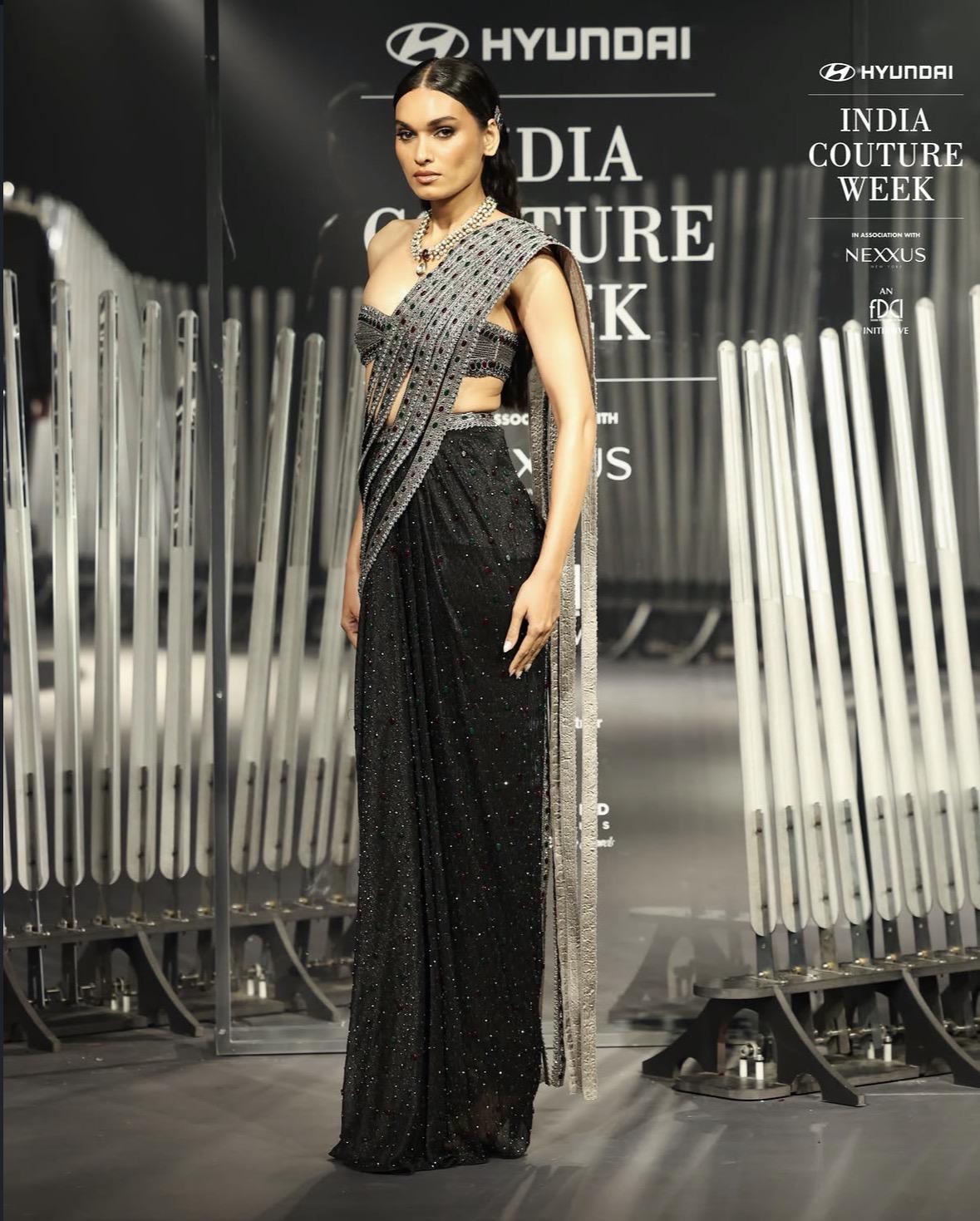
Image credits: @FDCI on Instagram

Image credits: @FDCI on Instagram
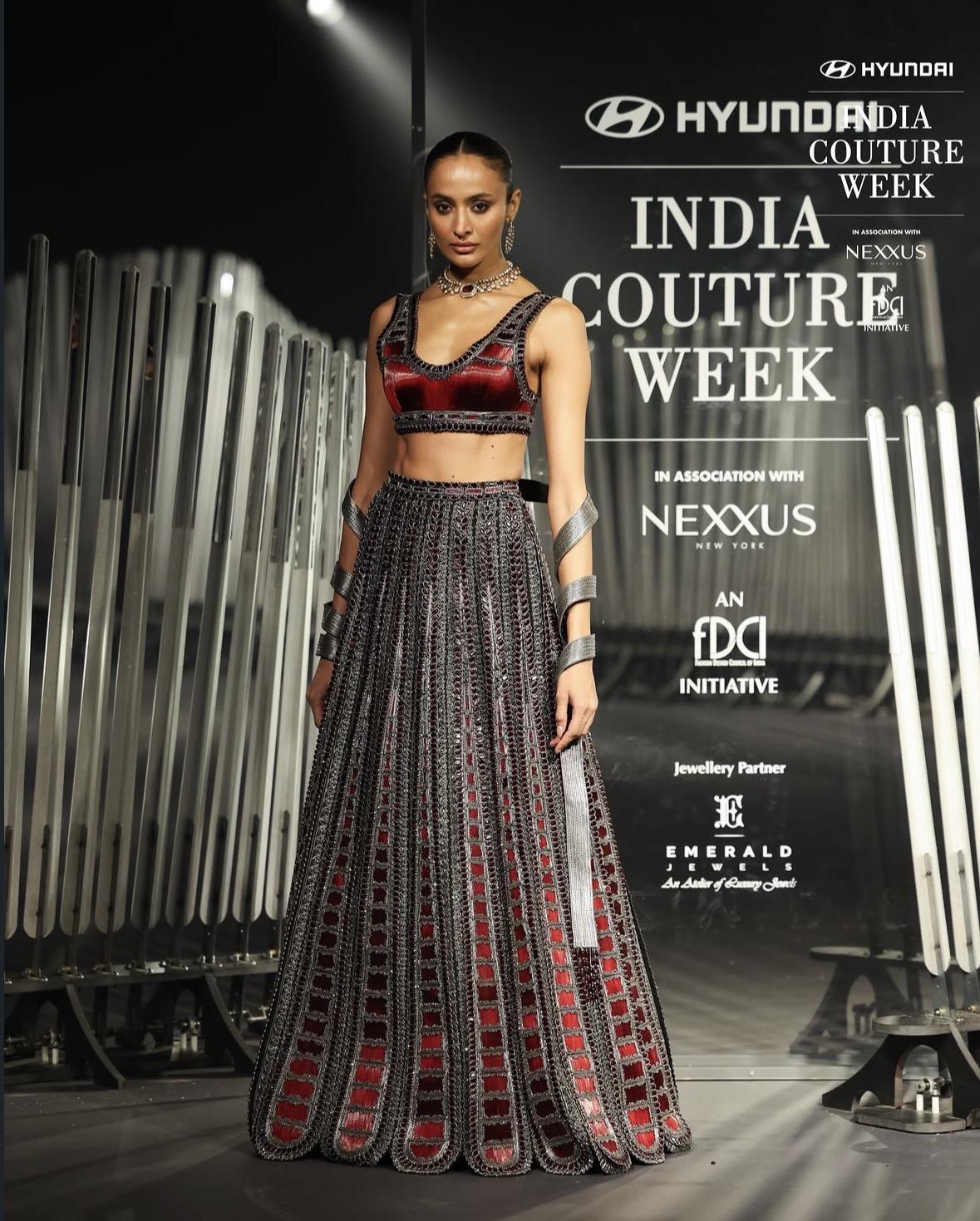
Image credits: @FDCI on Instagram
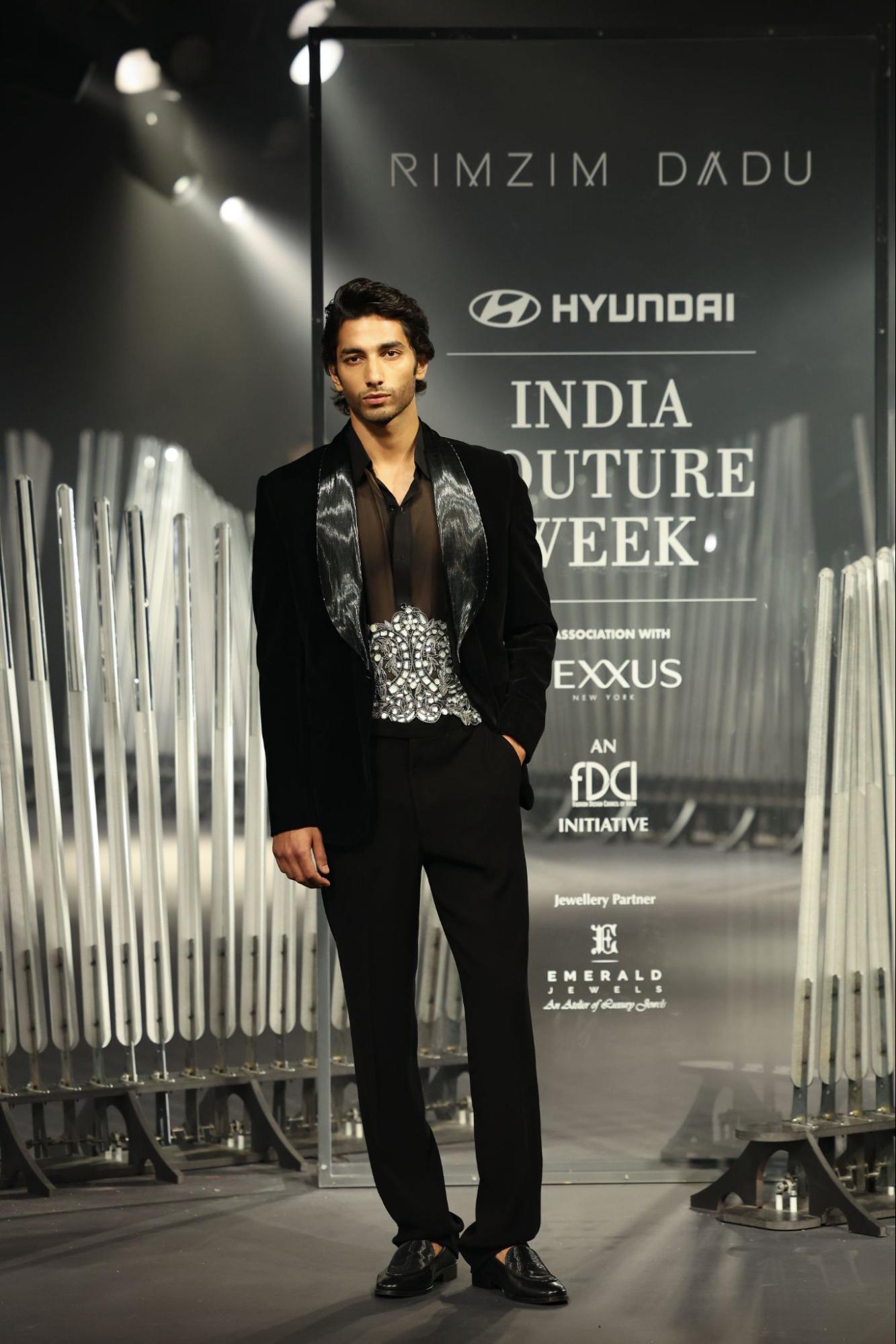
Image credits: @FDCI on Instagram

Mirror-work bandhgalas and embellished cummerbunds anchored the menswear
The designer stayed true to the aesthetic that has become synonymous with her label. Metallic cording, mirror-work, intricate beaded tassels and experimental drapes created garments that truly gave that feeling of that edgy, futuristic yet unmistakably handcrafted showcase. There was also a noticeable softness to INLAE. Amidst the metallic sheen and sculptural construction were moments of delicacy; translucent layers, floral detailing and silhouettes that felt lighter, allowing the collection to breathe without losing its signature edge. It felt like a reminder that even within an aesthetic built on structure, there is room for romance.
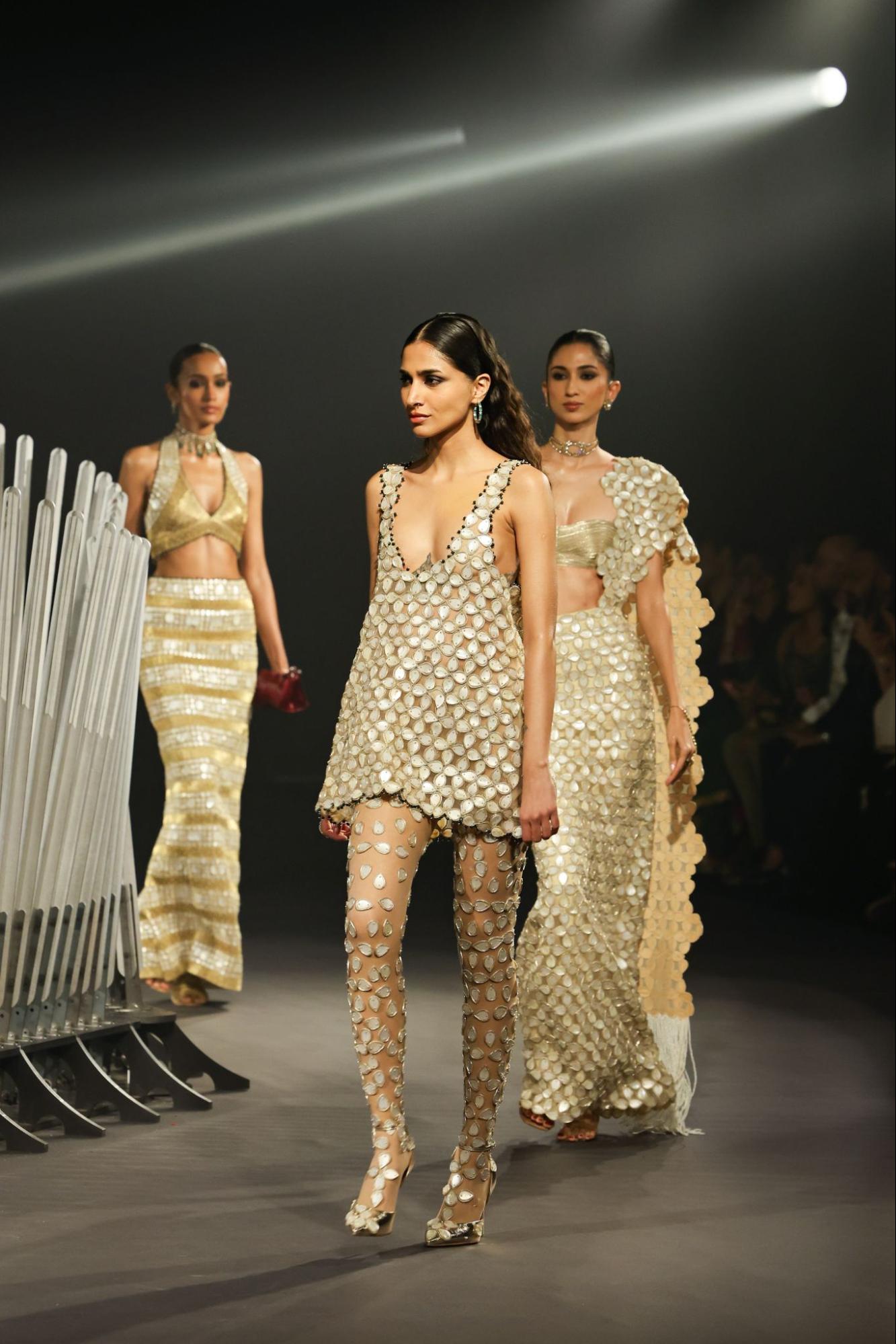
Image credits: @FDCI on Instagram

Image credits: @FDCI on Instagram
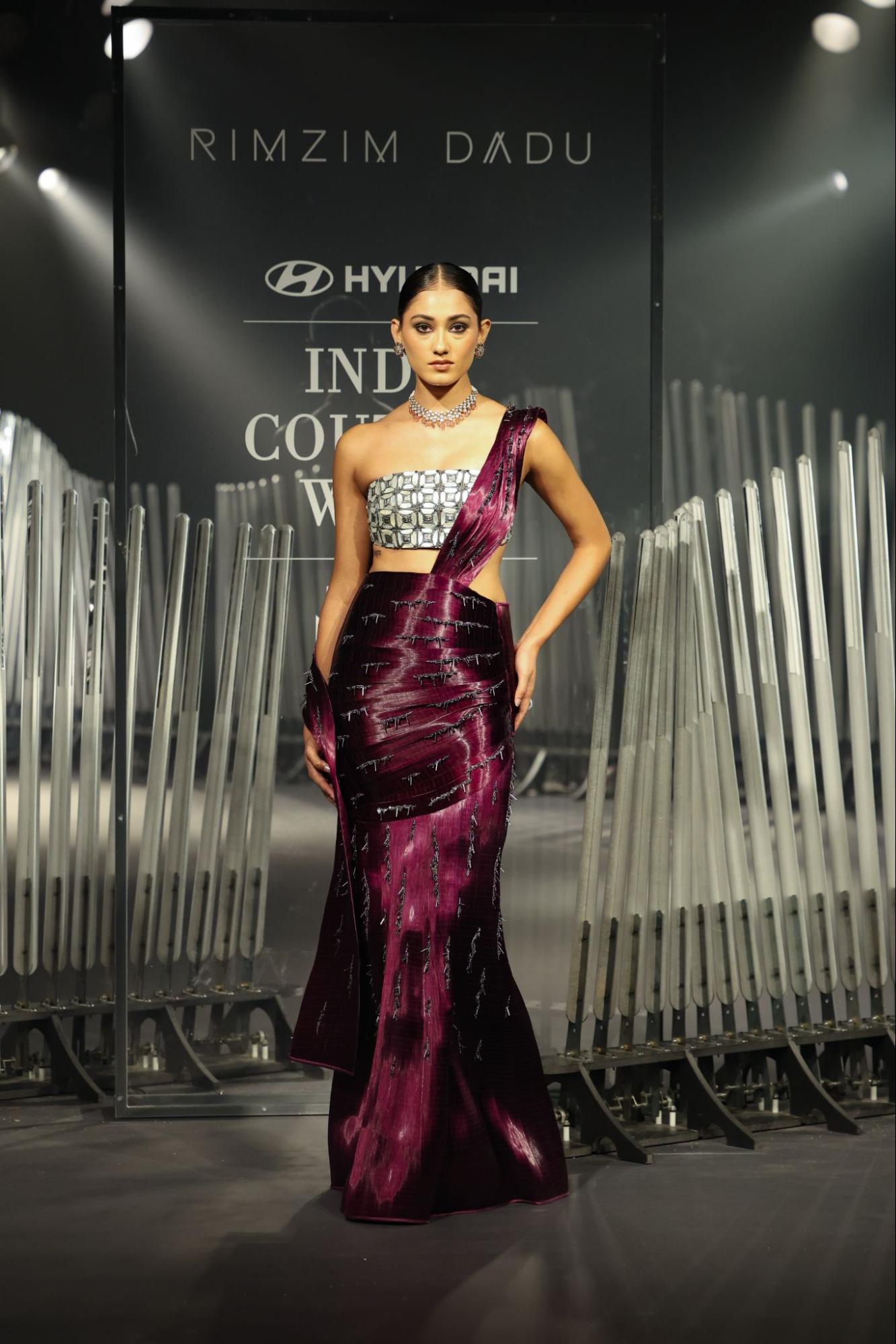
A closer look at Rimzim Dadu’s ICW 2026 collection.
Rimzim Dadu occupies a rare position in Indian fashion today. She is one of the few designers whose name immediately evokes a visual language of its own. While many labels are recognised by their embroidery or bridal codes, Dadu has built hers through her personal design language. That distinct identity has made her one of the most influential voices shaping Indian couture, both on and off the runway. What continues to set her apart is her ability to treat material as the hero. While embroidery often takes centre stage in Indian couture, Dadu approaches craftsmanship differently. Her work is rooted in experimentation, transforming materials like steel, metallic cords and unconventional surfaces into garments that feel like a movement. It is this willingness to push the boundaries of textile innovation that has made her one of the most distinctive voices in Indian fashion.
The evening concluded with a heartfelt moment as Rimzim Dadu walked out carrying the Indian flag during her final bow, earning an enthusiastic applause from the audience. A quiet, unforced gesture of patriotism at a time when the country could use more of exactly that kind of quiet conviction. It didn’t need a spotlight, and she didn’t give it one. That restraint made it land harder than if she had. With INLAE, Rimzim Dadu once again demonstrated that couture isn't only about embellishment or extravagance. Sometimes, it's about taking something as unyielding as steel and making it feel beautifully, impossibly alive. That quiet transformation remains her greatest craft.
TO BE CONTINUED, FOR SUBSCRIBERS ONLY.
This is where the surface ends and the reporting begins.
The complete piece, the full archive, and access to The French Press Circle. Reporting answerable only to its readers.
Already a subscriber ?
Login
Read these on the house, with our compliments.
A selection from the current issue, open to all readers. Read them in full. The rest is one decision away.



It’s a reputation she built over more than a decade, starting with experiments in industrial materials that nobody else in Indian fashion was touching, and turning them into a design vocabulary so distinct that “Rimzim Dadu” has become shorthand for a certain kind of futuristic, metallic femininity. There are designers who preserve craft, and then there are those who reinvent it. Rimzim Dadu has long belonged to the latter.
The show had begun even before the first look appeared. It opened with a kinetic installation called “Serpentine”; rigid steel rods arranged to ripple like a frozen wave. Rigidity dressed up as fluidity. That is exactly the tension Dadu has spent her career negotiating: hard materials coaxed into soft shapes. The set told you what to expect before a single model appeared, and for the most part, the clothes delivered on that promise.
The collection drew from the marble inlay work of Islamic architecture, translated into her now-familiar vocabulary, mother-of-pearl embellishment worked across her signature silhouettes. Her collection saw some garments that felt most like “refinement” rather than a repetition: a black embellished saree with a beaded, gem-studded pallu, a mirrored sculpted gown that moved the way liquid metal shouldn’t be able to, a burgundy-and-silver lehenga where color finally broke through the monochrome. The menswear, too, held its own with sharp bandhgalas and cummerbunds in the same metal palette, proof that her design language translates across gender without losing its edge.
Image credits: @FDCI on Instagram
Image credits: @FDCI on Instagram
Image credits: @FDCI on Instagram
Image credits: @FDCI on Instagram
Mirror-work bandhgalas and embellished cummerbunds anchored the menswear
The designer stayed true to the aesthetic that has become synonymous with her label. Metallic cording, mirror-work, intricate beaded tassels and experimental drapes created garments that truly gave that feeling of that edgy, futuristic yet unmistakably handcrafted showcase. There was also a noticeable softness to INLAE. Amidst the metallic sheen and sculptural construction were moments of delicacy; translucent layers, floral detailing and silhouettes that felt lighter, allowing the collection to breathe without losing its signature edge. It felt like a reminder that even within an aesthetic built on structure, there is room for romance.
Image credits: @FDCI on Instagram
Image credits: @FDCI on Instagram
A closer look at Rimzim Dadu’s ICW 2026 collection.
Rimzim Dadu occupies a rare position in Indian fashion today. She is one of the few designers whose name immediately evokes a visual language of its own. While many labels are recognised by their embroidery or bridal codes, Dadu has built hers through her personal design language. That distinct identity has made her one of the most influential voices shaping Indian couture, both on and off the runway. What continues to set her apart is her ability to treat material as the hero. While embroidery often takes centre stage in Indian couture, Dadu approaches craftsmanship differently. Her work is rooted in experimentation, transforming materials like steel, metallic cords and unconventional surfaces into garments that feel like a movement. It is this willingness to push the boundaries of textile innovation that has made her one of the most distinctive voices in Indian fashion.
The evening concluded with a heartfelt moment as Rimzim Dadu walked out carrying the Indian flag during her final bow, earning an enthusiastic applause from the audience. A quiet, unforced gesture of patriotism at a time when the country could use more of exactly that kind of quiet conviction. It didn’t need a spotlight, and she didn’t give it one. That restraint made it land harder than if she had. With INLAE, Rimzim Dadu once again demonstrated that couture isn't only about embellishment or extravagance. Sometimes, it's about taking something as unyielding as steel and making it feel beautifully, impossibly alive. That quiet transformation remains her greatest craft.
TO BE CONTINUED, FOR SUBSCRIBERS ONLY.
This is where the surface ends and the reporting begins.
The complete piece, the full archive, and access to The French Press Circle. Reporting answerable only to its readers.
Already a subscriber ?
Login
Read these on the house, with our compliments.
A selection from the current issue, open to all readers. Read them in full. The rest is one decision away.