It started with a single sentence from the highest court in the land.
On 15 May 2026, Chief Justice of India Surya Kant, presiding over a Supreme Court hearing related to fraudulent professional credentials and senior advocate designations, remarked: “There are youngsters like cockroaches, who don’t get any employment or have any place in the profession. Some of them become media, some of them become social media, RTI activists, and other activists, and they start attacking everyone.”
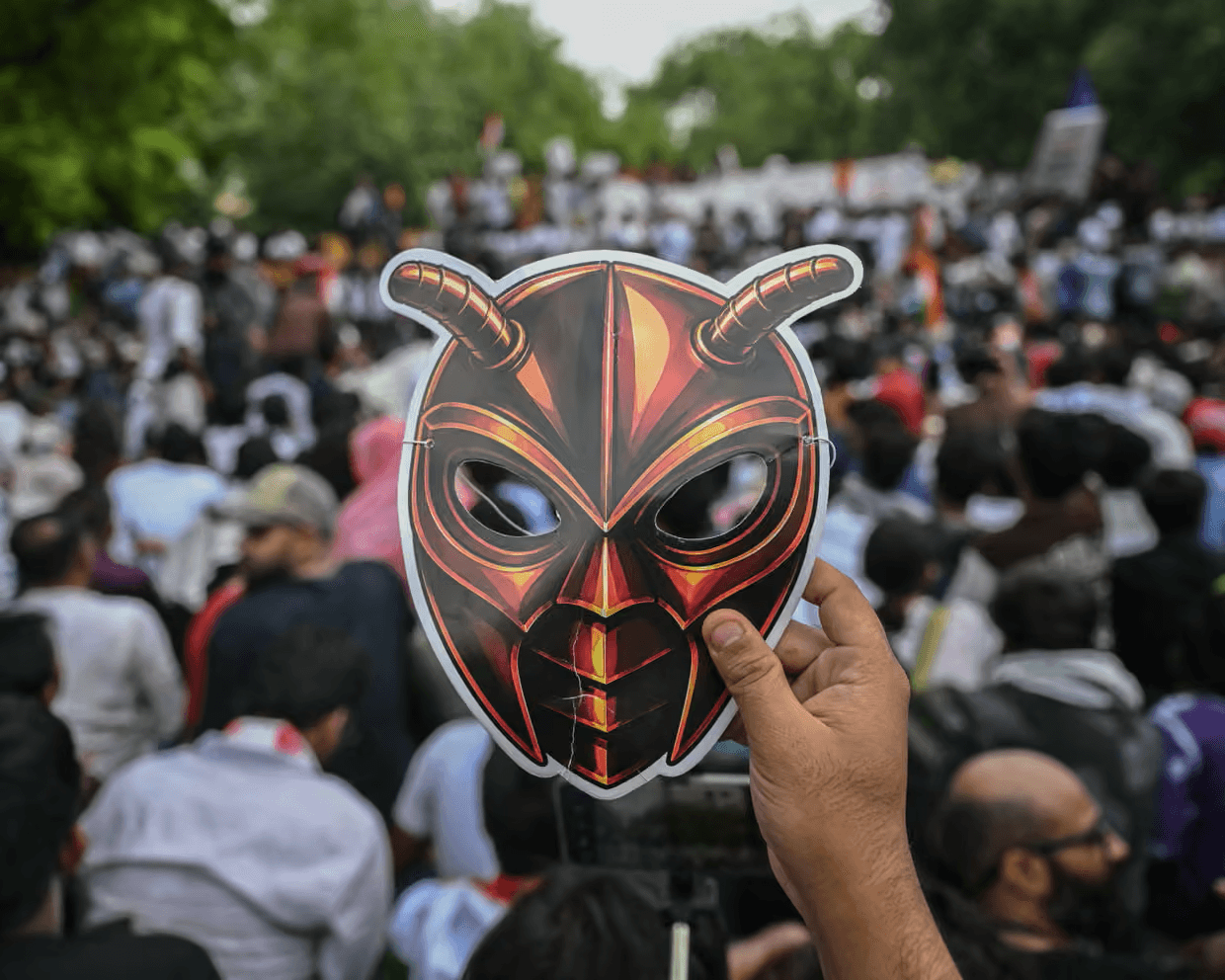
CJP Protest. Sourced from: Barta 24
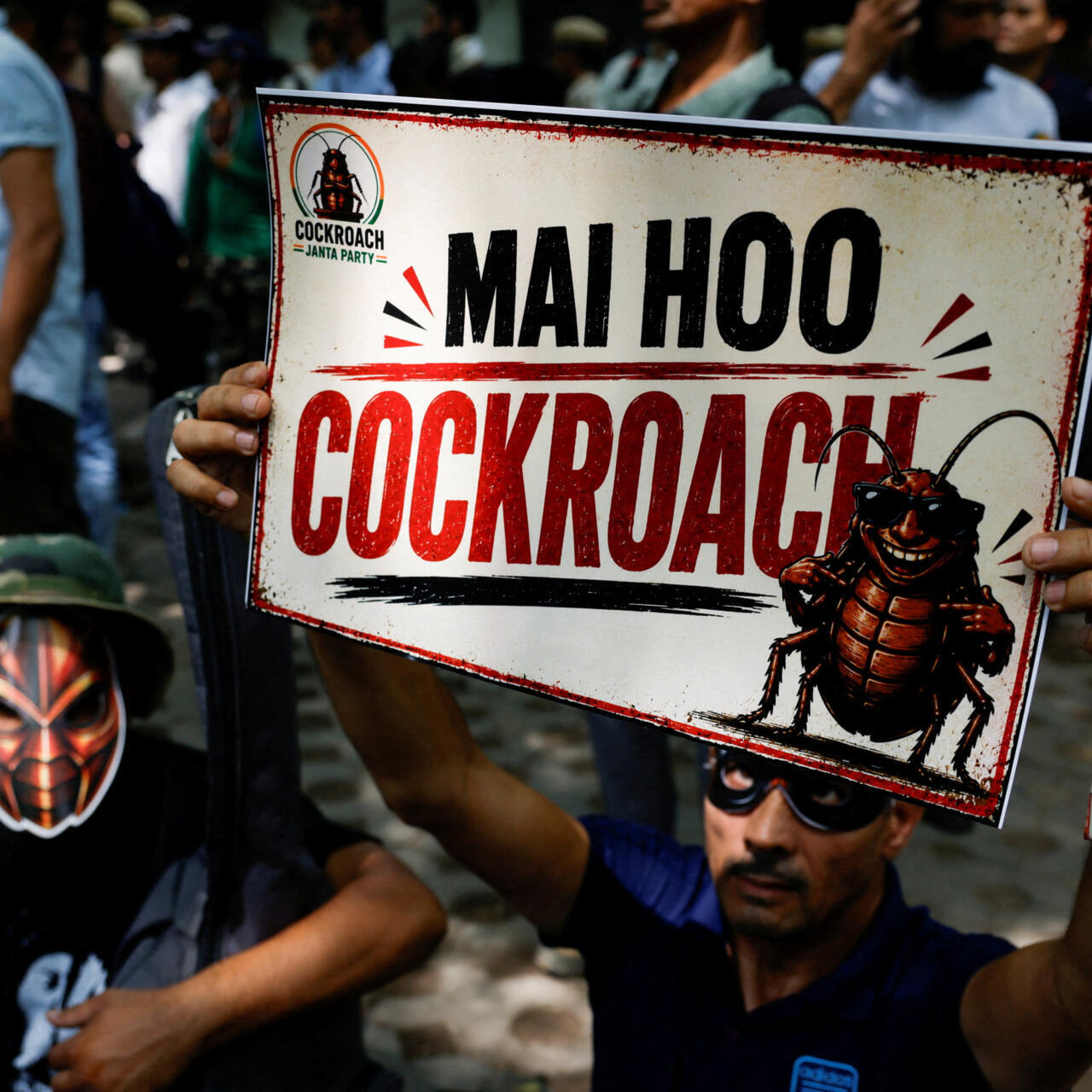
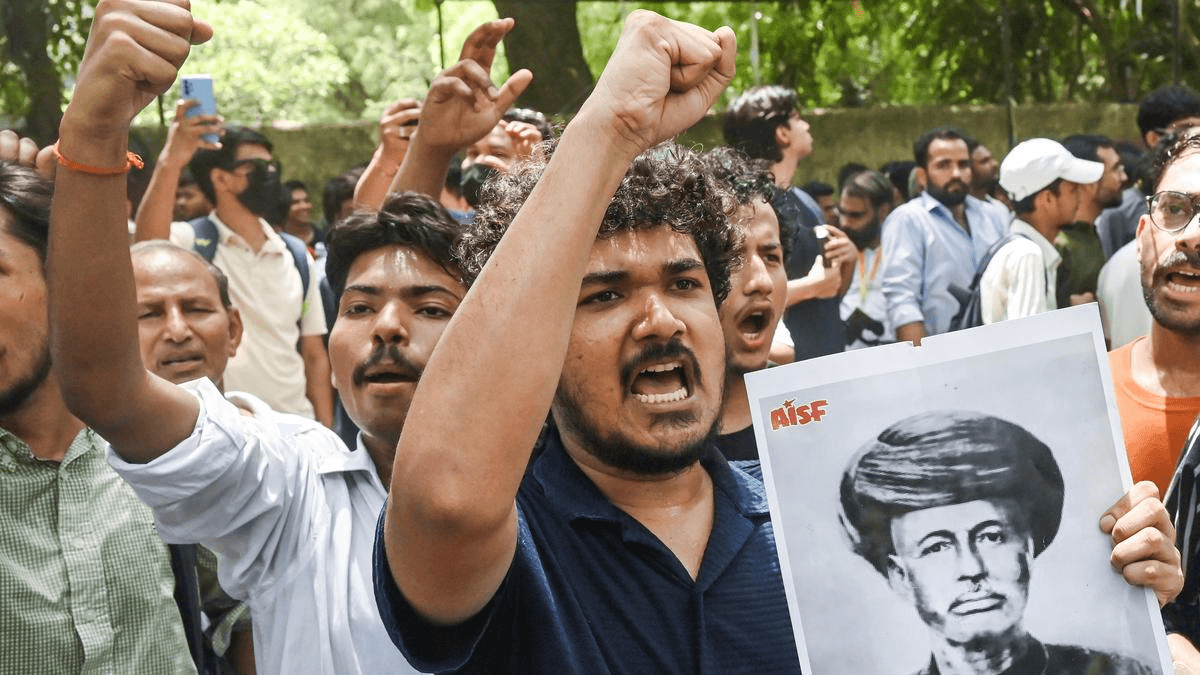
By the following morning, those words had ricocheted across every corner of the Indian internet. By June 6, they had put hundreds of young people in the streets of New Delhi’s Jantar Mantar, wearing cockroach masks, waving the national flag, and demanding the resignation of the country’s Education Minister. What happened in the three weeks between those two dates tells a story about unemployment, institutional trust, digital-age dissent, and a government watching the neighbourhood around it more nervously than it has let on.
THE MOVEMENT
The Cockroach Janta Party (CJP), whose name is a deliberate play on the ruling Bharatiya Janata Party, was founded on 16 May 2026, one day after the Chief Justice’s remarks, by Abhijeet Dipke, a political communications strategist and Boston University graduate who previously worked as a volunteer with the Aam Aadmi Party’s social media team during the 2020 Delhi elections and as a communications advisor to Delhi’s education department.
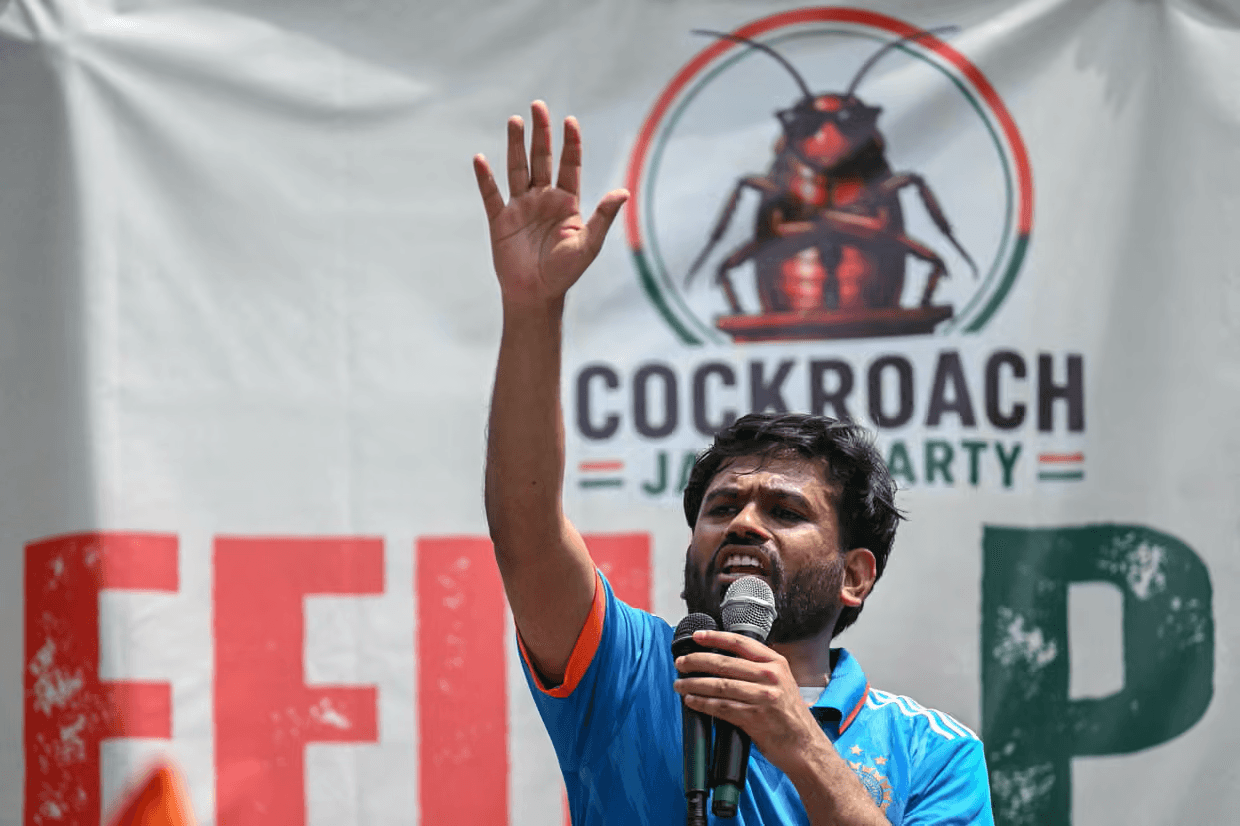
Abhijeet Dipke, a political communications strategist
Dipke, who was 30 at the time of the protest, announced the platform on X, listing eligibility as being unemployed, chronically online, and capable of “ranting professionally.”
The speed of what followed was staggering. Within 78 hours of launch, the CJP’s Instagram account crossed 3 million followers. It surpassed 10 million in under five days, overtaking the official handle of the BJP. By the date of the Jantar Mantar protest on June 6, that count had climbed to over 22.2 million.
CJP is not registered as a political party with the Election Commission of India. It describes itself as “a political front of the youth, by the youth, for the youth: Secular, Socialist, Democratic, and Lazy.” Dipke has stated publicly that the campaign has no interest in inducting established politicians, saying that “Gen Z wouldn’t like it if current politicians joined the CJP.”
The Chief Justice issued a clarification the day after his remarks, stating that his words had been misquoted and that he was specifically criticising individuals who had entered the legal profession using fake and bogus degrees, not the country’s unemployed youth. The clarification did not slow the movement.
“In politics and public life, perception often matters as much as intent. Once the remark entered the public sphere, people attached their own experiences and frustrations to it, and that’s what gave it power.”
Sidhant Madan, law student, NMIMS Chandigarh
Sidhant Madan, a 22-year-old law student at NMIMS Chandigarh, explains what gave the word its power regardless of its original context. “In politics and public life, perception often matters as much as intent. Once the remark entered the public sphere, people attached their own experiences and frustrations to it, and that’s what gave it power. History is full of examples where groups have taken labels that were originally intended as insults and transformed them into symbols of solidarity. The speed tells us that people were not waiting for a remark. They were waiting for a vehicle through which they could express concerns they already had.”
THE BIGGER NUMBERS BEHIND THE ANGER
The CJP gave the frustration a name and a costume. The underlying pressure predates both.
India’s youth unemployment rate for those aged 15 to 29 stood at 9.9% in 2025, against an overall unemployment rate of 3.1% for the broader population, according to the Periodic Labour Force Survey Annual Report 2025 released in March 2026. For university graduates, that figure is considerably higher: in 2022, the unemployment rate among those with secondary education or higher was 18.4%, and 29.1% among graduates specifically, compared to 3.4% among those without formal education.
For many young people preparing for competitive exams, a leaked paper represents the loss of years of focused preparation, alongside the financial sacrifices made by entire families in pursuit of stable employment. In the UPSC exam alone, 1.3 million students compete for just 1,255 vacancies. In the seven years preceding 2024, at least 70 paper leak cases had affected the futures of more than 20 million students.
Jai Lakra, a 23-year-old law student at NMIMS Mumbai, reads the convergence of those numbers in what the protest’s first images communicated. “For a generation often accused of limiting its activism to social media, it demonstrated a willingness to step into physical public spaces and collectively express frustration. The judge’s remark may have been the spark, but the fuel was already there. A large section of the youth was waiting for a focal point around which to rally.”
Sudeep Mukhia, an Indian journalist who formerly reported at News18, locates the delay in expression in a specific institutional failure. “Isolated anger does not bring about any change. It has taken long to find expression because the media, which was supposed to give expression to this, has simply refused to do it. While CJP was protesting the exam paper leak, the NSUI, which is the student wing of the Congress, was holding massive protests in several states. The media gave zero coverage to them. If the anger doesn’t find wider expression, how do you get to know that it’s there? And that’s how this government has also survived.”
TWO EXAM SCANDALS, ONE BREAKING POINT
The protest at Jantar Mantar was propelled by two concurrent education crises in May 2026.
The 2026 CBSE On-Screen Marking controversy centres on the public backlash against the Central Board of Secondary Education following its implementation of a new On-Screen Marking system for Grade 12 board examinations. After Class 12 results were announced on 13 May 2026, many students reported issues including blurred scans, missing pages, mismatched answer sheets, unmarked answers, and unexpected marks. A 19-year-old ethical hacker and Class 12 student, Nisarga Adhikary, claimed he had found serious security flaws in the OSM portal and had reported them to the Indian Computer Emergency Response Team in February 2026, but most remained unfixed by the time results were declared.
Running parallel was the NEET-UG crisis. On 3 May 2026, the NEET-UG examination was held for over 2.27 million aspirants seeking admission to undergraduate medical and dental courses. The exam was cancelled on 12 May 2026 following investigations that revealed overlaps between a pre-circulated guess paper and the actual question paper. The incident led to arrests, including of insiders from the National Testing Agency, and triggered petitions in the Supreme Court. The exam was subsequently rescheduled for June 21. The 2026 NEET controversy followed the pattern of the 2024 NEET controversy, which had already provoked nationwide protests two years prior.
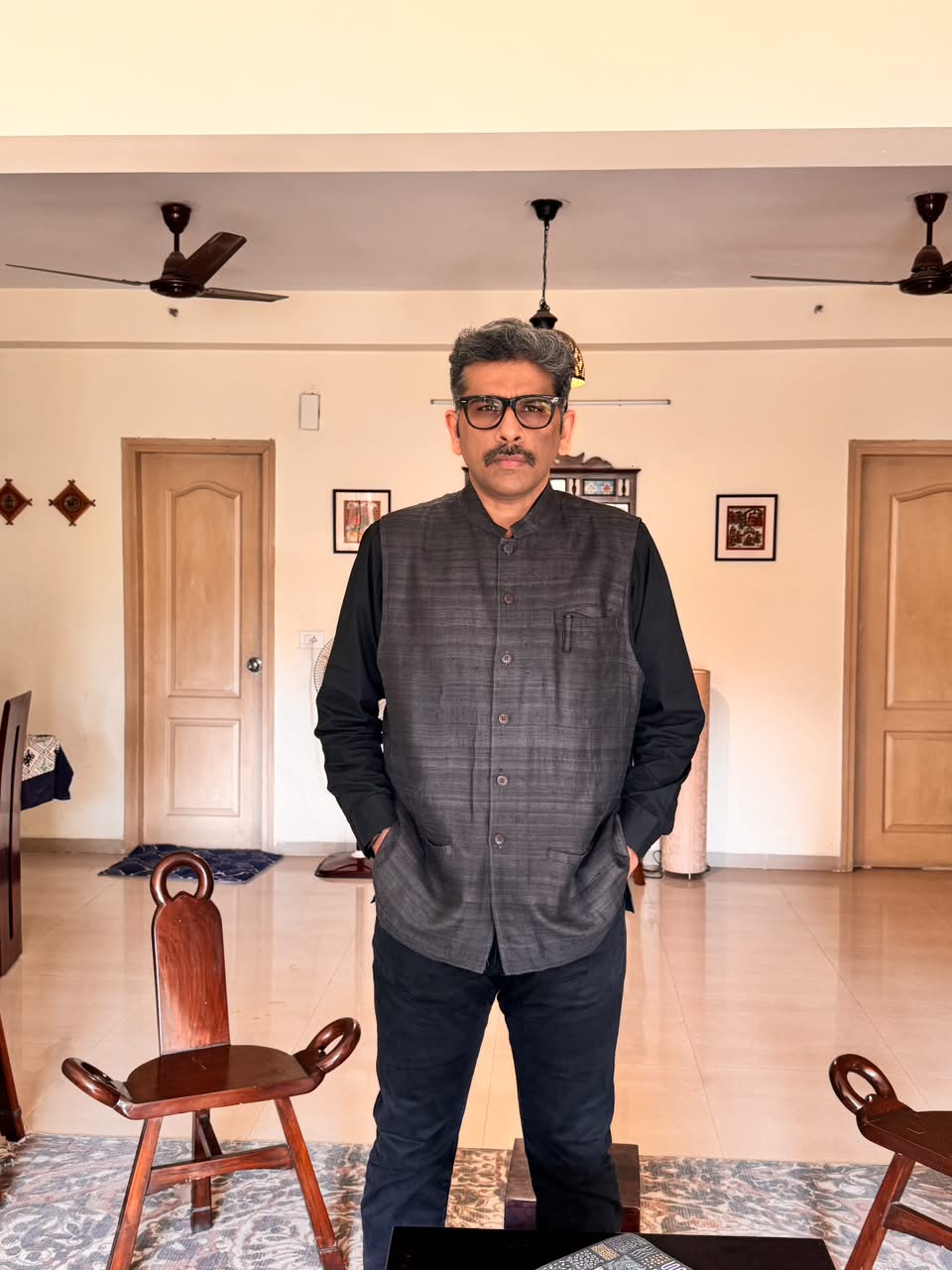
Sanket Upadhyay, a TV and media journalist. Image Courtsey: Sanket Upadhyay
Sanket Upadhyay, a TV and media journalist with 25 years of experience at NDTV and CNN-News18 and founder of DoubleCheck Network, places the accumulated failures in structural terms. “Years of opaque exam processes and unaccountable governance have left young people feeling unheard. The cockroach symbol cleverly converts an insult into a statement of resilience. It shows institutions cannot afford complacency. Creative, peaceful pushback is now the default when formal channels fail.”
JANTAR MANTAR: JUNE 6
The CJP had secured permission to hold the protest at Jantar Mantar until 5 pm. Delhi Police confirmed the permission was given as a “one time exception” with terms and conditions, and that they had relaxed the procedural requirement of advance notice for such protests.
Ahead of the protest, police tightened security at the airport and the Jantar Mantar site, setting up steel barricades at key points. Hundreds of mostly young people arrived in cockroach masks, carrying dog-eared exam guides and India’s national flag. They also brought flowers, at the suggestion of Sonam Wangchuk, the Ladakh-based climate activist, who had proposed the gesture independently and whose suggestion was adopted by protesters without formal endorsement from Dipke and the CJP leadership. Wangchuk himself walked in later in the day carrying a rose, and thanked the organisers for the tone of the demonstration.

Pratishtha Dobhal, former Editor-in-Chief of Cosmopolitan India and a Creative Technology Evangelist. Image Courtsey: Pratishtha Dobha
Pratishtha Dobhal, former Editor-in-Chief of Cosmopolitan India and a creative technology evangelist, was present at Jantar Mantar for the duration of the protest. She describes the atmosphere in the first hour before the crowd thickened: “The energy was participatory and reform forward. The first half had a lot of media, independent and a few mainstream, but the trickle of people was constant. It was very organic and the security forces quite relaxed. It felt as if they were also fed up of a system that had taken no accountability, and were silent supporters deployed for crowd management.”
On the symbolism of the objects protesters brought with them, Dobhal is precise. “When you look at them together, the books, flags and flowers, it’s a clear call for an education-forward country where books are a gateway to perspectives, knowledge, ideologies and liberation. I liked the intention and saw these as requests more than instructions.”
Al Jazeera’s correspondent Rebecca Bundhun, reporting from the site, noted that as crowds gathered through the day the number went into the thousands once media and spectators were counted. “Clearly there is support, but it doesn’t seem to fully reflect what we’re seeing in terms of the scale that we’ve seen online over the past couple of weeks. People here are very eager to have their voices heard, saying they do want more representation in parliament as well for the youth.”
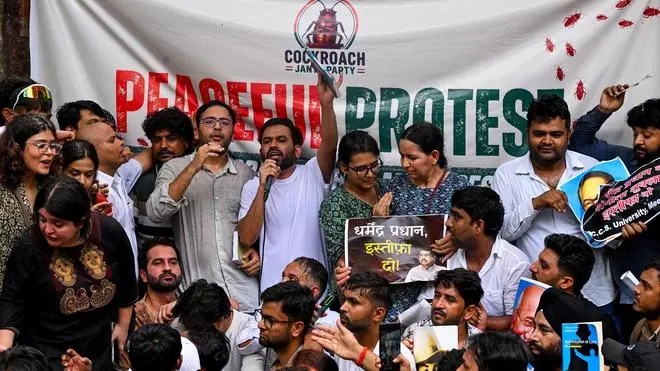
CJP Protest. Sourced from: Frontline- The Hindu
Protesters chanted slogans including “Cockroaches are coming, Dharmendra Pradhan is going,” directed at the Union Education Minister. Lakshay Verma, a college student who travelled from Alwar, Rajasthan to join the protest, told ThePrint: “So many aspirants commit suicide, no one is held responsible for their deaths.” Dipke, who had flown in from the United States to lead the rally, told the crowd: “The youth of this country will no longer fear; they will fight. Cockroaches do not fear either; they never die.”
Dobhal, whose editorial work at Cosmopolitan India was built around the same demographic that showed up at Jantar Mantar, reflects on the gap between what she expected and what she saw. “Young people are hungry for work that adds meaning to their life, which also means they are willing to learn and adapt to a constantly changing world, because if there is one thing they are certain of it is the uncertainty of our present times. I would have liked to see a lot more participation by young people from Delhi. Going in, I knew it would be a diverse socioeconomic group, since privilege often means you have more options to escape a tough situation and a highly competitive education ecosystem.”
On the question of what the protest’s structure means for journalism’s relationship to movements like this, Dobhal draws on a longer personal memory. “I was part of the crowd that sat for candle night vigils after the Delhi gang rape case of 2012. It was a reaction that was not rooted in structure or conventional ecosystems. Real journalism looks beyond conventions and chases the story regardless of structure.”
THE GOVERNMENT’S RESPONSE
The government’s handling of the movement’s rise has itself become a story.
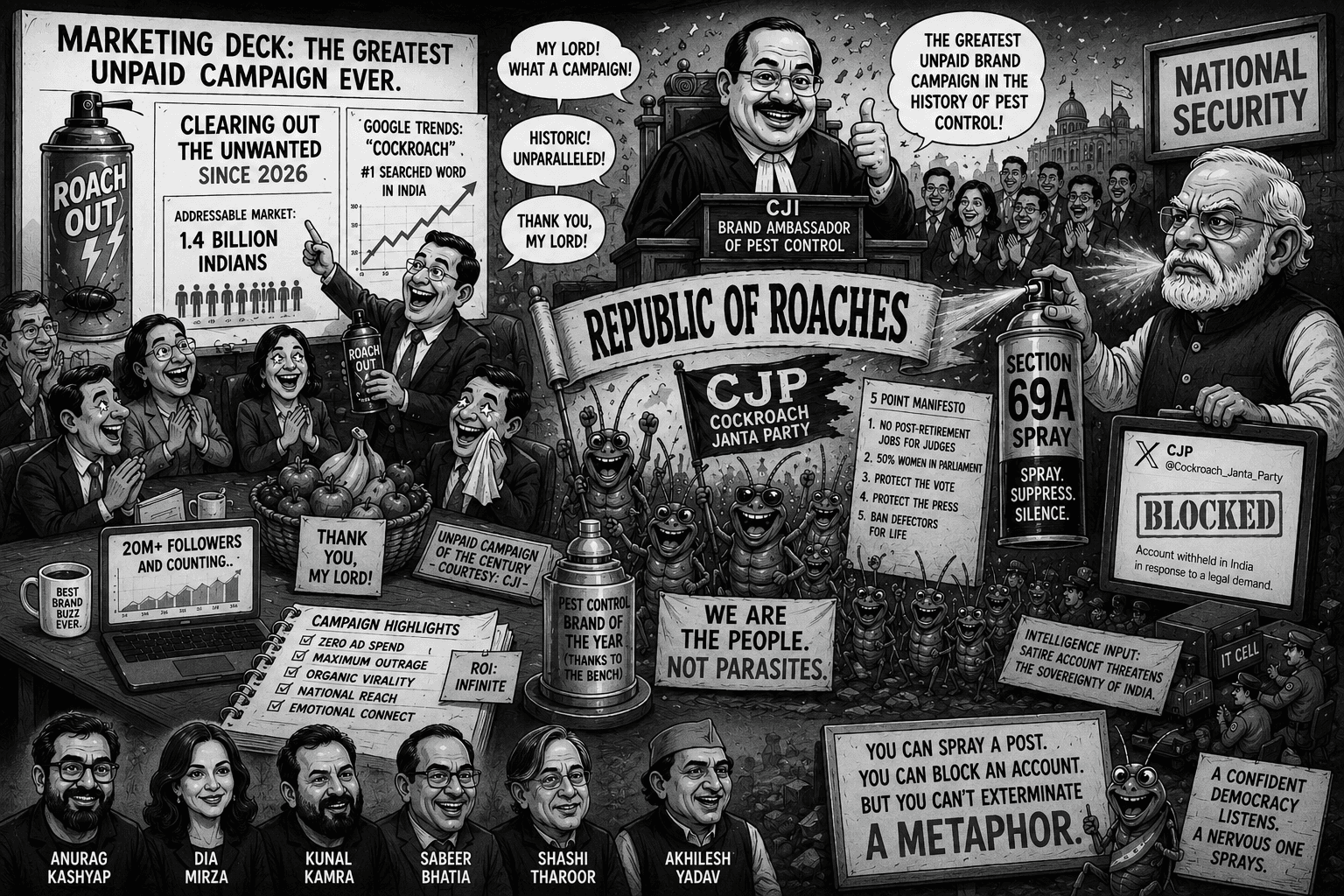
On 21 May 2026, the CJP’s X handle (@CJP_2029) was withheld in India under Section 69A of the Information Technology Act, 2000. The Internet Freedom Foundation issued a statement on the blocking the following day. Subsequently, the CJP’s official website was also blocked following directives from the Ministry of Electronics and Information Technology (MeitY), citing national security concerns. Founder Dipke posted on social media that the website had registered over 1 million signups before it was taken down. The Delhi High Court agreed to hear a petition filed by leaders of the movement challenging the blocking of the X handle, with petitioners arguing the suspension was arbitrary, without notice, and a violation of their fundamental right to freedom of speech and expression.
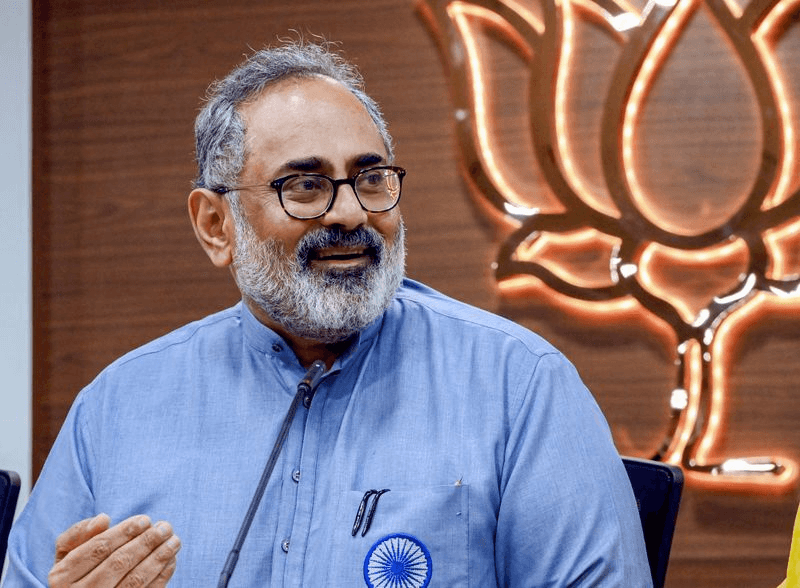
Rajeev Chandrasekhar, State President of BJP, Kerala
BJP’s Rajeev Chandrasekhar publicly claimed the CJP trend was part of a cross-border “influence operation” aimed at destabilising India. Dipke has stated that the movement is affiliated with no political organisation.
Dobhal, who watched the crowd come out after the handles were already blocked, frames the government’s decision as self-defeating. “Digital suppression is limiting a fundamental right to expression using a new medium of communication. It’s not something to be endorsed in a democracy. The numbers and the momentum the CJP Instagram handle amassed had been unprecedented because it was a knee-jerk satirical reaction to a statement, followed by a call to action which demanded change. The offline gathering challenged the notion that this was a one-off angst-ridden digital rant. There are also new platforms that are not popular or mainstream that keep channels of communication open. Discord did that for the Gen Z revolution in Nepal that shook the world and legacy politics.”
Sudeep Mukhia reads the blocking within the same pattern he has observed across the current administration’s handling of accountability. “The government’s instinct is to block everything and anything. Even when there is a demolition in a city like Jaipur, they will put off the internet because they don’t want anybody to come out and tell you what is actually happening. The playbook here is very clear. The government, any government, and particularly this government, is very scared of being asked for accountability. There is a fear when suddenly accountability comes from a non-political, unrecognised entity like CJP. Who do you target? Do you target Abhijeet Dipke? That becomes very obvious. Do you target Saurav Das? That becomes very obvious. You make heroes out of them. The fear is accountability. It’s very simple.”
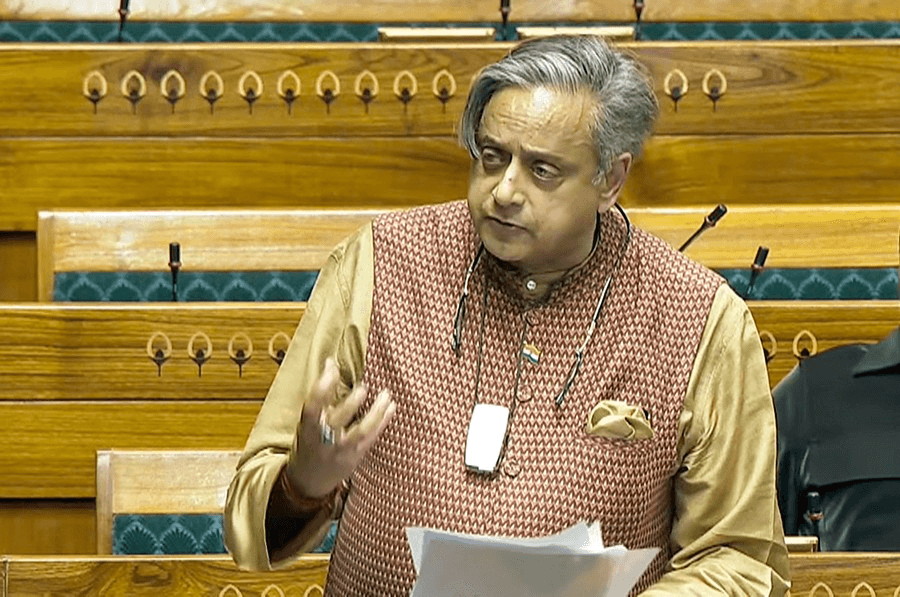
Shashi Tharoor, Congress MP
Congress MP Shashi Tharoor described the blocking of CJP’s X handle as “disastrous” for democracy, arguing that satirical outlets are healthy channels for public dissatisfaction and that the phenomenon signals an opportunity for political opposition to channel Gen Z discontent into mainstream electoral politics. Arvind Kejriwal backed the CJP’s demands on X, writing that the Modi government should address the issues rather than term protesters anti-national. Shiv Sena (UBT) spokesperson released a statement on behalf of party chief Uddhav Thackeray: “Do not underestimate the cockroaches. This is the warning given by the agitation at Jantar Mantar.” Trinamool Congress MPs Mahua Moitra and Kirti Azad expressed interest in joining the party. Social activist Anna Hazare stated that “youth power is national power.” TMC’s Mamata Banerjee and Abhishek Banerjee also expressed support, with party spokesperson Derek O’Brien describing it as “fighting a good fight.”
SATIRE, CULTURE, AND THE QUESTION OF FORM
The CJP’s chosen register, meme-based, self-deprecating, and ostentatiously lazy, has produced a substantive disagreement about whether satire is a durable political instrument or an escape valve.
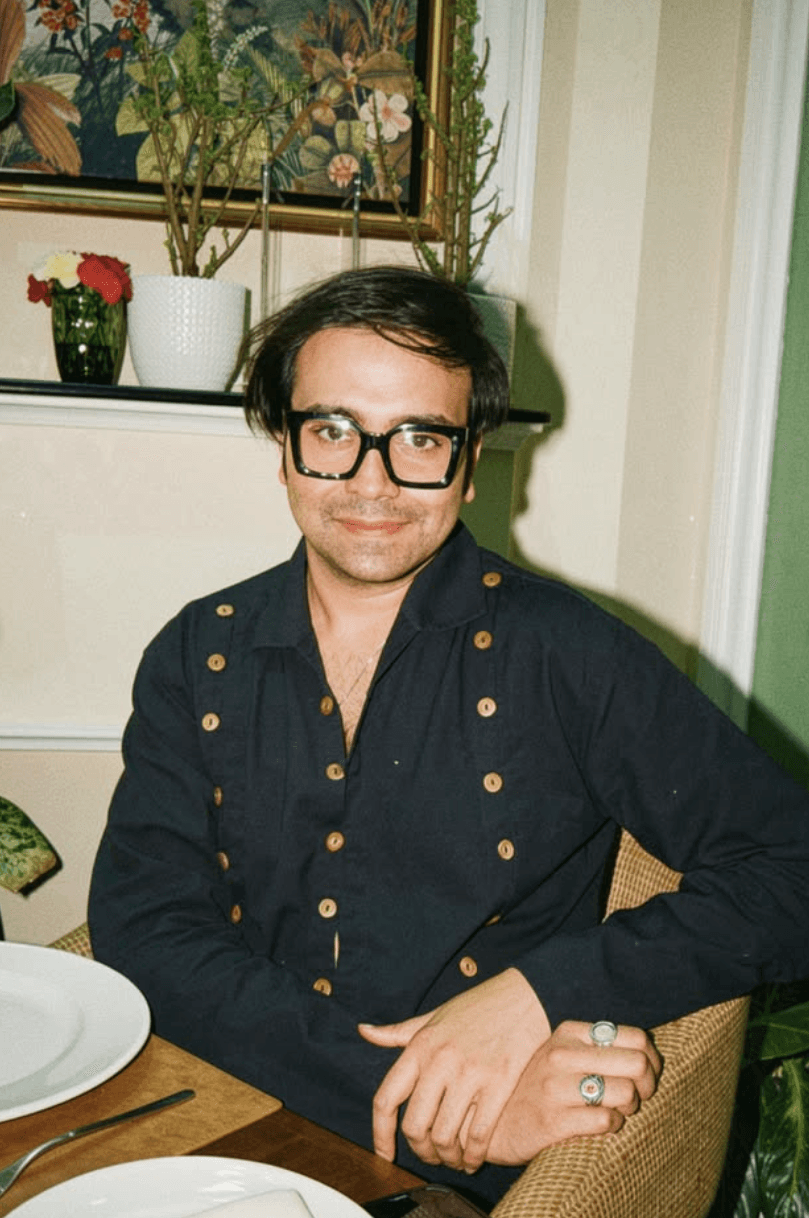
Mayank Choudhary, lifestyle reporter at NDTV
Mayank Choudhary, lifestyle reporter at NDTV, who followed the movement’s rise and its protest coverage but was not at Jantar Mantar himself, places it outside conventional political categories entirely. “More than a political movement, I see it as a cultural movement. It is a very big cultural thing that has happened in India’s younger population which cannot be unnoticed, and they have made sure that people noticed, regardless of mainstream media not covering them. The last huge cultural movement was Anna Hazare. All the media people were covering it 24x7. But we lived in a very different time back then and now we’re living in a very different time where press freedom in the country is under scrutiny and criticism. The way of doing it is absolutely new, it’s current, it’s relevant, and I do have a lot of hope from them, regardless of their loopholes. It’s just they have to be at it.”
Sudeep Mukhia takes a more sceptical position on whether the movement’s demands constitute a real political programme. “I don’t think there is any great genuine political demand of the CJP right now. They’re only demanding the resignation of the education minister. After that, they don’t really have any great plan. Will they make it a larger political platform, much like India Against Corruption did after 2012 against the UPA government? I don’t see any such plan as of now. Satire and memes, the government will always try and shut down, especially this government, which has tried to shut down satire of all sorts because they are unnecessarily prickly and sensitive. The media will also find ways to dismiss this because it makes them uncomfortable to question and ask for accountability from the government. They would much rather be making fun of these memes and asking questions of the opposition rather than the government.”
Sanket Upadhyay holds a middle position. “It reflects both anger and sophisticated digital performance. Core frustration over NEET leaks, joblessness and institutional indifference is real and widespread. At the same time, Gen Z has mastered scaling dissent through platforms. Virality is their native organising tool. The 22 million figure captures authentic pain amplified by algorithms. Converting that into sustained pressure is the harder, unanswered part.”
Sidhant Madan frames satire’s limits from the vantage of his generation. “Satire has always been a powerful political tool because it allows people to communicate ideas and criticisms in a way that’s accessible and memorable. In politics, humour often sticks longer than serious arguments. Terms like ‘Pappu’ are proof of that. At the same time, satire works best as a gateway. It can start a conversation, but eventually a movement needs real demands and real solutions. The humour got people’s attention. The underlying issues are what made people stay.”
Dobhal, who draws a parallel to Gandhi’s Champaran Satyagraha of 1917, is the most direct about what the transition from satire to politics requires. “The day CJP decided it was going to organise a peaceful protest, it ceased to be satirical commentary. He did not start with a mass rally. He began with a very small core team of fewer than 100 people. It took several years for Gandhi to gain organised momentum. I am not comparing the two, but giving context in numbers. Consistent action has remained integral to any revolution that has brought about reform. These are early days for CJP and Dipke. They will need to continuously organise with the same creativity they displayed at the time of the Instagram launch, and must remain extremely transparent and authentic in their demands. Each protest organised will need a debrief. What it lacked, what it can do better.”
THE INCLUSION QUESTION
The Jantar Mantar protest surfaced a separate and public debate about representation within the movement itself.
Choudhary raised publicly, on Instagram, the absence of women at the spokesperson level. He was not at the protest but followed the coverage closely. “All three spokespersons the movement has are men. At the protest, there were many women at the front line, very much visible. One of the spokespeople did clarify that they did reach out to women, but because of certain online backlash or bullying, a lot of women declined the position. It would have been nice to have a woman spokesperson.”
Choudhary also flagged a more direct internal accountability issue. One of the three named spokespersons, Vijeta Dahiya, faced public criticism after past remarks about transgender and gender non-binary people resurfaced online. “When these tweets and texts resurfaced, this person again went on defending his remarks to a point that he labelled gender identity as an elitist concept. That is a deal breaker for me.” A young transgender person, believed to be 19 or 20 years old, who had been harassed and asked derogatory questions by reporters at the protest site, had reels made of them that went viral. CJP subsequently posted that the movement is inclusive regardless of gender, sexuality, religion, faith, or caste. Choudhary’s overall assessment remained qualified: “It’s a very plus point here, minus point over there, which is also okay because it’s a developing thing. But because this movement is asking for accountability from the system, it also needs to look at itself and make sure that if there are criticisms, they should take that into consideration. Having a diverse panel of spokespeople, having the right kind of people at the front line.”
Sudeep Mukhia disagrees on where the focus should sit. “Women have been at the forefront of protests in this country for years and years and years. That is not the issue. The issue is, given the political atmosphere, if a woman takes a position that is not popular, even in the safety of their own homes, they are not safe for the simple reason that on social media they will be attacked and given physical threats. The issue is more important than whether women are talking about it or men are talking about it.”
AFTERMATH: THE TRAILER ENDS, THE TOUR BEGINS
Following the protest, Dipke posted on X that the Jantar Mantar demonstration was “just a trailer,” adding that his parents had faced threats during the preceding 15 days and had to leave their home. A CJP spokesperson told media that the movement intended to launch a nationwide stir if Union Education Minister Dharmendra Pradhan was not dismissed within seven days. “People in thousands came for the peaceful protest. For us the priority is to reset India’s education system. It is a long fight,” the spokesperson said.
CJP Protest. Sourced from: The Hindu
On 8 June 2026, the CJP announced a second protest, scheduled for 11 June at Savitribai Phule Pune University at 4 pm, under the hashtag #EducationMinisterMustResign.
Sanket Upadhyay notes that the pressure appeared to register even before the seven-day ultimatum expired. “I would say that the pressure is even working because in a recent function of the Bharatiya Janata Party celebrating 12 years of the Narendra Modi Government, Dharmendra Pradhan was missing. The government will have to be very clear to read this message and fix the mess in the education sector.”
THE REGIONAL MIRROR
Indian officials watching the CJP would do well to look at what has happened across India’s borders in the three years preceding June 2026. South Asia has produced, in rapid succession, three governments brought down by youth-driven protest movements, each beginning online and ending in the streets.
In Sri Lanka in 2022, largely youth-led protests against economic collapse forced President Gotabaya Rajapaksa from office after demonstrators occupied his Colombo residence. The government deployed the military and restricted social media access in an attempt to suppress the unrest; both moves accelerated rather than contained it.
In Bangladesh in 2024, a Gen Z movement ignited by fury over a 30% civil service quota for descendants of 1971 Liberation War veterans quickly morphed into a nationwide uprising against corruption, democratic backsliding, and economic stagnation. Student leaders issued ultimatums and lists of demands to the government. Every measure Sheikh Hasina’s administration took, from crackdowns on student agitators to telecommunications blackouts, aggravated the crisis. On 5 August 2024, Sheikh Hasina resigned after 15 years in power and fled to India.
Nepal followed in September 2025. After the government imposed a sweeping social media ban against a backdrop of economic dysfunction and widespread youth disillusionment, mass protests led largely by Generation Z demonstrators erupted across Kathmandu and other cities. By September 9, 2025, the parliament building and other government offices were in flames and Prime Minister K.P. Sharma Oli had resigned. The crisis left 74 dead and more than 2,113 injured by September 22. Former Chief Justice Sushila Karki was subsequently sworn in as interim prime minister, becoming the country’s first female head of government.
Analysts describe these uprisings as interconnected expressions of a region-wide discontent, ignited by the energy and aspirations of Gen Z, defined as those born between 1997 and 2012. All three movements began with a specific grievance, organised through decentralised platforms, and were met with digital crackdowns that drew more attention to the movements than before.
The voices in this story divide on how close the parallel is.
Dobhal, who was physically at Jantar Mantar and has followed the regional pattern, does not find the comparison abstract. “These are our neighbouring countries where the root cause of the protests and uprisings was similar to India’s: institutional corruption that had penetrated so far and deep that it was beginning to challenge basic livelihood. India is larger in size, diversity, and population index, which makes it far more complex to navigate.”
Sudeep Mukhia draws the structural distinction with precision. “The biggest difference between Bangladesh, Nepal, Sri Lanka is that India is at least ten times as big as all these countries. In urban areas there might be strong resentment against paper leaks. But in a village near Bhagalpur in Bihar where they don’t even look at exams as a possible way of getting out of their poor lives, it frankly doesn’t make a difference whether there is a paper leak or not. It is structurally different, but does it mean these things will never happen in India? The CJP has shown, in a very small initial way, that very quickly people can come out to protest.”
Sanket Upadhyay draws the sharpest distinction. “It would be unfair to compare the CJP movement with what we saw in our neighbourhood. Those movements turned violent. They were designed to exact political and regime change. Here, I don’t see any member of any pressure group turning violent or even claiming to overthrow the political dispensation. All they want is the government to fix extremely specific problems. India’s Generation Z is evolved enough to understand these nuances.”
Al Jazeera noted in its June 6 coverage that the group’s rise echoes a similar trend across South Asia, where youth movements born out of social media have been crucial in antigovernment protests, particularly in Sri Lanka, Bangladesh, and Nepal.
WHAT COMES NEXT
The CJP remains, for now, a satirical movement without registered party status, a formal electoral machinery, or a tested capacity to mobilise at scale beyond social media. Critics, including some aligned with the ruling party, have argued that Dipke’s AAP background suggests the movement may have been orchestrated by opposition parties, and that its social media success may not translate into sustained street mobilisation. Dipke denies any opposition affiliation.
Sanket Upadhyay frames the judgement he would apply a year from now. “Every movement requires people to drive it. But sadly all movements become more about those people and less and less about the message. Look at AAP: in 2011 to 2013, they kept talking about bringing in an anti-corruption lokpal bill, something they completely forgot when they came to power. If CJP goes political, they will battle the same problem. Politics and power has its own character. And it sucks you right in. I have always believed the biggest enemy for any movement is your own expectations from it. A year from now, I would like to judge CJP not for the crowds they gathered, not for the 22 million Instagram followers, but for the policy changes they were able to exact. This would require a two-C approach: confrontation when those in power are not listening, conversation when they start listening. Real change creates impact. Crowd only creates virality.”
Sudeep Mukhia names the clearest structural risk plainly. “If this movement dies, it will die simply because there is, right now, no plan beyond asking for Dharmendra Pradhan’s resignation. Tomorrow, at a very unlikely situation, he resigns. Then what do you do? If you want to make a political movement out of this, it needs to be far more widespread. It needs a bigger agenda. Frankly speaking, among those few things they listed out, everybody has forgotten everything except the resignation of the HRD minister. The movement will kill itself if it can’t sustain protest beyond a point and come up with new things.”
Jai Lakra, 23, draws the line between a moment and a movement. “The challenge is not generating outrage but maintaining organisation, discipline, and momentum once the initial excitement fades. An ideal political force requires organisation, leadership, clear objectives, and measurable outcomes. Most importantly, it would need to demonstrate an ability to influence actual political results, whether through policy changes, institutional reforms, or electoral impact. When a movement can translate public sentiment into tangible political consequences, it becomes something far more significant than a viral moment.”
Sidhant Madan, 22, holds out for what structural accountability would look like. “The real test is whether this movement can create lasting mechanisms through which young people are heard. If it can bridge that gap by turning frustration into dialogue, participation, and policy engagement, then it has the potential to become something much bigger than a protest movement.”
Dobhal, who sat in that crowd and has watched movements come and go across her editorial career, closes with a demand that applies equally to the movement and to the institutions it is challenging. “Demanding accountability is the big driver here, which means asking tough questions and refusing to accept the bare minimum.”
The numbers that matter most to the government in New Delhi may be these: India continues to produce a large number of educated young people, while the quality of school learning, the pace of job creation, and the stability of entry-level employment are falling short of expectations. That gap is not a CJP invention. It predated the Chief Justice’s remark by years. And when the cockroach mask comes off, the gap will still be there, waiting for the next person willing to name it.
Sources
Wikipedia (Cockroach Janta Party, 2026 NEET Controversy, 2026 CBSE On-Screen Marking Controversy, 2025 Nepalese Gen Z Protests, 2024 Bangladesh Non-Cooperation Movement); Al Jazeera; ThePrint; The Week; Sunday Guardian Live; Periodic Labour Force Survey Annual Report 2025; Internet Freedom Foundation; Council on Foreign Relations.
Interviews conducted by French Press Global
Pratishtha Dobhal, former Editor-in-Chief, Cosmopolitan India and creative technology evangelist (present at Jantar Mantar, June 6); Mayank Choudhary, lifestyle reporter, NDTV; Sanket Upadhyay, TV and media journalist, founder DoubleCheck Network; Sudeep Mukhia, Indian journalist, formerly News18; Jai Lakra, law student, NMIMS Mumbai, 23; Sidhant Madan, law student, NMIMS Chandigarh, 22.
TO BE CONTINUED, FOR SUBSCRIBERS ONLY.
This is where the surface ends and the reporting begins.
The complete piece, the full archive, and access to The French Press Circle. Reporting answerable only to its readers.
Already a subscriber ?
Login
Read these on the house, with our compliments.
A selection from the current issue, open to all readers. Read them in full. The rest is one decision away.






It started with a single sentence from the highest court in the land.
On 15 May 2026, Chief Justice of India Surya Kant, presiding over a Supreme Court hearing related to fraudulent professional credentials and senior advocate designations, remarked: “There are youngsters like cockroaches, who don’t get any employment or have any place in the profession. Some of them become media, some of them become social media, RTI activists, and other activists, and they start attacking everyone.”
CJP Protest. Sourced from: Barta 24
By the following morning, those words had ricocheted across every corner of the Indian internet. By June 6, they had put hundreds of young people in the streets of New Delhi’s Jantar Mantar, wearing cockroach masks, waving the national flag, and demanding the resignation of the country’s Education Minister. What happened in the three weeks between those two dates tells a story about unemployment, institutional trust, digital-age dissent, and a government watching the neighbourhood around it more nervously than it has let on.
THE MOVEMENT
The Cockroach Janta Party (CJP), whose name is a deliberate play on the ruling Bharatiya Janata Party, was founded on 16 May 2026, one day after the Chief Justice’s remarks, by Abhijeet Dipke, a political communications strategist and Boston University graduate who previously worked as a volunteer with the Aam Aadmi Party’s social media team during the 2020 Delhi elections and as a communications advisor to Delhi’s education department.
Abhijeet Dipke, a political communications strategist
Dipke, who was 30 at the time of the protest, announced the platform on X, listing eligibility as being unemployed, chronically online, and capable of “ranting professionally.”
The speed of what followed was staggering. Within 78 hours of launch, the CJP’s Instagram account crossed 3 million followers. It surpassed 10 million in under five days, overtaking the official handle of the BJP. By the date of the Jantar Mantar protest on June 6, that count had climbed to over 22.2 million.
CJP is not registered as a political party with the Election Commission of India. It describes itself as “a political front of the youth, by the youth, for the youth: Secular, Socialist, Democratic, and Lazy.” Dipke has stated publicly that the campaign has no interest in inducting established politicians, saying that “Gen Z wouldn’t like it if current politicians joined the CJP.”
The Chief Justice issued a clarification the day after his remarks, stating that his words had been misquoted and that he was specifically criticising individuals who had entered the legal profession using fake and bogus degrees, not the country’s unemployed youth. The clarification did not slow the movement.
“In politics and public life, perception often matters as much as intent. Once the remark entered the public sphere, people attached their own experiences and frustrations to it, and that’s what gave it power.”
Sidhant Madan, law student, NMIMS Chandigarh
Sidhant Madan, a 22-year-old law student at NMIMS Chandigarh, explains what gave the word its power regardless of its original context. “In politics and public life, perception often matters as much as intent. Once the remark entered the public sphere, people attached their own experiences and frustrations to it, and that’s what gave it power. History is full of examples where groups have taken labels that were originally intended as insults and transformed them into symbols of solidarity. The speed tells us that people were not waiting for a remark. They were waiting for a vehicle through which they could express concerns they already had.”
THE BIGGER NUMBERS BEHIND THE ANGER
The CJP gave the frustration a name and a costume. The underlying pressure predates both.
India’s youth unemployment rate for those aged 15 to 29 stood at 9.9% in 2025, against an overall unemployment rate of 3.1% for the broader population, according to the Periodic Labour Force Survey Annual Report 2025 released in March 2026. For university graduates, that figure is considerably higher: in 2022, the unemployment rate among those with secondary education or higher was 18.4%, and 29.1% among graduates specifically, compared to 3.4% among those without formal education.
For many young people preparing for competitive exams, a leaked paper represents the loss of years of focused preparation, alongside the financial sacrifices made by entire families in pursuit of stable employment. In the UPSC exam alone, 1.3 million students compete for just 1,255 vacancies. In the seven years preceding 2024, at least 70 paper leak cases had affected the futures of more than 20 million students.
Jai Lakra, a 23-year-old law student at NMIMS Mumbai, reads the convergence of those numbers in what the protest’s first images communicated. “For a generation often accused of limiting its activism to social media, it demonstrated a willingness to step into physical public spaces and collectively express frustration. The judge’s remark may have been the spark, but the fuel was already there. A large section of the youth was waiting for a focal point around which to rally.”
Sudeep Mukhia, an Indian journalist who formerly reported at News18, locates the delay in expression in a specific institutional failure. “Isolated anger does not bring about any change. It has taken long to find expression because the media, which was supposed to give expression to this, has simply refused to do it. While CJP was protesting the exam paper leak, the NSUI, which is the student wing of the Congress, was holding massive protests in several states. The media gave zero coverage to them. If the anger doesn’t find wider expression, how do you get to know that it’s there? And that’s how this government has also survived.”
TWO EXAM SCANDALS, ONE BREAKING POINT
The protest at Jantar Mantar was propelled by two concurrent education crises in May 2026.
The 2026 CBSE On-Screen Marking controversy centres on the public backlash against the Central Board of Secondary Education following its implementation of a new On-Screen Marking system for Grade 12 board examinations. After Class 12 results were announced on 13 May 2026, many students reported issues including blurred scans, missing pages, mismatched answer sheets, unmarked answers, and unexpected marks. A 19-year-old ethical hacker and Class 12 student, Nisarga Adhikary, claimed he had found serious security flaws in the OSM portal and had reported them to the Indian Computer Emergency Response Team in February 2026, but most remained unfixed by the time results were declared.
Running parallel was the NEET-UG crisis. On 3 May 2026, the NEET-UG examination was held for over 2.27 million aspirants seeking admission to undergraduate medical and dental courses. The exam was cancelled on 12 May 2026 following investigations that revealed overlaps between a pre-circulated guess paper and the actual question paper. The incident led to arrests, including of insiders from the National Testing Agency, and triggered petitions in the Supreme Court. The exam was subsequently rescheduled for June 21. The 2026 NEET controversy followed the pattern of the 2024 NEET controversy, which had already provoked nationwide protests two years prior.
Sanket Upadhyay, a TV and media journalist. Image Courtsey: Sanket Upadhyay
Sanket Upadhyay, a TV and media journalist with 25 years of experience at NDTV and CNN-News18 and founder of DoubleCheck Network, places the accumulated failures in structural terms. “Years of opaque exam processes and unaccountable governance have left young people feeling unheard. The cockroach symbol cleverly converts an insult into a statement of resilience. It shows institutions cannot afford complacency. Creative, peaceful pushback is now the default when formal channels fail.”
JANTAR MANTAR: JUNE 6
The CJP had secured permission to hold the protest at Jantar Mantar until 5 pm. Delhi Police confirmed the permission was given as a “one time exception” with terms and conditions, and that they had relaxed the procedural requirement of advance notice for such protests.
Ahead of the protest, police tightened security at the airport and the Jantar Mantar site, setting up steel barricades at key points. Hundreds of mostly young people arrived in cockroach masks, carrying dog-eared exam guides and India’s national flag. They also brought flowers, at the suggestion of Sonam Wangchuk, the Ladakh-based climate activist, who had proposed the gesture independently and whose suggestion was adopted by protesters without formal endorsement from Dipke and the CJP leadership. Wangchuk himself walked in later in the day carrying a rose, and thanked the organisers for the tone of the demonstration.
Pratishtha Dobhal, former Editor-in-Chief of Cosmopolitan India and a Creative Technology Evangelist. Image Courtsey: Pratishtha Dobha
Pratishtha Dobhal, former Editor-in-Chief of Cosmopolitan India and a creative technology evangelist, was present at Jantar Mantar for the duration of the protest. She describes the atmosphere in the first hour before the crowd thickened: “The energy was participatory and reform forward. The first half had a lot of media, independent and a few mainstream, but the trickle of people was constant. It was very organic and the security forces quite relaxed. It felt as if they were also fed up of a system that had taken no accountability, and were silent supporters deployed for crowd management.”
On the symbolism of the objects protesters brought with them, Dobhal is precise. “When you look at them together, the books, flags and flowers, it’s a clear call for an education-forward country where books are a gateway to perspectives, knowledge, ideologies and liberation. I liked the intention and saw these as requests more than instructions.”
Al Jazeera’s correspondent Rebecca Bundhun, reporting from the site, noted that as crowds gathered through the day the number went into the thousands once media and spectators were counted. “Clearly there is support, but it doesn’t seem to fully reflect what we’re seeing in terms of the scale that we’ve seen online over the past couple of weeks. People here are very eager to have their voices heard, saying they do want more representation in parliament as well for the youth.”
CJP Protest. Sourced from: Frontline- The Hindu
Protesters chanted slogans including “Cockroaches are coming, Dharmendra Pradhan is going,” directed at the Union Education Minister. Lakshay Verma, a college student who travelled from Alwar, Rajasthan to join the protest, told ThePrint: “So many aspirants commit suicide, no one is held responsible for their deaths.” Dipke, who had flown in from the United States to lead the rally, told the crowd: “The youth of this country will no longer fear; they will fight. Cockroaches do not fear either; they never die.”
Dobhal, whose editorial work at Cosmopolitan India was built around the same demographic that showed up at Jantar Mantar, reflects on the gap between what she expected and what she saw. “Young people are hungry for work that adds meaning to their life, which also means they are willing to learn and adapt to a constantly changing world, because if there is one thing they are certain of it is the uncertainty of our present times. I would have liked to see a lot more participation by young people from Delhi. Going in, I knew it would be a diverse socioeconomic group, since privilege often means you have more options to escape a tough situation and a highly competitive education ecosystem.”
On the question of what the protest’s structure means for journalism’s relationship to movements like this, Dobhal draws on a longer personal memory. “I was part of the crowd that sat for candle night vigils after the Delhi gang rape case of 2012. It was a reaction that was not rooted in structure or conventional ecosystems. Real journalism looks beyond conventions and chases the story regardless of structure.”
THE GOVERNMENT’S RESPONSE
The government’s handling of the movement’s rise has itself become a story.
On 21 May 2026, the CJP’s X handle (@CJP_2029) was withheld in India under Section 69A of the Information Technology Act, 2000. The Internet Freedom Foundation issued a statement on the blocking the following day. Subsequently, the CJP’s official website was also blocked following directives from the Ministry of Electronics and Information Technology (MeitY), citing national security concerns. Founder Dipke posted on social media that the website had registered over 1 million signups before it was taken down. The Delhi High Court agreed to hear a petition filed by leaders of the movement challenging the blocking of the X handle, with petitioners arguing the suspension was arbitrary, without notice, and a violation of their fundamental right to freedom of speech and expression.
Rajeev Chandrasekhar, State President of BJP, Kerala
BJP’s Rajeev Chandrasekhar publicly claimed the CJP trend was part of a cross-border “influence operation” aimed at destabilising India. Dipke has stated that the movement is affiliated with no political organisation.
Dobhal, who watched the crowd come out after the handles were already blocked, frames the government’s decision as self-defeating. “Digital suppression is limiting a fundamental right to expression using a new medium of communication. It’s not something to be endorsed in a democracy. The numbers and the momentum the CJP Instagram handle amassed had been unprecedented because it was a knee-jerk satirical reaction to a statement, followed by a call to action which demanded change. The offline gathering challenged the notion that this was a one-off angst-ridden digital rant. There are also new platforms that are not popular or mainstream that keep channels of communication open. Discord did that for the Gen Z revolution in Nepal that shook the world and legacy politics.”
Sudeep Mukhia reads the blocking within the same pattern he has observed across the current administration’s handling of accountability. “The government’s instinct is to block everything and anything. Even when there is a demolition in a city like Jaipur, they will put off the internet because they don’t want anybody to come out and tell you what is actually happening. The playbook here is very clear. The government, any government, and particularly this government, is very scared of being asked for accountability. There is a fear when suddenly accountability comes from a non-political, unrecognised entity like CJP. Who do you target? Do you target Abhijeet Dipke? That becomes very obvious. Do you target Saurav Das? That becomes very obvious. You make heroes out of them. The fear is accountability. It’s very simple.”
Shashi Tharoor, Congress MP
Congress MP Shashi Tharoor described the blocking of CJP’s X handle as “disastrous” for democracy, arguing that satirical outlets are healthy channels for public dissatisfaction and that the phenomenon signals an opportunity for political opposition to channel Gen Z discontent into mainstream electoral politics. Arvind Kejriwal backed the CJP’s demands on X, writing that the Modi government should address the issues rather than term protesters anti-national. Shiv Sena (UBT) spokesperson released a statement on behalf of party chief Uddhav Thackeray: “Do not underestimate the cockroaches. This is the warning given by the agitation at Jantar Mantar.” Trinamool Congress MPs Mahua Moitra and Kirti Azad expressed interest in joining the party. Social activist Anna Hazare stated that “youth power is national power.” TMC’s Mamata Banerjee and Abhishek Banerjee also expressed support, with party spokesperson Derek O’Brien describing it as “fighting a good fight.”
SATIRE, CULTURE, AND THE QUESTION OF FORM
The CJP’s chosen register, meme-based, self-deprecating, and ostentatiously lazy, has produced a substantive disagreement about whether satire is a durable political instrument or an escape valve.
Mayank Choudhary, lifestyle reporter at NDTV
Mayank Choudhary, lifestyle reporter at NDTV, who followed the movement’s rise and its protest coverage but was not at Jantar Mantar himself, places it outside conventional political categories entirely. “More than a political movement, I see it as a cultural movement. It is a very big cultural thing that has happened in India’s younger population which cannot be unnoticed, and they have made sure that people noticed, regardless of mainstream media not covering them. The last huge cultural movement was Anna Hazare. All the media people were covering it 24x7. But we lived in a very different time back then and now we’re living in a very different time where press freedom in the country is under scrutiny and criticism. The way of doing it is absolutely new, it’s current, it’s relevant, and I do have a lot of hope from them, regardless of their loopholes. It’s just they have to be at it.”
Sudeep Mukhia takes a more sceptical position on whether the movement’s demands constitute a real political programme. “I don’t think there is any great genuine political demand of the CJP right now. They’re only demanding the resignation of the education minister. After that, they don’t really have any great plan. Will they make it a larger political platform, much like India Against Corruption did after 2012 against the UPA government? I don’t see any such plan as of now. Satire and memes, the government will always try and shut down, especially this government, which has tried to shut down satire of all sorts because they are unnecessarily prickly and sensitive. The media will also find ways to dismiss this because it makes them uncomfortable to question and ask for accountability from the government. They would much rather be making fun of these memes and asking questions of the opposition rather than the government.”
Sanket Upadhyay holds a middle position. “It reflects both anger and sophisticated digital performance. Core frustration over NEET leaks, joblessness and institutional indifference is real and widespread. At the same time, Gen Z has mastered scaling dissent through platforms. Virality is their native organising tool. The 22 million figure captures authentic pain amplified by algorithms. Converting that into sustained pressure is the harder, unanswered part.”
Sidhant Madan frames satire’s limits from the vantage of his generation. “Satire has always been a powerful political tool because it allows people to communicate ideas and criticisms in a way that’s accessible and memorable. In politics, humour often sticks longer than serious arguments. Terms like ‘Pappu’ are proof of that. At the same time, satire works best as a gateway. It can start a conversation, but eventually a movement needs real demands and real solutions. The humour got people’s attention. The underlying issues are what made people stay.”
Dobhal, who draws a parallel to Gandhi’s Champaran Satyagraha of 1917, is the most direct about what the transition from satire to politics requires. “The day CJP decided it was going to organise a peaceful protest, it ceased to be satirical commentary. He did not start with a mass rally. He began with a very small core team of fewer than 100 people. It took several years for Gandhi to gain organised momentum. I am not comparing the two, but giving context in numbers. Consistent action has remained integral to any revolution that has brought about reform. These are early days for CJP and Dipke. They will need to continuously organise with the same creativity they displayed at the time of the Instagram launch, and must remain extremely transparent and authentic in their demands. Each protest organised will need a debrief. What it lacked, what it can do better.”
THE INCLUSION QUESTION
The Jantar Mantar protest surfaced a separate and public debate about representation within the movement itself.
Choudhary raised publicly, on Instagram, the absence of women at the spokesperson level. He was not at the protest but followed the coverage closely. “All three spokespersons the movement has are men. At the protest, there were many women at the front line, very much visible. One of the spokespeople did clarify that they did reach out to women, but because of certain online backlash or bullying, a lot of women declined the position. It would have been nice to have a woman spokesperson.”
Choudhary also flagged a more direct internal accountability issue. One of the three named spokespersons, Vijeta Dahiya, faced public criticism after past remarks about transgender and gender non-binary people resurfaced online. “When these tweets and texts resurfaced, this person again went on defending his remarks to a point that he labelled gender identity as an elitist concept. That is a deal breaker for me.” A young transgender person, believed to be 19 or 20 years old, who had been harassed and asked derogatory questions by reporters at the protest site, had reels made of them that went viral. CJP subsequently posted that the movement is inclusive regardless of gender, sexuality, religion, faith, or caste. Choudhary’s overall assessment remained qualified: “It’s a very plus point here, minus point over there, which is also okay because it’s a developing thing. But because this movement is asking for accountability from the system, it also needs to look at itself and make sure that if there are criticisms, they should take that into consideration. Having a diverse panel of spokespeople, having the right kind of people at the front line.”
Sudeep Mukhia disagrees on where the focus should sit. “Women have been at the forefront of protests in this country for years and years and years. That is not the issue. The issue is, given the political atmosphere, if a woman takes a position that is not popular, even in the safety of their own homes, they are not safe for the simple reason that on social media they will be attacked and given physical threats. The issue is more important than whether women are talking about it or men are talking about it.”
AFTERMATH: THE TRAILER ENDS, THE TOUR BEGINS
Following the protest, Dipke posted on X that the Jantar Mantar demonstration was “just a trailer,” adding that his parents had faced threats during the preceding 15 days and had to leave their home. A CJP spokesperson told media that the movement intended to launch a nationwide stir if Union Education Minister Dharmendra Pradhan was not dismissed within seven days. “People in thousands came for the peaceful protest. For us the priority is to reset India’s education system. It is a long fight,” the spokesperson said.
CJP Protest. Sourced from: The Hindu
On 8 June 2026, the CJP announced a second protest, scheduled for 11 June at Savitribai Phule Pune University at 4 pm, under the hashtag #EducationMinisterMustResign.
Sanket Upadhyay notes that the pressure appeared to register even before the seven-day ultimatum expired. “I would say that the pressure is even working because in a recent function of the Bharatiya Janata Party celebrating 12 years of the Narendra Modi Government, Dharmendra Pradhan was missing. The government will have to be very clear to read this message and fix the mess in the education sector.”
THE REGIONAL MIRROR
Indian officials watching the CJP would do well to look at what has happened across India’s borders in the three years preceding June 2026. South Asia has produced, in rapid succession, three governments brought down by youth-driven protest movements, each beginning online and ending in the streets.
In Sri Lanka in 2022, largely youth-led protests against economic collapse forced President Gotabaya Rajapaksa from office after demonstrators occupied his Colombo residence. The government deployed the military and restricted social media access in an attempt to suppress the unrest; both moves accelerated rather than contained it.
In Bangladesh in 2024, a Gen Z movement ignited by fury over a 30% civil service quota for descendants of 1971 Liberation War veterans quickly morphed into a nationwide uprising against corruption, democratic backsliding, and economic stagnation. Student leaders issued ultimatums and lists of demands to the government. Every measure Sheikh Hasina’s administration took, from crackdowns on student agitators to telecommunications blackouts, aggravated the crisis. On 5 August 2024, Sheikh Hasina resigned after 15 years in power and fled to India.
Nepal followed in September 2025. After the government imposed a sweeping social media ban against a backdrop of economic dysfunction and widespread youth disillusionment, mass protests led largely by Generation Z demonstrators erupted across Kathmandu and other cities. By September 9, 2025, the parliament building and other government offices were in flames and Prime Minister K.P. Sharma Oli had resigned. The crisis left 74 dead and more than 2,113 injured by September 22. Former Chief Justice Sushila Karki was subsequently sworn in as interim prime minister, becoming the country’s first female head of government.
Analysts describe these uprisings as interconnected expressions of a region-wide discontent, ignited by the energy and aspirations of Gen Z, defined as those born between 1997 and 2012. All three movements began with a specific grievance, organised through decentralised platforms, and were met with digital crackdowns that drew more attention to the movements than before.
The voices in this story divide on how close the parallel is.
Dobhal, who was physically at Jantar Mantar and has followed the regional pattern, does not find the comparison abstract. “These are our neighbouring countries where the root cause of the protests and uprisings was similar to India’s: institutional corruption that had penetrated so far and deep that it was beginning to challenge basic livelihood. India is larger in size, diversity, and population index, which makes it far more complex to navigate.”
Sudeep Mukhia draws the structural distinction with precision. “The biggest difference between Bangladesh, Nepal, Sri Lanka is that India is at least ten times as big as all these countries. In urban areas there might be strong resentment against paper leaks. But in a village near Bhagalpur in Bihar where they don’t even look at exams as a possible way of getting out of their poor lives, it frankly doesn’t make a difference whether there is a paper leak or not. It is structurally different, but does it mean these things will never happen in India? The CJP has shown, in a very small initial way, that very quickly people can come out to protest.”
Sanket Upadhyay draws the sharpest distinction. “It would be unfair to compare the CJP movement with what we saw in our neighbourhood. Those movements turned violent. They were designed to exact political and regime change. Here, I don’t see any member of any pressure group turning violent or even claiming to overthrow the political dispensation. All they want is the government to fix extremely specific problems. India’s Generation Z is evolved enough to understand these nuances.”
Al Jazeera noted in its June 6 coverage that the group’s rise echoes a similar trend across South Asia, where youth movements born out of social media have been crucial in antigovernment protests, particularly in Sri Lanka, Bangladesh, and Nepal.
WHAT COMES NEXT
The CJP remains, for now, a satirical movement without registered party status, a formal electoral machinery, or a tested capacity to mobilise at scale beyond social media. Critics, including some aligned with the ruling party, have argued that Dipke’s AAP background suggests the movement may have been orchestrated by opposition parties, and that its social media success may not translate into sustained street mobilisation. Dipke denies any opposition affiliation.
Sanket Upadhyay frames the judgement he would apply a year from now. “Every movement requires people to drive it. But sadly all movements become more about those people and less and less about the message. Look at AAP: in 2011 to 2013, they kept talking about bringing in an anti-corruption lokpal bill, something they completely forgot when they came to power. If CJP goes political, they will battle the same problem. Politics and power has its own character. And it sucks you right in. I have always believed the biggest enemy for any movement is your own expectations from it. A year from now, I would like to judge CJP not for the crowds they gathered, not for the 22 million Instagram followers, but for the policy changes they were able to exact. This would require a two-C approach: confrontation when those in power are not listening, conversation when they start listening. Real change creates impact. Crowd only creates virality.”
Sudeep Mukhia names the clearest structural risk plainly. “If this movement dies, it will die simply because there is, right now, no plan beyond asking for Dharmendra Pradhan’s resignation. Tomorrow, at a very unlikely situation, he resigns. Then what do you do? If you want to make a political movement out of this, it needs to be far more widespread. It needs a bigger agenda. Frankly speaking, among those few things they listed out, everybody has forgotten everything except the resignation of the HRD minister. The movement will kill itself if it can’t sustain protest beyond a point and come up with new things.”
Jai Lakra, 23, draws the line between a moment and a movement. “The challenge is not generating outrage but maintaining organisation, discipline, and momentum once the initial excitement fades. An ideal political force requires organisation, leadership, clear objectives, and measurable outcomes. Most importantly, it would need to demonstrate an ability to influence actual political results, whether through policy changes, institutional reforms, or electoral impact. When a movement can translate public sentiment into tangible political consequences, it becomes something far more significant than a viral moment.”
Sidhant Madan, 22, holds out for what structural accountability would look like. “The real test is whether this movement can create lasting mechanisms through which young people are heard. If it can bridge that gap by turning frustration into dialogue, participation, and policy engagement, then it has the potential to become something much bigger than a protest movement.”
Dobhal, who sat in that crowd and has watched movements come and go across her editorial career, closes with a demand that applies equally to the movement and to the institutions it is challenging. “Demanding accountability is the big driver here, which means asking tough questions and refusing to accept the bare minimum.”
The numbers that matter most to the government in New Delhi may be these: India continues to produce a large number of educated young people, while the quality of school learning, the pace of job creation, and the stability of entry-level employment are falling short of expectations. That gap is not a CJP invention. It predated the Chief Justice’s remark by years. And when the cockroach mask comes off, the gap will still be there, waiting for the next person willing to name it.
Sources
Wikipedia (Cockroach Janta Party, 2026 NEET Controversy, 2026 CBSE On-Screen Marking Controversy, 2025 Nepalese Gen Z Protests, 2024 Bangladesh Non-Cooperation Movement); Al Jazeera; ThePrint; The Week; Sunday Guardian Live; Periodic Labour Force Survey Annual Report 2025; Internet Freedom Foundation; Council on Foreign Relations.
Interviews conducted by French Press Global
Pratishtha Dobhal, former Editor-in-Chief, Cosmopolitan India and creative technology evangelist (present at Jantar Mantar, June 6); Mayank Choudhary, lifestyle reporter, NDTV; Sanket Upadhyay, TV and media journalist, founder DoubleCheck Network; Sudeep Mukhia, Indian journalist, formerly News18; Jai Lakra, law student, NMIMS Mumbai, 23; Sidhant Madan, law student, NMIMS Chandigarh, 22.
TO BE CONTINUED, FOR SUBSCRIBERS ONLY.
This is where the surface ends and the reporting begins.
The complete piece, the full archive, and access to The French Press Circle. Reporting answerable only to its readers.
Already a subscriber ?
Login
Read these on the house, with our compliments.
A selection from the current issue, open to all readers. Read them in full. The rest is one decision away.