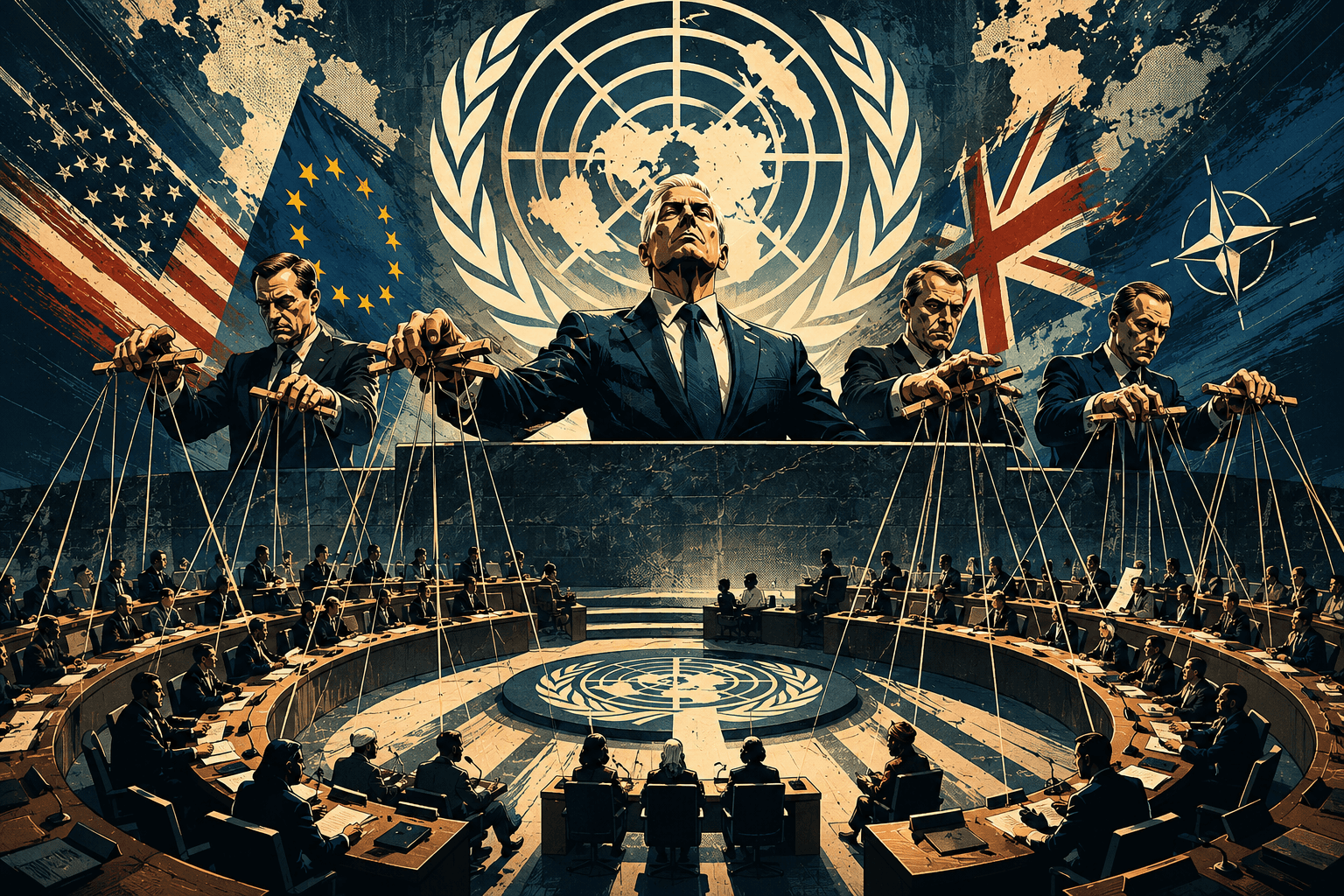
In the summer of 1945, humanity was still counting its dead. Sixty million people had been killed. Cities were ash. And the world's leaders, sitting in a conference hall in San Francisco, made a promise, never again. Out of that grief, out of that moral urgency, the United Nations was born. Its founding charter spoke of saving "succeeding generations from the scourge of war," of reaffirming "faith in fundamental human rights," of building a world governed by something other than raw force. It was, in theory, the most ambitious political project in human history: a universal body where every nation had a voice, and where power would finally be held accountable.
Eighty years on, that promise has a great deal to answer for.
The Ghost of the League
Before there was the UN, there was the League of Nations, the first attempt, after World War I, to build a system of collective security. It failed, catastrophically. Germany, Japan, and Italy all walked out. No enforcement mechanism, no political will, no teeth. By 1939, the world was at war again, and the League was finished. It was formally dissolved on April 19, 1946, handing over its assets, archives, and unfinished ambitions to the newly minted United Nations.
Here is the part worth sitting with: we did not learn from the League of Nations. We renamed it. We rehoused it. We gave it a permanent Security Council, five veto-wielding members, and a New York City address. But the fundamental flaw, that the most powerful nations would never truly cede control, was baked in from day one. The veto power granted to the United States, the United Kingdom, France, Russia, and China was not a feature of multilateralism. It was a safeguard for those who were never really willing to be governed by it.
The UN was designed to contain great power competition. What it actually became was a theatre for it.
Follow the Money
Nothing reveals an institution's politics quite like its budget. The United Nations is, in financial terms, a deeply Western project. The United States alone accounts for roughly 22% of the UN's regular budget and approximately 26% of its peacekeeping budget, figures that have remained structurally dominant since 1945. In 2025, the U.S. assessed contribution was close to $827 million, the single largest national bill in the system. Meanwhile, the U.S. did not appear on the UN's Honour Roll of fully paid members, meaning it leveraged this financial dominance while selectively withholding payment. This pattern repeats across administrations when the UN dares to be inconvenient.
Under the Trump administration's second term, this dynamic sharpened dramatically. The U.S. withdrew from major agencies, froze funding streams, and proposed a FY2026 budget to eliminate contributions to most UN bodies. USAID, which had channelled billions into UN humanitarian operations, was formally shut down on July 1, 2025.
Think about what that tells you. The largest funder can switch off the lights at any time. Not because the humanitarian need disappears. But because the political calculus has shifted in Washington. That is not a neutral international organisation. That is a subscription service, and the biggest subscriber sets the terms.
When It Actually Worked
And we must be- the UN has done real and meaningful things in the world. Since 1948, it has conducted successful peacekeeping operations across dozens of countries: Cambodia, Mozambique, Namibia, El Salvador, Guatemala, Tajikistan, Sierra Leone, Liberia, Timor-Leste, and Kosovo. In these places, the UN facilitated ceasefires, supported democratic transitions, protected civilians, and helped countries close the chapter on conflict. These are not small things. These are lives. These are nations that are more stable today because blue helmets showed up.
UNICEF has vaccinated hundreds of millions of children. The UN Refugee Agency has sheltered and sustained displaced populations at a scale no single government could manage. The World Food Programme feeds tens of millions of people annually. The International Court of Justice, however imperfectly, has offered at least a framework for holding states legally accountable.
So no, the UN is nothing. The honest critique is not that the institution has failed. It's that it works selectively. It works when powerful states allow it, when the political interests of the P5 align with the humanitarian need, and when the conflict in question doesn't involve anyone with a veto or a veto's protégé.
That is the central problem. Not incompetence. Architecture.
Palestine and the Machinery of Impunity
Nothing exposes this architecture more starkly than Palestine. Since October 7, 2023, the United States has vetoed six UN Security Council resolutions demanding a ceasefire in Gaza, including one co-sponsored by 14 of 15 Council members. Six times, a single country blocked an international call to stop a war that UN experts, human rights bodies, and independent legal scholars have described in terms of genocide. Six times, 2.2 million people were told, by the structure of this institution, that their lives did not meet the threshold for political inconvenience.
The broader Palestinian story with the UN is even older and more damning. Decisions about Palestinian statehood, about peace negotiations, about the future of a people, have been made for decades by external powers, without Palestinians meaningfully at the table. The two-state solution has been "the international consensus" for 30 years. It has never arrived. What has arrived, consistently, is the management of Palestinian suffering rather than its resolution.
There is a powerful argument emerging from academic and legal circles, one that came up in a seminar I attended recently- that the obsession with Palestinian statehood as the goal may itself be a distraction. Statehood has been used as a horizon: always on the way, never arrived. The real starting point, the argument goes, should be accountability. Justice first. Before we talk about borders and flags, we must ask who is answerable for the alleged war crimes that have been documented, in real time, in front of the world. Statehood becomes a strategy. Accountability becomes the destination.
The UN, structurally, cannot get us there. Not when the country funding 22% of its budget also holds a veto over any resolution that might inconvenience its regional allies.
The Iran Crisis and the Mask Slips
The latest escalation has made this even harder to ignore. On February 28, 2026, the United States and Israel launched strikes on Iran, killing Supreme Leader Ali Khamenei. Iran retaliated, hitting U.S. military facilities, Gulf infrastructure, and launching waves of ballistic missiles across the region. The Security Council met in emergency session within 24 hours. What happened?
Most Council members either muted their criticism of the U.S. or avoided it altogether. According to observers at the session, the U.S. ambassador at one point referred to the body as the "United States Security Council", apparently a slip, but one that landed with a certain clarity. China objected that the conflict had "neither legitimacy nor legal basis." Russia pushed back. But when the U.S. took over the Council presidency on March 1, the institutional space for meaningful pushback effectively closed. A resolution was eventually adopted condemning Iran's attacks on Gulf states, but the original U.S.-Israeli strikes, and the reported killing of 85 children at a girls' school in Minab, went without equivalent Security Council censure.
This is the institution working exactly as designed, the powerful police others. The powerful are not policed.
Running on Western Narrative
The broader ideological bias of the UN is something that rarely gets said plainly in polite diplomatic circles, but it is there, and it is structural. The Allied powers of World War II conceived the UN. Its headquarters are in New York. Its dominant language, in practice and in cultural assumption, is English. Its founding values, liberal democracy, free markets, and human rights, as defined in 1948, reflect the ideological priorities of the Western powers that built it.
This doesn't mean those values are wrong. But it does mean that the UN has never been a genuinely neutral arbiter. When it promotes certain models of governance, certain definitions of development, certain conceptions of sovereignty, it is not speaking from some apolitical Olympus. It often transmits a worldview. And when nations in the Global South push back, arguing that the rules-based international order was built to advantage those who wrote the rules, they are not being paranoid. They are being historically accurate.
A classmate I was speaking with recently put it this way: "If the UN actually worked, it would not have existed." The idea being that an institution genuinely capable of constraining great-power aggression would have been dismantled by the great powers before it could do so. What survives, then, is what they permitted to survive: the humanitarian arms, the soft diplomacy, the endless resolutions. The parts that don't bite.
The Question We Have to Sit With
The UN has done well. But good is not the same as just. An institution can feed refugees with one hand while protecting their persecutors with the other. It can win a Nobel Peace Prize while failing to stop a genocide. It can pass resolutions, generate reports, hold press conferences, and still leave 2.2 million people wondering why the machinery of the world's most powerful international body cannot produce a ceasefire on their behalf, while it produces one for others, elsewhere, when the political conditions are convenient.
We are told to believe in multilateralism as the alternative to might-makes-right. And the alternative is real. It matters. But the version of multilateralism we have is not neutral. It is hierarchical. It is funded by dominance and structured around veto power. It is an institution that replaced one failed experiment, the League of Nations, with another experiment that hid its failures more elegantly, behind more procedural language, more diplomatic immunity, more committee meetings.
My seminar ended without resolution. The questions just got larger. And I keep coming back to the fundamental one, the one that Palestine forces us to ask, that the US-Iran war forces us to ask, that every Security Council veto forces us to ask:
If the United Nations is the world's last line of defence against the unchecked power of the powerful, then who, exactly, is defending the world against the United Nations?
Header Picture- Ai generated
REFERENCE LIST
Amnesty International (2025). US sixth veto of resolution on Gaza ceasefire is a green light for Israel's campaign of annihilation, 22 September. Available at: https://www.amnesty.org/en/latest/news/2025/09/us-sixth-veto-of-ceasefire-resolution-greenlight-for-israels-campaign-of-annihilation-in-gaza/
BBC News (2024) US vetoes Security Council's Gaza ceasefire resolution, November. Available at: https://feeds.bbci.co.uk/news/articles/cjr4p9rg8zlo
Britannica (2026) League of Nations: history, definition and purpose. Available at: https://www.britannica.com/topic/League-of-Nations
Council on Foreign Relations (2025) How much does the U.S. fund the United Nations?, updated September. Available at: https://www.cfr.org/articles/funding-united-nations-what-impact-do-us-contributions-have-un-agencies-and-programs
Council on Foreign Relations (2026) Iran's war with Israel and the United States, Global Conflict Tracker, updated May. Available at: https://www.cfr.org/global-conflict-tracker/conflict/confrontation-between-united-states-and-iran
DonorTracker (2026) Donor profile: United States, updated February. Available at: https://donortracker.org/donor_profiles/united-states
Insights on India (2025) UN peacekeeping: successes, failures and reform needs, 17 March. Available at: https://www.insightsonindia.com/2025/03/17/upsc-editorial-analysis-evaluating-the-uns-effectiveness-in-conflict-resolution-and-peacekeeping/
International Crisis Group (2026) UN Security Council members limit criticism of U.S. over Iran, 2 March. Available at: https://www.crisisgroup.org/anb/middle-east-north-africa/iran-united-states-israelpalestine-global/un-security-council-members-limit-criticism-us-over-iran
Al Jazeera (2026) UN Security Council adopts resolution condemning Iran's attacks in the Gulf, 12 March. Available at: https://www.aljazeera.com/news/2026/3/12/un-security-council-adopts-resolution-condemning-irans-attacks-in-the-gulf
Lumen Learning The League of Nations, History of Western Civilization II. Available at: https://courses.lumenlearning.com/suny-hccc-worldhistory2/chapter/the-league-of-nations/
United Nations (1945) Charter of the United Nations, signed 26 June 1945, San Francisco. Available at: https://www.un.org/en/about-us/un-charter
United Nations Peacekeeping (no date) Our impact. Available at: https://peacekeeping.un.org/en/our-impact
United Nations Security Council (2026) Iran strikes could trigger wider conflict in Middle East: emergency meeting coverage, SC/16307, 28 February. Available at: https://press.un.org/en/2026/sc16307.doc.htm
United States Department of State (2025) Veto of the United Nations Security Council resolution on Gaza, 5 June. Available at: https://www.state.gov/releases/office-of-the-spokesperson/2025/06/veto-of-the-united-nations-security-council-resolution-on-gaza
World Population Review (2026) UN funding by country 2026. Available at: https://worldpopulationreview.com/country-rankings/un-funding-by-country
TO BE CONTINUED, FOR SUBSCRIBERS ONLY.
This is where the surface ends and the reporting begins.
The complete piece, the full archive, and access to The French Press Circle. Reporting answerable only to its readers.
Already a subscriber ?
Login
Read these on the house, with our compliments.
A selection from the current issue, open to all readers. Read them in full. The rest is one decision away.









In the summer of 1945, humanity was still counting its dead. Sixty million people had been killed. Cities were ash. And the world's leaders, sitting in a conference hall in San Francisco, made a promise, never again. Out of that grief, out of that moral urgency, the United Nations was born. Its founding charter spoke of saving "succeeding generations from the scourge of war," of reaffirming "faith in fundamental human rights," of building a world governed by something other than raw force. It was, in theory, the most ambitious political project in human history: a universal body where every nation had a voice, and where power would finally be held accountable.
Eighty years on, that promise has a great deal to answer for.
The Ghost of the League
Before there was the UN, there was the League of Nations, the first attempt, after World War I, to build a system of collective security. It failed, catastrophically. Germany, Japan, and Italy all walked out. No enforcement mechanism, no political will, no teeth. By 1939, the world was at war again, and the League was finished. It was formally dissolved on April 19, 1946, handing over its assets, archives, and unfinished ambitions to the newly minted United Nations.
Here is the part worth sitting with: we did not learn from the League of Nations. We renamed it. We rehoused it. We gave it a permanent Security Council, five veto-wielding members, and a New York City address. But the fundamental flaw, that the most powerful nations would never truly cede control, was baked in from day one. The veto power granted to the United States, the United Kingdom, France, Russia, and China was not a feature of multilateralism. It was a safeguard for those who were never really willing to be governed by it.
The UN was designed to contain great power competition. What it actually became was a theatre for it.
Follow the Money
Nothing reveals an institution's politics quite like its budget. The United Nations is, in financial terms, a deeply Western project. The United States alone accounts for roughly 22% of the UN's regular budget and approximately 26% of its peacekeeping budget, figures that have remained structurally dominant since 1945. In 2025, the U.S. assessed contribution was close to $827 million, the single largest national bill in the system. Meanwhile, the U.S. did not appear on the UN's Honour Roll of fully paid members, meaning it leveraged this financial dominance while selectively withholding payment. This pattern repeats across administrations when the UN dares to be inconvenient.
Under the Trump administration's second term, this dynamic sharpened dramatically. The U.S. withdrew from major agencies, froze funding streams, and proposed a FY2026 budget to eliminate contributions to most UN bodies. USAID, which had channelled billions into UN humanitarian operations, was formally shut down on July 1, 2025.
Think about what that tells you. The largest funder can switch off the lights at any time. Not because the humanitarian need disappears. But because the political calculus has shifted in Washington. That is not a neutral international organisation. That is a subscription service, and the biggest subscriber sets the terms.
When It Actually Worked
And we must be- the UN has done real and meaningful things in the world. Since 1948, it has conducted successful peacekeeping operations across dozens of countries: Cambodia, Mozambique, Namibia, El Salvador, Guatemala, Tajikistan, Sierra Leone, Liberia, Timor-Leste, and Kosovo. In these places, the UN facilitated ceasefires, supported democratic transitions, protected civilians, and helped countries close the chapter on conflict. These are not small things. These are lives. These are nations that are more stable today because blue helmets showed up.
UNICEF has vaccinated hundreds of millions of children. The UN Refugee Agency has sheltered and sustained displaced populations at a scale no single government could manage. The World Food Programme feeds tens of millions of people annually. The International Court of Justice, however imperfectly, has offered at least a framework for holding states legally accountable.
So no, the UN is nothing. The honest critique is not that the institution has failed. It's that it works selectively. It works when powerful states allow it, when the political interests of the P5 align with the humanitarian need, and when the conflict in question doesn't involve anyone with a veto or a veto's protégé.
That is the central problem. Not incompetence. Architecture.
Palestine and the Machinery of Impunity
Nothing exposes this architecture more starkly than Palestine. Since October 7, 2023, the United States has vetoed six UN Security Council resolutions demanding a ceasefire in Gaza, including one co-sponsored by 14 of 15 Council members. Six times, a single country blocked an international call to stop a war that UN experts, human rights bodies, and independent legal scholars have described in terms of genocide. Six times, 2.2 million people were told, by the structure of this institution, that their lives did not meet the threshold for political inconvenience.
The broader Palestinian story with the UN is even older and more damning. Decisions about Palestinian statehood, about peace negotiations, about the future of a people, have been made for decades by external powers, without Palestinians meaningfully at the table. The two-state solution has been "the international consensus" for 30 years. It has never arrived. What has arrived, consistently, is the management of Palestinian suffering rather than its resolution.
There is a powerful argument emerging from academic and legal circles, one that came up in a seminar I attended recently- that the obsession with Palestinian statehood as the goal may itself be a distraction. Statehood has been used as a horizon: always on the way, never arrived. The real starting point, the argument goes, should be accountability. Justice first. Before we talk about borders and flags, we must ask who is answerable for the alleged war crimes that have been documented, in real time, in front of the world. Statehood becomes a strategy. Accountability becomes the destination.
The UN, structurally, cannot get us there. Not when the country funding 22% of its budget also holds a veto over any resolution that might inconvenience its regional allies.
The Iran Crisis and the Mask Slips
The latest escalation has made this even harder to ignore. On February 28, 2026, the United States and Israel launched strikes on Iran, killing Supreme Leader Ali Khamenei. Iran retaliated, hitting U.S. military facilities, Gulf infrastructure, and launching waves of ballistic missiles across the region. The Security Council met in emergency session within 24 hours. What happened?
Most Council members either muted their criticism of the U.S. or avoided it altogether. According to observers at the session, the U.S. ambassador at one point referred to the body as the "United States Security Council", apparently a slip, but one that landed with a certain clarity. China objected that the conflict had "neither legitimacy nor legal basis." Russia pushed back. But when the U.S. took over the Council presidency on March 1, the institutional space for meaningful pushback effectively closed. A resolution was eventually adopted condemning Iran's attacks on Gulf states, but the original U.S.-Israeli strikes, and the reported killing of 85 children at a girls' school in Minab, went without equivalent Security Council censure.
This is the institution working exactly as designed, the powerful police others. The powerful are not policed.
Running on Western Narrative
The broader ideological bias of the UN is something that rarely gets said plainly in polite diplomatic circles, but it is there, and it is structural. The Allied powers of World War II conceived the UN. Its headquarters are in New York. Its dominant language, in practice and in cultural assumption, is English. Its founding values, liberal democracy, free markets, and human rights, as defined in 1948, reflect the ideological priorities of the Western powers that built it.
This doesn't mean those values are wrong. But it does mean that the UN has never been a genuinely neutral arbiter. When it promotes certain models of governance, certain definitions of development, certain conceptions of sovereignty, it is not speaking from some apolitical Olympus. It often transmits a worldview. And when nations in the Global South push back, arguing that the rules-based international order was built to advantage those who wrote the rules, they are not being paranoid. They are being historically accurate.
A classmate I was speaking with recently put it this way: "If the UN actually worked, it would not have existed." The idea being that an institution genuinely capable of constraining great-power aggression would have been dismantled by the great powers before it could do so. What survives, then, is what they permitted to survive: the humanitarian arms, the soft diplomacy, the endless resolutions. The parts that don't bite.
The Question We Have to Sit With
The UN has done well. But good is not the same as just. An institution can feed refugees with one hand while protecting their persecutors with the other. It can win a Nobel Peace Prize while failing to stop a genocide. It can pass resolutions, generate reports, hold press conferences, and still leave 2.2 million people wondering why the machinery of the world's most powerful international body cannot produce a ceasefire on their behalf, while it produces one for others, elsewhere, when the political conditions are convenient.
We are told to believe in multilateralism as the alternative to might-makes-right. And the alternative is real. It matters. But the version of multilateralism we have is not neutral. It is hierarchical. It is funded by dominance and structured around veto power. It is an institution that replaced one failed experiment, the League of Nations, with another experiment that hid its failures more elegantly, behind more procedural language, more diplomatic immunity, more committee meetings.
My seminar ended without resolution. The questions just got larger. And I keep coming back to the fundamental one, the one that Palestine forces us to ask, that the US-Iran war forces us to ask, that every Security Council veto forces us to ask:
If the United Nations is the world's last line of defence against the unchecked power of the powerful, then who, exactly, is defending the world against the United Nations?
Header Picture- Ai generated
REFERENCE LIST
Amnesty International (2025). US sixth veto of resolution on Gaza ceasefire is a green light for Israel's campaign of annihilation, 22 September. Available at: https://www.amnesty.org/en/latest/news/2025/09/us-sixth-veto-of-ceasefire-resolution-greenlight-for-israels-campaign-of-annihilation-in-gaza/
BBC News (2024) US vetoes Security Council's Gaza ceasefire resolution, November. Available at: https://feeds.bbci.co.uk/news/articles/cjr4p9rg8zlo
Britannica (2026) League of Nations: history, definition and purpose. Available at: https://www.britannica.com/topic/League-of-Nations
Council on Foreign Relations (2025) How much does the U.S. fund the United Nations?, updated September. Available at: https://www.cfr.org/articles/funding-united-nations-what-impact-do-us-contributions-have-un-agencies-and-programs
Council on Foreign Relations (2026) Iran's war with Israel and the United States, Global Conflict Tracker, updated May. Available at: https://www.cfr.org/global-conflict-tracker/conflict/confrontation-between-united-states-and-iran
DonorTracker (2026) Donor profile: United States, updated February. Available at: https://donortracker.org/donor_profiles/united-states
Insights on India (2025) UN peacekeeping: successes, failures and reform needs, 17 March. Available at: https://www.insightsonindia.com/2025/03/17/upsc-editorial-analysis-evaluating-the-uns-effectiveness-in-conflict-resolution-and-peacekeeping/
International Crisis Group (2026) UN Security Council members limit criticism of U.S. over Iran, 2 March. Available at: https://www.crisisgroup.org/anb/middle-east-north-africa/iran-united-states-israelpalestine-global/un-security-council-members-limit-criticism-us-over-iran
Al Jazeera (2026) UN Security Council adopts resolution condemning Iran's attacks in the Gulf, 12 March. Available at: https://www.aljazeera.com/news/2026/3/12/un-security-council-adopts-resolution-condemning-irans-attacks-in-the-gulf
Lumen Learning The League of Nations, History of Western Civilization II. Available at: https://courses.lumenlearning.com/suny-hccc-worldhistory2/chapter/the-league-of-nations/
United Nations (1945) Charter of the United Nations, signed 26 June 1945, San Francisco. Available at: https://www.un.org/en/about-us/un-charter
United Nations Peacekeeping (no date) Our impact. Available at: https://peacekeeping.un.org/en/our-impact
United Nations Security Council (2026) Iran strikes could trigger wider conflict in Middle East: emergency meeting coverage, SC/16307, 28 February. Available at: https://press.un.org/en/2026/sc16307.doc.htm
United States Department of State (2025) Veto of the United Nations Security Council resolution on Gaza, 5 June. Available at: https://www.state.gov/releases/office-of-the-spokesperson/2025/06/veto-of-the-united-nations-security-council-resolution-on-gaza
World Population Review (2026) UN funding by country 2026. Available at: https://worldpopulationreview.com/country-rankings/un-funding-by-country
TO BE CONTINUED, FOR SUBSCRIBERS ONLY.
This is where the surface ends and the reporting begins.
The complete piece, the full archive, and access to The French Press Circle. Reporting answerable only to its readers.
Already a subscriber ?
Login
Read these on the house, with our compliments.
A selection from the current issue, open to all readers. Read them in full. The rest is one decision away.