Viktor&Rolf Haute Couture AW26 "Gilded Age 2.0"
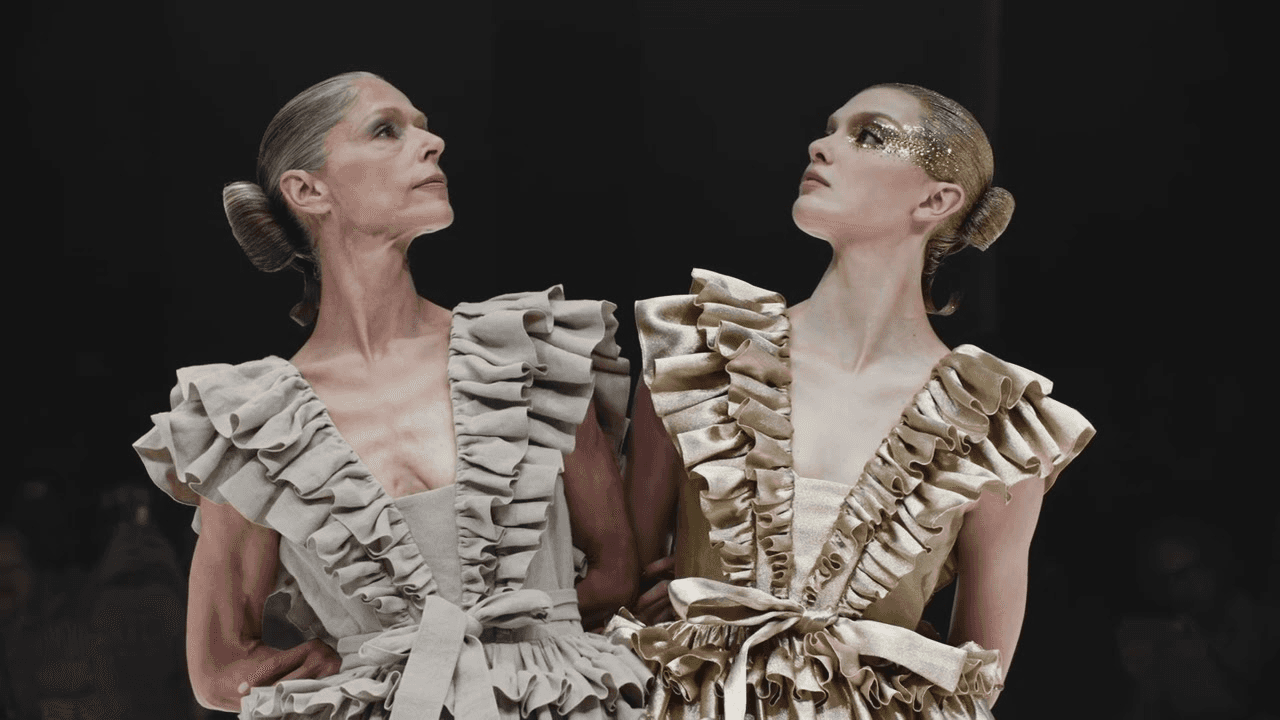
The Gilded Age took its name from Mark Twain as an accusation before history softened it into a period label: gold as veneer, splendor as surface treatment over base metal. Viktor Horsting and Rolf Snoeren reached for the phrase deliberately, titling their fall 2026 couture collection "Gilded Age 2.0" as a nod to the era we're living in now, with Snoeren adding that the goal was to tease beauty out of decadence. The staging did most of the philosophical work. On a circular platform built to resemble a bedroom, models Nathalie Haerlemans and Elpida Voryas Georgiadi mirrored each other's movements, as though separated by a looking glass that never quite reflected true. In near-perfect unison, the two reached into garment bags, boxes, and drawers for outfits they pulled on and off unaided.
A House Built on Blurring the Line Between Fashion and Art
Founded in Amsterdam and Paris in 1993 by Dutch designers Viktor Horsting and Rolf Snoeren after they met at the Arnhem Academy of Art and Design, Viktor & Rolf has spent more than three decades positioning itself less as a clothing label than as a running conceptual project that happens to use garments as its medium. The pair call themselves "fashion artists," and the description has stuck: their early, image-driven collections found more traction in museums than on sales floors, and the house has since been the subject of retrospectives at institutions including the Barbican, the Kunsthal Rotterdam, and, in 2025, the High Museum of Art in Atlanta. A brief, commercially minded detour into ready-to-wear and menswear in the 2000s, alongside blockbuster fragrance launches like Flowerbomb and Spicebomb, gave way in 2015 to a full return to haute couture only, a deliberate narrowing that let Horsting and Snoeren chase wearability, function, and form as open questions rather than sales targets. That decision set the template "Gilded Age 2.0" now follows: a small, tightly conceptual couture show built around a single idea, staged like an installation, and designed to generate as much discourse as desire. The house has form for exactly this kind of device-driven storytelling, having previously sent models onto the runway wrapped in duvets, dressed in slogans, and swathed in "paintings" peeled off the wall mid-show, a lineage this bedroom-as-runway concept extends rather than departs from.
An imperfect mirror is a precise choice. A true reflection would have handed the audience symmetry, a reassuring visual rhyme; this one offered drift instead, two bodies performing identical gestures and arriving at different results. The casting sharpened that drift into a thesis: just two models, one older and one younger, spent the entire show dressing and undressing, treating the set's furniture as their wardrobe. Read one way, the pair are strangers divided by class, gold on one side of the glass and sackcloth on the other. Read another way, they're the same woman at two points in her life, reaching into the same drawers, and the mirror is time rather than money. The collection sustains both readings at once, and that's where its intelligence lives.
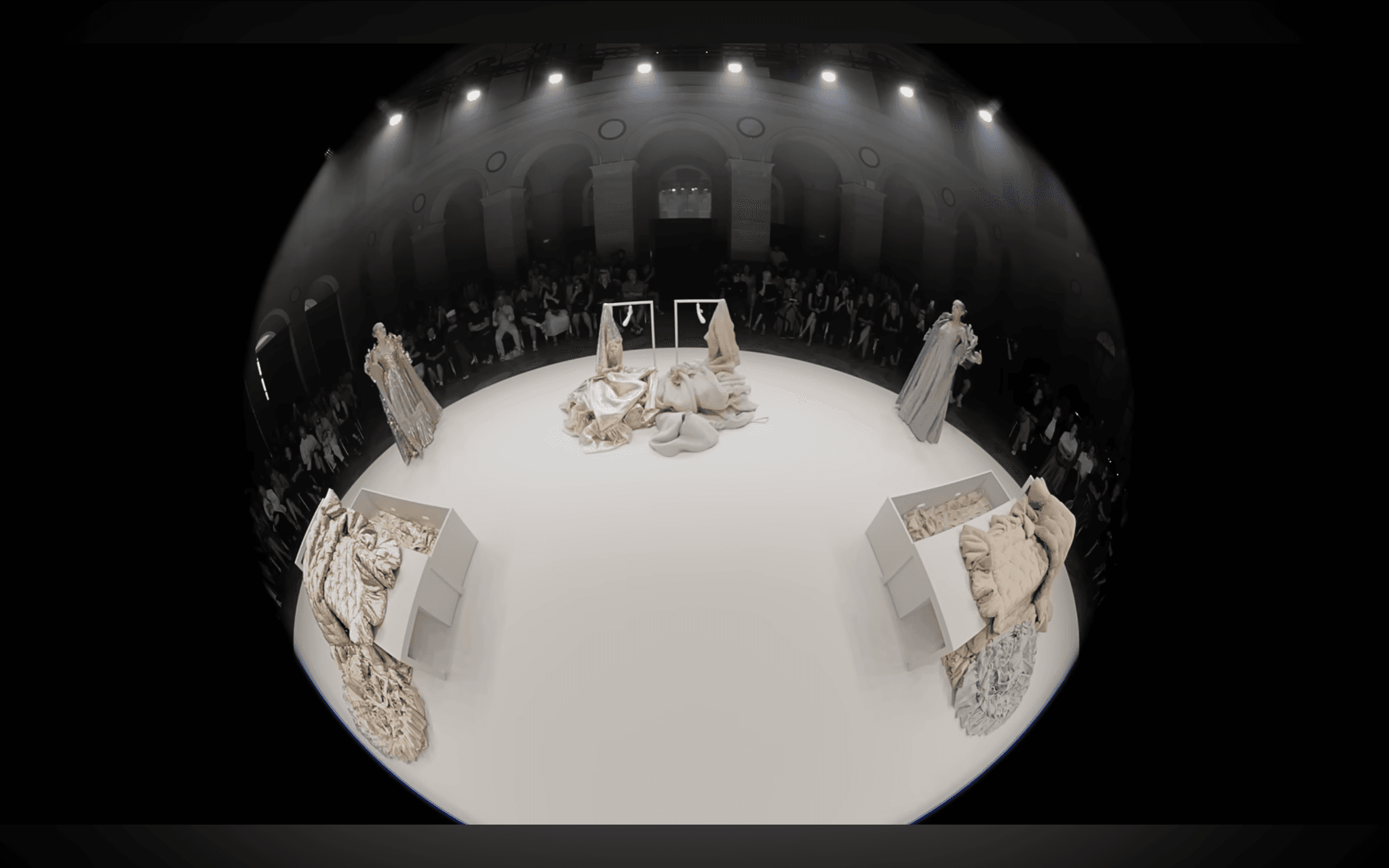
The bedroom set with oversized wardrobes and beds. Credit: Courtesy of Viktor & Rolf, via Youtube.
The sociologist Erving Goffman divided social life into front stage, where the self is performed, and backstage, where it is assembled. A bedroom is the canonical backstage of dress, the one room where clothing exists in its unperformed state, half on, inside out, hanging in the dark. Viktor & Rolf rotated that room, literally, into the proscenium. Duvets were whipped off beds and wrapped into couture gowns, candy-wrapper hats emerged from drawers and lavish gold coats appeared as though they'd been hanging in those wardrobes all along. The assembly of the self became the show; there was no finished self to reveal, only the perpetual act of dressing. John Berger's formulation from Ways of Seeing hovers over the whole arrangement: a woman is taught to watch herself being watched, to carry her own surveyor within her. Here two women dress before an audience without once acknowledging it, absorbed in their reflection instead, and the couture crowd is placed in the position of the internalised watcher Berger described, present, consuming, unaddressed.
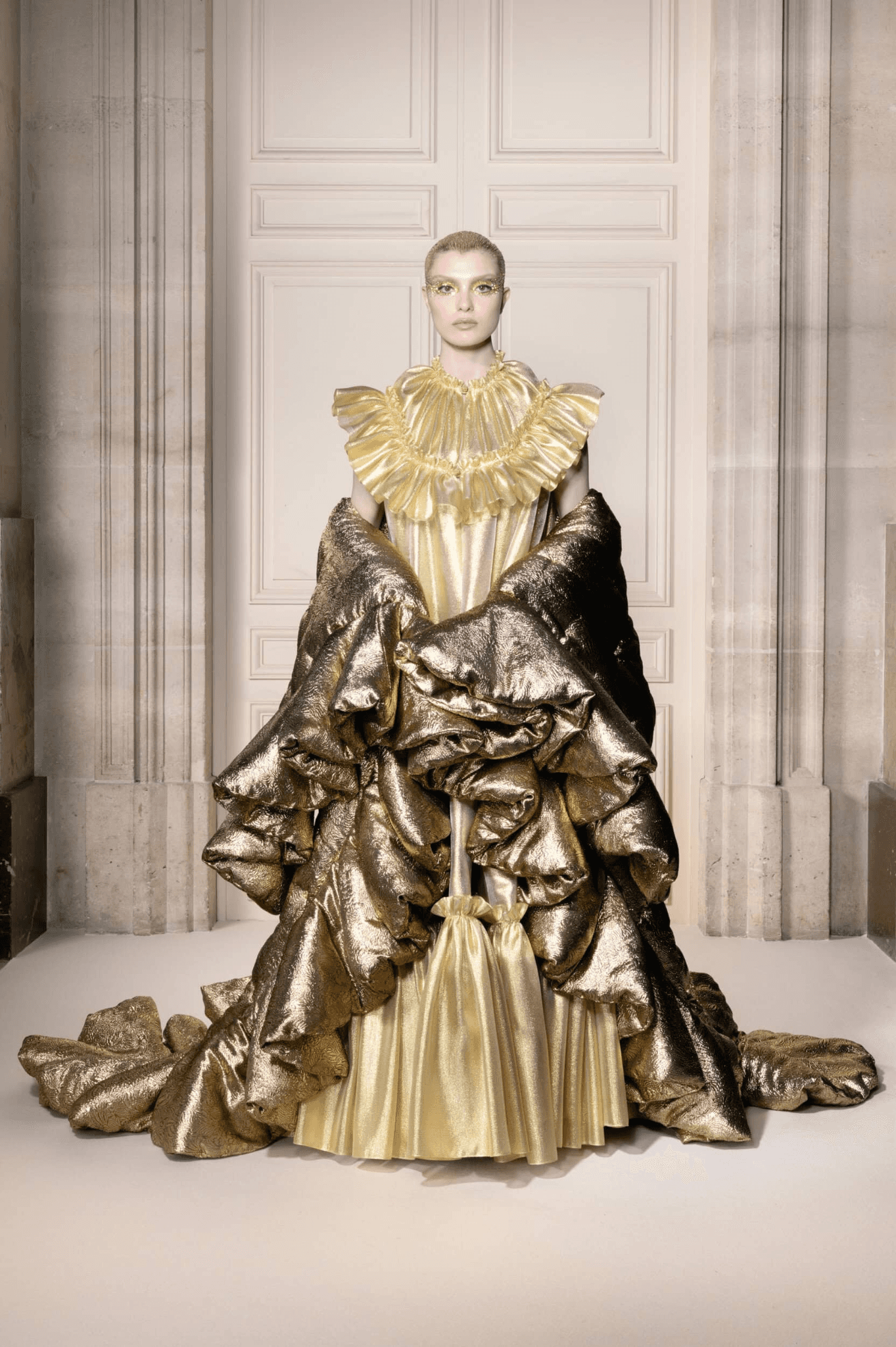
The garments carried the argument stitch by stitch. Every lavish gold look had a matching twin in coarse burlap, reducing the silhouette to its bones without losing an ounce of impact. On one pairing, beaded gold fringes on a minidress were echoed in the way edges were painstakingly frayed on the more modest material.
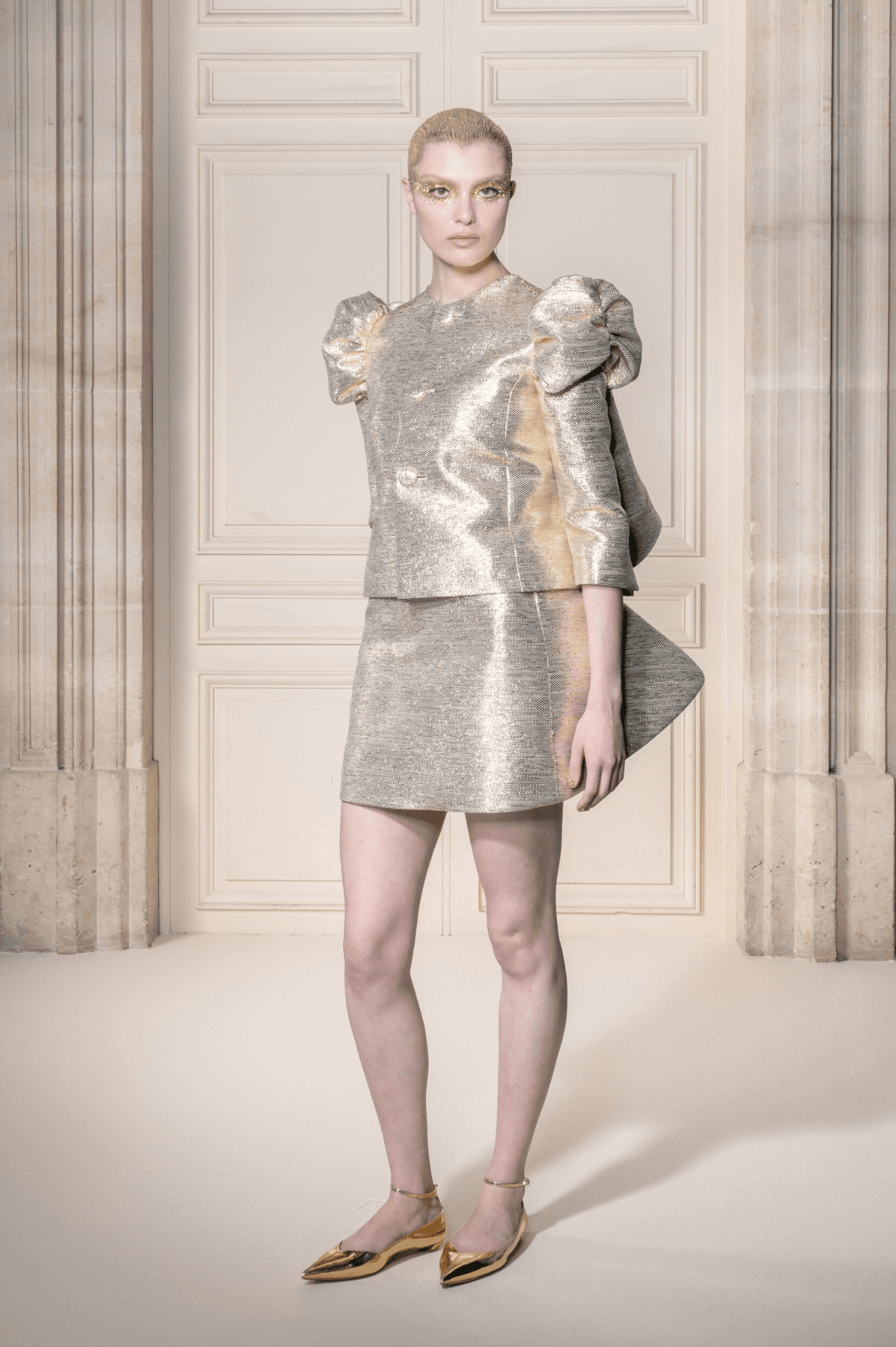
Credit: Launchmetrics Spotlight for The Impression. Gold beaded fringe answered by hand-frayed edges on the burlap counterpart.
Fraying is ordinarily what happens to cloth when labor stops; here it was produced by labor, hour upon hour of deliberate unravelling, so that the burlap's apparent poverty cost as much handwork as the gold's abundance. Veblen, writing during the first Gilded Age, argued that dress advertises wealth through visible waste; this collection quietly inverts him, spending couture hours on a material whose entire signification is thrift. A viewer on theFashionSpot forums caught the mechanism exactly, admiring the laminated jute scrim, and the contrast of the frayed trim and the gold bugle beads acting as a frayed trim. On another pairing, French knots running up the skirt, bodice and each of the many bows of one look did not look like a cop-out compared to its sequined counterpart, embroidery's slowest stitch answering embellishment's brightest one.
A coat with ruffled mutton-leg sleeves had roses all over, geometric origami-style ones reminiscent of Charles Rennie Mackintosh at the hem that evolved into three-dimensional rounded versions at the shoulders, a single motif travelling from flat abstraction to full bloom along the garment's vertical axis, restraint and decadence resolved within one silhouette rather than split across two bodies.
Credit: Launchmetrics Spotlight for The Impression. The rose coat with ruffled mutton-leg sleeves, its motif travelling from geometric abstraction to dimensional bloom.
The finale replaced metaphor with typography: the words "Restraint" and "Decadence" perched on the shoulders of the final pair in 3D lettering spelled out the topic at hand. The house has worn its language before, the "NO" coat of 2008, the slogan gowns of 2019, and the gesture sits in a lineage running through Barbara Kruger: text as ornament, caption as garment. Some in the audience wanted less sugar around the idea; one forum critic found the lineup excessively bulky, with the amount of bows and frills making it all too sugary, preferring a collection of just that scrim accented by the gold.
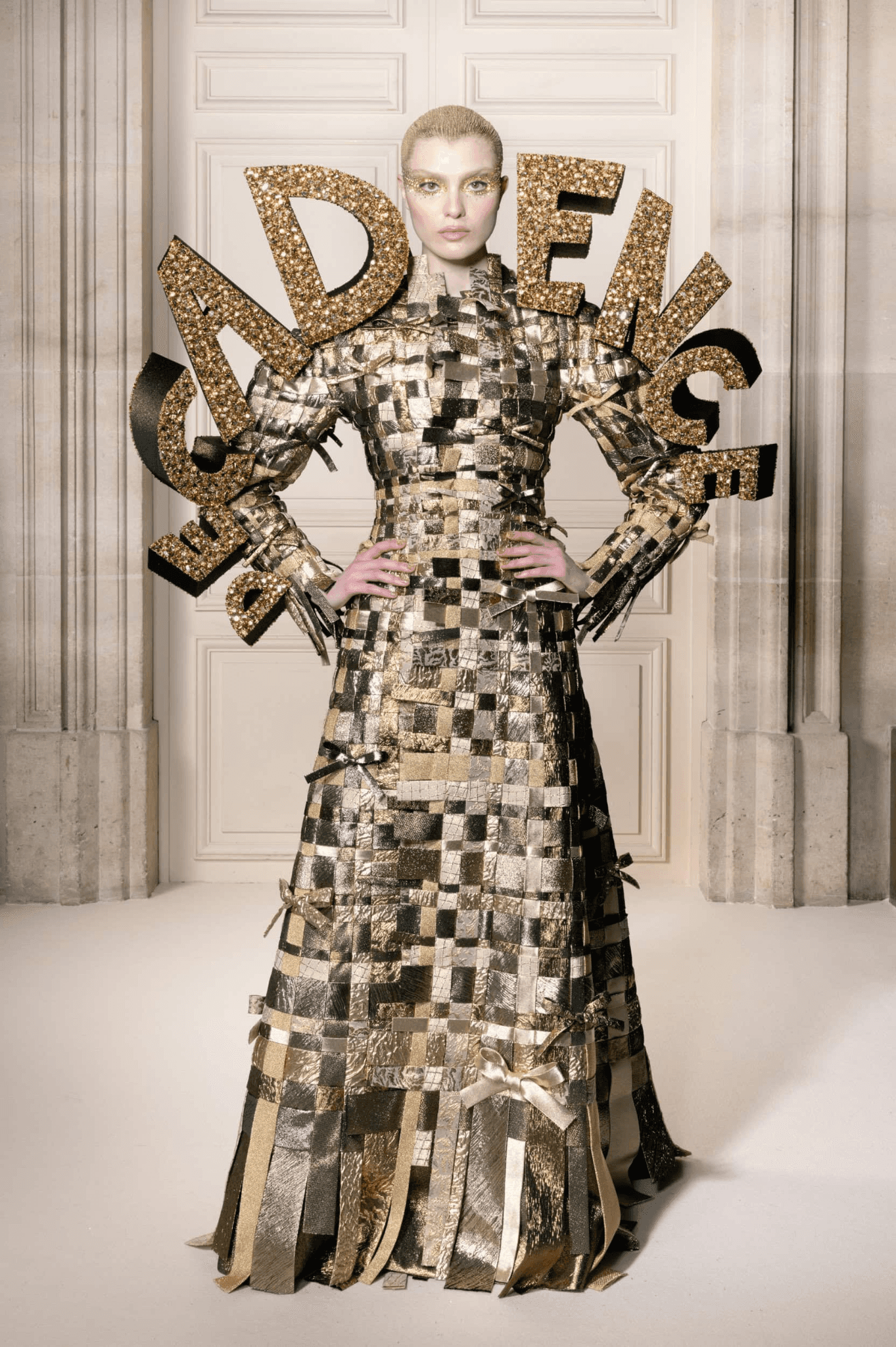
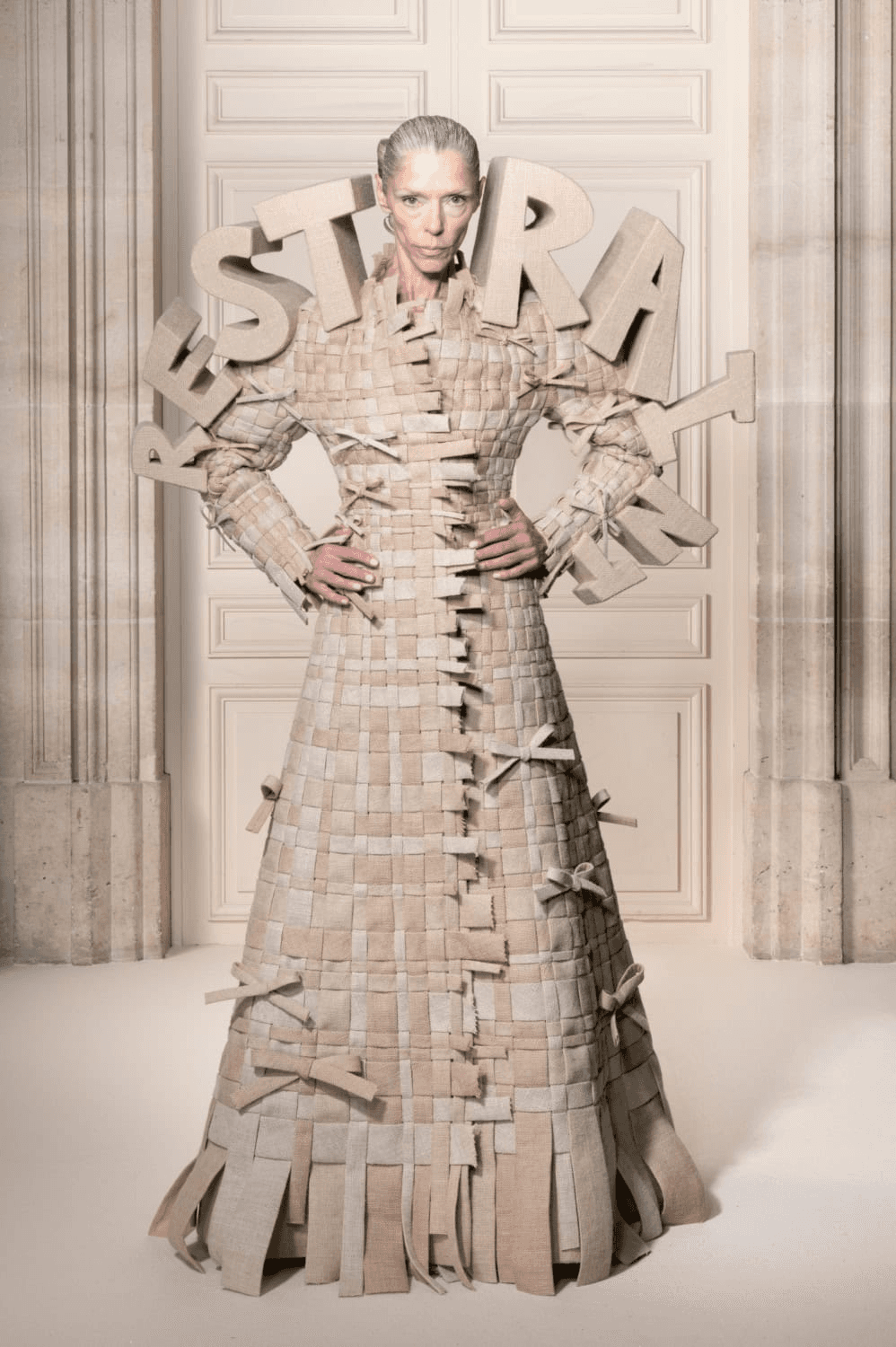
Credit: Launchmetrics Spotlight for The Impression. The finale pair, "Restraint" and "Decadence" spelled out in 3D lettering at the shoulder.
WWD's reviewer opened with the question the whole apparatus was built to pose: would a couture gown in anything but the most exquisite fabrics still be seen as precious? Depends how shallow you are. The bedroom kept turning, the two women kept dressing, and the mirror between them kept refusing to reflect cleanly. The review's last line left the era's verdict where the audience could reach it: in the age of social media, it goes without saying which side seems to be pulling ahead.
TO BE CONTINUED, FOR SUBSCRIBERS ONLY.
This is where the surface ends and the reporting begins.
The complete piece, the full archive, and access to The French Press Circle. Reporting answerable only to its readers.
Already a subscriber ?
Login
Read these on the house, with our compliments.
A selection from the current issue, open to all readers. Read them in full. The rest is one decision away.









Viktor&Rolf Haute Couture AW26 "Gilded Age 2.0"
The Gilded Age took its name from Mark Twain as an accusation before history softened it into a period label: gold as veneer, splendor as surface treatment over base metal. Viktor Horsting and Rolf Snoeren reached for the phrase deliberately, titling their fall 2026 couture collection "Gilded Age 2.0" as a nod to the era we're living in now, with Snoeren adding that the goal was to tease beauty out of decadence. The staging did most of the philosophical work. On a circular platform built to resemble a bedroom, models Nathalie Haerlemans and Elpida Voryas Georgiadi mirrored each other's movements, as though separated by a looking glass that never quite reflected true. In near-perfect unison, the two reached into garment bags, boxes, and drawers for outfits they pulled on and off unaided.
A House Built on Blurring the Line Between Fashion and Art
Founded in Amsterdam and Paris in 1993 by Dutch designers Viktor Horsting and Rolf Snoeren after they met at the Arnhem Academy of Art and Design, Viktor & Rolf has spent more than three decades positioning itself less as a clothing label than as a running conceptual project that happens to use garments as its medium. The pair call themselves "fashion artists," and the description has stuck: their early, image-driven collections found more traction in museums than on sales floors, and the house has since been the subject of retrospectives at institutions including the Barbican, the Kunsthal Rotterdam, and, in 2025, the High Museum of Art in Atlanta. A brief, commercially minded detour into ready-to-wear and menswear in the 2000s, alongside blockbuster fragrance launches like Flowerbomb and Spicebomb, gave way in 2015 to a full return to haute couture only, a deliberate narrowing that let Horsting and Snoeren chase wearability, function, and form as open questions rather than sales targets. That decision set the template "Gilded Age 2.0" now follows: a small, tightly conceptual couture show built around a single idea, staged like an installation, and designed to generate as much discourse as desire. The house has form for exactly this kind of device-driven storytelling, having previously sent models onto the runway wrapped in duvets, dressed in slogans, and swathed in "paintings" peeled off the wall mid-show, a lineage this bedroom-as-runway concept extends rather than departs from.
An imperfect mirror is a precise choice. A true reflection would have handed the audience symmetry, a reassuring visual rhyme; this one offered drift instead, two bodies performing identical gestures and arriving at different results. The casting sharpened that drift into a thesis: just two models, one older and one younger, spent the entire show dressing and undressing, treating the set's furniture as their wardrobe. Read one way, the pair are strangers divided by class, gold on one side of the glass and sackcloth on the other. Read another way, they're the same woman at two points in her life, reaching into the same drawers, and the mirror is time rather than money. The collection sustains both readings at once, and that's where its intelligence lives.
The bedroom set with oversized wardrobes and beds. Credit: Courtesy of Viktor & Rolf, via Youtube.
The sociologist Erving Goffman divided social life into front stage, where the self is performed, and backstage, where it is assembled. A bedroom is the canonical backstage of dress, the one room where clothing exists in its unperformed state, half on, inside out, hanging in the dark. Viktor & Rolf rotated that room, literally, into the proscenium. Duvets were whipped off beds and wrapped into couture gowns, candy-wrapper hats emerged from drawers and lavish gold coats appeared as though they'd been hanging in those wardrobes all along. The assembly of the self became the show; there was no finished self to reveal, only the perpetual act of dressing. John Berger's formulation from Ways of Seeing hovers over the whole arrangement: a woman is taught to watch herself being watched, to carry her own surveyor within her. Here two women dress before an audience without once acknowledging it, absorbed in their reflection instead, and the couture crowd is placed in the position of the internalised watcher Berger described, present, consuming, unaddressed.
The garments carried the argument stitch by stitch. Every lavish gold look had a matching twin in coarse burlap, reducing the silhouette to its bones without losing an ounce of impact. On one pairing, beaded gold fringes on a minidress were echoed in the way edges were painstakingly frayed on the more modest material.
Credit: Launchmetrics Spotlight for The Impression. Gold beaded fringe answered by hand-frayed edges on the burlap counterpart.
Fraying is ordinarily what happens to cloth when labor stops; here it was produced by labor, hour upon hour of deliberate unravelling, so that the burlap's apparent poverty cost as much handwork as the gold's abundance. Veblen, writing during the first Gilded Age, argued that dress advertises wealth through visible waste; this collection quietly inverts him, spending couture hours on a material whose entire signification is thrift. A viewer on theFashionSpot forums caught the mechanism exactly, admiring the laminated jute scrim, and the contrast of the frayed trim and the gold bugle beads acting as a frayed trim. On another pairing, French knots running up the skirt, bodice and each of the many bows of one look did not look like a cop-out compared to its sequined counterpart, embroidery's slowest stitch answering embellishment's brightest one.
A coat with ruffled mutton-leg sleeves had roses all over, geometric origami-style ones reminiscent of Charles Rennie Mackintosh at the hem that evolved into three-dimensional rounded versions at the shoulders, a single motif travelling from flat abstraction to full bloom along the garment's vertical axis, restraint and decadence resolved within one silhouette rather than split across two bodies.
Credit: Launchmetrics Spotlight for The Impression. The rose coat with ruffled mutton-leg sleeves, its motif travelling from geometric abstraction to dimensional bloom.
The finale replaced metaphor with typography: the words "Restraint" and "Decadence" perched on the shoulders of the final pair in 3D lettering spelled out the topic at hand. The house has worn its language before, the "NO" coat of 2008, the slogan gowns of 2019, and the gesture sits in a lineage running through Barbara Kruger: text as ornament, caption as garment. Some in the audience wanted less sugar around the idea; one forum critic found the lineup excessively bulky, with the amount of bows and frills making it all too sugary, preferring a collection of just that scrim accented by the gold.
Credit: Launchmetrics Spotlight for The Impression. The finale pair, "Restraint" and "Decadence" spelled out in 3D lettering at the shoulder.
WWD's reviewer opened with the question the whole apparatus was built to pose: would a couture gown in anything but the most exquisite fabrics still be seen as precious? Depends how shallow you are. The bedroom kept turning, the two women kept dressing, and the mirror between them kept refusing to reflect cleanly. The review's last line left the era's verdict where the audience could reach it: in the age of social media, it goes without saying which side seems to be pulling ahead.
TO BE CONTINUED, FOR SUBSCRIBERS ONLY.
This is where the surface ends and the reporting begins.
The complete piece, the full archive, and access to The French Press Circle. Reporting answerable only to its readers.
Already a subscriber ?
Login
Read these on the house, with our compliments.
A selection from the current issue, open to all readers. Read them in full. The rest is one decision away.