
The Man on the Wires

The image arrives like a still from a dream. A man stands barefoot on polished concrete, inside a jacket that seems to float around him. Fine wires stretch from its shoulders and sleeve to points beyond the frame, holding it perfectly in place. Sculpted, rib-pleated and closed with a single long zip, it is couture as suspension: a garment that commands the air on its own terms.
The man moves through it with grace. His face dips into the high funnel collar. One arm extends from a sleeve cut long enough to pour over the hand. The other rests on a bare hip, a tattooed shoulder catching the light, the legs entirely free.
It is the defining frame of The Body, In Form, Amit Aggarwal's new menswear campaign, and it poses an elegant question. What holds a man in place, and what happens when he steps forward? The campaign places the body at the heart of the work, celebrating "its strength, vulnerability, instinct and presence." Here, the structure keeps its shape and the man finds his freedom. Both are beautiful.
The Engineer's Son
Aggarwal's fascination with structure begins at home. He grew up in a family of engineers and scientists, and his ideas about form took shape as he watched his father work on engineering projects. From those early years came a lasting instinct: every beautiful shape is held up by something intelligent.
Tailoring is engineering in cloth. The built shoulder, the canvassed chest and the crisp lapel all carry weight, shaping the posture of authority men have worn for more than a century.

Aggarwal honours that system and then rebuilds it with a sculptor's freedom. In the words of the campaign, "Tailoring is sharpened and displaced. Shoulders become architectural." The proof is a black bandhgala of rare precision. Its mandarin collar and ornate buttons speak the language of ceremony. Across the front, fan-pleated panels sweep down from the shoulders, cinch at the waist into an hourglass and flare open again over the hip. Paired with wide, softly curved trousers and glossy sculpted shoes, it carries the poise of a sherwani and the drama of a Paris salon.
The collection also continues a journey. Aggarwal presented his first standalone menswear collection, Victore, in 2018, an exploration of finding victory within oneself. Eight years on, that inward gaze has turned beautifully physical, and the clothes now open onto the body itself.
The Art of the Drape

The most poetic look in the campaign is also its most Indian. A black velvet tuxedo jacket with a sweeping shawl lapel falls open over a bare chest. From the shoulder, a band of pleated fabric threaded with antique gold crosses the torso on the diagonal like a ceremonial sash. Below, a length of black cloth flecked with gold dots is wrapped and folded at the waist, then parts high on one leg as it moves.

It reads as evening wear and heirloom in a single gesture: a dinner jacket, a dhoti and an angavastram at once. Long before the Western suit reached the subcontinent, Indian men dressed in lengths of cloth wrapped and draped around the body, shaped by the person who wore them. Aggarwal returns to that fluid grammar with a couturier's polish.
The velvet holds its line while the drape flows freely beneath it. The campaign describes a deliberate tension between "rigid and fluid, exposed and protected, masculine and sensual." On this body, the two traditions meet in perfect balance. Indian menswear has always carried this fluidity, and Aggarwal brings it gloriously back into view.
Another Skin

Skin plays a starring role in these images. Tattoos trace the arms and legs. A butterfly rests on a sternum beneath a row of crescent moons. Bare feet meet bare concrete. The men appear exactly as they are, and the clothes arrive as a second layer of identity.
The campaign describes the garment as another skin, "one that can reveal, protect, transform and distort." Aggarwal's pieces do all four at once. A sculpted jacket shields the torso and leaves the legs gracefully bare. A velvet lapel frames the shoulders and opens to reveal the chest. The boundary between fabric and flesh shifts with every frame.
For a designer celebrated for couture sculpted to the female form, this marks an exciting new chapter. Men are invited to be vulnerable and powerful in the same breath. Here, exposure becomes one more element of the design.
Sculpted from Within

In another frame, a man in the pleated bandhgala stands beside a striking wall installation: a dark horizontal bar from which hangs a cascade of black teardrops, some full and heavy, some as small as seeds. They suggest raindrops, tears, seed pods or artefacts from a distant world.
The campaign treats these objects as part of the cast, describing them as "organic yet engineered" and as natural extensions of the body. Their silhouette echoes the jacket's pleats, which also gather, swell and fall.
The idea runs through Aggarwal's recent work. For ARCANUM, his India Couture Week collection in 2025, he built garments from the structure of DNA. He told Esquire India that one structured tuxedo, crafted from handwoven metallic strips and moulded polymer veins, was designed to look like an exoskeleton grown from the body itself. The Body, In Form carries that vision from the couture runway into menswear. The fossil, the armour and the seed share one purpose: a shape the body creates to protect what lies within.
Two Moods, One Season
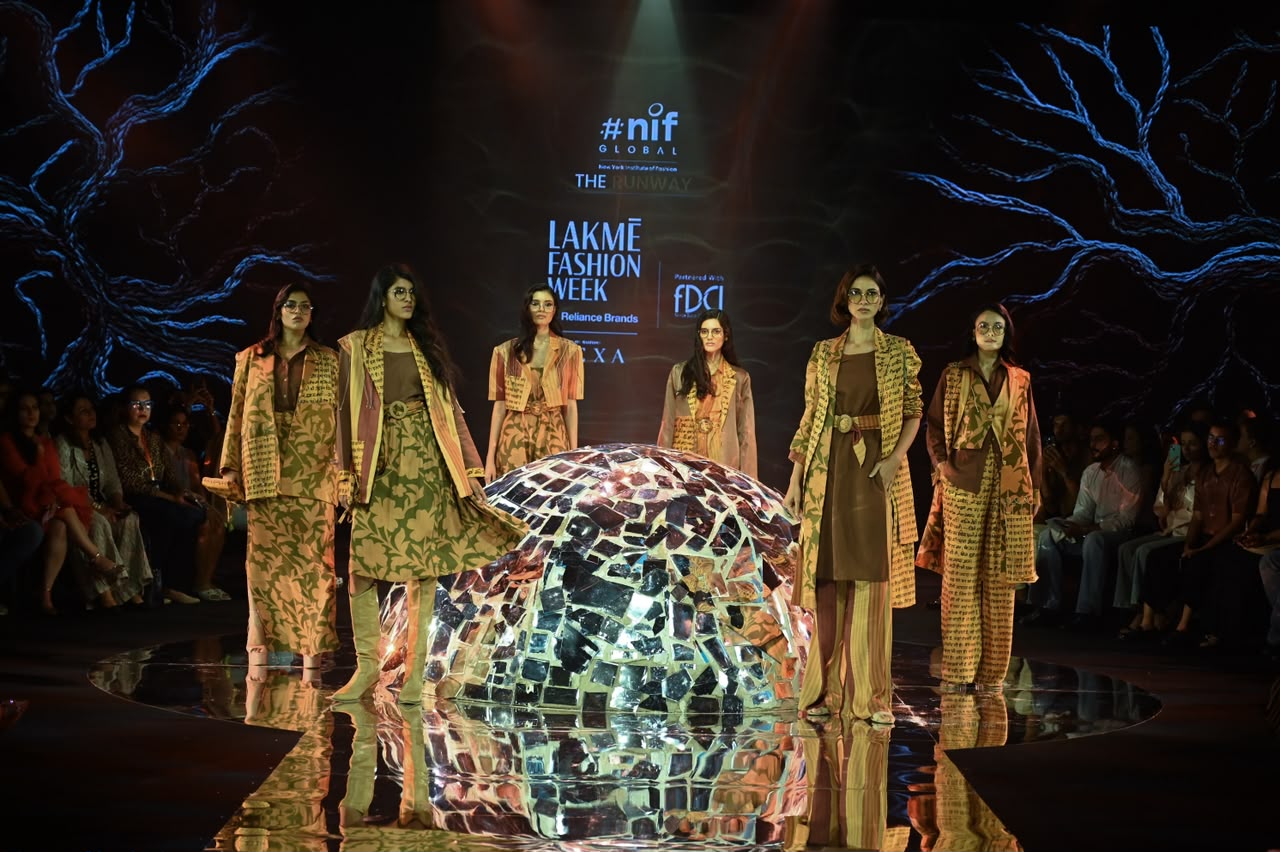
The timing makes the campaign even more compelling. Earlier this month, Aggarwal's prêt label AM:IT closed the Lakmé Fashion Week grand finale with On a Day Like Today, a joyful collection inspired by childhood memories of growing up in India. Balloons and ice-cream carts filled the runway, and the clothes burst with colour from a designer whose own wardrobe and couture favour monochrome.
Weeks later came The Body, In Form: grey walls, black cloth, bare feet and stillness. One designer, two moods, one season.
Together, they reveal the full range of his imagination. The campaign imagines a man who is commanding yet subtle, sensual yet sincere, ceremonial yet entirely modern. A designer who creates both the ice-cream cart and the wired jacket embodies that same richness. A man can hold many versions of himself, and each one deserves its own beautiful form.
What a Man Can Contain
This year, Aggarwal's couture has dressed Björk on stage and graced the Cannes red carpet. His menswear speaks in a quieter voice, and it may prove his boldest work yet. It offers men something rare and generous: the freedom to choose their own form.
Return to the man on the wires. The jacket holds its perfect shape, supported by forces beyond the frame. It stands ready, whenever he chooses to wear it.
The campaign closes on its own thesis: menswear as a way to explore "what a man can contain." The scaffolding stands tall. The skin is his.
TO BE CONTINUED, FOR SUBSCRIBERS ONLY.
This is where the surface ends and the reporting begins.
The complete piece, the full archive, and access to The French Press Circle. Reporting answerable only to its readers.
Already a subscriber ?
Login
Read these on the house, with our compliments.
A selection from the current issue, open to all readers. Read them in full. The rest is one decision away.




The Man on the Wires
The image arrives like a still from a dream. A man stands barefoot on polished concrete, inside a jacket that seems to float around him. Fine wires stretch from its shoulders and sleeve to points beyond the frame, holding it perfectly in place. Sculpted, rib-pleated and closed with a single long zip, it is couture as suspension: a garment that commands the air on its own terms.
The man moves through it with grace. His face dips into the high funnel collar. One arm extends from a sleeve cut long enough to pour over the hand. The other rests on a bare hip, a tattooed shoulder catching the light, the legs entirely free.
It is the defining frame of The Body, In Form, Amit Aggarwal's new menswear campaign, and it poses an elegant question. What holds a man in place, and what happens when he steps forward? The campaign places the body at the heart of the work, celebrating "its strength, vulnerability, instinct and presence." Here, the structure keeps its shape and the man finds his freedom. Both are beautiful.
The Engineer's Son
Aggarwal's fascination with structure begins at home. He grew up in a family of engineers and scientists, and his ideas about form took shape as he watched his father work on engineering projects. From those early years came a lasting instinct: every beautiful shape is held up by something intelligent.
Tailoring is engineering in cloth. The built shoulder, the canvassed chest and the crisp lapel all carry weight, shaping the posture of authority men have worn for more than a century.
Aggarwal honours that system and then rebuilds it with a sculptor's freedom. In the words of the campaign, "Tailoring is sharpened and displaced. Shoulders become architectural." The proof is a black bandhgala of rare precision. Its mandarin collar and ornate buttons speak the language of ceremony. Across the front, fan-pleated panels sweep down from the shoulders, cinch at the waist into an hourglass and flare open again over the hip. Paired with wide, softly curved trousers and glossy sculpted shoes, it carries the poise of a sherwani and the drama of a Paris salon.
The collection also continues a journey. Aggarwal presented his first standalone menswear collection, Victore, in 2018, an exploration of finding victory within oneself. Eight years on, that inward gaze has turned beautifully physical, and the clothes now open onto the body itself.
The Art of the Drape
The most poetic look in the campaign is also its most Indian. A black velvet tuxedo jacket with a sweeping shawl lapel falls open over a bare chest. From the shoulder, a band of pleated fabric threaded with antique gold crosses the torso on the diagonal like a ceremonial sash. Below, a length of black cloth flecked with gold dots is wrapped and folded at the waist, then parts high on one leg as it moves.
It reads as evening wear and heirloom in a single gesture: a dinner jacket, a dhoti and an angavastram at once. Long before the Western suit reached the subcontinent, Indian men dressed in lengths of cloth wrapped and draped around the body, shaped by the person who wore them. Aggarwal returns to that fluid grammar with a couturier's polish.
The velvet holds its line while the drape flows freely beneath it. The campaign describes a deliberate tension between "rigid and fluid, exposed and protected, masculine and sensual." On this body, the two traditions meet in perfect balance. Indian menswear has always carried this fluidity, and Aggarwal brings it gloriously back into view.
Another Skin
Skin plays a starring role in these images. Tattoos trace the arms and legs. A butterfly rests on a sternum beneath a row of crescent moons. Bare feet meet bare concrete. The men appear exactly as they are, and the clothes arrive as a second layer of identity.
The campaign describes the garment as another skin, "one that can reveal, protect, transform and distort." Aggarwal's pieces do all four at once. A sculpted jacket shields the torso and leaves the legs gracefully bare. A velvet lapel frames the shoulders and opens to reveal the chest. The boundary between fabric and flesh shifts with every frame.
For a designer celebrated for couture sculpted to the female form, this marks an exciting new chapter. Men are invited to be vulnerable and powerful in the same breath. Here, exposure becomes one more element of the design.
Sculpted from Within
In another frame, a man in the pleated bandhgala stands beside a striking wall installation: a dark horizontal bar from which hangs a cascade of black teardrops, some full and heavy, some as small as seeds. They suggest raindrops, tears, seed pods or artefacts from a distant world.
The campaign treats these objects as part of the cast, describing them as "organic yet engineered" and as natural extensions of the body. Their silhouette echoes the jacket's pleats, which also gather, swell and fall.
The idea runs through Aggarwal's recent work. For ARCANUM, his India Couture Week collection in 2025, he built garments from the structure of DNA. He told Esquire India that one structured tuxedo, crafted from handwoven metallic strips and moulded polymer veins, was designed to look like an exoskeleton grown from the body itself. The Body, In Form carries that vision from the couture runway into menswear. The fossil, the armour and the seed share one purpose: a shape the body creates to protect what lies within.
Two Moods, One Season
The timing makes the campaign even more compelling. Earlier this month, Aggarwal's prêt label AM:IT closed the Lakmé Fashion Week grand finale with On a Day Like Today, a joyful collection inspired by childhood memories of growing up in India. Balloons and ice-cream carts filled the runway, and the clothes burst with colour from a designer whose own wardrobe and couture favour monochrome.
Weeks later came The Body, In Form: grey walls, black cloth, bare feet and stillness. One designer, two moods, one season.
Together, they reveal the full range of his imagination. The campaign imagines a man who is commanding yet subtle, sensual yet sincere, ceremonial yet entirely modern. A designer who creates both the ice-cream cart and the wired jacket embodies that same richness. A man can hold many versions of himself, and each one deserves its own beautiful form.
What a Man Can Contain
This year, Aggarwal's couture has dressed Björk on stage and graced the Cannes red carpet. His menswear speaks in a quieter voice, and it may prove his boldest work yet. It offers men something rare and generous: the freedom to choose their own form.
Return to the man on the wires. The jacket holds its perfect shape, supported by forces beyond the frame. It stands ready, whenever he chooses to wear it.
The campaign closes on its own thesis: menswear as a way to explore "what a man can contain." The scaffolding stands tall. The skin is his.
TO BE CONTINUED, FOR SUBSCRIBERS ONLY.
This is where the surface ends and the reporting begins.
The complete piece, the full archive, and access to The French Press Circle. Reporting answerable only to its readers.
Already a subscriber ?
Login
Read these on the house, with our compliments.
A selection from the current issue, open to all readers. Read them in full. The rest is one decision away.

