
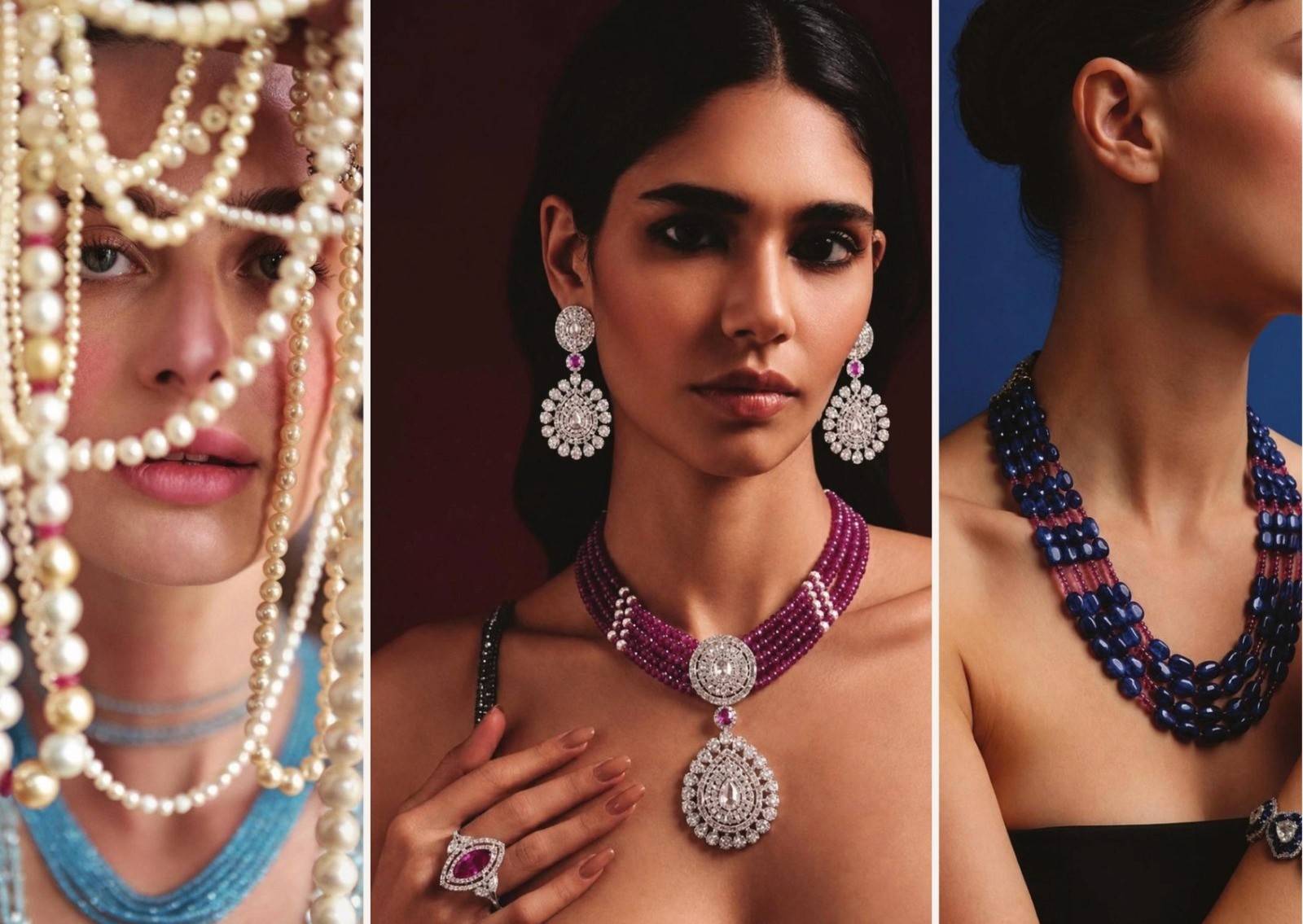
For designer Keya Agarwal Badhalia, a jewel begins with observation: a leopard's gaze, a seahorse's curled tail, the flash of a flycatcher in flight at Ranthambore. As founder of KEYA by Adbhut, the contemporary art-led label from Jaipur, Keya translates these moments into limited, numbered works where gemstones become colour, gold becomes form and centuries-old Indian techniques find a bold new voice.

Keya Agarwal
Her path to the workbench is as layered as her jewels. Keya is a designer, a researcher and the author of Luxury Uncut: How Technology Is Rewriting the Value of Gems, a book that studies how technology reshapes rarity, value and authenticity as lab-grown stones gain acceptance. KEYA, she explains, is the next chapter of the same inquiry: "if technology can recreate the physical properties of a gemstone, what is it that still makes a jewel truly valuable?" Her answer lives in the workshop, where the history of a particular stone, the hand that carves the gold and the decisions of the maker give each object its identity. Keya welcomes the new and champions what she calls "what remains deeply human."
The foundation was laid in Jaipur, inside her family's jewellery house, Adbhut. "I inherited a 500 year old technique," Keya shares, referring to Partash, the art of carving gold by hand into intricate patterns. Craftsmen, gemstone dealers and lively conversations about colour, origin, cutting and quality filled her childhood, and family travels opened the gemstone trade in Hong Kong, Bangkok and Taiwan. Studies at USC, HKUST and Bocconi, with a focus on finance, then carried her through Taipei, Los Angeles, Milan and Hong Kong, each city enriching her view of value, design and luxury.

Back in Jaipur, she brought a fresh visual vocabulary. "I brought back a different way of seeing what was already there," she says. The Mughal miniature, with its devoted observation of animals, foliage and landscape, became her starting point, and the animal world became her contemporary language: leopards, peacocks, swans, turtles and seahorses, sculpted in gold and gemstones. "The techniques are inherited, but the language is mine," she adds.

KEYA's debut universe unfolds in two worlds. Under the Ocean celebrates shells, marine life and fluid forms, while Into the Forest gathers wildlife, foliage and the wild spirit of nature. Jaipur's celebrated vocabulary of peacocks and vines welcomed new companions, and the karigars brought their mastery to a seahorse's curl and a shell's spiral. "Jadau was actually more adaptable than I initially expected," Keya recalls, as the setting technique let the team build each creature's silhouette in gold and let gemstones paint its colour and movement. Gulabi Meena, Jaipur's signature pink enamel, taught the art of editing: every engraved cell and every colour firing shapes the result, so Keya selected the details that serve each form and kept every jewel comfortable against the body. "I wanted the ocean to enter a distinctly Jaipur vocabulary," she says.

Each KEYA piece travels through a minimum of six to seven skilled hands: the goldsmith who builds the structure, the karigar who prepares the openings for each stone, the setters and Utarai artisans who shape slices of natural gemstone into what Keya describes as "a mosaic of real gemstones," the Partash carver, the Meenakari artist and the finishing and polishing specialists. Her resplendent quetzal earrings illustrate the journey. A sketch of the bird in flight leads to refinements with the goldsmith, stones are fitted so that Utarai renders every feather, chillai carving gives the gold depth and texture, and enamel on the reverse reveals the bird's true features. "The final piece is therefore a conversation between design and craftsmanship," Keya notes.
She shares credit generously. The name on each work belongs to "mine as the designer, and the karigar's hands as part of the authorship of the object," and she envisions "greater maker visibility" for the artisans behind every piece. The sentiment carries a long Jaipur echo: in March 1963, Prime Minister Jawaharlal Nehru wrote to Finance Minister Morarji Desai to champion the city's enamelled gold, describing it as "very fine and beautiful."

Priced from ₹2 lakh to ₹15 lakh, every KEYA piece is individually numbered, released in a small edition and held as a registered design. A design made in five pieces exists as five objects in the world. "The hand is fundamental to how KEYA is made and, therefore, to its value," Keya says, and she invites collectors to ask a new question: "What am I actually collecting?" Gold and natural gemstones form the solid foundation, while authorship, provenance and scarcity add further layers that she leaves the market to recognise over time.
The reverse of each jewel carries hand-painted detail, a tribute to the kundan tradition of enamel on the back and, first of all, a gift to the wearer. Meenakari also takes centre stage on the front, in the painted face of a tiger and the eyes of a leopard on a kada. "The object should reward you when you pick it up and examine it," says Keya.
That love of the tactile guides how KEYA is shared. Previews travel through the year, and the label's debut at Delhi Art Weekend, held 25 to 27 September 2026 and curated by Raihan Vadra with Usual Suspect, placed the work within a wider art and collecting community. "I want them to encounter it," Keya says of her collectors, inviting them to turn each piece, study the carving and watch the stones shift in the light. Editions follow the same logic: "The work comes first; the scarcity follows from the work."
With roughly 65 pieces created so far, KEYA remains an intimate studio of designer and artisans. "I would rather make five very considered objects and know that each one has been given the time, attention and individuality it deserves," Keya says. For her, heritage flourishes when it receives fresh subjects, and the craft gains another generation of relevance: "It can survive by being given new things to say."
TO BE CONTINUED, FOR SUBSCRIBERS ONLY.
This is where the surface ends and the reporting begins.
The complete piece, the full archive, and access to The French Press Circle. Reporting answerable only to its readers.
Already a subscriber ?
Login
Read these on the house, with our compliments.
A selection from the current issue, open to all readers. Read them in full. The rest is one decision away.






For designer Keya Agarwal Badhalia, a jewel begins with observation: a leopard's gaze, a seahorse's curled tail, the flash of a flycatcher in flight at Ranthambore. As founder of KEYA by Adbhut, the contemporary art-led label from Jaipur, Keya translates these moments into limited, numbered works where gemstones become colour, gold becomes form and centuries-old Indian techniques find a bold new voice.
Keya Agarwal
Her path to the workbench is as layered as her jewels. Keya is a designer, a researcher and the author of Luxury Uncut: How Technology Is Rewriting the Value of Gems, a book that studies how technology reshapes rarity, value and authenticity as lab-grown stones gain acceptance. KEYA, she explains, is the next chapter of the same inquiry: "if technology can recreate the physical properties of a gemstone, what is it that still makes a jewel truly valuable?" Her answer lives in the workshop, where the history of a particular stone, the hand that carves the gold and the decisions of the maker give each object its identity. Keya welcomes the new and champions what she calls "what remains deeply human."
The foundation was laid in Jaipur, inside her family's jewellery house, Adbhut. "I inherited a 500 year old technique," Keya shares, referring to Partash, the art of carving gold by hand into intricate patterns. Craftsmen, gemstone dealers and lively conversations about colour, origin, cutting and quality filled her childhood, and family travels opened the gemstone trade in Hong Kong, Bangkok and Taiwan. Studies at USC, HKUST and Bocconi, with a focus on finance, then carried her through Taipei, Los Angeles, Milan and Hong Kong, each city enriching her view of value, design and luxury.
Back in Jaipur, she brought a fresh visual vocabulary. "I brought back a different way of seeing what was already there," she says. The Mughal miniature, with its devoted observation of animals, foliage and landscape, became her starting point, and the animal world became her contemporary language: leopards, peacocks, swans, turtles and seahorses, sculpted in gold and gemstones. "The techniques are inherited, but the language is mine," she adds.
KEYA's debut universe unfolds in two worlds. Under the Ocean celebrates shells, marine life and fluid forms, while Into the Forest gathers wildlife, foliage and the wild spirit of nature. Jaipur's celebrated vocabulary of peacocks and vines welcomed new companions, and the karigars brought their mastery to a seahorse's curl and a shell's spiral. "Jadau was actually more adaptable than I initially expected," Keya recalls, as the setting technique let the team build each creature's silhouette in gold and let gemstones paint its colour and movement. Gulabi Meena, Jaipur's signature pink enamel, taught the art of editing: every engraved cell and every colour firing shapes the result, so Keya selected the details that serve each form and kept every jewel comfortable against the body. "I wanted the ocean to enter a distinctly Jaipur vocabulary," she says.
Each KEYA piece travels through a minimum of six to seven skilled hands: the goldsmith who builds the structure, the karigar who prepares the openings for each stone, the setters and Utarai artisans who shape slices of natural gemstone into what Keya describes as "a mosaic of real gemstones," the Partash carver, the Meenakari artist and the finishing and polishing specialists. Her resplendent quetzal earrings illustrate the journey. A sketch of the bird in flight leads to refinements with the goldsmith, stones are fitted so that Utarai renders every feather, chillai carving gives the gold depth and texture, and enamel on the reverse reveals the bird's true features. "The final piece is therefore a conversation between design and craftsmanship," Keya notes.
She shares credit generously. The name on each work belongs to "mine as the designer, and the karigar's hands as part of the authorship of the object," and she envisions "greater maker visibility" for the artisans behind every piece. The sentiment carries a long Jaipur echo: in March 1963, Prime Minister Jawaharlal Nehru wrote to Finance Minister Morarji Desai to champion the city's enamelled gold, describing it as "very fine and beautiful."
Priced from ₹2 lakh to ₹15 lakh, every KEYA piece is individually numbered, released in a small edition and held as a registered design. A design made in five pieces exists as five objects in the world. "The hand is fundamental to how KEYA is made and, therefore, to its value," Keya says, and she invites collectors to ask a new question: "What am I actually collecting?" Gold and natural gemstones form the solid foundation, while authorship, provenance and scarcity add further layers that she leaves the market to recognise over time.
The reverse of each jewel carries hand-painted detail, a tribute to the kundan tradition of enamel on the back and, first of all, a gift to the wearer. Meenakari also takes centre stage on the front, in the painted face of a tiger and the eyes of a leopard on a kada. "The object should reward you when you pick it up and examine it," says Keya.
That love of the tactile guides how KEYA is shared. Previews travel through the year, and the label's debut at Delhi Art Weekend, held 25 to 27 September 2026 and curated by Raihan Vadra with Usual Suspect, placed the work within a wider art and collecting community. "I want them to encounter it," Keya says of her collectors, inviting them to turn each piece, study the carving and watch the stones shift in the light. Editions follow the same logic: "The work comes first; the scarcity follows from the work."
With roughly 65 pieces created so far, KEYA remains an intimate studio of designer and artisans. "I would rather make five very considered objects and know that each one has been given the time, attention and individuality it deserves," Keya says. For her, heritage flourishes when it receives fresh subjects, and the craft gains another generation of relevance: "It can survive by being given new things to say."
TO BE CONTINUED, FOR SUBSCRIBERS ONLY.
This is where the surface ends and the reporting begins.
The complete piece, the full archive, and access to The French Press Circle. Reporting answerable only to its readers.
Already a subscriber ?
Login
Read these on the house, with our compliments.
A selection from the current issue, open to all readers. Read them in full. The rest is one decision away.