
On 30 September, Shweta Kapur opened her Delhi home to the 431-88 community, and by the time guests had walked through it, every room had taken on a new job. A sewing machine sat on the dining table, with shoes arranged across the surfaces around it as if the table had been rezoned for production. Hangers swung from rails, and standing racks held full looks at eye level. In one corner, a red dress with a sculpted cut-out at the waist stood on a jointed wooden mannequin inside an arched alcove framed by grey curtains. Nearby, a white shirt with a black beaded tassel hung from a garment steamer left standing in the room, the way a working studio leaves its tools.

Guests at the dining table, with the sewing machine in the foreground and a rail of 431-88 pieces behind. ·
 The sewing machine on the dining table. | 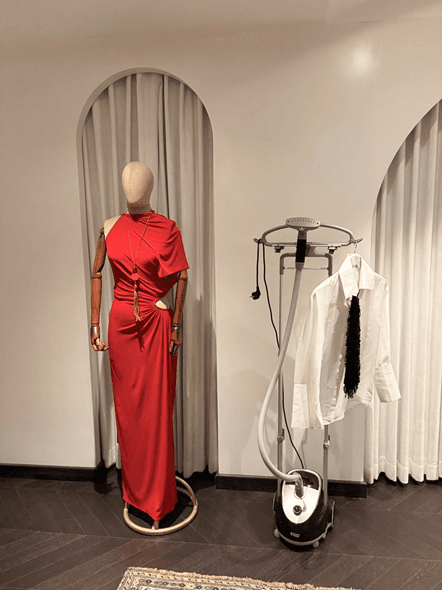 The red dress on its jointed wooden mannequin, and the white shirt on the garment steamer. |
The washroom held the evening's biggest surprise. Kapur had installed a live bar counter there, complete with a bartender, and guests were handed tomatini martinis and fortune cookies. Fashion events usually cordon off the private rooms, so a washroom turned into a destination says a great deal about how this house was meant to be used.
 The washroom bar, set up inside the shower. · |  A 431-88 martini bottle on a block of ice in the basin. · |
We asked her why anyone would open their own home to a crowd, given that a home is generally the most personal space a person has. Kapur answered without hesitation. "I wanted this entire thing to feel intimate and personal, we wanted to bring the community together, and there is no other place like home," she told us. The reply explains the design of the whole night. A boutique has to manufacture closeness, whereas a home arrives with it, and Kapur used that advantage in every room.
The bedroom pressed the point hardest. Pillows stitched with the words Play and Sexy in looping script sat against the headboard, and silver sequinned pieces lay spread across a charcoal striped duvet. Wardrobe doors stood open above the bed, with reds, blacks, whites and ink-marbled prints hanging in plain view, while a glass and a stack of books waited on the bedside table. Clothes seen in the room where people actually dress make a case that no rail in a retail space can match, and the bedroom held the most persuasive display of the evening.
 The bed with the Play and Sexy pillows and silver sequinned pieces. · |
A black board lettered 431-88 held the label's thinking in public. Instant photographs of models and garment rails were pinned beside botanical studies and a sheet of annotated pencil sketches for skirts. Alongside them hung a strip of ivory fabric traced with beaded black lines that branched like veins, and a hanger sculpted as a baguette hooked onto the corner. The board put process on display, and it connected directly to the collection at the centre of the evening, Biophilia F/W '26. The butterfly runs through it as a symbol of transformation, carried by cocoon-like forms, gathered skirts, fluid draping, layered textures and organic markings. A cocoon holds something still in the making, and the sewing machine on the dining table delivered the same idea in plain sight. Most brands present the finished garment and keep the labour offstage, whereas Kapur placed the machine at the centre of the room and let her guests walk around it.
 The 431-88 board, with instant photographs, botanical studies, skirt sketches and the beaded fabric strip. · |
Apartment-88 is billed as a travelling retail and experience format, built to feel like a lived-in apartment and to bring fashion, design, culture and community together through conversation and discovery. Multidisciplinary artist Eeshaan Kashyap, a close friend of Kapur, shaped the rooms, furniture, objects and details into one environment. His own practice, built around the Tablescape concept store, treats the arrangement of a table as a place where art and function blur, which gives the dining table turned workbench the look of a decision made with intentThe format also raises the standard the clothes must meet. In domestic light, at arm's length, with no merchandising theatre to flatter them, every seam and every fall of fabric gets examined. A label that lays its pieces on a bed and opens its wardrobes to a crowd has confidence in its construction, and 431-88 accepted those terms for an entire evening.
 A red fringed piece with a beaded neckline, on a 431-88 hanger. · |  An olive jacket over a tiered skirt, styled on a stand. · |
The harder test arrives with the next edition. Future Apartment-88 editions could take place in contemporary homes, galleries or design-led hospitality spaces, and each will have to generate the intimacy that Kapur's own home supplied without effort. The Delhi debut worked because the biography on display was hers, down to the machine, the table and the bar in the washroom. Whether 431-88 can rebuild that sense of belonging inside rooms with no history with the label will decide if Apartment-88 becomes a format or stays a single memorable night.
TO BE CONTINUED, FOR SUBSCRIBERS ONLY.
This is where the surface ends and the reporting begins.
The complete piece, the full archive, and access to The French Press Circle. Reporting answerable only to its readers.
Already a subscriber ?
Login
Read these on the house, with our compliments.
A selection from the current issue, open to all readers. Read them in full. The rest is one decision away.









On 30 September, Shweta Kapur opened her Delhi home to the 431-88 community, and by the time guests had walked through it, every room had taken on a new job. A sewing machine sat on the dining table, with shoes arranged across the surfaces around it as if the table had been rezoned for production. Hangers swung from rails, and standing racks held full looks at eye level. In one corner, a red dress with a sculpted cut-out at the waist stood on a jointed wooden mannequin inside an arched alcove framed by grey curtains. Nearby, a white shirt with a black beaded tassel hung from a garment steamer left standing in the room, the way a working studio leaves its tools.
Guests at the dining table, with the sewing machine in the foreground and a rail of 431-88 pieces behind. ·
The sewing machine on the dining table. | The red dress on its jointed wooden mannequin, and the white shirt on the garment steamer. |
The washroom held the evening's biggest surprise. Kapur had installed a live bar counter there, complete with a bartender, and guests were handed tomatini martinis and fortune cookies. Fashion events usually cordon off the private rooms, so a washroom turned into a destination says a great deal about how this house was meant to be used.
The washroom bar, set up inside the shower. · | A 431-88 martini bottle on a block of ice in the basin. · |
We asked her why anyone would open their own home to a crowd, given that a home is generally the most personal space a person has. Kapur answered without hesitation. "I wanted this entire thing to feel intimate and personal, we wanted to bring the community together, and there is no other place like home," she told us. The reply explains the design of the whole night. A boutique has to manufacture closeness, whereas a home arrives with it, and Kapur used that advantage in every room.
The bedroom pressed the point hardest. Pillows stitched with the words Play and Sexy in looping script sat against the headboard, and silver sequinned pieces lay spread across a charcoal striped duvet. Wardrobe doors stood open above the bed, with reds, blacks, whites and ink-marbled prints hanging in plain view, while a glass and a stack of books waited on the bedside table. Clothes seen in the room where people actually dress make a case that no rail in a retail space can match, and the bedroom held the most persuasive display of the evening.
The bed with the Play and Sexy pillows and silver sequinned pieces. · |
A black board lettered 431-88 held the label's thinking in public. Instant photographs of models and garment rails were pinned beside botanical studies and a sheet of annotated pencil sketches for skirts. Alongside them hung a strip of ivory fabric traced with beaded black lines that branched like veins, and a hanger sculpted as a baguette hooked onto the corner. The board put process on display, and it connected directly to the collection at the centre of the evening, Biophilia F/W '26. The butterfly runs through it as a symbol of transformation, carried by cocoon-like forms, gathered skirts, fluid draping, layered textures and organic markings. A cocoon holds something still in the making, and the sewing machine on the dining table delivered the same idea in plain sight. Most brands present the finished garment and keep the labour offstage, whereas Kapur placed the machine at the centre of the room and let her guests walk around it.
The 431-88 board, with instant photographs, botanical studies, skirt sketches and the beaded fabric strip. · |
Apartment-88 is billed as a travelling retail and experience format, built to feel like a lived-in apartment and to bring fashion, design, culture and community together through conversation and discovery. Multidisciplinary artist Eeshaan Kashyap, a close friend of Kapur, shaped the rooms, furniture, objects and details into one environment. His own practice, built around the Tablescape concept store, treats the arrangement of a table as a place where art and function blur, which gives the dining table turned workbench the look of a decision made with intentThe format also raises the standard the clothes must meet. In domestic light, at arm's length, with no merchandising theatre to flatter them, every seam and every fall of fabric gets examined. A label that lays its pieces on a bed and opens its wardrobes to a crowd has confidence in its construction, and 431-88 accepted those terms for an entire evening.
A red fringed piece with a beaded neckline, on a 431-88 hanger. · | An olive jacket over a tiered skirt, styled on a stand. · |
The harder test arrives with the next edition. Future Apartment-88 editions could take place in contemporary homes, galleries or design-led hospitality spaces, and each will have to generate the intimacy that Kapur's own home supplied without effort. The Delhi debut worked because the biography on display was hers, down to the machine, the table and the bar in the washroom. Whether 431-88 can rebuild that sense of belonging inside rooms with no history with the label will decide if Apartment-88 becomes a format or stays a single memorable night.
TO BE CONTINUED, FOR SUBSCRIBERS ONLY.
This is where the surface ends and the reporting begins.
The complete piece, the full archive, and access to The French Press Circle. Reporting answerable only to its readers.
Already a subscriber ?
Login
Read these on the house, with our compliments.
A selection from the current issue, open to all readers. Read them in full. The rest is one decision away.
