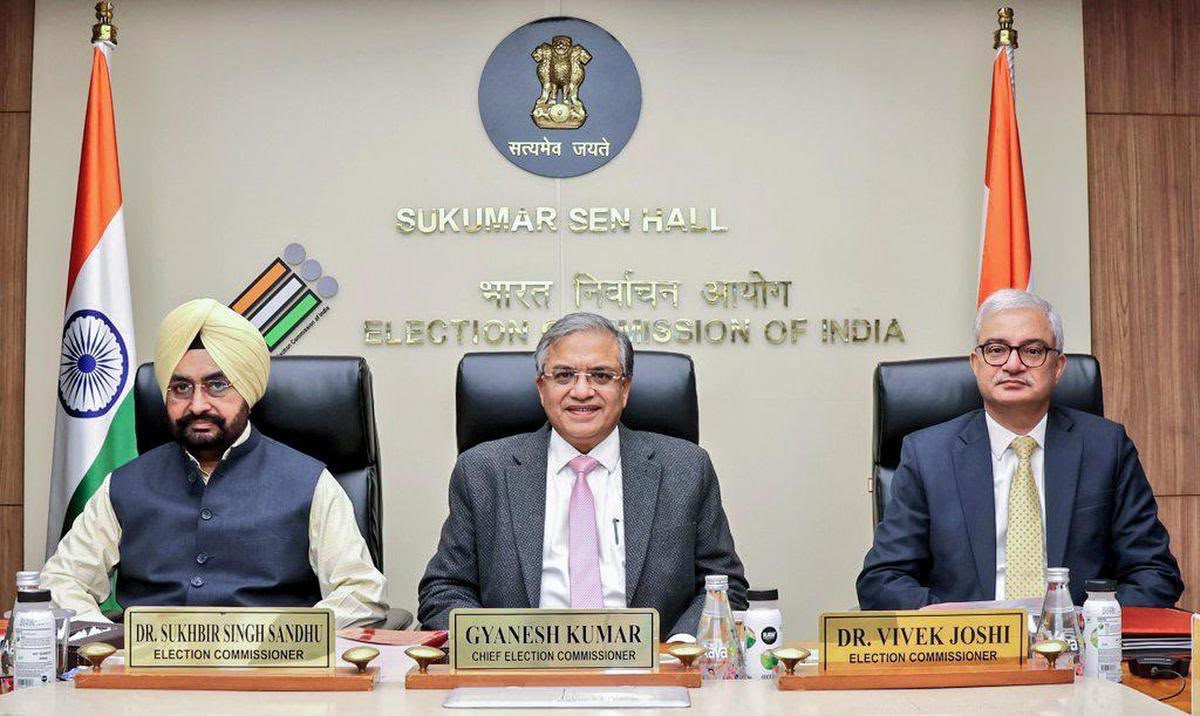
When the Election Commission of India announced nine decisions after its meeting on Saturday, September 26, it spoke in the language of administrative routine. The calendar tells another story, because three days earlier The Indian Express had reported that Election Commissioners Sukhbir Singh Sandhu and Vivek Joshi had recorded objections at least 14 times over ten months, some against orders they said were issued without their knowledge, and the Commission's four-page note reads, point by point, like a reply to that report.
The allegations
The reporting, by Ritika Chopra, described a three-member Commission in which two members were repeatedly bypassed on the systems that hold the country's electoral rolls. The objections touched the Special Intensive Revision at several points: a declaration added to Form 6 without amending the Registration of Electors Rules, the integrity and centralisation of the ECINet software, appeals filed in West Bengal against voters whose inclusion judicial officers had ordered, and 97 voters in Goa who were cleared by local officers and still missing from the final roll.
The Commission answered on the day the report appeared, describing the objections as "suggestions" and maintaining that all key decisions were unanimous. A statement from the Commission added that "differing views and observations are a normal part of deliberation in any institution." After the meeting, its press note said the commissioners' letter to the Cabinet Secretary concerned the working of an officer on deputation and touched no policy matter.
What the Commission decided
On procedure, the Commission will now circulate agendas before every meeting and issue minutes afterwards, take its own approval for officers' foreign trips, and complete annual performance appraisal reports by December 31 each year. New IT modules and portals must pass through a Committee of Officers before the Commission approves them.
On systems, ECINet will be reviewed by a committee headed by a Senior Deputy Election Commissioner and joined by an independent expert from an IIT or IIIT, which will report to the Commission. The Commission also maintains that field officers hold role-based access to the platform.
On the rolls, the forms prescribed under the Registration of Electors Rules, including Form 6, will apply outside the SIR period. Voters served notices over unmapped entries or logical discrepancies will receive visits from booth level officers who collect their documents, with hearings held only in exceptional circumstances, preferably online, and any adult family member may attend on the voter's behalf. In Goa, the Chief Electoral Officer has directed house-to-house visits to the left-out voters, and 81 of the 97 have now filled Form 6. Claim and objection deadlines in Delhi and Maharashtra have been extended.
Outlook observed that these decisions correspond closely with the concerns the two commissioners reportedly raised, among them missing agendas and minutes, travel without approval, IT modules built without their knowledge and the demand for an independent audit of the roll database. A Commission that maintains nothing was amiss has, in effect, rewritten its own procedures to repair what it says was never broken.
What the note leaves unanswered
The most pointed gap concerns Form 6. Joshi's objection covered the online version on ECINet, where an additional question about the applicant's parents had been inserted and applicants could not proceed without answering it. The note speaks of the statutory form outside the SIR period and says the Supreme Court upheld the SIR declaration, yet it never says whether the online question has been removed. On October 5, Chief Justice Surya Kant told the court, "Any modified Form 6 has not been approved by us."
Other questions remain open. The note does not say who authorised the West Bengal appeals against voters whose inclusion judicial officers had ordered, nor whether those appeals were filed on the Commission's behalf. It offers no reason why a software facility sought in Goa to restore voter names was never enabled. It is silent on whether the senior officials whose functioning the commissioners reportedly questioned, Director General (IT) Seema Khanna and Senior Deputy Election Commissioner Maneesh Garg, will keep their positions, and on whether the Chief Election Commissioner will consult his two colleagues before decisions are made. Congress general secretary Jairam Ramesh said the press note never directly denied the report and demanded that the SIR be suspended.
Courts and streets
The questions have reached the Supreme Court. On October 5, a bench of Chief Justice Surya Kant and Justices Joymalya Bagchi and V Mohana declined to suspend the Chief Election Commissioner without hearing him, and issued notice to the Union, the Commission, Gyanesh Kumar, both Election Commissioners, Maneesh Garg and Seema Khanna. The Quint reported that the bench also expects the Commission to follow the law requiring majority or unanimous decisions.
On the streets, the Cockroach Janta Party called its Jantar Mantar protest on October 10 to demand Kumar's resignation, and estimates of those detained across Delhi ranged from around 1,500 to more than 7,000. A Supreme Court special sitting the next day directed that peaceful, unarmed gatherings must not face illegal detention.
The Commission has now changed how it keeps records, circulates agendas and reviews its software. It has yet to say who authorised what, and on whose signature, in the cases that drew the dissent. Until it does, every repair invites the same question: what exactly was broken?
TO BE CONTINUED, FOR SUBSCRIBERS ONLY.
This is where the surface ends and the reporting begins.
The complete piece, the full archive, and access to The French Press Circle. Reporting answerable only to its readers.
Already a subscriber ?
Login
Read these on the house, with our compliments.
A selection from the current issue, open to all readers. Read them in full. The rest is one decision away.










When the Election Commission of India announced nine decisions after its meeting on Saturday, September 26, it spoke in the language of administrative routine. The calendar tells another story, because three days earlier The Indian Express had reported that Election Commissioners Sukhbir Singh Sandhu and Vivek Joshi had recorded objections at least 14 times over ten months, some against orders they said were issued without their knowledge, and the Commission's four-page note reads, point by point, like a reply to that report.
The allegations
The reporting, by Ritika Chopra, described a three-member Commission in which two members were repeatedly bypassed on the systems that hold the country's electoral rolls. The objections touched the Special Intensive Revision at several points: a declaration added to Form 6 without amending the Registration of Electors Rules, the integrity and centralisation of the ECINet software, appeals filed in West Bengal against voters whose inclusion judicial officers had ordered, and 97 voters in Goa who were cleared by local officers and still missing from the final roll.
The Commission answered on the day the report appeared, describing the objections as "suggestions" and maintaining that all key decisions were unanimous. A statement from the Commission added that "differing views and observations are a normal part of deliberation in any institution." After the meeting, its press note said the commissioners' letter to the Cabinet Secretary concerned the working of an officer on deputation and touched no policy matter.
What the Commission decided
On procedure, the Commission will now circulate agendas before every meeting and issue minutes afterwards, take its own approval for officers' foreign trips, and complete annual performance appraisal reports by December 31 each year. New IT modules and portals must pass through a Committee of Officers before the Commission approves them.
On systems, ECINet will be reviewed by a committee headed by a Senior Deputy Election Commissioner and joined by an independent expert from an IIT or IIIT, which will report to the Commission. The Commission also maintains that field officers hold role-based access to the platform.
On the rolls, the forms prescribed under the Registration of Electors Rules, including Form 6, will apply outside the SIR period. Voters served notices over unmapped entries or logical discrepancies will receive visits from booth level officers who collect their documents, with hearings held only in exceptional circumstances, preferably online, and any adult family member may attend on the voter's behalf. In Goa, the Chief Electoral Officer has directed house-to-house visits to the left-out voters, and 81 of the 97 have now filled Form 6. Claim and objection deadlines in Delhi and Maharashtra have been extended.
Outlook observed that these decisions correspond closely with the concerns the two commissioners reportedly raised, among them missing agendas and minutes, travel without approval, IT modules built without their knowledge and the demand for an independent audit of the roll database. A Commission that maintains nothing was amiss has, in effect, rewritten its own procedures to repair what it says was never broken.
What the note leaves unanswered
The most pointed gap concerns Form 6. Joshi's objection covered the online version on ECINet, where an additional question about the applicant's parents had been inserted and applicants could not proceed without answering it. The note speaks of the statutory form outside the SIR period and says the Supreme Court upheld the SIR declaration, yet it never says whether the online question has been removed. On October 5, Chief Justice Surya Kant told the court, "Any modified Form 6 has not been approved by us."
Other questions remain open. The note does not say who authorised the West Bengal appeals against voters whose inclusion judicial officers had ordered, nor whether those appeals were filed on the Commission's behalf. It offers no reason why a software facility sought in Goa to restore voter names was never enabled. It is silent on whether the senior officials whose functioning the commissioners reportedly questioned, Director General (IT) Seema Khanna and Senior Deputy Election Commissioner Maneesh Garg, will keep their positions, and on whether the Chief Election Commissioner will consult his two colleagues before decisions are made. Congress general secretary Jairam Ramesh said the press note never directly denied the report and demanded that the SIR be suspended.
Courts and streets
The questions have reached the Supreme Court. On October 5, a bench of Chief Justice Surya Kant and Justices Joymalya Bagchi and V Mohana declined to suspend the Chief Election Commissioner without hearing him, and issued notice to the Union, the Commission, Gyanesh Kumar, both Election Commissioners, Maneesh Garg and Seema Khanna. The Quint reported that the bench also expects the Commission to follow the law requiring majority or unanimous decisions.
On the streets, the Cockroach Janta Party called its Jantar Mantar protest on October 10 to demand Kumar's resignation, and estimates of those detained across Delhi ranged from around 1,500 to more than 7,000. A Supreme Court special sitting the next day directed that peaceful, unarmed gatherings must not face illegal detention.
The Commission has now changed how it keeps records, circulates agendas and reviews its software. It has yet to say who authorised what, and on whose signature, in the cases that drew the dissent. Until it does, every repair invites the same question: what exactly was broken?
TO BE CONTINUED, FOR SUBSCRIBERS ONLY.
This is where the surface ends and the reporting begins.
The complete piece, the full archive, and access to The French Press Circle. Reporting answerable only to its readers.
Already a subscriber ?
Login
Read these on the house, with our compliments.
A selection from the current issue, open to all readers. Read them in full. The rest is one decision away.


