
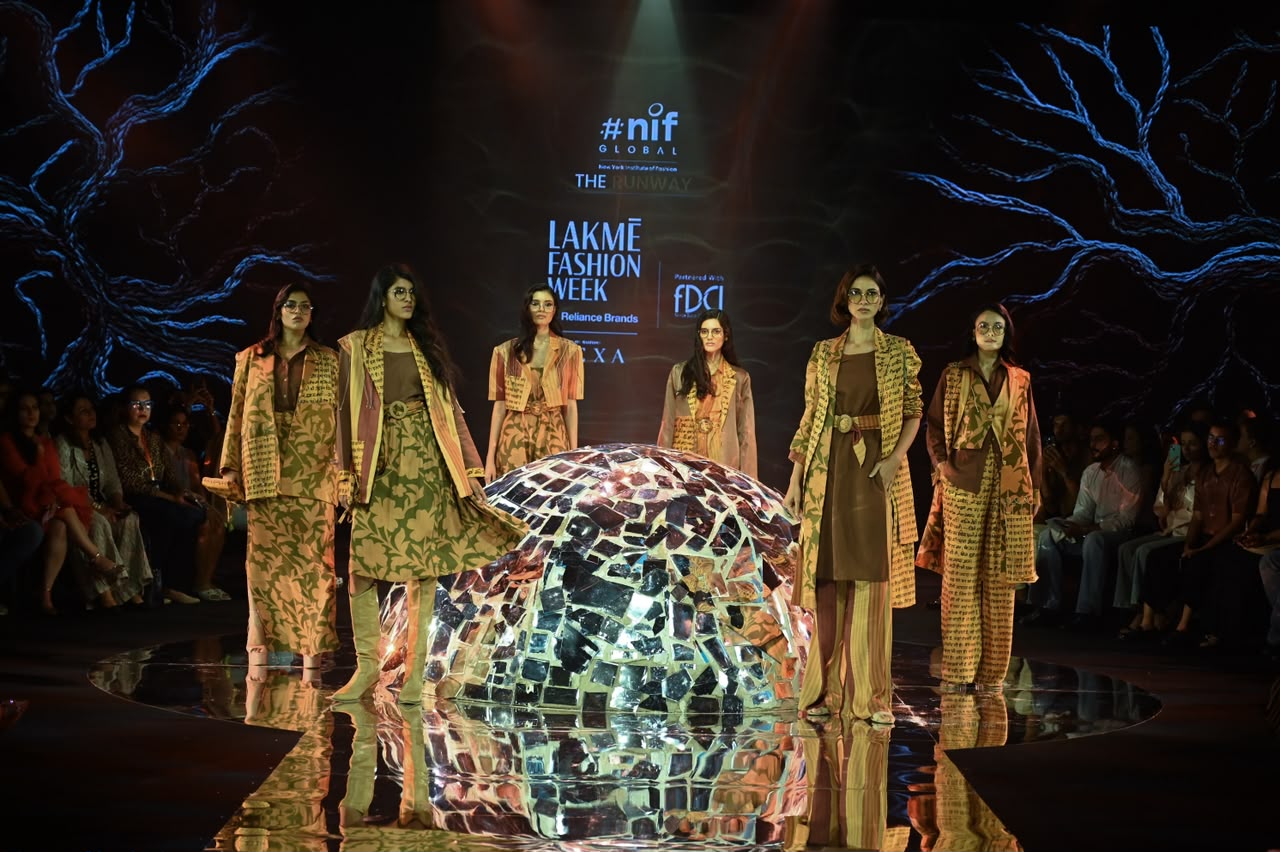
On 17 October, at Taj Palace in New Delhi, Siddhartha Bansal asked the front row at Lakmē Fashion Week in partnership with FDCI to leave the ground and look down. The collection he built for that view, World From Above, treats the planet as one continuous landscape, and a designer who made his name through colour and print found that altitude rearranged everything he thought he knew about both.


Movement has always been Bansal's subject. Seven Heaven, which he showed in 2023 as the winner of NEXA presents The Spotlight, was a kaleidoscope of ruffles and rainbows, and Paradise City, his Spring/Summer 26 showcase, followed a global nomad through one city after another. World From Above extends that journey in a new direction. "Instead of moving through individual cities, I wanted to step away from the map and look at the world as one continuous landscape," he says. The shift in perspective carries its own logic, because, as he explains it, "When you are on the ground, you notice differences and boundaries. From above, those distinctions begin to disappear, and what you see instead are patterns, connections, textures and a larger sense of continuity."
His architectural anchor is the Vesara temple, the Deccan's answer to a long argument between northern and southern building traditions, where two vocabularies settled into a third. Bansal read that fusion as a design brief. "What fascinated me about Vesara architecture was precisely that it represents an intersection of influences," he says, and the collection follows the same method, gathering temple plans, carved pillars and ornamental friezes beside the textures of salt lakes, mineral earth and mountain ranges. Oneness, in his definition, asks for "allowing differences to exist together and finding the beauty in that coexistence." No single image delivered the idea. He credits the trio together, all of them sharing "an incredible sense of geometry, rhythm and organic pattern" once seen from the air, with the temple plans supplying structure and symmetry while "salt lakes and mountain ranges introduced something much more fluid and unpredictable."

That conversation between the built and the natural runs through the clothes. One look pairs a mandarin-collared jacket in deep, heavily textured green with rust-orange panels and sleeves, the two colours divided by stepped borders of gold bead and zari that trace the profile of a temple plan. Fluid emerald trousers and a cylindrical black bag complete it, and the silhouette reads as architecture softened by drape. Another look turns the same thinking toward terrain: a bottle-green jacket with gathered, gently puffed sleeves opens over a red sequin camisole, while the skirt below falls in broad bands of plum, ochre, crimson and teal, layered like strata seen from a window seat. Red beads, a tasselled cord and sequinned red heels keep the palette burning.
The fabrics hold their own identities, and Bansal says so plainly. "Silk organza brings transparency and architectural lightness, tussar has a beautiful organic texture, and Chanderi brings softness and movement," he says, naming the sheer-against-tactile contrast as the pairing he loves most. Pleats, hand tucks and pinch tucks give the cloth its structure, and the hand texturing that follows reaches for the depth of carved stone. The moment that convinced him came when the stone-inspired surfaces first took shape, as a flat textile acquired "depth and almost a topographical quality." He recalls that "It started feeling less like an embellishment and more like a landscape in itself."

Colour has not left his vocabulary, and the emeralds, rusts and crimsons on the runway prove it, yet this season widened the toolkit. Architecture sharpened his thinking on proportion and construction, and the natural references invited unpredictability into the process. "Sometimes texture, silhouette and construction can communicate just as powerfully," he says of the lesson.
A message of oneness invites scrutiny of the credit line, and Bansal places it where it belongs. "The artisans are an essential part of the process," he says, and he locates the collection's character in their hands: "the hand creates small variations, and those imperfections are what give the surface its character." A collection that preaches connection earns the claim by naming the people whose handwork carries it, and the heavy embroidery on this runway makes that debt visible at every seam.

John Lennon's "Imagine" accompanied the show, a choice Bansal ties directly to the thesis. He hoped the audience left with "a sense of openness and possibility," and he states the collection's whole argument in one line from the designer's note: "we are all one, only divided by borders." His closing wish for the clothes outside the show is generous in scale. "If someone wears a piece from this collection and feels a little more open to the world around them, then I think the collection has achieved what I wanted it to."
TO BE CONTINUED, FOR SUBSCRIBERS ONLY.
This is where the surface ends and the reporting begins.
The complete piece, the full archive, and access to The French Press Circle. Reporting answerable only to its readers.
Already a subscriber ?
Login
Read these on the house, with our compliments.
A selection from the current issue, open to all readers. Read them in full. The rest is one decision away.




On 17 October, at Taj Palace in New Delhi, Siddhartha Bansal asked the front row at Lakmē Fashion Week in partnership with FDCI to leave the ground and look down. The collection he built for that view, World From Above, treats the planet as one continuous landscape, and a designer who made his name through colour and print found that altitude rearranged everything he thought he knew about both.
Movement has always been Bansal's subject. Seven Heaven, which he showed in 2023 as the winner of NEXA presents The Spotlight, was a kaleidoscope of ruffles and rainbows, and Paradise City, his Spring/Summer 26 showcase, followed a global nomad through one city after another. World From Above extends that journey in a new direction. "Instead of moving through individual cities, I wanted to step away from the map and look at the world as one continuous landscape," he says. The shift in perspective carries its own logic, because, as he explains it, "When you are on the ground, you notice differences and boundaries. From above, those distinctions begin to disappear, and what you see instead are patterns, connections, textures and a larger sense of continuity."
His architectural anchor is the Vesara temple, the Deccan's answer to a long argument between northern and southern building traditions, where two vocabularies settled into a third. Bansal read that fusion as a design brief. "What fascinated me about Vesara architecture was precisely that it represents an intersection of influences," he says, and the collection follows the same method, gathering temple plans, carved pillars and ornamental friezes beside the textures of salt lakes, mineral earth and mountain ranges. Oneness, in his definition, asks for "allowing differences to exist together and finding the beauty in that coexistence." No single image delivered the idea. He credits the trio together, all of them sharing "an incredible sense of geometry, rhythm and organic pattern" once seen from the air, with the temple plans supplying structure and symmetry while "salt lakes and mountain ranges introduced something much more fluid and unpredictable."
That conversation between the built and the natural runs through the clothes. One look pairs a mandarin-collared jacket in deep, heavily textured green with rust-orange panels and sleeves, the two colours divided by stepped borders of gold bead and zari that trace the profile of a temple plan. Fluid emerald trousers and a cylindrical black bag complete it, and the silhouette reads as architecture softened by drape. Another look turns the same thinking toward terrain: a bottle-green jacket with gathered, gently puffed sleeves opens over a red sequin camisole, while the skirt below falls in broad bands of plum, ochre, crimson and teal, layered like strata seen from a window seat. Red beads, a tasselled cord and sequinned red heels keep the palette burning.
The fabrics hold their own identities, and Bansal says so plainly. "Silk organza brings transparency and architectural lightness, tussar has a beautiful organic texture, and Chanderi brings softness and movement," he says, naming the sheer-against-tactile contrast as the pairing he loves most. Pleats, hand tucks and pinch tucks give the cloth its structure, and the hand texturing that follows reaches for the depth of carved stone. The moment that convinced him came when the stone-inspired surfaces first took shape, as a flat textile acquired "depth and almost a topographical quality." He recalls that "It started feeling less like an embellishment and more like a landscape in itself."
Colour has not left his vocabulary, and the emeralds, rusts and crimsons on the runway prove it, yet this season widened the toolkit. Architecture sharpened his thinking on proportion and construction, and the natural references invited unpredictability into the process. "Sometimes texture, silhouette and construction can communicate just as powerfully," he says of the lesson.
A message of oneness invites scrutiny of the credit line, and Bansal places it where it belongs. "The artisans are an essential part of the process," he says, and he locates the collection's character in their hands: "the hand creates small variations, and those imperfections are what give the surface its character." A collection that preaches connection earns the claim by naming the people whose handwork carries it, and the heavy embroidery on this runway makes that debt visible at every seam.
John Lennon's "Imagine" accompanied the show, a choice Bansal ties directly to the thesis. He hoped the audience left with "a sense of openness and possibility," and he states the collection's whole argument in one line from the designer's note: "we are all one, only divided by borders." His closing wish for the clothes outside the show is generous in scale. "If someone wears a piece from this collection and feels a little more open to the world around them, then I think the collection has achieved what I wanted it to."
TO BE CONTINUED, FOR SUBSCRIBERS ONLY.
This is where the surface ends and the reporting begins.
The complete piece, the full archive, and access to The French Press Circle. Reporting answerable only to its readers.
Already a subscriber ?
Login
Read these on the house, with our compliments.
A selection from the current issue, open to all readers. Read them in full. The rest is one decision away.


