
Nearly every celebrated blue diamond in history has come out of two places: the old Golconda workings of the Deccan, which gave the world the Hope, and the Cullinan mine of South Africa. Botswana, the largest producer of diamonds by value on earth, had never entered that lineage until 2018, when a 41.11-carat rough with a greyish blue cast surfaced at the Orapa Mine. Cutters worked on it for the better part of a year and surrendered half its weight, arriving at a 20.46-carat oval graded Fancy Deep Blue, type IIb, its hue owed to traces of boron folded into the crystal somewhere in the lower mantle, three billion years before there was a Botswana to name it after. The stone spent the years since in state custody, exhibited once at the American Museum of Natural History in New York, never sold, never worn.
Terres de Contrastes, Messika's new high jewellery collection, begins with this diamond's first setting. The form Valérie Messika has chosen for it is the rivière, the graduated line of stones that entered European jewellery in the Georgian eighteenth century and has signified continuity ever since. Here the river runs to unusual depth: more than 500 white diamonds in a serpentine course around the neck, thickening as they descend, with the blue oval hung low against the sternum rather than at the throat. Crowns and republics have long understood the difference between owning a treasure and being seen with one; the Botswana government retains the stone, and the necklace exists somewhere between commission and embassy, a piece of national property travelling in couture.
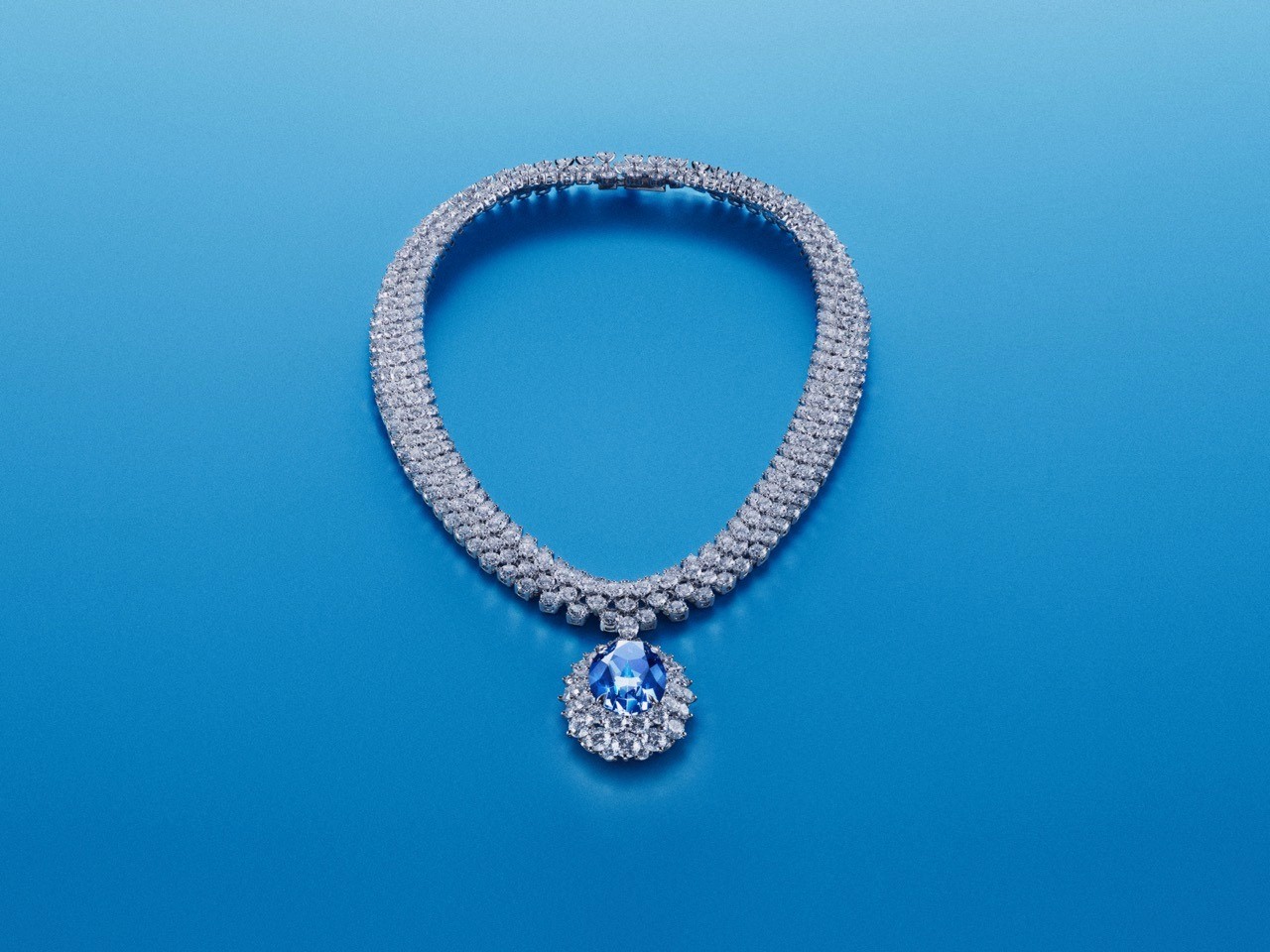
Le Okavango Blue necklace. The 20.46-carat Fancy Deep Blue diamond, discovered at the Orapa Mine in 2018, suspended from more than 500 white diamonds.
Image courtesy Messika ©️ AMPM
"In my mind, three words rule this collection: power, colour, life," says Valérie Messika, the house's founder and artistic director. "Power, because the landscapes themselves command it. Colour, because Botswana summons its own all-governing light. And life, because every piece strikes its own vital rhythm; the heartbeat of a nation jewelled by the beauty of contrast."
The collection is organised as three territories of colour: the blues and greens of the Okavango Delta, the ochre and burnt orange of the Kalahari, the white of the Makgadikgadi salt pans under a rose dusk. It follows Terres d'Instinct, the 2025 collection drawn from Namibia, which introduced coloured stones into a house that had worked almost exclusively in diamonds since Valérie Messika, daughter of the Parisian dealer André Messika, founded it in 2005. The house made its name on the idea of the diamond in motion, stones set to slide and turn against the skin, and the vocabulary of this collection keeps returning to that founding preoccupation even as the palette widens.
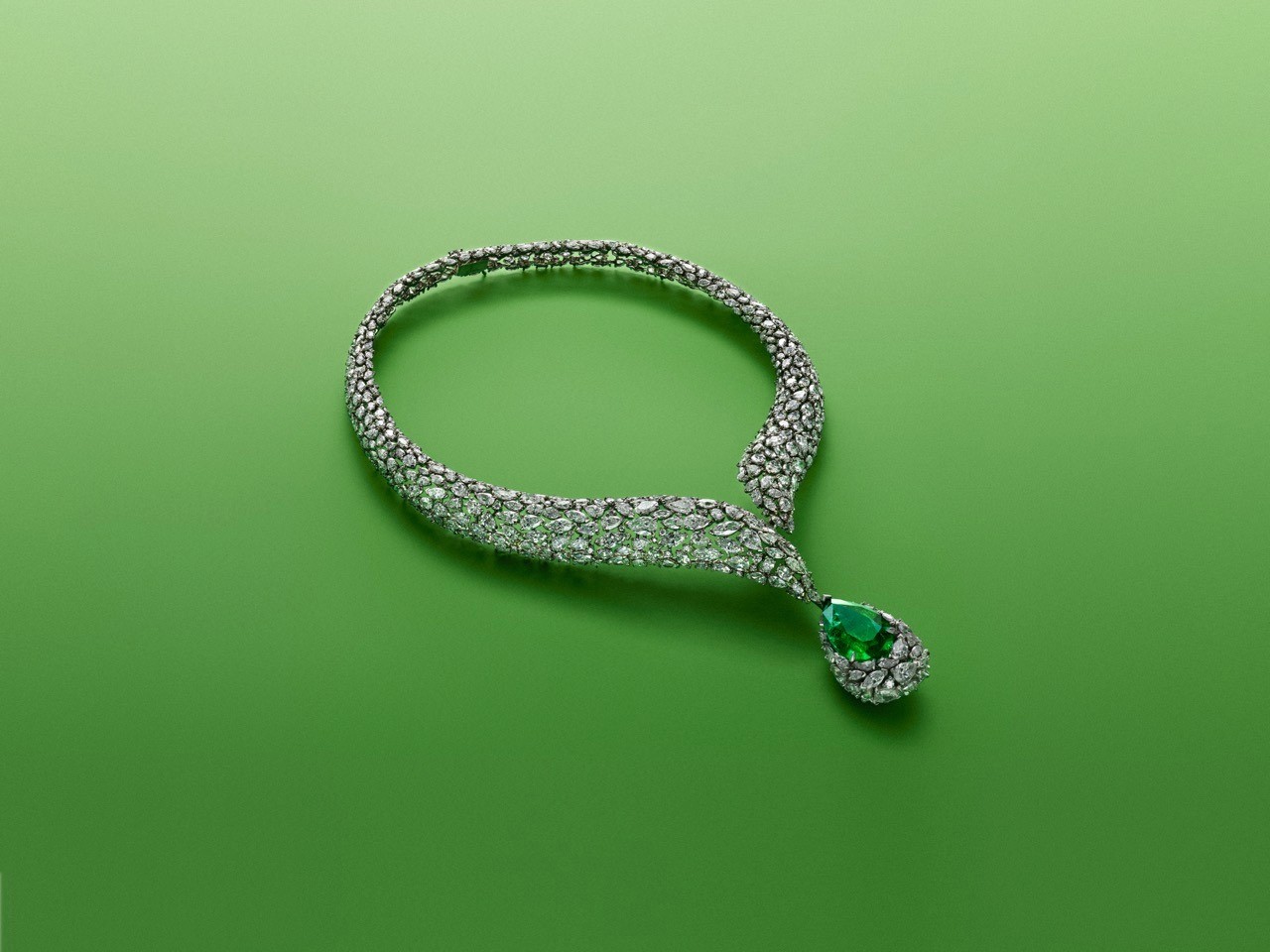
Delta Sacré necklace. A 12.81-carat pear-shaped emerald below a lattice of more than 600 diamonds in marquise, brilliant, pear and oval cuts.
Image courtesy Messika ©️ AMPM
Seen from the air, the Okavango is a river that fails magnificently: it travels over a thousand kilometres and never finds the sea, spending itself instead across the sands of the Kalahari in channels that redraw themselves with every flood. Delta Sacré takes this aerial view as its pattern. More than 600 diamonds in four different cuts, marquise, brilliant, pear and oval, are laid in an openwork lattice where no two neighbouring stones repeat a shape, each one chosen by hand against the stones beside it. Pavé of mixed cuts asks more of a setter than uniform rounds ever do; every seat is unique, and the whole must stay supple enough to move with the collarbone. At its centre hangs a 12.81-carat pear-shaped emerald. Emeralds have always been the most candid of the great stones. Their inclusions, the jardin, are visible to the naked eye and were treasured rather than concealed by the Mughal courts, which carved verses into Colombian emeralds and wore them as talismans. To hang one alone at the end of a necklace, unaccompanied, continues that older attitude towards the stone: the garden is shown, and the flood-built landscape above it holds still in a way the actual delta never does.
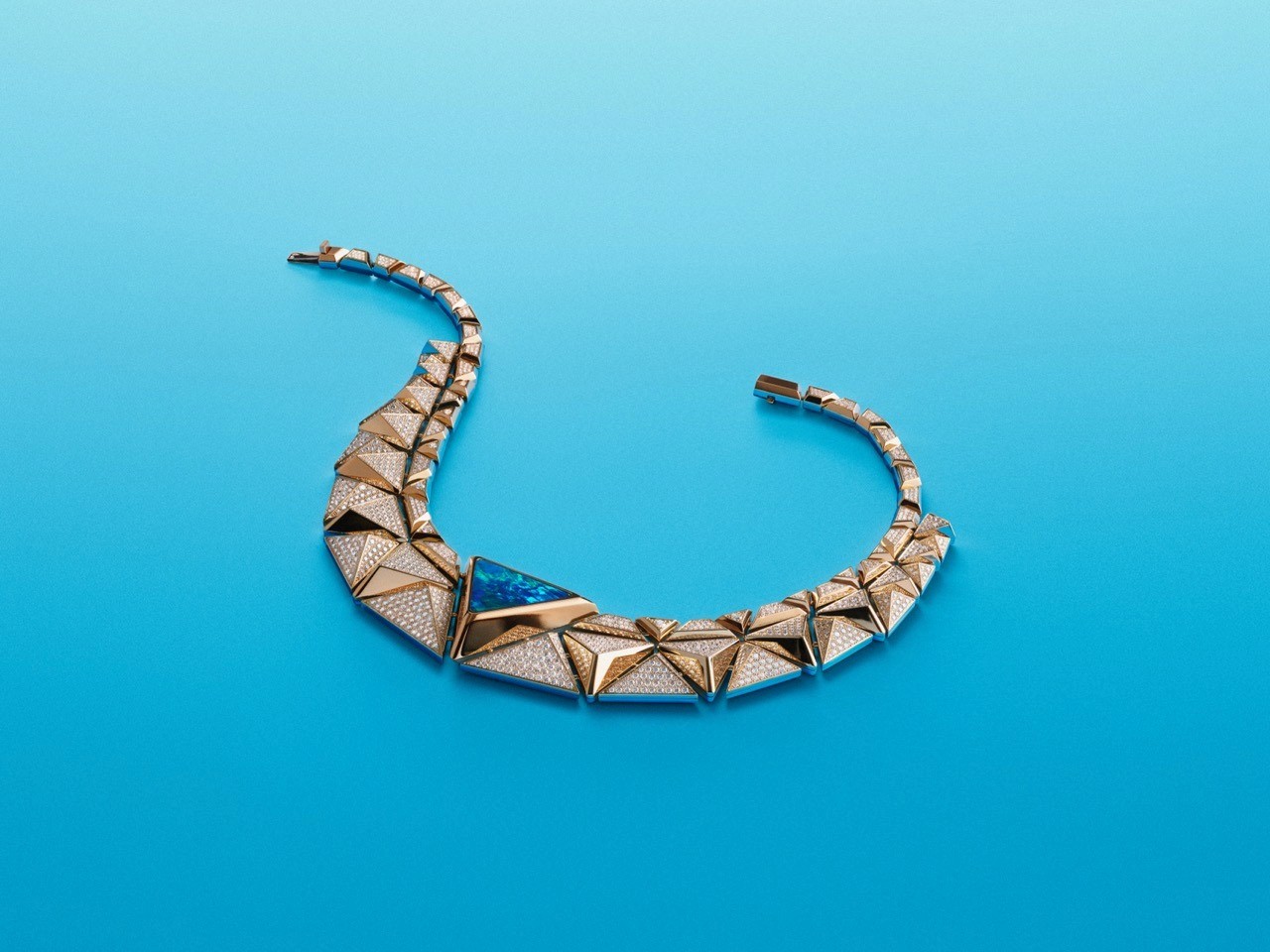
Féroce necklace. Triangular volumes of mirror-polished gold and pavé diamonds around a 16.98-carat Australian black opal.
Image courtesy Messika ©️ AMPM
Féroce takes its subject from below the waterline. The Nile crocodile has occupied the Okavango's channels since long before the river had its present course, and the necklace renders it in a geometry closer to the Paris of the 1920s than to natural history: triangular volumes in mirror-polished gold alternating with pavé, arranged in the rhythm of a serrated jaw. At the centre sits a 16.98-carat Australian black opal, almost certainly the most temperamental stone in the collection. Pliny the Elder wrote that the opal carried within it the fire of the carbuncle, the purple of amethyst and the green of emerald at once, and the description holds two thousand years later; the play of colour comes from silica spheres diffracting light, and this one moves between night blue, water green and an electric flash with the wearer. Opal sits at 5.5 to 6.5 on the Mohs scale, softer than the quartz in household dust, and mounting one inside hard-edged gold architecture is the kind of decision an atelier makes only when it trusts its own tolerances. Cartier gave high jewellery its great predator a century ago when Jeanne Toussaint's panther became the house's emblem; Féroce belongs to that lineage while declining the figure entirely, keeping only the animal's geometry and its patience.
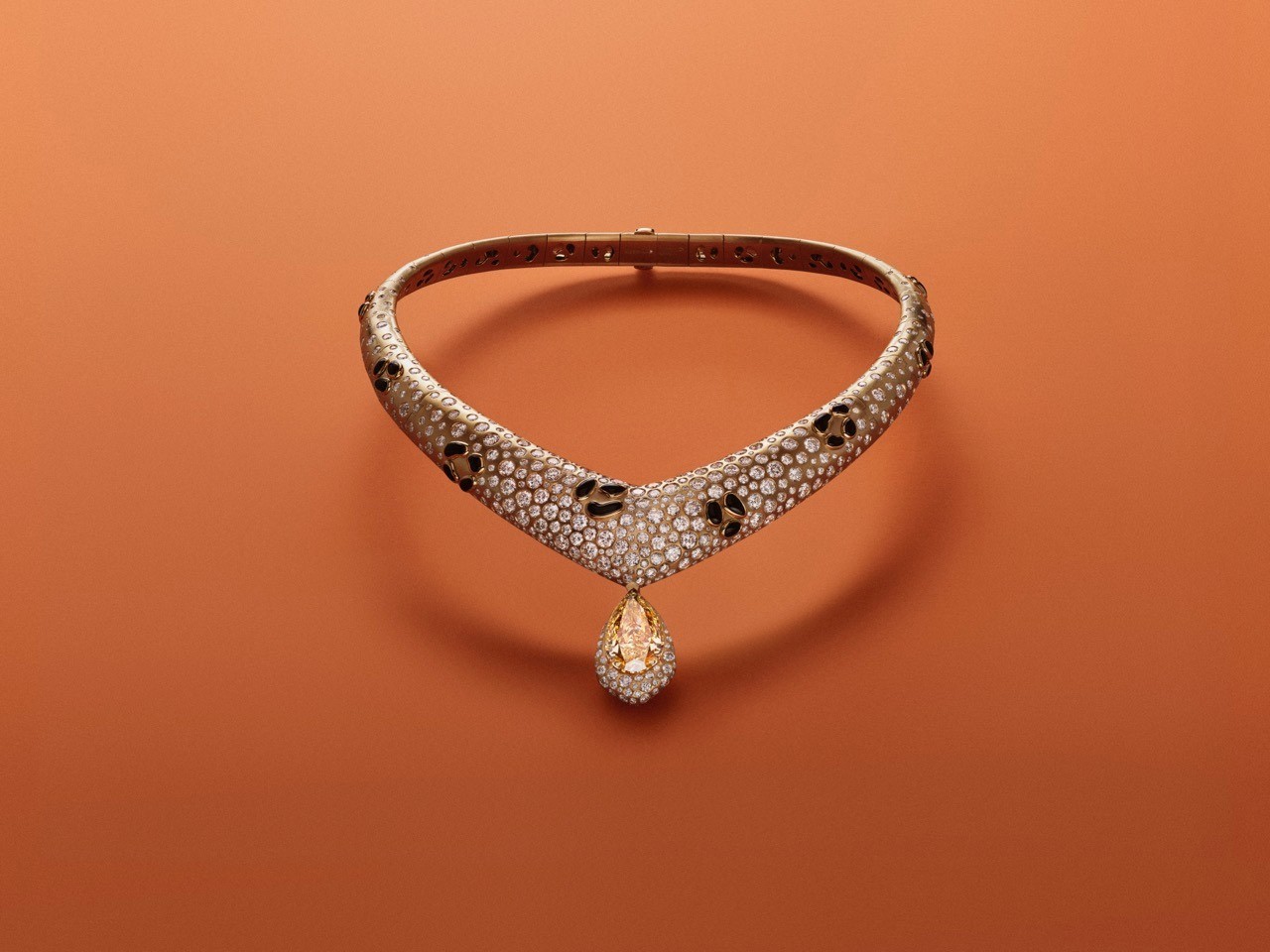
Règne necklace. Flush-set onyx spots and pawprints across diamond pavé, with a Fancy Deep Brownish Yellow pear-shaped diamond.
Image courtesy Messika ©️ AMPM
Règne stays with the predators but moves onto land, and into memory; the piece grew out of Valérie Messika's own safaris. Anyone who has tracked a cheetah in the Kalahari knows the animal mostly by its absence, a pawprint in red sand, a shape dissolving into dry grass, and the necklace works the same way. Onyx, cut to measure and set flush into the gold so that stone and metal form one unbroken surface, appears as spots and as pawprints scattered across a V-shaped collar of pavé. Flush setting allows no margin: each cavity is carved to its stone, and a fraction of a millimetre shows. Below hangs a pear-shaped diamond graded Fancy Deep Brownish Yellow, a colour the trade once undervalued and now prizes, here doing the work of late afternoon light on baked earth. The animal itself never appears. Its territory does.
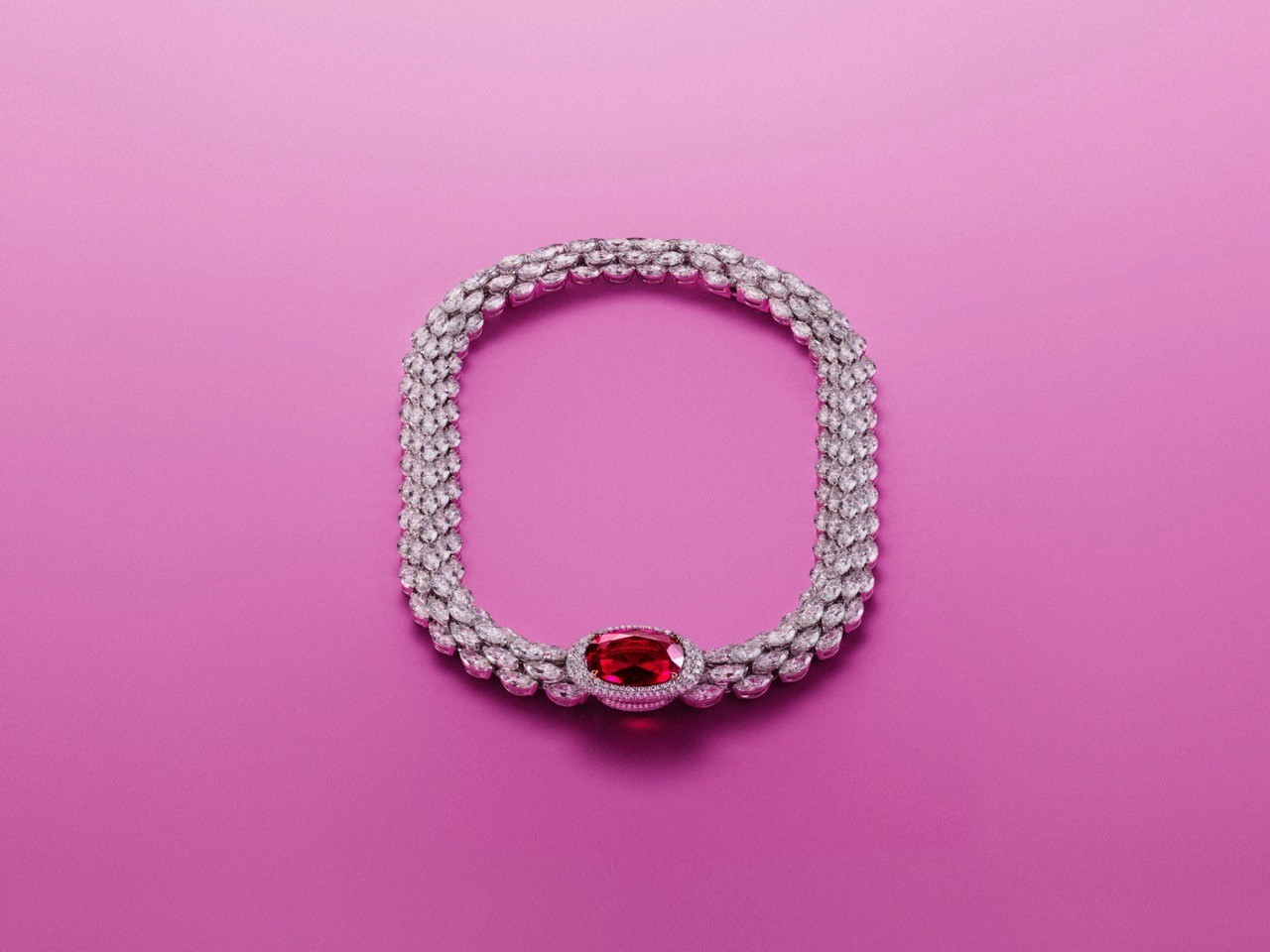
Python Rubellite necklace. Five rows of marquise-cut diamonds around a 13.54-carat oval rubellite.
Image courtesy Messika ©️ AMPM
The Makgadikgadi pans are the floor of a lake that died; an inland sea larger than Switzerland once stood there, and what remains is a plain of salt so level it curves with the earth. Python Rubellite crosses this white ground in the oldest costume in jewellery. The serpent has been worn since Egypt, was Queen Victoria's engagement ring, and coiled through the twentieth century as Bulgari's Serpenti; Messika's version dispenses with head and tail and keeps only the skin. Five synchronised rows of marquise-cut diamonds form the scales, a cut whose pointed ends make alignment across multiple rows one of the more exacting exercises in setting, and the necklace is articulated to coil against the collarbone with the give of something alive. At its centre, a 13.54-carat oval rubellite, the variety of tourmaline whose red survives artificial light, the test by which the trade separates rubellite from lesser pink tourmaline. Against the white lattice it reads as the sun does over the pans at dusk, holding its colour while everything around it goes pale.
The collection continues in October at the Messika Haute Joaillerie show during Paris Fashion Week, where the house presents its high jewellery on a runway rather than in vitrines, and where a stone that waited seven years in a vault will be judged the way the house has always preferred: in motion, on a body, in the open.
TO BE CONTINUED, FOR SUBSCRIBERS ONLY.
This is where the surface ends and the reporting begins.
The complete piece, the full archive, and access to The French Press Circle. Reporting answerable only to its readers.
Already a subscriber ?
Login
Read these on the house, with our compliments.
A selection from the current issue, open to all readers. Read them in full. The rest is one decision away.







Nearly every celebrated blue diamond in history has come out of two places: the old Golconda workings of the Deccan, which gave the world the Hope, and the Cullinan mine of South Africa. Botswana, the largest producer of diamonds by value on earth, had never entered that lineage until 2018, when a 41.11-carat rough with a greyish blue cast surfaced at the Orapa Mine. Cutters worked on it for the better part of a year and surrendered half its weight, arriving at a 20.46-carat oval graded Fancy Deep Blue, type IIb, its hue owed to traces of boron folded into the crystal somewhere in the lower mantle, three billion years before there was a Botswana to name it after. The stone spent the years since in state custody, exhibited once at the American Museum of Natural History in New York, never sold, never worn.
Terres de Contrastes, Messika's new high jewellery collection, begins with this diamond's first setting. The form Valérie Messika has chosen for it is the rivière, the graduated line of stones that entered European jewellery in the Georgian eighteenth century and has signified continuity ever since. Here the river runs to unusual depth: more than 500 white diamonds in a serpentine course around the neck, thickening as they descend, with the blue oval hung low against the sternum rather than at the throat. Crowns and republics have long understood the difference between owning a treasure and being seen with one; the Botswana government retains the stone, and the necklace exists somewhere between commission and embassy, a piece of national property travelling in couture.
Le Okavango Blue necklace. The 20.46-carat Fancy Deep Blue diamond, discovered at the Orapa Mine in 2018, suspended from more than 500 white diamonds.
Image courtesy Messika ©️ AMPM
"In my mind, three words rule this collection: power, colour, life," says Valérie Messika, the house's founder and artistic director. "Power, because the landscapes themselves command it. Colour, because Botswana summons its own all-governing light. And life, because every piece strikes its own vital rhythm; the heartbeat of a nation jewelled by the beauty of contrast."
The collection is organised as three territories of colour: the blues and greens of the Okavango Delta, the ochre and burnt orange of the Kalahari, the white of the Makgadikgadi salt pans under a rose dusk. It follows Terres d'Instinct, the 2025 collection drawn from Namibia, which introduced coloured stones into a house that had worked almost exclusively in diamonds since Valérie Messika, daughter of the Parisian dealer André Messika, founded it in 2005. The house made its name on the idea of the diamond in motion, stones set to slide and turn against the skin, and the vocabulary of this collection keeps returning to that founding preoccupation even as the palette widens.
Delta Sacré necklace. A 12.81-carat pear-shaped emerald below a lattice of more than 600 diamonds in marquise, brilliant, pear and oval cuts.
Image courtesy Messika ©️ AMPM
Seen from the air, the Okavango is a river that fails magnificently: it travels over a thousand kilometres and never finds the sea, spending itself instead across the sands of the Kalahari in channels that redraw themselves with every flood. Delta Sacré takes this aerial view as its pattern. More than 600 diamonds in four different cuts, marquise, brilliant, pear and oval, are laid in an openwork lattice where no two neighbouring stones repeat a shape, each one chosen by hand against the stones beside it. Pavé of mixed cuts asks more of a setter than uniform rounds ever do; every seat is unique, and the whole must stay supple enough to move with the collarbone. At its centre hangs a 12.81-carat pear-shaped emerald. Emeralds have always been the most candid of the great stones. Their inclusions, the jardin, are visible to the naked eye and were treasured rather than concealed by the Mughal courts, which carved verses into Colombian emeralds and wore them as talismans. To hang one alone at the end of a necklace, unaccompanied, continues that older attitude towards the stone: the garden is shown, and the flood-built landscape above it holds still in a way the actual delta never does.
Féroce necklace. Triangular volumes of mirror-polished gold and pavé diamonds around a 16.98-carat Australian black opal.
Image courtesy Messika ©️ AMPM
Féroce takes its subject from below the waterline. The Nile crocodile has occupied the Okavango's channels since long before the river had its present course, and the necklace renders it in a geometry closer to the Paris of the 1920s than to natural history: triangular volumes in mirror-polished gold alternating with pavé, arranged in the rhythm of a serrated jaw. At the centre sits a 16.98-carat Australian black opal, almost certainly the most temperamental stone in the collection. Pliny the Elder wrote that the opal carried within it the fire of the carbuncle, the purple of amethyst and the green of emerald at once, and the description holds two thousand years later; the play of colour comes from silica spheres diffracting light, and this one moves between night blue, water green and an electric flash with the wearer. Opal sits at 5.5 to 6.5 on the Mohs scale, softer than the quartz in household dust, and mounting one inside hard-edged gold architecture is the kind of decision an atelier makes only when it trusts its own tolerances. Cartier gave high jewellery its great predator a century ago when Jeanne Toussaint's panther became the house's emblem; Féroce belongs to that lineage while declining the figure entirely, keeping only the animal's geometry and its patience.
Règne necklace. Flush-set onyx spots and pawprints across diamond pavé, with a Fancy Deep Brownish Yellow pear-shaped diamond.
Image courtesy Messika ©️ AMPM
Règne stays with the predators but moves onto land, and into memory; the piece grew out of Valérie Messika's own safaris. Anyone who has tracked a cheetah in the Kalahari knows the animal mostly by its absence, a pawprint in red sand, a shape dissolving into dry grass, and the necklace works the same way. Onyx, cut to measure and set flush into the gold so that stone and metal form one unbroken surface, appears as spots and as pawprints scattered across a V-shaped collar of pavé. Flush setting allows no margin: each cavity is carved to its stone, and a fraction of a millimetre shows. Below hangs a pear-shaped diamond graded Fancy Deep Brownish Yellow, a colour the trade once undervalued and now prizes, here doing the work of late afternoon light on baked earth. The animal itself never appears. Its territory does.
Python Rubellite necklace. Five rows of marquise-cut diamonds around a 13.54-carat oval rubellite.
Image courtesy Messika ©️ AMPM
The Makgadikgadi pans are the floor of a lake that died; an inland sea larger than Switzerland once stood there, and what remains is a plain of salt so level it curves with the earth. Python Rubellite crosses this white ground in the oldest costume in jewellery. The serpent has been worn since Egypt, was Queen Victoria's engagement ring, and coiled through the twentieth century as Bulgari's Serpenti; Messika's version dispenses with head and tail and keeps only the skin. Five synchronised rows of marquise-cut diamonds form the scales, a cut whose pointed ends make alignment across multiple rows one of the more exacting exercises in setting, and the necklace is articulated to coil against the collarbone with the give of something alive. At its centre, a 13.54-carat oval rubellite, the variety of tourmaline whose red survives artificial light, the test by which the trade separates rubellite from lesser pink tourmaline. Against the white lattice it reads as the sun does over the pans at dusk, holding its colour while everything around it goes pale.
The collection continues in October at the Messika Haute Joaillerie show during Paris Fashion Week, where the house presents its high jewellery on a runway rather than in vitrines, and where a stone that waited seven years in a vault will be judged the way the house has always preferred: in motion, on a body, in the open.
TO BE CONTINUED, FOR SUBSCRIBERS ONLY.
This is where the surface ends and the reporting begins.
The complete piece, the full archive, and access to The French Press Circle. Reporting answerable only to its readers.
Already a subscriber ?
Login
Read these on the house, with our compliments.
A selection from the current issue, open to all readers. Read them in full. The rest is one decision away.