
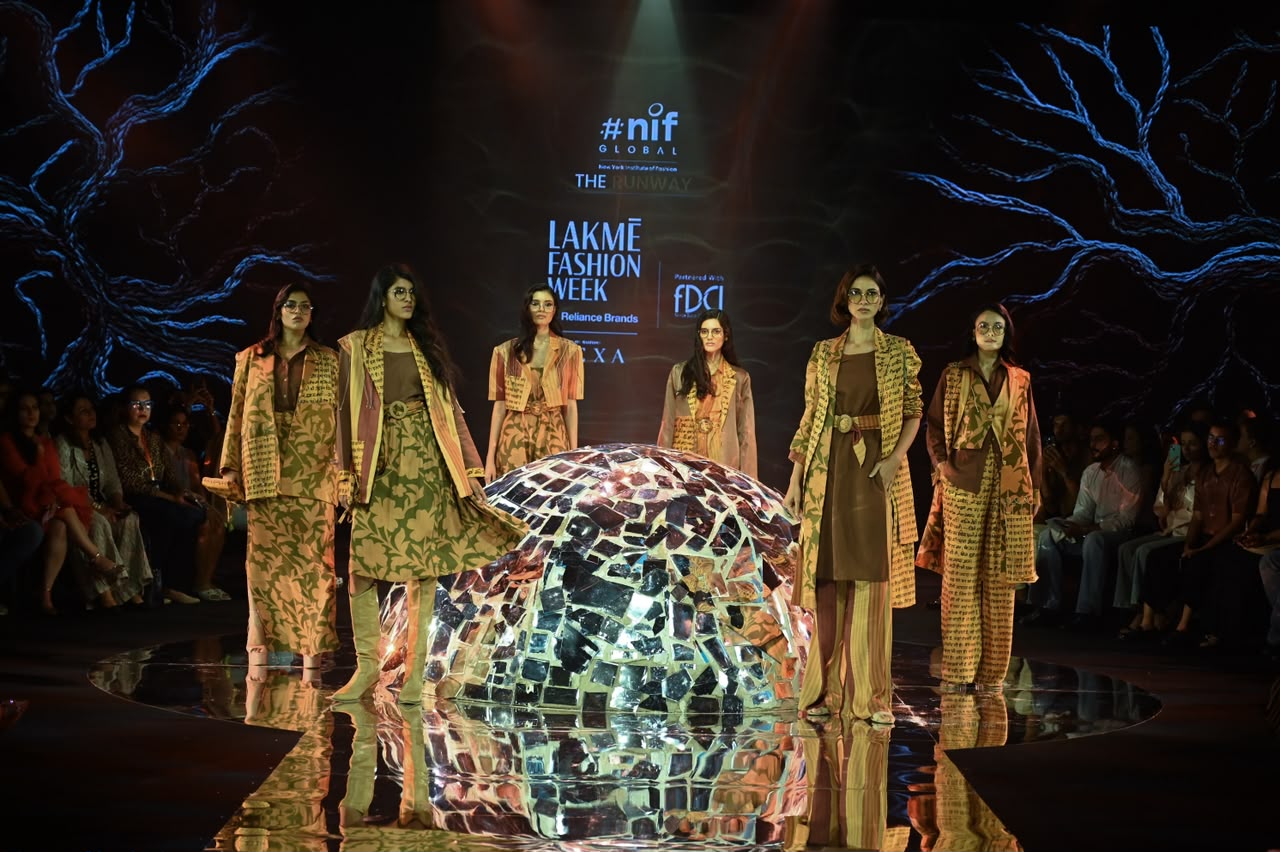
I watched R|Elan × HUEMN at Lakmé Fashion Week in collaboration with FDCI in Delhi on 16 October, and I could not leave the city outside the room.
Later, listening to Pranav Kirti speak about his work, I understood why I had felt the city so acutely within it.
“As long as you’re breathing, you can’t be apolitical,” he told me. He added, “Even when you’re saying you’re apolitical, you’re political.”
That observation places the artist within the world he inhabits. Declaring a distance from politics does not remove us from its consequences. We still live within arrangements of power; we still make choices about what receives our attention.
For Pranav, however, that awareness does not mean beginning a collection with a predetermined message. He spoke about his family, his past and experiences of love and loss. What reaches the runway has passed through a private life. His clothes carry what he has felt, including things he cannot fully explain in words.
Before turning to that work, I also want to acknowledge Sunil Sethi’s tireless commitment to giving different expressions of Indian fashion a platform. I admire the work he puts in, day after day, to ensure that distinct sensibilities can find an audience. Under his stewardship, FDCI leaves no stone unturned in presenting what I consider some of the country’s finest and most respected fashion showcases. Making room for a designer’s independence is an achievement of its own.
At Taj Palace that evening, a figure walked towards us in ivory.

The face was entirely covered. Arms crossed tightly over the chest. Wide trousers moved beneath a torso that appeared held in place. I searched for an expression, something through which to encounter the person approaching me.
The fabric withheld it.
And still, the person kept walking.
The tension lay in the body itself. The stride suggested freedom while the covered head and folded arms suggested constraint. I found myself watching with an attention that went beyond admiring a silhouette.

Elsewhere, a face confronted us directly. Red makeup surrounded the eyes, suggesting bruising. A white shirt bore a blood-red splash across the chest. Generously cut dark trousers gave the look composure, making the disturbance above them more pronounced.
The gaze remained steady.
Through makeup and styling, the image suggested someone carrying the evidence of an ordeal while refusing to lower their eyes. The ivory figure had left me searching for a face. This one made me conscious of being seen in return.
I carried the knowledge of Delhi’s protests and the questions surrounding people taken into custody into these encounters. It shaped what the images made me feel. Pranav’s account of his process helped me understand how such a reading could coexist with experiences entirely different from mine.
“I’m not trying to control or prove a point. I’m just being myself,” he said. “As long as you’re feeling something, I feel I have done my job well.”
That willingness to let a work exceed its maker’s explanation is central to his practice. He described taking in what happens around him like a sponge. When he creates, what he has absorbed begins to emerge.
The metaphor is revealing. The source material has already mingled. A memory does not arrive neatly separated from the atmosphere of the present. An experience within a family may sit beside something witnessed in public. He allows those associations to find their way into the work without requiring each one to announce its origin.
“My objective is not to take things from around me and put into work and display that, because that’s too simple for me,” he explained.
This matters to the way the collection should be read. To assign every covered face a single explanation would diminish the complexity that made it affecting. The work left people free to discover their own meaning.
The collection explored beauty and terror through experimental silhouettes, original prints and intricate craftsmanship brought into contemporary sportswear. It marked HUEMN’s second collaboration with R|Elan on this platform and reflected the label’s 14-year journey. R|Elan also unveiled a renewed brand identity as it entered its eighth year.
These material and institutional details belong in the story because the emotional charge depended on actual decisions about clothes.

An oxblood denim jacket carried Chikankari embroidery. The delicacy of the handwork changed the register of the denim, bringing another history into a familiar contemporary form. An original snakeskin print extended the collection’s interest in surfaces that could attract and unsettle at once.

The draped garment the studio calls its “mummy top” drew on the wrapped forms of Egyptian mummies. Covering a body acquired several possible meanings. The fabric could suggest protection, but its arrangement could also make one think of confinement. As the wearer moved, neither association quite displaced the other.
The release identifies seven R|Elan fabric technologies in the collection: Kooltex, GreenGold, Cotluk, EcoTherm, AllClima, EcoGold and AirTherm. The oxblood jacket used EcoGold. Kooltex appeared in the “mummy top” and a hand-illustrated dusty-print jacket. Cargo trousers used EvaSoft, described in the release as a fibre engineered for a soft touch, enhanced moisture management and superior wet strength.
The significance of that partnership lay in what the materials enabled Pranav to express. The relationship between fabric and body remained the substance of the show. A thought became legible through a proportion, a fold, the way a garment permitted or interrupted movement.
“I make commentary through my work in fashion, and I take that with utmost responsibility,” he told me.
His insistence on that responsibility gives weight to his reluctance to explain everything. He recognises the limits of translating a garment into a verbal proposition. The uncertainty is part of an honest process.
“There has to be room for immense error,” he said.
It is a demanding position for a designer to hold. It requires the confidence to present work without closing down the questions it raises. It also asks the spectator to participate, bringing their own experience to what they see.


On the runway, colour shifted the atmosphere. Red and electric blue asserted themselves alongside green. Hooded forms appeared among exposed faces. In the closing procession, different ways of covering and presenting the body occupied the space together.
I found myself looking for the individual within each look.
Pranav’s words returned me to that instinct. He spoke of seeing himself in what he makes, whether poetry or clothes. Yet he also understood that an audience must be free to discover something he could not determine for them.
“If I try to overexplain and if I try to spoon-feed my own thought process, first of all, I’ll end up paralyzing my audience,” he said.
“You need to find out what you are able to see in it.”
What I saw, in Delhi that evening, was the effort of remaining a person under pressure.
Those folded arms made me think about holding oneself together when the circumstances around you become difficult to bear. The covered faces made me conscious of how quickly public language can turn a human being into a category.
We say “protester” or “detainee” because we need words to describe events. But those descriptions can become the point at which our interest stops. We cease to imagine the face, the private fear, someone waiting at home for news.
HUEMN brought my attention back to that person.
For me, this was where the collection acquired political force. The treatment of the body is central to the exercise of power. Where may it stand? How freely may it move? What happens when its presence becomes inconvenient?
Such questions reach into the meaning of citizenship. They also reach into fashion, which shapes how we appear before others and how we experience being seen.
My reading does not exhaust the collection. Another spectator might have recognised grief, a memory from childhood or the need for shelter. Pranav’s account makes room for those responses. His work can register the times precisely because it contains more than a single argument about them.

The figures kept walking. The person in ivory continued towards us with the face covered and arms folded. Whatever the garment withheld, the body remained present, occupying the runway and commanding our attention.

For me, this belongs among the most powerful Indian runway presentations of this season or even the year. That is my judgment as someone who witnessed it and has continued to think about it long after the show ended.
When I recorded my response afterwards, I wore a HUEMN shirt Pranav had gifted me. It reads, “It’s done, bro.” I disclose that gift here. My admiration rests on the work and on the seriousness with which he approaches his medium.
I consider Pranav among India’s finest designers of contemporary prêt and streetwear. His work deserves a wider international audience willing to engage with the questions it opens.
I came to see his clothes. I left thinking about the people inside them.
I kept returning to that figure in ivory, still advancing towards us, and to the exposed face that seemed to ask what we would do with what we had seen.
Pranav said that even the claim to be apolitical is political. His work left me thinking about the choices contained in our attention: whom we recognise, what we tolerate, when we turn away.
He asked his audience to find what they could see in his work. In Delhi that evening, I saw the human cost of looking away.
TO BE CONTINUED, FOR SUBSCRIBERS ONLY.
This is where the surface ends and the reporting begins.
The complete piece, the full archive, and access to The French Press Circle. Reporting answerable only to its readers.
Already a subscriber ?
Login
Read these on the house, with our compliments.
A selection from the current issue, open to all readers. Read them in full. The rest is one decision away.





I watched R|Elan × HUEMN at Lakmé Fashion Week in collaboration with FDCI in Delhi on 16 October, and I could not leave the city outside the room.
Later, listening to Pranav Kirti speak about his work, I understood why I had felt the city so acutely within it.
“As long as you’re breathing, you can’t be apolitical,” he told me. He added, “Even when you’re saying you’re apolitical, you’re political.”
That observation places the artist within the world he inhabits. Declaring a distance from politics does not remove us from its consequences. We still live within arrangements of power; we still make choices about what receives our attention.
For Pranav, however, that awareness does not mean beginning a collection with a predetermined message. He spoke about his family, his past and experiences of love and loss. What reaches the runway has passed through a private life. His clothes carry what he has felt, including things he cannot fully explain in words.
Before turning to that work, I also want to acknowledge Sunil Sethi’s tireless commitment to giving different expressions of Indian fashion a platform. I admire the work he puts in, day after day, to ensure that distinct sensibilities can find an audience. Under his stewardship, FDCI leaves no stone unturned in presenting what I consider some of the country’s finest and most respected fashion showcases. Making room for a designer’s independence is an achievement of its own.
At Taj Palace that evening, a figure walked towards us in ivory.
The face was entirely covered. Arms crossed tightly over the chest. Wide trousers moved beneath a torso that appeared held in place. I searched for an expression, something through which to encounter the person approaching me.
The fabric withheld it.
And still, the person kept walking.
The tension lay in the body itself. The stride suggested freedom while the covered head and folded arms suggested constraint. I found myself watching with an attention that went beyond admiring a silhouette.
Elsewhere, a face confronted us directly. Red makeup surrounded the eyes, suggesting bruising. A white shirt bore a blood-red splash across the chest. Generously cut dark trousers gave the look composure, making the disturbance above them more pronounced.
The gaze remained steady.
Through makeup and styling, the image suggested someone carrying the evidence of an ordeal while refusing to lower their eyes. The ivory figure had left me searching for a face. This one made me conscious of being seen in return.
I carried the knowledge of Delhi’s protests and the questions surrounding people taken into custody into these encounters. It shaped what the images made me feel. Pranav’s account of his process helped me understand how such a reading could coexist with experiences entirely different from mine.
“I’m not trying to control or prove a point. I’m just being myself,” he said. “As long as you’re feeling something, I feel I have done my job well.”
That willingness to let a work exceed its maker’s explanation is central to his practice. He described taking in what happens around him like a sponge. When he creates, what he has absorbed begins to emerge.
The metaphor is revealing. The source material has already mingled. A memory does not arrive neatly separated from the atmosphere of the present. An experience within a family may sit beside something witnessed in public. He allows those associations to find their way into the work without requiring each one to announce its origin.
“My objective is not to take things from around me and put into work and display that, because that’s too simple for me,” he explained.
This matters to the way the collection should be read. To assign every covered face a single explanation would diminish the complexity that made it affecting. The work left people free to discover their own meaning.
The collection explored beauty and terror through experimental silhouettes, original prints and intricate craftsmanship brought into contemporary sportswear. It marked HUEMN’s second collaboration with R|Elan on this platform and reflected the label’s 14-year journey. R|Elan also unveiled a renewed brand identity as it entered its eighth year.
These material and institutional details belong in the story because the emotional charge depended on actual decisions about clothes.
An oxblood denim jacket carried Chikankari embroidery. The delicacy of the handwork changed the register of the denim, bringing another history into a familiar contemporary form. An original snakeskin print extended the collection’s interest in surfaces that could attract and unsettle at once.
The draped garment the studio calls its “mummy top” drew on the wrapped forms of Egyptian mummies. Covering a body acquired several possible meanings. The fabric could suggest protection, but its arrangement could also make one think of confinement. As the wearer moved, neither association quite displaced the other.
The release identifies seven R|Elan fabric technologies in the collection: Kooltex, GreenGold, Cotluk, EcoTherm, AllClima, EcoGold and AirTherm. The oxblood jacket used EcoGold. Kooltex appeared in the “mummy top” and a hand-illustrated dusty-print jacket. Cargo trousers used EvaSoft, described in the release as a fibre engineered for a soft touch, enhanced moisture management and superior wet strength.
The significance of that partnership lay in what the materials enabled Pranav to express. The relationship between fabric and body remained the substance of the show. A thought became legible through a proportion, a fold, the way a garment permitted or interrupted movement.
“I make commentary through my work in fashion, and I take that with utmost responsibility,” he told me.
His insistence on that responsibility gives weight to his reluctance to explain everything. He recognises the limits of translating a garment into a verbal proposition. The uncertainty is part of an honest process.
“There has to be room for immense error,” he said.
It is a demanding position for a designer to hold. It requires the confidence to present work without closing down the questions it raises. It also asks the spectator to participate, bringing their own experience to what they see.
On the runway, colour shifted the atmosphere. Red and electric blue asserted themselves alongside green. Hooded forms appeared among exposed faces. In the closing procession, different ways of covering and presenting the body occupied the space together.
I found myself looking for the individual within each look.
Pranav’s words returned me to that instinct. He spoke of seeing himself in what he makes, whether poetry or clothes. Yet he also understood that an audience must be free to discover something he could not determine for them.
“If I try to overexplain and if I try to spoon-feed my own thought process, first of all, I’ll end up paralyzing my audience,” he said.
“You need to find out what you are able to see in it.”
What I saw, in Delhi that evening, was the effort of remaining a person under pressure.
Those folded arms made me think about holding oneself together when the circumstances around you become difficult to bear. The covered faces made me conscious of how quickly public language can turn a human being into a category.
We say “protester” or “detainee” because we need words to describe events. But those descriptions can become the point at which our interest stops. We cease to imagine the face, the private fear, someone waiting at home for news.
HUEMN brought my attention back to that person.
For me, this was where the collection acquired political force. The treatment of the body is central to the exercise of power. Where may it stand? How freely may it move? What happens when its presence becomes inconvenient?
Such questions reach into the meaning of citizenship. They also reach into fashion, which shapes how we appear before others and how we experience being seen.
My reading does not exhaust the collection. Another spectator might have recognised grief, a memory from childhood or the need for shelter. Pranav’s account makes room for those responses. His work can register the times precisely because it contains more than a single argument about them.
The figures kept walking. The person in ivory continued towards us with the face covered and arms folded. Whatever the garment withheld, the body remained present, occupying the runway and commanding our attention.
For me, this belongs among the most powerful Indian runway presentations of this season or even the year. That is my judgment as someone who witnessed it and has continued to think about it long after the show ended.
When I recorded my response afterwards, I wore a HUEMN shirt Pranav had gifted me. It reads, “It’s done, bro.” I disclose that gift here. My admiration rests on the work and on the seriousness with which he approaches his medium.
I consider Pranav among India’s finest designers of contemporary prêt and streetwear. His work deserves a wider international audience willing to engage with the questions it opens.
I came to see his clothes. I left thinking about the people inside them.
I kept returning to that figure in ivory, still advancing towards us, and to the exposed face that seemed to ask what we would do with what we had seen.
Pranav said that even the claim to be apolitical is political. His work left me thinking about the choices contained in our attention: whom we recognise, what we tolerate, when we turn away.
He asked his audience to find what they could see in his work. In Delhi that evening, I saw the human cost of looking away.
TO BE CONTINUED, FOR SUBSCRIBERS ONLY.
This is where the surface ends and the reporting begins.
The complete piece, the full archive, and access to The French Press Circle. Reporting answerable only to its readers.
Already a subscriber ?
Login
Read these on the house, with our compliments.
A selection from the current issue, open to all readers. Read them in full. The rest is one decision away.

