
On 18 October, the First Cut runway at Taj Palace, New Delhi, took on the character of an Indian neighbourhood street. A woven charpai hung from a wooden frame at the entrance, a handloom stood at the head of the stage, and master artisans sat along the ramp at their machines, practising their crafts as the collections moved past them.
Into this setting, Pearl Academy's Fashion Design and Styling students sent out GENअNOखी: India, Worn Your Way. Their collections examined how a new generation uses fashion as a language, and what that language says about being Indian today.
Heritage, Remixed by a New Generation
Created by the Fashion Design Council of India (FDCI) and Pearl Academy, First Cut puts emerging design talent in front of the fashion induHeritage, Remixed by a New Generationstry. This season it arrived at Lakmē Fashion Week, in partnership with FDCI, with a timely question: how is a new generation shaping its Indian identity through the clothes it chooses?
The title holds the answer. GENअNOखी, meaning unique or distinctive, describes young Indians who move easily between heritage and global influence and make both their own. The students paired contemporary silhouettes and experimental styling with traditional craft and reimagined textiles. The result is a wardrobe that is rooted and entirely personal, made by designers who grew up around these crafts and see endless room to reinterpret them.
The presentation featured six master artisans representing crafts including Zardozi embroidery, Charpai weaving, block printing, Gota Patti, handloom wool weaving and Charkha spinning, celebrating a fresh interpretation of Indian identity through the lens of Gen Z. Having the artisans on the runway gave the evening its warmth. Generations of skill sat a few feet from the young designers carrying it forward, and that conversation ran through every look.

Aditi Srivastava, President of Pearl Academy
Aditi Srivastava, President, Pearl Academy, described the Gen Z idea of a new look as "fluid, local, hybrid, conscious and deeply personal." In her words, "Craft becomes attitude, surface, structure and statement." Sunil Sethi, Chairman, FDCI, called First Cut "an important platform for emerging designers to gain industry exposure," and described GENअNOखी as "an exciting interpretation of Indian fashion by blending traditional craftsmanship with contemporary perspectives."
Heritage in Every Thread
On the runway, that idea became clothes you could picture on a college campus tomorrow. Each look carried a traditional technique at its centre and wore it with sneakers, sunglasses and plenty of humour.
The show opened with cloth itself, shaped by the spirit of Charkha spinning and handloom weaving.

A quilted madras-check wrap coat with crochet flowers and wooden bead toggles, layered over indigo denim balloon trousers.
Checked cotton, the fabric of every Indian household, turned up in one of the evening's best pieces: a quilted wrap coat in green, violet and lilac madras check. Red blanket stitch traced its edges, crocheted flowers sat across the front, and a string of painted wooden toy beads fastened the waist. Layered panels fell to the ankle over indigo denim balloon trousers and pastel high-tops. Part razai, part dressing gown, part statement overcoat, it brought a lovely sense of home onto the ramp.Block printing came next, and this time it arrived with volume.

A patchwork puffer in bandhani and block-printed paisley, paired with a striped column skirt finished in tasselled drawcords.
The boldest silhouette of the night was a cropped puffer pieced together from patchwork, its magenta funnel neck rising right up to a pair of green tinted sunglasses. Plum bandhani, sage and ice-blue panels made up the body, cream piping outlined every seam, and the balloon sleeves were cut from orange block-printed paisley joined by visible hand stitching. Underneath, a floor-length column skirt in red bandhani and coral block-printed strips swung with beaded, tasselled drawcords. Two of India's most familiar surfaces became the architecture of the look.

A pintucked violet kurta under a hand-stitched ruched shrug, with a lime pleated apron and gathered trousers.
The menswear shared that sense of fun. A violet kurta with fine pintucks and tiny loop buttons sat under a cream shrug whose ruched sleeves ran past the fingertips, dotted with small cross and running stitches in green and plum. A pleated lime apron wrapped the hips at an angle, and purple trousers gathered into soft folds at the shin. Wire spectacles on a chain and burgundy sneakers finished a kurta pyjama redrawn for a generation that dresses to say something.

A cerulean cropped blazer and tiered ruffle skirt, edged with floral embroidery and strings of gota-inspired tassels.
The most dramatic look came in a single shade of cerulean. A sharp-shouldered blazer was cropped at the ribs, its lapel falling into a cowl and tied at the side. Below it, a tiered ruffle skirt opened at a high slit lined with richly embroidered floral borders in rose, gold and leaf green. Strings of gold beads and tassels in crimson, sky blue and ivory crossed the leg like jewellery, a confident salute to Gota Patti and tassel work. Red glass bangles, wired earphones and sunglasses pushed into the hair kept it firmly in the present.

A powder blue tunic with hand-gathered shoulders and draped trousers, carried with a red leather pony bag.
A powder blue menswear look made the case for softness. A long, high-necked tunic with loop fastenings opened over draped trousers, and the shoulders carried sculpted epaulettes of cream fabric, hand-gathered into a dense, shibori-like texture. Full sleeves narrowed into smocked, embroidered cuffs. A glossy red leather bag shaped like a pony added the perfect touch of wit.
Colour led the next part of the show, and this is where GENअNOखी was at its most playful.

Magenta in two moods: a sheer lace-up organza shirt with floral shorts, and a hooded cape over a layered brown skirt.
Magenta returned again and again, almost as a signature. One pairing put a sheer organza shirt, laced up the front with cord ties and gathered at the wrist, over layered ivory shorts embroidered with small florals, with sprigs of baby's breath tied at the ankles above argyle socks. Beside it walked a magenta hooded cape with ruched sleeves, worn over an embroidered ivory bralette and a chocolate brown skirt that fell in soft, uneven layers.

A sheer lemon tunic over a lilac check ruffle mini, styled with a striped tie and playful accessories.
School uniform references turned joyful in a sheer lemon tunic, pintucked across the bodice and scattered with tiny embroidered motifs, worn over a lilac check ruffle mini. A lilac striped tie hung loose at the neck. Lilac sunglasses, bright hair clips, a plush toy bag on a chain and cheese-print socks with clear heels gave it a cheeky, irresistible charm.

An apricot cape and red bustier with a handwoven wool panel falling into a long pale blue fringe.
Handloom wool weaving had its most graphic moment in a look dressed in sunset shades. An apricot cape draped over a red bustier, with a lemon tie-dyed scarf wound at the neck. At the hip hung a woven maroon panel patterned with zigzag diamonds in yellow, turquoise and red, falling into a long fringe of pale blue cord that brushed the ankle. A mustard headwrap and chunky resin bangles completed a perfect piece of festival dressing.Then the mood softened, and the collection had room to breathe.

A mint green kimono jacket with lace insets over a handkerchief-hem skirt, finished with flower tassels.
A mint green set paired a wide-sleeved kimono jacket, tied at the front and inset with fine lace, with a handkerchief-hem skirt layered over cargo shorts. Tiny yellow flower tassels hung from the pockets, and neon clogs with smiley-face socks kept the mood sunny.

An embroidered organza jacket over a bandeau, with teal trousers panelled in woven textiles and running stitch.
A pale blue organza jacket with cascading lapels, embroidered at the shoulder with a gleaming yellow motif that recalls Zardozi, framed a green and teal bandeau. The trousers stole the look: teal panels cut like rolling waves, inset with lime and mint woven textiles and traced in visible yellow running stitch. A fuchsia bandana and black boots gave it an easy edge.
A Finale in Full Colour

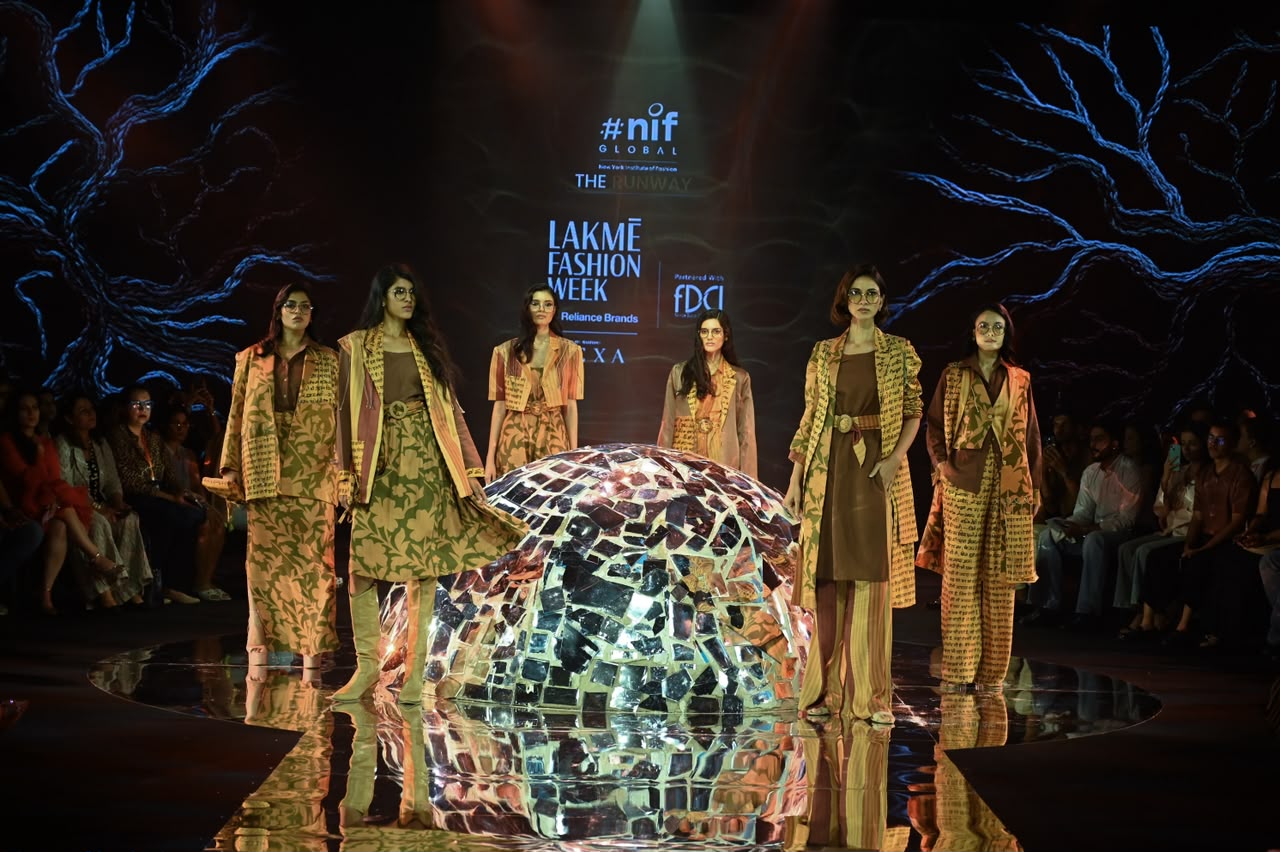
The GENअNOखी finale: checks, colour and craft united on the First Cut runway.
The finale line-up gathered the collections into a single frame of violet, chartreuse, teal and saffron, with checked fabrics running through almost every look. A purple halter top met a cropped jacket in contrasting yellow and blue checks. A violet bomber with ballooning check sleeves sat over draped dhoti trousers in two shades of plaid, finished with a plush bunny at the waist. A khaki waistcoat with a long bow collar layered over a yellow skirt bound with a plaid sash. Sneakers grounded nearly every look, a clear signal that these designers dress for real life.

The evening also saw the launch of The Ultimate Styling Guide for Modern Men by Dr Sharad Mehra, Chairman, Pearl Academy, published by Penguin Random House India. The book guides men towards a more considered everyday wardrobe, built on fit, proportion, colour and a few well-chosen essentials.
With GENअNOखी, Pearl Academy's students make a compelling case for craft as a living material, one that can be quilted, cropped, ruched and remixed while keeping its roots firmly in view. First Cut has long served as a meeting point between heritage and innovation, and this edition offers a clear view of the road ahead for Indian fashion: personal, culturally confident and open to experiment. India, worn their way, looks wonderfully bright.
TO BE CONTINUED, FOR SUBSCRIBERS ONLY.
This is where the surface ends and the reporting begins.
The complete piece, the full archive, and access to The French Press Circle. Reporting answerable only to its readers.
Already a subscriber ?
Login
Read these on the house, with our compliments.
A selection from the current issue, open to all readers. Read them in full. The rest is one decision away.





On 18 October, the First Cut runway at Taj Palace, New Delhi, took on the character of an Indian neighbourhood street. A woven charpai hung from a wooden frame at the entrance, a handloom stood at the head of the stage, and master artisans sat along the ramp at their machines, practising their crafts as the collections moved past them.
Into this setting, Pearl Academy's Fashion Design and Styling students sent out GENअNOखी: India, Worn Your Way. Their collections examined how a new generation uses fashion as a language, and what that language says about being Indian today.
Heritage, Remixed by a New Generation
Created by the Fashion Design Council of India (FDCI) and Pearl Academy, First Cut puts emerging design talent in front of the fashion induHeritage, Remixed by a New Generationstry. This season it arrived at Lakmē Fashion Week, in partnership with FDCI, with a timely question: how is a new generation shaping its Indian identity through the clothes it chooses?
The title holds the answer. GENअNOखी, meaning unique or distinctive, describes young Indians who move easily between heritage and global influence and make both their own. The students paired contemporary silhouettes and experimental styling with traditional craft and reimagined textiles. The result is a wardrobe that is rooted and entirely personal, made by designers who grew up around these crafts and see endless room to reinterpret them.
The presentation featured six master artisans representing crafts including Zardozi embroidery, Charpai weaving, block printing, Gota Patti, handloom wool weaving and Charkha spinning, celebrating a fresh interpretation of Indian identity through the lens of Gen Z. Having the artisans on the runway gave the evening its warmth. Generations of skill sat a few feet from the young designers carrying it forward, and that conversation ran through every look.
Aditi Srivastava, President of Pearl Academy
Aditi Srivastava, President, Pearl Academy, described the Gen Z idea of a new look as "fluid, local, hybrid, conscious and deeply personal." In her words, "Craft becomes attitude, surface, structure and statement." Sunil Sethi, Chairman, FDCI, called First Cut "an important platform for emerging designers to gain industry exposure," and described GENअNOखी as "an exciting interpretation of Indian fashion by blending traditional craftsmanship with contemporary perspectives."
Heritage in Every Thread
On the runway, that idea became clothes you could picture on a college campus tomorrow. Each look carried a traditional technique at its centre and wore it with sneakers, sunglasses and plenty of humour.
The show opened with cloth itself, shaped by the spirit of Charkha spinning and handloom weaving.
A quilted madras-check wrap coat with crochet flowers and wooden bead toggles, layered over indigo denim balloon trousers.
Checked cotton, the fabric of every Indian household, turned up in one of the evening's best pieces: a quilted wrap coat in green, violet and lilac madras check. Red blanket stitch traced its edges, crocheted flowers sat across the front, and a string of painted wooden toy beads fastened the waist. Layered panels fell to the ankle over indigo denim balloon trousers and pastel high-tops. Part razai, part dressing gown, part statement overcoat, it brought a lovely sense of home onto the ramp.Block printing came next, and this time it arrived with volume.
A patchwork puffer in bandhani and block-printed paisley, paired with a striped column skirt finished in tasselled drawcords.
The boldest silhouette of the night was a cropped puffer pieced together from patchwork, its magenta funnel neck rising right up to a pair of green tinted sunglasses. Plum bandhani, sage and ice-blue panels made up the body, cream piping outlined every seam, and the balloon sleeves were cut from orange block-printed paisley joined by visible hand stitching. Underneath, a floor-length column skirt in red bandhani and coral block-printed strips swung with beaded, tasselled drawcords. Two of India's most familiar surfaces became the architecture of the look.
A pintucked violet kurta under a hand-stitched ruched shrug, with a lime pleated apron and gathered trousers.
The menswear shared that sense of fun. A violet kurta with fine pintucks and tiny loop buttons sat under a cream shrug whose ruched sleeves ran past the fingertips, dotted with small cross and running stitches in green and plum. A pleated lime apron wrapped the hips at an angle, and purple trousers gathered into soft folds at the shin. Wire spectacles on a chain and burgundy sneakers finished a kurta pyjama redrawn for a generation that dresses to say something.
A cerulean cropped blazer and tiered ruffle skirt, edged with floral embroidery and strings of gota-inspired tassels.
The most dramatic look came in a single shade of cerulean. A sharp-shouldered blazer was cropped at the ribs, its lapel falling into a cowl and tied at the side. Below it, a tiered ruffle skirt opened at a high slit lined with richly embroidered floral borders in rose, gold and leaf green. Strings of gold beads and tassels in crimson, sky blue and ivory crossed the leg like jewellery, a confident salute to Gota Patti and tassel work. Red glass bangles, wired earphones and sunglasses pushed into the hair kept it firmly in the present.
A powder blue tunic with hand-gathered shoulders and draped trousers, carried with a red leather pony bag.
A powder blue menswear look made the case for softness. A long, high-necked tunic with loop fastenings opened over draped trousers, and the shoulders carried sculpted epaulettes of cream fabric, hand-gathered into a dense, shibori-like texture. Full sleeves narrowed into smocked, embroidered cuffs. A glossy red leather bag shaped like a pony added the perfect touch of wit.
Colour led the next part of the show, and this is where GENअNOखी was at its most playful.
Magenta in two moods: a sheer lace-up organza shirt with floral shorts, and a hooded cape over a layered brown skirt.
Magenta returned again and again, almost as a signature. One pairing put a sheer organza shirt, laced up the front with cord ties and gathered at the wrist, over layered ivory shorts embroidered with small florals, with sprigs of baby's breath tied at the ankles above argyle socks. Beside it walked a magenta hooded cape with ruched sleeves, worn over an embroidered ivory bralette and a chocolate brown skirt that fell in soft, uneven layers.
A sheer lemon tunic over a lilac check ruffle mini, styled with a striped tie and playful accessories.
School uniform references turned joyful in a sheer lemon tunic, pintucked across the bodice and scattered with tiny embroidered motifs, worn over a lilac check ruffle mini. A lilac striped tie hung loose at the neck. Lilac sunglasses, bright hair clips, a plush toy bag on a chain and cheese-print socks with clear heels gave it a cheeky, irresistible charm.
An apricot cape and red bustier with a handwoven wool panel falling into a long pale blue fringe.
Handloom wool weaving had its most graphic moment in a look dressed in sunset shades. An apricot cape draped over a red bustier, with a lemon tie-dyed scarf wound at the neck. At the hip hung a woven maroon panel patterned with zigzag diamonds in yellow, turquoise and red, falling into a long fringe of pale blue cord that brushed the ankle. A mustard headwrap and chunky resin bangles completed a perfect piece of festival dressing.Then the mood softened, and the collection had room to breathe.
A mint green kimono jacket with lace insets over a handkerchief-hem skirt, finished with flower tassels.
A mint green set paired a wide-sleeved kimono jacket, tied at the front and inset with fine lace, with a handkerchief-hem skirt layered over cargo shorts. Tiny yellow flower tassels hung from the pockets, and neon clogs with smiley-face socks kept the mood sunny.
An embroidered organza jacket over a bandeau, with teal trousers panelled in woven textiles and running stitch.
A pale blue organza jacket with cascading lapels, embroidered at the shoulder with a gleaming yellow motif that recalls Zardozi, framed a green and teal bandeau. The trousers stole the look: teal panels cut like rolling waves, inset with lime and mint woven textiles and traced in visible yellow running stitch. A fuchsia bandana and black boots gave it an easy edge.
A Finale in Full Colour
The GENअNOखी finale: checks, colour and craft united on the First Cut runway.
The finale line-up gathered the collections into a single frame of violet, chartreuse, teal and saffron, with checked fabrics running through almost every look. A purple halter top met a cropped jacket in contrasting yellow and blue checks. A violet bomber with ballooning check sleeves sat over draped dhoti trousers in two shades of plaid, finished with a plush bunny at the waist. A khaki waistcoat with a long bow collar layered over a yellow skirt bound with a plaid sash. Sneakers grounded nearly every look, a clear signal that these designers dress for real life.
The evening also saw the launch of The Ultimate Styling Guide for Modern Men by Dr Sharad Mehra, Chairman, Pearl Academy, published by Penguin Random House India. The book guides men towards a more considered everyday wardrobe, built on fit, proportion, colour and a few well-chosen essentials.
With GENअNOखी, Pearl Academy's students make a compelling case for craft as a living material, one that can be quilted, cropped, ruched and remixed while keeping its roots firmly in view. First Cut has long served as a meeting point between heritage and innovation, and this edition offers a clear view of the road ahead for Indian fashion: personal, culturally confident and open to experiment. India, worn their way, looks wonderfully bright.
TO BE CONTINUED, FOR SUBSCRIBERS ONLY.
This is where the surface ends and the reporting begins.
The complete piece, the full archive, and access to The French Press Circle. Reporting answerable only to its readers.
Already a subscriber ?
Login
Read these on the house, with our compliments.
A selection from the current issue, open to all readers. Read them in full. The rest is one decision away.