
A woman in her thirties walks into the Delhi store and tells Rhea Chakraborty about a family function.
"She's thirty plus and her family members, whenever they do a gathering, keep insisting that she needs to get married, and all her family gatherings become very torturous for her," Rhea says. "And she said, you know, I bought that indifferent t-shirt and I knew this was going to happen, so I just wore that t-shirt and went. And I was like, okay, this is exactly what I hoped for."

That transaction is the whole company in miniature, and it has very little to do with streetwear. A sentence spoken at that gathering becomes a statement that has to be defended in front of relatives. The same sentence printed on a chest is deniable. It can be waved off as a joke, a trend, something picked up at a mall. The wearer gets the benefit of having said it and keeps the option of never having said it.

Chapter 2 is in the business of selling that option, at roughly two thousand rupees a unit, to a country where the cost of direct confrontation inside a family is high and the appetite for it is low.
The category they left
The brand launched into streetwear and left it within a quarter.
"When we started the brand, we thought streetwear, oversized clothing, comfortable clothing is the way to go," Showik Chakraborty says. "We soon pivoted, I think three months down the launch of the brand. We realised it's not essentially streetwear that we're building. We're building a new category, which is bridge to street. It's neither your regular clothing nor your streetwear. It's something in between. You can wear the same clothes to a party, to a day at office. You want to make it everyday essentials."

The pivot identifies something about how the form arrived here. In America, streetwear grew out of skate, hip hop, surf and basketball. Scarcity, the drop, the queue and the resale premium were all products of subcultures that existed before the clothes did. India imported the aesthetic and the release mechanic without the subculture underneath, which left the theatre of scarcity performed for an audience that had never needed it.
The Indian wardrobe has also never organised itself around subcultural separation. It runs on occasion stretch: one garment carrying a person through an office, a gathering, a commute, a dinner. Telling an Indian buyer that a shirt is good for one context asks that buyer to absorb a cost they have historically refused.
Rhea makes the aesthetic case for the same decision.
"We're not as outlandish as most streetwear brands seem to be. If clothes have to speak for you, you have to feel comfortable in them, and not everyone's going to be comfortable in something that's extremely loud or extremely out there. That's not everyone's personality.
Clothes should be almost like an extension of you."
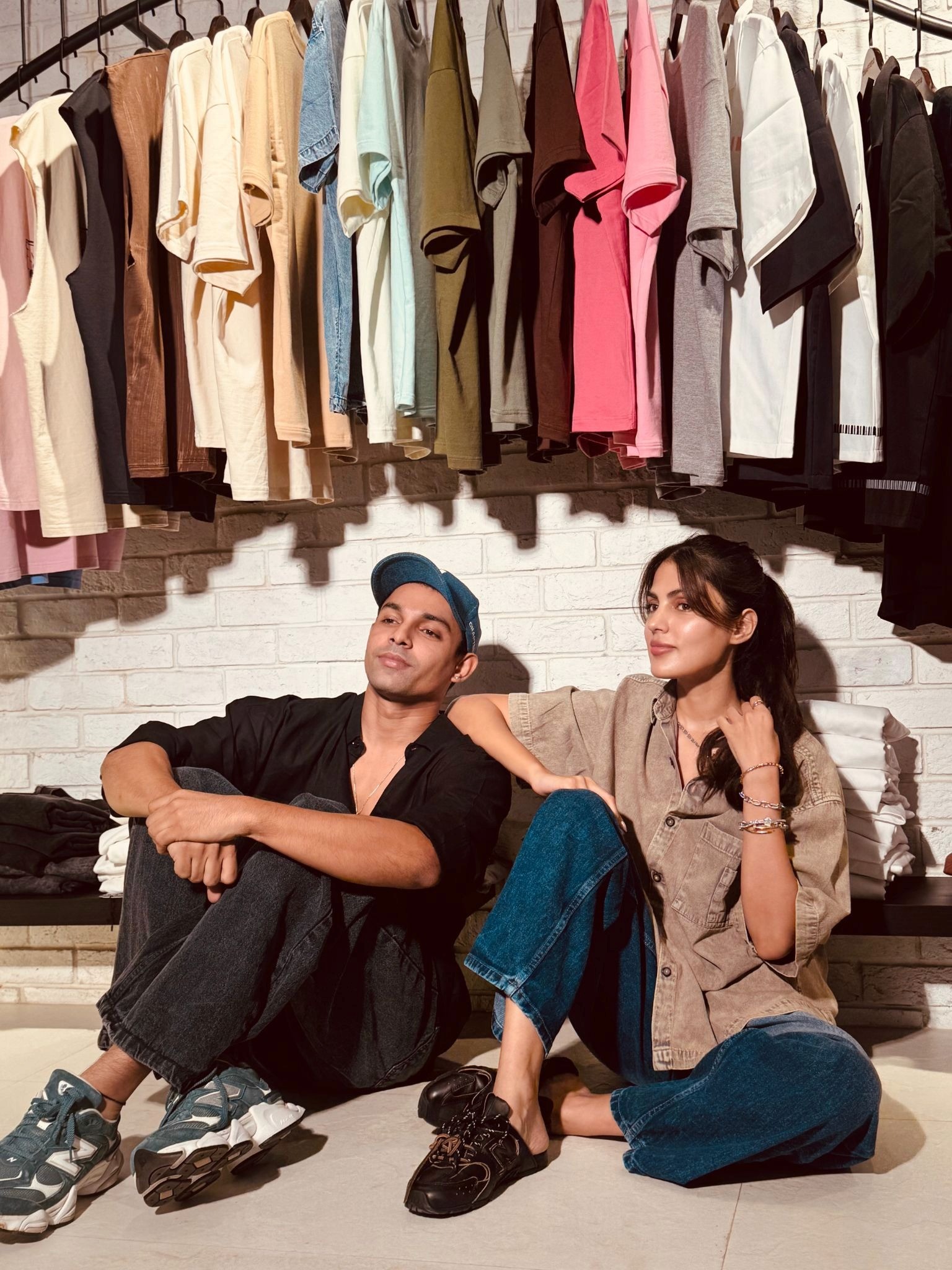
Then the part that reads as a design principle rather than a preference: "The words have to feel empowering rather than escaping. When you wear something very loud, you're in fact trying to draw attention away from yourself. We want people to go inwards. We want them to hear their inner voice. And that is essentially what we did to heal."
The product line follows from this. "We have anti-everything. We have indifferent. We have a t-shirt that says cancel, which I'm wearing right now. We have a t-shirt that says gaslit." These are terms lifted from the therapy-adjacent internet, and they work as compressed emotional states. Nobody wears GASLIT to start a fight. They wear it to name a condition they are already inside.
The saturation question, answered the wrong way round
Every account of Indian streetwear opens with the claim that the market is saturated. Showik disagrees, and his reasoning is sharper than the consensus.
"I feel like Indian streetwear overall is not saturated. Every single brand out there speaks for themselves. It's a very tiny community. For it to be saturated, it will require a much larger force behind it, having thousands and thousands of brands competing for the same audience, same customer. Streetwear in itself is a niche industry yet. It is yet to blow up in India in terms of growth."
He points at his own street. "If you see Linking Road, where Chapter 2's store is, an entire road is full of D2C fashion brands."
Streetwear holds under five percent of India's fashion market. A category that small cannot be saturated; it can only be crowded at the entrance. What exists is high brand density inside a narrow funnel, which produces the sensation of saturation without the economics of it. The distinction sets strategy. If the market is saturated, the answer is differentiation at any
cost, which is how a hundred labels end up performing the same eccentricity. If the category is small and growing, the answer is dull: better product, sane pricing, distribution into places nobody has bothered to visit.
"What makes Chapter 2 different, firstly, is that again, we are not essentially streetwear," Showik says. "If we had to consider ourselves as bridge to street, we are really good with the product quality, followed by pricing, followed by the story behind it. Each brand that exists in India has a story, has a thought behind it, but somehow we are trying to put those thoughts into every single drop that we do. We won't be satisfied till every single piece in that collection speaks for something."

Where the Indianness actually lives
"It's completely made in India," Rhea says. "We don't import a single fabric. Everything is made in India, sourced in India and designed in India. We have a lot of our t-shirts where we write Chapter 2 in Hindi. We use the Devanagari script quite a bit in some of our hoodie sets and some of our t-shirts. I don't think we borrow it at all from any international brand. I don't think the aesthetic that works in Japan will work in India. I don't think the aesthetic that works in LA will necessarily work in India. The Indian aesthetic will work in India, and the Indian aesthetic is changing."
She is careful about the limits of that claim. "We don't create out of thin air. We also create based on some subconscious understanding of what we've seen or liked on social media or in a movie or somewhere that we travelled, and hence those references and those cultures also slightly become part of our lived experiences and then they formulate onto a t-shirt."
Her credential for the subject is geographic. "Our dad was in the army. So we grew up all over India. We went to around twelve, thirteen schools in twelve years. We've lived in north, south, east, west, in places that people haven't even heard of. So I don't think there's anyone more Indian than him and I."
The more consequential answer is structural, and Showik gives it.
"The Indian body type is so different. A sample comes of a t-shirt, I make six or seven people wear it in our office, all different body types, then we try to find exactly what each one of them is feeling comfortable in. If you go to see, our XS to XXL sizing is much more different than any other brand, because we are trying to cater to that body type which is in between.
There are people who are between an S and an M. You can wear the S also, you can wear the M also. If you really want to fit like a regular t-shirt, you wear an S. If you want it oversized, you wear an M. Giving that option to the Indian consumer, that's also pretty Indian about us."
Rhea adds the proportion that Western pattern blocks are not drawn for. "Indian women especially, we have broader hips than broader shoulders, whereas in the west it's the other way around mostly. Whether it's our denims or our t-shirts, they are built in a way where it'll enhance that and not the opposite way."
A Devanagari print is a signal, and anyone can buy one. A size curve graded off Indian bodies is capital, sampling time and months of vendor work. Showik put in the months. "I personally went and spent one and a half months with each and every vendor, practically living with them to understand the process of building, so we could cut cost."
Unisex, invented by the dhobi
The origin of the brand's gender-neutral position has nothing to do with ideology. It begins with theft.
"He has stolen all my t-shirts over the last thirty years," Rhea says of her brother. "Today only I caught him wearing one of my t-shirts, and I'm like, it's literally fitting you, it's one of my shorter t-shirts, it's like a crop top on you. And he's like, no, I think it's cool."
Then the structural fact underneath the joke. "A lot of families, we have dhobis in India. We don't have laundry, we have dhobis. And when the clothes come back from the dhobi, many a times they may go into the wrong cupboards, because if the two t-shirts look similar, it could go into Showik's, it could go into mine, it could go into my parents'. Every time I bought a new t-shirt and I wore it the first time, the second time it never came back to me. And then I saw Showik somewhere on his Instagram and I'm like, hey, that's my t-shirt."
The conclusion was operational before it became a position. "And then I said, you know what, should we just make this unisex?"

Western unisex fashion arrives through gender politics and is sold as a stance. Indian unisex arrives through the shared household, the dhobi, the sibling raid, the cousin's cupboard. The politics are real here too, and Rhea states them: "We don't really believe in gender to be different. We're gender neutral as a brand. The world is moving to a place where gender neutrality is becoming more and more accepted, thankfully, and more people wear what they like, not what they should." The sequencing is what keeps it from reading as a marketing gesture. The domestic fact came first.
It shows up at till level. "I have seen many couples coming in saying, you take the black one, I'll take the white one, and we'll share."
Segmenting by rupture
The strangest decision in this business is the definition of the customer. Apparel segments by age, income and city tier. Chapter 2 segments by biographical discontinuity.
"Chapter 2 essentially means change is the only constant," Showik says. "It could be a change in your lifestyle. You're changing jobs. You're going through a breakup. You're going through a divorce. You're changing yourself. You're changing your gender. It could be anything and everything that revolves around change. Everyone fears change. We are trying to build a platform where we say, you know what, join us, where we all face change together without judgment, without fear."
Rhea puts the same idea in first person, and the list is unglamorous. "Chapter 2 is a second chance at life. In our personal terms we would say, the ability to go to work, the ability to work, the ability to earn a livelihood, the ability to have friends, the ability to meet them, the ability to have a passport is Chapter 2 for Showik and me."
Two consequences follow, and they appear to have been discovered rather than planned. The market is permanently renewing, because rupture is not a life stage. And the age band collapses as a variable. They aimed at 16 to 35 and got something else.

"We saw a sudden spike between the age group of 45 to 60," Showik says. "All our friends, their parents started coming to the store. There's an entire customer psychology behind it. They have started dressing younger. They want to look younger. They want to feel younger. They want to look like their kids. They want to match with their kids. So we are catering to that audience. We launched a junior line which is 6 to 14, covering the entire audience from 6 to 60. At the end of the day, age doesn't matter. Retention is the most important thing. LTV is important for us."
Pricing was set by a man checking his own wallet. "As a 27 year old then, before building the brand, I was like, can I buy a five, six thousand rupee t-shirt? Yes, of course. But I'll have to save up for a period of time. Is it aspirational to me? Yes. But can I buy it and wear it every day? I'll have to think twice before wearing it. That's when we pivoted. We were like, why don't we look at a pricing that's comfortable to everybody? Why narrow our audience down? They should be able to buy a Chapter 2."
Three hundred pop-ups as fieldwork
In year one they did more than three hundred pop-ups.
"Showik's just been the warrior behind all these pop-ups, who's gone and put up a rack anywhere that he could to test out markets," Rhea says. "In year one I think we did 300 plus pop-ups. Which is insane. It's unheard of." Later, on her brother's appetite for it: "A year only has 365 days. So do the math."
Showik's account starts from a problem in e-commerce physics. "When we started the brand, I was like, how does one sell online a t-shirt which you can't feel or touch and understand the quality of? So we went on this rampage of taking a rack from Bombay to all of India. Maybe a cafe, some live music is happening, we were there. We were there on a Sunday in Surat. We were there on a Monday in Raipur. We were there on a Tuesday in Ludhiana."
Read as marketing, three hundred weekends is inefficient. Read as research, it is the most valuable asset the company owns. A dashboard is an excellent instrument for recording purchases and a useless one for recording refusals. It cannot tell you that someone picked up a shirt at 3,000, liked it, and put it down. Showik went looking for exactly that.
"Offline you can have conversations, you can engage the customer. Let's understand why they don't want to buy this for 3,000, or why would they buy it for 2,000. What is it about the quality that they like. Every event that we did, we had pages and pages, notebooks written
down. This customer said this. We used to get their data, their contacts, and then call them, ask them, and we used to launch a collection whether they liked it or not."
He also names the attention economics that pushed him offline. "When they meet you in person they always remember you more than they swipe when they are looking on Instagram or Facebook through ads. The ADHD is so high that personally also I don't look at anything more than three seconds when I'm scrolling."
Rhea's summary of what those weekends bought: "When you meet customers in person they tell you very honestly what they feel. That touch and feel thing is still there in India. The Indian consumer is, A, price sensitive, yes, but B, also very particular about fit, which is why a certain t-shirt might work in the west but it'll most definitely not work in India. All of this knowledge only came to us because of these hundreds of pop-ups."
Asked what converts a stranger into a community member, Showik gives two things. "One is of course the product, the quality, the pricing. Second is the team." And then the part that turns a stall into a confessional. "When we get talking, they start talking to me about their chapter 2, what it really means to them, to a point where the conversation sometimes goes to one, two hours, going and getting a bite. That gives them a sense of security. That builds trust and loyalty. Vulnerability, when embraced, there's nothing more powerful."
The service standard he sets for himself is absolute and slightly unhinged. "I am in touch with almost every single customer who has any query that comes on Instagram. I am at 2 am also sending a screenshot on the customer group saying customer is king and they'll always be."
Discipline, and the refusal to forecast
The financial story is austere.
"The fact that Showik and I didn't make any money was the financial discipline that we follow," Rhea says. "Showik and I have still done jhadu pocha at the Delhi store when needed. When you're a founder, it's not something glamorous. It requires that intensity. It requires no ego. You're essentially selling clothes. So you have to leave your egos at home and you have to do everything that's required of you."
Headcount was the moat. "We were a very lean team. I think that's what saved us. We were just a five member team until last year, November. Even when we were scaling we were very tight. Five of us did everything at one point. That is the discipline that's now become the ethos of the company, where no one's going to be like, yeah, this is not in my KRA. We tell people even when we're hiring them that boss, we work like this. If this is your vibe, you come."
They ran the company out of her home, then out of the Bandra store, and took an office only recently. "Remaining lean and cost cutting is very crucial, because you don't realise when 1,000 rupees becomes 10,000 becomes one lakh and suddenly you're like, oh, we've spent so much."
Product discipline matched it. "We entered the market with 80 t-shirts," Showik says. "That's like, if you divide it by five sizes, do the math, it's 16 per size."
The Kishore and Ashni Biyani investment came out of a podcast Rhea was hosting.
"I knew Ashni and Kishore sir. I had met them socially and I was like, would you like to come on a podcast, because they truly are in their chapter 2. He's building an empire from scratch all over again. And when they came, I started asking him advice. I'm like, since I have you on the chair, tell me what you think about scaling versus profitability. And he said, listen, I'm happy to give you some free advice for some free equity. I was like, free, no, but why don't you invest in the brand? It was just like a mock joke situation, and as luck would have it, he said yes."
What she wanted from him was not the cheque. "He's essentially the retail king of India. He understands fashion and apparel and retail expansion like no other. He's guided us through all the pitfalls we could potentially have. He always says focus on building brand rather than making revenue, which is very impressive for an investor."
Then comes the moment most founders would never allow to run. Asked where the company is in five years, Rhea declines the genre.
"Having been through everything that we've been through in life, the one thing that I truly live by is that nobody knows what's going to happen tomorrow. And I know it doesn't sound amazing from the mouth of a founder, but it is the truth. I can wish that Chapter 2 becomes a thousand crore company, and yes, I hope so, and I will give it my all to scale it to that level. But the truth is that I don't know. I have also shared this with someone like Kishore sir, that sir, I can put it on a spreadsheet and an Excel for you and it's all going to look great, everyone's going to be excited, but the truth is that we are going to evolve with the brand, and the brand is also going to take us somewhere. The consumers are also going to take us somewhere. So we have to keep that leeway."
This is epistemic humility earned the hard way, and it is more defensible than the convention it breaks. It also sits against her brother, who resolves arguments with evidence and has traded his own appetite for scale.
"I call it hunger versus number," Showik says. "You need to see the data first. Earlier, if you asked me this fourteen months ago, I'd be like, store, let's go crazy. Now I've been humbled by a few people saying let's build it sustainably. Instead of expanding to 30 stores, we're doing it slowly. Build each store out profitably, double down on each store that we build, and then move on to the next one. You can take the decision right now thinking it's good for you now, but you have to look at data and see twelve months later, twenty-four months later, thirty-six months later, what is going to happen."
The pipeline is short and specific: Gurgaon, an airport, Bangalore under serious consideration.
Gut, and the people who run on it
For all the data talk, the design engine is something else entirely.
"We've never followed trends," Rhea says. "There has never been a moment in the last year and a half where I or Showik has messaged the design team saying, yeah, this is what's working, we should make this. It's always been, what's up guys, what are you feeling today? And the team one day said, we all feel manipulated. I'm like, do you feel gaslit? And they were like, yes. And we're like, okay, let's make a t-shirt that says gaslit. That's literally how we work. And I think only someone without a business background or a fashion background can do that, because we're just going with gut here."
The Bandra store was decided the same way. "Showik had a gut feeling that we should open a store in Bandra. He went and found a spot and he came to me, he said let's open it. I was like, are you crazy, it's too early, it's such a big risk, what if it doesn't work. We opened it. It worked."

The hiring runs on the same instrument, and it amounts to an arbitrage on a labour pool that conventional recruiting underprices. "Most of the people who work with Chapter 2 are people who are in their chapter 2, and even if they are not bookishly qualified for the job, they're qualified by spirit. That's what's really unique, and that's somehow what the brand has become. It's not that we had some big master plan. And I feel that is disruptive in a world that's all about pure numbers, pure finance, pure scaling."
They are choosing to go slower than they can. "We have the opportunity to scale faster than we are, but we're choosing to grow slowly because we want to keep our community strong rather than spreading out too thin. We want the numbers. We want the revenue. We want all of that. But as we scale, we can't lose who we are." Her analogy is cinematic: "It's like a very indie business. The difference between a small film that does really well versus a really big film that does really well is the difference."
The floor work continues. "Showik and I have recently swept the floors at our Delhi store. We have steam ironed clothes as of day before on a shoot. We're still not running it entirely based on hierarchy or structure. It's got a lot of emotion, and it's personal to us. The brand, it is our chapter 2."
The risks nobody in the room names
Two are structural.
The first is the half-life of a feeling. Generating product by asking a room what it feels today is a real method, and it produced GASLIT, and sentiment expires faster than cotton. The hybrid they are building is the hedge. "Per collection, if you drop fifty styles, we know these five, seven are moving," Showik says. "Let's test them out for the next 90 days. Do they have the capacity of becoming the bestsellers? Then we add it to the core collection. Since we are a new brand, it's been only sixteen months, we are yet identifying."
He is firm about what they will not do with a drop. "We don't make collections which we intend to sell out within a day or two. We intend to make a collection when we're sure of what
we are trying to tell the audience. It's not like you'll just drop a t-shirt and be like, okay, cool, just buy it. That's never the intention and it will never be the intention."
The second is succession of meaning. A company whose emotional premise is its founders' biography has to detach from that biography eventually. The handover is already visible in who they hire and in what they now take from customers.
The accident, industrialised
All of it traces back to a garment nobody designed to mean anything.
"I had worn this t-shirt in 2020 when I got arrested, that said roses are red, violets are blue, let's smash the patriarchy, me and you," Rhea says. "And that t-shirt spoke for me when I couldn't speak for myself. It was sent to me by an NGO and it happened to be in my cupboard and it was right in front of me on the day, and I was like, you know what, this is what I'm feeling, I'm going to wear this."

When they reissued it on Women's Day this year: "I have goosebumps when I say this, that life comes full circle. I couldn't have thought in my wildest dreams that that t-shirt would have so much meaning in my life, that it would dictate the next decade of my life, and that it would be one of the key propellers for Showik and I to start Chapter 2."
The first version of the company was a way to make rent. "The initial idea was to just sell these to our friends in Bandra and make some money for our livelihood. That was pretty much it. None of us have a business background or a fashion background." Before clothes, there were other ideas. "We started with soaps and I don't know where all we went."
What they say about the years before that is brief and unsentimental, which is itself the position. "We believe in moving forward. The only duty of a human being is to continue. We have found a way to drown out the outer noise, because very often when you're lost in these worlds of social media and trolling, you forget what it is that you want to do, what you want to build, where you want to go." The clearest line: "Now it doesn't affect us. And that's why the indifferent t-shirt came to life, because we are totally indifferent. There's no hate. There's no feeling of vengefulness. It's just indifference."
Showik's account of how the two of them ran that period sounds like a shift roster. "Rhea and I were trauma bonded even closer. We had decided, if one of us is having a bad day, the other one will take the smile on everyone's face. Back in the day it was me, mom, dad, Rhea and a couple of friends." Rhea traces the composure to an army childhood: "Growing up as an army kid, you really see strength in dignity. So many uncles, my dad's friends and colleagues, who were fighting for the nation and going to Kargil and coming back. There's a sense of dignity, strength and purpose that you have from the very beginning."
The division of labour that resulted is her joke and her brother's org chart. "Showik is the CEO and I'm the chief of everything else officer." Their conflict protocol is Showik's: "If this is your department, I'm not going to say anything. If this is my department, you're not going to say anything. Let's meet with data, let's get data and let data speak."
And one line that explains the asymmetry better than any cap table: "I have given Chapter 2 everything that I have, and I think he's given Chapter 2 everything that he didn't even have."
The interesting question the company poses is an artistic one. That original shirt worked because the accident was total. Nobody planned the collision of a slogan, a body and a day. What Chapter 2 attempts is the industrialisation of that accident, with a size curve and a margin attached. Most art is an attempt to repeat something that happened once by mistake, and most of it fails on the second try.
The stores are where the bet gets tested. "Our stores are not just passive stores. They're active stores," Rhea says. "It's a hub for the community to come participate in events, meet each other, because this community can't just exist online. We do a lot of events, health and wellness, yoga, and we do something called next life progression, which is the opposite of past life regression."
Global comes later, and the sequence is deliberate. "Before we go global we definitely want to capture India completely. This brand is made by Indians, for Indians, of Indians. It's a ten year journey. The journey also dictates the path and the path also dictates the journey."
The tagline is Showik's one-line summary of the product: "Write your own sequel. We are here to make you feel what you are feeling but can't say, through our clothes." The sign-off, on everything, is Rhea's: "Chapter 2, onwards and upwards."
The last words of the interview belong to the CEO, who had sat through an hour of philosophy and had one instruction left.
"Go shop now."
TO BE CONTINUED, FOR SUBSCRIBERS ONLY.
This is where the surface ends and the reporting begins.
The complete piece, the full archive, and access to The French Press Circle. Reporting answerable only to its readers.
Already a subscriber ?
Login
Read these on the house, with our compliments.
A selection from the current issue, open to all readers. Read them in full. The rest is one decision away.







A woman in her thirties walks into the Delhi store and tells Rhea Chakraborty about a family function.
"She's thirty plus and her family members, whenever they do a gathering, keep insisting that she needs to get married, and all her family gatherings become very torturous for her," Rhea says. "And she said, you know, I bought that indifferent t-shirt and I knew this was going to happen, so I just wore that t-shirt and went. And I was like, okay, this is exactly what I hoped for."
That transaction is the whole company in miniature, and it has very little to do with streetwear. A sentence spoken at that gathering becomes a statement that has to be defended in front of relatives. The same sentence printed on a chest is deniable. It can be waved off as a joke, a trend, something picked up at a mall. The wearer gets the benefit of having said it and keeps the option of never having said it.
Chapter 2 is in the business of selling that option, at roughly two thousand rupees a unit, to a country where the cost of direct confrontation inside a family is high and the appetite for it is low.
The category they left
The brand launched into streetwear and left it within a quarter.
"When we started the brand, we thought streetwear, oversized clothing, comfortable clothing is the way to go," Showik Chakraborty says. "We soon pivoted, I think three months down the launch of the brand. We realised it's not essentially streetwear that we're building. We're building a new category, which is bridge to street. It's neither your regular clothing nor your streetwear. It's something in between. You can wear the same clothes to a party, to a day at office. You want to make it everyday essentials."
The pivot identifies something about how the form arrived here. In America, streetwear grew out of skate, hip hop, surf and basketball. Scarcity, the drop, the queue and the resale premium were all products of subcultures that existed before the clothes did. India imported the aesthetic and the release mechanic without the subculture underneath, which left the theatre of scarcity performed for an audience that had never needed it.
The Indian wardrobe has also never organised itself around subcultural separation. It runs on occasion stretch: one garment carrying a person through an office, a gathering, a commute, a dinner. Telling an Indian buyer that a shirt is good for one context asks that buyer to absorb a cost they have historically refused.
Rhea makes the aesthetic case for the same decision.
"We're not as outlandish as most streetwear brands seem to be. If clothes have to speak for you, you have to feel comfortable in them, and not everyone's going to be comfortable in something that's extremely loud or extremely out there. That's not everyone's personality.
Clothes should be almost like an extension of you."
Then the part that reads as a design principle rather than a preference: "The words have to feel empowering rather than escaping. When you wear something very loud, you're in fact trying to draw attention away from yourself. We want people to go inwards. We want them to hear their inner voice. And that is essentially what we did to heal."
The product line follows from this. "We have anti-everything. We have indifferent. We have a t-shirt that says cancel, which I'm wearing right now. We have a t-shirt that says gaslit." These are terms lifted from the therapy-adjacent internet, and they work as compressed emotional states. Nobody wears GASLIT to start a fight. They wear it to name a condition they are already inside.
The saturation question, answered the wrong way round
Every account of Indian streetwear opens with the claim that the market is saturated. Showik disagrees, and his reasoning is sharper than the consensus.
"I feel like Indian streetwear overall is not saturated. Every single brand out there speaks for themselves. It's a very tiny community. For it to be saturated, it will require a much larger force behind it, having thousands and thousands of brands competing for the same audience, same customer. Streetwear in itself is a niche industry yet. It is yet to blow up in India in terms of growth."
He points at his own street. "If you see Linking Road, where Chapter 2's store is, an entire road is full of D2C fashion brands."
Streetwear holds under five percent of India's fashion market. A category that small cannot be saturated; it can only be crowded at the entrance. What exists is high brand density inside a narrow funnel, which produces the sensation of saturation without the economics of it. The distinction sets strategy. If the market is saturated, the answer is differentiation at any
cost, which is how a hundred labels end up performing the same eccentricity. If the category is small and growing, the answer is dull: better product, sane pricing, distribution into places nobody has bothered to visit.
"What makes Chapter 2 different, firstly, is that again, we are not essentially streetwear," Showik says. "If we had to consider ourselves as bridge to street, we are really good with the product quality, followed by pricing, followed by the story behind it. Each brand that exists in India has a story, has a thought behind it, but somehow we are trying to put those thoughts into every single drop that we do. We won't be satisfied till every single piece in that collection speaks for something."
Where the Indianness actually lives
"It's completely made in India," Rhea says. "We don't import a single fabric. Everything is made in India, sourced in India and designed in India. We have a lot of our t-shirts where we write Chapter 2 in Hindi. We use the Devanagari script quite a bit in some of our hoodie sets and some of our t-shirts. I don't think we borrow it at all from any international brand. I don't think the aesthetic that works in Japan will work in India. I don't think the aesthetic that works in LA will necessarily work in India. The Indian aesthetic will work in India, and the Indian aesthetic is changing."
She is careful about the limits of that claim. "We don't create out of thin air. We also create based on some subconscious understanding of what we've seen or liked on social media or in a movie or somewhere that we travelled, and hence those references and those cultures also slightly become part of our lived experiences and then they formulate onto a t-shirt."
Her credential for the subject is geographic. "Our dad was in the army. So we grew up all over India. We went to around twelve, thirteen schools in twelve years. We've lived in north, south, east, west, in places that people haven't even heard of. So I don't think there's anyone more Indian than him and I."
The more consequential answer is structural, and Showik gives it.
"The Indian body type is so different. A sample comes of a t-shirt, I make six or seven people wear it in our office, all different body types, then we try to find exactly what each one of them is feeling comfortable in. If you go to see, our XS to XXL sizing is much more different than any other brand, because we are trying to cater to that body type which is in between.
There are people who are between an S and an M. You can wear the S also, you can wear the M also. If you really want to fit like a regular t-shirt, you wear an S. If you want it oversized, you wear an M. Giving that option to the Indian consumer, that's also pretty Indian about us."
Rhea adds the proportion that Western pattern blocks are not drawn for. "Indian women especially, we have broader hips than broader shoulders, whereas in the west it's the other way around mostly. Whether it's our denims or our t-shirts, they are built in a way where it'll enhance that and not the opposite way."
A Devanagari print is a signal, and anyone can buy one. A size curve graded off Indian bodies is capital, sampling time and months of vendor work. Showik put in the months. "I personally went and spent one and a half months with each and every vendor, practically living with them to understand the process of building, so we could cut cost."
Unisex, invented by the dhobi
The origin of the brand's gender-neutral position has nothing to do with ideology. It begins with theft.
"He has stolen all my t-shirts over the last thirty years," Rhea says of her brother. "Today only I caught him wearing one of my t-shirts, and I'm like, it's literally fitting you, it's one of my shorter t-shirts, it's like a crop top on you. And he's like, no, I think it's cool."
Then the structural fact underneath the joke. "A lot of families, we have dhobis in India. We don't have laundry, we have dhobis. And when the clothes come back from the dhobi, many a times they may go into the wrong cupboards, because if the two t-shirts look similar, it could go into Showik's, it could go into mine, it could go into my parents'. Every time I bought a new t-shirt and I wore it the first time, the second time it never came back to me. And then I saw Showik somewhere on his Instagram and I'm like, hey, that's my t-shirt."
The conclusion was operational before it became a position. "And then I said, you know what, should we just make this unisex?"
Western unisex fashion arrives through gender politics and is sold as a stance. Indian unisex arrives through the shared household, the dhobi, the sibling raid, the cousin's cupboard. The politics are real here too, and Rhea states them: "We don't really believe in gender to be different. We're gender neutral as a brand. The world is moving to a place where gender neutrality is becoming more and more accepted, thankfully, and more people wear what they like, not what they should." The sequencing is what keeps it from reading as a marketing gesture. The domestic fact came first.
It shows up at till level. "I have seen many couples coming in saying, you take the black one, I'll take the white one, and we'll share."
Segmenting by rupture
The strangest decision in this business is the definition of the customer. Apparel segments by age, income and city tier. Chapter 2 segments by biographical discontinuity.
"Chapter 2 essentially means change is the only constant," Showik says. "It could be a change in your lifestyle. You're changing jobs. You're going through a breakup. You're going through a divorce. You're changing yourself. You're changing your gender. It could be anything and everything that revolves around change. Everyone fears change. We are trying to build a platform where we say, you know what, join us, where we all face change together without judgment, without fear."
Rhea puts the same idea in first person, and the list is unglamorous. "Chapter 2 is a second chance at life. In our personal terms we would say, the ability to go to work, the ability to work, the ability to earn a livelihood, the ability to have friends, the ability to meet them, the ability to have a passport is Chapter 2 for Showik and me."
Two consequences follow, and they appear to have been discovered rather than planned. The market is permanently renewing, because rupture is not a life stage. And the age band collapses as a variable. They aimed at 16 to 35 and got something else.
"We saw a sudden spike between the age group of 45 to 60," Showik says. "All our friends, their parents started coming to the store. There's an entire customer psychology behind it. They have started dressing younger. They want to look younger. They want to feel younger. They want to look like their kids. They want to match with their kids. So we are catering to that audience. We launched a junior line which is 6 to 14, covering the entire audience from 6 to 60. At the end of the day, age doesn't matter. Retention is the most important thing. LTV is important for us."
Pricing was set by a man checking his own wallet. "As a 27 year old then, before building the brand, I was like, can I buy a five, six thousand rupee t-shirt? Yes, of course. But I'll have to save up for a period of time. Is it aspirational to me? Yes. But can I buy it and wear it every day? I'll have to think twice before wearing it. That's when we pivoted. We were like, why don't we look at a pricing that's comfortable to everybody? Why narrow our audience down? They should be able to buy a Chapter 2."
Three hundred pop-ups as fieldwork
In year one they did more than three hundred pop-ups.
"Showik's just been the warrior behind all these pop-ups, who's gone and put up a rack anywhere that he could to test out markets," Rhea says. "In year one I think we did 300 plus pop-ups. Which is insane. It's unheard of." Later, on her brother's appetite for it: "A year only has 365 days. So do the math."
Showik's account starts from a problem in e-commerce physics. "When we started the brand, I was like, how does one sell online a t-shirt which you can't feel or touch and understand the quality of? So we went on this rampage of taking a rack from Bombay to all of India. Maybe a cafe, some live music is happening, we were there. We were there on a Sunday in Surat. We were there on a Monday in Raipur. We were there on a Tuesday in Ludhiana."
Read as marketing, three hundred weekends is inefficient. Read as research, it is the most valuable asset the company owns. A dashboard is an excellent instrument for recording purchases and a useless one for recording refusals. It cannot tell you that someone picked up a shirt at 3,000, liked it, and put it down. Showik went looking for exactly that.
"Offline you can have conversations, you can engage the customer. Let's understand why they don't want to buy this for 3,000, or why would they buy it for 2,000. What is it about the quality that they like. Every event that we did, we had pages and pages, notebooks written
down. This customer said this. We used to get their data, their contacts, and then call them, ask them, and we used to launch a collection whether they liked it or not."
He also names the attention economics that pushed him offline. "When they meet you in person they always remember you more than they swipe when they are looking on Instagram or Facebook through ads. The ADHD is so high that personally also I don't look at anything more than three seconds when I'm scrolling."
Rhea's summary of what those weekends bought: "When you meet customers in person they tell you very honestly what they feel. That touch and feel thing is still there in India. The Indian consumer is, A, price sensitive, yes, but B, also very particular about fit, which is why a certain t-shirt might work in the west but it'll most definitely not work in India. All of this knowledge only came to us because of these hundreds of pop-ups."
Asked what converts a stranger into a community member, Showik gives two things. "One is of course the product, the quality, the pricing. Second is the team." And then the part that turns a stall into a confessional. "When we get talking, they start talking to me about their chapter 2, what it really means to them, to a point where the conversation sometimes goes to one, two hours, going and getting a bite. That gives them a sense of security. That builds trust and loyalty. Vulnerability, when embraced, there's nothing more powerful."
The service standard he sets for himself is absolute and slightly unhinged. "I am in touch with almost every single customer who has any query that comes on Instagram. I am at 2 am also sending a screenshot on the customer group saying customer is king and they'll always be."
Discipline, and the refusal to forecast
The financial story is austere.
"The fact that Showik and I didn't make any money was the financial discipline that we follow," Rhea says. "Showik and I have still done jhadu pocha at the Delhi store when needed. When you're a founder, it's not something glamorous. It requires that intensity. It requires no ego. You're essentially selling clothes. So you have to leave your egos at home and you have to do everything that's required of you."
Headcount was the moat. "We were a very lean team. I think that's what saved us. We were just a five member team until last year, November. Even when we were scaling we were very tight. Five of us did everything at one point. That is the discipline that's now become the ethos of the company, where no one's going to be like, yeah, this is not in my KRA. We tell people even when we're hiring them that boss, we work like this. If this is your vibe, you come."
They ran the company out of her home, then out of the Bandra store, and took an office only recently. "Remaining lean and cost cutting is very crucial, because you don't realise when 1,000 rupees becomes 10,000 becomes one lakh and suddenly you're like, oh, we've spent so much."
Product discipline matched it. "We entered the market with 80 t-shirts," Showik says. "That's like, if you divide it by five sizes, do the math, it's 16 per size."
The Kishore and Ashni Biyani investment came out of a podcast Rhea was hosting.
"I knew Ashni and Kishore sir. I had met them socially and I was like, would you like to come on a podcast, because they truly are in their chapter 2. He's building an empire from scratch all over again. And when they came, I started asking him advice. I'm like, since I have you on the chair, tell me what you think about scaling versus profitability. And he said, listen, I'm happy to give you some free advice for some free equity. I was like, free, no, but why don't you invest in the brand? It was just like a mock joke situation, and as luck would have it, he said yes."
What she wanted from him was not the cheque. "He's essentially the retail king of India. He understands fashion and apparel and retail expansion like no other. He's guided us through all the pitfalls we could potentially have. He always says focus on building brand rather than making revenue, which is very impressive for an investor."
Then comes the moment most founders would never allow to run. Asked where the company is in five years, Rhea declines the genre.
"Having been through everything that we've been through in life, the one thing that I truly live by is that nobody knows what's going to happen tomorrow. And I know it doesn't sound amazing from the mouth of a founder, but it is the truth. I can wish that Chapter 2 becomes a thousand crore company, and yes, I hope so, and I will give it my all to scale it to that level. But the truth is that I don't know. I have also shared this with someone like Kishore sir, that sir, I can put it on a spreadsheet and an Excel for you and it's all going to look great, everyone's going to be excited, but the truth is that we are going to evolve with the brand, and the brand is also going to take us somewhere. The consumers are also going to take us somewhere. So we have to keep that leeway."
This is epistemic humility earned the hard way, and it is more defensible than the convention it breaks. It also sits against her brother, who resolves arguments with evidence and has traded his own appetite for scale.
"I call it hunger versus number," Showik says. "You need to see the data first. Earlier, if you asked me this fourteen months ago, I'd be like, store, let's go crazy. Now I've been humbled by a few people saying let's build it sustainably. Instead of expanding to 30 stores, we're doing it slowly. Build each store out profitably, double down on each store that we build, and then move on to the next one. You can take the decision right now thinking it's good for you now, but you have to look at data and see twelve months later, twenty-four months later, thirty-six months later, what is going to happen."
The pipeline is short and specific: Gurgaon, an airport, Bangalore under serious consideration.
Gut, and the people who run on it
For all the data talk, the design engine is something else entirely.
"We've never followed trends," Rhea says. "There has never been a moment in the last year and a half where I or Showik has messaged the design team saying, yeah, this is what's working, we should make this. It's always been, what's up guys, what are you feeling today? And the team one day said, we all feel manipulated. I'm like, do you feel gaslit? And they were like, yes. And we're like, okay, let's make a t-shirt that says gaslit. That's literally how we work. And I think only someone without a business background or a fashion background can do that, because we're just going with gut here."
The Bandra store was decided the same way. "Showik had a gut feeling that we should open a store in Bandra. He went and found a spot and he came to me, he said let's open it. I was like, are you crazy, it's too early, it's such a big risk, what if it doesn't work. We opened it. It worked."
The hiring runs on the same instrument, and it amounts to an arbitrage on a labour pool that conventional recruiting underprices. "Most of the people who work with Chapter 2 are people who are in their chapter 2, and even if they are not bookishly qualified for the job, they're qualified by spirit. That's what's really unique, and that's somehow what the brand has become. It's not that we had some big master plan. And I feel that is disruptive in a world that's all about pure numbers, pure finance, pure scaling."
They are choosing to go slower than they can. "We have the opportunity to scale faster than we are, but we're choosing to grow slowly because we want to keep our community strong rather than spreading out too thin. We want the numbers. We want the revenue. We want all of that. But as we scale, we can't lose who we are." Her analogy is cinematic: "It's like a very indie business. The difference between a small film that does really well versus a really big film that does really well is the difference."
The floor work continues. "Showik and I have recently swept the floors at our Delhi store. We have steam ironed clothes as of day before on a shoot. We're still not running it entirely based on hierarchy or structure. It's got a lot of emotion, and it's personal to us. The brand, it is our chapter 2."
The risks nobody in the room names
Two are structural.
The first is the half-life of a feeling. Generating product by asking a room what it feels today is a real method, and it produced GASLIT, and sentiment expires faster than cotton. The hybrid they are building is the hedge. "Per collection, if you drop fifty styles, we know these five, seven are moving," Showik says. "Let's test them out for the next 90 days. Do they have the capacity of becoming the bestsellers? Then we add it to the core collection. Since we are a new brand, it's been only sixteen months, we are yet identifying."
He is firm about what they will not do with a drop. "We don't make collections which we intend to sell out within a day or two. We intend to make a collection when we're sure of what
we are trying to tell the audience. It's not like you'll just drop a t-shirt and be like, okay, cool, just buy it. That's never the intention and it will never be the intention."
The second is succession of meaning. A company whose emotional premise is its founders' biography has to detach from that biography eventually. The handover is already visible in who they hire and in what they now take from customers.
The accident, industrialised
All of it traces back to a garment nobody designed to mean anything.
"I had worn this t-shirt in 2020 when I got arrested, that said roses are red, violets are blue, let's smash the patriarchy, me and you," Rhea says. "And that t-shirt spoke for me when I couldn't speak for myself. It was sent to me by an NGO and it happened to be in my cupboard and it was right in front of me on the day, and I was like, you know what, this is what I'm feeling, I'm going to wear this."
When they reissued it on Women's Day this year: "I have goosebumps when I say this, that life comes full circle. I couldn't have thought in my wildest dreams that that t-shirt would have so much meaning in my life, that it would dictate the next decade of my life, and that it would be one of the key propellers for Showik and I to start Chapter 2."
The first version of the company was a way to make rent. "The initial idea was to just sell these to our friends in Bandra and make some money for our livelihood. That was pretty much it. None of us have a business background or a fashion background." Before clothes, there were other ideas. "We started with soaps and I don't know where all we went."
What they say about the years before that is brief and unsentimental, which is itself the position. "We believe in moving forward. The only duty of a human being is to continue. We have found a way to drown out the outer noise, because very often when you're lost in these worlds of social media and trolling, you forget what it is that you want to do, what you want to build, where you want to go." The clearest line: "Now it doesn't affect us. And that's why the indifferent t-shirt came to life, because we are totally indifferent. There's no hate. There's no feeling of vengefulness. It's just indifference."
Showik's account of how the two of them ran that period sounds like a shift roster. "Rhea and I were trauma bonded even closer. We had decided, if one of us is having a bad day, the other one will take the smile on everyone's face. Back in the day it was me, mom, dad, Rhea and a couple of friends." Rhea traces the composure to an army childhood: "Growing up as an army kid, you really see strength in dignity. So many uncles, my dad's friends and colleagues, who were fighting for the nation and going to Kargil and coming back. There's a sense of dignity, strength and purpose that you have from the very beginning."
The division of labour that resulted is her joke and her brother's org chart. "Showik is the CEO and I'm the chief of everything else officer." Their conflict protocol is Showik's: "If this is your department, I'm not going to say anything. If this is my department, you're not going to say anything. Let's meet with data, let's get data and let data speak."
And one line that explains the asymmetry better than any cap table: "I have given Chapter 2 everything that I have, and I think he's given Chapter 2 everything that he didn't even have."
The interesting question the company poses is an artistic one. That original shirt worked because the accident was total. Nobody planned the collision of a slogan, a body and a day. What Chapter 2 attempts is the industrialisation of that accident, with a size curve and a margin attached. Most art is an attempt to repeat something that happened once by mistake, and most of it fails on the second try.
The stores are where the bet gets tested. "Our stores are not just passive stores. They're active stores," Rhea says. "It's a hub for the community to come participate in events, meet each other, because this community can't just exist online. We do a lot of events, health and wellness, yoga, and we do something called next life progression, which is the opposite of past life regression."
Global comes later, and the sequence is deliberate. "Before we go global we definitely want to capture India completely. This brand is made by Indians, for Indians, of Indians. It's a ten year journey. The journey also dictates the path and the path also dictates the journey."
The tagline is Showik's one-line summary of the product: "Write your own sequel. We are here to make you feel what you are feeling but can't say, through our clothes." The sign-off, on everything, is Rhea's: "Chapter 2, onwards and upwards."
The last words of the interview belong to the CEO, who had sat through an hour of philosophy and had one instruction left.
"Go shop now."
TO BE CONTINUED, FOR SUBSCRIBERS ONLY.
This is where the surface ends and the reporting begins.
The complete piece, the full archive, and access to The French Press Circle. Reporting answerable only to its readers.
Already a subscriber ?
Login
Read these on the house, with our compliments.
A selection from the current issue, open to all readers. Read them in full. The rest is one decision away.

