
The Royal Automobile Club's ballroom is one of London's most fitting stages for Indian couture. Gilt chandeliers, fluted columns and a carpet of swirling acanthus already speak the language of ornament. On Friday, 30 October, Anamika Khanna gave that room a worthy match.

Anamika Khanna | Indian fashion designer
The designer presented a special couture showcase as part of the UK-India Creative Circle's annual Diwali celebration, in collaboration with Amrapali Jewels. It was a concise and eloquent presentation, distilling how Khanna carries Indian craft from the trousseau into a contemporary silhouette.

Gold tissue, worn high at the throat: the sari reimagined as a halter, crowned with an Amrapali headpiece.
Old Threads, New Lines
Khanna's signature has always been the dialogue between heirloom technique and a modern line, and London saw it in close focus. The textiles celebrated India; the shapes embraced the wider world.
A sleeveless bodice of raised gold embroidery, so dense it read almost as carved metal, sat over a full, midi-length skirt of lilac-and-gold brocade. It was a lehenga in spirit, a 1950s cocktail skirt in proportion. A long ivory satin coat with a mandarin collar, wreathed in thread-embroidered florals and metallic leaves, was worn open over wide trousers of sage silk velvet.

An ivory satin coat wreathed in florals, worn over fluid sage velvet and jewelled cuffs.
Velvet returned as the collection's most sensual note. A deep emerald length was ruched and knotted over an ivory satin skirt, beneath a jacket of gold embroidery laced at the waist and trailing long silk tassels. It evoked the grace of a sari drape in a fresh new form.
The sari itself appeared in its purest form: gold tissue with a worked border, its pallu wound high around the throat as a halter, leaving the shoulders bare. A red georgette look followed the same idea further, the fabric falling in a deep plunge, twisted through a ring at the waist and topped by a long coat dense with sequins, mirror work and multicoloured thread.

Red georgette twisted through a ring at the waist, beneath a richly worked coat and an emerald pendant.
The softer side of the house was there too. A butter-yellow organza skirt, scattered with red and sage flowers, came with an embellished bralette and a fringed, embroidered cape. An ivory kaftan of gold-worked tonal embroidery moved with a loose, unhurried drape.

Butter-yellow organza blooms with red and sage florals beneath a fringed, embroidered cape.

An ivory kaftan of tonal gold embroidery, finished with a crystal headpiece and starburst earrings.
When Craft Turns Sculptural
Two looks showed the collection at its most daring. One paired a slim red bandeau with a voluminous skirt of knotted, frayed red cord, opened at the front with a sculpted cut-out. It was richly textural and boldly sculptural.

A sculptural skirt of knotted red cord, paired with a turquoise, ruby and pearl bib necklace.
The other was best seen from behind. A backless top of feathery, frayed fringe gave way to a burgundy velvet skirt and train worked in metallic thread with elephants, horses and lions among foliage. It recalled the hunting-scene motifs of Mughal textiles, and as it moved down the aisle it held the room's attention completely.

Elephants, horses and lions in metallic thread trail across burgundy velvet.
A strapless gold gown of cutwork and lace, its bodice shaped into scalloped shell fans, offered the evening's most classic glamour.

Gold cutwork and scalloped shell fans, framed by an emerald-set Amrapali choker.
Jewels With a Long Memory
If Khanna's clothes leaned modern, Amrapali's jewellery anchored them in tradition. The pairing worked beautifully because each house brought its own distinct voice.
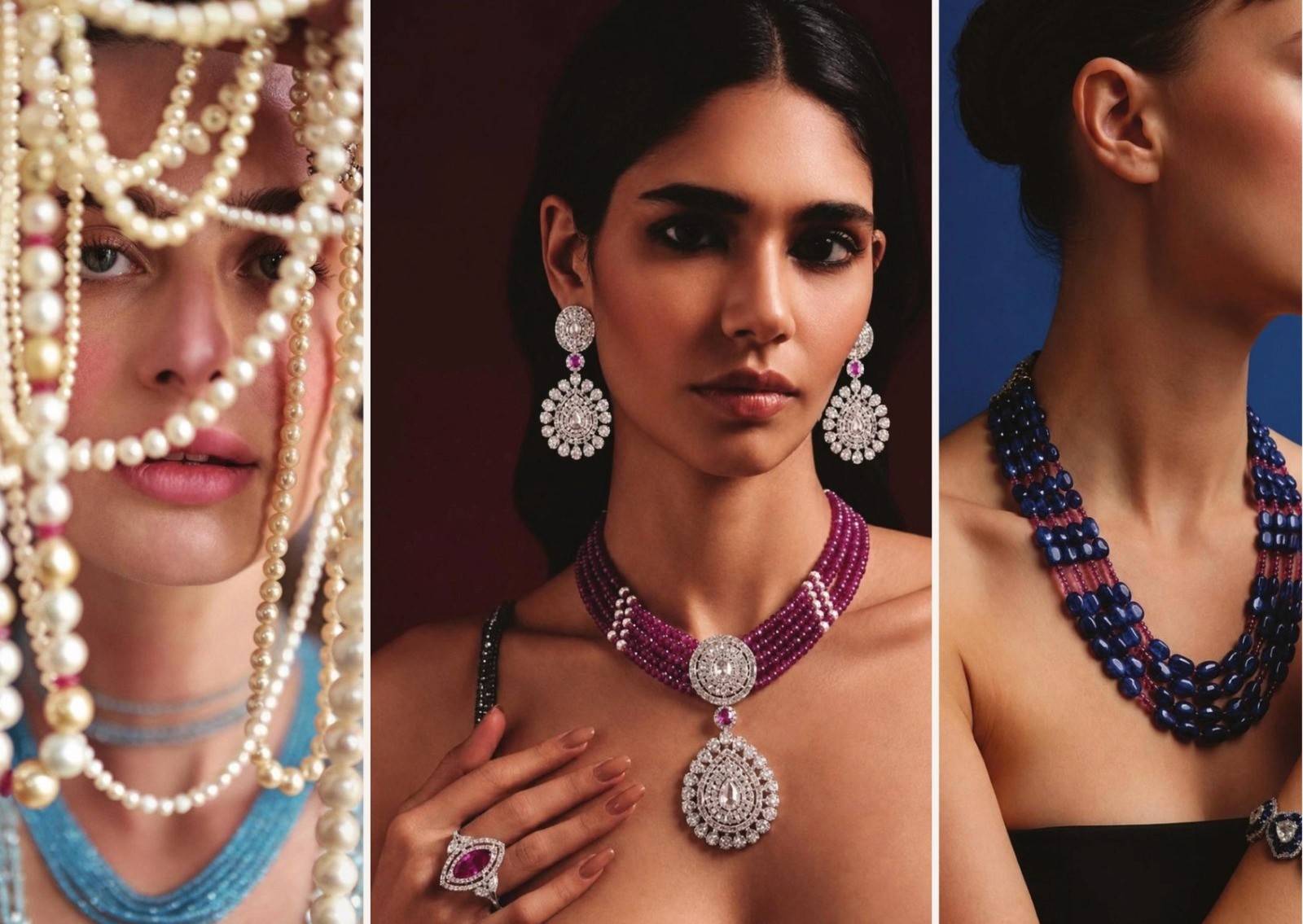
A bib necklace of turquoise, rubies, emerald drops and pearls glowed against the vivid red bandeau. Tiers of diamonds and emeralds, finished with a ruby drop, lay across the embroidered ivory jacket. A gold choker set with emeralds framed the shell-fan gown, while a single emerald pendant on a diamond chain illuminated the red georgette plunge. Elsewhere there were jewelled cuffs at the wrists, a ruby floral choker and an intricate gold headpiece falling over the forehead of the sari look.
Tarang Arora, CEO and Creative Director of Amrapali Jewels, framed the collaboration as a meeting of two crafts. "Our craft draws from centuries of tradition, yet continues to evolve through the way we interpret it for contemporary audiences," he said. "Collaborating with Anamika Khanna in London offered an opportunity to bring these traditions into conversation with a distinctive couture language."
For Khanna, the setting gave the work its meaning. "For me, fashion is a powerful way of telling stories and connecting cultures," she said, describing the evening as a celebration of "the extraordinary creative relationship between India and the UK."
An Evening in Harmony
The showcase formed the centrepiece of the UK-India Creative Circle's annual Diwali celebration, hosted by its Founder and Executive Chair, Dr R. Sri Ram. Leading voices from fashion, luxury, music, media, business and culture filled the room, many dressed in embroidered silks and jewel tones. The guests became part of the spectacle, a glittering extension of the runway itself.
Music carried the evening's spirit of cultural exchange. The London Philharmonic Orchestra presented classical works for string quartet alongside arrangements of A.R. Rahman's songs, bridging two great traditions with elegance. As the night deepened, Club Blue raised the tempo with a contemporary DJ set powered by British rapper and producer Lancey Foux, featuring DJ Kizzi and DJ Amari.
As Diwali lamps glowed across the city, Pall Mall shone with a light of its own. Khanna's couture and Amrapali's heirlooms spoke of India with grace and assurance. Together, they offered London a portrait of Indian craft that is deeply rooted, luminously modern and entirely of the moment.
TO BE CONTINUED, FOR SUBSCRIBERS ONLY.
This is where the surface ends and the reporting begins.
The complete piece, the full archive, and access to The French Press Circle. Reporting answerable only to its readers.
Already a subscriber ?
Login
Read these on the house, with our compliments.
A selection from the current issue, open to all readers. Read them in full. The rest is one decision away.






The Royal Automobile Club's ballroom is one of London's most fitting stages for Indian couture. Gilt chandeliers, fluted columns and a carpet of swirling acanthus already speak the language of ornament. On Friday, 30 October, Anamika Khanna gave that room a worthy match.
Anamika Khanna | Indian fashion designer
The designer presented a special couture showcase as part of the UK-India Creative Circle's annual Diwali celebration, in collaboration with Amrapali Jewels. It was a concise and eloquent presentation, distilling how Khanna carries Indian craft from the trousseau into a contemporary silhouette.
Gold tissue, worn high at the throat: the sari reimagined as a halter, crowned with an Amrapali headpiece.
Old Threads, New Lines
Khanna's signature has always been the dialogue between heirloom technique and a modern line, and London saw it in close focus. The textiles celebrated India; the shapes embraced the wider world.
A sleeveless bodice of raised gold embroidery, so dense it read almost as carved metal, sat over a full, midi-length skirt of lilac-and-gold brocade. It was a lehenga in spirit, a 1950s cocktail skirt in proportion. A long ivory satin coat with a mandarin collar, wreathed in thread-embroidered florals and metallic leaves, was worn open over wide trousers of sage silk velvet.
An ivory satin coat wreathed in florals, worn over fluid sage velvet and jewelled cuffs.
Velvet returned as the collection's most sensual note. A deep emerald length was ruched and knotted over an ivory satin skirt, beneath a jacket of gold embroidery laced at the waist and trailing long silk tassels. It evoked the grace of a sari drape in a fresh new form.
The sari itself appeared in its purest form: gold tissue with a worked border, its pallu wound high around the throat as a halter, leaving the shoulders bare. A red georgette look followed the same idea further, the fabric falling in a deep plunge, twisted through a ring at the waist and topped by a long coat dense with sequins, mirror work and multicoloured thread.
Red georgette twisted through a ring at the waist, beneath a richly worked coat and an emerald pendant.
The softer side of the house was there too. A butter-yellow organza skirt, scattered with red and sage flowers, came with an embellished bralette and a fringed, embroidered cape. An ivory kaftan of gold-worked tonal embroidery moved with a loose, unhurried drape.
Butter-yellow organza blooms with red and sage florals beneath a fringed, embroidered cape.
An ivory kaftan of tonal gold embroidery, finished with a crystal headpiece and starburst earrings.
When Craft Turns Sculptural
Two looks showed the collection at its most daring. One paired a slim red bandeau with a voluminous skirt of knotted, frayed red cord, opened at the front with a sculpted cut-out. It was richly textural and boldly sculptural.
A sculptural skirt of knotted red cord, paired with a turquoise, ruby and pearl bib necklace.
The other was best seen from behind. A backless top of feathery, frayed fringe gave way to a burgundy velvet skirt and train worked in metallic thread with elephants, horses and lions among foliage. It recalled the hunting-scene motifs of Mughal textiles, and as it moved down the aisle it held the room's attention completely.
Elephants, horses and lions in metallic thread trail across burgundy velvet.
A strapless gold gown of cutwork and lace, its bodice shaped into scalloped shell fans, offered the evening's most classic glamour.
Gold cutwork and scalloped shell fans, framed by an emerald-set Amrapali choker.
Jewels With a Long Memory
If Khanna's clothes leaned modern, Amrapali's jewellery anchored them in tradition. The pairing worked beautifully because each house brought its own distinct voice.
A bib necklace of turquoise, rubies, emerald drops and pearls glowed against the vivid red bandeau. Tiers of diamonds and emeralds, finished with a ruby drop, lay across the embroidered ivory jacket. A gold choker set with emeralds framed the shell-fan gown, while a single emerald pendant on a diamond chain illuminated the red georgette plunge. Elsewhere there were jewelled cuffs at the wrists, a ruby floral choker and an intricate gold headpiece falling over the forehead of the sari look.
Tarang Arora, CEO and Creative Director of Amrapali Jewels, framed the collaboration as a meeting of two crafts. "Our craft draws from centuries of tradition, yet continues to evolve through the way we interpret it for contemporary audiences," he said. "Collaborating with Anamika Khanna in London offered an opportunity to bring these traditions into conversation with a distinctive couture language."
For Khanna, the setting gave the work its meaning. "For me, fashion is a powerful way of telling stories and connecting cultures," she said, describing the evening as a celebration of "the extraordinary creative relationship between India and the UK."
An Evening in Harmony
The showcase formed the centrepiece of the UK-India Creative Circle's annual Diwali celebration, hosted by its Founder and Executive Chair, Dr R. Sri Ram. Leading voices from fashion, luxury, music, media, business and culture filled the room, many dressed in embroidered silks and jewel tones. The guests became part of the spectacle, a glittering extension of the runway itself.
Music carried the evening's spirit of cultural exchange. The London Philharmonic Orchestra presented classical works for string quartet alongside arrangements of A.R. Rahman's songs, bridging two great traditions with elegance. As the night deepened, Club Blue raised the tempo with a contemporary DJ set powered by British rapper and producer Lancey Foux, featuring DJ Kizzi and DJ Amari.
As Diwali lamps glowed across the city, Pall Mall shone with a light of its own. Khanna's couture and Amrapali's heirlooms spoke of India with grace and assurance. Together, they offered London a portrait of Indian craft that is deeply rooted, luminously modern and entirely of the moment.
TO BE CONTINUED, FOR SUBSCRIBERS ONLY.
This is where the surface ends and the reporting begins.
The complete piece, the full archive, and access to The French Press Circle. Reporting answerable only to its readers.
Already a subscriber ?
Login
Read these on the house, with our compliments.
A selection from the current issue, open to all readers. Read them in full. The rest is one decision away.