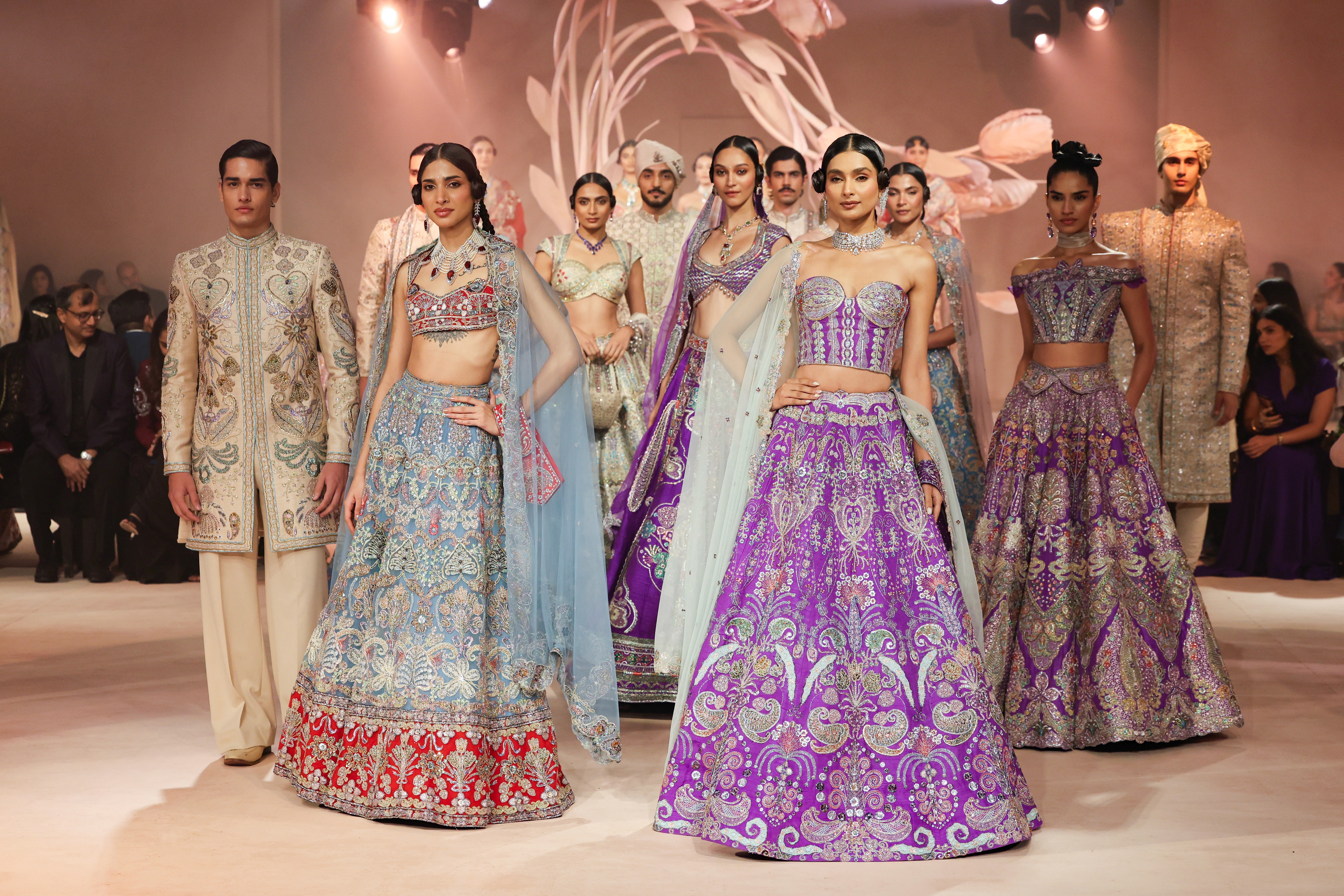
Aisha Rao presented Priyasi at Hyundai India Couture Week 2026 on 29 July, her second appearance on the calendar following a 2025 debut, Wild at Heart, that closed with Sara Ali Khan in rose-gold metallic, a register the designer has since described as outside her usual palette. If that first outing established Rao as couture week's newest maximalist, Priyasi reads as the consolidation, the collection where the house tests whether its surface vocabulary can carry a narrative rather than simply decorate one.
The narrative is love, examined as an inheritance passed between generations. Rao's source list is unexpectedly literary for a couture collection: the devotion of Shah Jahan and Mumtaz Mahal, the thwarted longing of Salim and Anarkali, Austen's restraint and Tolstoy's excess, the muses of Raja Ravi Varma. She organises these into three emotional registers, Longing, Union and Remembrance, and frames the collection as a "co-creation through co-narration," love as something two people author together. It is a conceptually dense brief, and Rao is disciplined about where it lives. The literature becomes a language; the clothes speak in the house's established grammar of polychromatic appliqué, aari, zardozi and macramé worked over lacework and self-developed mesh, a technical continuity that also defined Inter-Hana, her Lakmé show earlier in 2026, where she reinterpreted the botanical restraint of Japanese artist Fumi Imamura through the same appliqué logic.
Her signature appliqué is upcycling by method, fabric waste composed into sizeable motifs and then overlaid with hand embroidery, an approach that has drawn a Bollywood clientele since Kareena Kapoor Khan wore the label for Bridal Asia in 2020. The engineering challenge Rao has set herself over successive seasons is holding that density while keeping the garment light, and Priyasi is at its most persuasive where that tension resolves.
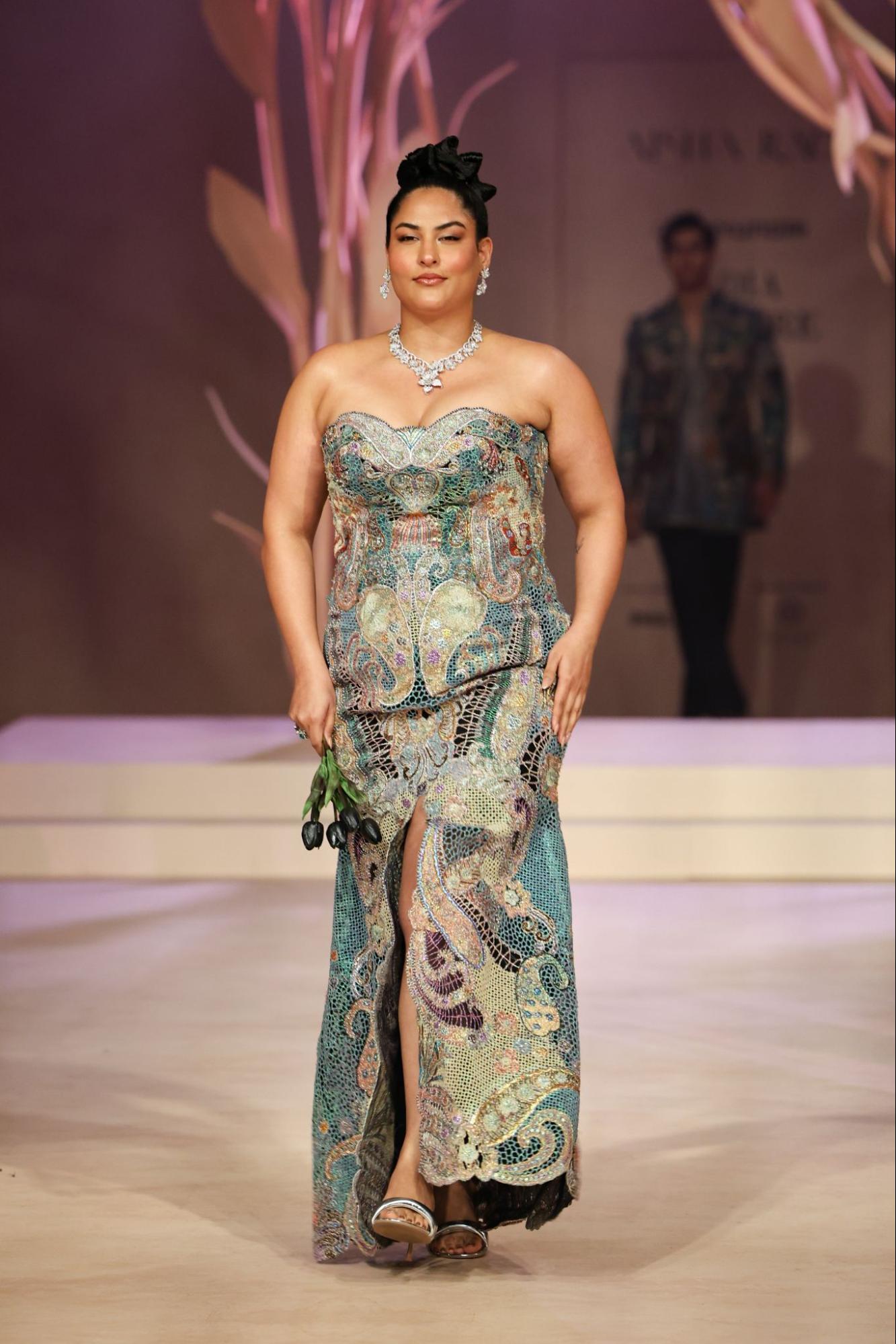
Content Creator Sakshi Sindwani in a strapless column in paisley and floral appliqué across an aqueous blue-and-gold ground, split high on a boned bodice.
The strapless columns make the case most efficiently. On one, paisley and floral appliqué move across an aqueous blue-and-gold ground in mirrored symmetry, the bodice boned to a sweetheart line, the skirt slit high to keep a heavily worked surface in motion. The embroidery reads legibly precisely because the silhouette holds still beneath it, a proportion Rao has refined into her cleanest register.
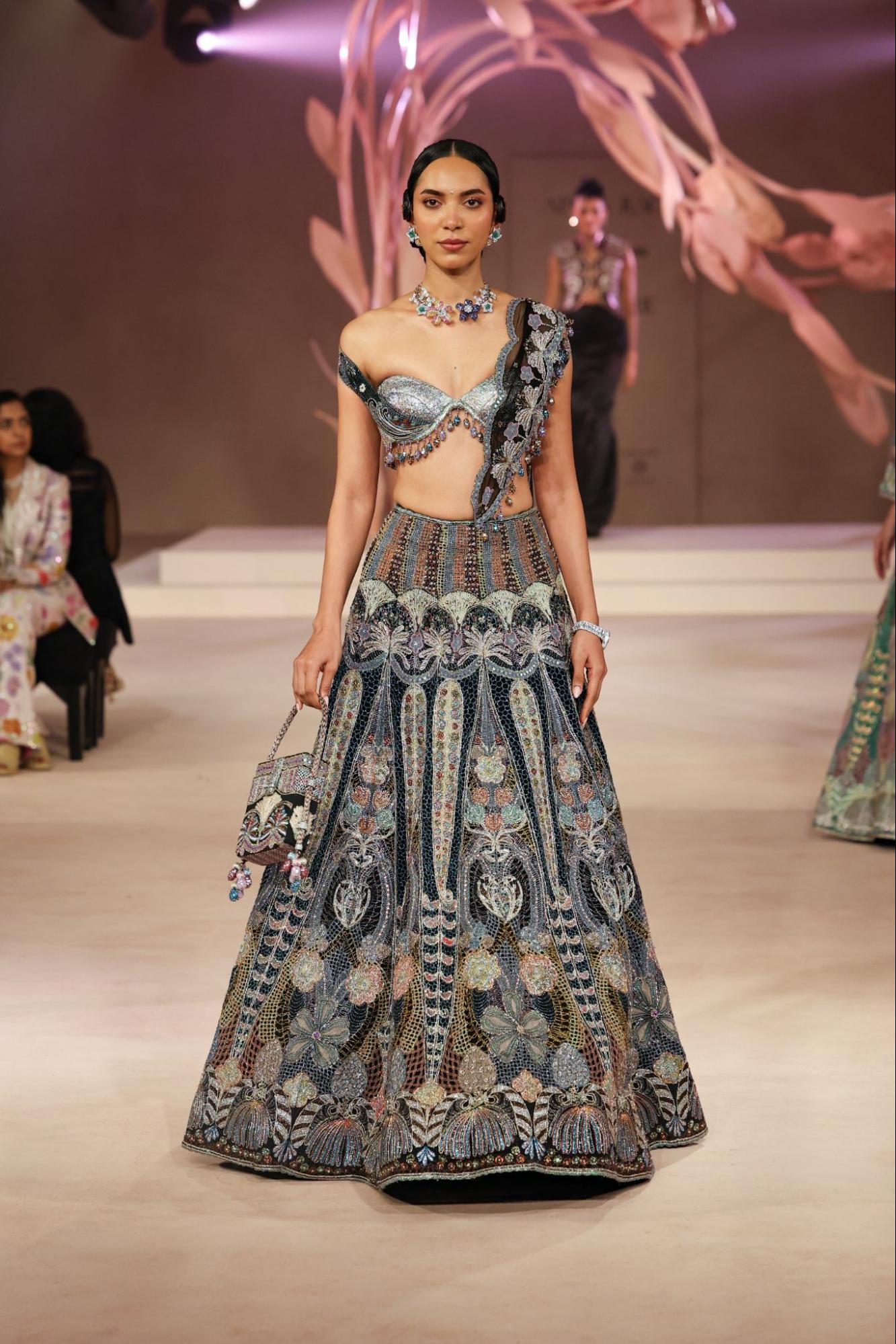
An asymmetric bustier, one side a sculpted metallic cup with beaded fringe, the other a floral appliqué panel, over a mosaic-worked teal lehenga.
The collection's structural thinking sharpens in an asymmetric lehenga set whose bustier is bisected: one side a sculpted metallic cup finished with a cascade of beaded fringe, the other a floral appliqué panel curving across the ribcage into the waistband. Over a teal A-line skirt worked in mosaic-like cutwork, the divided bodice reads as the collection's theme rendered in construction, two halves negotiated into a single garment, the co-narration made literal.
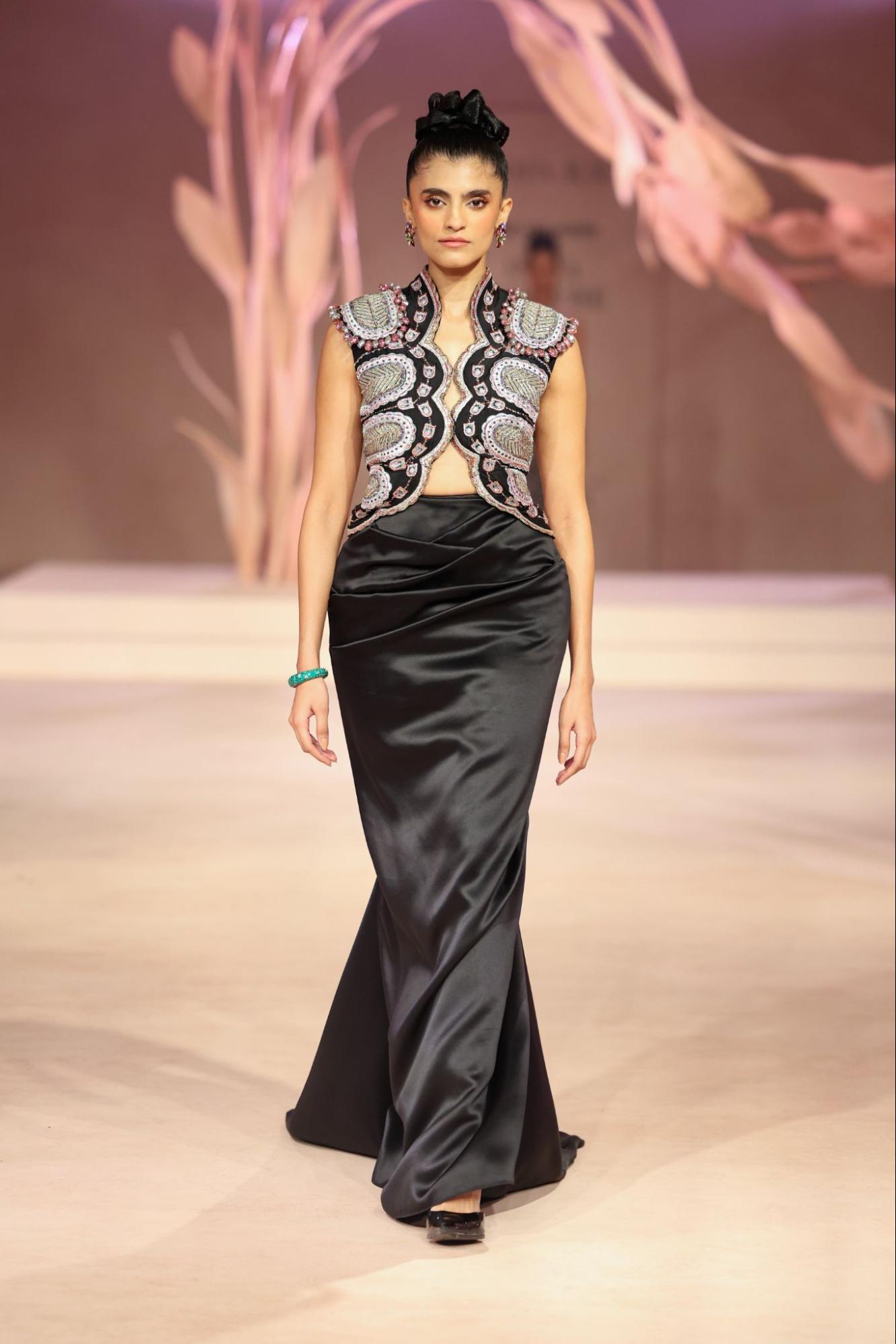
A ruched black satin fish-tail skirt with a sleeveless waistcoat of silver leaf-forms and pink stones across squared shoulders.
Colour is Rao's calling card, which makes the black exit the more deliberate. A fluid satin fish-tail skirt, ruched at the hip and drawn into a train, sits under a sleeveless waistcoat whose black ground carries silver leaf-forms and pale-pink stonework across structured, squared shoulders. The look imports a Western eveningwear silhouette into the lineup and lets the embroidery function as tailoring detail rather than allover ornament, a register that widens the collection's occasion range beyond the wedding.
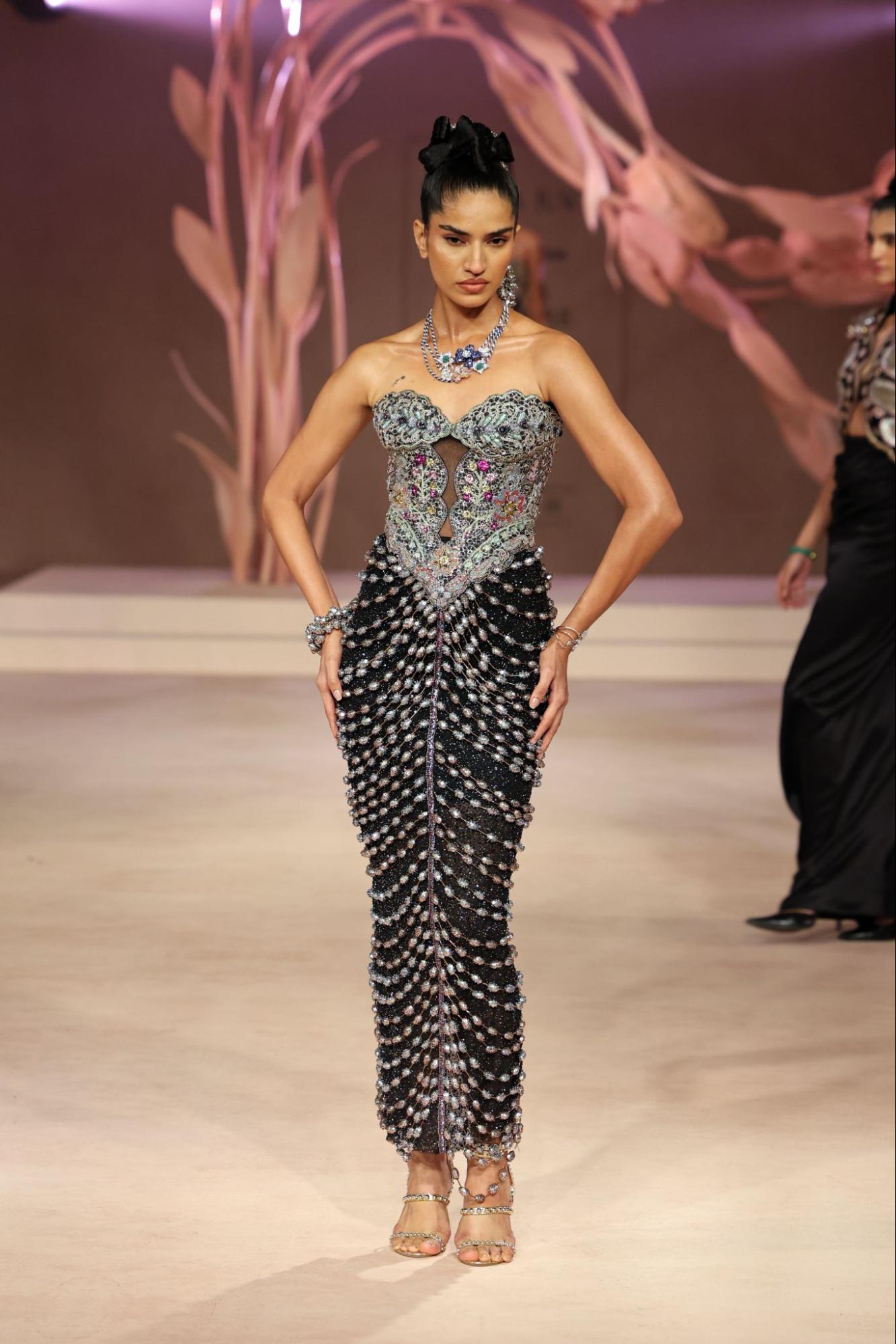
A strapless gown joining an embroidered corset to a slim skirt worked entirely in bugle-bead fringe.
Elsewhere the density turns kinetic. A strapless gown marries an embroidered corset bodice to a slim skirt worked entirely in bugle-bead fringe, the beadwork laid in feathered diagonal rows that shift and refract with each step, the ornament engineered for movement rather than the still frame.
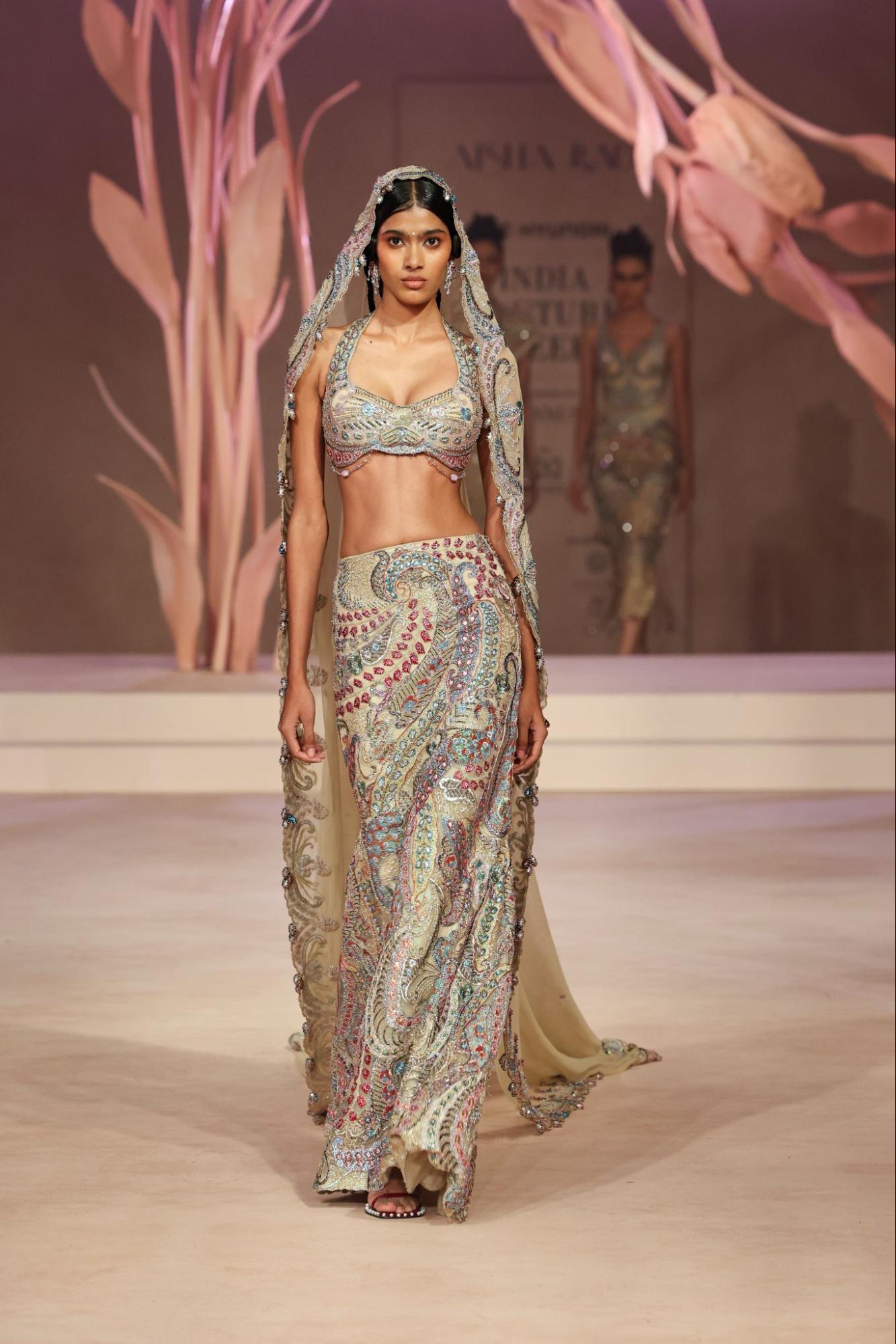
A pale gold embellished bralette and low-slung draped skirt worn under a long embroidered veil that frames the face.
Longing finds its clearest visual form in a pale gold set, an embellished bralette over a low, paisley-embroidered draped skirt, worn under an embroidered veil that frames the face and falls the length of the body. The bareness of the styling and the downward weight of the veil give the exit its yearning, portrait-like stillness, the register the collection's title points toward.
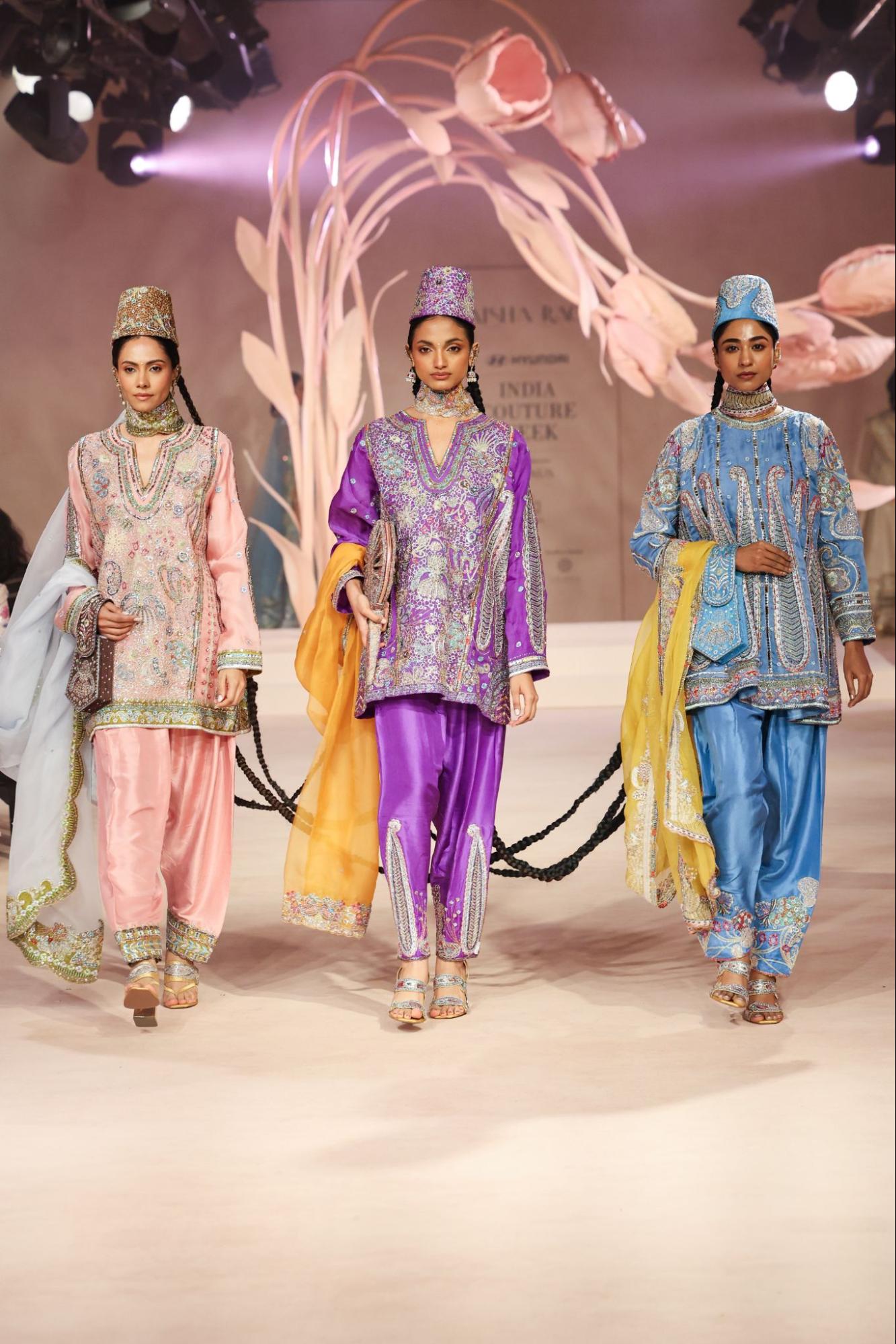
A trio of jewel-toned salwar suits in rose, violet and cornflower blue, styled with contrast dupattas, embroidered caps and long plaits.
A trio of jewel-toned salwar suits, in rose, violet and cornflower blue with marigold and ivory dupattas, embroidered caps and long plaits, lightens the register into something closer to festive dressing. It sits alongside a broader shift on the 2026 calendar toward the contemporary bride who wants the personal over the ceremonial, a movement Rao shares with Rimzim Dadu and House of Masaba, and it plays to the whimsy that runs through her work even at its most embellished.
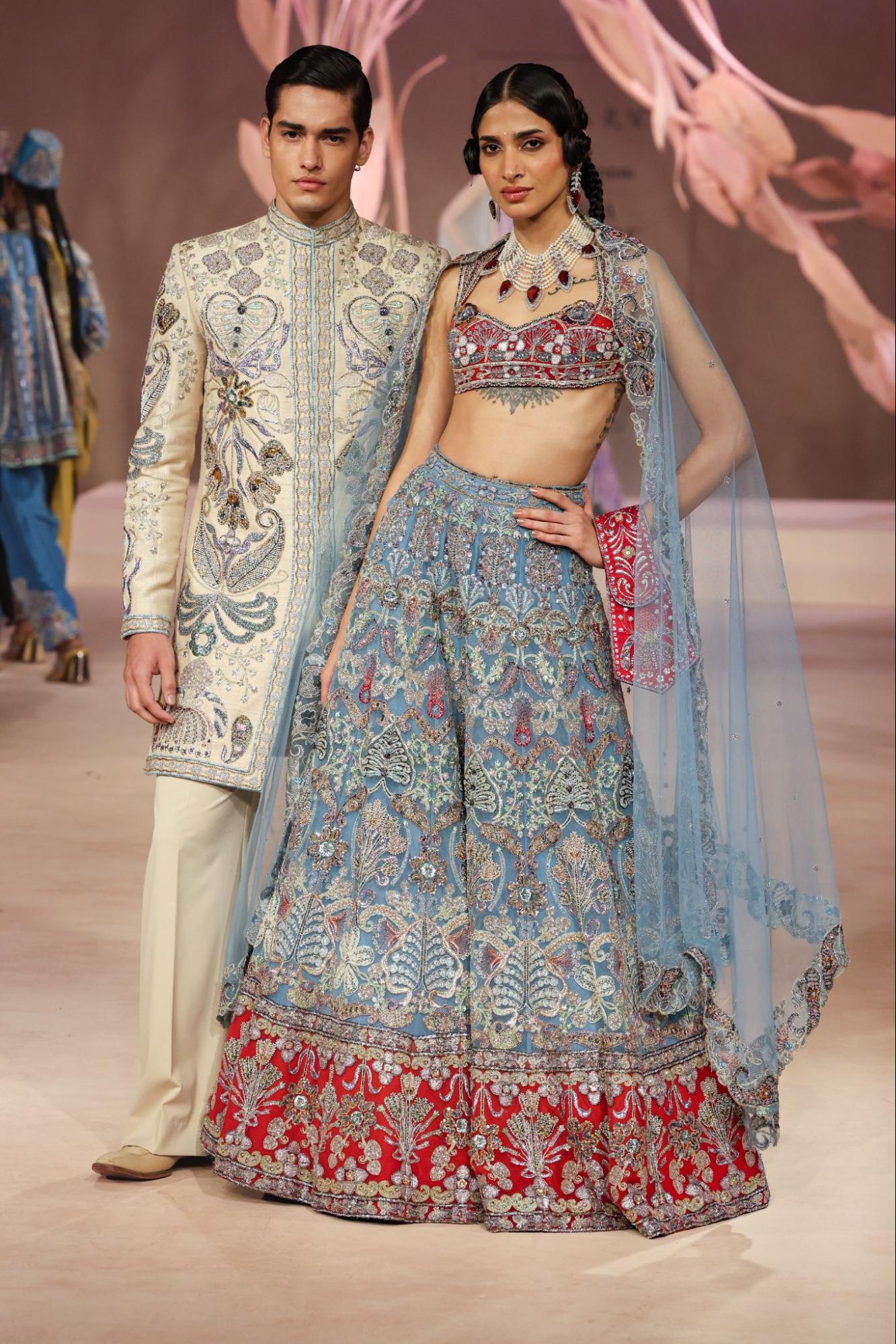
A couple look, a powder-blue lehenga rising from a red gold-worked hem, beside an ivory sherwani in tonal beadwork.
Union is staged literally through menswear presented in pairs. Here a powder-blue lehenga, its embroidered body rising from a deep red, gold-worked hem, is worn with a red-and-silver bralette, pearl-and-ruby collar and sheer embroidered dupatta, beside an ivory sherwani dense with tonal thread and beadwork. The pairing makes the collection's central theme visible on the runway.
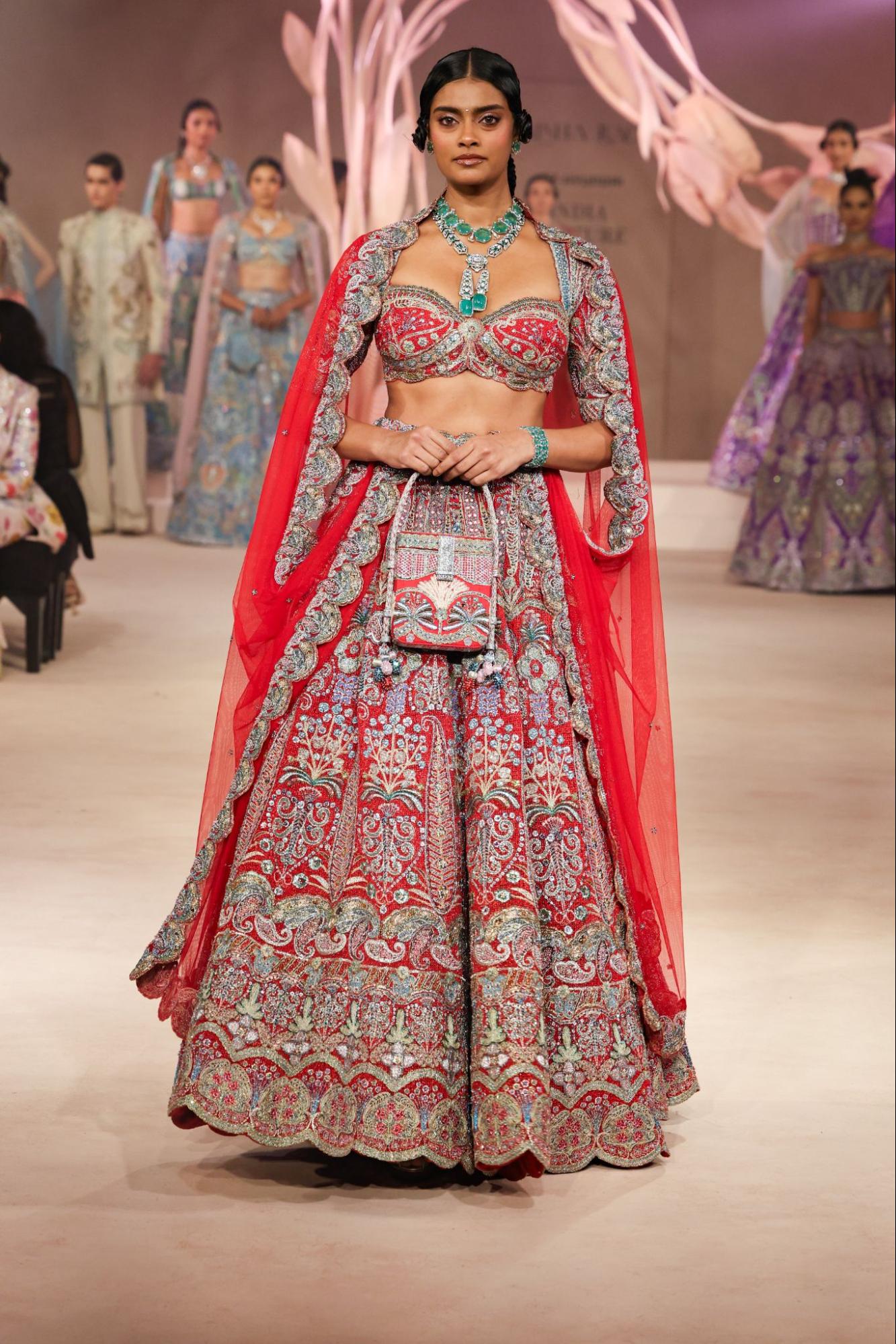
A scarlet lehenga in silver and pastel paisley, topped with a floor-length scalloped net cape and an emerald-and-diamond necklace.
The bridal apex is a scarlet lehenga worked in silver and pastel paisley, its bralette and full skirt layered under a floor-length net cape edged in scalloped embroidery, finished with an emerald-and-diamond necklace from the Shree Jewellers line. It is the exit closest to the wedding market that underwrites the business, executed with the surface complexity that is the label's argument for its price.
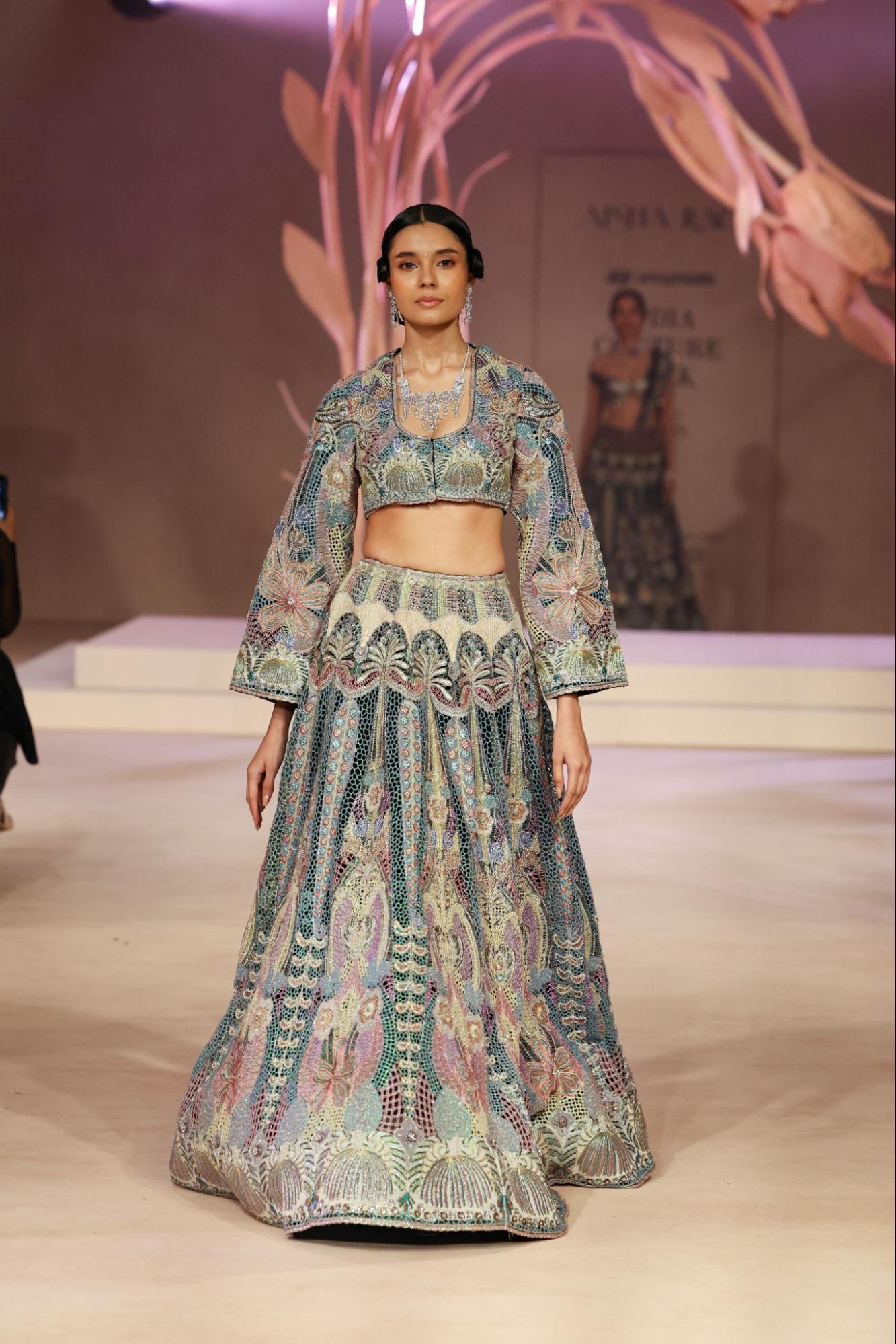
A cropped bell-sleeved jacket over a matching bralette and full lehenga, photographed beneath the show's monumental tulip installation.
The scenography extended the collection into three dimensions. The runway was built as a sculptural landscape of monumental tulips, the flower serving as Priyasi's emotional anchor for its cross-cultural association with love, staged with layered lighting, a cinematic score and a live performance that collapsed the distance between runway and stage. The sustainability sits inside the garments rather than on the label copy: bio-resham and bio-badla, developed in-house from atelier remnants, extend the upcycling logic the house was founded on in 2017, when Rao left a law degree from NUJS and training at IED Barcelona and Parsons to build the brand around waste-based appliqué.
Rao positions the collection as inheritance examined rather than restaged. "Every generation inherits stories of love before it learns to tell its own," she said. "With Priyasi, I found myself returning to these stories that have shaped generations, not to recreate them, but to understand why they continue to resonate. Whether drawn from history, literature, mythology or cinema, each narrative carries the same emotional thread while belonging uniquely to its own time. I wanted the collection to feel like an evolving conversation between these worlds, where every garment becomes a fragment of a larger story, inviting the wearer to find their own meaning within it."
The presentation carried two partnerships: a fine jewellery line Rao personally designed with Shree Jewellers, returning from her 2025 debut, styled into the looks as coloured-stone counterpoints to the embroidery, and Philips as gifting partner. Each model walked the finale holding a single tulip, the image the show resolved on.
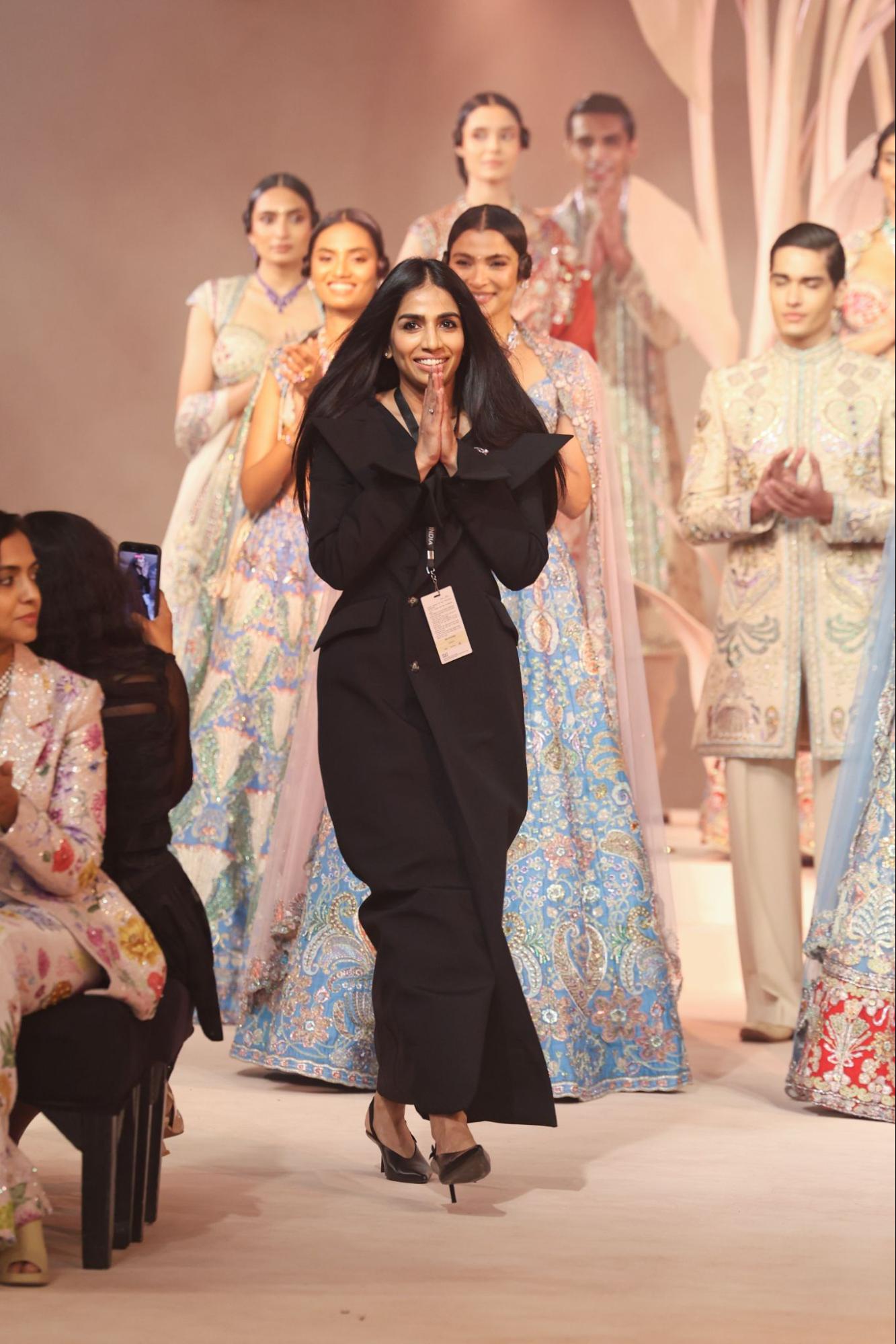
Aisha Rao takes her bow in a sculptural black suit, her cast assembled behind her across the collection's pastels, reds and blues.
Rao closed in a sculptural black suit, her cast fanned behind her in the collection's full chromatic spread. Two editions into her couture-week tenure, Priyasi maps a designer working out the ratio between her surface and her structure, and finding the point at which the embroidery can carry the concept without the silhouette straining to hold it.
TO BE CONTINUED, FOR SUBSCRIBERS ONLY.
This is where the surface ends and the reporting begins.
The complete piece, the full archive, and access to The French Press Circle. Reporting answerable only to its readers.
Already a subscriber ?
Login
Read these on the house, with our compliments.
A selection from the current issue, open to all readers. Read them in full. The rest is one decision away.




Aisha Rao presented Priyasi at Hyundai India Couture Week 2026 on 29 July, her second appearance on the calendar following a 2025 debut, Wild at Heart, that closed with Sara Ali Khan in rose-gold metallic, a register the designer has since described as outside her usual palette. If that first outing established Rao as couture week's newest maximalist, Priyasi reads as the consolidation, the collection where the house tests whether its surface vocabulary can carry a narrative rather than simply decorate one.
The narrative is love, examined as an inheritance passed between generations. Rao's source list is unexpectedly literary for a couture collection: the devotion of Shah Jahan and Mumtaz Mahal, the thwarted longing of Salim and Anarkali, Austen's restraint and Tolstoy's excess, the muses of Raja Ravi Varma. She organises these into three emotional registers, Longing, Union and Remembrance, and frames the collection as a "co-creation through co-narration," love as something two people author together. It is a conceptually dense brief, and Rao is disciplined about where it lives. The literature becomes a language; the clothes speak in the house's established grammar of polychromatic appliqué, aari, zardozi and macramé worked over lacework and self-developed mesh, a technical continuity that also defined Inter-Hana, her Lakmé show earlier in 2026, where she reinterpreted the botanical restraint of Japanese artist Fumi Imamura through the same appliqué logic.
Her signature appliqué is upcycling by method, fabric waste composed into sizeable motifs and then overlaid with hand embroidery, an approach that has drawn a Bollywood clientele since Kareena Kapoor Khan wore the label for Bridal Asia in 2020. The engineering challenge Rao has set herself over successive seasons is holding that density while keeping the garment light, and Priyasi is at its most persuasive where that tension resolves.
Content Creator Sakshi Sindwani in a strapless column in paisley and floral appliqué across an aqueous blue-and-gold ground, split high on a boned bodice.
The strapless columns make the case most efficiently. On one, paisley and floral appliqué move across an aqueous blue-and-gold ground in mirrored symmetry, the bodice boned to a sweetheart line, the skirt slit high to keep a heavily worked surface in motion. The embroidery reads legibly precisely because the silhouette holds still beneath it, a proportion Rao has refined into her cleanest register.
An asymmetric bustier, one side a sculpted metallic cup with beaded fringe, the other a floral appliqué panel, over a mosaic-worked teal lehenga.
The collection's structural thinking sharpens in an asymmetric lehenga set whose bustier is bisected: one side a sculpted metallic cup finished with a cascade of beaded fringe, the other a floral appliqué panel curving across the ribcage into the waistband. Over a teal A-line skirt worked in mosaic-like cutwork, the divided bodice reads as the collection's theme rendered in construction, two halves negotiated into a single garment, the co-narration made literal.
A ruched black satin fish-tail skirt with a sleeveless waistcoat of silver leaf-forms and pink stones across squared shoulders.
Colour is Rao's calling card, which makes the black exit the more deliberate. A fluid satin fish-tail skirt, ruched at the hip and drawn into a train, sits under a sleeveless waistcoat whose black ground carries silver leaf-forms and pale-pink stonework across structured, squared shoulders. The look imports a Western eveningwear silhouette into the lineup and lets the embroidery function as tailoring detail rather than allover ornament, a register that widens the collection's occasion range beyond the wedding.
A strapless gown joining an embroidered corset to a slim skirt worked entirely in bugle-bead fringe.
Elsewhere the density turns kinetic. A strapless gown marries an embroidered corset bodice to a slim skirt worked entirely in bugle-bead fringe, the beadwork laid in feathered diagonal rows that shift and refract with each step, the ornament engineered for movement rather than the still frame.
A pale gold embellished bralette and low-slung draped skirt worn under a long embroidered veil that frames the face.
Longing finds its clearest visual form in a pale gold set, an embellished bralette over a low, paisley-embroidered draped skirt, worn under an embroidered veil that frames the face and falls the length of the body. The bareness of the styling and the downward weight of the veil give the exit its yearning, portrait-like stillness, the register the collection's title points toward.
A trio of jewel-toned salwar suits in rose, violet and cornflower blue, styled with contrast dupattas, embroidered caps and long plaits.
A trio of jewel-toned salwar suits, in rose, violet and cornflower blue with marigold and ivory dupattas, embroidered caps and long plaits, lightens the register into something closer to festive dressing. It sits alongside a broader shift on the 2026 calendar toward the contemporary bride who wants the personal over the ceremonial, a movement Rao shares with Rimzim Dadu and House of Masaba, and it plays to the whimsy that runs through her work even at its most embellished.
A couple look, a powder-blue lehenga rising from a red gold-worked hem, beside an ivory sherwani in tonal beadwork.
Union is staged literally through menswear presented in pairs. Here a powder-blue lehenga, its embroidered body rising from a deep red, gold-worked hem, is worn with a red-and-silver bralette, pearl-and-ruby collar and sheer embroidered dupatta, beside an ivory sherwani dense with tonal thread and beadwork. The pairing makes the collection's central theme visible on the runway.
A scarlet lehenga in silver and pastel paisley, topped with a floor-length scalloped net cape and an emerald-and-diamond necklace.
The bridal apex is a scarlet lehenga worked in silver and pastel paisley, its bralette and full skirt layered under a floor-length net cape edged in scalloped embroidery, finished with an emerald-and-diamond necklace from the Shree Jewellers line. It is the exit closest to the wedding market that underwrites the business, executed with the surface complexity that is the label's argument for its price.
A cropped bell-sleeved jacket over a matching bralette and full lehenga, photographed beneath the show's monumental tulip installation.
The scenography extended the collection into three dimensions. The runway was built as a sculptural landscape of monumental tulips, the flower serving as Priyasi's emotional anchor for its cross-cultural association with love, staged with layered lighting, a cinematic score and a live performance that collapsed the distance between runway and stage. The sustainability sits inside the garments rather than on the label copy: bio-resham and bio-badla, developed in-house from atelier remnants, extend the upcycling logic the house was founded on in 2017, when Rao left a law degree from NUJS and training at IED Barcelona and Parsons to build the brand around waste-based appliqué.
Rao positions the collection as inheritance examined rather than restaged. "Every generation inherits stories of love before it learns to tell its own," she said. "With Priyasi, I found myself returning to these stories that have shaped generations, not to recreate them, but to understand why they continue to resonate. Whether drawn from history, literature, mythology or cinema, each narrative carries the same emotional thread while belonging uniquely to its own time. I wanted the collection to feel like an evolving conversation between these worlds, where every garment becomes a fragment of a larger story, inviting the wearer to find their own meaning within it."
The presentation carried two partnerships: a fine jewellery line Rao personally designed with Shree Jewellers, returning from her 2025 debut, styled into the looks as coloured-stone counterpoints to the embroidery, and Philips as gifting partner. Each model walked the finale holding a single tulip, the image the show resolved on.
Aisha Rao takes her bow in a sculptural black suit, her cast assembled behind her across the collection's pastels, reds and blues.
Rao closed in a sculptural black suit, her cast fanned behind her in the collection's full chromatic spread. Two editions into her couture-week tenure, Priyasi maps a designer working out the ratio between her surface and her structure, and finding the point at which the embroidery can carry the concept without the silhouette straining to hold it.
TO BE CONTINUED, FOR SUBSCRIBERS ONLY.
This is where the surface ends and the reporting begins.
The complete piece, the full archive, and access to The French Press Circle. Reporting answerable only to its readers.
Already a subscriber ?
Login
Read these on the house, with our compliments.
A selection from the current issue, open to all readers. Read them in full. The rest is one decision away.