There is a productive irony embedded in the Indian wedding industry's recent history. At the moment the country's bridal fashion market crossed $100 billion in valuation, at the moment it became one of the most photographed, most live streamed, most globally coveted spectacles in contemporary pop culture, it began to lose the thing that had given it meaning in the first place. The heirloom sensibility. The slow accumulation. The idea that what a woman wore on her wedding day was the beginning of a wardrobe, instead of a Pinterest board.
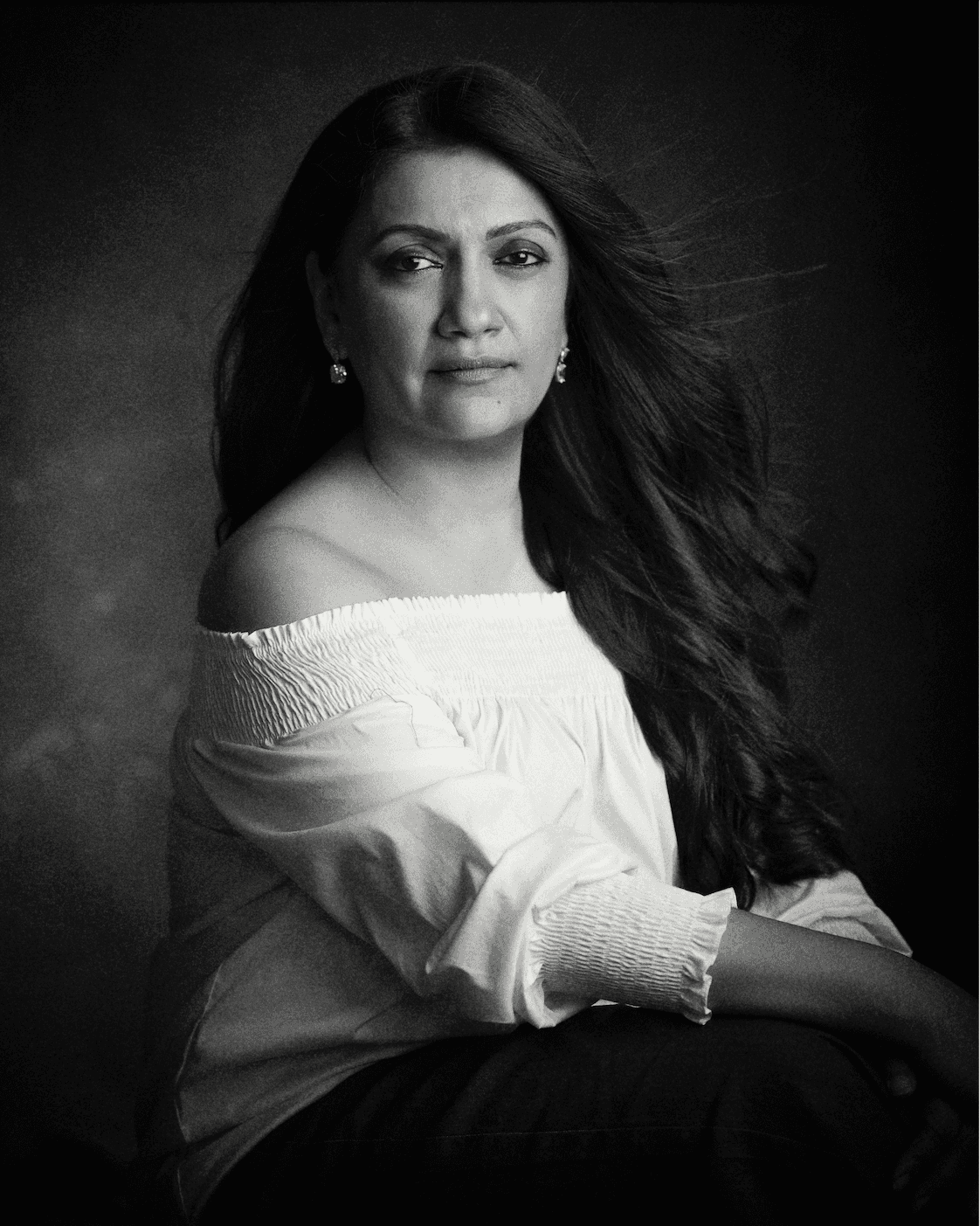
Portrait of Seema Gujral. Image courtesy: Seema Gujral
Seema Gujral, who has been building her couture house since 1995, watched this transformation from a different vantage point. Her house moved to its own rhythm while the industry accelerated around it. In three decades, she has not launched a diffusion line, has not produced a celebrity capsule, has not recalibrated her aesthetic toward whatever the international market found legible that season. Her clients now bring their daughters. The house has dressed Alia Bhatt, Kiara Advani, and Madhuri Dixit across generations of Indian cinema, without once bending its design language to accommodate a trending moment. This is, in the context of modern Indian fashion, a unique biography.
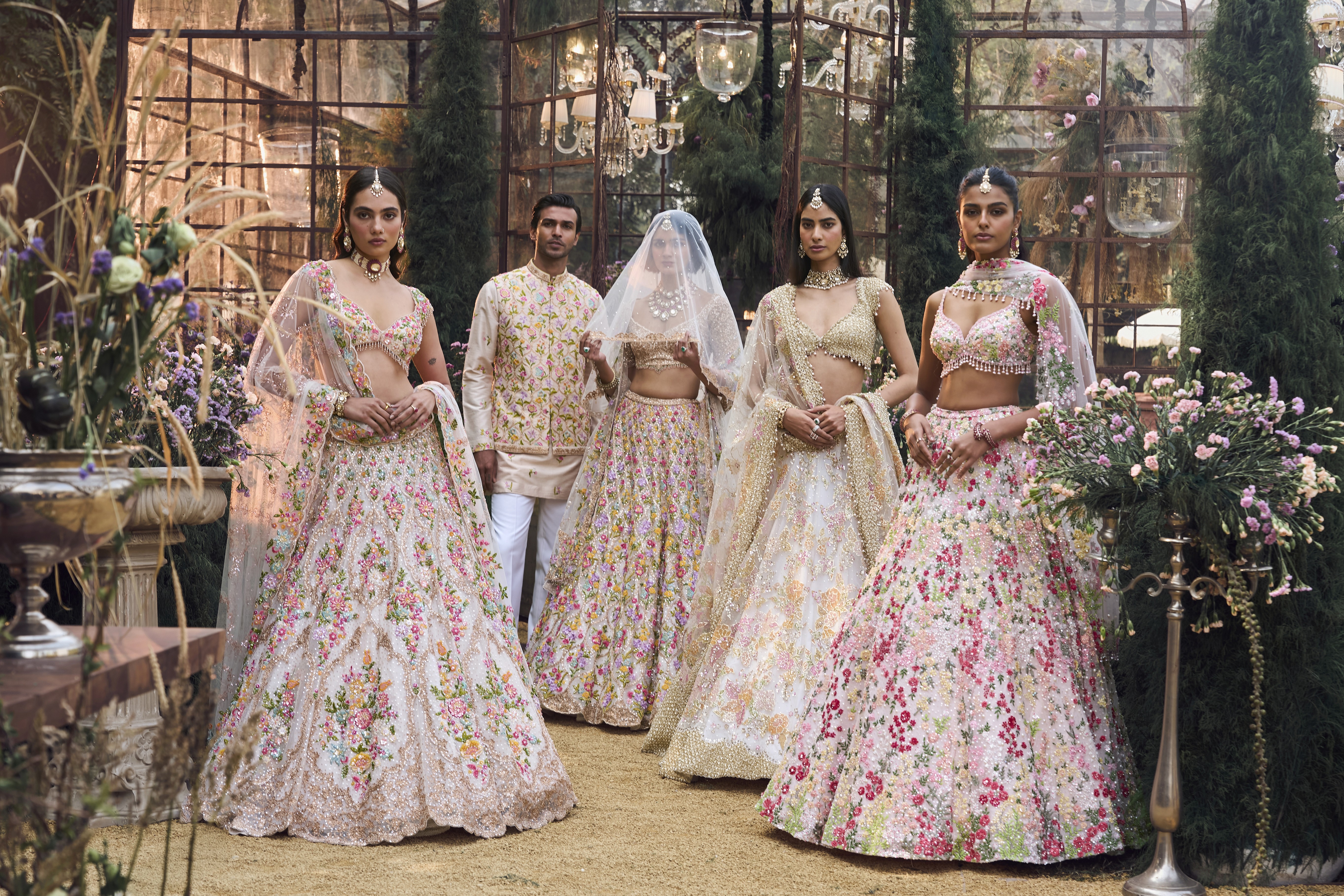
Her Summer Bridal 2026 collection, The Promise, built on hand-laid zardosi, fine thread work, pearls, crystals, and meenakari buttons across a palette of ivory, champagne gold, sage, stone grey, and powder peach, is the most complete expression yet of what that biography means when it arrives on the body. But to understand the collection, one has to first understand the tradition it is in conversation with, and the degree to which that tradition has been dismantled, piece by piece, in the name of progress.
The Original Luxury
Before it became a Pinterest board category and a luxury shopping expedition, the trousseau was an epistemic system. It encoded, in cloth and embroidery and the weight of fabric across generations, a family's understanding of what endured. A grandmother who could distinguish between a hand-knotted and machine-laid zari border was not simply demonstrating taste. She was exercising a form of knowledge that her household recognised as authoritative, a technical and aesthetic literacy that had been accumulated over years of observation, of running fingers over fabric in market stalls, of watching how a weave held its colour across decades of use and washing.
The trousseau was, in this sense, one of the few spaces in traditional domestic life where women's labour and aesthetic intelligence were taken completely seriously. The embroidery a mother spent two years completing for her daughter's trousseau was an argument, made in thread, about what she believed her daughter's life should contain.
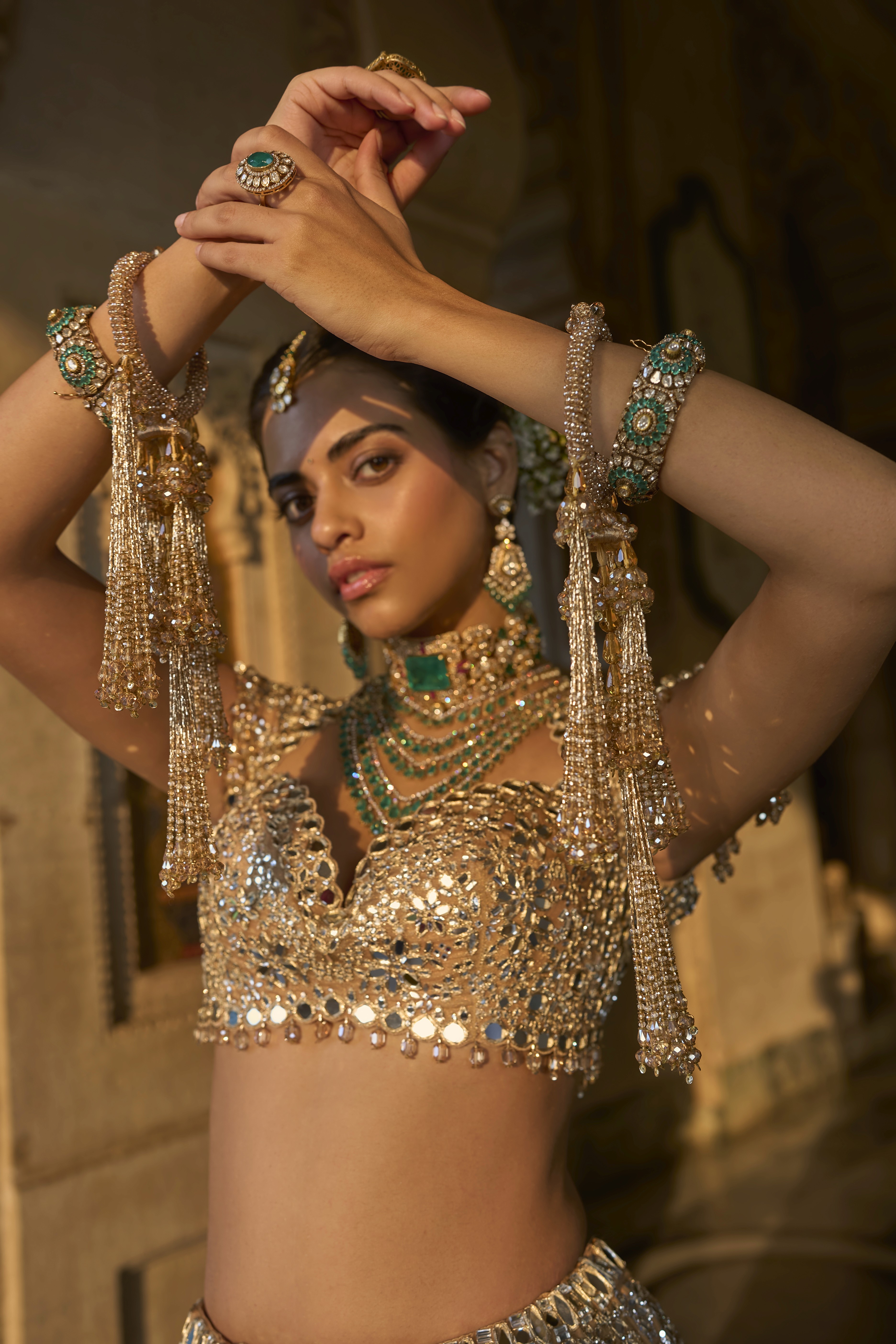
Detail from The Promise, Summer Bridal 2026. Image courtesy: Seema Gujral
Textile historian Rta Kapur Chishti has written at length about how Indian embroidery traditions, from the phulkari of Punjab to the chikankari of Lucknow, were repositories of a community's visual vocabulary, passed from women to women outside the formal structures of institutional knowledge. The trousseau was where this vocabulary became personal, where the collective tradition was translated into an individual inheritance.
Gujral thinks about this lineage with care. "While the traditional trousseau has evolved, I think the intention behind it, thoughtfulness, curation, and emotional value, still exists," she says. "Today, brides approach couture with a clearer sense of personal style, which creates a new, more individual version of that tradition."
The contemporary bride who spends eighteen months researching her couture, who arrives at a fitting knowing exactly which thread work techniques she wants and why, is exercising a version of that same aesthetic intelligence. What separates her experience from previous generations is the framework surrounding it. She is doing it alone, without the intergenerational scaffolding, without the accumulated household knowledge, without the grandmother who could read the embroidery and tell her whether it would hold.
The Attention Economy
The industrialisation of the Indian wedding is well-documented at this point. The average North Indian wedding now costs between 20 and 30 lakh rupees at the lower end of the market, and orders of magnitude more at the top. The bridal fashion segment alone, according to industry estimates, is growing at roughly 15 to 18 percent annually. Destination weddings have spawned entire economies. Wedding stylists, bridal choreographers, content creators who document the function across multiple social platforms, a full infrastructure has grown up around the business of getting married.
What this infrastructure optimises for is the photographable moment. The outfits that read best on Instagram are rarely the ones built for three decades of rewearing. The silhouettes that generate the most engagement tend toward maximalism, toward the spectacular, toward the kind of visual density that communicates luxury at a glance. In this economy, restraint is a harder sell than opulence. The subtle zardosi border, no matter how extraordinary the craftsmanship, loses the scroll-stop competition against a heavily embellished lehenga that announces itself in a thumbnail.
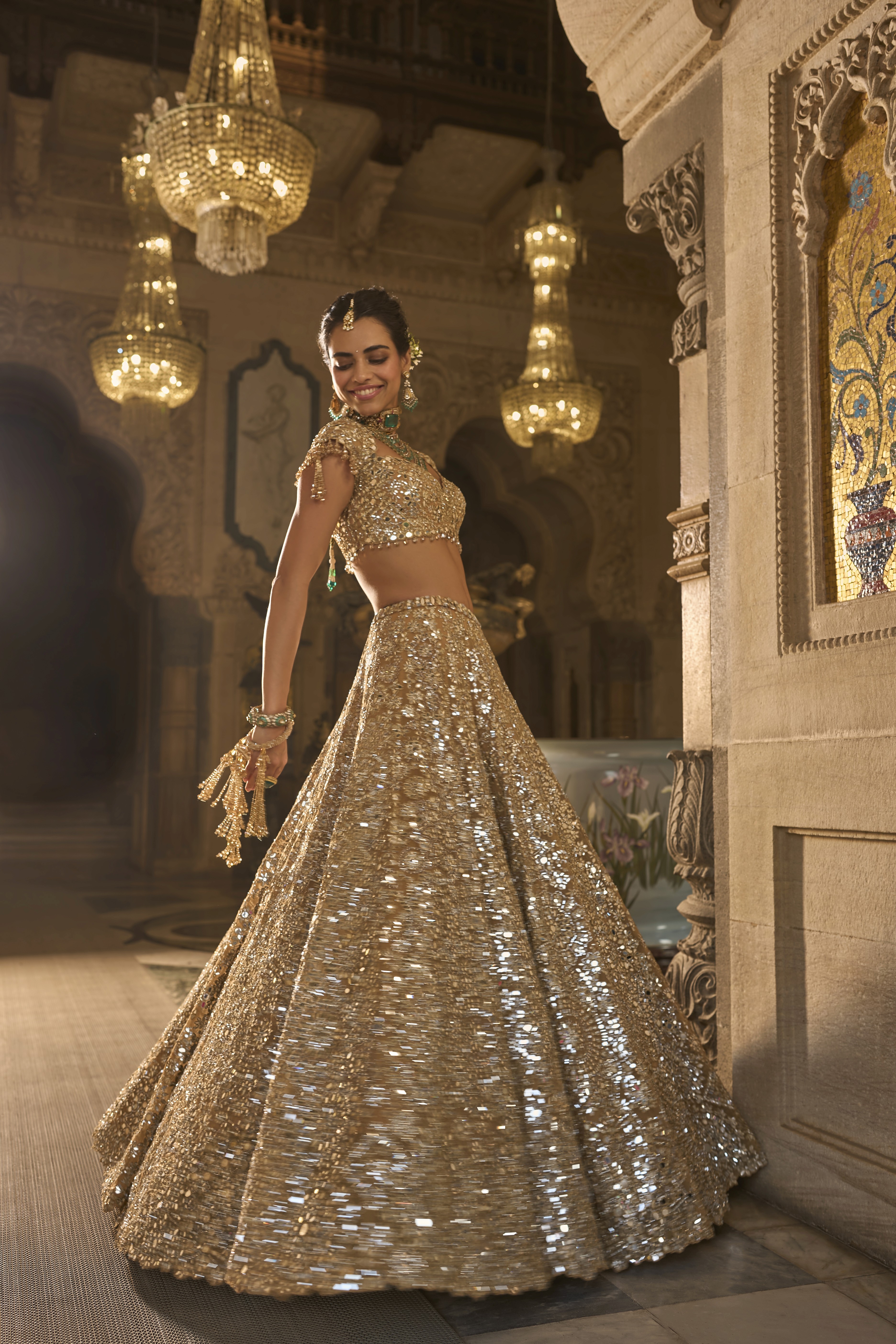
A lehenga from The Promise, Summer Bridal 2026. Image courtesy: Seema Gujral
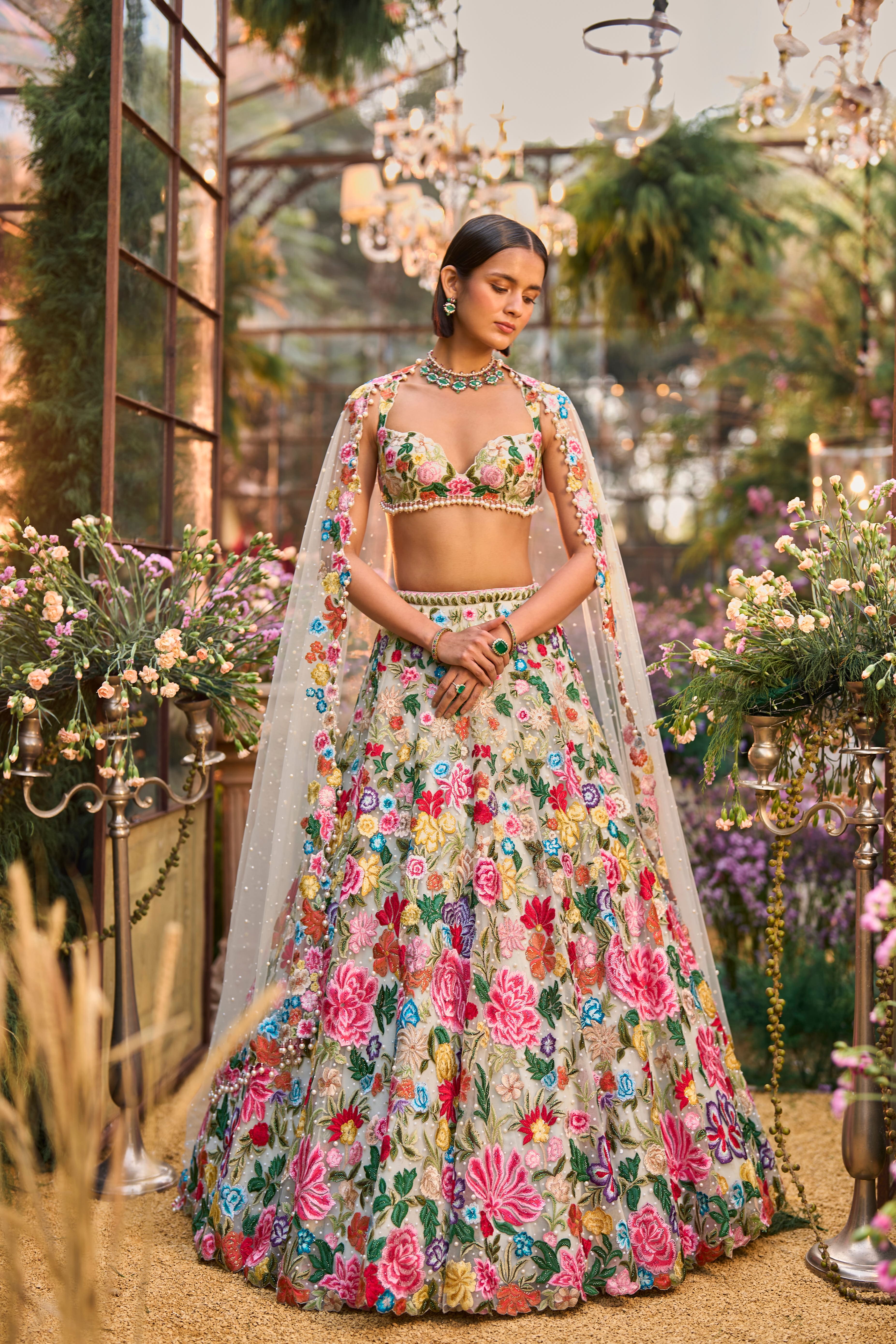
A hand-embroidered lehenga from The Promise, Summer Bridal 2026. Image courtesy: Seema Gujral
Indian bridal fashion has responded to this environment in predictable ways. Collections have grown larger and louder. Colour palettes have expanded into territory that would have been considered unwearable in any other context. The red lehenga has been reimagined approximately three hundred times. Celebrity endorsements have become load-bearing structural elements of a house's brand strategy rather than occasional validations of it.
Gujral has watched all of this with the equanimity of someone who decided early on where she stood. When asked whether her refusal to chase the international gaze, to calibrate her work against what the West finds legible or exotic, was a conscious strategic decision or simply a natural consequence of what she was drawn to making, the answer cuts through any suggestion of positioning. "It's always been a natural approach rather than a conscious decision," she says. "I've focused on creating what feels authentic to our aesthetic, refined, intricate, and rooted in Indian craftsmanship, while ensuring it resonates with the modern wearer."
The Karigars and the Stakes of Craft
Every piece in The Promise carries hundreds of hours of hand embroidery by artisans whose skills are generational. This fact, stated baldly, has a way of sliding past the reader without registering its full weight. The scale of that labour becomes clearer when viewed in practical terms. A single heavily worked lehenga in this collection may represent eight to twelve months of work by multiple artisans. The zardosi technique, which involves laying metal wire and thread in intricate patterns on fabric, requires years to learn and decades to master. The meenakari work on the buttons draws on a craft tradition with roots in Mughal-era jewellery-making that has survived in specific artisan communities, passed father to son and mother to daughter, through centuries of political upheaval and economic disruption.
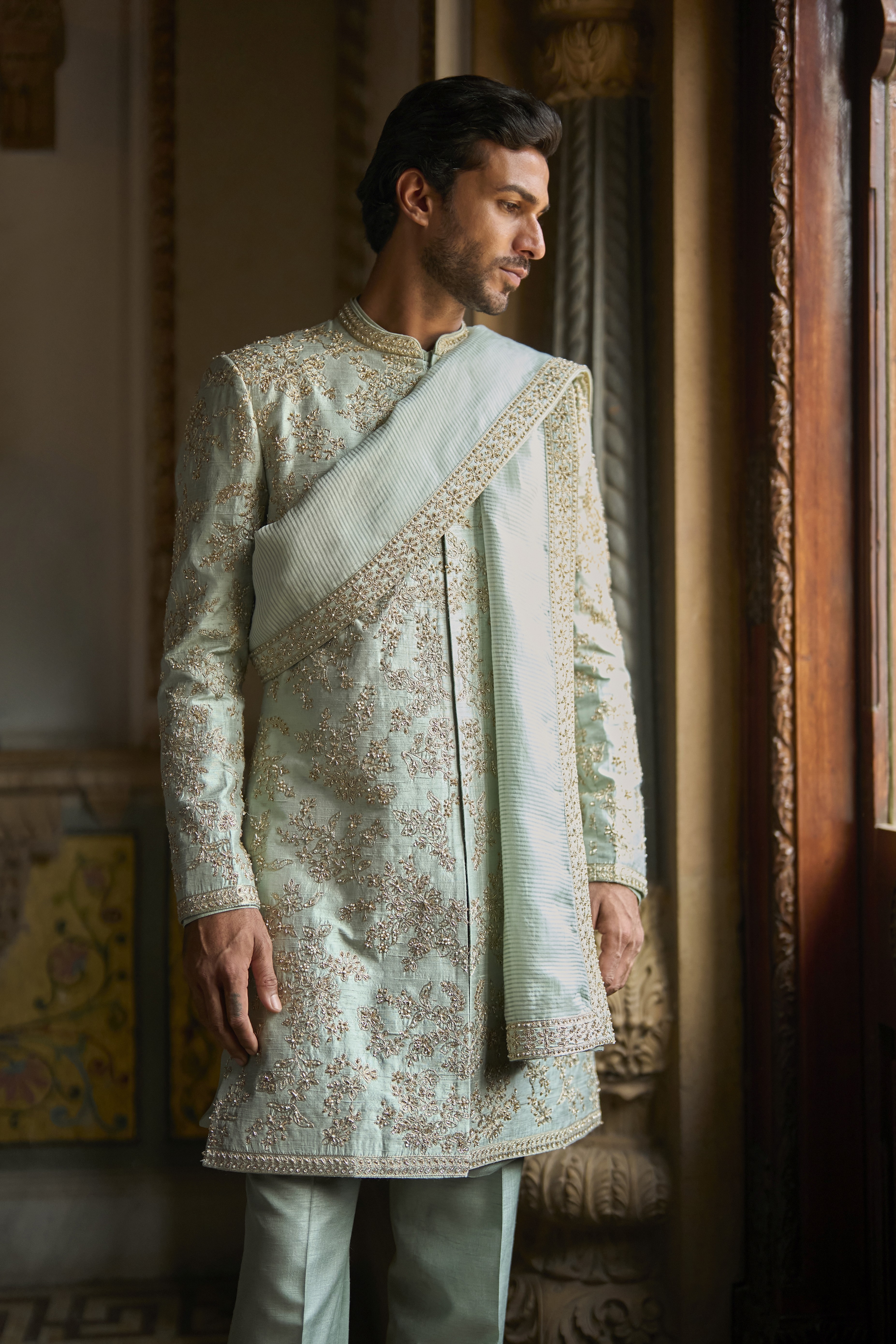
Hand-embroidered sherwani from The Promise, Summer Bridal 2026. Image courtesy: Seema Gujral
At a moment when machine embroidery and AI-assisted surface design are entering even the luxury segment, the choice to remain hand-crafted is a position with direct consequences for the livelihoods of artisans whose skills have no alternative market. The Fashion Revolution movement has documented repeatedly how the luxury industry's shift toward semi-mechanised embroidery has hollowed out entire craft clusters in Uttar Pradesh, Rajasthan, and West Bengal, communities whose economic survival was predicated on their technical knowledge remaining valued.
Genuine craft patronage costs more, takes longer, and requires the kind of sustained institutional commitment that a trend-driven business model cannot support. Gujral understands the calibration this demands at the level of the individual garment. "It comes down to restraint," she says. "We focus on layering techniques in a way that feels refined rather than overwhelming, ensuring that the embroidery enhances the garment without taking away from its elegance and movement."
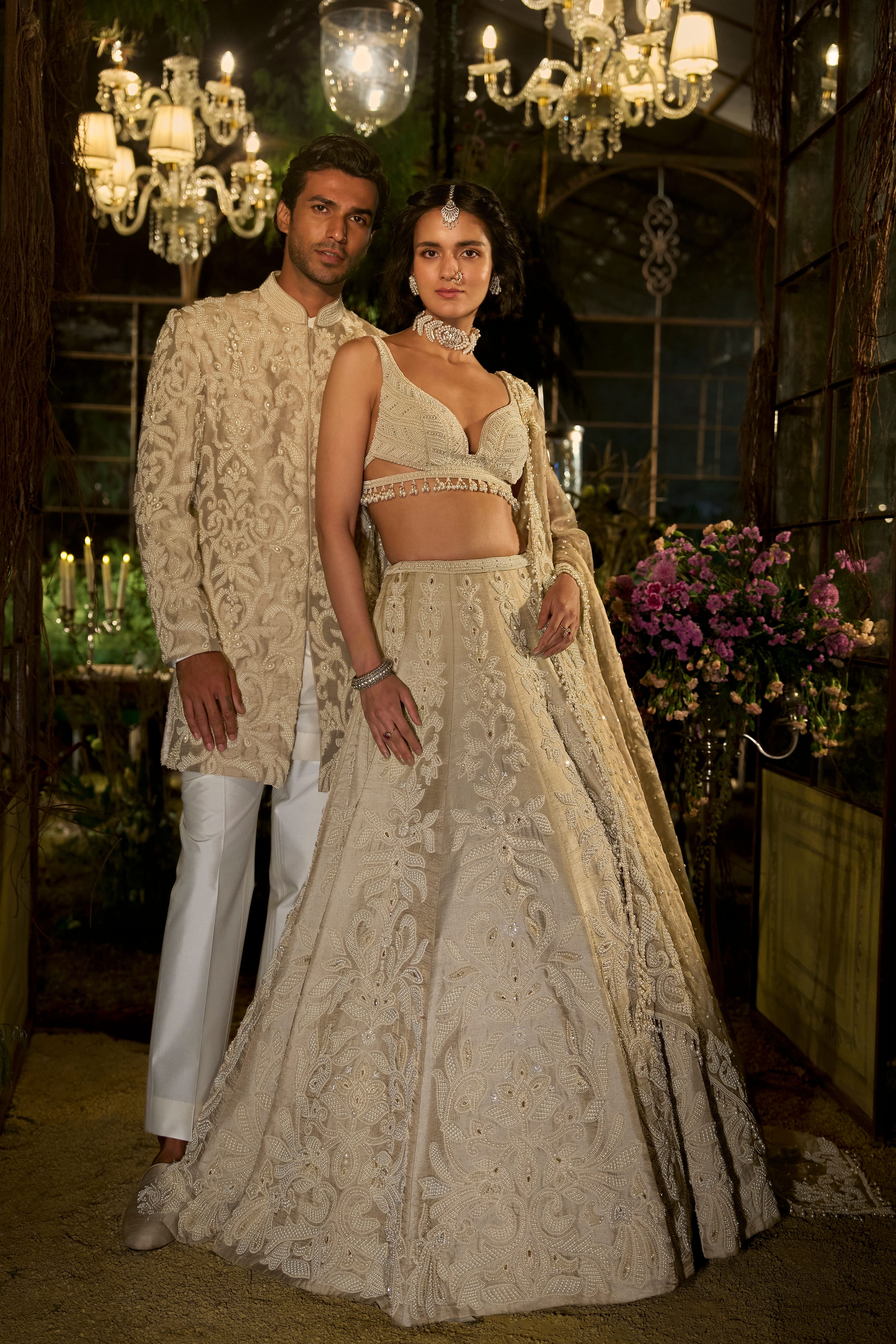
Tone-on-tone embroidery in champagne gold, from The Promise collection. Image courtesy: Seema Gujral
That sentence contains an entire philosophy of craft. The embroidery remains in service of the garment. The garment remains in service of the woman who wears it. Within that hierarchy, technique matters because of what it contributes to the whole, not because it demands attention for itself.
Beyond Red
The decision to build The Promise around ivory, champagne gold, sage, stone grey, and powder peach is a direct engagement with one of Indian bridal tradition's most symbolically loaded conventions. Red, in the Hindu bridal context, carries the weight of centuries. It is the colour of Lakshmi, of auspiciousness, of the sindoor that marks marital status. A bride in red is legible across the full breadth of the tradition. A bride in ivory sage is making an individual statement rather than a communal one.
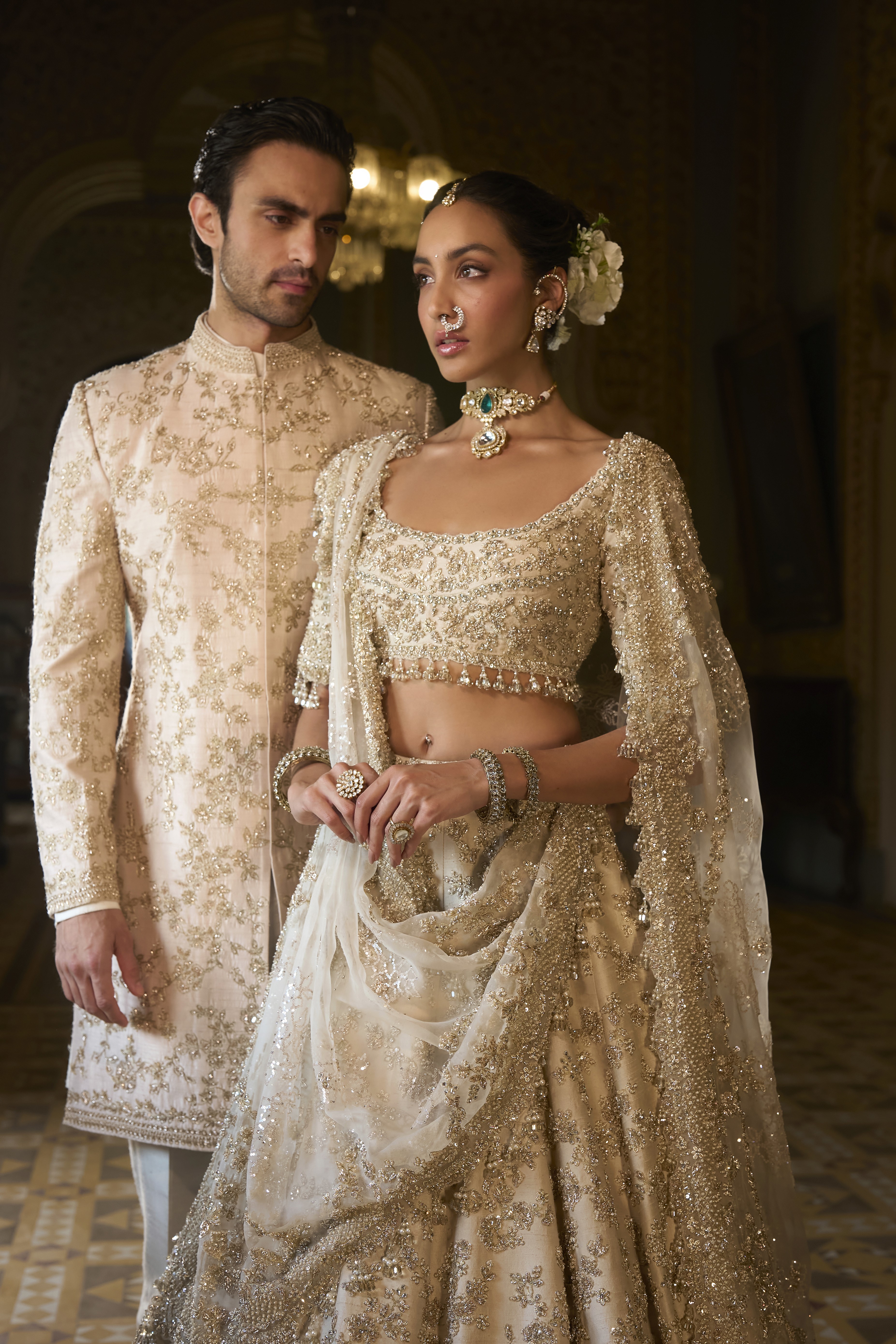
Bridal and groom wear in champagne gold, from The Promise, Summer Bridal 2026. Image courtesy: Seema Gujral
The shift has been gathering pace for a decade, driven by a generation of brides who came of age watching South Asian diaspora weddings in the West, where the collision of traditions produced new hybrid aesthetics, and by the global spread of the destination wedding, where a bride might be dressing for multiple ceremonies across multiple days and wants a wardrobe that allows for more range. The shift carries cultural implications that extend beyond aesthetics. Families who read the absence of red as a rejection of tradition are not misreading the signal. The contemporary bride in ivory is, at some level, asserting her own sartorial authority over a symbol that previously belonged to the community.
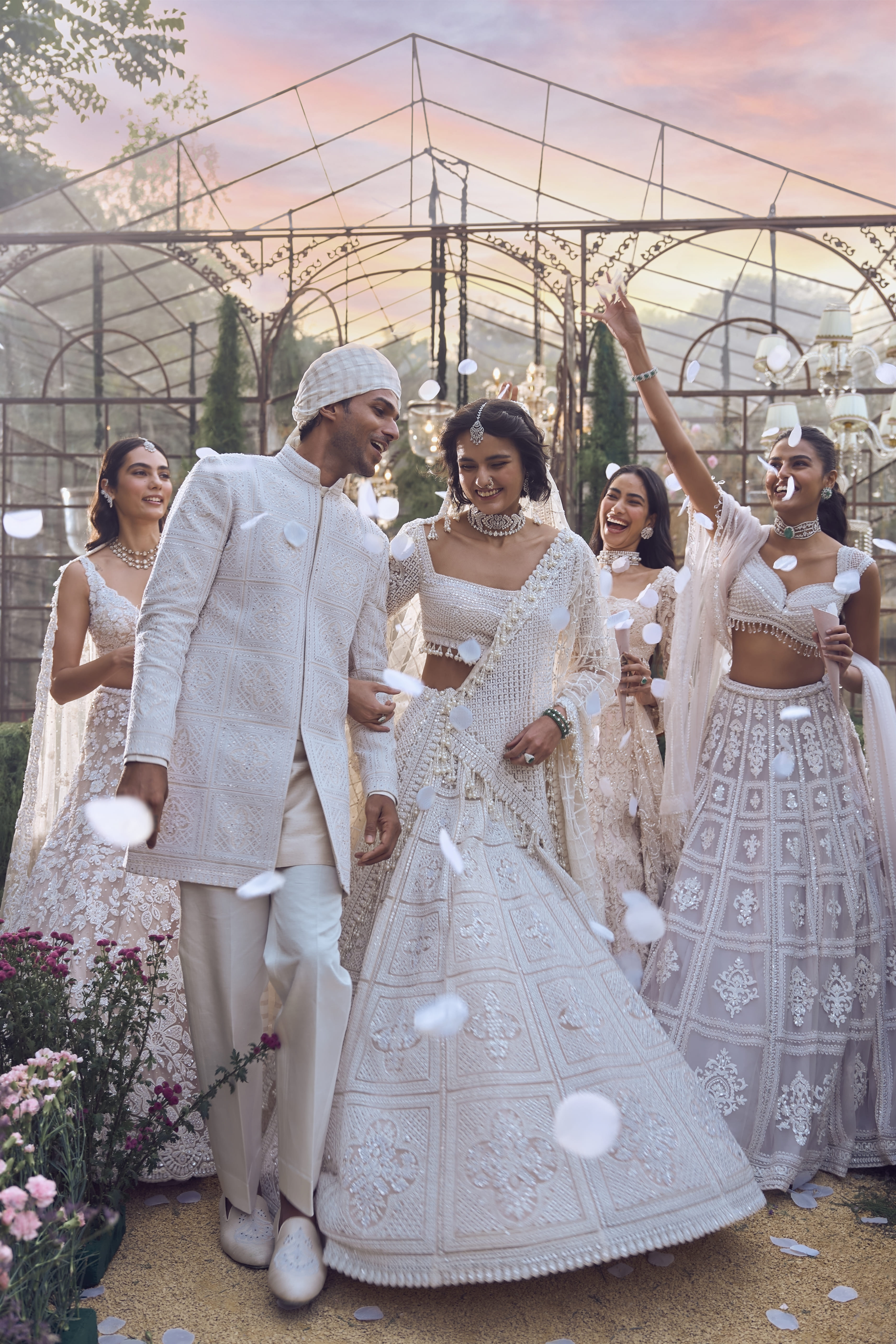
The bride in ivory, from The Promise, Summer Bridal 2026. Image courtesy: Seema Gujral
Gujral frames it as expansion. "The softer palette offers a more nuanced expression of bridal identity," she says. "It allows the bride to feel understated yet luminous, and reflects how modern brides are redefining how they want to be seen on their wedding day."
The idea speaks to a larger transformation in bridal culture. For much of its history, bridal dress functioned as a public statement directed toward family and community. The wedding was the moment a woman was most publicly visible, most closely examined, most thoroughly assessed by her community. The dress was not personal expression so much as social communication, a signal broadcast to the assembled witnesses of a family's standing, a bride's value, a household's taste. The contemporary bride who chooses restraint over spectacle is, in a real sense, withdrawing from that broadcast. The audience has changed. Personal meaning increasingly carries more weight than communal approval. This is a shift in the social function of bridal clothing that goes considerably deeper than a palette change.
The Vow and the Garment
The Promise takes its title seriously. A promise implies duration: it is a speech act that reaches into the future and binds the present to it. Gujral's articulation of how that idea moved through the actual making of the collection is precise. "With The Promise, the idea of a vow translated into pieces that feel intimate and lasting," she says. "Every element, from the embroidery to the silhouettes, was designed to reflect emotion, commitment, and the idea of a garment becoming part of a personal history."
The collection also extends this idea to the groom, giving him a fully realised wardrobe of sherwanis and coordinated occasion wear made with the same craft attention as the womenswear. This is a reflection of something Gujral is observing change in how couples approach the ceremony rather than a prescription about what weddings should look like. "It reflects how weddings today are more collaborative, with both partners equally involved in how they present themselves," she says. "Designing menswear with the same level of detail allows for a more cohesive and considered celebration."
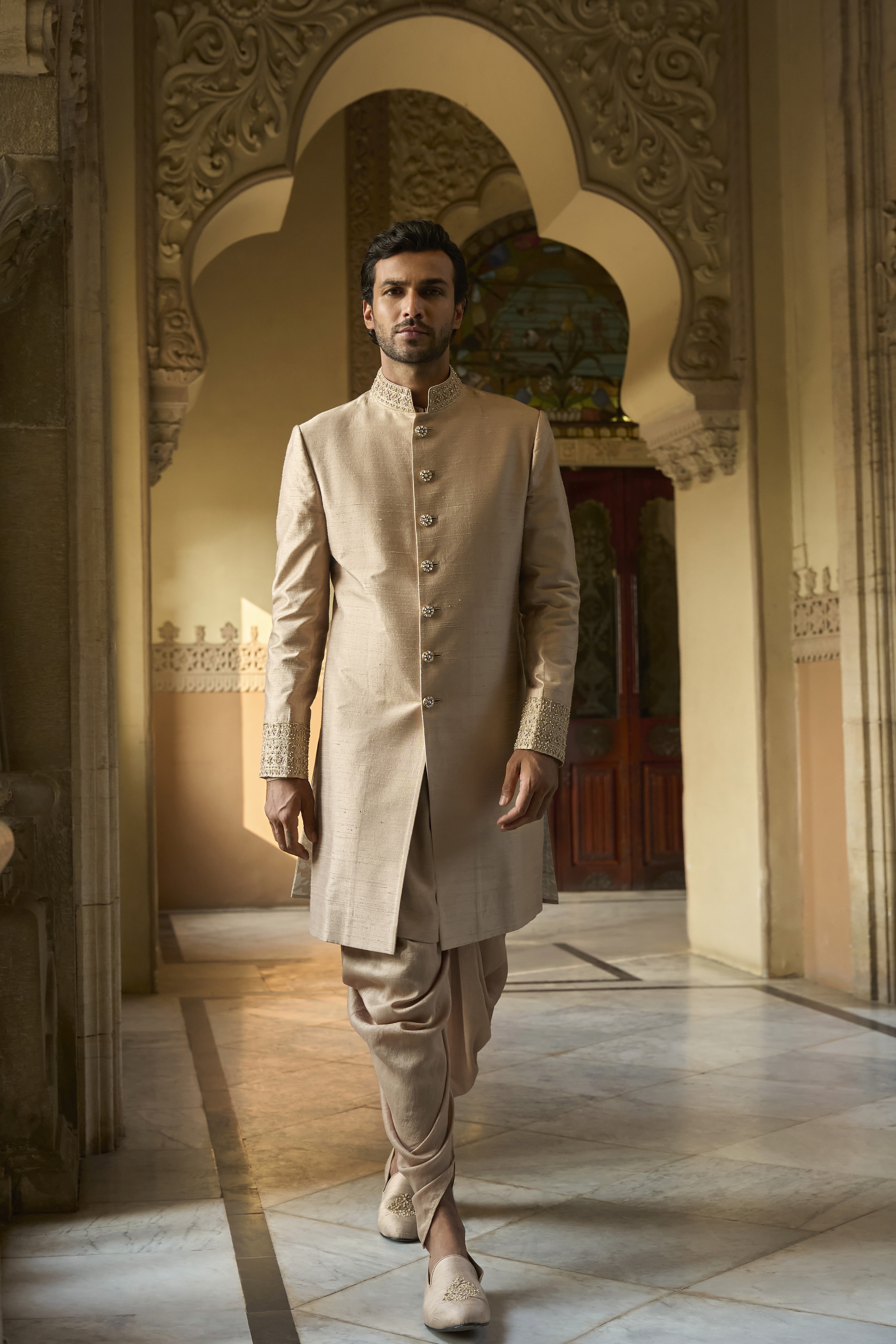
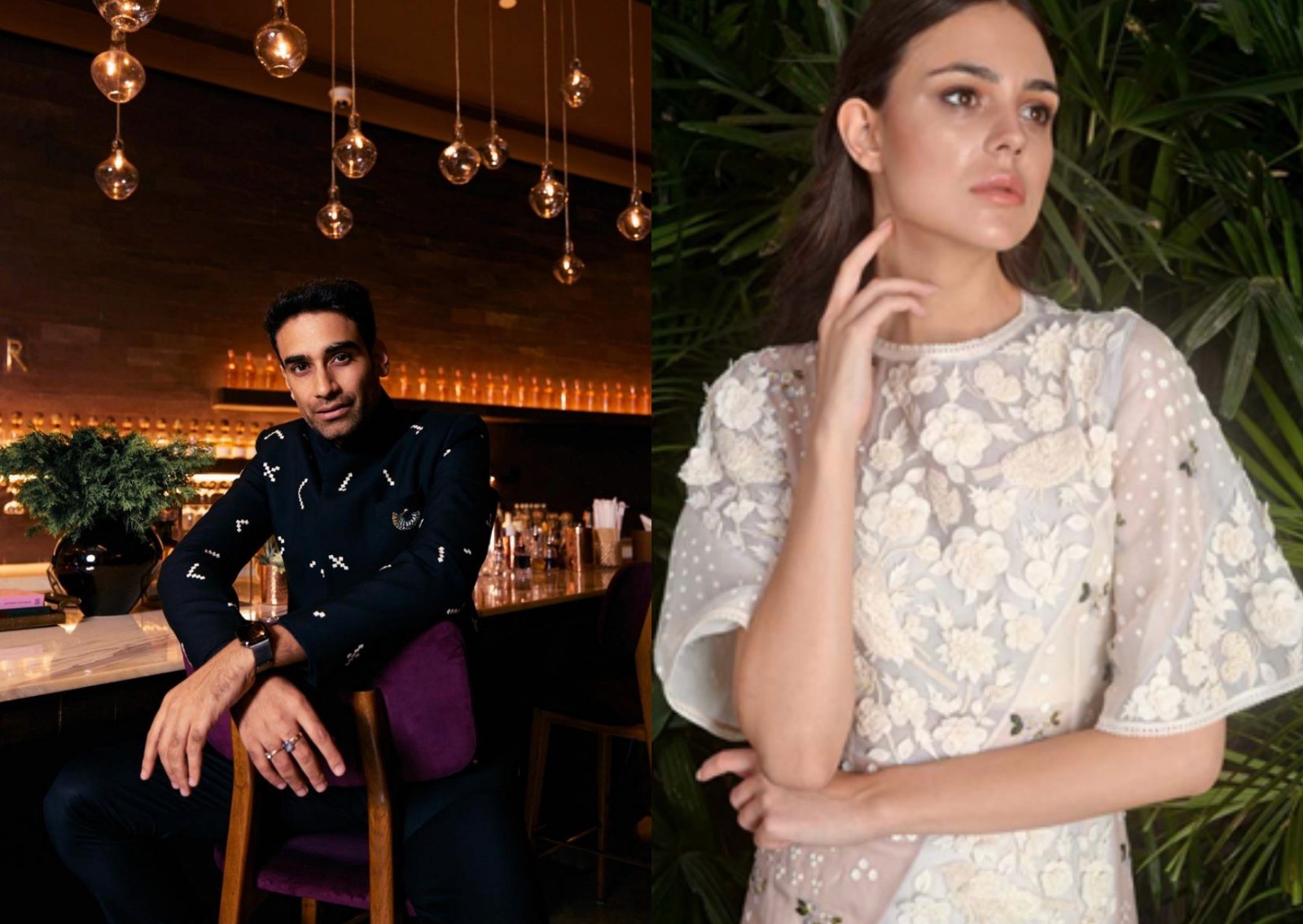
Groom wear from The Promise, Summer Bridal 2026. Image courtesy: Seema Gujral
The collection also offers a perspective on sustainability that extends beyond materials and supply chains. The industry's dominant framework for ecological responsibility focuses on materials and supply chains: organic fibres, traceable sourcing, reduced water use in dyeing. These are legitimate concerns, addressed with varying degrees of seriousness across the market. But there is another argument available, one that The Promise makes without ever using the word sustainability. The most responsible object in any consumption system is one made so well that it is never discarded. A lehenga built with this level of craft integrity, worn at a wedding and then kept for thirty years, reworn by a daughter, altered and preserved, is making an environmental argument that the industry's certifications and material audits rarely reach.
Resisting the Algorithm
There is a paradox embedded in being a couture house of Seema Gujral's stature. The house has dressed three generations of Indian cinema. When a woman of Madhuri Dixit's or Alia Bhatt's or Kiara Advani's visibility chooses your work for a moment that will be seen by millions, the cultural weight of that choice is substantial. It represents a form of endorsement that no advertising campaign can replicate. And yet the logic of that visibility, if followed to its conclusion, leads directly toward the trend-chasing, celebrity-optimising, spectacle-oriented mode of production that the house has consistently declined.
Gujral holds this tension without apparent difficulty. "It's always an honour when someone chooses our work for a moment that will be widely seen," she says. "While visibility is important, it doesn't change how we design. We remain focused on craftsmanship and creating pieces that feel authentic to the brand."
The confidence embedded in that sentence is the confidence of a house that knows what it is. Across thirty years of watching the Indian fashion industry transform around her, through the rise of destination weddings and social media documentation and the globalisation of the South Asian bridal aesthetic, Gujral has returned consistently to the same answer when asked what has never changed. "What has remained constant is our commitment to craftsmanship and attention to detail," she says. "That foundation continues to guide every collection, regardless of how the industry evolves."
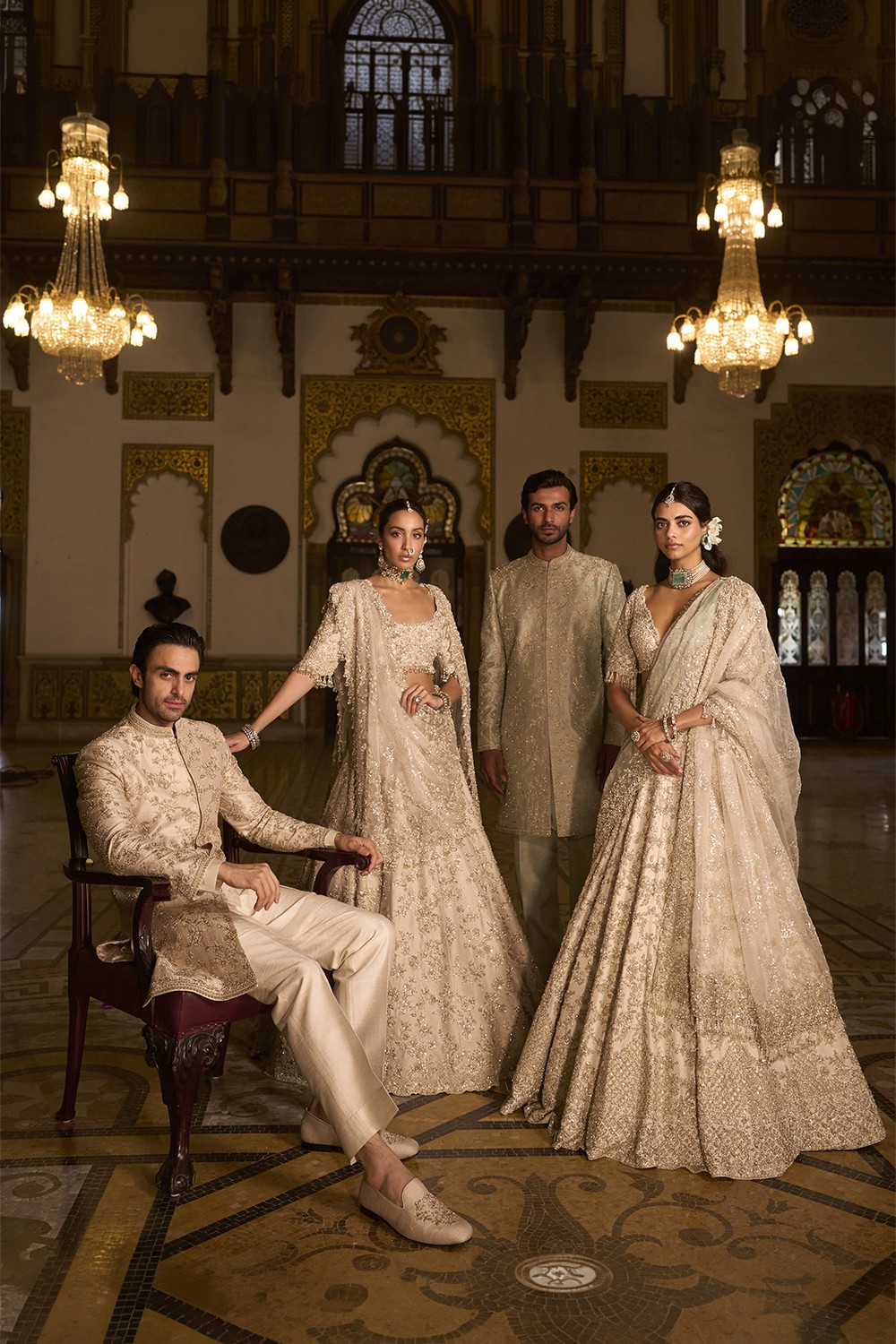
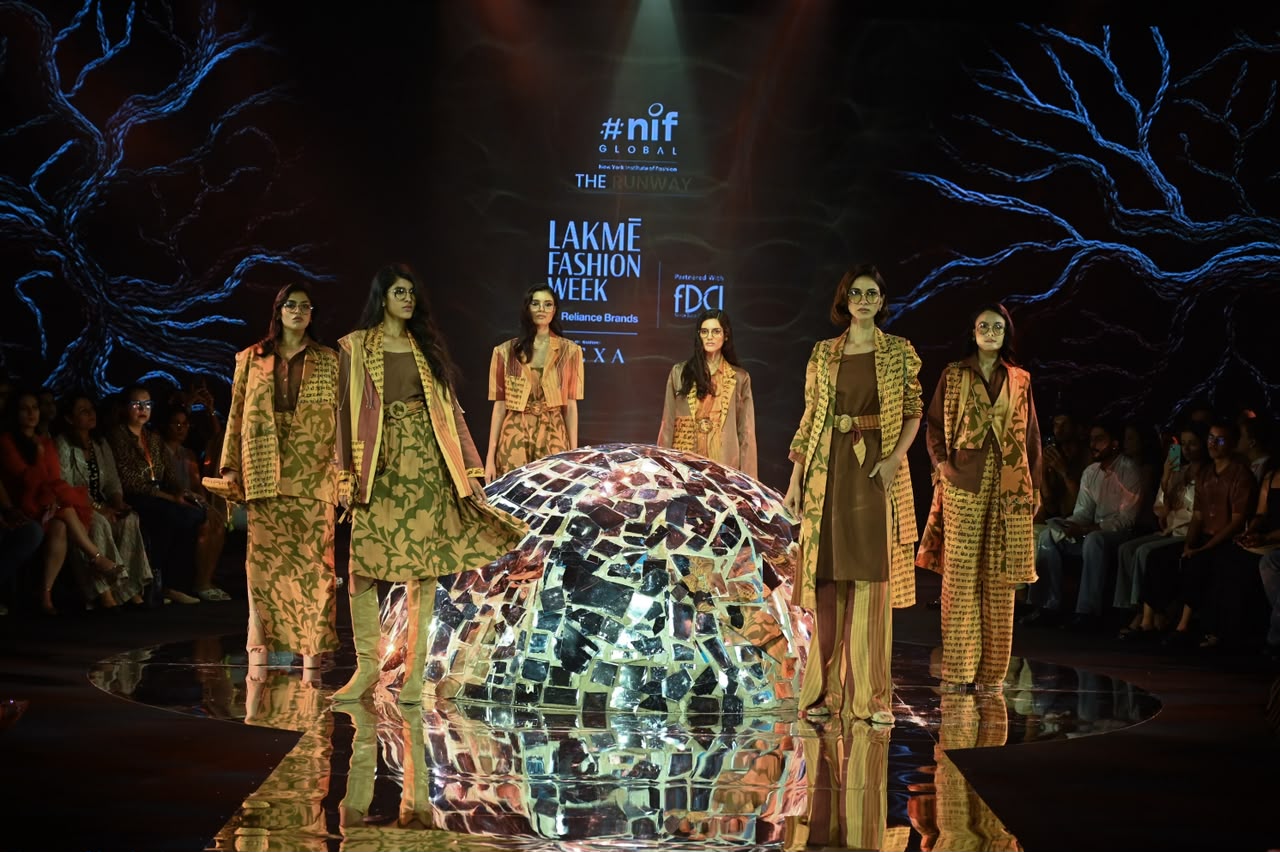
Looks from The Promise, Summer Bridal 2026. Image courtesy: Seema Gujral
The Indian bridal fashion industry will continue to evolve through celebrity collaborations, digital visibility, and changing interpretations of tradition. The market for all of this is vast and growing and entirely real. But within it, there is also a different appetite, one that has always existed and is perhaps more visible now than it has been in some time: for objects made to last, for craft that carries the weight of the hands that made it, for the garment that becomes, over decades of keeping, the closest thing a wardrobe has to a promise kept.
Seema Gujral has been making that argument in cloth since 1995. The Promise is simply the latest, most articulate chapter of a case she has been building her entire career.
TO BE CONTINUED, FOR SUBSCRIBERS ONLY.
This is where the surface ends and the reporting begins.
The complete piece, the full archive, and access to The French Press Circle. Reporting answerable only to its readers.
Already a subscriber ?
Login
Read these on the house, with our compliments.
A selection from the current issue, open to all readers. Read them in full. The rest is one decision away.







There is a productive irony embedded in the Indian wedding industry's recent history. At the moment the country's bridal fashion market crossed $100 billion in valuation, at the moment it became one of the most photographed, most live streamed, most globally coveted spectacles in contemporary pop culture, it began to lose the thing that had given it meaning in the first place. The heirloom sensibility. The slow accumulation. The idea that what a woman wore on her wedding day was the beginning of a wardrobe, instead of a Pinterest board.
Portrait of Seema Gujral. Image courtesy: Seema Gujral
Seema Gujral, who has been building her couture house since 1995, watched this transformation from a different vantage point. Her house moved to its own rhythm while the industry accelerated around it. In three decades, she has not launched a diffusion line, has not produced a celebrity capsule, has not recalibrated her aesthetic toward whatever the international market found legible that season. Her clients now bring their daughters. The house has dressed Alia Bhatt, Kiara Advani, and Madhuri Dixit across generations of Indian cinema, without once bending its design language to accommodate a trending moment. This is, in the context of modern Indian fashion, a unique biography.
Her Summer Bridal 2026 collection, The Promise, built on hand-laid zardosi, fine thread work, pearls, crystals, and meenakari buttons across a palette of ivory, champagne gold, sage, stone grey, and powder peach, is the most complete expression yet of what that biography means when it arrives on the body. But to understand the collection, one has to first understand the tradition it is in conversation with, and the degree to which that tradition has been dismantled, piece by piece, in the name of progress.
The Original Luxury
Before it became a Pinterest board category and a luxury shopping expedition, the trousseau was an epistemic system. It encoded, in cloth and embroidery and the weight of fabric across generations, a family's understanding of what endured. A grandmother who could distinguish between a hand-knotted and machine-laid zari border was not simply demonstrating taste. She was exercising a form of knowledge that her household recognised as authoritative, a technical and aesthetic literacy that had been accumulated over years of observation, of running fingers over fabric in market stalls, of watching how a weave held its colour across decades of use and washing.
The trousseau was, in this sense, one of the few spaces in traditional domestic life where women's labour and aesthetic intelligence were taken completely seriously. The embroidery a mother spent two years completing for her daughter's trousseau was an argument, made in thread, about what she believed her daughter's life should contain.
Detail from The Promise, Summer Bridal 2026. Image courtesy: Seema Gujral
Textile historian Rta Kapur Chishti has written at length about how Indian embroidery traditions, from the phulkari of Punjab to the chikankari of Lucknow, were repositories of a community's visual vocabulary, passed from women to women outside the formal structures of institutional knowledge. The trousseau was where this vocabulary became personal, where the collective tradition was translated into an individual inheritance.
Gujral thinks about this lineage with care. "While the traditional trousseau has evolved, I think the intention behind it, thoughtfulness, curation, and emotional value, still exists," she says. "Today, brides approach couture with a clearer sense of personal style, which creates a new, more individual version of that tradition."
The contemporary bride who spends eighteen months researching her couture, who arrives at a fitting knowing exactly which thread work techniques she wants and why, is exercising a version of that same aesthetic intelligence. What separates her experience from previous generations is the framework surrounding it. She is doing it alone, without the intergenerational scaffolding, without the accumulated household knowledge, without the grandmother who could read the embroidery and tell her whether it would hold.
The Attention Economy
The industrialisation of the Indian wedding is well-documented at this point. The average North Indian wedding now costs between 20 and 30 lakh rupees at the lower end of the market, and orders of magnitude more at the top. The bridal fashion segment alone, according to industry estimates, is growing at roughly 15 to 18 percent annually. Destination weddings have spawned entire economies. Wedding stylists, bridal choreographers, content creators who document the function across multiple social platforms, a full infrastructure has grown up around the business of getting married.
What this infrastructure optimises for is the photographable moment. The outfits that read best on Instagram are rarely the ones built for three decades of rewearing. The silhouettes that generate the most engagement tend toward maximalism, toward the spectacular, toward the kind of visual density that communicates luxury at a glance. In this economy, restraint is a harder sell than opulence. The subtle zardosi border, no matter how extraordinary the craftsmanship, loses the scroll-stop competition against a heavily embellished lehenga that announces itself in a thumbnail.
A lehenga from The Promise, Summer Bridal 2026. Image courtesy: Seema Gujral
A hand-embroidered lehenga from The Promise, Summer Bridal 2026. Image courtesy: Seema Gujral
Indian bridal fashion has responded to this environment in predictable ways. Collections have grown larger and louder. Colour palettes have expanded into territory that would have been considered unwearable in any other context. The red lehenga has been reimagined approximately three hundred times. Celebrity endorsements have become load-bearing structural elements of a house's brand strategy rather than occasional validations of it.
Gujral has watched all of this with the equanimity of someone who decided early on where she stood. When asked whether her refusal to chase the international gaze, to calibrate her work against what the West finds legible or exotic, was a conscious strategic decision or simply a natural consequence of what she was drawn to making, the answer cuts through any suggestion of positioning. "It's always been a natural approach rather than a conscious decision," she says. "I've focused on creating what feels authentic to our aesthetic, refined, intricate, and rooted in Indian craftsmanship, while ensuring it resonates with the modern wearer."
The Karigars and the Stakes of Craft
Every piece in The Promise carries hundreds of hours of hand embroidery by artisans whose skills are generational. This fact, stated baldly, has a way of sliding past the reader without registering its full weight. The scale of that labour becomes clearer when viewed in practical terms. A single heavily worked lehenga in this collection may represent eight to twelve months of work by multiple artisans. The zardosi technique, which involves laying metal wire and thread in intricate patterns on fabric, requires years to learn and decades to master. The meenakari work on the buttons draws on a craft tradition with roots in Mughal-era jewellery-making that has survived in specific artisan communities, passed father to son and mother to daughter, through centuries of political upheaval and economic disruption.
Hand-embroidered sherwani from The Promise, Summer Bridal 2026. Image courtesy: Seema Gujral
At a moment when machine embroidery and AI-assisted surface design are entering even the luxury segment, the choice to remain hand-crafted is a position with direct consequences for the livelihoods of artisans whose skills have no alternative market. The Fashion Revolution movement has documented repeatedly how the luxury industry's shift toward semi-mechanised embroidery has hollowed out entire craft clusters in Uttar Pradesh, Rajasthan, and West Bengal, communities whose economic survival was predicated on their technical knowledge remaining valued.
Genuine craft patronage costs more, takes longer, and requires the kind of sustained institutional commitment that a trend-driven business model cannot support. Gujral understands the calibration this demands at the level of the individual garment. "It comes down to restraint," she says. "We focus on layering techniques in a way that feels refined rather than overwhelming, ensuring that the embroidery enhances the garment without taking away from its elegance and movement."
Tone-on-tone embroidery in champagne gold, from The Promise collection. Image courtesy: Seema Gujral
That sentence contains an entire philosophy of craft. The embroidery remains in service of the garment. The garment remains in service of the woman who wears it. Within that hierarchy, technique matters because of what it contributes to the whole, not because it demands attention for itself.
Beyond Red
The decision to build The Promise around ivory, champagne gold, sage, stone grey, and powder peach is a direct engagement with one of Indian bridal tradition's most symbolically loaded conventions. Red, in the Hindu bridal context, carries the weight of centuries. It is the colour of Lakshmi, of auspiciousness, of the sindoor that marks marital status. A bride in red is legible across the full breadth of the tradition. A bride in ivory sage is making an individual statement rather than a communal one.
Bridal and groom wear in champagne gold, from The Promise, Summer Bridal 2026. Image courtesy: Seema Gujral
The shift has been gathering pace for a decade, driven by a generation of brides who came of age watching South Asian diaspora weddings in the West, where the collision of traditions produced new hybrid aesthetics, and by the global spread of the destination wedding, where a bride might be dressing for multiple ceremonies across multiple days and wants a wardrobe that allows for more range. The shift carries cultural implications that extend beyond aesthetics. Families who read the absence of red as a rejection of tradition are not misreading the signal. The contemporary bride in ivory is, at some level, asserting her own sartorial authority over a symbol that previously belonged to the community.
The bride in ivory, from The Promise, Summer Bridal 2026. Image courtesy: Seema Gujral
Gujral frames it as expansion. "The softer palette offers a more nuanced expression of bridal identity," she says. "It allows the bride to feel understated yet luminous, and reflects how modern brides are redefining how they want to be seen on their wedding day."
The idea speaks to a larger transformation in bridal culture. For much of its history, bridal dress functioned as a public statement directed toward family and community. The wedding was the moment a woman was most publicly visible, most closely examined, most thoroughly assessed by her community. The dress was not personal expression so much as social communication, a signal broadcast to the assembled witnesses of a family's standing, a bride's value, a household's taste. The contemporary bride who chooses restraint over spectacle is, in a real sense, withdrawing from that broadcast. The audience has changed. Personal meaning increasingly carries more weight than communal approval. This is a shift in the social function of bridal clothing that goes considerably deeper than a palette change.
The Vow and the Garment
The Promise takes its title seriously. A promise implies duration: it is a speech act that reaches into the future and binds the present to it. Gujral's articulation of how that idea moved through the actual making of the collection is precise. "With The Promise, the idea of a vow translated into pieces that feel intimate and lasting," she says. "Every element, from the embroidery to the silhouettes, was designed to reflect emotion, commitment, and the idea of a garment becoming part of a personal history."
The collection also extends this idea to the groom, giving him a fully realised wardrobe of sherwanis and coordinated occasion wear made with the same craft attention as the womenswear. This is a reflection of something Gujral is observing change in how couples approach the ceremony rather than a prescription about what weddings should look like. "It reflects how weddings today are more collaborative, with both partners equally involved in how they present themselves," she says. "Designing menswear with the same level of detail allows for a more cohesive and considered celebration."
Groom wear from The Promise, Summer Bridal 2026. Image courtesy: Seema Gujral
The collection also offers a perspective on sustainability that extends beyond materials and supply chains. The industry's dominant framework for ecological responsibility focuses on materials and supply chains: organic fibres, traceable sourcing, reduced water use in dyeing. These are legitimate concerns, addressed with varying degrees of seriousness across the market. But there is another argument available, one that The Promise makes without ever using the word sustainability. The most responsible object in any consumption system is one made so well that it is never discarded. A lehenga built with this level of craft integrity, worn at a wedding and then kept for thirty years, reworn by a daughter, altered and preserved, is making an environmental argument that the industry's certifications and material audits rarely reach.
Resisting the Algorithm
There is a paradox embedded in being a couture house of Seema Gujral's stature. The house has dressed three generations of Indian cinema. When a woman of Madhuri Dixit's or Alia Bhatt's or Kiara Advani's visibility chooses your work for a moment that will be seen by millions, the cultural weight of that choice is substantial. It represents a form of endorsement that no advertising campaign can replicate. And yet the logic of that visibility, if followed to its conclusion, leads directly toward the trend-chasing, celebrity-optimising, spectacle-oriented mode of production that the house has consistently declined.
Gujral holds this tension without apparent difficulty. "It's always an honour when someone chooses our work for a moment that will be widely seen," she says. "While visibility is important, it doesn't change how we design. We remain focused on craftsmanship and creating pieces that feel authentic to the brand."
The confidence embedded in that sentence is the confidence of a house that knows what it is. Across thirty years of watching the Indian fashion industry transform around her, through the rise of destination weddings and social media documentation and the globalisation of the South Asian bridal aesthetic, Gujral has returned consistently to the same answer when asked what has never changed. "What has remained constant is our commitment to craftsmanship and attention to detail," she says. "That foundation continues to guide every collection, regardless of how the industry evolves."
Looks from The Promise, Summer Bridal 2026. Image courtesy: Seema Gujral
The Indian bridal fashion industry will continue to evolve through celebrity collaborations, digital visibility, and changing interpretations of tradition. The market for all of this is vast and growing and entirely real. But within it, there is also a different appetite, one that has always existed and is perhaps more visible now than it has been in some time: for objects made to last, for craft that carries the weight of the hands that made it, for the garment that becomes, over decades of keeping, the closest thing a wardrobe has to a promise kept.
Seema Gujral has been making that argument in cloth since 1995. The Promise is simply the latest, most articulate chapter of a case she has been building her entire career.
TO BE CONTINUED, FOR SUBSCRIBERS ONLY.
This is where the surface ends and the reporting begins.
The complete piece, the full archive, and access to The French Press Circle. Reporting answerable only to its readers.
Already a subscriber ?
Login
Read these on the house, with our compliments.
A selection from the current issue, open to all readers. Read them in full. The rest is one decision away.