There is a tendency, particularly among those outside the industry, to dismiss modern luxury fashion as indulgent, irrational, even faintly ridiculous, and while that instinct is not entirely incorrect, it is fundamentally incomplete. What appears absurd on the surface is, in reality, one of the most sophisticated exercises in value creation in contemporary capitalism. Fashion has quietly rewritten the rules of value, moving it away from utility, craftsmanship and even design in the traditional sense, and relocating it firmly into the domains of narrative, context, visibility and narrative signalling. Nowhere is this more aggressively evident than in the rise of fashion’s most absurd objects, which, far from being anomalies, are in fact the purest expressions of how luxury now functions.
Take Balenciaga’s leather trash pouch, retailing at approximately $1,790, designed to resemble a garbage bag with unnerving accuracy. There is no reinterpretation here, no attempt to soften the reference, no design flourish that redeems it into something conventionally desirable. It is precisely what it looks like, and that is exactly why it works. From a traditional product standpoint, it is indefensible; from a branding standpoint, it is near perfect. It achieves instant recognisability, triggers global conversation, and forces a binary reaction that ensures maximum circulation. People laugh, people critique, people share, and somewhere within that cycle, the object accrues value. The mistake is to assume that the laughter signals failure. It does not. It signals entry. Absurdity, in modern fashion is a distribution strategy and not a risk anymore.
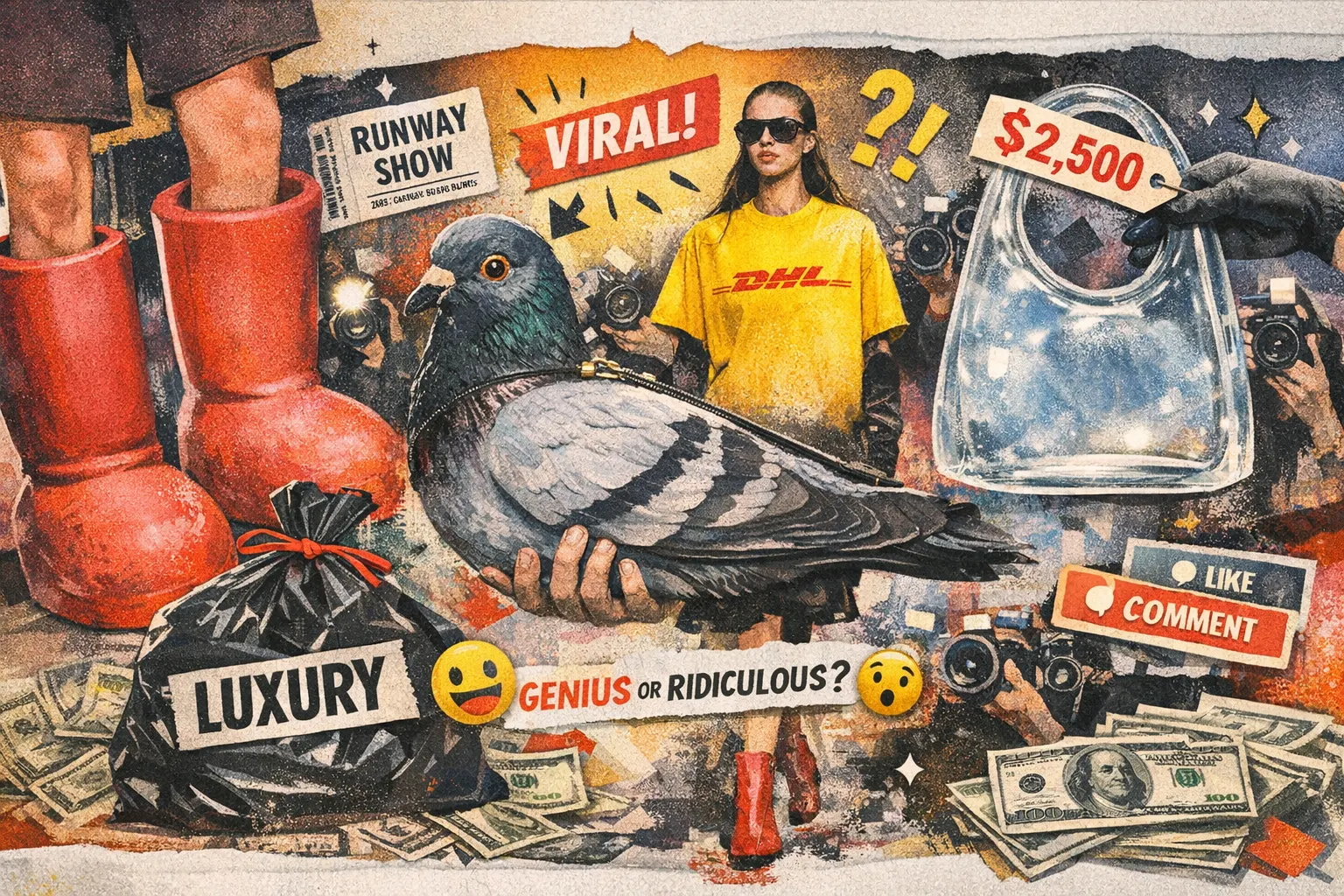
This is a pattern that has been systematically refined. When Vetements sent a DHL T-shirt down the runway and priced it as luxury, it transformed the context. The cotton remained unchanged, the logo remained mundane, but the meaning shifted entirely. Similarly, JW Anderson’s hyper-realistic pigeon clutch presented it in its most literal form and relied entirely on context to elevate it. Coperni pushed the idea further with a handbag composed of approximately 99 percent air, engineered from silica aerogel, a material more commonly associated with aerospace than accessories. Functionally negligible, conceptually provocative, and visually arresting, it existed more as a statement of what could be framed as luxury if enough authority was applied. MSCHF’s Big Red Boots, exaggerated to the point of caricature, completed the spectrum, proving that when an object becomes sufficiently recognisable, realism itself becomes optional. Across these examples, the underlying principle is consistent: the reaction carries value.
What appears chaotic is, in fact, highly structured. Each of these products begins with radical familiarity, drawing from objects that require no explanation: a trash bag, a pigeon, a shopping tote. They are then placed within an elevated ecosystem, surrounded by editorial imagery, runway validation, celebrity endorsement and controlled distribution. Pricing is used to assert value, functioning as a signal rather than a consequence. The design itself is inherently viral, engineered for screenshots, debate and replication across platforms. And perhaps most critically, each object sustains an ambiguity of sorts. It is never entirely clear whether it is serious or satirical, and that tension is precisely what fuels its longevity in the mainstream conversation.
The consumer journey in these cases is remarkably predictable. It begins with recognition, often accompanied by disbelief. This looks absurd. It moves quickly into amplification. Have you seen this? Debate follows. Is this genius or nonsense? With repetition comes normalisation; the object ceases to shock and begins to familiarise. And eventually, adoption occurs. By the time the purchase decision is made, the absurdity has simply been reframed. What was once ridiculous becomes acceptable, and what is acceptable, in the right context, becomes desirable.
It would be convenient to frame this as a story of brands deceiving consumers, but that reading is reductive. The consumer is participating. The purchase is rarely about the object itself and almost always about what the object signifies. Alignment, awareness, sartorial fluency, the ability to recognise the reference and choose to engage with it. To carry a bag that resembles a trash pouch is to understand it completely and to signal that understanding outwardly. This is consent within a shared system of meaning.
April Fool’s Day, in contrast, operates on temporary illusion. It relies on a reveal, a moment where the audience recognises the trick and the narrative collapses. Fashion has eliminated that collapse entirely. There is no reveal because there is no need for one. The absurd is presented with unwavering conviction, repeated across channels, validated by authority, and absorbed into mainstream conversation without ever being framed as a joke. The illusion is the product.
What fashion ultimately demonstrates, with a clarity that extends far beyond clothing, is that value is constructed and can be cleverly assigned. A trash bag becomes luxury when it is placed within a system that assigns it meaning. A pigeon becomes desirable when it becomes visible in the right contexts. A bag made of air becomes aspirational because it exists at the intersection of technology, spectacle and narrative. This is consensus engineering at scale.
Fashion already perfected the mechanics of April Fool’s Day! By presenting the absurd with such clarity, repetition and confidence that disbelief gradually gives way to desire. The joke if there ever was one, is that we continue to believe there is one at all.
TO BE CONTINUED, FOR SUBSCRIBERS ONLY.
This is where the surface ends and the reporting begins.
The complete piece, the full archive, and access to The French Press Circle. Reporting answerable only to its readers.
Already a subscriber ?
Login
Read these on the house, with our compliments.
A selection from the current issue, open to all readers. Read them in full. The rest is one decision away.











There is a tendency, particularly among those outside the industry, to dismiss modern luxury fashion as indulgent, irrational, even faintly ridiculous, and while that instinct is not entirely incorrect, it is fundamentally incomplete. What appears absurd on the surface is, in reality, one of the most sophisticated exercises in value creation in contemporary capitalism. Fashion has quietly rewritten the rules of value, moving it away from utility, craftsmanship and even design in the traditional sense, and relocating it firmly into the domains of narrative, context, visibility and narrative signalling. Nowhere is this more aggressively evident than in the rise of fashion’s most absurd objects, which, far from being anomalies, are in fact the purest expressions of how luxury now functions.
Take Balenciaga’s leather trash pouch, retailing at approximately $1,790, designed to resemble a garbage bag with unnerving accuracy. There is no reinterpretation here, no attempt to soften the reference, no design flourish that redeems it into something conventionally desirable. It is precisely what it looks like, and that is exactly why it works. From a traditional product standpoint, it is indefensible; from a branding standpoint, it is near perfect. It achieves instant recognisability, triggers global conversation, and forces a binary reaction that ensures maximum circulation. People laugh, people critique, people share, and somewhere within that cycle, the object accrues value. The mistake is to assume that the laughter signals failure. It does not. It signals entry. Absurdity, in modern fashion is a distribution strategy and not a risk anymore.
This is a pattern that has been systematically refined. When Vetements sent a DHL T-shirt down the runway and priced it as luxury, it transformed the context. The cotton remained unchanged, the logo remained mundane, but the meaning shifted entirely. Similarly, JW Anderson’s hyper-realistic pigeon clutch presented it in its most literal form and relied entirely on context to elevate it. Coperni pushed the idea further with a handbag composed of approximately 99 percent air, engineered from silica aerogel, a material more commonly associated with aerospace than accessories. Functionally negligible, conceptually provocative, and visually arresting, it existed more as a statement of what could be framed as luxury if enough authority was applied. MSCHF’s Big Red Boots, exaggerated to the point of caricature, completed the spectrum, proving that when an object becomes sufficiently recognisable, realism itself becomes optional. Across these examples, the underlying principle is consistent: the reaction carries value.
What appears chaotic is, in fact, highly structured. Each of these products begins with radical familiarity, drawing from objects that require no explanation: a trash bag, a pigeon, a shopping tote. They are then placed within an elevated ecosystem, surrounded by editorial imagery, runway validation, celebrity endorsement and controlled distribution. Pricing is used to assert value, functioning as a signal rather than a consequence. The design itself is inherently viral, engineered for screenshots, debate and replication across platforms. And perhaps most critically, each object sustains an ambiguity of sorts. It is never entirely clear whether it is serious or satirical, and that tension is precisely what fuels its longevity in the mainstream conversation.
The consumer journey in these cases is remarkably predictable. It begins with recognition, often accompanied by disbelief. This looks absurd. It moves quickly into amplification. Have you seen this? Debate follows. Is this genius or nonsense? With repetition comes normalisation; the object ceases to shock and begins to familiarise. And eventually, adoption occurs. By the time the purchase decision is made, the absurdity has simply been reframed. What was once ridiculous becomes acceptable, and what is acceptable, in the right context, becomes desirable.
It would be convenient to frame this as a story of brands deceiving consumers, but that reading is reductive. The consumer is participating. The purchase is rarely about the object itself and almost always about what the object signifies. Alignment, awareness, sartorial fluency, the ability to recognise the reference and choose to engage with it. To carry a bag that resembles a trash pouch is to understand it completely and to signal that understanding outwardly. This is consent within a shared system of meaning.
April Fool’s Day, in contrast, operates on temporary illusion. It relies on a reveal, a moment where the audience recognises the trick and the narrative collapses. Fashion has eliminated that collapse entirely. There is no reveal because there is no need for one. The absurd is presented with unwavering conviction, repeated across channels, validated by authority, and absorbed into mainstream conversation without ever being framed as a joke. The illusion is the product.
What fashion ultimately demonstrates, with a clarity that extends far beyond clothing, is that value is constructed and can be cleverly assigned. A trash bag becomes luxury when it is placed within a system that assigns it meaning. A pigeon becomes desirable when it becomes visible in the right contexts. A bag made of air becomes aspirational because it exists at the intersection of technology, spectacle and narrative. This is consensus engineering at scale.
Fashion already perfected the mechanics of April Fool’s Day! By presenting the absurd with such clarity, repetition and confidence that disbelief gradually gives way to desire. The joke if there ever was one, is that we continue to believe there is one at all.
TO BE CONTINUED, FOR SUBSCRIBERS ONLY.
This is where the surface ends and the reporting begins.
The complete piece, the full archive, and access to The French Press Circle. Reporting answerable only to its readers.
Already a subscriber ?
Login
Read these on the house, with our compliments.
A selection from the current issue, open to all readers. Read them in full. The rest is one decision away.