On October 7, 2023, Hamas-led attackers killed about 1,200 people in Israel and took roughly 250 hostages, according to Israeli authorities. What followed has become one of the most sustained and destructive military campaigns in the region in recent history.
By early 2026, the Palestinian Health Ministry reports that more than 70,000 people have been killed in Gaza. Civilian infrastructure has been extensively degraded. Housing, hospitals, and water systems have collapsed at scale. The United Nations continues to warn of hunger and near-famine conditions, with aid flows inconsistent and frequently disrupted.
Along Israel’s northern frontier, exchanges with Hezbollah that began in late 2023 displaced tens of thousands in their initial phase. In subsequent escalations tied to a broader regional confrontation, displacement on the Lebanese side has reached far higher levels.
In December 2023, South Africa brought a genocide case against Israel at the International Court of Justice. In January 2024, the court issued provisional measures requiring Israel to prevent acts under the Genocide Convention and facilitate humanitarian aid, while stopping short of ordering a ceasefire.
The United States continues to provide Israel with approximately 3.8 billion dollars annually in military assistance, supplemented by additional wartime appropriations.
It is a stress test of systems. Political, legal, and economic.
If morality governed markets, oil would not trade. Instead, markets price risk. Brent crude has repeatedly approached or crossed the 90 dollar per barrel mark during periods of escalation because the Middle East remains structurally embedded in global energy supply. Roughly a fifth of the world’s oil passes through the Strait of Hormuz. Every threat to that corridor is immediately priced.
India absorbs this almost mechanically.
India imports approximately 85 percent of its crude oil requirements. Even with diversification across suppliers, price exposure remains absolute. A 10 dollar increase in crude can widen the current account deficit by roughly 0.3 to 0.4 percent of GDP and exert direct pressure on the rupee. India also imports close to 60 percent of its LPG consumption, much of it historically routed through Hormuz-linked supply chains. Domestic pricing may be politically moderated, but the underlying economics remain global. Aviation turbine fuel rises. Freight costs follow. Paint, chemicals, logistics, aviation, all begin to adjust margins quietly.
Inflation in India rarely arrives as a headline in chaotic TV shows playing tawdry graphics with anchors presenting the news amidst fake siren audio effects.
Indian equity markets, as always, perform resilience. This fascinates me more than anything else really. Being a half Gujarati, I can safely say dandha-core is a way of life.
The Sensex crossed 80,000 and the Nifty 50 breached 24,000 in early 2026, driven by domestic liquidity, SIP flows, and a persistent retail bid. Since then, volatility has returned. Foreign institutional outflows, crude sensitivity, and global risk aversion have introduced correction phases.
The index recalibrates.
Sectorally, however, the story is less composed.
Oil marketing companies compress. Airlines bleed on fuel. Paint companies watch margins erode with each uptick in crude derivatives. Bullion tells the truth more directly. Gold has traded near or above 2,100 dollars per ounce in recent cycles. In India, that translates to roughly 65,000 to 70,000 rupees per 10 grams, depending on currency movement. Every geopolitical tremor finds its way into gold pricing with almost no delay. Gold is a sensitive human being. It absorbs fear! Defence budgets globally are expanding again. Procurement pipelines are active across the United States, Europe, and the Middle East. It is line-item expenditure. Often markets look like they are designed to metabolise war.
Now, closer home
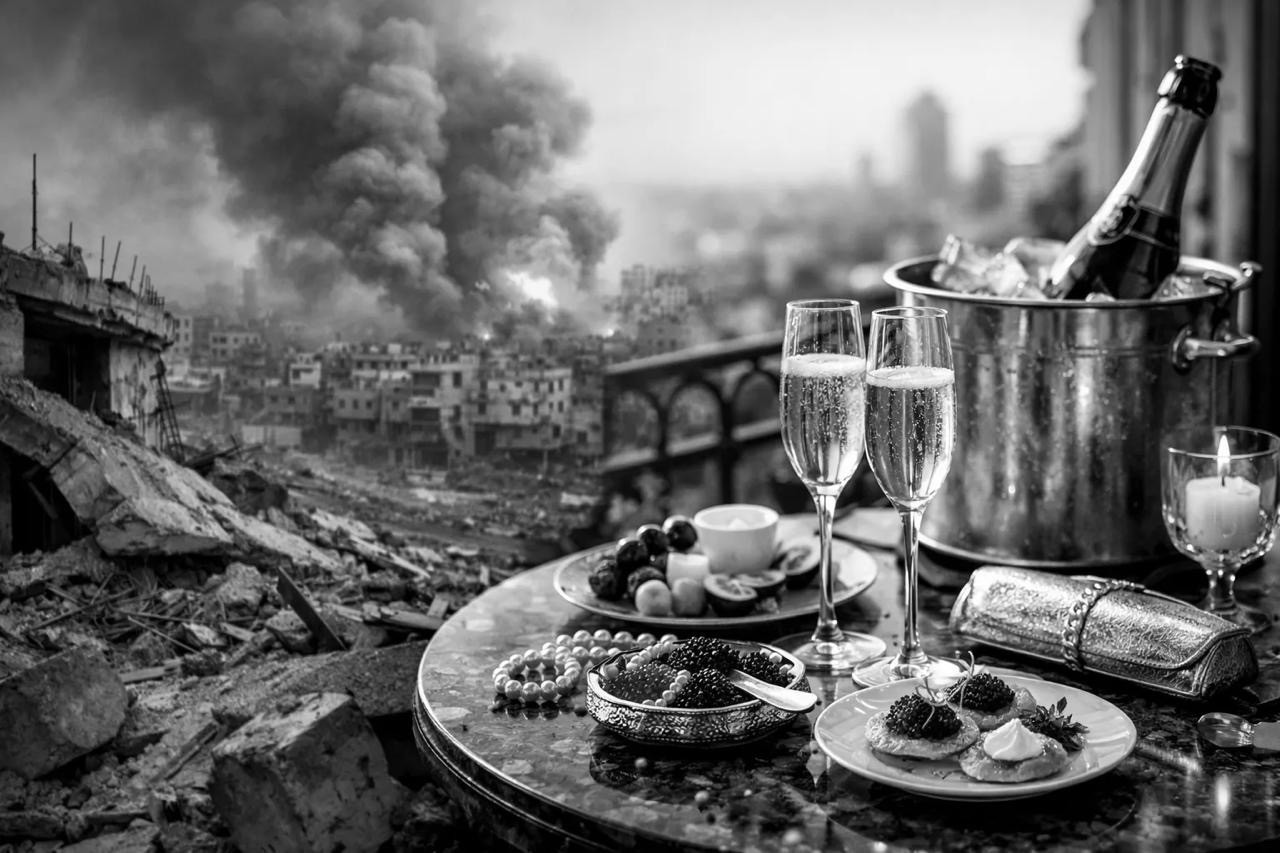
Delhi and Mumbai are operational. There are previews, trunk shows, private dinners, brand launches. Guest lists are being curated. Collections unveiled. Capital is still negotiated across tables where the wine is better. Maison French Press included. My calendar is accelerating. And none of it has paused because of the war out of pure design.
Businesses cannot suspend themselves indefinitely in response to geopolitical events. Salaries need to be paid. Investors need visibility. Brands need continuity. Momentum may look like indulgence. But in reality, it is infrastructure. Even within war zones, economies contract, distort, reroute, but they do not just vanish into thin air. Case in point - Dubai. So the expectation that Delhi, or any functioning global city, should halt itself entirely would be moral theatre at best. The show goes on despite our sensitivities.
Love it or hate it but the systems are built that way.
What has changed is the interface of war. This is among the most intensely documented and algorithmically distributed conflicts the region has experienced. Civilian deaths are recorded in real time. Airstrikes become loops on news channels. Official statements and information through “government sources” are consumed as content units.
Israel communicates with acute awareness of global optics. Hamas operates within visibility structures that extend narrative reach beyond geography. Iran signals influence through calibrated escalation, often without direct attribution. The conflict exists simultaneously across legal forums, TV news channels, digital platforms, financial markets, and diplomatic language.
For globally exposed audiences, particularly in cities like Delhi, the discomfort lies in the absence of clean binaries
Support for Palestinian civilians is interpreted as selective empathy. Support for Israel’s security is interpreted as endorsement of disproportionate force. The ICJ has introduced legal language into mainstream conversation but has not resolved the conflict. India’s position remains deliberately balanced. Strategic ties with Israel, energy dependencies in the Gulf, and broader geopolitical considerations leave little room for absolutism. So what emerges is controlled ambiguity. Public figures hedge, brands neutralise language and rooms that we create stay informed, but careful.
Distance Unfortunately Is the Real Luxury
For those within the conflict, war is immediate. For us, it is informational and often expensive with lowering of our purchasing power and silently shrugging off things beyond our control. And honestly…what other option do civilians have? We track it on screens, analyse it in conversations, reference it between courses. But we are not structurally altered by it. That distance is the defining privilege of our position.
The greatest luxury right now is insulation.
What This Moment Actually Exposes
The Middle East has always been shaped by unresolved histories. Colonial borders, ideological fractures, contested sovereignties, and the strategic interests of larger powers. What is new is the condition of the observer. We are hyper-informed and selectively engaged. We are emotionally responsive and operationally unchanged. We can track crude prices at 9 am, approve a guest list at 2 pm, and attend a launch at 8 pm without experiencing contradiction. Because our subjective reality allows us not to care beyond a point.
The Middle East today requires political resolution, sustained diplomacy, and structural accountability over theatrical grief. The rest of the world will continue in parallel. Delhi will host, brands will launch, rooms will fill, champagne will be served, wine will be poured, conversations will move from geopolitics to hemlines without apology. Because the machinery of life does not stop for it.
And perhaps that is the most accurate way to read this moment is - we are pricing it in. We can be accused of ignoring it but what other choice do we have except carry on.
TO BE CONTINUED, FOR SUBSCRIBERS ONLY.
This is where the surface ends and the reporting begins.
The complete piece, the full archive, and access to The French Press Circle. Reporting answerable only to its readers.
Already a subscriber ?
Login
Read these on the house, with our compliments.
A selection from the current issue, open to all readers. Read them in full. The rest is one decision away.










On October 7, 2023, Hamas-led attackers killed about 1,200 people in Israel and took roughly 250 hostages, according to Israeli authorities. What followed has become one of the most sustained and destructive military campaigns in the region in recent history.
By early 2026, the Palestinian Health Ministry reports that more than 70,000 people have been killed in Gaza. Civilian infrastructure has been extensively degraded. Housing, hospitals, and water systems have collapsed at scale. The United Nations continues to warn of hunger and near-famine conditions, with aid flows inconsistent and frequently disrupted.
Along Israel’s northern frontier, exchanges with Hezbollah that began in late 2023 displaced tens of thousands in their initial phase. In subsequent escalations tied to a broader regional confrontation, displacement on the Lebanese side has reached far higher levels.
In December 2023, South Africa brought a genocide case against Israel at the International Court of Justice. In January 2024, the court issued provisional measures requiring Israel to prevent acts under the Genocide Convention and facilitate humanitarian aid, while stopping short of ordering a ceasefire.
The United States continues to provide Israel with approximately 3.8 billion dollars annually in military assistance, supplemented by additional wartime appropriations.
It is a stress test of systems. Political, legal, and economic.
If morality governed markets, oil would not trade. Instead, markets price risk. Brent crude has repeatedly approached or crossed the 90 dollar per barrel mark during periods of escalation because the Middle East remains structurally embedded in global energy supply. Roughly a fifth of the world’s oil passes through the Strait of Hormuz. Every threat to that corridor is immediately priced.
India absorbs this almost mechanically.
India imports approximately 85 percent of its crude oil requirements. Even with diversification across suppliers, price exposure remains absolute. A 10 dollar increase in crude can widen the current account deficit by roughly 0.3 to 0.4 percent of GDP and exert direct pressure on the rupee. India also imports close to 60 percent of its LPG consumption, much of it historically routed through Hormuz-linked supply chains. Domestic pricing may be politically moderated, but the underlying economics remain global. Aviation turbine fuel rises. Freight costs follow. Paint, chemicals, logistics, aviation, all begin to adjust margins quietly.
Inflation in India rarely arrives as a headline in chaotic TV shows playing tawdry graphics with anchors presenting the news amidst fake siren audio effects.
Indian equity markets, as always, perform resilience. This fascinates me more than anything else really. Being a half Gujarati, I can safely say dandha-core is a way of life.
The Sensex crossed 80,000 and the Nifty 50 breached 24,000 in early 2026, driven by domestic liquidity, SIP flows, and a persistent retail bid. Since then, volatility has returned. Foreign institutional outflows, crude sensitivity, and global risk aversion have introduced correction phases.
The index recalibrates.
Sectorally, however, the story is less composed.
Oil marketing companies compress. Airlines bleed on fuel. Paint companies watch margins erode with each uptick in crude derivatives. Bullion tells the truth more directly. Gold has traded near or above 2,100 dollars per ounce in recent cycles. In India, that translates to roughly 65,000 to 70,000 rupees per 10 grams, depending on currency movement. Every geopolitical tremor finds its way into gold pricing with almost no delay. Gold is a sensitive human being. It absorbs fear! Defence budgets globally are expanding again. Procurement pipelines are active across the United States, Europe, and the Middle East. It is line-item expenditure. Often markets look like they are designed to metabolise war.
Now, closer home
Delhi and Mumbai are operational. There are previews, trunk shows, private dinners, brand launches. Guest lists are being curated. Collections unveiled. Capital is still negotiated across tables where the wine is better. Maison French Press included. My calendar is accelerating. And none of it has paused because of the war out of pure design.
Businesses cannot suspend themselves indefinitely in response to geopolitical events. Salaries need to be paid. Investors need visibility. Brands need continuity. Momentum may look like indulgence. But in reality, it is infrastructure. Even within war zones, economies contract, distort, reroute, but they do not just vanish into thin air. Case in point - Dubai. So the expectation that Delhi, or any functioning global city, should halt itself entirely would be moral theatre at best. The show goes on despite our sensitivities.
Love it or hate it but the systems are built that way.
What has changed is the interface of war. This is among the most intensely documented and algorithmically distributed conflicts the region has experienced. Civilian deaths are recorded in real time. Airstrikes become loops on news channels. Official statements and information through “government sources” are consumed as content units.
Israel communicates with acute awareness of global optics. Hamas operates within visibility structures that extend narrative reach beyond geography. Iran signals influence through calibrated escalation, often without direct attribution. The conflict exists simultaneously across legal forums, TV news channels, digital platforms, financial markets, and diplomatic language.
For globally exposed audiences, particularly in cities like Delhi, the discomfort lies in the absence of clean binaries
Support for Palestinian civilians is interpreted as selective empathy. Support for Israel’s security is interpreted as endorsement of disproportionate force. The ICJ has introduced legal language into mainstream conversation but has not resolved the conflict. India’s position remains deliberately balanced. Strategic ties with Israel, energy dependencies in the Gulf, and broader geopolitical considerations leave little room for absolutism. So what emerges is controlled ambiguity. Public figures hedge, brands neutralise language and rooms that we create stay informed, but careful.
Distance Unfortunately Is the Real Luxury
For those within the conflict, war is immediate. For us, it is informational and often expensive with lowering of our purchasing power and silently shrugging off things beyond our control. And honestly…what other option do civilians have? We track it on screens, analyse it in conversations, reference it between courses. But we are not structurally altered by it. That distance is the defining privilege of our position.
The greatest luxury right now is insulation.
What This Moment Actually Exposes
The Middle East has always been shaped by unresolved histories. Colonial borders, ideological fractures, contested sovereignties, and the strategic interests of larger powers. What is new is the condition of the observer. We are hyper-informed and selectively engaged. We are emotionally responsive and operationally unchanged. We can track crude prices at 9 am, approve a guest list at 2 pm, and attend a launch at 8 pm without experiencing contradiction. Because our subjective reality allows us not to care beyond a point.
The Middle East today requires political resolution, sustained diplomacy, and structural accountability over theatrical grief. The rest of the world will continue in parallel. Delhi will host, brands will launch, rooms will fill, champagne will be served, wine will be poured, conversations will move from geopolitics to hemlines without apology. Because the machinery of life does not stop for it.
And perhaps that is the most accurate way to read this moment is - we are pricing it in. We can be accused of ignoring it but what other choice do we have except carry on.
TO BE CONTINUED, FOR SUBSCRIBERS ONLY.
This is where the surface ends and the reporting begins.
The complete piece, the full archive, and access to The French Press Circle. Reporting answerable only to its readers.
Already a subscriber ?
Login
Read these on the house, with our compliments.
A selection from the current issue, open to all readers. Read them in full. The rest is one decision away.