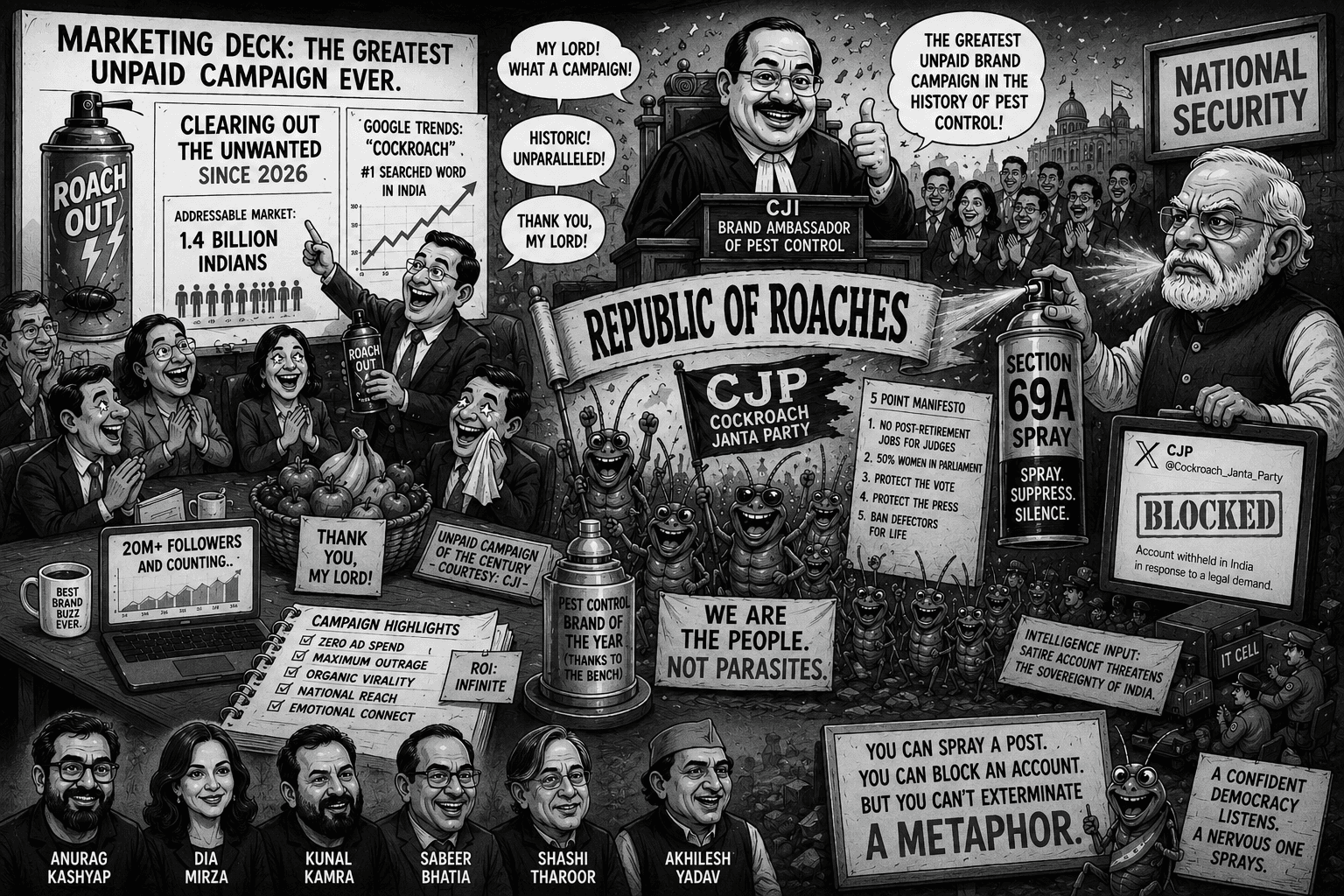
Right now, in a marketing department somewhere in this country, a brand manager for cockroach repellent is staring at the career changing year of their dreams. “Cockroach” is the most searched word in India. Their product has gone viral without a single rupee of spend. Picture the marketing deck: a heroic can of insecticide, the tagline “CLEARING OUT THE UNWANTED SINCE 2026,” an addressable market of 1.4 billion people who now have very strong feelings about the word. Somewhere a CMO is weeping with joy. Somewhere a media-buying team has been told to cancel its leave. The Chief Justice of India has just delivered the greatest unpaid brand campaign in the history of pest control, and every repellent label in the country owes him a fruit basket and a percentage.
That is the joke. Now the part where it stops being funny.
It started in a courtroom, where the Chief Justice, Surya Kant, reportedly called drifting unemployed youth “cockroaches” and “parasites” in a case that had nothing to do with them. He has since clarified he only meant the ones with fake degrees. The clarification arrived about one viral cycle too late. The nation heard “cockroach” leave the highest bench in the land and, as is tradition, did not stay for the asterisk.
Enter Abhijeet Dipke, thirty, a PR grad fresh out of Boston University and a former AAP man, who heard an insult and saw a logo. A day later, the Cockroach Janta Party was born. The name does all the work: “Janta” means the people, and the rhyme with a certain ruling party is the entire argument in three syllables. Call it a junta if you like. They took the slur, printed it on a flag, and the people who coined it now get to watch more than twenty million followers and counting wear it as a badge. That is what we in branding call a repositioning.
The numbers are absurd. More followers than the ruling party. More than the Congress. A guest list running from Anurag Kashyap to Dia Mirza to Kunal Kamra. Volunteers cleaning the Yamuna dressed as actual cockroaches, which I am thrilled to report is a real sentence about real adults. The party has a five-point manifesto so reasonable it’s almost rude: no post-retirement jobs for judges, half of Parliament for women, protect the vote, protect the press, and a long ban on politicians switching sides for cash. A cartoon insect just published a sharper reform agenda than the actual opposition has managed in twelve years. And the punchline inside the punchline: this “Gen Z uprising” is led by a thirty-year-old millennial. The generation that got the bill instead of the dividend is now writing the youth’s manifesto for them. Beautiful.
Here is the part nobody wants to say out loud. When the opposition forgets it has a job, the job doesn’t disappear. It goes looking for someone with the nerve to do it, and last week the only applicant was a roach. Even the politicians can see it. Shashi Tharoor called the ban “disastrous and deeply unwise.” Akhilesh Yadav summed up the era in three letters: “BJP vs CJP.” Sabeer Bhatia, the man who gave you Hotmail, popped up to tell the cockroaches to fight for their rights.
Now the cold water, because cheerleading isn’t journalism. A movement that hits millions on raw anger is a movement someone can drive, and the driver matters. Dipke insists there’s no party behind this, while being conspicuously close to the AAP and openly devoted to its founder. So the uncomfortable question stands: real youth revolt, or the opposition getting split all over again, the way an entire generation got dazzled and dumped fifteen years ago? The knockoffs are already here, including one rival outfit offering fifteen points on the grounds that five wasn’t trying hard enough. Lend them your voice. Keep your data. Your name and email are plenty. The phone number and the linked accounts stay with you, because a list of millions of furious young Indians is gold to idealists and hustlers alike, and right now nobody can tell you which one is holding the clipboard.
And then the costume comes off and the numbers stop being funny. Nearly forty percent of young graduates are jobless, nine times the rate of people who never finished school, which means the country built an education system that manufactures the exact disappointment it can’t employ. Inflation outruns the salary. The rupee keeps finding new urinals to get pissed on. The freedoms keep narrowing. These are the precise conditions under which, last year, the youth of Nepal and Bangladesh turned a group chat into a change of government. India has 367 million young people, and a good number of them have looked at the ballot and decided a bug represents them better than anyone on it.
Worth remembering: this isn’t the first CJP. Before the cockroach, those letters belonged to Citizens for Justice and Peace, the outfit Teesta Setalvad co-founded in 2002 to fight for the Gujarat riot victims, and which has spent two decades defending minorities and dissenters, paying for it in raids, cases, and jail. The acronym comes pre-loaded. Setalvad in a courtroom or a roach on Instagram, the C, the J and the P have always pointed the same way: at a State getting a little too comfortable with the word “no.” New costume. Same twenty-three-year-old argument.
Which brings us to the masterstroke, Section 69A. It’s the government’s mute button for the internet: block almost anything in the name of sovereignty or public order, no hearing required, and the order itself is legally secret. They can delete you and classify the reason for deleting you. This is what made the CJP’s X account disappear on Thursday, on an intelligence tip that a satire account threatened the sovereignty of the nation.
Sit with that for a second. A nuclear-armed state of 1.4 billion people convened its security apparatus, invoked national security, and pointed all of it at a drawing of an insect in a sash. The repellent brand could not have written better copy. The roaches said power squashes whatever annoys it. Power then squashed them, live, on national television, and proved their entire point for free.
So, the only question worth asking. What exactly is the State afraid of?
A confident democracy can take a joke. It laughs, then quietly goes and fixes the unemployment that made the joke land, until the joke stops being funny because it stops being true. That is how a secure government kills satire: it makes it obsolete. The nervous government does the opposite. It mistakes a few million laughs for a coup and reaches for 69A, stamps “national security” on a cartoon, and tells the whole country that the cartoon hit something real. Nothing confirms a joke landed like watching the target file charges against it. The State refusing to treat this as satire is the State admitting it never was just satire. These millions followed a cockroach. They followed a feeling, the feeling of finally being heard, and that feeling has a name. It’s hope. Hope is a good thing. A government that sprays insecticide at hope has misread the room, the moment, and possibly the century.
The roaches got the one thing the government missed. “Vermin” only stings while you accept the label. Put it on a flag and it’s a movement, and you cannot spray a movement. It responds to exactly two things, being heard or being ignored, and only one of those gets you a quiet country. India has picked the other one, and reached, as always, for the slipper.
You cannot exterminate a metaphor. You can only confirm it, and the State just signed the confirmation in triplicate. The pest-control companies, meanwhile, are having the time of their lives.